



iPhone Screen Time has become a daily reality for millions of users, shaping how people work, communicate, and engage with digital content. In the US alone, smartphone users now average over 5 hours of daily phone use, a 14% increase from last year, highlighting the growing centrality of mobile screens in everyday life. Many users now check their phones around 58 times per day, making screen habits a key factor in productivity and well‑being. These figures matter to app developers, health professionals, and productivity coaches alike, as they signal broader shifts in technology use and digital behavior. Explore the full breakdown of iPhone screen time trends and what they mean, and beyond.
Editor’s Choice
- Average daily smartphone usage in the US is about 5h 16m in 2026, up 14% year‑over‑year.
- Global average daily screen time is approximately 6h 45m as of late 2025.
- Mobile pickups average roughly 58 times a day per user in 2026.
- Nearly 41% of American teens spend 8+ hours daily on screens.
- iOS 26 adoption sat at about 16.3% among iPhones as of Jan 2026, showing a slower rollout.
- Screen time trackers and digital wellness tools downloads have surged in recent years (2023–2025).
- US screen time often exceeds global averages, with Americans regularly above 7 hours daily across devices.
Recent Developments
- iOS 26 remains the current iPhone operating system, released in September 2025, bringing UI and performance changes.
- Despite new features, only ~16.3% of devices have iOS 26 installed as of early 2026.
- Apple is testing iOS 26.3 beta with enhancements around connectivity and system performance.
- New adaptive power management aims to better preserve battery during intense screen use.
- Digital wellness and analytics features are increasingly highlighted in iOS updates to encourage mindful use.
- Screen Time remains central to Apple’s push toward well‑being tools across iPhone and other devices.
- Third‑party apps like OffScreen amplify Screen Time data with focus timers and usage breakdowns.
- Developers are innovating around engagement and intervention metrics tied to real‑time screen interaction.
Average Daily Screen Time
- Worldwide average daily screen time stands at ~6h 45m per day (late 2025).
- In the US, users average about 7h 2m daily across screens.
- Smartphone‑only daily use averages ~4h 37m worldwide.
- Americans specifically spend ~5h 16m per day on phones.
- Average screen time has increased steadily nearly every year since 2013.
- Teens in the US report nearly 8+ hours daily on screens.
- Worldwide, total screen time is roughly 47h+ per week.
- Screen time varies seasonally and by reporting method, but overall trends remain upward.
Screen Time by Country
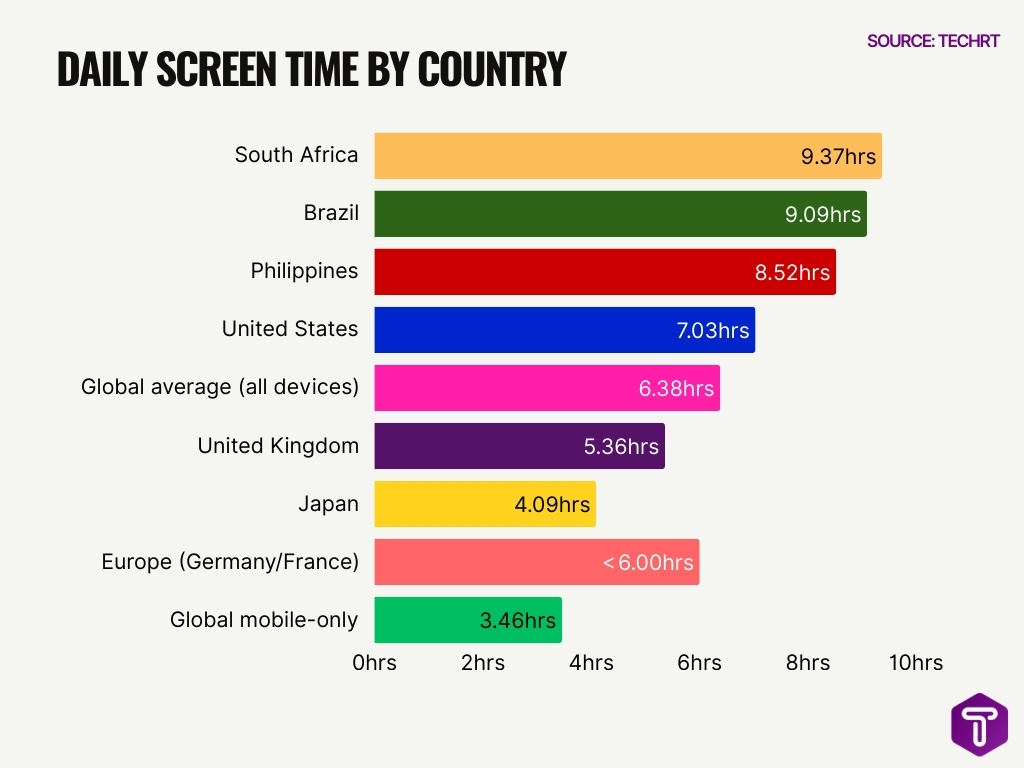
- South African users average 9 hours 37 minutes of daily screen time, topping global rankings.
- US adults average 7 hours 3 minutes daily, exceeding the worldwide mean.
- Global average screen time stands at 6 hours 38 minutes per day across devices.
- The Philippines records 8 hours 52 minutes, driven by mobile engagement.
- Brazilians average 9 hours 9 minutes daily, second to South Africa.
- UK users log 5 hours 36 minutes, below the global average.
- Japan has the lowest at 4 hours and 9 minutes of daily screen time.
- Mobile screen time globally averages 3 hours 46 minutes, outpacing desktop.
- European countries like Germany and France average under 6 hours daily.
Screen Time by Age Group
- Screen time surges notably around ages 11–13, with mobile use increasing sharply.
- Ages 16–24 typically record the highest daily usage (~9.1h).
- Adults ages 25–44 average about 7.8h per day.
- Users 45+ often have lower daily totals (~5.6h).
- Teens are more likely to exceed 8+ hours of screen engagement than older groups.
- Younger adults show higher engagement with social and entertainment apps.
- Digital wellness tracking adoption is highest among Millennials and Gen Z.
- Older age groups may spend more time on reading and news content than on social media.
Screen Time Trends Over Time
- Global screen time averaged 6 hours 9 minutes daily in Q3 2013, rising to 6 hours 38 minutes by Q3 2024.
- Daily screen time increased by over 30 minutes globally since 2013.
- Pandemic peak saw global averages hit 6 hours 58 minutes in Q3 2021.
- US screen time peaked at 7 hours 11 minutes in Q3 2020, dipping to 6 hours 40 minutes in 2024.
- Recent year-on-year global growth averaged 0.5-1.3% from 2022 to 2024.
- 67% of users now monitor screen time, up from 43% in 2023.
- Children’s screen time rose 1.75 hours daily during the early pandemic, staying 1.11 hours higher post-restrictions.
- Gen Z averages 9 hours daily, far exceeding older cohorts at under 5 hours.
- 41% of US teens exceed 8 hours daily entertainment screen time.
- 2026 forecasts predict AR/VR adding up to 1.2 hours daily to averages.
Social Media Usage
- Globally, smartphone users spend around 2 hours and 20 minutes per day on social media apps.
- Social platforms account for an estimated 35% of all mobile time spent within apps.
- In the US, TikTok has over 150 million monthly active users, making it a dominant platform among Gen Z.
- Instagram remains close behind, with roughly 148 million active US users in 2025.
- Facebook still holds relevance with about 178 million active US users, especially among older age groups.
- YouTube leads global mobile social engagement, with very high active user counts across regions.
- TikTok users tend to watch for over an hour daily, reinforcing its screen time impact.
- Messaging apps like WhatsApp have billions of monthly active users worldwide, contributing significantly to daily screen engagement.
Weekly iPhone Screen Time Overview
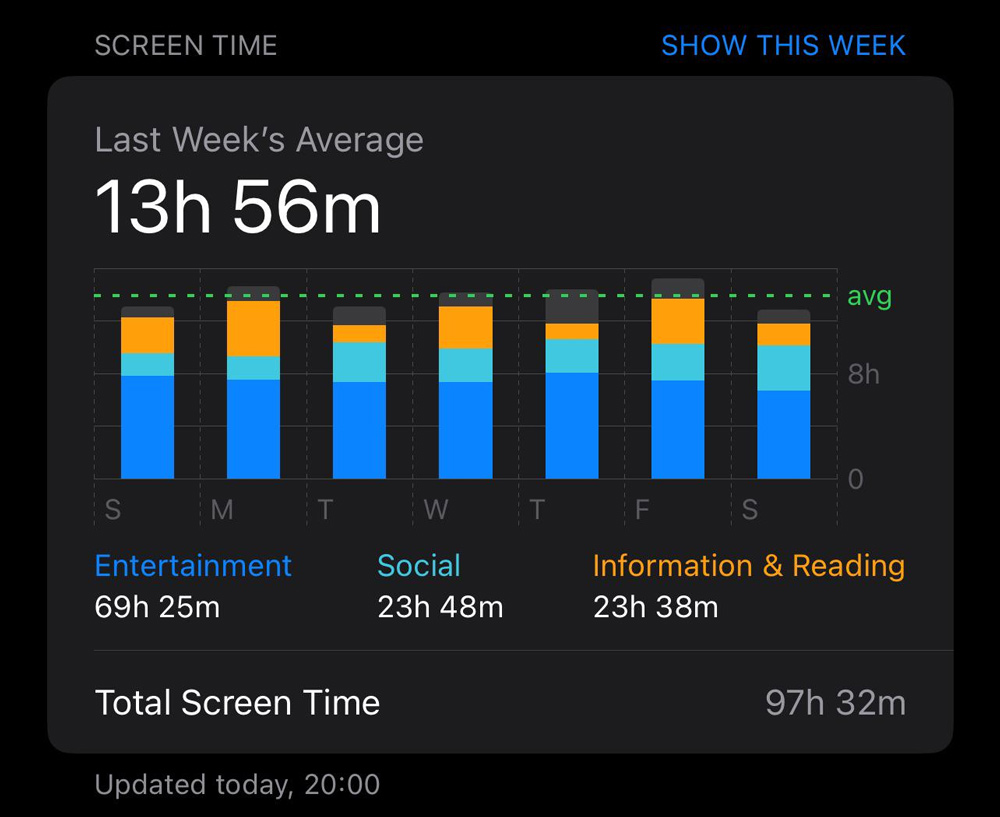
- Average daily screen time reached 13 hours 56 minutes, indicating consistently high iPhone usage throughout the week.
- Total screen time accumulated 97 hours 32 minutes over the week, highlighting heavy overall device dependence.
- Entertainment dominated usage with 69 hours and 25 minutes, making it the largest screen time category by a wide margin.
- Social app usage totaled 23 hours 48 minutes, reflecting significant time spent on communication and social platforms.
- Information and Reading accounted for 23 hours 38 minutes, showing strong engagement with news, articles, and learning content.
- Daily screen time consistently stayed between 12 and 15 hours, remaining close to the weekly average on most days.
- Friday recorded the highest screen time, suggesting increased device usage toward the end of the workweek.
- Midweek days showed slightly lower usage, though screen time remained well above 12 hours per day.
- Entertainment usage remained the dominant category every single day, outweighing both social and reading activities.
- Overall, iPhone usage remained stable across all seven days, indicating habitual and sustained screen engagement rather than sporadic spikes.
Pickups Per Day
- Users check their phones about 58 times per day on average worldwide.
- Around 52% of those pickups happen during typical work hours, underlining frequent interruptions.
- Roughly 69% of pickups last under 2 minutes, suggesting many quick checks.
- The average length of a pickup session is approximately 1 minute 15 seconds.
- Self‑reported data suggests some individuals unlock their phones up to 96 times per day in the US.
- Anecdotal tracking shows variability, with some users reporting 30–150 pickups per day.
- Pickup frequency tends to spike when notifications are active.
- Frequent pickups reflect habitual checking behavior that often precedes sustained screen sessions.
Notifications Statistics
- Average users receive 146 notifications daily, one every 10 minutes.
- Parents average 293 notifications and 93 pickups daily, with 15.9 device-prompted.
- US smartphone users get about 46 push notifications per day.
- Teens receive roughly 240 app notifications daily, 25% during school hours.
- Users average 65 notifications daily, mostly from messengers and email.
- Gen Z users receive 181 notifications daily, one every 8 minutes.
- Adults pick up phones an average of 80 times daily due to notifications.
- Disabling notifications correlates with lower checking frequency and screen time.
- Nearly 33% of workers are distracted by notifications every 15 minutes.
- It takes 23 minutes to refocus after a notification interruption.
Top Apps Usage
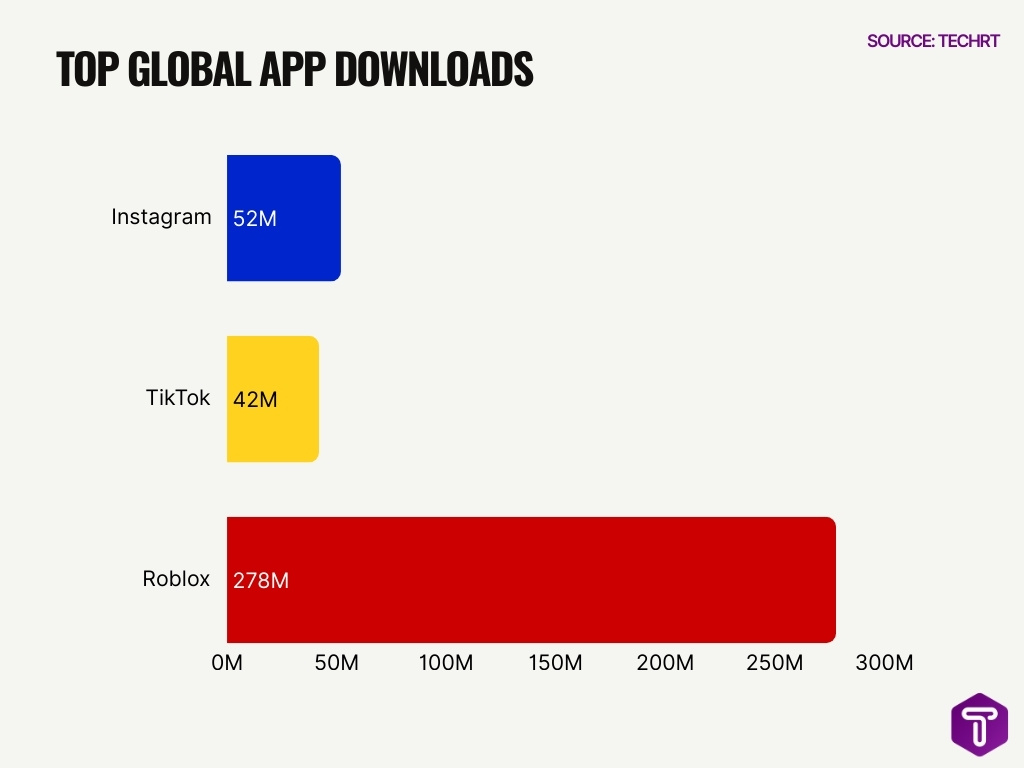
- Instagram topped worldwide downloads in October 2025 with 52 million.
- ChatGPT led US iPhone downloads for 2025, surpassing TikTok and Threads.
- Average smartphone users interact with 10 different apps daily.
- 70% of US digital media time derives from mobile apps.
- Global users average 4.9 hours daily on phones, 89% in apps.
- 49% of people open an app 11+ times per day.
- Social media apps claim over 40% of total mobile app usage.
- TikTok garnered 42 million worldwide downloads in October 2025.
- The YouTube app reached 76% US mobile audience in 2025.
- Roblox led gaming with 278 million downloads in 2025.
US iPhone Users
- In the US, iOS holds a ~58% smartphone market share, meaning a majority of phone users are on iPhone.
- iPhone users actively engage with screens at rates similar to broader smartphone averages.
- Many of the top downloaded apps in the US in 2025 were iPhone titles, including ChatGPT, Threads, and TikTok.
- iPhone users contribute significantly to daily social media and messaging traffic.
- Popular productivity and utility apps also shape iPhone engagement patterns.
- US iPhone users tend to use both messaging and social apps as key screen time drivers.
- App engagement among iPhone users reflects broader media and communication consumption trends.
- iOS users often engage with emerging AI and assistant tools like ChatGPT alongside traditional social platforms.
Daily App Usage Breakdown on iOS
- iPhone owners launch a typical top 5 group of apps daily, including social media, messaging, entertainment, navigation, and productivity tools.
- Reports show that social networking apps alone can represent over 40% of total daily app usage time.
- Messaging and communication apps often exceed 1.5–2 hours daily combined for many users.
- Browsers, email, and calendar apps contribute a moderate share tied closely to professional or educational usage.
- Entertainment apps, including video streaming or gaming, may take up 1–2 hours on average on non‑work days.
- Navigation and map apps typically show bursts of use rather than sustained durations, influencing daily totals intermittently.
- Productivity app usage tends to spike during standard work hours (9 a.m. to 5 p.m.).
- Weekly usage views on iOS show patterns that differ significantly from day to day, illustrating lifestyle effects.
Screen Time by Device
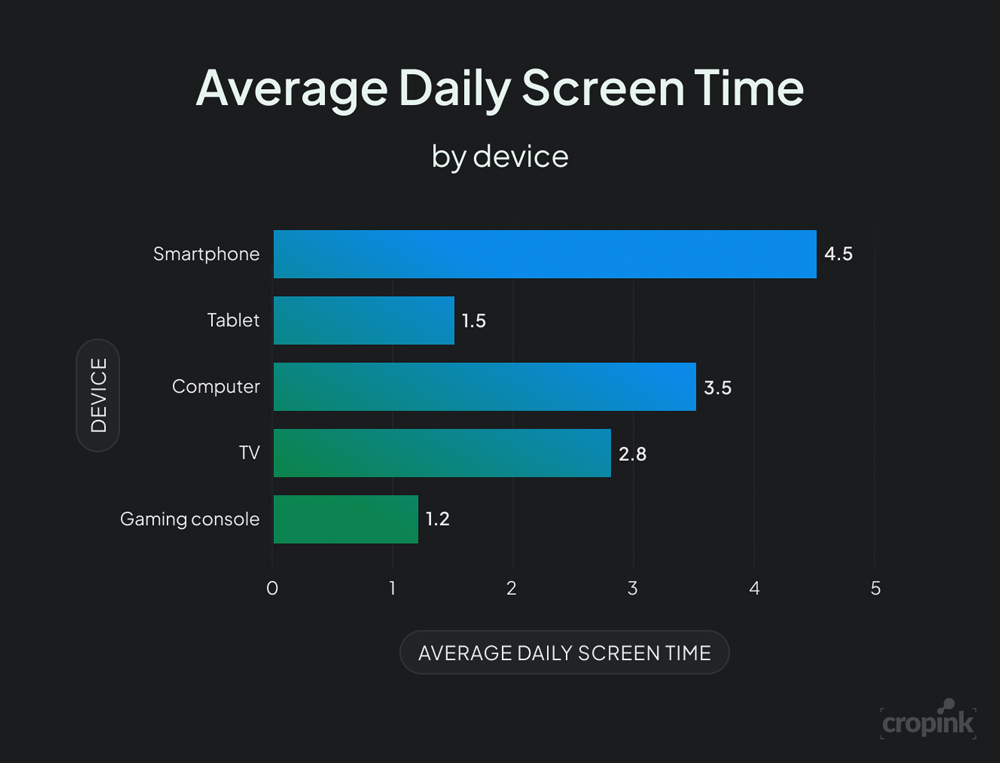
- Smartphones dominate with an average of ~3.5–4 hours daily screen time, outpacing other devices.
- US users spend 3 hours 30 minutes on mobile devices versus 3 hours 34 minutes on computers.
- Gen Z averages 9 hours total screen time daily, heavily skewed toward smartphones.
- Teenagers log 6 hours and 5 minutes on smartphones alone for social media and videos.
- Laptops/desktops claim 2.5–3 hours daily, mainly for work among middle-aged adults.
- TV screens account for ~2–3 hours, boosted by streaming in older users.
- Tablets contribute ~1 hour or less, used for reading and casual browsing.
- Global average screen time hits 6 hours 40 minutes daily across all devices.
Effects of Screen Time on Productivity and Well‑Being
- Individuals with over 4 hours/day of screen time face 25.9% depression symptoms and 27.1% anxiety symptoms, versus lower users.
- Adolescents exceeding 5 hours/day on screens show 70% higher risk of suicidal thoughts.
- Over 104 million working-age Americans exceed 7 hours/day screen time, causing productivity losses up to $1,431/person annually.
- Each extra hour of bedtime screen use raises insomnia odds by 63% and cuts sleep by 24 minutes.
- Children with >6 hours/day screen time have 47.3% low physical activity rates.
- Fragmented smartphone use increases distraction for 77% of adolescents.
- Teens with >4 hours/day non-school screen time report infrequent social support at 48.6%.
- Moderate 1-3 hours/day personal screen use correlates with optimal well-being outcomes.
- Educational screen time boosts children’s persistence and learning with no major health impacts.
- Structured breaks from screens sustain high productivity and prevent burnout in teams.
Why Parents Limit Their Child’s Screen Time
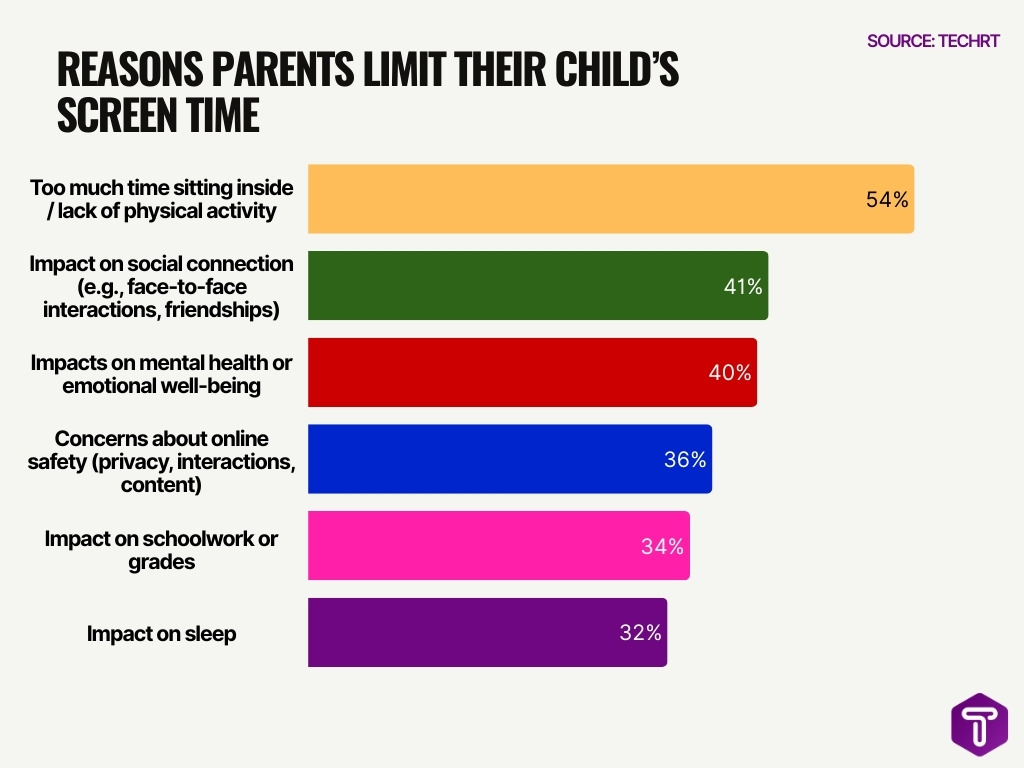
- Lack of physical activity is the leading concern, with 54% of parents saying excessive screen time keeps children sitting indoors too long.
- Social development issues influence 41% of parents, who worry about reduced face-to-face interactions and friendships.
- Mental health and emotional well-being are a major factor for 40% of parents, reflecting growing concerns about screen-related stress and mood impacts.
- Online safety risks, including privacy, inappropriate content, and digital interactions, prompt 36% of parents to restrict screen use.
- Academic performance plays a role for 34% of parents, who believe excessive screen time can negatively affect schoolwork or grades.
- Sleep disruption is cited by 32% of parents, highlighting concerns about screen exposure interfering with healthy sleep routines.
Impact of Screen Time Features on iOS Adoption
- Screen Time, introduced in iOS 12, provides detailed Activity Reports showing time spent in apps and pickups, aiding digital wellness.
- 66% of U.S. parents use parental controls on kids’ devices, with Screen Time enabling family management.
- 51% of parents utilize parental control apps, rising to 77% for children aged 5–11.
- Over 50 million families worldwide use Apple’s Screen Time feature as of 2024.
- iPhone users average 4 hours 54 minutes daily screen time, 32% more than Android users’ 3 hours 42 minutes.
- 73% of parents of 5–11-year-olds monitor app usage via tools like Screen Time.
- iOS 18 adoption reaches 68% among iPhones, 76% for recent models, boosted by wellness updates.
- Studies show that screen time awareness leads to moderated smartphone usage patterns in iOS users.
- iOS commands 44.8% wellness app market share in 2025 due to seamless ecosystem integration.
Screen Time Impact on Mental Health Perception
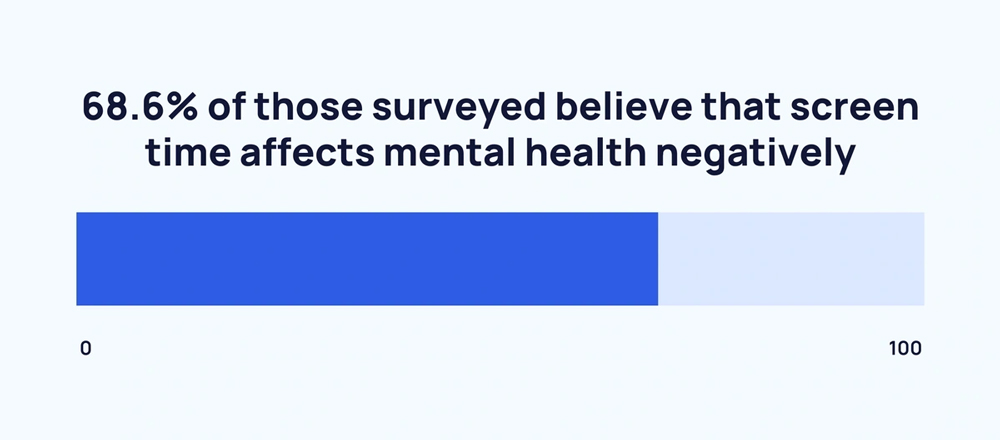
- 68.6% of respondents believe that screen time negatively affects mental health, showing a strong majority concern about its psychological impact.
- The data indicate that more than two-thirds of people surveyed associate prolonged screen exposure with mental health challenges such as stress, anxiety, or reduced emotional well-being.
- In contrast, 31.4% of respondents do not view screen time as harmful to mental health, highlighting a noticeable perception divide.
- The findings suggest rising public awareness around digital overuse and its potential consequences on mental health.
- This perception reinforces ongoing discussions about healthy screen habits, digital balance, and the need for screen time management strategies.
Screen Time and Digital Wellness Movements
- Digital wellness movements promote intentional screen use and regular breaks to reduce burnout.
- Mindfulness tools, including Screen Time dashboards and focus apps, aim to cultivate healthier digital habits.
- Wellness advocates suggest digital minimalism techniques can improve focus and mental health.
- Many wellness programs encourage users to track usage and set intentional goals each week.
- Workplace digital wellness initiatives increasingly include screen time awareness training.
- Family screen time challenges and screen‑free days are becoming more common strategies among wellness communities.
- Social campaigns highlight the benefits of time away from devices for sleep quality and interpersonal connection.
- Digital wellness apps have seen surges in downloads as users seek better usage control.
Frequently Asked Questions (FAQs)
How many hours per day does the average person spend on their screen in 2025–2026?
The typical user spends about 6 hours and 45 minutes of screen time daily, totaling roughly 47 hours and 15 minutes per week as of late 2025.
How long does the average person spend on their phone, specifically each day?
Recent data shows the average person spends around 4 hours and 37 minutes per day on their smartphone.
What percentage of the global smartphone market does iOS (iPhone) hold in 2026?
The iPhone commands approximately 27.7% of the worldwide smartphone market share in 2026.
How many times per day does the average person check their phone?
Users check their phones about 58 times per day on average, roughly once every 25 minutes.
What share of smartphone users in the US does iOS hold?
In the United States, iOS holds about 57.97% of the smartphone market share in 2026.
Conclusion
iPhone Screen Time trends show that digital engagement remains a central piece of daily life, with meaningful implications for productivity, wellness, and family dynamics. The nuances across categories, parental control usage, and behavioral effects emphasize that how screen time is used often matters as much as how much. With screen usage tracking now widely adopted and built into iOS, users and families have clearer visibility and tools for balancing digital habits.
Continued focus on digital wellness, supported by both device features and broader movements, suggests that mindful use will become an increasingly integral part of personal and societal well‑being.

Leave a comment
Have something to say about this article? Add your comment and start the discussion.