


Online gaming has evolved into one of the largest digital entertainment sectors worldwide, shaping how people interact, compete, and spend online. From multiplayer titles connecting millions of players to esports tournaments filling arenas and streaming platforms, the industry influences technology adoption, social interaction, and global entertainment revenue. Businesses, from game studios to cloud infrastructure providers, now rely heavily on gaming-driven engagement and monetization. Explore the latest numbers and trends below to understand how online gaming continues to expand beyond.
Editor’s Choice
- The global video game industry generated about $197 billion in revenue in 2025, marking a 7.5% year over year increase.
- There are approximately 3.32 billion active gamers worldwide, a number that has increased by over 1 billion players in the past decade.
- The global gaming population reached roughly 3.6 billion players in 2025, representing over 61% of internet users.
- Mobile games generated nearly $108 billion in revenue in 2025, accounting for almost half of the global gaming market.
- The global online gaming market is projected to reach $119.55 billion in 2026, growing at a 9.8% CAGR from 2025.
- The broader gaming market may exceed $360 billion in 2025 and continue expanding significantly through 2034.
- Mobile gaming alone accounts for 83% of global players, highlighting the dominance of smartphones in the gaming ecosystem.
Recent Developments
- The gaming industry reached $197 billion in revenue in 2025, fueled largely by mobile and PC game growth.
- Mobile in-app purchases generated almost $130 billion in 2025, representing nearly half of the global industry revenue.
- Steam recorded $1.6 billion in revenue in December 2025 alone, reflecting a surge in PC gaming activity.
- Capcom reported that 50% of its game sales now come from PC platforms, highlighting the rapid growth of PC gaming ecosystems.
- The global games market is projected to grow to $188.9 billion in 2025, despite delays in blockbuster releases.
- The cloud gaming market, valued at $2.27 billion in 2024, is projected to reach over $21 billion by 2030 due to faster internet and 5G adoption.
- Global esports revenue continues to expand and may exceed $757 million in 2026, reflecting rising sponsorships and media rights deals.
- Major global investors, including sovereign funds, have begun investing tens of billions of dollars in gaming and esports companies to capitalize on industry growth.
- High-speed broadband and smartphone penetration remain key drivers enabling real-time multiplayer gaming globally.
Overview of Online Gaming in 2026
- The online gaming market is expected to grow from $108.89 billion in 2025 to $119.55 billion in 2026.
- Global online gaming revenue is forecast to surpass $244 billion by 2026, continuing a steady expansion trajectory.
- Asia Pacific remains the dominant gaming region, controlling over 50% of the global market share.
- More than 60% of the world’s internet users play video games, making gaming one of the most widely adopted digital activities.
- Mobile devices account for the majority of gaming activity, with over 3 billion mobile gamers globally.
- The gaming sector now generates more revenue than the global film and music industries combined.
- Cross-platform gaming has become standard, allowing players on PC, consoles, and mobile devices to interact within the same ecosystems.
- Social features such as chat, streaming, and in-game events drive higher engagement and retention among younger gamers.
- The expansion of 5G and cloud infrastructure is expected to accelerate real-time online gaming adoption globally.
Global Online Gaming Market Growth Forecast
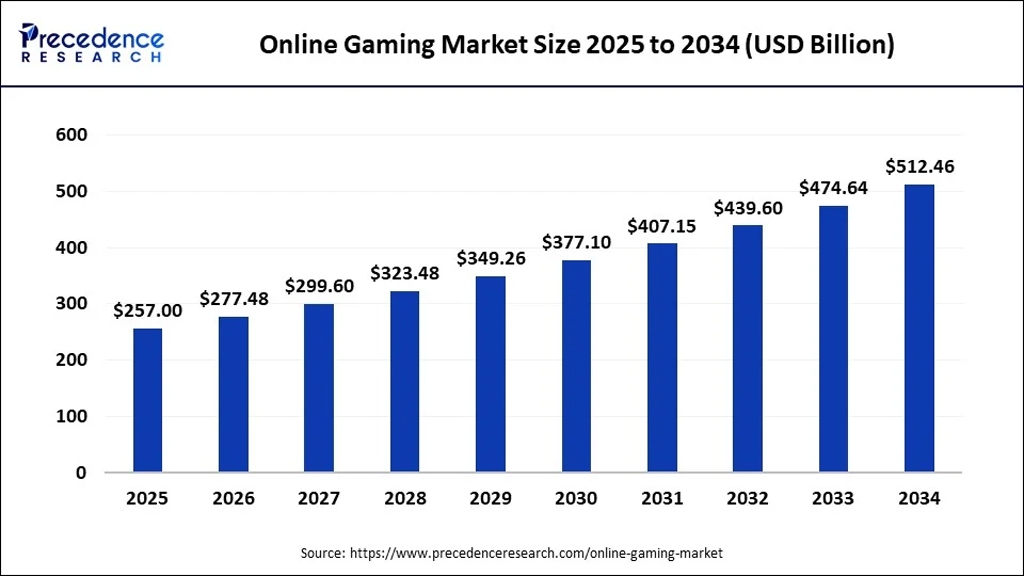
- The global online gaming market is projected to grow from $257 billion in 2025 to $512.46 billion by 2034, highlighting the rapid expansion of the digital gaming ecosystem.
- In the near term, the market is expected to reach $277.48 billion in 2026 and $299.60 billion in 2027, reflecting strong demand for mobile gaming, esports, and cloud gaming platforms.
- By 2028, the industry is forecast to cross $323.48 billion, driven by increasing internet penetration and smartphone adoption worldwide.
- The market is expected to reach $349.26 billion in 2029 and grow further to $377.10 billion by 2030, showing steady annual growth across the global gaming sector.
- The industry is projected to surpass the $400 billion milestone in 2031, reaching $407.15 billion, marking a significant stage in the expansion of online gaming economies.
- Continued growth is expected with the market reaching $439.60 billion in 2032 and $474.64 billion in 2033, fueled by live-service games, in-game purchases, and multiplayer ecosystems.
- By 2034, the online gaming market is forecast to hit $512.46 billion, effectively doubling its size within a decade and confirming gaming as one of the fastest-growing segments of the global entertainment industry.
Key Global Online Gaming Statistics
- The global gaming audience surpassed 3.58 billion players in 2025, representing about 60% of the global online population.
- Mobile gaming remains dominant with 3 billion players, representing over 80% of all gamers worldwide.
- PC gaming has an estimated 936 million players globally, supported by digital platforms like Steam.
- Console gaming revenue exceeded $45 billion globally in 2025.
- PC gaming generated approximately $43 billion in revenue in 2025.
- Mobile games produced nearly 49% of global gaming revenue in 2024 and 2025.
- Asia Pacific controlled about 46% of the global gaming market share, and its share continues to grow.
- The global gaming industry is projected to grow at around 8 to 13% CAGR across various forecasts through the next decade.
- The number of gamers globally has increased by over 1 billion players since 2016.
Online Gaming Growth and CAGR Trends
- The online gaming market is projected to grow at a 9.8% CAGR from 2025 to 2026.
- Another forecast estimates a 9.4% CAGR through 2034 for the online gaming sector.
- The broader gaming market is expected to grow at about 8.4% CAGR between 2024 and 2029.
- Some forecasts suggest the online gaming market may grow at 10.5% CAGR between 2025 and 2032.
- The cloud gaming segment is projected to grow at a 44.3% CAGR through 2030, making it one of the fastest-growing gaming sectors.
- Esports is expected to grow at a 16.8% CAGR through 2034 as media rights and sponsorship deals increase.
- The global gaming industry expanded 7.5% year over year in 2025, reflecting sustained demand for interactive entertainment.
- Online gaming adoption continues to accelerate due to increasing broadband access, smartphone usage, and cross-platform ecosystems.
- Emerging technologies such as VR, AR, and cloud infrastructure are expected to drive the next phase of industry expansion.
Game Genre Download Distribution in India
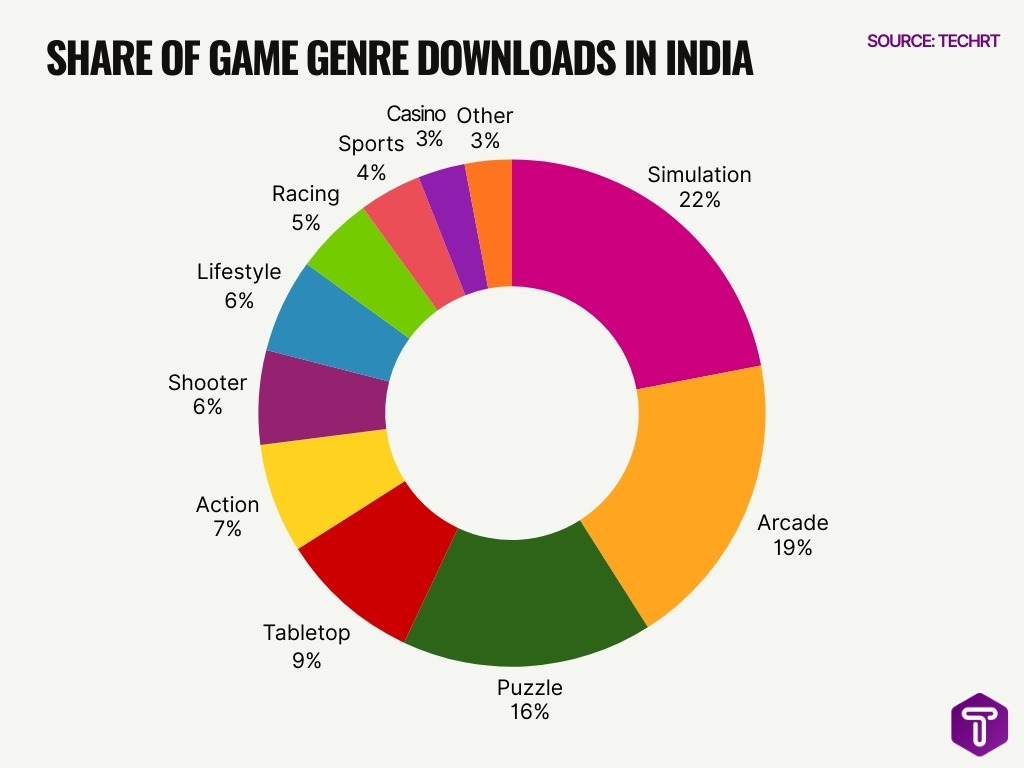
- Simulation games dominate the market, accounting for 22% of total game downloads in India, making them the most popular genre among players.
- Arcade games rank second, capturing 19% of downloads, highlighting the strong demand for fast-paced and casual gameplay experiences.
- Puzzle games hold the third-largest share at 16%, showing that brain-teasing and strategy-based games remain highly popular among Indian mobile gamers.
- Tabletop games account for 9% of downloads, indicating steady interest in classic board-style and card-based digital games.
- Action games contribute 7% of total downloads, reflecting a solid audience for combat-focused and adventure-driven gameplay.
- Both Shooter games and Lifestyle games hold 6% each, showing balanced demand for competitive shooting titles and casual lifestyle-based games.
- Racing games make up 5% of downloads, demonstrating moderate popularity for car racing and speed-based gaming experiences.
- Sports games represent 4% of total downloads, suggesting a smaller yet consistent player base for sports simulations and competitive sports titles.
- Casino games account for 3% of downloads, reflecting limited but steady interest in gambling-style gaming formats.
- The “Other” category also contributes 3%, covering niche or emerging game genres outside mainstream categories.
- Overall, casual and simulation-based genres dominate India’s gaming downloads, with Simulation, Arcade, and Puzzle games alone accounting for 57% of total downloads.
Number of Online Gamers Worldwide
- The global gaming population reached approximately 3.38 billion players in 2024, representing about 40% of the world’s population.
- Industry estimates suggest the number of gamers will surpass 3.6 billion by 2026 as mobile access expands.
- Asia Pacific accounts for the largest share with over 1.8 billion gamers, making it the world’s biggest gaming region.
- Europe hosts around 715 million gamers, representing nearly 17% of the global gaming audience.
- Latin America has roughly 420 million gamers, reflecting rapid growth driven by affordable smartphones.
- The United States alone has more than 215 million gamers, meaning roughly 65% of Americans play video games.
- Mobile devices account for the majority of players, with about 3 billion mobile gamers worldwide.
- PC gaming attracts around 936 million players globally, supported by digital distribution platforms and esports ecosystems.
- Console gaming reaches roughly 629 million players worldwide, with continued growth from next-generation hardware adoption.
Online Gaming Penetration by Region
- Asia Pacific leads global gaming penetration with over 55% of the world’s gamers located in the region.
- North America has one of the highest penetration rates, with about 70% of the population playing video games.
- Europe records approximately 52% gaming penetration among internet users.
- In Southeast Asia, gaming penetration exceeds 80% of internet users, fueled by mobile gaming.
- Latin America has a gaming penetration rate of around 58% of the population, supported by improved internet access.
- The Middle East and North Africa gaming market now includes over 377 million players.
- Africa’s gaming audience surpassed 349 million players, making it one of the fastest-growing gaming regions.
- China remains the world’s largest gaming market by users, with more than 740 million gamers.
- South Korea reports gaming participation rates exceeding 70% among internet users, reflecting its strong esports culture.
Country-Wise Online Gaming Statistics
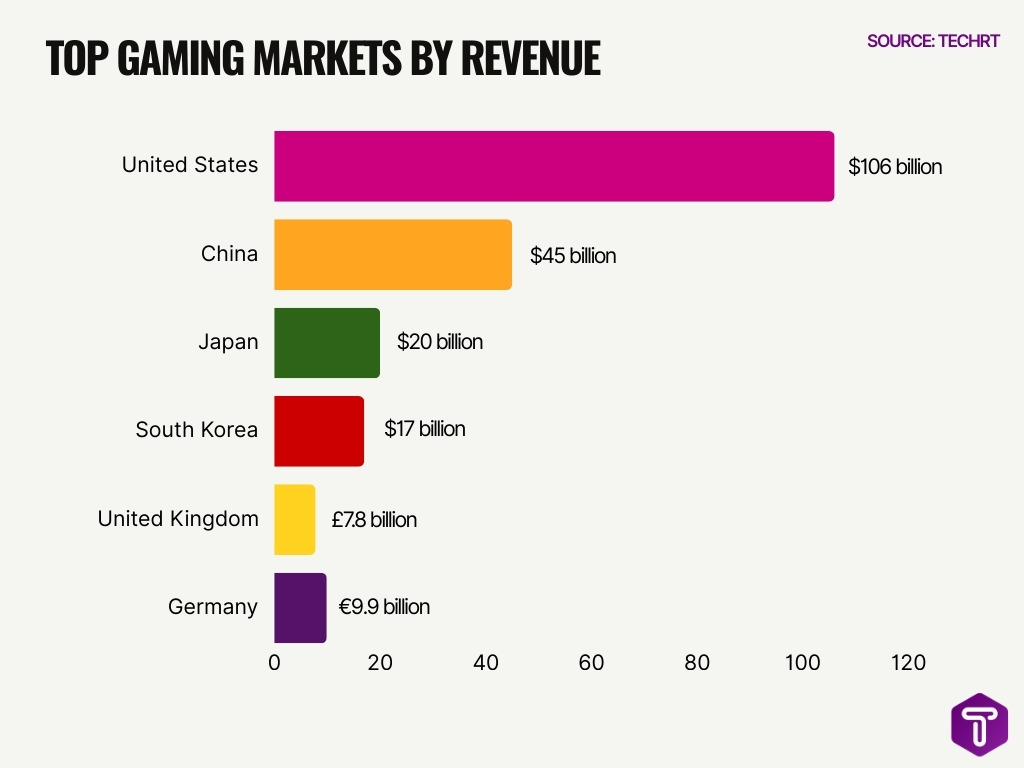
- The United States gaming market generated about $106 billion in economic output, including hardware, software, and services.
- China generated approximately $45 billion in gaming revenue, maintaining its status as the world’s largest gaming market by revenue.
- Japan’s gaming market surpassed $20 billion in annual revenue, driven by mobile and console gaming.
- South Korea’s gaming industry generated roughly $17 billion in revenue, supported by esports and online multiplayer games.
- The United Kingdom gaming market reached about £7.8 billion in consumer spending.
- Germany reported gaming revenues of approximately €9.9 billion, reflecting strong growth in digital distribution.
- Brazil leads Latin America with over 100 million gamers, representing the largest gaming population in the region.
- India’s gaming market surpassed 568 million gamers, driven primarily by mobile gaming.
- Canada reported 23 million gamers, representing roughly 61% of the national population.
Mobile Online Gaming Statistics
- Mobile gaming generated around $92 billion in revenue in 2024, accounting for nearly half of global gaming revenue.
- The number of mobile gamers worldwide surpassed 3 billion players.
- Mobile games account for about 49% of global gaming revenue, making them the largest gaming segment.
- The average mobile gamer spends approximately 6.5 hours per week playing games on smartphones.
- Mobile gaming revenue in the United States exceeded $26 billion.
- In-app purchases generate nearly 80% of mobile gaming revenue globally.
- Over 700,000 mobile games are available across the Apple App Store and Google Play combined.
- Asia Pacific contributes nearly 55% of global mobile gaming revenue, driven by China, Japan, and South Korea.
- Hyper casual mobile games account for over 30% of all mobile game downloads worldwide.
PC and Console Online Gaming Statistics
- PC gaming generated approximately $43 billion in global revenue.
- Console gaming revenue reached about $51 billion globally, driven by next-generation consoles and digital game sales.
- Steam reached a record 34 million concurrent players, highlighting strong PC gaming engagement.
- The PlayStation Network reported over 118 million monthly active users globally.
- Xbox Game Pass surpassed 34 million subscribers, reflecting the growth of gaming subscription services.
- Digital downloads account for more than 90% of PC game sales today.
- Console gamers spend an average of 7 to 8 hours per week gaming online.
- PC gaming hardware revenue exceeded $38 billion globally.
- Multiplayer online games account for a majority of playtime on PC and console platforms.
Online Gaming Participation Declines With Age
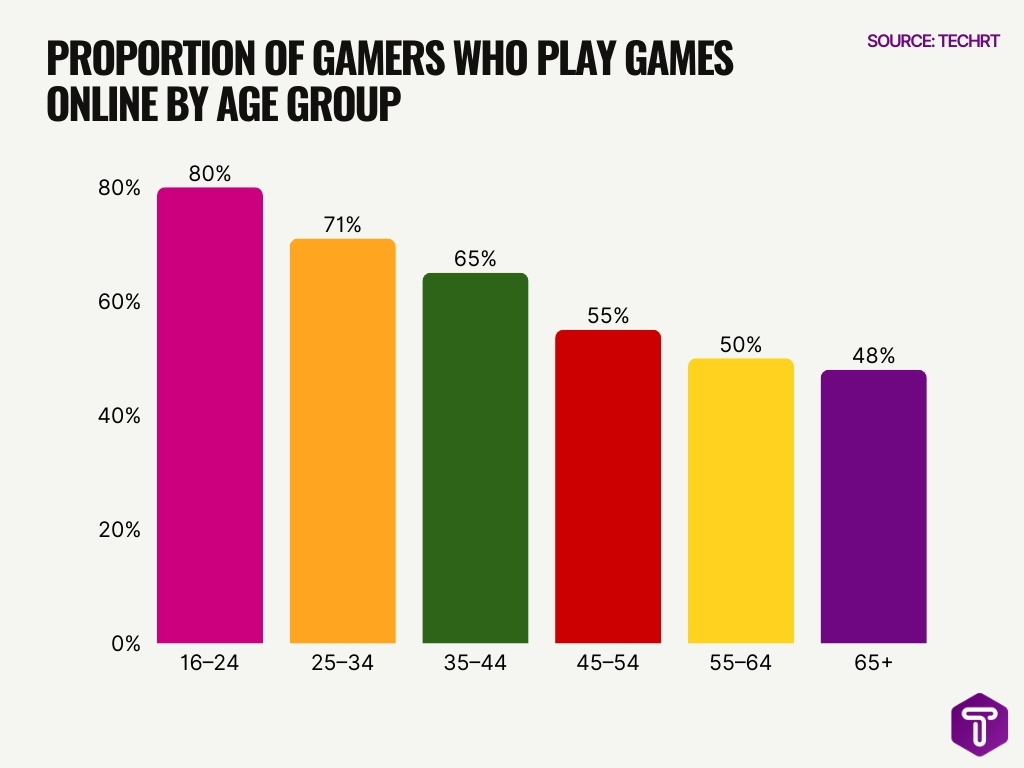
- Young gamers dominate online play, with 80% of gamers aged 16–24 playing games online, making them the most active age group in the online gaming ecosystem.
- Among gamers aged 25–34, about 71% play games online, showing that millennials remain highly engaged with multiplayer and internet-connected gaming experiences.
- Online gaming participation drops slightly for the 35–44 age group, where 65% of gamers play online, indicating strong but gradually declining engagement as age increases.
- In the 45–54 age group, only 55% of gamers participate in online gaming, marking the first age segment where participation falls close to half of gamers.
- For gamers aged 55–64, around 50% play games online, suggesting that half of older gamers still engage with online gameplay despite lower adoption compared to younger demographics.
- The 65+ age group records the lowest participation, with 48% of gamers playing online, highlighting a significant generational gap in online gaming adoption.
- Overall, the data shows a clear downward trend in online gaming participation as age increases, dropping from 80% among 16–24 gamers to 48% among gamers aged 65+.
Cloud Gaming and Streaming Statistics
- The global cloud gaming market was valued at around $2.27 billion in 2024.
- Cloud gaming is expected to grow at a 44.3% CAGR through 2030.
- The cloud gaming market may surpass $21 billion by 2030 as infrastructure improves.
- Platforms like NVIDIA GeForce NOW have attracted over 25 million registered users globally.
- Xbox Cloud Gaming is available in over 28 countries, expanding accessibility to console-quality games without hardware.
- Early cloud gaming experiments accelerated the broader adoption of game streaming technologies across the industry.
- High-speed 5G networks significantly reduce latency, enabling smoother real-time cloud gaming experiences.
- Cloud gaming enables players to stream games directly to smartphones, PCs, and smart TVs without downloads.
- Subscription-based cloud gaming services are emerging as a new revenue model for publishers and platforms.
Esports Audience, Viewership, and Revenue Statistics
- The global esports audience exceeded 540 million viewers in 2024, including both enthusiasts and casual viewers.
- The esports market generated about $1.6 billion in revenue.
- Sponsorships account for nearly 40% of total esports revenue worldwide.
- Global esports revenue could exceed $1.9 billion by 2025 as sponsorship and advertising expand.
- Major esports tournaments recorded over 6 million peak viewers for leading global competitions.
- Twitch remains the leading gaming streaming platform with over 35 million daily visitors.
- YouTube Gaming attracts millions of viewers, with gaming streams generating billions of watch hours annually.
- Professional esports tournaments now offer prize pools exceeding $40 million for major events.
- The United States and China remain two of the largest esports markets in terms of revenue and audience.
Online Gambling and Real Money Gaming Statistics
- The global online gambling market was valued at approximately $63.5 billion, and is projected to exceed $153 billion by 2030.
- In the United States, online sports betting revenue surpassed $11 billion, reflecting rapid legalization across multiple states.
- Real money gaming platforms account for nearly 30% of total online gaming revenue in some mature markets.
- Over 26 U.S. states have legalized sports betting, significantly increasing participation in online wagering.
- The number of online gambling users worldwide is expected to reach 281 million by 2029.
- Online casinos generate the largest revenue share in the digital gambling sector, accounting for about 35% of total online gambling revenue.
- Mobile devices account for nearly 50% of all online gambling activity, reflecting the shift toward mobile gaming experiences.
- The global real money gaming segment is growing at a 10%+ CAGR, driven by digital payments and smartphone adoption.
- North America represents one of the fastest-growing online betting markets due to expanding legal frameworks.
Online Gaming Participation by Platform and Gender
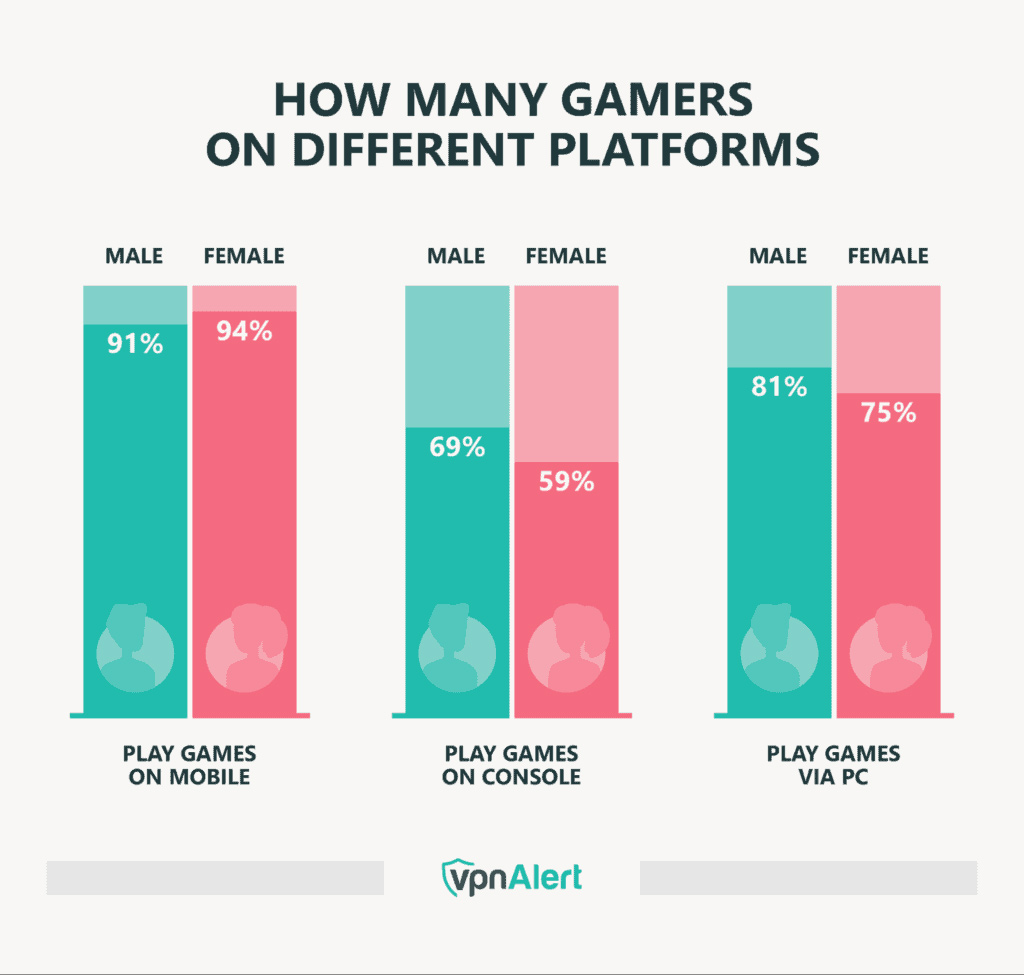
- Mobile gaming is the most popular platform among both genders, with 94% of female gamers and 91% of male gamers playing games on mobile devices.
- Console gaming shows a noticeable gender gap, as 69% of male gamers play games on consoles compared to 59% of female gamers.
- PC gaming remains highly popular, with 81% of male gamers and 75% of female gamers playing games via PC.
- Male gamers are more active on traditional gaming platforms, particularly consoles and PCs, where participation rates are higher than those of female gamers.
- Female gamers dominate mobile gaming adoption, slightly surpassing male gamers with a 3 percentage point higher participation rate on mobile devices.
- Overall, mobile gaming leads across all platforms, while PC and console gaming show stronger engagement among male players compared to female players.
Online Gaming Behavior and Engagement (Time Spent)
- Gamers worldwide spend an average of 8.45 hours per week playing video games.
- In the United States, gamers spend roughly 7 hours per week gaming online across different platforms.
- Mobile gamers typically play for 30 to 45 minutes per session, often engaging multiple times per day.
- Multiplayer online games drive the highest engagement, with some titles averaging 20+ hours of playtime per month per player.
- Around 79% of gamers report playing with friends or family online, emphasizing the social nature of gaming.
- Streaming platforms such as Twitch and YouTube Gaming contribute to extended gaming engagement through spectator content.
- Approximately 67% of gamers play games to relax or reduce stress, making gaming a popular leisure activity.
- Competitive gamers often dedicate 10 to 20 hours weekly to improve skills in esports-oriented titles.
- Cross-platform gaming has increased session times because players can continue gameplay across multiple devices.
Popular Online Game Genres and Titles
- Action‑adventure games were played by 48.9% of gamers worldwide in Q3 2024, making them the second‑most played genre after shooters.
- Shooter games were played by 51.9% of global gamers in Q3 2024 and led the market with about 20.8% of gaming revenue in 2024.
- The global role‑playing games (RPG) market was worth about $23.2 billion in 2023 and is forecast to reach $53.8 billion by 2032 (≈9.8% CAGR).
- Battle royale is a mass‑market phenomenon, with around 68% of gamers worldwide playing the mode, and Fortnite alone reaching about 110 million MAU and 650 million registered users in 2025.
- MOBA titles dominate esports, as League of Legends and Mobile Legends: Bang Bang amassed roughly 750 million and 476 million esports hours watched, respectively, in 2024, topping all games.
- Mobile puzzle / hyper‑casual games generated about $10 billion in in‑app purchase revenue in 2023 and have accumulated roughly 50 billion all‑time downloads across 2012–2023.
- Sandbox hit Minecraft reached around 185.7 million monthly active players worldwide by October 2024, up from 141 million global active players reported in 2021.
- The MMORPG market was valued at about $14.1 billion in 2023 and is projected to grow to $23.8 billion by 2030 at a roughly 7.7% CAGR, driven by long‑term online engagement.
- Football sim EA Sports FC 24 sold about 2.25 million copies in the UK alone in 2023, making it the country’s best‑selling game and underscoring the pull of officially licensed leagues and clubs.
Global Player Perceptions on the Emotional and Well-being Benefits of Video Games
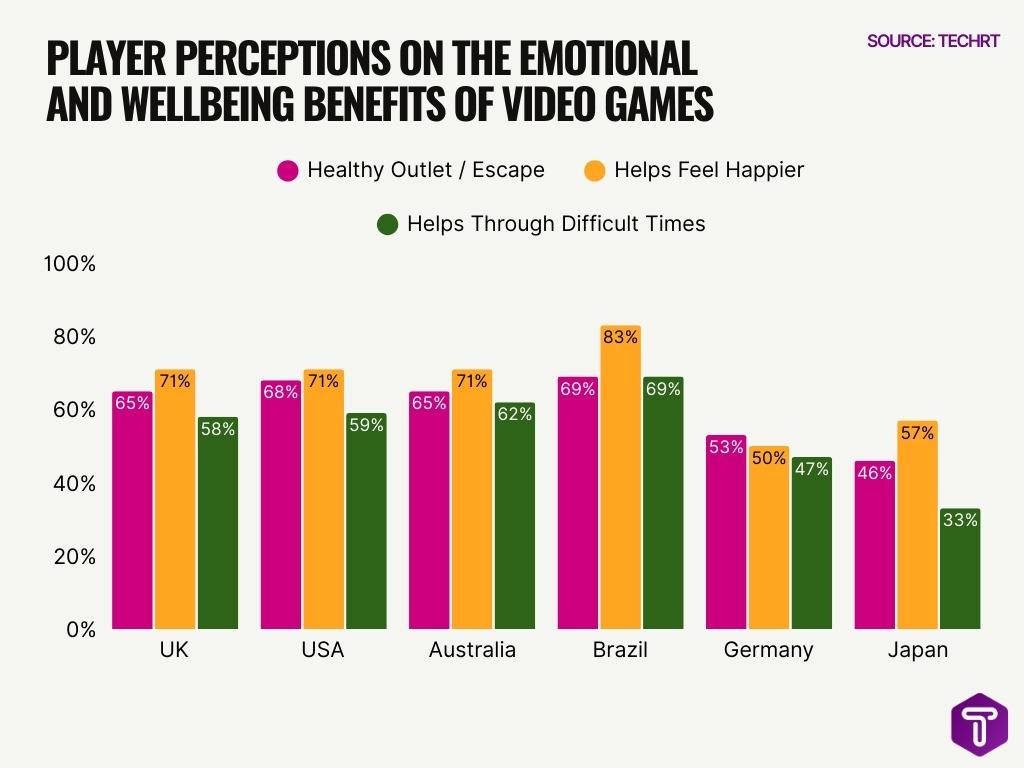
- Brazil shows the strongest emotional impact of gaming, with 83% of players saying video games help them feel happier. Additionally, 69% view gaming as a healthy escape, and 69% say it helps them through difficult times.
- In the UK, 71% of gamers report that video games help them feel happier, while 65% see gaming as a healthy outlet or escape. Meanwhile, 58% believe games help them cope with difficult times.
- USA gamers show similar sentiments, with 71% saying games help them feel happier, 68% considering gaming a healthy escape, and 59% believing games help them deal with difficult times.
- In Australia, 71% of players say gaming helps them feel happier, 65% view it as a healthy outlet, and 62% say games help them through difficult times.
- Germany reports more moderate perceptions, where 53% see gaming as a healthy escape, 50% say it makes them feel happier, and 47% believe it helps them cope with difficult moments.
- Japan records the lowest emotional well-being perceptions from gaming, with 46% saying games serve as a healthy outlet, 57% reporting that games make them feel happier, and only 33% believing games help them through difficult times.
In App Purchases and Monetization Statistics
- In-app purchases account for nearly 79% of total mobile gaming revenue globally.
- The global in-game transaction market generated more than $67 billion annually in recent industry estimates.
- Cosmetic purchases such as skins and character customization represent one of the most profitable monetization models in online games.
- Subscription gaming services such as Xbox Game Pass and PlayStation Plus collectively attract tens of millions of subscribers worldwide.
- Battle passes and seasonal content updates significantly increase player retention and spending.
- Advertising in mobile games generates billions of dollars annually, particularly in free-to-play titles.
- Free-to-play games dominate the industry, accounting for nearly 78% of global gaming revenue.
- Premium console games still generate strong revenue through digital downloads and expansions.
- Microtransactions remain a core monetization strategy for multiplayer and mobile games.
Frequently Asked Questions (FAQs)
How many people play video games worldwide?
Around 3.32 billion people globally play video games, representing more than 40% of the world’s population.
How large is the global online gaming market?
The global online gaming market reached about $225.28 billion in 2025 and is projected to grow to $424.14 billion by 2032.
What is the expected CAGR of the online gaming market?
The online gaming industry is projected to grow at approximately 9.4% CAGR between 2025 and 2034.
How much revenue does the global gaming industry generate annually?
The global video game market generated roughly $197 billion in revenue in 2025, growing 7.5% year over year.
How big is the global esports audience?
The worldwide esports audience is expected to reach around 640.8 million viewers by 2025.
Conclusion
Online gaming continues to expand rapidly as technology, connectivity, and digital distribution reshape the global entertainment landscape. The industry now reaches billions of players worldwide, with mobile gaming leading growth while PC, console, and cloud gaming create diverse ecosystems for players.
Looking ahead, innovations such as cloud streaming, cross-platform play, esports, and in-game economies will further drive engagement and revenue. As gaming evolves from a niche hobby into a mainstream digital activity, the statistics above illustrate how online gaming will remain a dominant force in entertainment, technology, and digital culture for years to come.

Leave a comment
Have something to say about this article? Add your comment and start the discussion.