




Online shopping has evolved from a convenience into a core part of global retail, shaping how consumers discover, evaluate, and purchase products. Businesses across sectors, from direct-to-consumer brands to large retailers, now depend on e-commerce data to refine pricing strategies, personalize customer experiences, and optimize supply chains. At the same time, logistics providers and fintech companies use these insights to improve delivery speed, payment security, and cross-border transactions.
As mobile usage accelerates and digital platforms continue to expand, consumers expect faster, more seamless, and highly personalized shopping journeys. This shift not only influences how products are sold but also how businesses compete in an increasingly digital-first economy. Understanding the latest online shopping statistics offers a clear view of where the market stands today and where it is heading next, so let’s dive into the data that defines online shopping.
Editor’s Choice
- Global e-commerce sales are projected to reach $6.88 trillion in 2026, growing 7.2% year over year.
- There are approximately 2.77 billion online shoppers worldwide as of 2025.
- E-commerce will account for 21.1% of global retail sales in 2026.
- U.S. e-commerce sales are expected to reach $1.38 trillion in 2026.
- Around 84.3% of Americans (288 million people) shop online.
- Over 52% of online shoppers purchase internationally, highlighting cross-border demand.
- Nearly 34% of consumers shop online weekly, showing strong habitual usage.
Recent Developments
- U.S. online holiday sales reached a record $257.8 billion in 2025, up 6.8% YoY.
- Smartphone-driven purchases accounted for 56.4% of U.S. online transactions in 2025, rising from 54.5%.
- Buy Now, Pay Later (BNPL) spending hit $20 billion during the 2025 holiday season, up nearly 10% YoY.
- AI-powered shopping tools saw a 693% increase in usage in 2025, signaling rapid adoption.
- Over 8,000 U.S. retail stores closed in 2025, reflecting a shift toward digital channels.
- Social commerce platforms generated $19 billion in global sales in Q3 2025.
- U.S. social commerce sales reached $4 to $4.5 billion in one quarter, growing 125% QoQ.
- AI adoption is accelerating, with up to 40% of enterprise apps expected to include AI by 2026.
Global Online Shopping Overview
- Global e-commerce sales exceeded $6.42 trillion entering 2026.
- Around 27% of the global population shops online, showing widespread adoption.
- Global online retail sales reached $6.86 trillion in 2025, growing 8.3% YoY.
- E-commerce accounted for over 20% of global retail sales in 2025.
- By 2028, more than 50% of the global population aged 14+ will shop online.
- There are over 28 million e-commerce stores worldwide, indicating market saturation.
- Southeast Asia and Latin America show growth rates up to 23%, leading global expansion.
- U.S. consumers account for 22.3% of global online sales, making it a dominant market.
Online Shopping Market Size
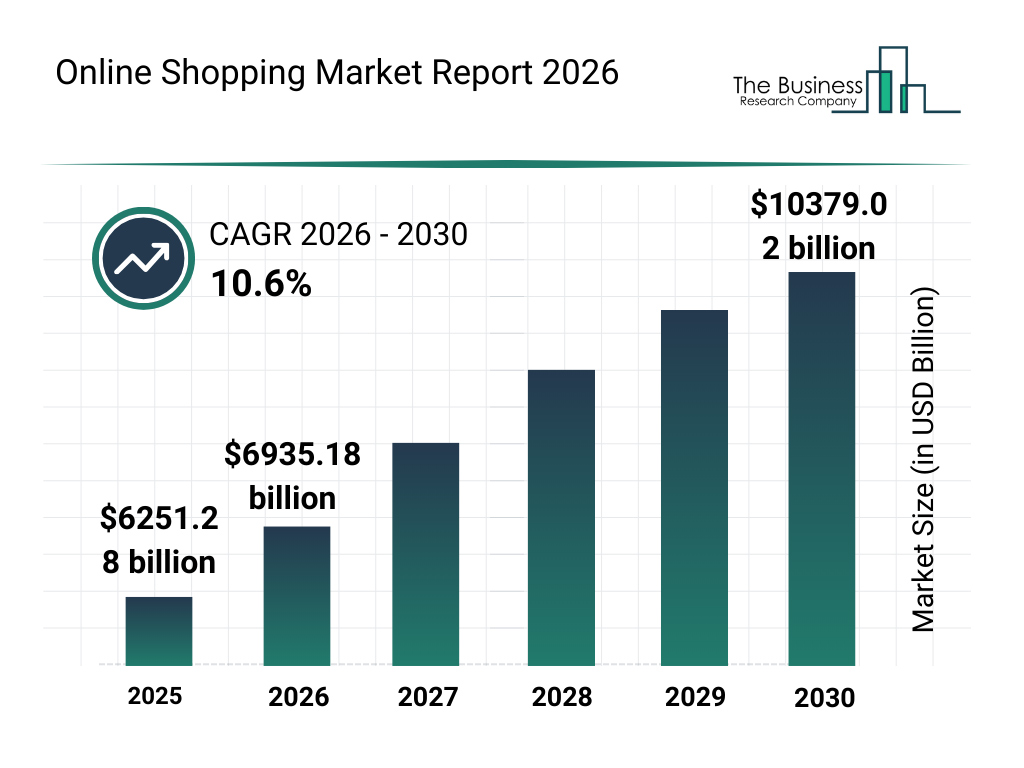
- The global online shopping market is projected to grow from $6,251.28 billion in 2025 to $10,379.02 billion by 2030, highlighting a massive expansion in digital commerce.
- The market is expected to register a strong CAGR of 10.6% between 2026 and 2030, indicating consistent and accelerated growth over the forecast period.
- In 2026, the market size reaches approximately $6,935.18 billion, marking a significant year-on-year increase from 2025.
- The industry is projected to cross around $7.7 trillion in 2027, driven by rising internet penetration and digital adoption.
- By 2028, the market is expected to approach nearly $8.5 trillion, supported by growth in mobile commerce and online marketplaces.
- The upward trajectory continues in 2029, with the market estimated to exceed $9.5 trillion, reflecting strong consumer demand and global e-commerce expansion.
- By 2030, the market is forecasted to surpass the $10 trillion milestone, reinforcing the dominance of online shopping in the global retail ecosystem.
- The data shows a steady year-over-year growth trend, with no projected decline, indicating a resilient and expanding market landscape.
- Rapid advancements in digital payments, logistics, and AI-driven personalization are key contributors to this sustained growth.
- The consistent rise in market size highlights a shift in consumer behavior toward convenience, accessibility, and online-first purchasing habits.
Number of Online Shoppers Worldwide
- There are 2.77 billion global online shoppers as of 2025.
- This number is expected to exceed 2.8 billion users globally.
- About 27% of the world’s population shops online, indicating mainstream adoption.
- The U.S. has 288 million online shoppers, representing 84.3% of its population.
- Americans make up 10.4% of global online shoppers, showing strong market concentration.
- By 2028, more than half of global consumers will shop online.
- Weekly online shopping behavior is observed in 34% of users globally.
- Nearly 99% of consumers read reviews before purchasing online, influencing decisions.
Online Shopping Growth Trends Over Time
- Global e-commerce sales grew from $4.28 trillion in 2020 to $6.86 trillion in 2025, marking a steady upward trajectory.
- The market is projected to reach $6.88 trillion in 2026, continuing moderate post-pandemic growth.
- Between 2023 and 2024, global e-commerce grew by approximately 8% year over year.
- U.S. e-commerce sales increased by 9.24% in 2024, outpacing overall retail growth.
- During the pandemic (2020 to 2021), e-commerce experienced a surge of over 25% growth, reshaping long-term trends.
- Growth has stabilized but remains strong, with annual increases averaging 6% to 10% globally.
- Emerging markets such as India and Brazil are driving growth with 20%+ annual expansion rates.
- Subscription-based e-commerce models have grown by over 60% since 2021, signaling evolving consumer habits.
Online Shopping Penetration by Country
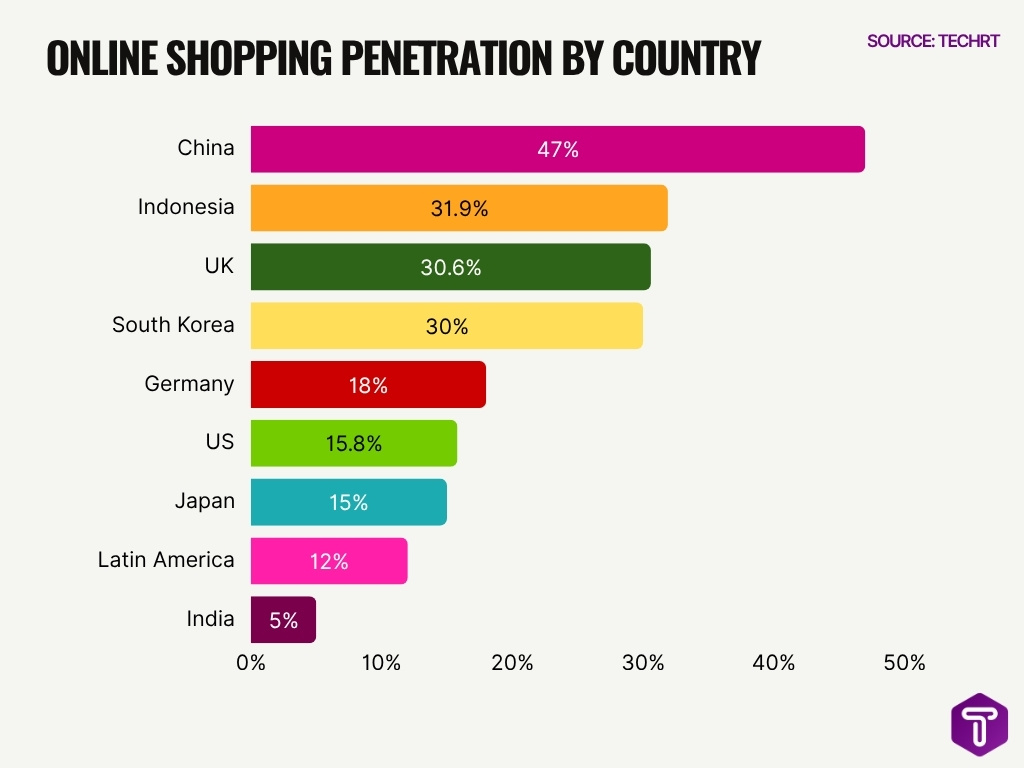
- China leads globally with a 47% penetration rate, indicating near-saturation in urban markets and a highly mature e-commerce ecosystem.
- Indonesia (31.9%) and the UK (30.6%) show strong adoption, but for different reasons; Indonesia is rapidly leapfrogging traditional retail, while the UK represents a stable, mature market.
- South Korea (30%) stands out as a mobile-first economy, where smartphones dominate the online shopping experience.
- Germany (18%) sits in a mid-growth phase, highlighting significant room for further e-commerce expansion.
- The United States (15.8%), despite being a massive retail market, has a relatively low penetration rate, suggesting untapped digital potential.
- Japan (15%) reflects a unique consumer behavior where traditional retail remains strong, slowing e-commerce adoption compared to peers.
- Latin America (12% average) represents a high-growth opportunity region, driven by increasing internet access and digital payments adoption.
- India trails at just 5%, but this signals massive upside potential, fueled by rapid smartphone penetration, digital payments, and expanding logistics networks.
- Overall, the data reveals a clear divide between mature markets (30%+) and emerging markets (<20%), highlighting where future e-commerce growth will be concentrated.
Online Shopping Share of Total Retail Sales
- E-commerce accounts for 20.8% of global retail sales in 2025, up from 18% in 2022.
- This share is expected to rise to 21.1% in 2026, reflecting continued digital adoption.
- In the U.S., online sales represent approximately 15.6% of total retail sales.
- China leads globally, with e-commerce making up over 45% of total retail sales.
- The UK has one of the highest penetration rates, with online sales contributing over 30% of retail revenue.
- Mobile commerce alone contributes nearly 60% of global e-commerce sales, boosting retail share.
- By 2028, e-commerce is projected to account for 23% of total retail sales worldwide.
- Brick-and-mortar retail still dominates in sectors like groceries, where online share remains under 15% globally.
Online vs In-Store Shopping Preferences
- Around 55% of consumers prefer online shopping due to convenience and pricing.
- However, 45% still prefer in-store shopping for a tactile experience and immediate purchase.
- About 73% of shoppers use both online and offline channels, indicating omnichannel behavior.
- Nearly 67% of consumers research products online before buying in-store.
- Conversely, 58% of shoppers check products in-store before purchasing online, highlighting showrooming.
- U.S. consumers spend 36% more when shopping omnichannel vs single-channel.
- Convenience (84%) and price comparison (72%) are the top reasons for choosing online shopping.
- Immediate product access (65%) and in-person service (59%) drive in-store preference.
How Price Sensitivity Drives Cart Abandonment Across Generations
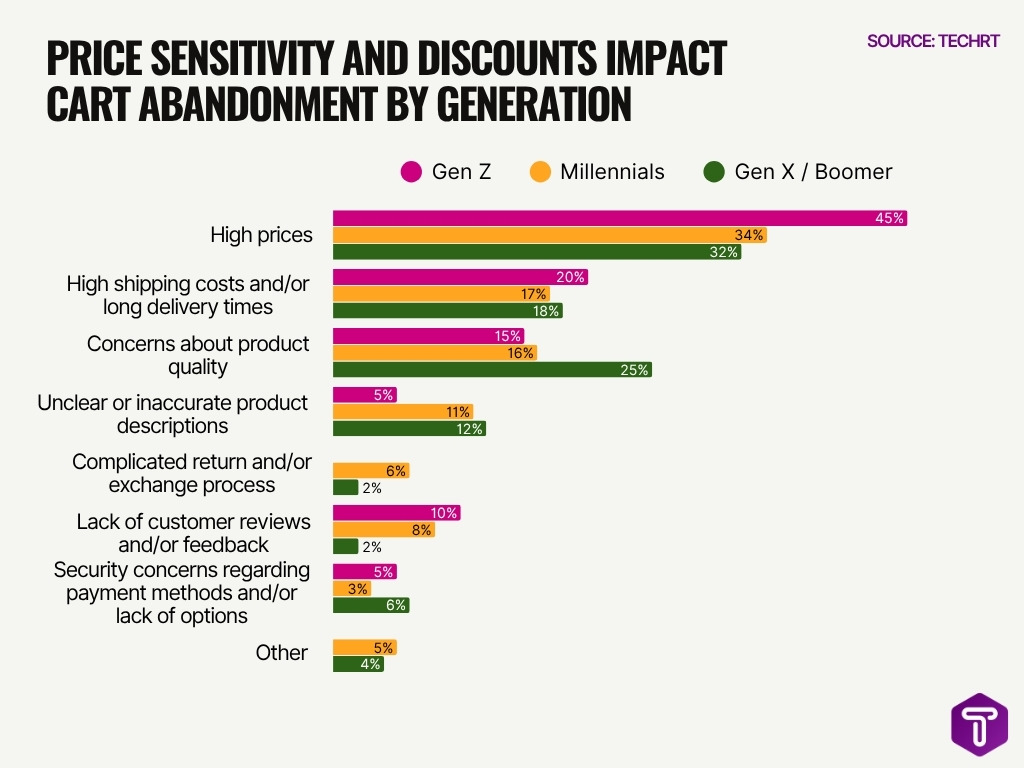
- High prices are the #1 reason for cart abandonment, especially among Gen Z (45%), compared to Millennials (34%) and Gen X/Boomers (32%).
- Shipping costs and delivery times remain a major friction point, affecting 20% of Gen Z, 17% of Millennials, and 18% of Gen X/Boomers.
- Older shoppers are more concerned about product quality, with Gen X/Boomers at 25%, significantly higher than Gen Z (15%) and Millennials (16%).
- Unclear or inaccurate product descriptions impact older generations more, with 12% of Gen X/Boomers and 11% of Millennials, compared to just 5% of Gen Z.
- Complicated return processes are a minor issue overall, but still affect 6% of Millennials and 2% of Gen X/Boomers, while Gen Z shows 0% concern.
- Lack of customer reviews matters most to Gen Z (10%), compared to Millennials (8%), and only 2% of Gen X/Boomers.
- Security concerns around payments are greatest among Gen X/Boomers (6%), versus Gen Z (5%) and Millennials (3%).
- “Other” reasons remain minimal across all groups, with Millennials (5%), Gen X/Boomers (4%), and Gen Z (0%).
Online Shopping by Device (Desktop, Mobile, Tablet)
- Mobile devices account for over 58% of global website traffic, dominating e-commerce access.
- In the U.S., 56.4% of online purchases in 2025 were made via smartphones, up from 54.5%.
- Desktop still contributes around 40% of e-commerce revenue, especially for high-value purchases.
- Tablet usage accounts for roughly 2% to 4% of online shopping traffic, declining in recent years.
- Mobile conversion rates are typically lower than desktop (2% to 3% vs 4% to 5%), due to UX limitations.
- Average order value (AOV) on desktop is 20% higher than mobile, reflecting purchase behavior differences.
- Over 90% of internet users access the web via mobile devices, influencing shopping trends.
- Voice commerce via mobile assistants is growing, with over 20% of users making voice-based purchases.
Online Marketplaces and Platforms
- Online marketplaces account for the majority of global e-commerce sales, with China controlling 50% by 2025.
- Amazon commands 35.7% of the U.S. e-commerce market in 2025, generating $440 billion in sales.
- China’s B2C e-commerce market reached $673.59 billion in 2025, dominating global volume.
- Walmart‘s U.S. e-commerce sales surged 21% year-over-year in Q1 2025.
- Third-party sellers drive over 60% of Amazon sales in 2025.
- Shopify powers 2.64 million active stores worldwide as of Q3 2025.
- eBay maintains approximately 1.7 billion live listings in 2025.
- Digital marketplaces offer 30-40% lower customer acquisition costs than standalone stores.
Online Shopping Categories and Top Product Types
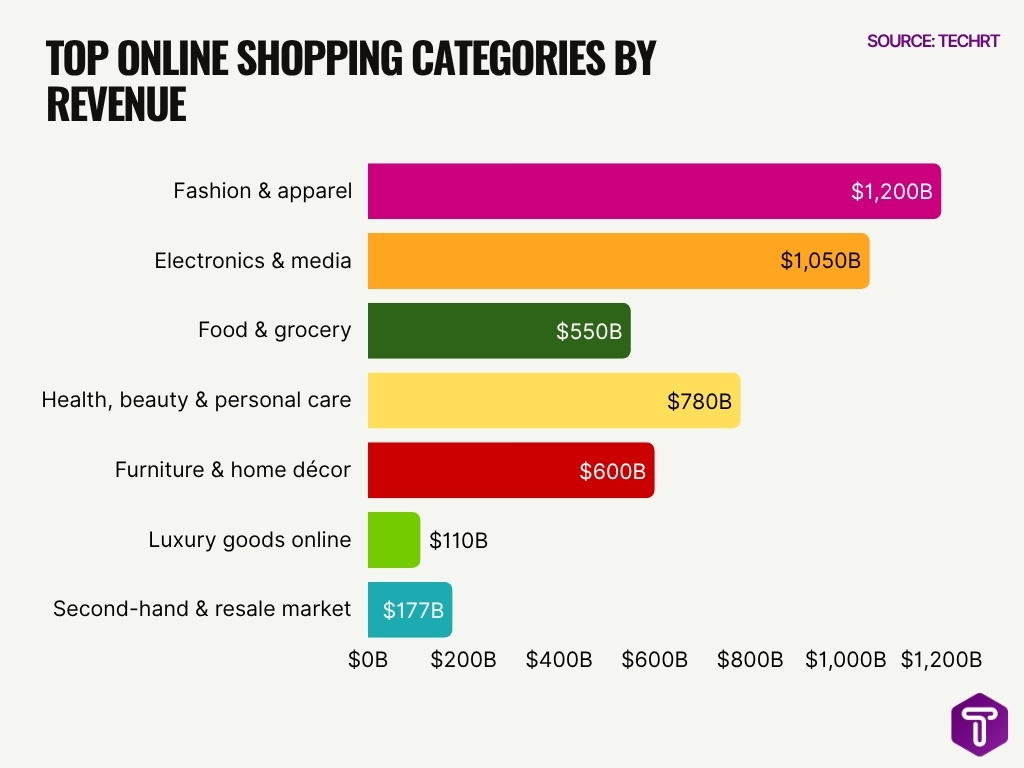
- Fashion & apparel lead online shopping, generating about $1.2 trillion in e-commerce revenue and over 23% of global online retail sales in 2025.
- Electronics & media are the second-largest online category, with around $1.05 trillion in revenue and a roughly 20% share of global e-commerce purchases.
- Food & grocery e-commerce reached about $550 billion in sales and is among the fastest-growing categories worldwide.
- Health, beauty & personal care products generate roughly $780 billion online, accounting for close to 15% of global e-commerce revenue.
- Furniture & home décor represent around $600 billion in online sales and recently recorded double-digit (10%+) annual growth, fuelled by home-improvement demand.
- Health & wellness (supplements, personal care) is one of the fastest-rising online categories, growing at about 20% CAGR in recent years.
- Sustainable and eco-friendly products online are expanding quickly, with an estimated 18% CAGR, making them a leading niche category.
- Luxury goods sold online are expected to reach around $110 billion in annual revenue by 2025, as high-end brands boost their digital channels.
- Global second-hand and resale markets are projected to hit about $350 billion by 2027, more than doubling from a $177 billion valuation in 2022.
Social Commerce and Online Shopping via Social Media
- Global social commerce sales are expected to hit $1.2 trillion by 2026.
- Around 106 million U.S. consumers will make purchases via social platforms in 2025.
- Social commerce generated $19 billion in global sales in Q3 2025, reflecting strong quarterly growth.
- Facebook and Instagram drive over 70% of all social commerce activity worldwide.
- Nearly 49% of consumers say influencer recommendations shape their purchasing decisions online.
- Gen Z shoppers are 2x more likely to buy directly through social media than older generations.
- Average social commerce conversion rates reach 4.5%, surpassing standard e-commerce metrics.
- Live-stream shopping can raise engagement levels by up to 10x compared to typical posts.
- About 62% of brands plan to increase investment in social commerce tools in 2026.
- The Asia-Pacific region accounts for nearly 60% of global social commerce sales.
Cross-Border and International Online Shopping
- Over 52% of online shoppers purchase from international retailers, highlighting global demand.
- Cross-border e-commerce is projected to reach $7.9 trillion by 2030.
- Around 57% of U.S. shoppers have made at least one international purchase online.
- China dominates cross-border exports, contributing a major share of global shipments.
- Europe accounts for nearly 25% of cross-border e-commerce transactions.
- Free shipping influences over 70% of cross-border purchase decisions.
- Currency transparency affects over 60% of shoppers’ trust in international sites.
- Delivery time expectations remain critical, with 48% of shoppers abandoning purchases due to long shipping times.
Online Purchase Timing and Monthly Spending
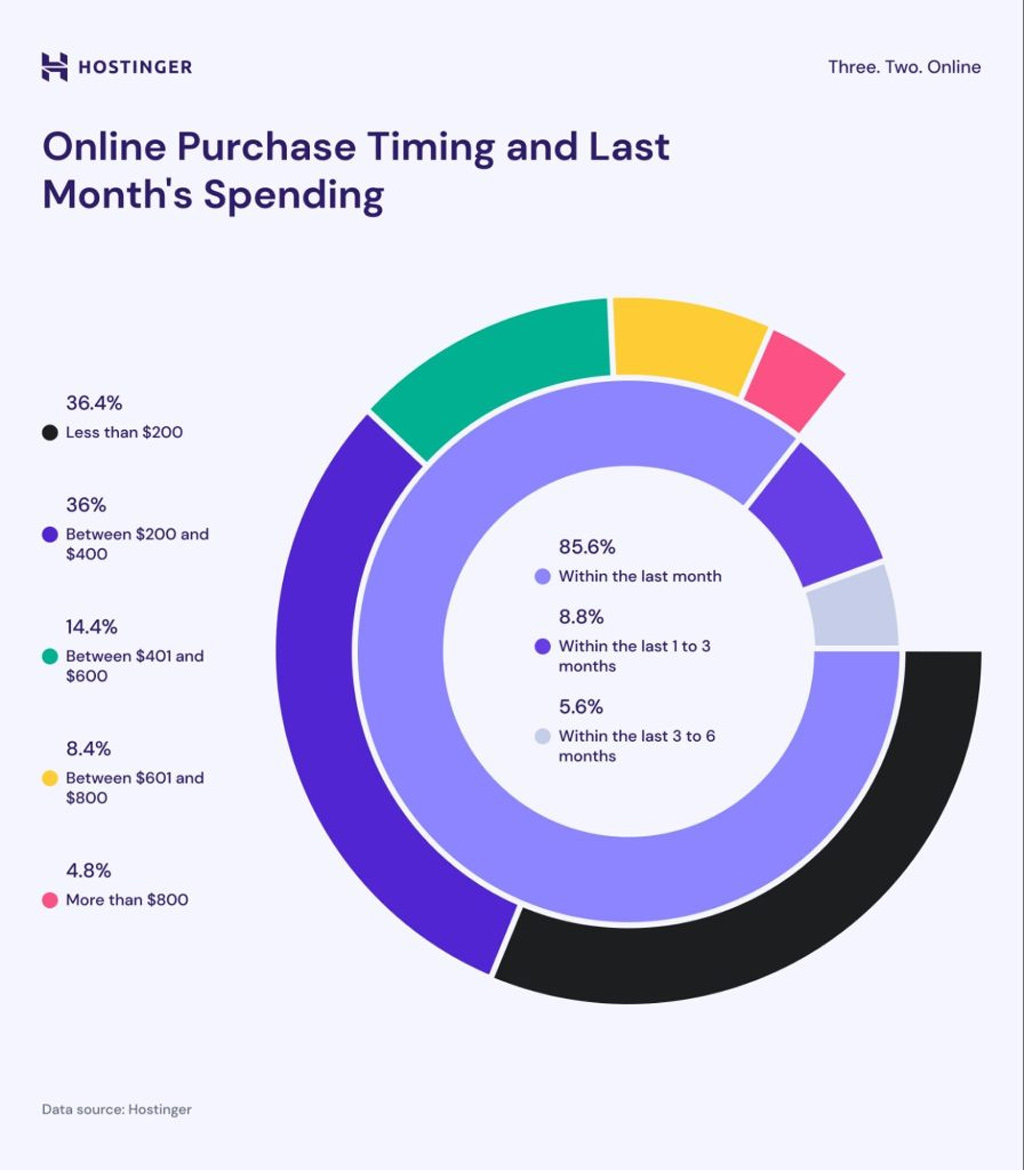
- A dominant 85.6% of consumers made purchases within the last month, highlighting strong and consistent online shopping activity.
- Only 8.8% of users reported shopping within the last 1 to 3 months, showing a sharp drop in mid-term purchasing frequency.
- A minimal 5.6% of consumers made purchases within the last 3 to 6 months, indicating low long-term inactivity among online shoppers.
- The majority of shoppers fall into lower spending brackets, with 36.4% spending less than $200 in the last month.
- Nearly an equal share, 36% of consumers, spent between $200 and $400, making it one of the most common spending ranges.
- A smaller segment, 14.4% of shoppers, spent between $401 and $600, showing moderate spending behavior.
- Only 8.4% of users spent between $601 and $800, indicating fewer high-value transactions.
- A very small proportion, just 4.8%, spent more than $800, highlighting that high spenders are relatively rare.
- Combining lower spending tiers, over 72% of consumers spend under $400, emphasizing a strong preference for budget-conscious shopping.
- The data suggests that frequent, low-to-moderate value purchases dominate online shopping behavior rather than occasional high-ticket spending.
Online Shopping Frequency and Spending Habits
- Around 34% of global consumers shop online weekly, reflecting habitual behavior.
- U.S. consumers spend an average of $5,381 annually on online purchases.
- Nearly 72% of shoppers make impulse purchases online, often driven by discounts.
- Millennials and Gen Z account for over 60% of online spending, shaping trends.
- About 49% of consumers wait for sales events before making purchases.
- Subscription services influence spending, with over 75% of consumers subscribed to at least one service.
- Average order value globally ranges between $80 and $120 per transaction.
- Loyalty programs increase repeat purchases by up to 30%, improving retention.
Mobile Commerce (M-Commerce) Statistics
- Mobile commerce is expected to generate $4.5 trillion in sales in 2025, accounting for a major share of e-commerce.
- M-commerce represents nearly 60% of total e-commerce sales globally.
- In the U.S., mobile commerce sales surpassed $710 billion in 2025.
- Mobile wallet usage is growing rapidly, with over 2.8 billion users globally.
- Conversion rates for mobile apps are 3x higher than mobile websites, encouraging app adoption.
- Push notifications can increase mobile engagement by up to 88%, boosting conversions.
- Mobile shoppers are 40% more likely to make impulse purchases compared to desktop users.
- By 2027, mobile commerce is projected to exceed $6 trillion globally.
Online Payment Methods and Digital Wallets
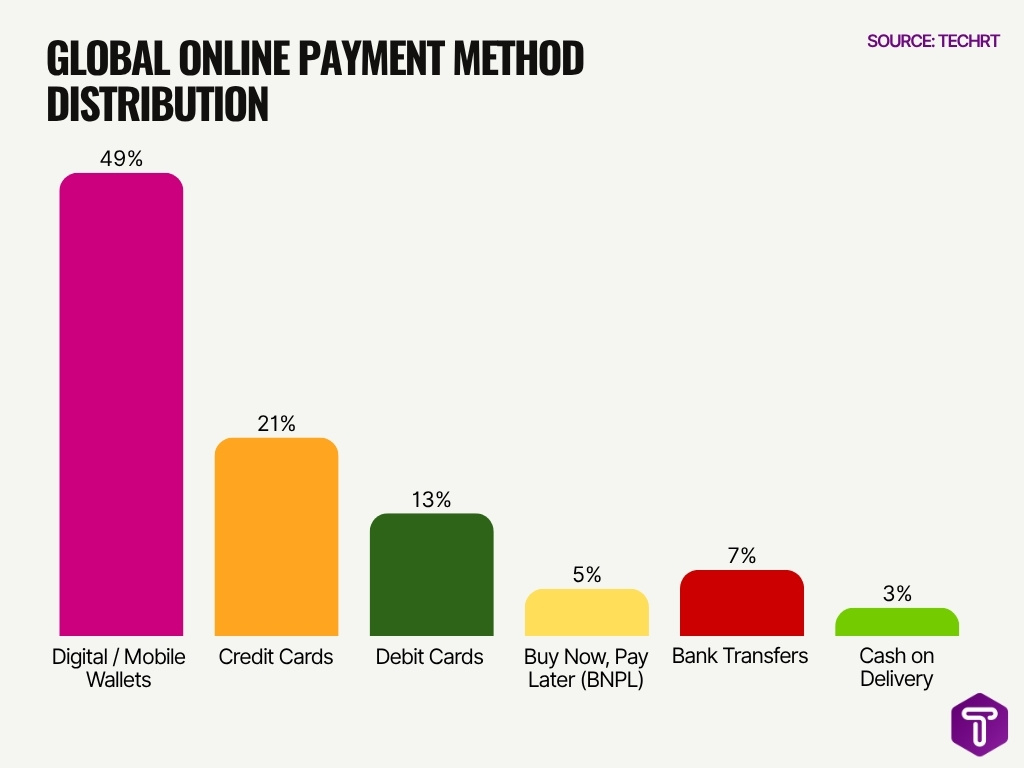
- Digital/mobile wallets dominate online transactions with a massive 49% share, making them the most preferred payment method globally.
- Credit cards account for 21%, showing they remain a strong and trusted option for online shoppers.
- Debit cards contribute 13%, indicating moderate usage compared to credit-based payment methods.
- Buy Now, Pay Later (BNPL) holds 5% share, but is rapidly growing, signaling a shift toward flexible payment options.
- Bank transfers make up 7%, reflecting steady but less dominant usage in e-commerce transactions.
- Cash on delivery (COD) is used in only 3% of payments, highlighting a clear move toward digital-first payment methods.
- The combined share of digital wallets + cards (83%) shows that cashless payments overwhelmingly dominate online shopping.
- The rise of BNPL and digital wallets indicates increasing consumer preference for convenience, speed, and flexibility in payments.
Future Trends and Forecasts in Online Shopping
- Global e-commerce sales are expected to reach $7.89 trillion by 2028.
- AI-powered personalization is expected to influence over 80% of customer interactions by 2026.
- Voice commerce is projected to exceed $150 billion in sales by 2027.
- Augmented reality tools can increase conversion rates by up to 40%.
- Same-day delivery adoption is growing, with over 60% of consumers expecting it by 2026.
- Sustainability influences buying decisions, with over 70% of consumers preferring eco-friendly brands.
- Subscription e-commerce is projected to reach $904 billion by 2026.
- Social commerce is forecast to grow three times faster than traditional e-commerce.
Frequently Asked Questions (FAQs)
What is the projected global e-commerce sales value in 2026?
Global e-commerce sales are expected to reach $6.88 trillion in 2026.
How many people worldwide shop online as of 2025–2026?
More than 2.7 billion to 3 billion people globally shop online.
What percentage of total retail sales will e-commerce account for in 2026?
E-commerce is projected to account for 21.1% of global retail sales in 2026.
What share of total e-commerce sales comes from mobile commerce?
Mobile commerce contributes around 59% to 60% of total e-commerce sales globally.
What is the average global online shopping cart abandonment rate?
The global cart abandonment rate is approximately 48% to 70%, depending on factors like extra costs and checkout friction.
Conclusion
Online shopping continues to expand at a steady pace, supported by advances in mobile technology, digital payments, and data-driven personalization. Consumers now move fluidly between devices and channels, expecting convenience, speed, and transparency at every step. As a result, businesses must rethink traditional retail models and prioritize seamless, omnichannel experiences that meet these evolving expectations.
Moreover, emerging trends such as social commerce, AI-powered recommendations, and faster delivery options are reshaping how and where purchases happen. Companies that invest in these areas, while also addressing challenges like cart abandonment and payment security, will be better positioned to capture long-term growth. Ultimately, the data highlights a clear direction: online shopping is no longer an alternative to retail but a central force driving its future.

Leave a comment
Have something to say about this article? Add your comment and start the discussion.