




The Over-the-Top (OTT) ecosystem continues to redefine media consumption around the world, with streaming platforms eclipsing traditional broadcast and cable TV over the past decade. Rapid broadband adoption, improved device connectivity, and global demand for on-demand entertainment have made OTT part of everyday life for billions. In industries like advertising and sports broadcasting, OTT’s rise has already shifted billions in revenue and viewing hours. As it unfolds, key data highlights how watching, monetizing, and delivering content are evolving. Read on for the latest statistics shaping the OTT landscape.
Editor’s Choice
- Global OTT market projected worth: about $316.40 billion in 2026.
- Nearly 58% of digital video viewers worldwide will watch subscription OTT in 2026.
- India’s OTT user base hit 601 million users in 2025.
- Streaming surpassed traditional TV viewing share in the U.S. in 2025.
- Worldwide OTT revenue projected to exceed $443.29 billion by 2029.
- Connected TV users in India jumped 87% within one year.
- Netflix has roughly 300 million global subscribers as of the latest pooled data.
Recent Developments
- OTT platforms together now compete with broadcast and cable in total viewing share. By mid-2025, streaming accounted for 44.8% of total TV viewership in the U.S., the highest reported share to date.
- Regional players in India have expanded, pushing OTT culture beyond English content into broadband-native formats.
- Warner Bros Discovery predicted its streaming platform could reach 150 million subscribers by 2026, reflecting aggressive global expansion plans.
- Connected TV usage is rapidly rising, a key shift from mobile-only streaming.
- Anime and niche genre viewership surged on major platforms like Netflix, where 50% of subscribers are anime fans.
- New pricing models such as ad tiers and FAST channels are reshaping platform strategies in 2026.
- Global OTT revenue projections were revised upward in recent industry forecasts due to sustained demand.
- Analysts highlight increasing fragmentation among OTT viewers across regions and platforms.
What is OTT?
- Over-the-Top (OTT) refers to video, audio, or messaging content delivered over the internet without traditional broadcast or cable distribution.
- Previously considered a niche market, OTT is now central to global media consumption.
- OTT platforms include subscription, ad-supported, and transactional content services.
- OTT bypasses traditional networks, reaching audiences directly through apps and internet services.
- Streaming is dominant on mobile phones, tablets, connected TVs, and desktop browsers.
- The term also covers music, live sports, and user-generated content services delivered online.
- OTT has blurred lines between traditional broadcast, social media video, and direct-to-consumer platforms.
- Adoption trends vary widely by region and demographic groups worldwide.
OTT Streaming Market Growth Outlook
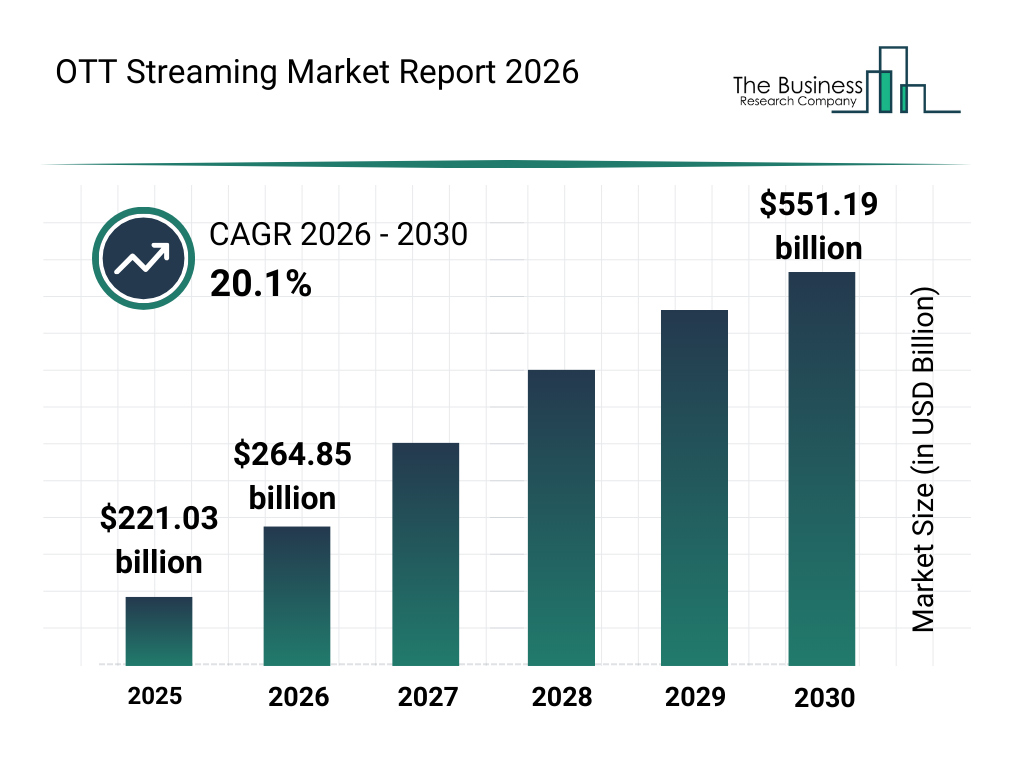
- The global OTT streaming market was valued at $221.03 billion in 2025, reflecting a strong foundation for future growth.
- In 2026, the market is projected to reach $264.85 billion, showing a significant year-over-year increase.
- From 2026 to 2030, the market is expected to grow at a CAGR of 20.1%, highlighting rapid industry expansion.
- By 2030, the OTT streaming market is forecasted to reach $551.19 billion, more than doubling its 2026 value.
- The consistent upward trend from 2025 to 2030 indicates rising demand for digital content and streaming services worldwide.
- Strong growth is driven by increasing smartphone penetration, wider internet accessibility, and higher adoption of subscription-based platforms.
OTT Revenue by Region
- North America leads with the U.S. OTT market at $146.30 billion in 2025, driven by 64% from advertising.
- Asia-Pacific OTT revenues exceeded $25 billion recently, growing at over 12% CAGR.
- Europe OTT market projected to reach €38.4 billion by 2029.
- Latin America OTT revenues to hit $19 billion by 2030, up from $11 billion in 2023.
- U.S. connected-TV advertising generated $15 billion in 2025.
- India boasts 148+ million paid OTT subscribers in 2025.
- Regional language content drives 50%+ of India’s paid OTT subscriptions by 2030.
- MENA streaming market reaches $1.5 billion by end-2025, with 27 million SVOD subscribers.
- The Southeast Asia OTT video market generated over $3 billion in 2023.
Global OTT User Growth Trends
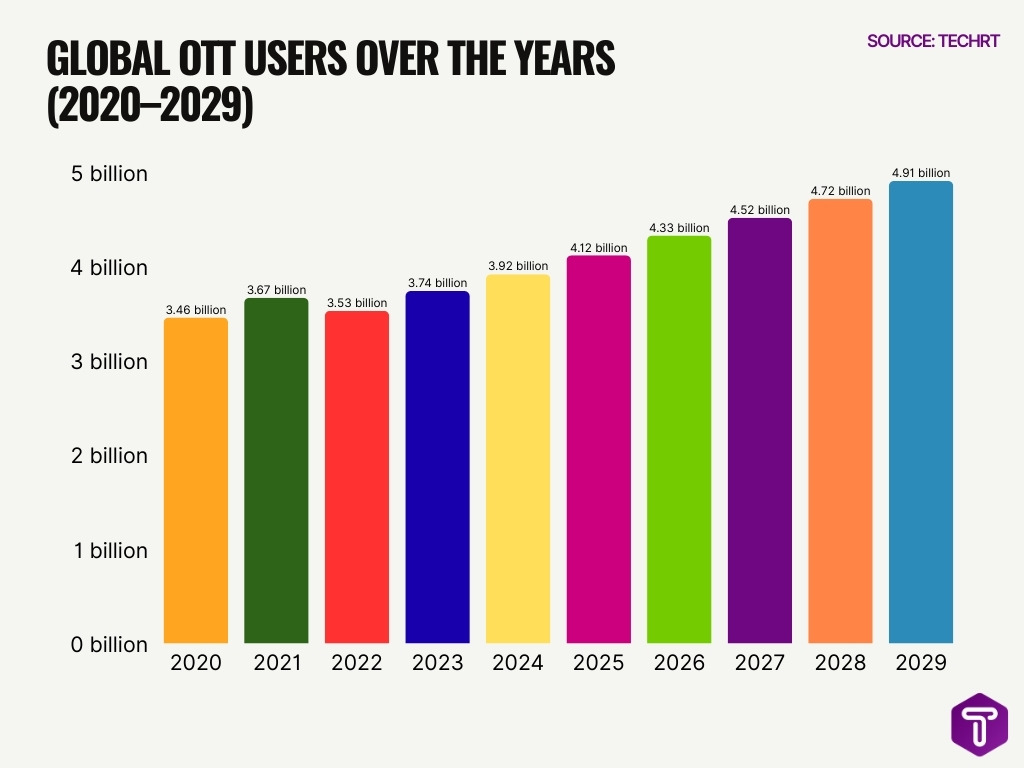
- Global OTT users increased from 3.46 billion in 2020 to 3.67 billion in 2021, reflecting steady early post-pandemic growth.
- In 2022, the user base adjusted slightly to 3.53 billion, indicating a short-term slowdown in market expansion.
- OTT adoption rebounded in 2023, reaching 3.74 billion users, supported by rising mobile and smart TV penetration.
- By 2024, the global OTT audience will have grown further to 3.92 billion, showing strong mainstream acceptance.
- The number of OTT users is projected to cross 4.12 billion in 2025, marking a major milestone for the industry.
- In 2026, global users are expected to reach 4.33 billion, driven by emerging market adoption.
- OTT platforms are forecast to serve 4.52 billion users in 2027, highlighting continued platform expansion.
- User growth is projected to accelerate to 4.72 billion in 2028, fueled by localized content and affordable subscriptions.
- By 2029, global OTT users are expected to reach 4.91 billion, representing peak penetration in major markets.
- Overall, the OTT market is expected to grow by more than 1.45 billion users between 2020 and 2029, underlining its long-term scalability.
OTT Revenue by Platform Type (SVOD, AVOD, TVOD)
- Subscription Video on Demand (SVOD) continues to lead the OTT market, with SVOD revenue expected to exceed $139 billion by 2027.
- In 2024, the OTT video advertising segment contributed over $176.60 billion globally, highlighting the growth of AVOD models.
- Ad-supported video-on-demand (AVOD) revenue is projected to surpass $318 billion by 2027.
- Hybrid service models that combine subscription and ads are among the fastest-growing segments through 2031.
- Transactional Video on Demand (TVOD) remains a smaller segment but drives incremental user spending through pay-per-view content.
- Many platforms are adopting FAST (Free Ad-Supported Streaming TV) channels, adding new monetization avenues in 2026.
- In the United States, AVoD revenue alone is projected to exceed $21.6 billion by 2029.
- Global consumer spending is also diversifying across SVOD, AVOD, hybrid, and niche transactional services.
OTT Penetration Rate by Region
- Global OTT penetration is projected at around 70.92% in 2025.
- By 2029, penetration could climb to over 78.62% worldwide.
- Canada registered a penetration rate exceeding 130%, reflecting multiple service uptake per user.
- The United Kingdom recorded a penetration above 132%.
- Belgium and Norway reported rates exceeding 100% in recent years.
- Global penetration has more than doubled since 2019 (~48.28%), highlighting rapid adoption.
- In the United States, streaming now represents a majority share of television consumption.
- Penetration growth rates remain highest in APAC and LATAM regions due to digital infrastructure investment.
OTT Subscribers by Leading Platforms
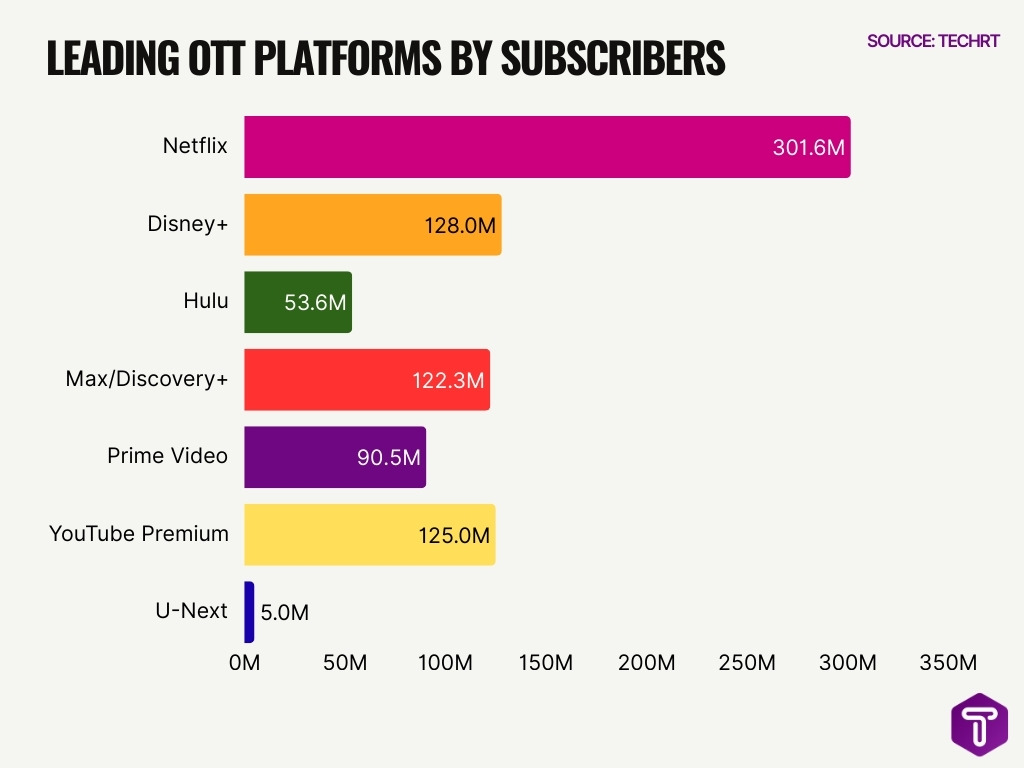
- As of 2025, Netflix had approximately 301.6 million global subscribers.
- Disney+ reported around 128 million subscribers in fiscal 2025.
- Hulu had about 53.6 million subscribers in the U.S. in 2025.
- Warner Bros. Discovery’s Max/Discovery+ reported roughly 122.3 million subscribers in early 2025.
- Prime Video usage in the U.S. was estimated at 90.5 million viewers in 2025.
- YouTube Premium (including Music) counted about 125 million subscribers in 2025.
- Regional platforms also show growth; for example, niche regional services in India expand user reach.
- U-Next in Japan surpassed 5 million paid subscribers by late 2025.
OTT Usage by Device
- Smartphones dominate OTT viewing, with over 70% of content consumed on mobile devices globally.
- Connected TVs account for 35.3% of total OTT viewing time worldwide.
- In India, connected TV users surged 85% to 129.2 million in 2025.
- Smartphones and tablets hold 52.4% share in OTT access types.
- 80% of OTT users switch between multiple devices like phones, tablets, and TVs.
- Gaming consoles capture 6.8% of global OTT viewing time.
- Tablets represent 4.8% of OTT streaming time, popular in family settings.
- Desktops take 7.1% of viewing, favored by younger demographics.
- OTT TV apps will be installed on 80% of smart TVs by 2025.
- International markets see higher mobile OTT at 41.8% viewing time in Asia.
Time Spent on OTT Platforms
- U.S. OTT viewers average around 17 hours of OTT content weekly.
- Daily engagement per user is approximately 70 minutes on average.
- About 75% of OTT users stream at least three times per week.
- Nearly 35% stream multiple times per day, reflecting high usage frequency patterns.
- OTT sessions often last between 20 and 60 minutes each.
- Binge-watching is popular, with over 70% of users reporting regular binge viewing.
- Rural OTT engagement in regions like India is rising, with average sessions of 15–30 minutes.
- Time spent on OTT continues to displace traditional TV viewing globally.
OTT Users by Age Group Distribution
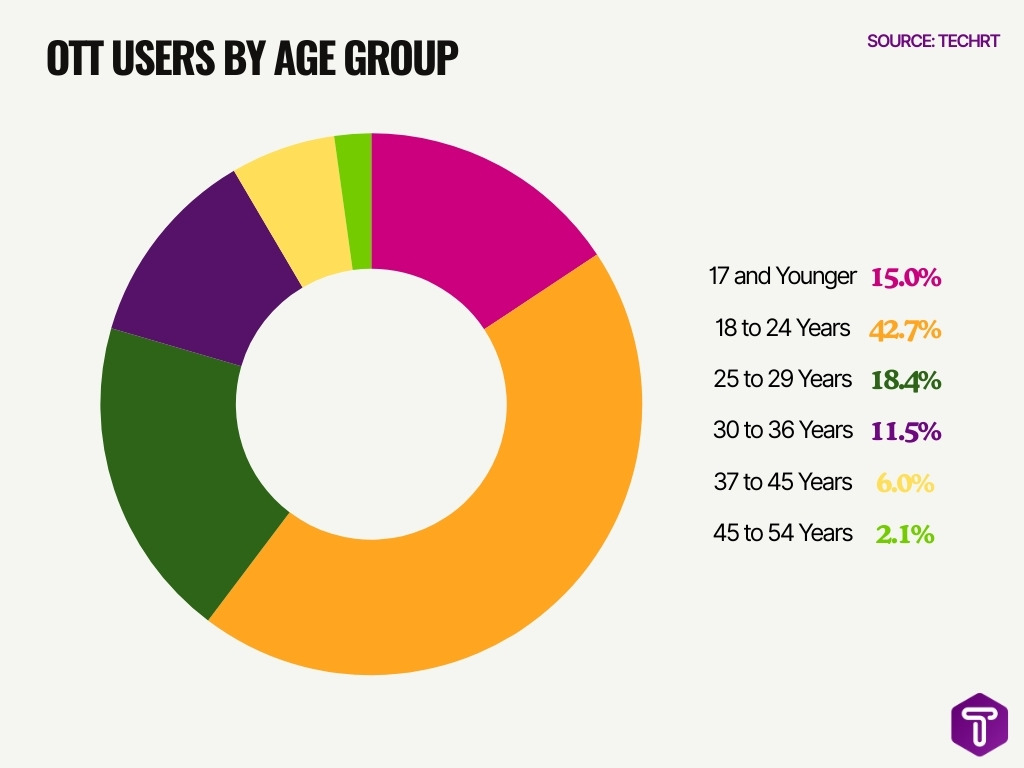
- The 18 to 24-year age group dominates OTT consumption, accounting for a massive 42.7% of total users.
- Users aged 25 to 29 years represent the second-largest segment, contributing 18.4% of the OTT audience.
- Viewers 17 years and younger make up 15% of OTT users, highlighting strong adoption among Gen Z and younger audiences.
- The 30 to 36-year age bracket accounts for 11.5%, showing moderate engagement among early millennials.
- Adults aged 37 to 45 years contribute 6%, indicating a noticeable decline in usage compared to younger demographics.
- The 45 to 54 years group represents just 2.1%, making it the smallest OTT user segment in the dataset.
- Combined, users under 30 years old account for over 76% of total OTT users, clearly demonstrating that OTT platforms are heavily youth-driven.
Cord-Cutting and OTT vs Traditional TV Viewership
- In July 2025, streaming accounted for 44.8% of total U.S. TV viewing, surpassing the combined share of broadcast and cable for the first time.
- Cable TV subscriptions in the U.S. fell below 60 million households in 2024, continuing a decade-long decline.
- More than 5 million U.S. households cut the cord in 2024 alone, accelerating post-pandemic trends.
- By 2026, over 75 million U.S. households are expected to be cord-cutters or cord-nevers.
- Traditional pay TV penetration in the U.S. dropped below 50% of households in 2025.
- Younger viewers (18–34) spend nearly twice as much time streaming compared to watching linear TV.
- Live sports streaming drove record OTT sign-ups during major events like the NFL playoffs and global soccer tournaments in 2025.
- Globally, OTT platforms now command the majority share of digital video consumption in developed markets.
OTT Content Consumption by Genre and Original Content
- Over 70% of OTT users binge-watch regularly.
- Entertainment and movies hold 34.57% of the OTT consumption share in 2025.
- More than 50% of Netflix members watch anime.
- SVOD accounts for 46.12% of OTT revenue in 2025.
- Sports content grows at 12.67% CAGR through 2031 in OTT.
- Regional languages drive over 50% of India’s paid OTT market.
- AVOD revenue reaches $54.54 billion globally in 2025.
- Binge-watching occurs regularly with 70% of OTT viewers.
- Live sports OTT market hits $37.7 billion in 2025.
US OTT Video Subscription Revenue Growth
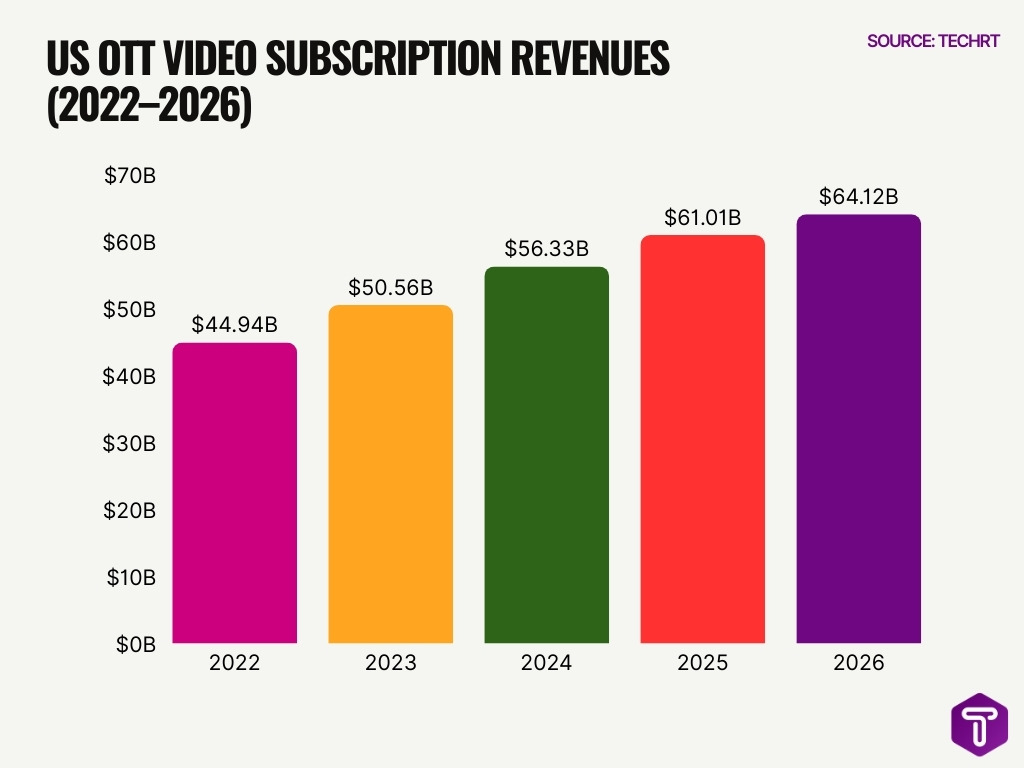
- US OTT subscription revenue increased from $44.94 billion in 2022 to $64.12 billion in 2026, showing strong long-term market expansion.
- Between 2022 and 2023, revenues grew from $44.94 billion to $50.56 billion, reflecting rising consumer adoption of streaming services.
- In 2024, the market reached $56.33 billion, driven by higher subscription penetration and premium content investments.
- Revenue crossed the $60 billion mark in 2025, hitting $61.01 billion, highlighting sustained user retention and pricing power.
- By 2026, OTT subscription revenues peaked at $64.12 billion, confirming the sector’s position as a dominant force in digital entertainment.
- Overall, the market added more than $19.18 billion in new revenue between 2022 and 2026, underlining consistent annual growth.
- The steady year-over-year increase reflects strong consumer demand, multi-subscription behavior, and expanding original content libraries.
- Rising revenues also indicate improved monetization strategies, including tiered pricing models and bundled subscription plans.
ARPU, Churn Rate, and Multi-Subscription Behavior
- The average OTT household in the U.S. subscribes to 3.8 streaming services in 2025.
- Monthly churn rates across major U.S. streaming services averaged 5–6% in 2024–2025.
- Ad-supported tiers reduced churn by up to 25% compared to premium-only tiers.
- Average revenue per user (ARPU) for leading global SVOD platforms ranges between $7 and $15 per month, depending on region.
- Password-sharing crackdowns contributed to a 10% uplift in paid memberships for certain platforms in 2024.
- Bundling strategies (e.g., multi-platform packages) improved retention rates by over 15%.
- Emerging markets show lower ARPU but faster subscriber growth compared to North America.
- Consumers increasingly rotate subscriptions seasonally, especially around major content releases.
Impact of 5G, Smart TV, and Connected TV on OTT Growth
- Global 5G subscriptions exceeded 1.5 billion connections in 2025, accelerating mobile streaming adoption.
- Smart TV shipments surpassed 240 million units globally in 2024.
- Connected TV households in the U.S. exceeded 90% penetration in 2025.
- India’s Connected TV users grew 87% year-over-year, reaching 129.2 million users.
- 5G rollout improved average mobile streaming speeds by more than 30% compared to 4G.
- Over 70% of OTT viewing in developed markets now occurs on television screens, not mobile.
- Gaming consoles and streaming sticks contribute significantly to OTT device usage in North America.
- Broadband penetration remains the strongest predictor of OTT market expansion globally.
Impact Analysis of Key Factors in the Global OTT Content Market
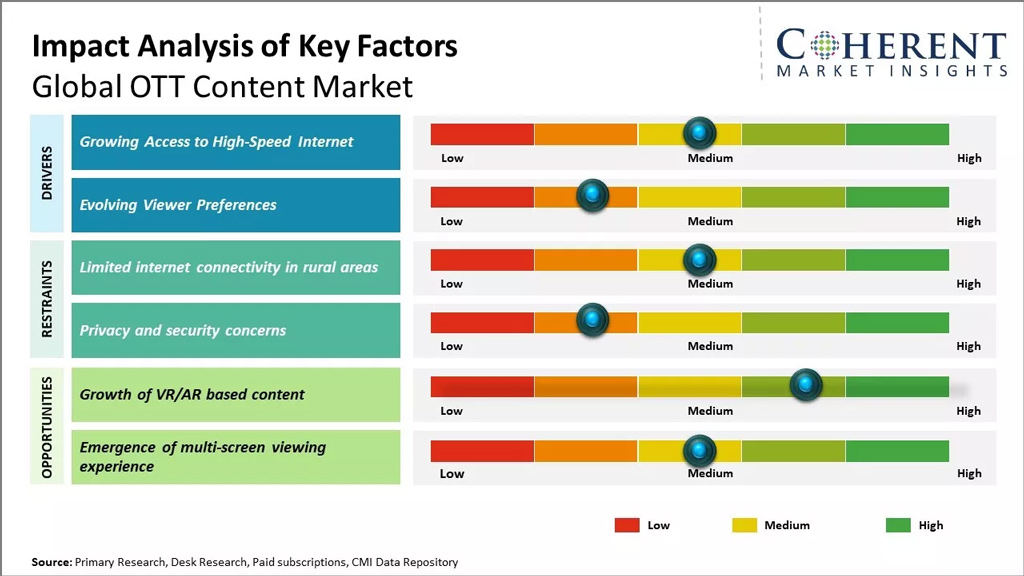
- Growing access to high-speed internet shows a medium impact, highlighting its steady role in expanding global OTT adoption.
- Evolving viewer preferences register a medium influence, reflecting changing demands for personalized and on-demand content.
- Limited internet connectivity in rural areas carries a medium restraint, continuing to restrict OTT market penetration in underserved regions.
- Privacy and security concerns have a medium impact, affecting user trust and platform credibility worldwide.
- Growth of VR/AR-based content demonstrates a high impact, positioning immersive technologies as a major future growth driver for OTT platforms.
- Emergence of multi-screen viewing experience maintains a medium impact, supporting increased content consumption across devices.
Key OTT Market Trends, Challenges, and Future Outlook
- Netflix leads with $18 billion content spend in 2025, nearly double Disney’s $8.6 billion for streaming services.
- Global OTT market projected to reach $434.5 billion by 2027 at 16.5% CAGR.
- Asia-Pacific OTT market valued at $62.27 billion in 2022, with India leading high CAGR growth.
- Latin America OTT platform market to grow from $20.6 billion in 2024 to $52.2 billion by 2033 at 10.36% CAGR.
- Nearly 80% of content watched on major platforms is influenced by AI-driven recommendations.
- Hybrid ad-supported tiers forecast to grow at 12.81% CAGR through 2031 amid subscription fatigue.
- 2025 saw major OTT consolidation, with monthly M&A deals across the value chain.
- U.S. CTV ad spend hit $30 billion in 2024, surpassing cable as AVOD expands.
- India’s OTT market to double to INR 35,000 crore by 2028 at 14.9% CAGR.
Frequently Asked Questions (FAQs)
What is the projected global OTT market size in 2026?
The global OTT video market size is projected at about $316.40 billion in 2026, underscoring ongoing expansion in OTT streaming revenue worldwide.
How many OTT users were there globally in 2024?
The global OTT user base is expected to reach around 5.76 billion people in 2026, up from about 4.95 billion in 2023, as OTT becomes mainstream for video consumption.
What was India’s OTT audience size and paid subscribers in 2025?
India’s OTT audience reached 601.2 million users in 2025, with 148.2 million active paid subscriptions.
What CAGR is the OTT market forecast to grow at from 2022 to 2034?
The global OTT market is projected to grow at a 26.42% compound annual growth rate (CAGR) from 2022 to 2034.
How large is the video streaming industry globally as of 2025?
The global video streaming market was valued at approximately $811.37 billion in 2025 and continues to expand rapidly.
Conclusion
OTT platforms now sit at the center of global media consumption. Streaming has overtaken traditional television in key markets, advertising dollars are shifting rapidly to connected TV, and consumers routinely manage multiple subscriptions at once. Meanwhile, 5G connectivity, Smart TV adoption, and hybrid monetization models continue to expand access and revenue potential.
As we move deeper, the data makes one trend clear: OTT is no longer an alternative to traditional TV; it is the dominant model shaping the future of entertainment, advertising, and digital media worldwide.

Leave a comment
Have something to say about this article? Add your comment and start the discussion.