




Outsourcing continues to reshape how companies operate, reduce costs, and access global talent. From U.S. startups outsourcing software development to established enterprises delegating customer support or finance operations, organizations rely on external providers to scale faster and operate efficiently. For example, SaaS companies frequently outsource development teams to accelerate product releases, while retailers outsource logistics and customer service to handle seasonal demand spikes. The following outsourcing statistics highlight market size, adoption trends, and technology shifts shaping outsourcing, helping readers understand where the industry is heading.
Editor’s Choice
- The global outsourcing market surpassed $620 billion in 2024 and is projected to reach over $1 trillion by 2030, driven by IT services, BPO, and cloud infrastructure outsourcing.
- Around 76% of companies worldwide outsource at least one business function, showing how mainstream outsourcing has become across industries.
- IT outsourcing accounts for more than 60% of total outsourcing contracts, making it the largest outsourcing category globally.
- Businesses report average cost reductions of 15%–30% when they outsource IT and business processes compared with in-house operations.
- The United States remains the largest outsourcing client market, representing roughly one-third of global outsourcing demand.
- India continues to dominate offshore outsourcing, generating more than $200 billion in IT-BPM industry revenue in 2024.
- By 2026, over 50% of enterprises are expected to outsource AI-related services such as data labeling, model development, and analytics support.
Recent Developments
- In 2024, global IT outsourcing spending exceeded $540 billion, reflecting a steady increase as organizations accelerate digital transformation initiatives.
- Generative AI integration in outsourcing contracts increased by more than 40% between 2023 and 2025, particularly in software development and customer support.
- Over 64% of CIOs expanded outsourcing budgets in 2024, primarily for cybersecurity, cloud migration, and AI projects.
- Nearshore outsourcing demand grew by nearly 20% in North America during 2024, as companies seek closer collaboration and fewer time-zone challenges.
- The global BPO sector reached approximately $280 billion in 2024, reflecting strong demand for finance, HR, and CX outsourcing services.
- Around 37% of outsourcing contracts signed in 2024 involved digital transformation services, including cloud, analytics, and automation.
- Cybersecurity outsourcing grew 15% year-over-year in 2025, as organizations face increasing cyber threats and compliance requirements.
- Roughly 46% of enterprises now use multi-vendor outsourcing strategies instead of relying on a single service provider.
- Latin America’s outsourcing industry expanded by about 13% in 2024, largely due to demand for nearshore development teams.
Global Outsourcing Services Market Growth Insights
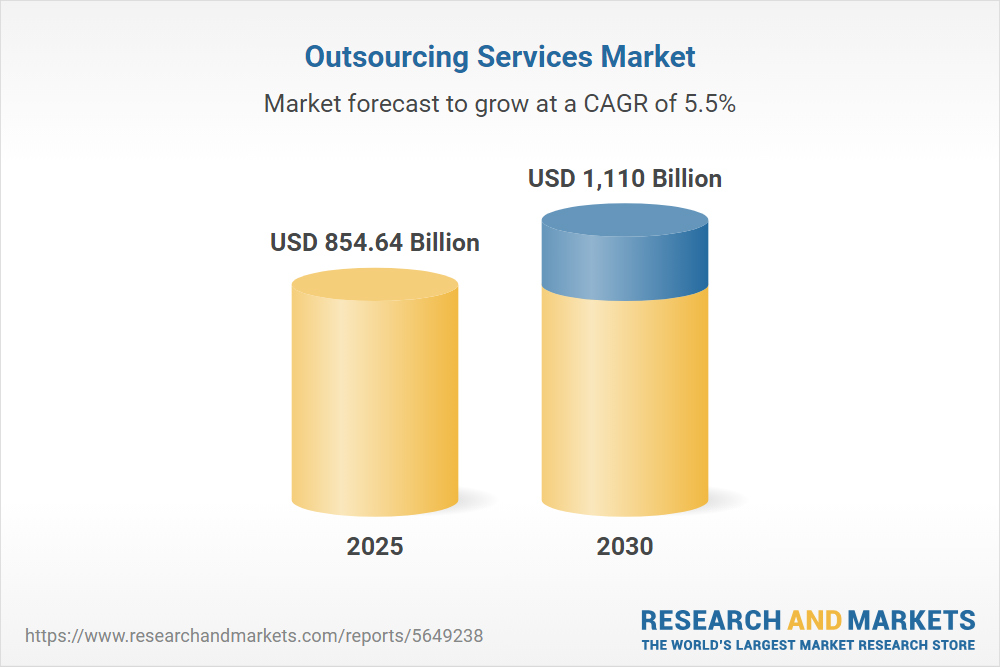
- The global outsourcing services market is projected to reach $1.11 trillion by 2030, highlighting the continued expansion of outsourcing across industries.
- In 2025, the market size is estimated at $854.64 billion, demonstrating the already significant scale of the outsourcing sector worldwide.
- The market is expected to grow at a compound annual growth rate (CAGR) of 5.1% between 2025 and 2030, reflecting steady demand for outsourced services.
- Over the five-year period (2025–2030), the industry is forecast to add more than $255 billion in market value, indicating strong enterprise adoption of outsourcing solutions.
- This growth underscores how businesses are increasingly leveraging outsourcing to reduce operational costs, access specialized talent, and improve efficiency.
Business Process Outsourcing (BPO) Statistics
- The global BPO market reached about $280 billion in 2024 and continues to grow steadily across finance, HR, and customer service functions.
- Customer support services account for nearly 35% of the BPO market, making it the largest BPO segment.
- The BPO sector is projected to grow at a CAGR of roughly 9% between 2024 and 2030.
- Around 60% of BPO clients are based in North America, primarily in the United States.
- Finance and accounting outsourcing represents about 15% of the BPO market, with steady demand from mid-size enterprises.
- The Philippines employs more than 1.5 million workers in the BPO industry, making it one of the largest outsourcing hubs globally.
- BPO providers handled over 20 billion customer interactions annually worldwide by 2024.
- Healthcare BPO services grew by more than 12% in 2024, driven by medical billing and insurance claims processing demand.
- Automation and AI adoption in BPO increased by about 25% between 2023 and 2025, improving service speed and reducing costs.
IT and Software Development Outsourcing Statistics
- The global IT outsourcing market surpassed $430 billion in 2024 and continues to expand with cloud and AI development demand.
- Approximately 64% of companies outsource software development tasks, including application development and maintenance.
- Businesses save 20%–30% in development costs by outsourcing software engineering teams offshore.
- India produces over 1.5 million engineering graduates annually, supporting its position as a leading outsourcing destination.
- Around 47% of startups outsource software development to accelerate product launches and reduce hiring costs.
- Eastern Europe’s outsourcing market grew by about 11% in 2024, particularly in Poland, Ukraine, and Romania.
- Cloud migration projects represent more than 35% of IT outsourcing contracts signed in 2024.
- Cybersecurity outsourcing demand increased by roughly 15% year-over-year, reflecting rising global cyber threats.
- By 2026, nearly 70% of enterprises will outsource at least part of their application development lifecycle.
IT Outsourcing Market Revenue Growth
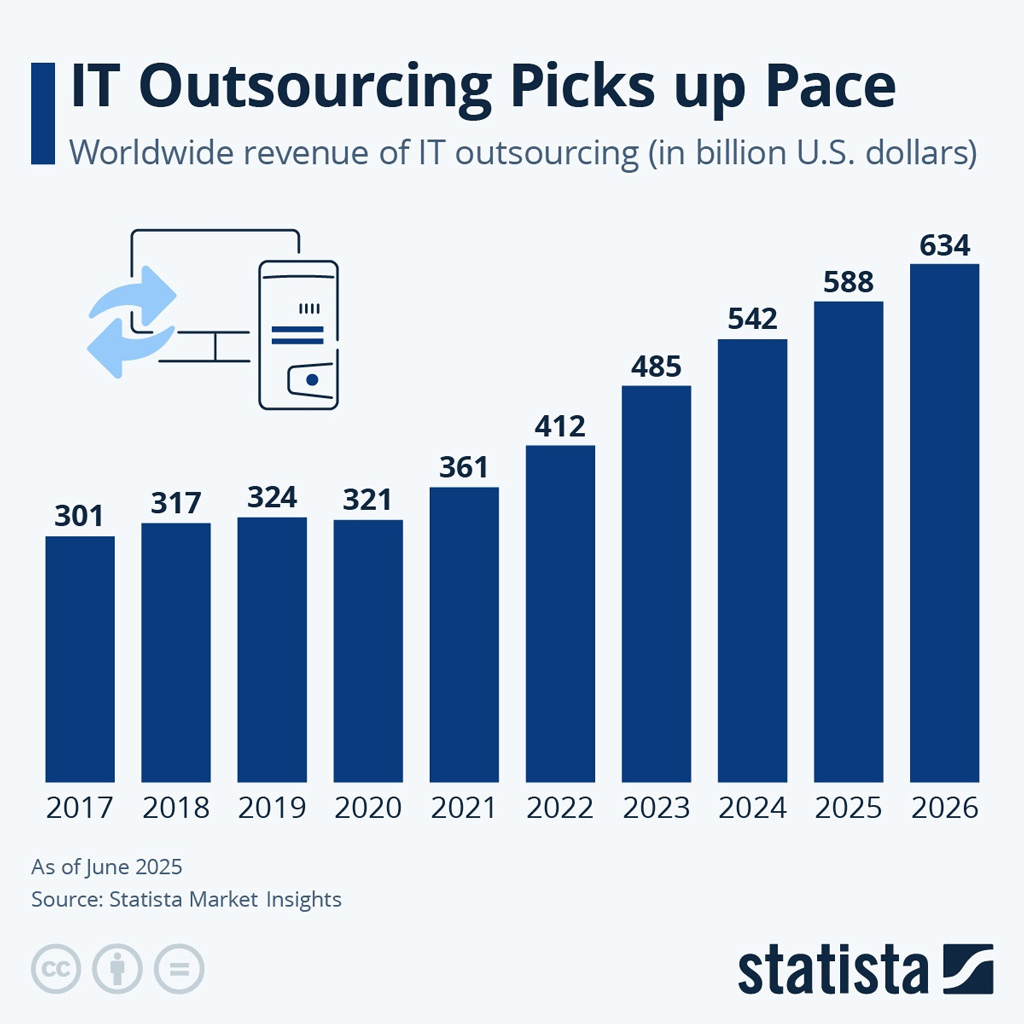
- The global IT outsourcing market revenue grew from $301 billion in 2017 to a projected $634 billion in 2026, more than doubling within nine years, highlighting strong global demand for outsourced IT services.
- After steady growth between 2017 ($301B) and 2019 ($324B), the market experienced a slight dip in 2020 to $321 billion, reflecting the short-term disruption caused by the COVID-19 pandemic.
- The market rebounded quickly in 2021, reaching $361 billion, signaling renewed enterprise investment in digital transformation, cloud migration, and remote infrastructure.
- Growth accelerated significantly between 2022 and 2024, with revenue rising from $412 billion to $542 billion, indicating increased outsourcing demand for software development, cybersecurity, and cloud services.
- The market is projected to continue expanding, reaching $588 billion in 2025 and $634 billion in 2026, driven by AI adoption, global talent shortages, and cost optimization strategies.
- Between 2023 ($485B) and 2026 ($634B) alone, the industry is expected to add nearly $149 billion in additional market value, demonstrating the growing reliance of enterprises on external IT service providers.
- Overall, the data shows a consistent upward trajectory since 2021, positioning IT outsourcing as one of the fastest-growing segments of the global technology services market.
Knowledge Process Outsourcing (KPO) Statistics
- The global Knowledge Process Outsourcing (KPO) market was valued at roughly $75 billion in 2024 and is expected to exceed $140 billion by 2030 as demand grows for analytics, legal services, and research outsourcing.
- KPO services are projected to grow at a compound annual growth rate (CAGR) of around 18% between 2024 and 2030, significantly faster than traditional BPO services.
- India accounts for more than 50% of the global KPO market, especially in data analytics, legal research, and financial analysis services.
- Around 42% of financial services firms outsource high-value research and analytics functions to external KPO providers.
- Healthcare and pharmaceutical companies increased KPO outsourcing spending by nearly 20% in 2024, mainly for clinical data analysis and research support.
- Over 35% of legal firms in the United States outsource document review and legal research tasks to specialized providers.
- Data analytics and market research account for roughly 30% of total KPO service demand globally.
- Nearly 48% of enterprises say outsourcing knowledge-intensive work improves innovation and decision-making speed.
- By 2026, more than 60% of large enterprises are expected to outsource advanced analytics tasks such as predictive modeling and data science support.
Customer Support and CX Outsourcing Statistics
- The global customer experience (CX) outsourcing market surpassed $95 billion in 2024 and continues to expand as companies prioritize customer satisfaction.
- Customer service represents about 35% of the global BPO industry, making it the largest outsourced business process.
- Approximately 80% of companies outsource some portion of their customer support operations.
- The Philippines handles nearly 15% of the world’s outsourced customer service operations, employing over 1.5 million workers in call center and CX roles.
- Businesses can reduce customer support costs by up to 30% through outsourcing compared with maintaining in-house call centers.
- Around 60% of outsourced CX interactions now involve digital channels, including live chat, email, and social media support.
- AI-assisted CX outsourcing solutions improved average response times by approximately 20% in 2024.
- Nearly 45% of companies outsource multilingual customer support to reach global markets more effectively.
- The Latin American CX outsourcing market grew by about 12% in 2024, driven by demand from U.S. companies seeking nearshore services.
Overall Outsourcing Adoption Rates
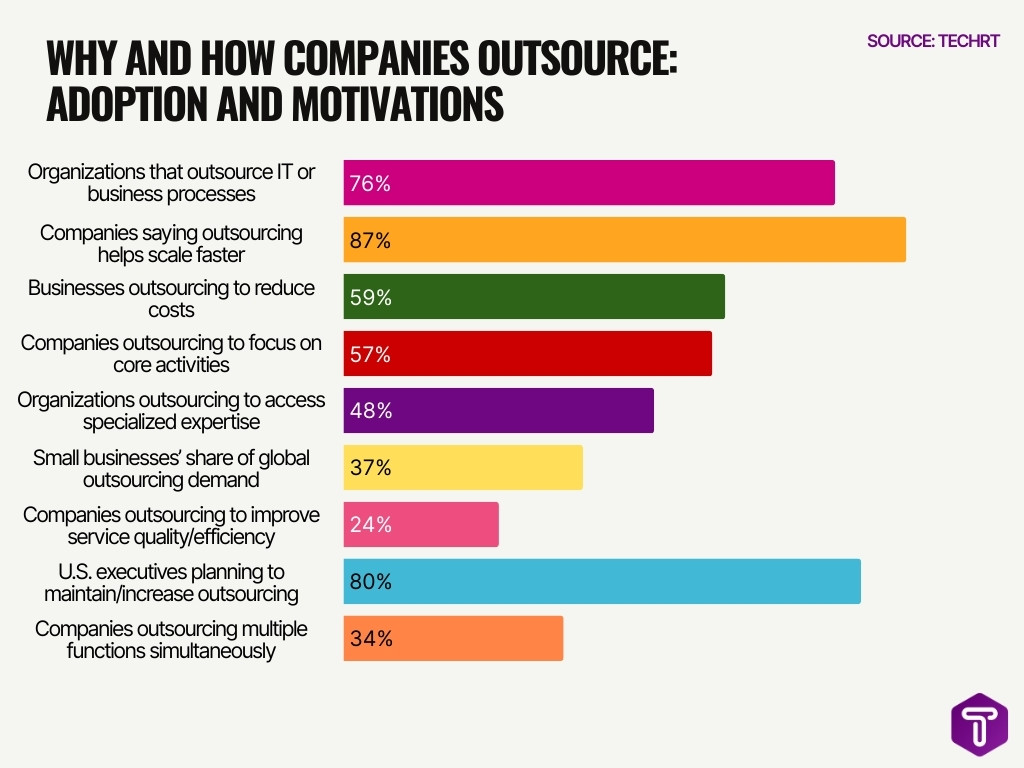
- About 76% of organizations outsource IT services or business processes to external providers.
- Nearly 87% of companies say outsourcing helps them scale operations faster compared with relying solely on internal teams.
- 59% of businesses outsource to reduce operational costs, making cost savings the leading motivation.
- Around 57% of companies outsource to focus on core business activities, freeing internal teams to handle strategic work.
- Approximately 48% of organizations outsource to access specialized expertise that is difficult to hire internally.
- Small businesses account for nearly 37% of outsourcing demand globally, especially in IT support and marketing.
- Around 24% of companies outsource to improve service quality and efficiency rather than solely for cost reduction.
- Over 80% of U.S. executives plan to maintain or increase outsourcing in the next three years as digital transformation accelerates.
- Nearly 34% of companies outsource multiple functions simultaneously, including IT, HR, and customer service.
Finance and Accounting Outsourcing Statistics
- The finance and accounting outsourcing (FAO) market reached approximately $60 billion in 2024 and continues to grow steadily.
- FAO services are projected to expand at a CAGR of around 9% through 2030.
- Accounts payable and accounts receivable services make up nearly 40% of outsourced finance operations globally.
- Around 57% of organizations outsource some finance processes, including payroll, bookkeeping, and tax preparation.
- Companies report cost savings of 20%–40% when outsourcing finance and accounting functions.
- Nearly 33% of mid-sized U.S. companies outsource payroll processing to external service providers.
- Automation and robotic process automation (RPA) are used in about 30% of finance outsourcing contracts signed in 2024.
- India and the Philippines together host more than 50% of global FAO delivery centers.
- By 2026, around 65% of enterprises are expected to outsource at least one financial reporting or compliance process.
HR and Recruitment Outsourcing Statistics
- The global HR outsourcing market exceeded $45 billion in 2024, covering payroll, recruitment, training, and employee management services.
- HR outsourcing services are forecast to grow at a CAGR of about 8% through 2030.
- Approximately 58% of organizations outsource at least one HR function, such as payroll or recruitment.
- Recruitment Process Outsourcing (RPO) accounts for nearly 30% of HR outsourcing services worldwide.
- Companies report cost reductions of around 25% in hiring expenses when using RPO providers.
- Nearly 40% of U.S. companies outsource payroll administration to specialized providers.
- HR outsourcing helped organizations reduce average hiring time by roughly 30% in 2024.
- Technology and healthcare industries are the largest adopters of recruitment outsourcing, accounting for nearly 45% of RPO contracts.
- By 2026, more than 50% of enterprises are expected to use external HR platforms for workforce management.
Data Center and Infrastructure Outsourcing Statistics
- The global data center outsourcing market was valued at about $140 billion in 2024, fueled by cloud adoption and digital transformation initiatives.
- Infrastructure outsourcing is projected to grow at a CAGR of around 7% through 2030.
- Nearly 70% of enterprises outsource at least part of their IT infrastructure, including servers, networking, and storage systems.
- Cloud infrastructure services represent over 60% of new infrastructure outsourcing contracts signed in 2024.
- Companies can reduce infrastructure operating costs by 20%–35% through outsourcing and cloud migration.
- The United States accounts for about 40% of global data center outsourcing demand.
- Hyperscale cloud providers expanded global data center capacity by more than 15% in 2024.
- Managed security services represent one of the fastest-growing infrastructure outsourcing segments, increasing around 13% annually.
- By 2026, over 75% of enterprise workloads are expected to run on outsourced cloud infrastructure.
Global Outsourcing Market Share by Region
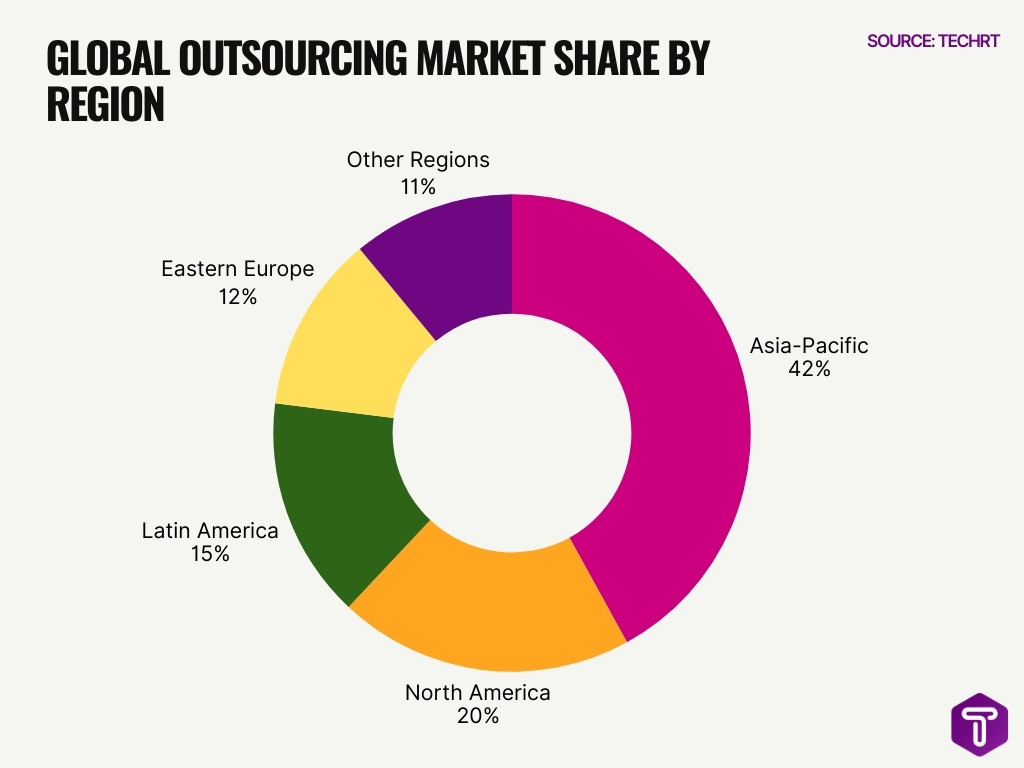
- Asia-Pacific dominates the global outsourcing market, accounting for 42% of the total market share, making it the largest outsourcing hub worldwide due to lower labor costs and a vast skilled workforce.
- North America holds the second-largest share at 20%, reflecting strong demand for outsourcing services from large enterprises, particularly in IT services, customer support, and business process outsourcing (BPO).
- Latin America represents 15% of the global outsourcing market, benefiting from nearshoring advantages, cultural compatibility with North American companies, and growing technology talent pools.
- Eastern Europe captures 12% of the outsourcing market, driven by highly skilled developers, strong STEM education systems, and competitive service costs for IT and software development outsourcing.
- Other regions collectively account for 11% of the market, including emerging outsourcing destinations in Africa, the Middle East, and Southeast Asia, which are gradually gaining traction due to expanding digital infrastructure and talent availability.
- Overall, the data highlights that Asia-Pacific alone holds more than double the market share of North America, underscoring the region’s dominance in global outsourcing operations and offshore service delivery.
Outsourcing by Company Size (SMBs vs Enterprises)
- Small and medium-sized businesses (SMBs) account for nearly 37% of global outsourcing demand, particularly for IT and marketing services.
- Around 52% of SMBs outsource at least one business process, compared with over 80% of large enterprises.
- SMBs typically outsource IT support, accounting, and digital marketing as their most common external services.
- Large enterprises spend more than $100 billion annually on outsourcing contracts, particularly in IT and infrastructure services.
- 74% of Fortune 500 companies outsource IT services to external vendors.
- SMBs report average cost savings of around 27% from outsourcing operational tasks.
- Approximately 46% of startups outsource software development during early product stages.
- Enterprises are three times more likely than SMBs to outsource multiple business functions simultaneously.
- Nearly 60% of SMBs plan to increase outsourcing budgets by 2026 as they adopt cloud and digital tools.
Key Insights from Outsourcing Statistics by Industry
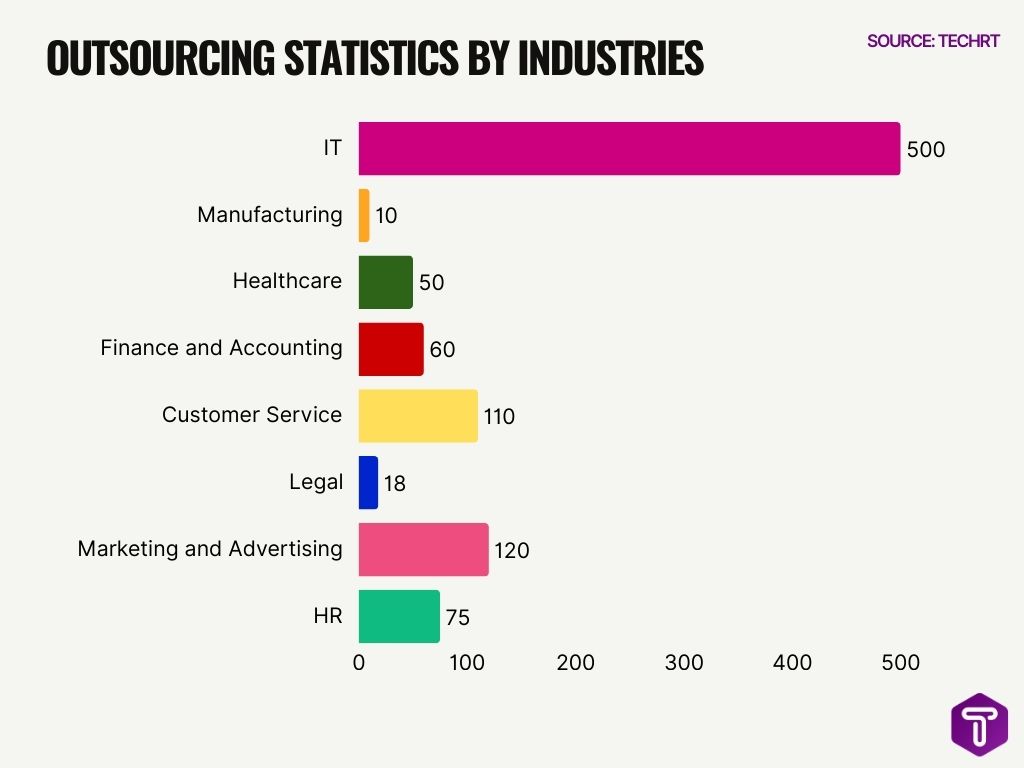
- The IT industry dominates outsourcing, with 500 outsourcing instances, making it the largest outsourcing sector among all industries analyzed.
- Marketing and advertising rank as the second-highest outsourcing sector, accounting for 120 cases, highlighting the growing reliance on external agencies for digital marketing, campaigns, and content services.
- Customer Service outsourcing is also significant, with 110 instances, showing that many companies prefer third-party providers to handle support operations and call centers.
- The HR sector records 75 outsourcing cases, indicating that organizations frequently outsource recruitment, payroll management, and HR administration.
- Finance and Accounting outsourcing stands at 60 cases, reflecting increasing demand for external bookkeeping, tax management, and financial reporting services.
- Healthcare outsourcing reaches 50 instances, demonstrating a moderate trend where organizations outsource medical billing, IT systems, and administrative processes.
- Legal outsourcing remains limited, with only 18 cases, as many companies prefer to keep sensitive legal work in-house.
- Manufacturing shows the lowest outsourcing activity, with just 10 instances, suggesting that most companies maintain direct control over production operations rather than outsourcing them.
Nearshoring vs Offshoring Statistics
- Around 45% of U.S. companies prefer nearshore outsourcing partners to reduce time-zone differences and improve collaboration.
- Nearshore outsourcing demand in North America grew by nearly 20% between 2023 and 2025.
- Mexico and Costa Rica have become key nearshoring destinations, hosting thousands of IT service and customer support centers.
- Companies report average productivity improvements of about 15% when working with nearshore teams compared with offshore teams in distant time zones.
- Despite nearshoring growth, over 70% of global outsourcing contracts still involve offshore delivery locations, primarily in Asia.
- India alone accounts for nearly 55% of offshore IT outsourcing services worldwide.
- Around 37% of enterprises use a hybrid outsourcing model, combining offshore cost advantages with nearshore collaboration.
- The average hourly rate for offshore software developers can be 50%–70% lower than U.S. developer rates.
- By 2026, nearshoring adoption is expected to increase by about 25% among North American enterprises.
Remote and Hybrid Workforce Outsourcing Statistics
- The global shift to remote work accelerated outsourcing adoption, with over 62% of companies using distributed outsourcing teams in 2024.
- Remote outsourcing platforms grew by nearly 30% between 2022 and 2024, enabling companies to hire global freelancers and contractors.
- Approximately 70% of outsourced software development teams operate in remote or hybrid models.
- Freelance and gig-based outsourcing contributed more than $450 billion to the global economy in 2024.
- Around 48% of companies expanded remote outsourcing after the COVID-19 pandemic to maintain flexible workforce structures.
- Businesses reported up to 25% productivity gains when managing distributed outsourcing teams using digital collaboration tools.
- Digital communication platforms such as Slack, Zoom, and Microsoft Teams are used by over 80% of remote outsourcing teams.
- Nearly 40% of outsourcing providers now offer fully remote service delivery models instead of traditional office-based outsourcing centers.
- By 2026, more than half of global outsourced IT teams are expected to operate in hybrid work environments.
Outsourcing Adoption Rates by Organization Size
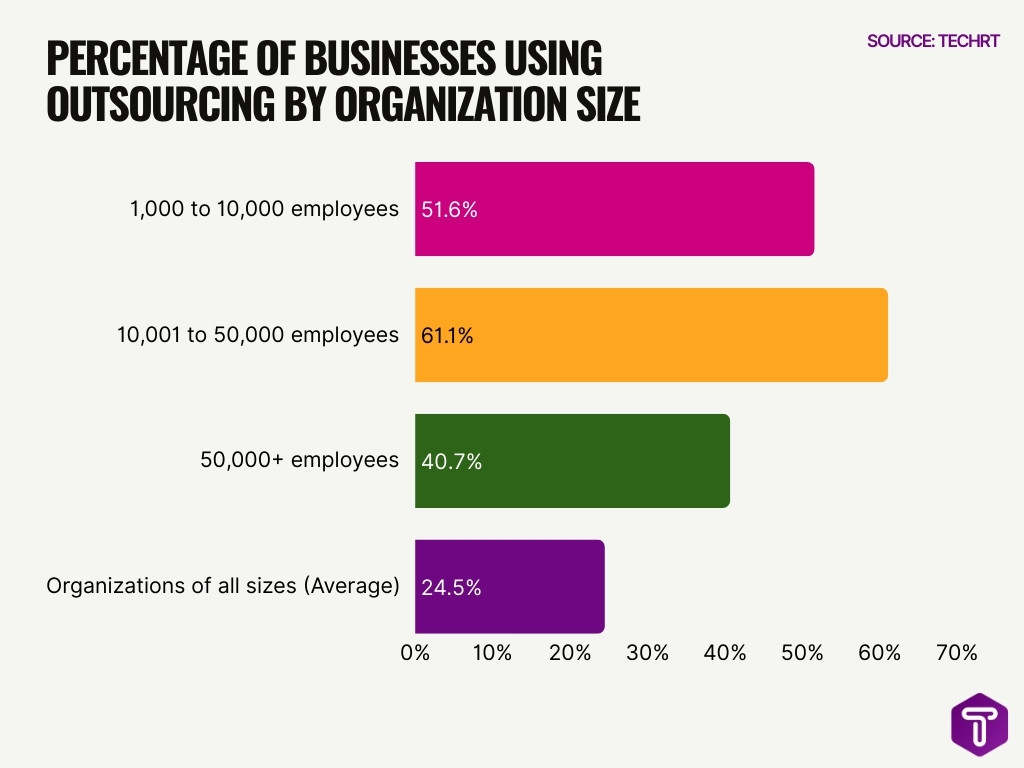
- Large enterprises with 10,001 to 50,000 employees show the highest outsourcing adoption rate at 61.1%, indicating that mid-to-very large organizations rely heavily on outsourcing to manage complex operations and scale efficiently.
- Companies with 1,000 to 10,000 employees also demonstrate strong outsourcing usage, with 51.6% of businesses leveraging external service providers to improve efficiency and reduce operational costs.
- Among the largest organizations with over 50,000 employees, about 40.7% use outsourcing, suggesting that while many large enterprises outsource, some maintain substantial in-house resources.
- Across organizations of all sizes, the average outsourcing adoption rate stands at 24.5%, showing that outsourcing is widely used but significantly more common among larger companies.
- Overall, the data highlights a clear trend: the likelihood of outsourcing increases with organizational size, as larger companies often require specialized expertise, scalability, and cost optimization through external partners.
Cost Savings and ROI from Outsourcing
- Companies report average operational cost savings of 15%–30% when outsourcing business functions.
- Approximately 59% of organizations outsource primarily to reduce costs, making it the top outsourcing motivation.
- Outsourcing IT infrastructure can reduce capital expenditures by up to 40% through shared cloud infrastructure.
- Businesses save around 20%–25% in operational expenses by outsourcing finance and accounting services.
- Nearly 57% of companies say outsourcing helps them focus on core competencies, improving productivity and profitability.
- Enterprises using outsourcing strategies report ROI improvements of about 30% over five years compared with companies relying solely on internal teams.
- Startups can reduce development costs by up to 50% by outsourcing engineering teams offshore.
- Customer support outsourcing can lower service costs by about 30% while maintaining service quality.
- Cloud outsourcing reduces infrastructure management costs by nearly 35% on average.
Top Reasons Businesses Choose Outsourcing
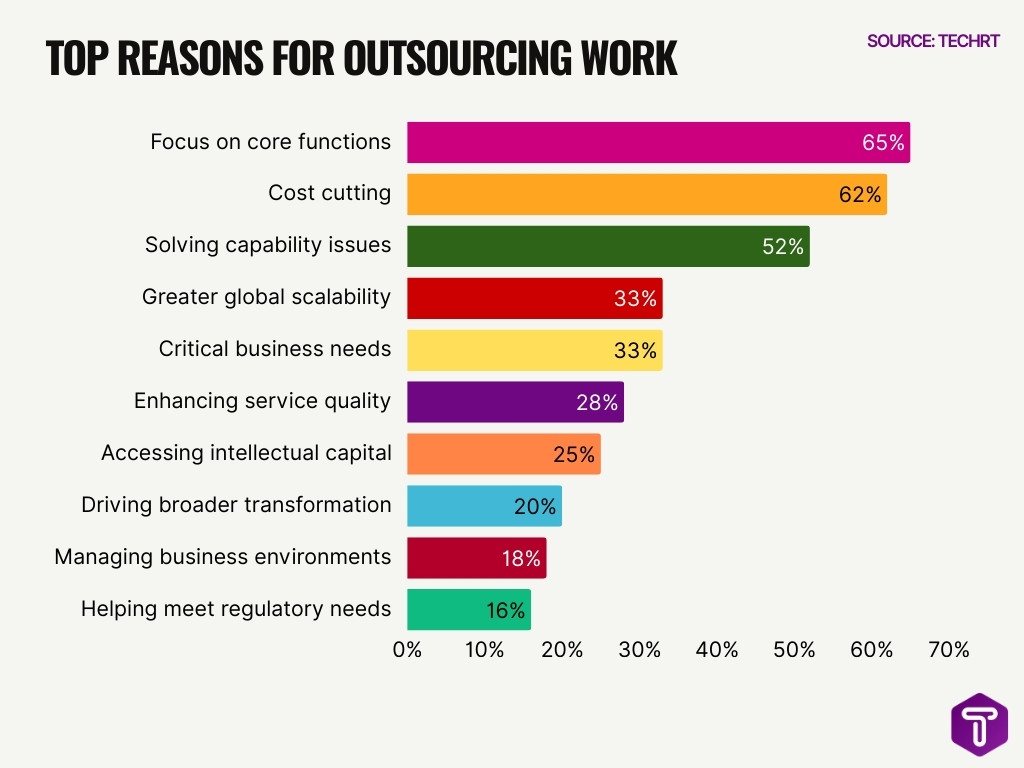
- The primary reason businesses outsource work is to focus on core functions, with 65% of companies outsourcing non-core activities so they can concentrate on strategic operations and growth.
- Cost reduction remains a major driver, as 62% of organizations outsource to cut operational expenses, reduce overhead, and optimize resource allocation.
- Around 52% of companies outsource to solve capability issues, allowing them to access specialized skills, advanced technologies, and expert talent that may not exist internally.
- Approximately 33% of businesses outsource to achieve greater global scalability, enabling them to expand operations quickly across markets without building large in-house teams.
- Another 33% of organizations outsource to address critical business needs, such as urgent projects, specialized services, or time-sensitive operations.
- About 28% of companies outsource to enhance service quality, leveraging experienced external providers and industry experts to deliver better outcomes.
- Nearly 25% of businesses outsource to access intellectual capital, gaining expert knowledge, innovation, and technical expertise from external partners.
- Around 20% of organizations use outsourcing to drive broader business transformation, including digital transformation, modernization, and process improvement initiatives.
- Approximately 18% of companies outsource to manage better complex business environments, such as global operations, compliance, and operational challenges.
- Finally, 16% of businesses outsource to meet regulatory requirements, ensuring compliance with industry regulations and legal standards through specialized providers.
AI, Automation, and RPA in Outsourcing
- Around 65% of outsourcing providers integrated AI tools into service delivery by 2024, primarily for analytics and workflow automation.
- The global RPA market surpassed $4.6–4.7 billion by 2025 and is projected to reach over $35 billion by 2033, reflecting rapid outsourcing-driven growth.
- Automation outsourcing is forecast to grow from about $7.15 billion in 2024 to nearly $86.41 billion by 2034 at a 28.3% CAGR.
- AI and automation are key in winning new outsourcing deals in 2024, with 83% of surveyed executives leveraging AI as part of outsourced services.
- AI-enabled outsourcing and automation solutions can cut operational or processing costs by up to 40%, especially in customer service and back-office work.
- Chatbots and conversational AI now handle a major share of outsourced CX, with 80% of businesses saying bots help manage complaints more easily.
- Over 80% of businesses have adopted AI in some form, increasingly embedding these tools into outsourced IT and business processes.
- Chatbots drive significant efficiency in outsourced support, saving an estimated 2.5 billion customer service hours annually for businesses.
- North America accounts for over 38.4% of the automation outsourcing market, generating about $2.74 billion in revenue in 2024.
Frequently Asked Questions (FAQs)
What is the size of the global outsourcing market?
The global outsourcing services market was estimated at $3.8 trillion in 2024 and is projected to reach around $7.11 trillion by 2030, growing at a 11.3% CAGR.
How large is the global IT outsourcing market?
The global IT services outsourcing market was valued at about $744.6 billion in 2024 and is expected to reach around $807.9 billion in 2025.
What percentage of executives plan to increase outsourcing investment?
About 80% of executives plan to maintain or increase their investment in outsourcing services in the coming years.
How big is the global business process outsourcing (BPO) market?
The global BPO market was valued at $328.37 billion in 2025 and is projected to grow to $695.77 billion by 2033, with a 9.9% CAGR.
What share of companies use outsourcing for IT services?
Around 57% of Global 2000 companies use outsourcing, and among them, 92% outsource IT services.
Conclusion
Outsourcing continues to evolve as a strategic tool for businesses seeking efficiency, specialized expertise, and operational flexibility. Companies across industries, from technology and finance to healthcare and retail, rely on outsourcing partners to manage complex tasks, reduce costs, and accelerate innovation. At the same time, trends such as AI-driven automation, nearshoring strategies, and remote workforce models are reshaping how organizations collaborate with external service providers. As digital transformation accelerates and beyond, outsourcing will remain a critical driver of global business growth, enabling companies to scale operations, access global talent pools, and stay competitive in rapidly changing markets.

Leave a comment
Have something to say about this article? Add your comment and start the discussion.