


Referral marketing continues to shape how brands acquire and retain customers. From eCommerce platforms using referral codes to SaaS companies driving growth through customer advocacy, this strategy delivers measurable results across industries. Businesses now rely on referrals not just for acquisition, but also for building trust, improving retention, and increasing lifetime value. As consumers grow more skeptical of traditional advertising and increasingly rely on peer recommendations, referral marketing has evolved into a core growth channel rather than a supporting tactic.
Whether it’s a fintech app encouraging user invites or a subscription service rewarding loyal customers, referrals influence real purchasing decisions every day. As trust in ads declines and peer influence rises, referrals now play a central role in conversion and retention strategies. Let’s explore the data behind this shift.
Editor’s Choice
- 92% of consumers trust recommendations from friends and family over advertising.
- Referral marketing drives 3–5x higher conversion rates than other channels.
- Referred customers are 4x more likely to purchase compared to non-referred users.
- Between 10% and 35% of new customers come from referrals.
- Referred customers show 16% higher lifetime value on average.
- Businesses report 25% lower acquisition costs through referral programs.
- Around 65% of new business opportunities come from referrals and recommendations.
Recent Developments
- 75% of B2B companies are expected to implement automated referral tracking systems by 2026.
- AI-powered referral programs boost conversion rates by up to 35%.
- 84% of B2B buying journeys now start with a referral.
- Companies adopting referral marketing saw an 86% increase in revenue year-over-year.
- 95% of US business leaders value referral-generated leads for their quality.
- Social media has become the top referral channel for 28% of US businesses.
- 31% of marketers say automated emails are critical to referral program success.
- Mobile-optimized referral programs see 56% higher engagement rates.
- 71% higher Net Promoter Scores (NPS) are reported by companies with structured referral programs.
Key Referral Marketing Statistics You Should Know
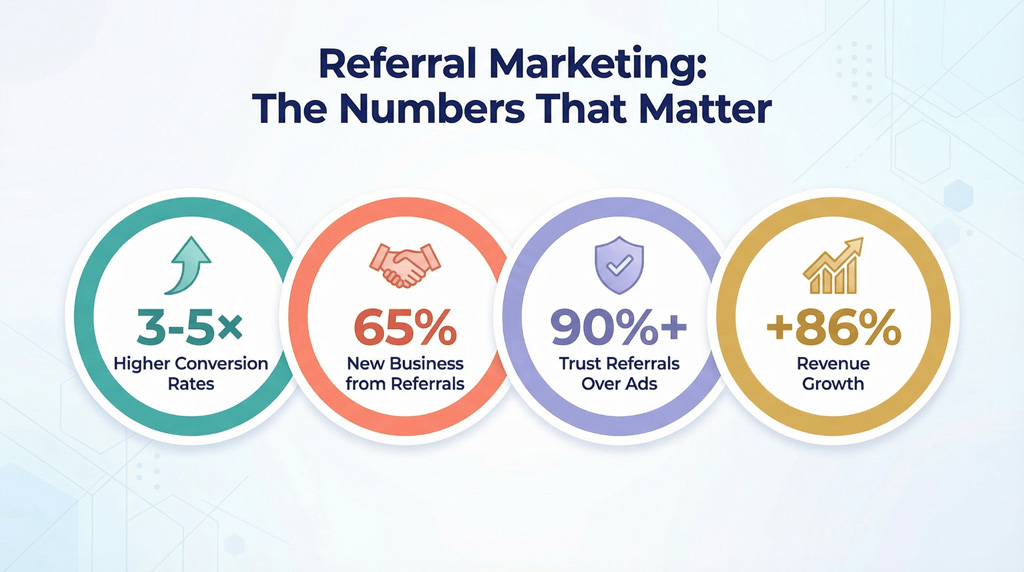
- Referral marketing delivers 3–5x higher conversion rates, making it one of the most effective customer acquisition channels compared to traditional marketing.
- Around 65% of new business comes directly from referrals, highlighting the power of word-of-mouth in driving consistent growth.
- More than 90% of consumers trust referrals over ads, proving that social proof and personal recommendations significantly influence purchase decisions.
- Businesses leveraging referral programs can experience up to +86% revenue growth, demonstrating its strong impact on profitability and scalability.
- The data clearly indicates that referral marketing is not just a tactic but a high-ROI growth strategy that builds both trust and long-term customer value.
Global and Regional Referral Trends
- Referral marketing influences 20% to 50% of purchasing decisions globally.
- 60% of small businesses report that referrals generate a majority of their customers.
- 32% of US business leaders say trust is the top driver of referrals.
- The global average referral rate stands at 2.35% across industries.
- 84% of consumers worldwide trust recommendations from friends over any other source.
- 28% of US companies identify social sharing as the most effective referral channel.
- Referral‑driven revenue is a top KPI for 65% of business leaders.
- Companies in financial services acquire up to 71% of customers via referrals.
- 52% of small businesses state that referrals are their top source of new business.
- 82% of small businesses claim that referrals are their primary source of new customers.
Social Media and Referral Behavior
- 78% of consumers share brand experiences on social media.
- Social sharing drives 31% of referral traffic globally.
- Facebook and Instagram account for over 60% of referral shares.
- Social media referrals convert at 2x higher rates than display ads.
- 71% of consumers are more likely to share referral links via messaging apps.
- Influencer‑driven referrals increase engagement by 40%.
- User‑generated content boosts referral conversions by 29%.
- 54% of Gen Z discover brands through social referrals.
- 88% of Millennials trust recommendations from friends and family.
- 84% of B2B buying processes begin with a referral.
How Consumers Discover New Brands vs Marketer Perception
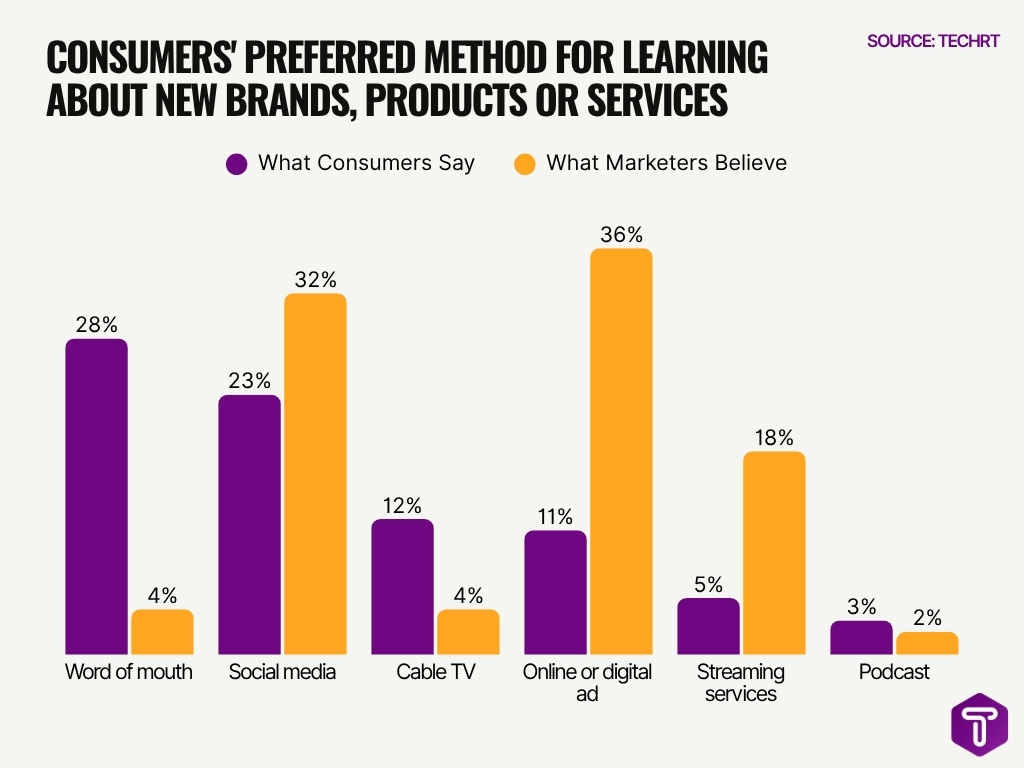
- Word of mouth dominates consumer preference (28%), yet marketers significantly undervalue it at just 4%, indicating a major trust gap in marketing strategy.
- Social media is the second most effective channel for consumers (23%), while marketers overestimate its impact at 32%, showing a misalignment in channel prioritization.
- Online or digital ads are heavily favored by marketers (36%), but only 11% of consumers prefer them, highlighting a clear overinvestment in paid advertising.
- Cable TV still holds moderate consumer influence (12%), but marketers rate it much lower at 4%, suggesting traditional media may be undervalued.
- Streaming services are overestimated by marketers (18%), compared to just 5% consumer preference, indicating inefficient allocation toward OTT platforms.
- Podcasts remain a niche discovery channel, with only 3% of consumers and 2% of marketers considering them impactful.
- Overall, there is a significant disconnect between consumer behavior and marketer assumptions, especially in high-trust channels like word of mouth versus paid digital channels.
- The data suggests brands should rebalance their marketing mix, prioritizing organic, trust-driven channels over overvalued digital ads.
Referral Marketing Conversion Rates
- Referral leads convert 30% better than leads from other channels.
- Referral campaigns deliver 3–5x higher conversion rates than traditional channels.
- Average referral conversion rates range between 3% and 5% in 2025.
- Referred leads in B2B convert at around 11% on average.
- Referral traffic converts at 2.9% across industries, outperforming social media.
- Referral marketing delivers 30% higher conversion rates than any other acquisition channel.
- Millennials show referral conversion rates of 45%, among the highest by generation.
- Gen X users convert at 46% via referrals, outperforming most demographics.
Customer Lifetime Value and Profitability
- Referred customers deliver 16% higher lifetime value (LTV) compared to non-referred customers.
- Customers acquired through referrals have a 25% higher profit margin on average.
- Referred customers spend 13% more per order than non-referred customers.
- Businesses report 18% lower churn rates among referred customers.
- Referral-driven customers generate 30% more long-term revenue.
- Repeat purchase rates are 37% higher among referred users.
- Referred users are 4x more likely to refer others, compounding lifetime value.
- SaaS companies report 20% faster payback periods for referral-acquired customers.
- Referral programs increase customer profitability by 25% to 50% over time.
Most Popular Referral Methods
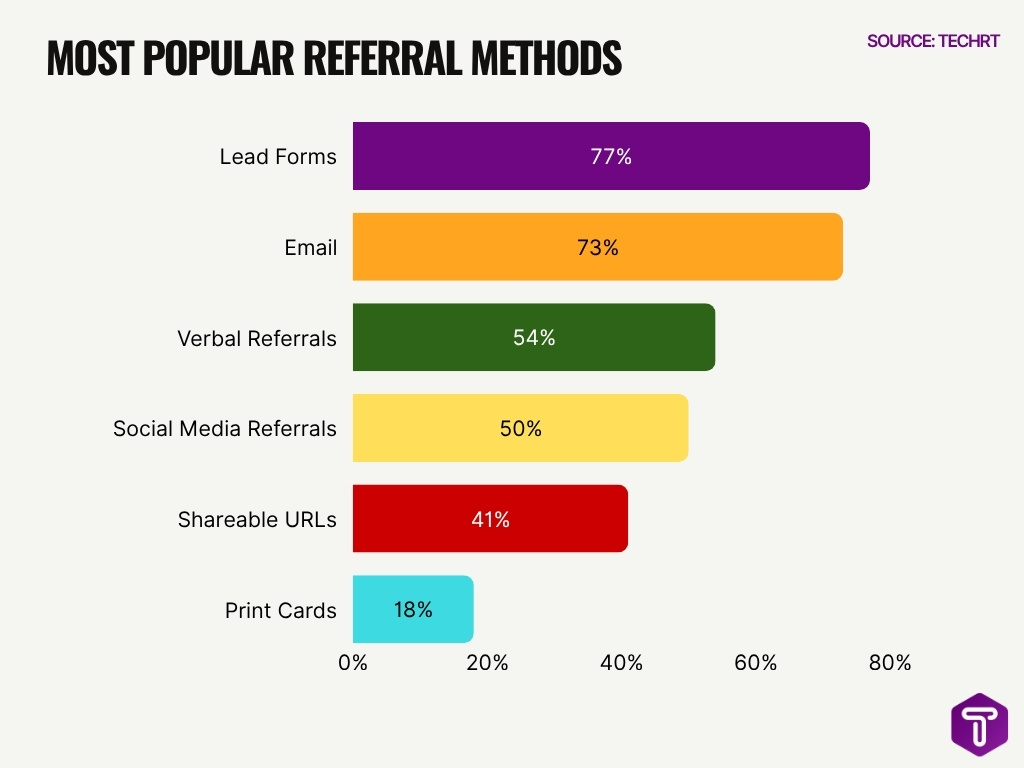
- Lead forms dominate referral strategies, with 77% of marketers identifying them as the top referral method for both B2B and B2C businesses.
- Email referrals remain highly effective, with 73% of marketers relying on email as a core referral channel.
- Verbal referrals still hold a strong influence, accounting for 54%, highlighting the continued importance of word-of-mouth marketing.
- Social media referrals contribute significantly, with 50% adoption, showing how platforms drive digital word-of-mouth and sharing behavior.
- Shareable URLs are moderately used, at 41%, indicating their role in trackable and scalable referral campaigns.
- Print cards are the least utilized method, with only 18% usage, reflecting a shift toward digital-first referral strategies.
- Overall, the data indicate a clear preference for digital referral channels, with lead forms and email leading the ecosystem, while traditional methods lag.
Retention and Loyalty of Referred Customers
- Referred customers are 37% more likely to stay loyal to brands.
- Retention rates for referred customers are 16% higher than those for other acquisition channels.
- Referral customers show 18% higher brand loyalty scores.
- 65% of referred customers become repeat buyers within the first year.
- Subscription businesses see 25% longer retention cycles from referrals.
- Referral-based customers are 2x more likely to advocate for brands.
- Loyalty program participation increases by 22% when tied to referrals.
- Customers referred by friends are 50% more likely to trust brand messaging.
Consumer Participation in Referral Programs
- 83% of satisfied customers are willing to refer, but only 29% actually do.
- Referral participation increases by 68% when incentives are offered.
- Email-based referral invitations generate 3x higher participation rates than social-only campaigns.
- 55% of consumers share referrals via mobile devices.
- Referral programs with clear rewards see 2–3x higher engagement rates.
- 42% of customers join referral programs after their first purchase.
- Millennials are 2.5x more likely to participate in referral programs than older demographics.
- Gamified referral programs increase participation by 47%.
Cost-Effectiveness of Referral Marketing
- Referral marketing reduces customer acquisition costs by 25% to 40%.
- Companies report 60% lower cost-per-lead through referrals.
- Referral programs deliver 5x higher ROI compared to paid advertising.
- Paid ads cost 3x more per acquisition than referral-driven customers.
- Businesses save up to $1,000 per acquired customer using referrals.
- Referral channels require minimal ongoing ad spend, improving margins.
- Small businesses rely on referrals for over 60% of low-cost customer acquisition.
- Referral marketing reduces marketing spend inefficiencies by 30%.
Trust in Referral Marketing Across Generations
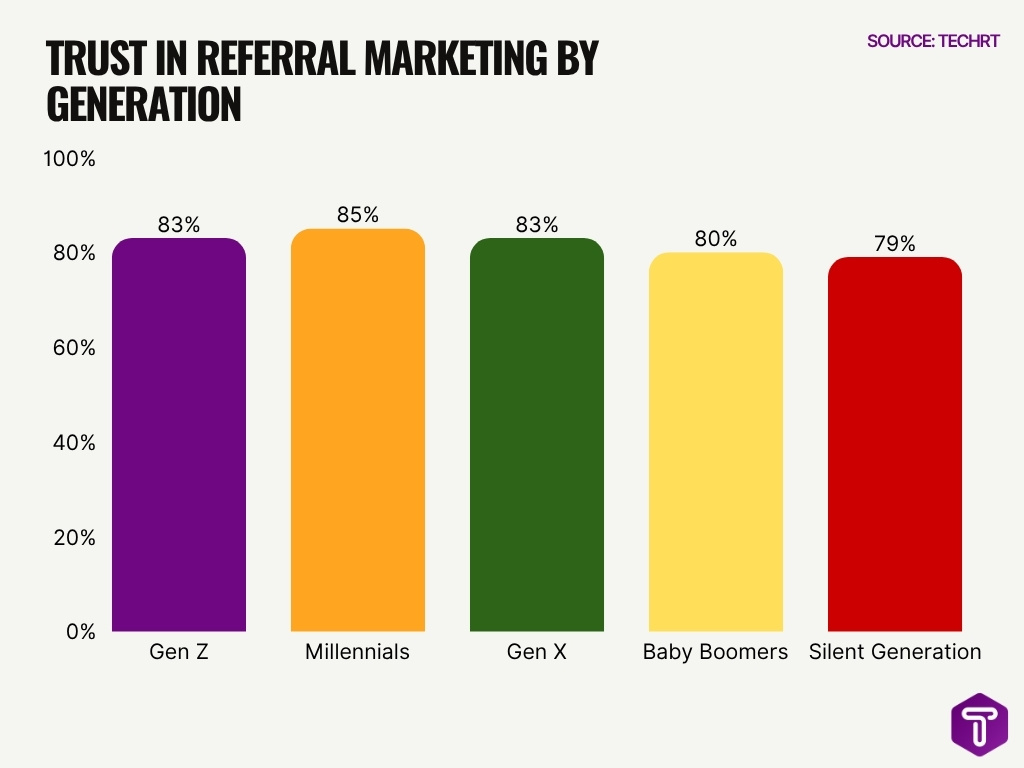
- Millennials lead in trust levels, with 85% relying on referral marketing, the highest among all generations.
- Both Gen Z (83%) and Gen X (83%) show equally strong trust, indicating consistent confidence among younger and middle-aged audiences.
- Baby Boomers report a slightly lower trust level at 80%, but still demonstrate high overall confidence in referrals.
- The Silent Generation has the lowest trust at 79%, though the difference is minimal compared to other groups.
- Overall, trust in referral marketing remains consistently high across all age groups, ranging narrowly between 79% and 85%.
- The data highlights that word-of-mouth and referrals are universally trusted, regardless of generational differences.
ROI and Performance of Referral Programs
- Referral programs generate an ROI of up to 300% or more.
- Businesses see 86% revenue growth after implementing referral strategies.
- Referral leads convert 30% better, increasing campaign ROI.
- Referral programs contribute to 20–30% of total revenue for mature brands.
- Brands using referral marketing report 2x faster growth rates.
- 65% of marketers say referral programs deliver the highest ROI among channels.
- Referral campaigns achieve 4x higher click-through rates (CTR) than email campaigns.
- Referral-based campaigns reduce cost per conversion by 33%.
Mobile and App-Based Referrals
- 65% of referral traffic now comes from mobile devices.
- Mobile referral programs show 56% higher engagement rates.
- App-based referral programs drive 3x higher participation rates.
- Mobile users are 2x more likely to complete referral actions instantly.
- Push notifications increase referral participation by 48%.
- 70% of Gen Z users prefer mobile referral sharing over desktop.
- In-app referral prompts increase conversion rates by 35%.
- Mobile referral links see 2.5x higher click-through rates than desktop links.
B2B Vendors Prefer Referral-Driven Marketing
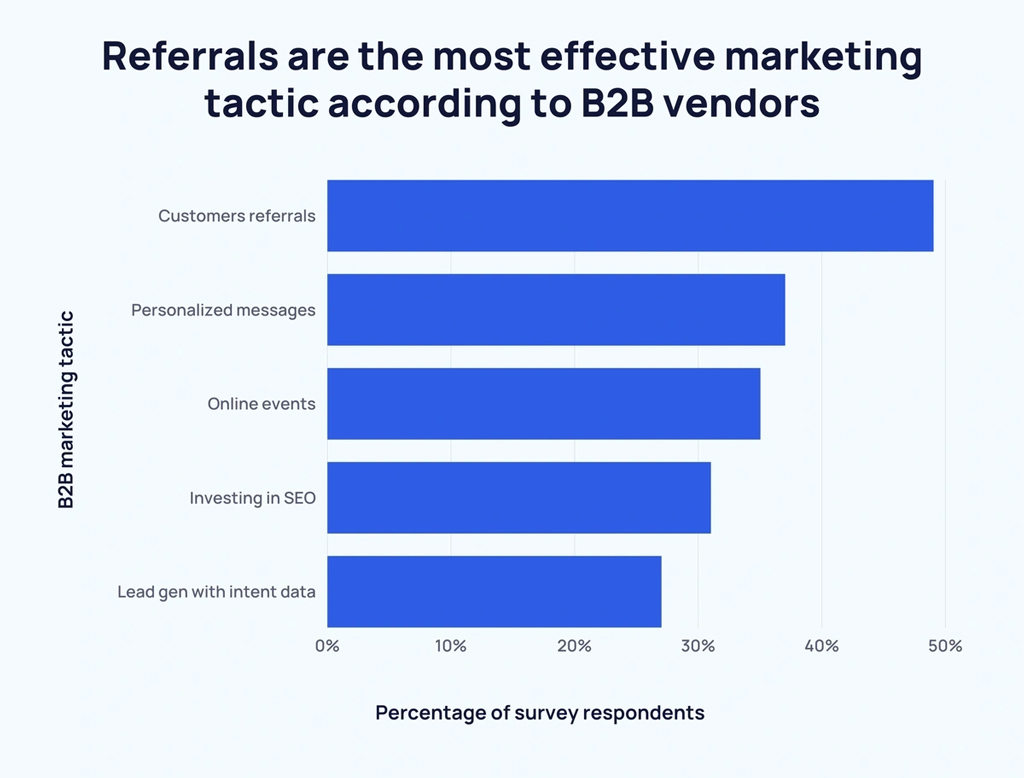
- Customer referrals dominate as the most effective tactic, with 49% of B2B vendors ranking it at the top, highlighting the strong impact of trust-based marketing.
- Personalized messaging (37%) ranks second, showing that tailored communication continues to be a powerful engagement driver in B2B strategies.
- Online events (35%) remain highly effective, indicating that webinars, virtual conferences, and live sessions are key channels for lead nurturing.
- Investing in SEO (31%) still delivers solid results, reinforcing the importance of organic visibility and long-term content strategies.
- Lead generation with intent data (27%), while lowest on the list, still plays a significant role by helping businesses target high-intent prospects more precisely.
- Overall, the data clearly shows a shift toward relationship-driven and personalized marketing approaches, with referrals significantly outperforming traditional digital tactics.
Industry-Specific Referral Performance
- Financial services firms acquire up to 71% of clients via referrals.
- eCommerce brands see referral conversion rates of 4% to 6%, higher than average.
- SaaS companies report 20–30% of new signups from referral programs.
- Healthcare providers gain 30% of new patients through referrals.
- Hospitality businesses report 40% of bookings influenced by referrals.
- Education platforms see 25% higher enrollment rates through referrals.
- Retail brands experience 2x higher purchase rates via referral traffic.
- Subscription-based services generate up to 50% of growth from referrals.
Reward Types and Incentive Preferences
- 74% of consumers say incentives increase their likelihood to refer.
- Cash rewards drive 2x higher participation rates than non-monetary rewards.
- Discount-based incentives increase referral conversions by 32%.
- 57% of consumers prefer cash or gift cards over other rewards.
- Dual-sided incentives, boosting both referrer and referee, boost conversions by 22%.
- Tiered rewards increase engagement by 35%.
- Experiential rewards improve referral quality by 18%.
- 43% of Gen Z users prefer digital wallet rewards for referrals.
What Drives Customers to Make Referrals
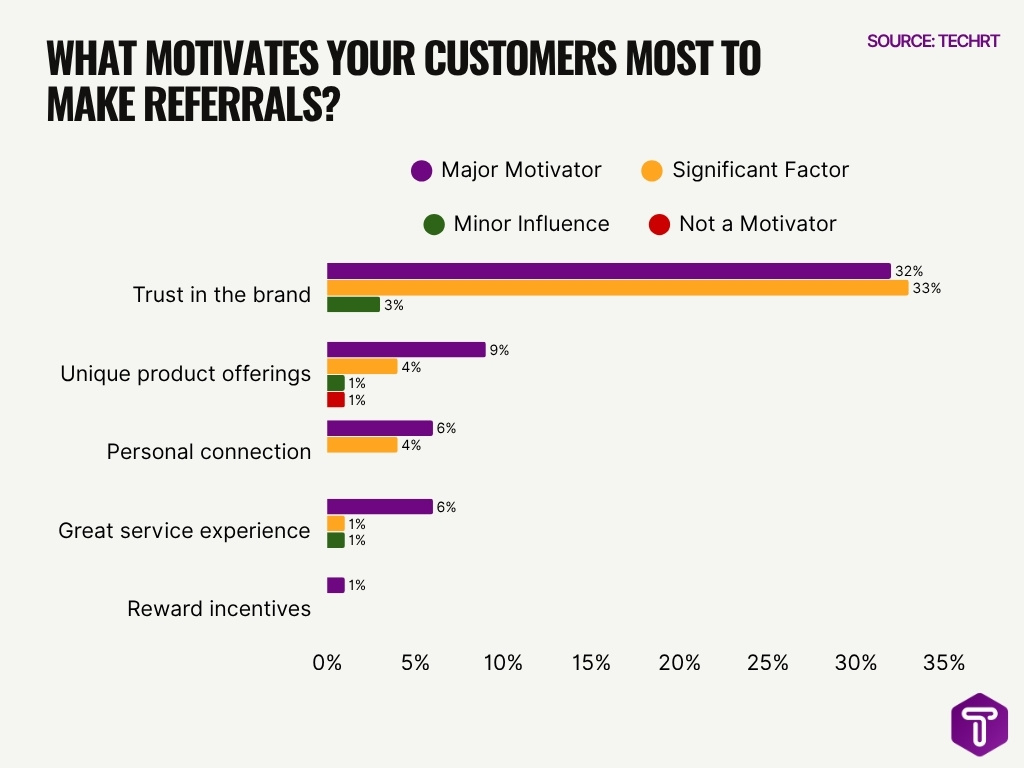
- Trust in the brand dominates referrals, with a combined 65% influence (32% major motivator + 33% significant factor), making it the strongest driver by a wide margin.
- Unique product offerings play a secondary role, contributing around 13% total impact, including 9% as a major motivator, showing that differentiation still matters but is far less powerful than trust.
- Personal connection influences a smaller segment, with only 6% citing it as a major motivator and 4% as a significant factor, indicating emotional relationships have a limited but notable impact.
- A great service experience contributes modestly, with 6% major motivation and minimal additional influence, suggesting that good service alone is not enough to drive referrals.
- Reward incentives have almost no impact, with just 1% identifying them as a major motivator, highlighting that financial or promotional rewards are not key drivers of referral behavior.
- Minor influence and “not a motivator” categories remain negligible across all factors, reinforcing that referrals are primarily driven by strong positive experiences rather than weak or neutral factors.
- Overall, the data clearly indicates that trust and credibility outweigh transactional incentives, emphasizing the importance of brand reputation over rewards-based referral strategies.
Program Design and Gamification Effects
- Gamified referral programs increase engagement by 47%.
- Leaderboards and progress tracking boost participation by 29%.
- Referral programs with clear UX design see 2–3x higher completion rates.
- Gamification elements increase referral frequency by 34%.
- Programs with social sharing integrations see 26% higher engagement.
- Personalized referral experiences improve conversions by 31%.
- Multi-step referral challenges increase participation by 40%.
- 58% of users engage more with interactive referral dashboards.
Program Optimization and Automation
- Automated referral systems improve efficiency by 30% through streamlined tracking and reduced manual processes.
- AI-powered referral programs increase conversions by 35% compared to traditional methods.
- Businesses using automation achieve 2x faster campaign scaling with real-time tracking systems.
- Email automation drives 31% of referral program success via targeted campaigns.
- Predictive analytics boosts referral ROI by 28% using data-driven optimizations.
- CRM-integrated programs enhance lead tracking accuracy by 30% with seamless workflows.
- Automated reminders increase referral completion rates by 36%.
- 75% of B2B companies will adopt automated referral tracking by 2026.
- Dual-sided rewards in automated programs lift participation by 45%.
Consumer Trust Trends: Friends vs Brands
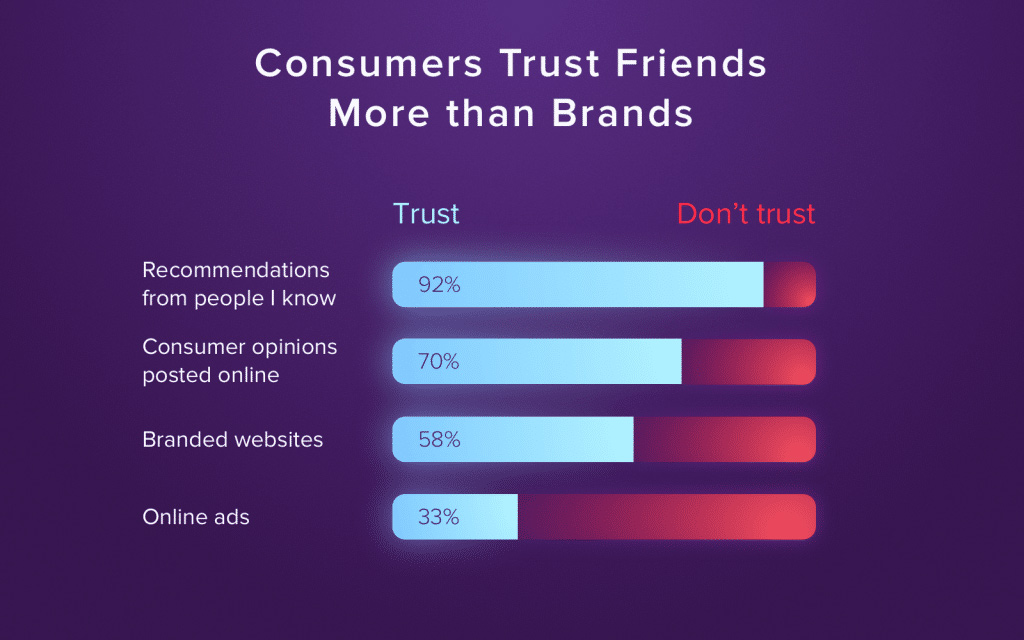
- Recommendations from people I know are the most trusted source, with a massive 92% trust rate, showing the strong influence of word-of-mouth marketing.
- Only 8% of consumers don’t trust personal recommendations, highlighting how peer influence dominates buying decisions.
- Consumer opinions posted online also perform well, earning 70% trust, making reviews and testimonials a key conversion driver.
- However, 30% still distrust online opinions, indicating concerns around fake reviews or biased feedback.
- Branded websites receive moderate trust at 58%, showing that while official sources matter, they are less trusted than peer-generated content.
- A notable 42% of users don’t trust branded websites, suggesting skepticism toward self-promotional content.
- Online ads are the least trusted, with only 33% trust, reinforcing the declining effectiveness of traditional digital advertising.
- A significant 67% of consumers don’t trust online ads, emphasizing the need for brands to shift toward authentic and referral-based marketing strategies.
- Overall, the data clearly shows that trust decreases as content becomes more brand-controlled, while peer-driven channels dominate consumer confidence.
Future Trends in Referral Marketing
- Referral marketing is expected to grow at a compound annual rate of 11%+ through 2030.
- 80% of brands plan to expand referral programs by 2026.
- AI personalization will drive 40% of referral program innovations.
- Blockchain-based referral tracking is emerging in 15% of fintech platforms.
- Social commerce referrals are projected to account for 25% of referral traffic by 2027.
- Voice-based referrals via smart assistants are expected to grow by 20% annually.
- 70% of Gen Z consumers will rely primarily on peer recommendations by 2026.
- Brands integrating referral programs with loyalty ecosystems see 35% higher retention rates.
Frequently Asked Questions (FAQs)
What percentage of consumers trust referral recommendations over ads?
Around 86% to 92% of consumers trust recommendations from friends and family over traditional advertising.
How much higher are referral marketing conversion rates compared to other channels?
Referral marketing delivers 3 to 5 times higher conversion rates than other acquisition channels.
What share of new business comes from referrals?
Approximately 65% of new business opportunities come from referrals and recommendations.
How much more do referred customers spend compared to non-referred customers?
Referred customers spend about 16% more on average than non-referred customers.
What is the projected CAGR of the referral marketing software market?
The referral marketing software market is expected to grow at a 13.3% CAGR from 2025 to 2035.
Conclusion
Referral marketing continues to deliver measurable growth across both B2C and B2B sectors. It reduces acquisition costs, improves conversion rates, and builds long-term customer value through trust-driven engagement. More importantly, it creates a self-sustaining growth loop where satisfied customers bring in new users, who in turn become advocates themselves. As automation, AI, and mobile-first behaviors reshape how referral programs operate, businesses can now scale these efforts with greater precision and efficiency.
At the same time, evolving consumer expectations mean that brands must design referral experiences that feel seamless, rewarding, and personalized. The statistics in this report highlight a clear trend: referrals are no longer optional but essential for scalable and sustainable growth. Organizations that invest in structured, data-driven referral strategies will be better positioned to compete in an increasingly trust-driven digital economy.

Leave a comment
Have something to say about this article? Add your comment and start the discussion.