



Retargeting has become a core strategy in modern digital marketing, helping brands reconnect with users who didn’t convert on their first visit. Whether it’s an e-commerce brand recovering abandoned carts or a SaaS company re-engaging trial users, retargeting plays a direct role in driving measurable revenue. It allows marketers to focus on high-intent audiences instead of starting from scratch with every campaign, which makes it both cost-efficient and performance-driven.
As digital advertising costs continue to rise and privacy regulations reshape how data is collected, retargeting offers a practical way to maximize existing traffic and improve campaign outcomes. From personalized product ads to cross-channel engagement strategies, businesses now rely on retargeting to guide users through the buying journey with precision. Let’s explore the latest data and uncover what makes retargeting one of the most effective performance marketing tactics today.
Editor’s Choice
- 77% of marketers actively run retargeting campaigns to recover lost leads.
- Retargeted users are 70% more likely to convert than first-time visitors.
- Retargeting ads can boost conversion rates by up to 150%.
- Users are 3x more likely to click on retargeted ads compared to cold audiences.
- Retargeting campaigns typically achieve a CTR of 0.7%–1.2%, significantly higher than standard display ads.
- Retargeting ads are 10x more effective than traditional display ads in driving engagement.
- Around 92% of marketers believe retargeting outperforms other advertising strategies.
Recent Developments
- CTR across Google Ads industries increased by 2% to 16% in 2025, signaling better targeting and creative optimization.
- Retargeting conversion rates improved by 28% when paired with awareness campaigns.
- AI-driven dynamic remarketing now boosts ROAS by 50%–150%.
- Retargeting CPC is now 45% lower than standard PPC campaigns, improving cost efficiency.
- Privacy changes have increased reliance on first-party data targeting, with over 50% of companies reviewing tools monthly.
- Mobile retargeting adoption reached 47% of enterprises, reflecting mobile-first strategies.
- Dynamic product ads now deliver 2–5x higher ROAS due to personalization.
- Conversion rates in Google Ads rose 6.84% year-over-year in 2025, supporting stronger retargeting performance.
Key Retargeting Statistics Overview
- 92% of first-time website visitors do not convert without retargeting.
- Retargeting brings back 26% of users who previously visited a site.
- Retargeted users view 3x more pages per session than non-retargeted users.
- Retargeting increases marketing efficiency by over 1,000% compared to standard tactics.
- 80% of e-commerce brands run retargeting campaigns weekly.
- Retargeting reduces cost per acquisition by up to 42%.
- Over 80% of retargeting spend goes to Google and Facebook platforms.
- Customer retention is a primary goal for 55% of marketers using retargeting.
Retargeting Ad Performance by Platform
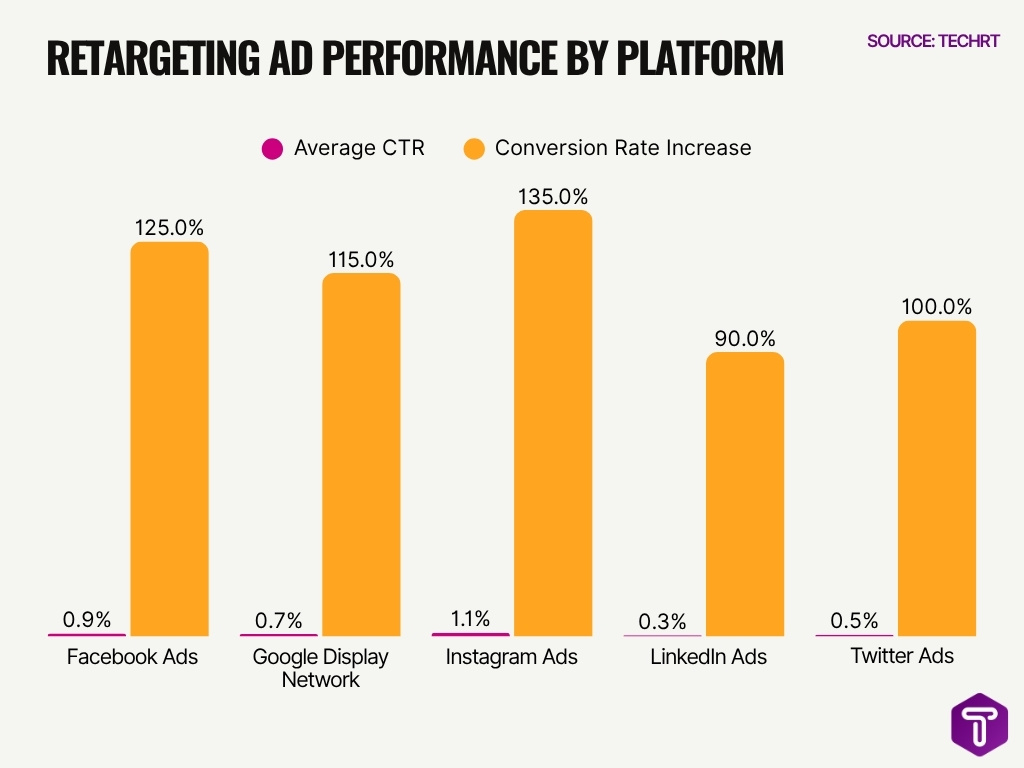
- Instagram leads in performance with the highest CTR of 1.1% and a strong 135% conversion rate increase, making it the most effective retargeting platform overall.
- Facebook delivers solid results with a 0.9% CTR and 125% boost in conversions, highlighting its strength in audience-based retargeting.
- Google Display Network shows balanced performance, achieving a 0.7% CTR and 115% conversion lift, making it reliable for broad reach campaigns.
- Twitter provides moderate engagement, with a 0.5% CTR and 100% conversion increase, indicating steady but less aggressive retargeting impact.
- LinkedIn has the lowest engagement, with just 0.3% CTR and a 90% conversion increase, suggesting it is less effective for retargeting despite its B2B targeting capabilities.
- Social platforms outperform professional networks, as Instagram and Facebook significantly exceed LinkedIn in both CTR and conversion gains.
- Even the lowest-performing platform (LinkedIn) still delivers a 90% increase in conversions, proving that retargeting consistently improves outcomes across all platforms.
Retargeting Effectiveness and Performance Statistics
- Retargeting increases conversion likelihood by 70% or more.
- Retargeted users are 70% more likely to complete purchases.
- Retargeting improves overall campaign conversion rates by 50% in many industries.
- Retargeting campaigns deliver an average ROAS of 4x or higher.
- Retargeting ads outperform standard display ads by 10x in effectiveness.
- Users exposed to retargeting ads show 20%–40% higher purchase intent on platforms like YouTube.
- Retargeting campaigns increase return visits by 28%–45% when combined with urgency messaging.
- Businesses report improved engagement metrics with longer session duration and higher interaction rates for retargeted audiences.
Retargeting Click-Through Rate (CTR) Statistics
- Average retargeting CTR ranges between 0.7% and 1.2%.
- Retargeting CTR is nearly 10x higher than standard display ads.
- Google Display retargeting campaigns achieve CTRs of 0.7%–1.2%.
- Standard display ads often average just 0.05%–0.1% CTR, highlighting the retargeting advantage.
- Social retargeting campaigns typically reach 0.8%–1.4% CTR.
- Native and interactive retargeting ads can deliver 2–3x higher CTR than banner formats.
- CTR improvements across industries grew by up to 16.3% year-over-year in 2025.
- Personalized retargeting creatives increase CTR by 10%–20% compared to static ads.
Retargeting Conversion Rate Statistics
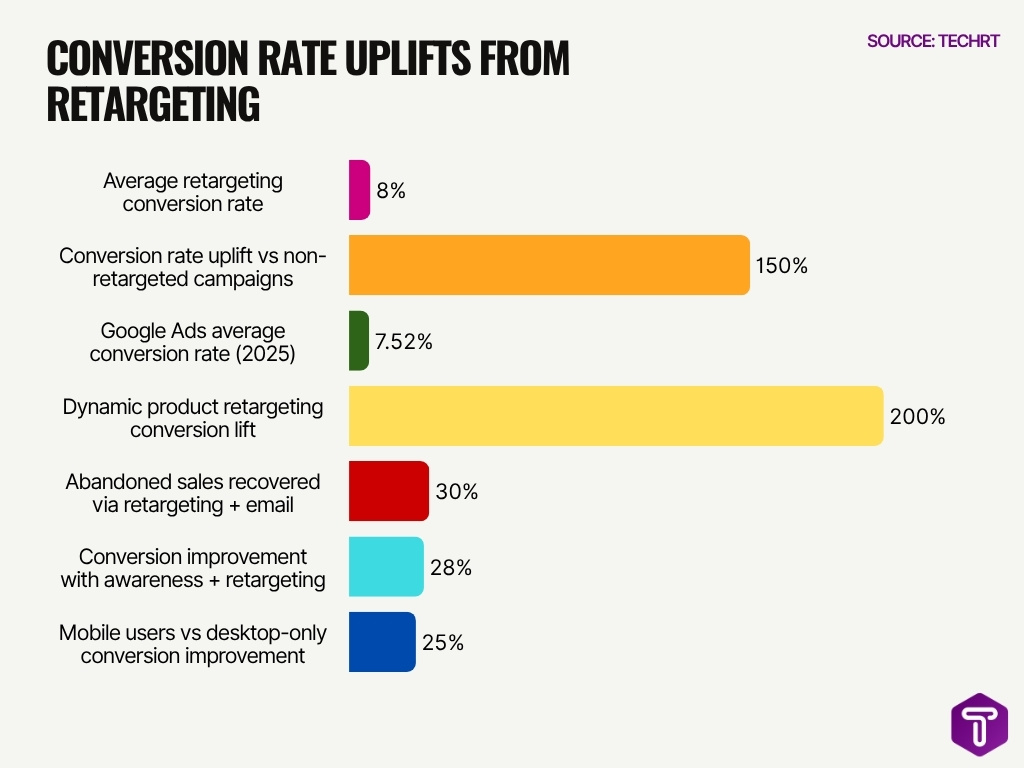
- Retargeting campaigns achieve average conversion rates of 7%–8%.
- Retargeting increases conversion rates by up to 150% compared to non-retargeted campaigns.
- Google Ads’ average conversion rate reached 7.52% in 2025, aligning with retargeting benchmarks.
- Dynamic product retargeting ads boost conversions by 50%–200%.
- Retargeting combined with email campaigns recovers 20%–30% of abandoned sales.
- Cart abandonment recovery improves significantly with retargeting, contributing to reduced lost revenue.
- Conversion rates improve by 28% when retargeting is paired with awareness campaigns.
- Retargeted mobile users convert 25% better than desktop-only audiences.
Retargeting Return on Ad Spend (ROAS) and ROI Statistics
- Retargeting campaigns generate an average ROAS of 4:1, meaning $4 earned for every $1 spent.
- Dynamic retargeting ads can drive ROAS improvements of 50% to 150% due to personalization.
- Businesses report ROI increases of up to 300% when retargeting is layered with email marketing.
- Retargeting reduces wasted ad spend by up to 30%–50%, improving overall campaign efficiency.
- Google Display retargeting campaigns often deliver 2x higher ROI compared to prospecting campaigns.
- Retargeting audiences typically generate 3x higher lifetime value (LTV) than cold audiences.
- Marketers report that 68% of retargeting campaigns outperform standard paid search ROI.
- Cross-channel retargeting strategies increase ROI by 15%–35% when synchronized across platforms.
Retargeting Cost, CPC, CPM, and CPA Statistics
- Retargeting CPC is typically 30%–50% lower than standard PPC campaigns.
- Average CPC for retargeting ads ranges between $0.66 and $1.23 across industries.
- CPM for retargeting campaigns averages $5–$25, depending on audience segmentation.
- Retargeting reduces cost per acquisition (CPA) by up to 42%.
- Facebook retargeting CPA can be 2x lower than cold audience targeting.
- Programmatic retargeting campaigns lower acquisition costs by 20%–30% compared to manual bidding.
- Retargeting budgets account for 10%–25% of total digital ad spend for many brands.
- Automated bidding strategies reduce CPC volatility by 15%–20% in retargeting campaigns.
Retargeting vs Standard Display and Search Ads Statistics
- Retargeting ads are 10x more likely to get clicks than standard display ads.
- Standard display ads average CTR of 0.05%–0.1%, compared to retargeting’s 0.7%–1.2%.
- Retargeting campaigns produce 2x higher conversion rates than standard search ads.
- Paid search ads convert at 2%–3%, while retargeting conversions often exceed 7%.
- Retargeting improves brand recall by 70%, compared to standard display exposure.
- Retargeted users are 3x more likely to engage than users exposed to cold ads.
- Retargeting campaigns increase ad relevance scores, lowering costs by 10%–20%.
- Brands using both search and retargeting strategies see synergy-driven conversion lifts of 20%–30%.
Targeted Ads Perception by Age Group
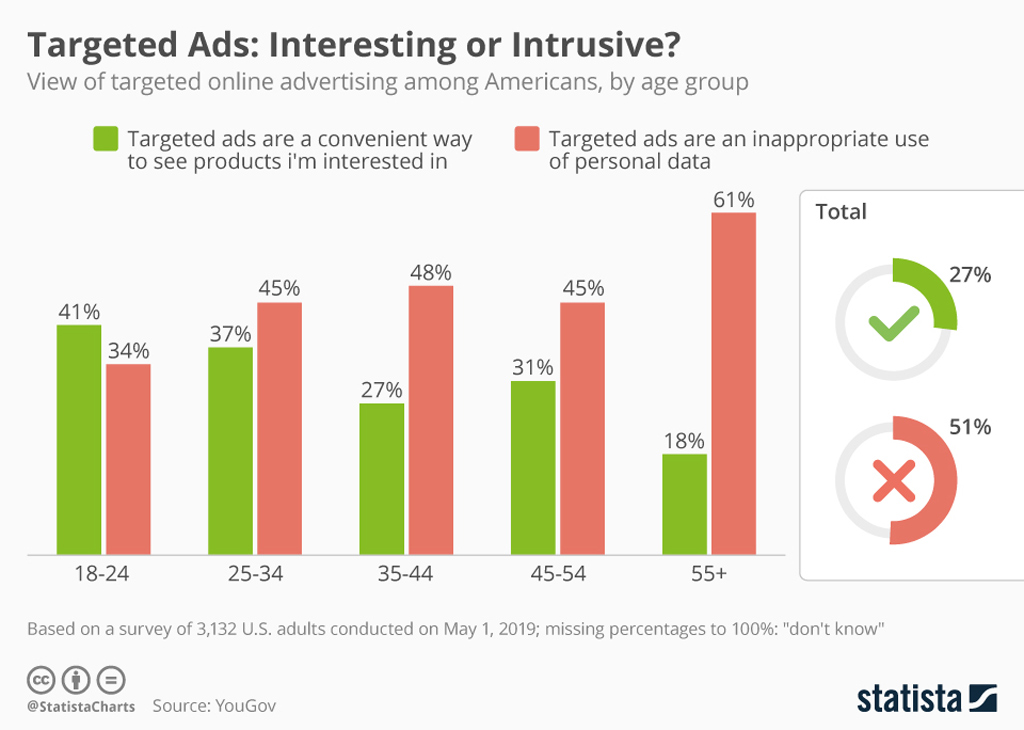
- Younger users (18–24) are the most receptive, with 41% saying targeted ads are convenient, compared to only 34% who find them inappropriate.
- Among 25–34-year-olds, sentiment begins to shift, as 45% view targeted ads as an inappropriate use of personal data, surpassing the 37% who see them as convenient.
- In the 35–44 age group, skepticism increases further, with nearly half (48%) considering targeted ads intrusive, while just 27% find them useful.
- Mid-age users (45–54) continue this trend, where 45% perceive ads as inappropriate versus 31% who see them as beneficial.
- Older adults (55+) show the strongest resistance, with a significant 61% labeling targeted ads as inappropriate, and only 18% viewing them as convenient.
- Overall sentiment is negative, as only 27% of respondents find targeted ads useful, while a majority 51% consider them an invasion of privacy.
- The data highlights a clear age-based divide, where younger audiences are more accepting, while older demographics are increasingly concerned about data privacy.
- This suggests marketers should adopt age-specific personalization strategies, balancing relevance for younger users and privacy reassurance for older audiences.
Retargeting Impact on Shopping Cart Abandonment Statistics
- Global cart abandonment rates average 69.8%, creating a large retargeting opportunity.
- Retargeting emails recover 10%–30% of abandoned carts.
- Display retargeting ads can recover up to 26% of abandoned shoppers.
- Adding urgency messaging increases cart recovery rates by 15%–25%.
- Multi-channel retargeting improves cart recovery by 50% or more compared to single-channel campaigns.
- Personalized product retargeting increases purchase likelihood by 70%.
- Cart abandonment retargeting contributes to 20%+ revenue recovery for e-commerce brands.
- Retargeted shoppers are 2x more likely to return and complete purchases.
Retargeting and Customer Journey Funnel Statistics
- It takes 6–8 touchpoints before a customer converts, making retargeting essential.
- Retargeting improves mid-funnel engagement by 30%–50%.
- Retargeting shortens the sales cycle by 10%–20%.
- Brands using retargeting see 50% higher lead nurturing efficiency.
- Retargeting increases brand recall by 70%, improving funnel progression.
- Video retargeting campaigns improve top-to-mid funnel transitions by 20%–40%.
- Sequential retargeting messaging boosts conversions by 15%–30%.
- Funnel-based retargeting strategies improve customer retention by 25% or more.
Retargeting Adoption Rates by Industry
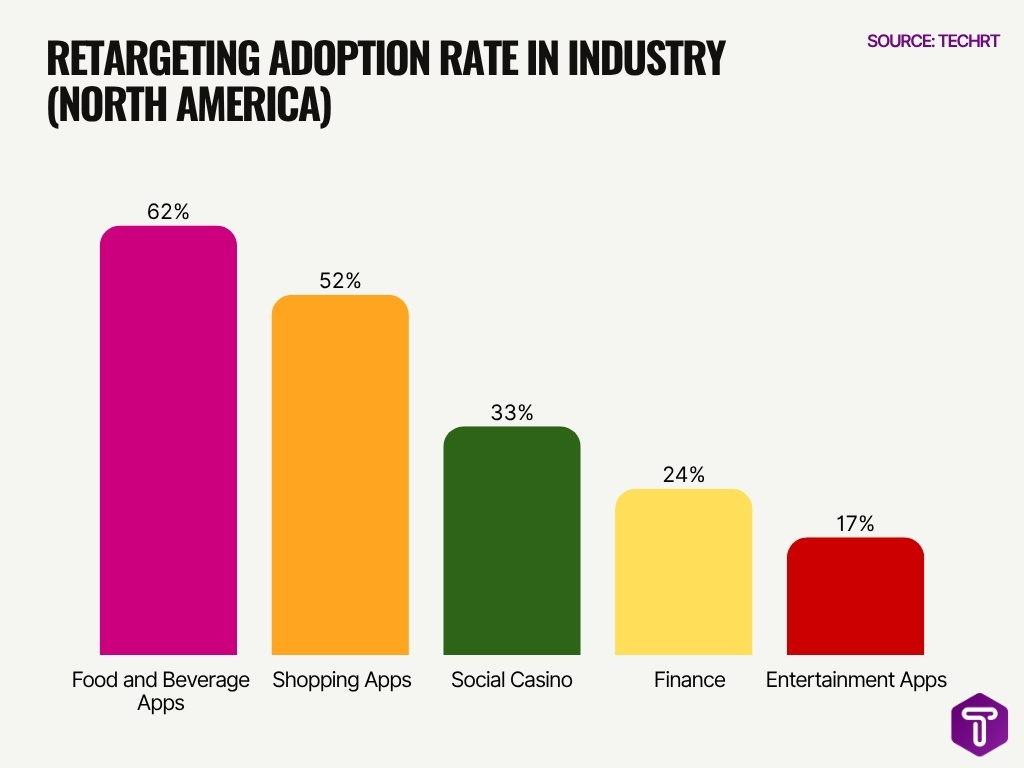
- Food and beverage apps lead the market with the highest adoption rate at 62%, indicating strong reliance on retargeting to drive repeat purchases and engagement.
- Shopping apps follow closely at 52%, showing that over half of e-commerce platforms actively use retargeting to recover abandoned carts and boost conversions.
- Social casino apps report a moderate adoption rate of 33%, suggesting selective but strategic use of retargeting for user re-engagement.
- Finance industry adoption stands at 24%, reflecting a more cautious approach, likely due to regulatory constraints and longer decision cycles.
- Entertainment apps have the lowest adoption at 17%, indicating untapped potential for retargeting strategies in this segment.
- There is a 45 percentage point gap between the highest (62%) and lowest (17%) adopting industries, highlighting significant variation in retargeting maturity across sectors.
- Overall, consumer-driven industries (food, shopping) show higher adoption rates, while regulated or engagement-based sectors (finance, entertainment) lag.
Mobile vs Desktop Retargeting Statistics
- Mobile devices account for over 60% of retargeting impressions globally.
- Mobile retargeting conversion rates are 25% higher than desktop-only campaigns.
- Desktop users still show higher average order values (AOV) despite lower volume.
- Mobile CPC is typically 20%–30% lower than desktop CPC in retargeting campaigns.
- Cross-device retargeting increases conversions by 15%–20%.
- Mobile retargeting ads achieve higher engagement rates due to frequent device usage.
- Desktop retargeting campaigns tend to generate higher conversion intent for B2B audiences.
- Mobile-first strategies now dominate over 50% of retargeting campaign budgets.
Cross-Device and Cross-Channel Retargeting Statistics
- Cross-device retargeting improves conversion rates by 15%–30%.
- Consumers use an average of 3 devices before completing a purchase.
- Cross-channel campaigns increase engagement by 20%–35%.
- Retargeting across platforms (Google, Meta, email) boosts conversions by 30%+.
- Marketers using omnichannel retargeting report 90% higher customer retention rates.
- Sequential messaging across channels increases CTR by 15%–25%.
- Cross-device tracking accuracy has improved to 80%+ with AI models.
- Multi-platform retargeting campaigns generate 2x higher engagement than single-channel efforts.
Retargeting Techniques Usage Among Marketers
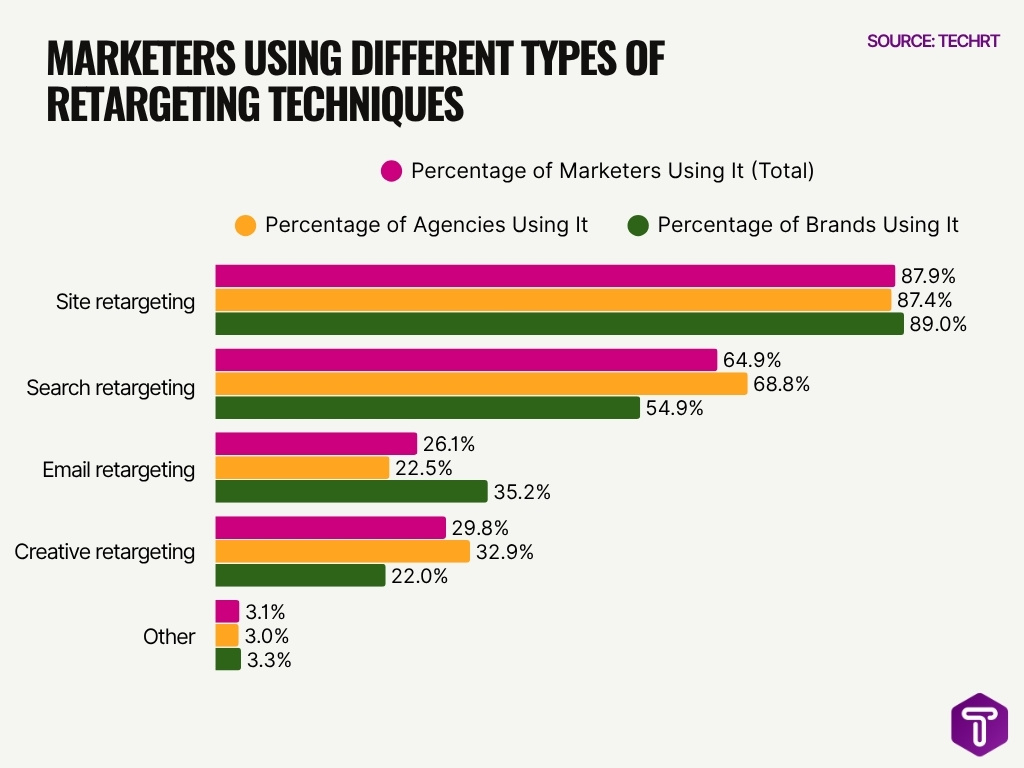
- Site retargeting dominates adoption, with 87.9% of marketers using it, including 87.4% of agencies and 89.0% of brands, making it the most widely used retargeting strategy.
- Search retargeting is the second most popular, adopted by 64.9% of marketers, with higher usage among agencies (68.8%) compared to brands (54.9%), indicating stronger agency reliance on search intent data.
- Email retargeting shows a niche but brand-heavy trend, used by only 26.1% of marketers, but significantly higher among brands (35.2%) than agencies (22.5%), suggesting brands prioritize owned channels.
- Creative retargeting adoption remains moderate, with 29.8% of marketers using it; however, agencies (32.9%) leverage it more than brands (22.0%), likely due to advanced campaign optimization capabilities.
- “Other” retargeting techniques are minimal, accounting for just 3.1% overall usage, showing that the market is heavily concentrated around core retargeting methods.
- The data highlights a clear performance-driven hierarchy, where site and search retargeting dominate, while email and creative approaches play more supportive or specialized roles.
- A notable gap exists between agency and brand strategies, especially in search (+13.9% agency vs brand) and email (+12.7% brand vs agency), indicating different channel priorities and expertise.
- Overall, the ecosystem reflects a strong preference for high-intent audience targeting, with over 60% adoption in intent-based techniques like site and search retargeting.
Frequency, Ad Fatigue, and Creative Decay Statistics in Retargeting
- Showing retargeting ads 5–7 times per user yields optimal performance before fatigue sets in.
- CTR drops by 15%–25% after repeated exposure without a creative refresh.
- Ad fatigue can reduce conversion rates by up to 30% if frequency is not managed.
- Rotating creatives every 2–4 weeks improves campaign performance by 20%+.
- High-frequency retargeting increases negative brand perception by 10%–15%.
- Sequential messaging reduces fatigue and improves conversions by 15%–30%.
- Video-based retargeting ads experience slower creative decay than static banners.
- Frequency capping reduces wasted impressions by 20%–40%.
Email and Abandoned Cart Retargeting Statistics
- Abandoned cart emails achieve an average open rate of 40%–50%.
- Click-through rates for cart recovery emails range between 8%–10%.
- Email retargeting recovers 10%–30% of abandoned carts.
- Sending three-cart reminder emails increases conversions by 69% compared to a single email.
- Personalized subject lines improve email open rates by 20%+.
- Timing matters: emails sent within 1 hour of abandonment perform best.
- Including discounts in retargeting emails increases conversion rates by 10%–20%.
- Email retargeting delivers one of the highest ROIs, averaging $36–$42 per $1 spent.
Consumer Concern Toward Retargeted Ads
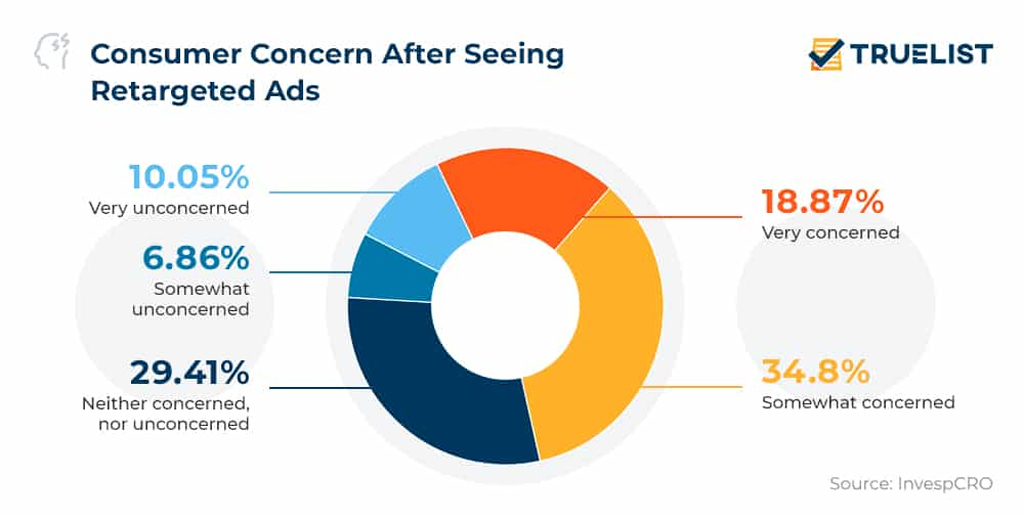
- A significant 34.8% of consumers are somewhat concerned, making it the largest segment, indicating moderate discomfort with retargeting practices.
- Nearly 1 in 5 users (18.87%) are very concerned, highlighting a strong privacy sensitivity among a notable portion of the audience.
- Combined, over 53.67% of consumers show concern (somewhat + very), suggesting that more than half of users react negatively to retargeted ads.
- A substantial 29.41% remain neutral, meaning they are neither concerned nor unconcerned, representing an opportunity for brands to influence perception.
- Only a small portion—6.86% somewhat unconcerned and 10.05% very unconcerned—indicates that just 16.91% of users are comfortable with retargeting.
- The data clearly shows a trust gap in retargeting strategies, where concern outweighs comfort by a wide margin.
- Marketers should prioritize transparency, personalization, and frequency control to address the high concern levels (53.67%) and improve user sentiment.
Privacy, Cookies, and First-Party Data Retargeting Statistics
- Over 50% of marketers now prioritize first-party data due to cookie restrictions.
- Google’s cookie deprecation has pushed over 60% of advertisers to revise targeting strategies.
- First-party data campaigns show 2x higher engagement rates than third-party cookie targeting.
- Privacy-focused targeting reduces audience reach by 30%–40% but improves data quality.
- Consent-based retargeting improves trust and boosts conversions by 10%–15%.
- Contextual retargeting is gaining traction, with adoption increasing by 20%+ year-over-year.
- Data privacy regulations impact over 70% of global digital campaigns.
- Brands investing in first-party data strategies see ROI improvements of 20%–40%.
AI, Automation, and Future of Retargeting Statistics
- AI-driven retargeting improves campaign efficiency by 30%–50%.
- Automated bidding increases conversions by 15%–25%.
- Predictive analytics boosts retargeting performance by 20%–35%.
- AI-powered segmentation increases audience accuracy by 25%–40%.
- Chatbots and conversational retargeting improve lead conversion rates by 10%–20%.
- Programmatic advertising accounts for over 90% of display ad spend in 2025.
- Machine learning reduces CPA by 20%–30% in retargeting campaigns.
- AI-generated creatives improve engagement rates by 15%–25%.
Frequently Asked Questions (FAQs)
What is the average click-through rate (CTR) for retargeting ads?
The average retargeting CTR ranges between 0.7% and 1.2%, which is nearly 10x higher than standard display ads at around 0.05%–0.1%.
How much can retargeting improve conversion rates?
Retargeting can increase conversion rates by up to 150%, and retargeted users are about 70% more likely to convert than new visitors.
What is the average conversion rate for retargeting campaigns in 2025–2026?
The average retargeting conversion rate is approximately 7.5%, significantly higher than general e-commerce averages of under 2%.
What is the typical cost per click (CPC) for retargeting ads?
Retargeting CPC typically ranges from $0.66 to $1.23, making it more cost-efficient than many standard PPC campaigns.
What return on ad spend (ROAS) do retargeting campaigns deliver?
Retargeting campaigns generate an average ROAS of around 4.2×, meaning businesses earn about $4.20 for every $1 spent.
Conclusion
Retargeting continues to evolve as one of the most reliable ways to convert high-intent audiences in a crowded digital landscape. The data clearly shows that brands leveraging retargeting strategies benefit from stronger engagement, higher conversion rates, and more efficient use of ad spend. From personalized dynamic ads to AI-driven optimization, retargeting consistently delivers measurable improvements across key performance metrics.
At the same time, shifts in privacy regulations and the decline of third-party cookies are changing how marketers approach audience targeting. This transition is pushing brands toward first-party data strategies, smarter segmentation, and more transparent user experiences. Companies that adapt quickly to these changes while maintaining relevance and personalization will gain a competitive edge.
Ultimately, successful retargeting is not just about showing ads again; it’s about delivering the right message at the right moment across the customer journey. Brands that balance personalization, frequency control, and cross-channel consistency will see the strongest results. As highlighted throughout this report, retargeting is no longer optional; it’s a core growth engine that businesses should continuously refine, optimize, and scale.

Leave a comment
Have something to say about this article? Add your comment and start the discussion.