




Screen time is shaping how every generation interacts with the world. From toddlers swiping on tablets to adults juggling screens for work and leisure, digital engagement is now part of daily life. Recent research shows that screen use has surged across age groups, with consequences for social behavior, health, and productivity. In business and education, understanding these patterns helps companies tailor content and schools optimize learning environments. Scroll through this article to explore the latest statistics on screen time by age group and what they mean for families and society.
Editor’s Choice
- Adults in the U.S. average about 7 hours of screen time per day in 2025.
- Gen Z leads with around 9 hours per day of screen engagement.
- Children ages 0–8 average about 2.5 hours daily on screens.
- Nearly half of teens have 4+ hours of daily screen time.
- About 40% of U.S. children under 2 use tablets by age 2.
- Adolescents from lower-income households spend over 9 hours daily.
- The worldwide average is roughly 6 hours and 40 minutes per day on screens.
Recent Developments
- Screen guidance for under‑5s is being prepared by UK authorities, recognizing risks to language development.
- New studies show 98% of two‑year‑olds use screens daily, averaging over two hours.
- Increases in YouTube use among under‑2s with 62% engagement.
- Younger adults, Gen Z and millennials, are actively reducing screen time for well‑being.
- UK media warns that toddlers with excessive screen use may have smaller vocabularies.
- Sleep studies link screen use to sleep irregularities in preschoolers.
- Parental concerns about digital addiction are rising, with 96 hours/year of screen battles reported.
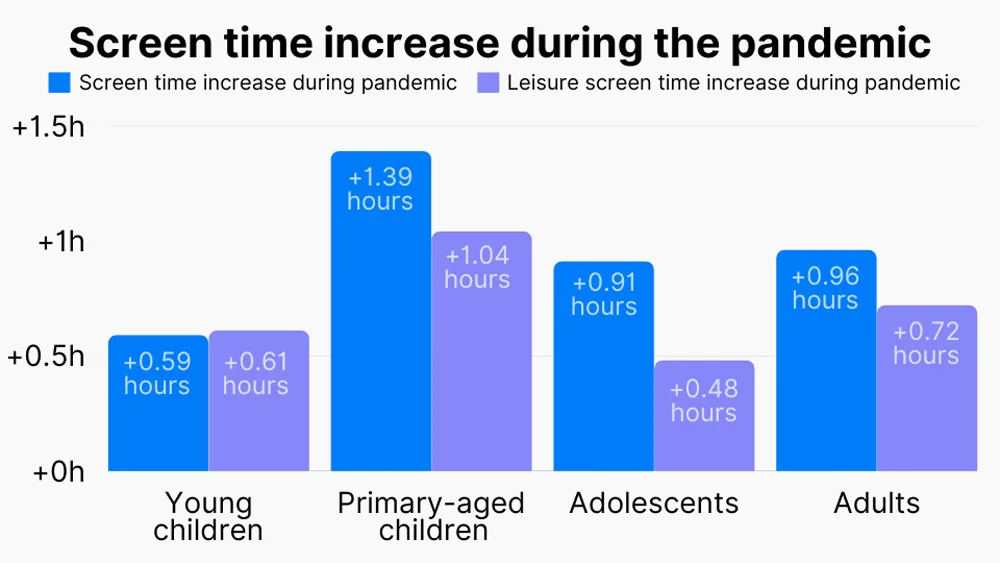
Screen Time Increase by Age Group During the Pandemic
- Young children recorded a +0.59 hours increase in overall screen time, while leisure screen time rose slightly higher at +0.61 hours during the pandemic.
- Primary-aged children experienced the largest surge, with total screen time increasing by +1.39 hours and leisure screen time rising by +1.04 hours.
- Adolescents saw overall screen time grow by +0.91 hours, but leisure screen time increased by only +0.48 hours, indicating a greater share of screen use for non-leisure activities.
- Adults reported a +0.96 hours rise in total screen time, alongside a +0.72 hours increase in leisure screen time during the pandemic period.
- Across all age groups, primary-aged children showed the most significant screen time expansion, while young children experienced the smallest overall increase.
Screen Time for Children Under 2
- Recommended screen time: zero for under 18 months (except video chat).
- Nearly half (49%) of children aged 0–2 engage with smartphones.
- Under‑two screen time averages about 1.23 hours daily in some studies.
- 98% of two‑year‑olds watch screens daily in some countries.
- Screen habits in this group have risen compared to pre‑pandemic levels.
- The World Health Organization advises ≤1 hour/day for ages 2–4.
- Nearly 40% of children under age 2 use tablets by age 2.
- Screen exposure for infants is linked to delayed language development in emerging research.
Screen Time for Ages 2–4 Years
- Average screen time for this group remains above guidelines in many regions.
- WHO and pediatric groups recommend ≤1 hour daily.
- More than 1 in 4 children under 2 meet screen limits, showing slight improvements.
- Digital devices often replace play in daily routines.
- Parents report increased tablet and phone exposure in toddlers.
- Sleep disturbances have been associated with excessive screen time among 2–5‑year‑olds.
- Some studies show early screen use correlates with less outdoor activity later.
- Engagement with devices at this age is nearly universal in some surveys.
Screen Time for Ages 5–8 Years
- Children aged 5–8 average of 2.5 hours per day on digital screens.
- Nearly one in four owns a cellphone by age 8.
- Screen use includes gaming and short‑form videos, rising sharply.
- CDC data shows significant variability, with many exceeding 2+ hours daily.
- Excess screens can delay physical play and social interaction.
- Some reports note average usage near 5–6 hours per day among older children in this range.
- Tablet and smartphone engagement often outpaces TV viewing.
- Screen time increases the risk of sedentary behavior and reduced fitness.
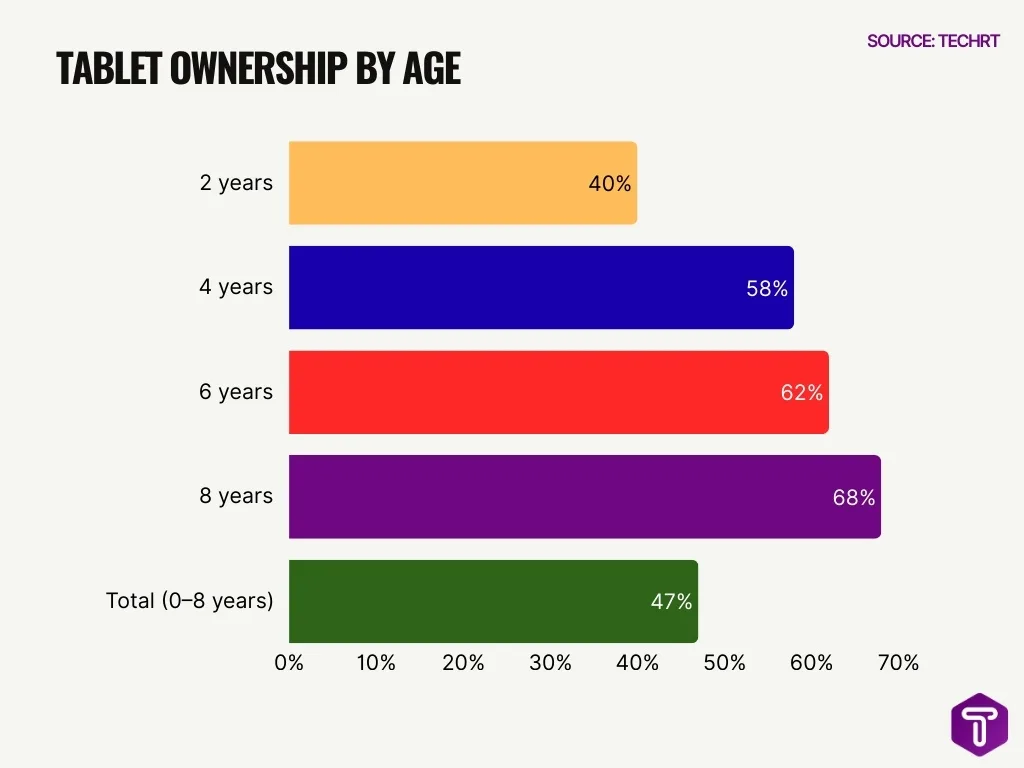
Tablet Ownership Trends Among Children Aged 0–8 (2024)
- 40% of 2-year-olds already own a tablet, highlighting early exposure to digital devices at toddler age.
- Tablet ownership rises sharply to 58% among 4-year-olds, indicating growing use during the preschool years.
- By age 6, 62% of children have their own tablet, reflecting increased adoption as children enter formal schooling.
- 8-year-olds show the highest ownership rate at 68%, demonstrating that tablets are becoming a standard device for older children.
- Overall, 47% of children aged 0–8 own a tablet, underscoring the widespread penetration of tablets among young children.
Screen Time for Teens 8–12
- Tweens average about 5 hours of screen use per day.
- Tablet and phone engagement often begins before this age.
- Half of tweens now exceed recommended screen limits.
- Gaming and social media contribute significantly to total screen hours.
- Screen use is linked with lower physical activity in tweens.
- Parents increasingly report digital conflict around screen rules.
- Short‑form video platforms dominate usage patterns.
- Excessive use often displaces homework and offline play.
Screen Time for Teens 13–18
- Average daily screen time for teens is about 7 hours 22 minutes, nearly half of their waking day.
- Globally, teens often exceed 8 hours per day, with significant entertainment and social media use.
- Roughly 41% of American teens spend more than 8 hours daily on screens.
- Teens from lower‑income households average 9 hours 19 minutes per day.
- 50% of teens report 4+ hours of screen use per day in health surveys.
- Boys often log around 9 hours 16 minutes, while girls average about 8 hours 2 minutes daily.
- High screen time correlates with irregular sleep and lower physical activity among teens.
- Social media dominates teen screen use, far outpacing educational content.
Screen Time for Young Adults 18–24
- Young adults (16–24) are among the highest screen users, averaging about 7+ hours per day.
- Women aged 16–24 spend approximately 7 hours and 35 minutes daily, higher than their male counterparts.
- Screen use often includes social media, streaming video, and messaging.
- Smartphone checks average 58 times per day across adults, affecting this age group.
- Digital workers may extend these hours due to remote work demands.
- Young adults report screen use contributing to stress and reduced sleep quality.
- Most 18–24‑year‑olds balance work and leisure screens, often multitasking.
- Screen time trends have held steady or risen compared with pre‑pandemic levels.
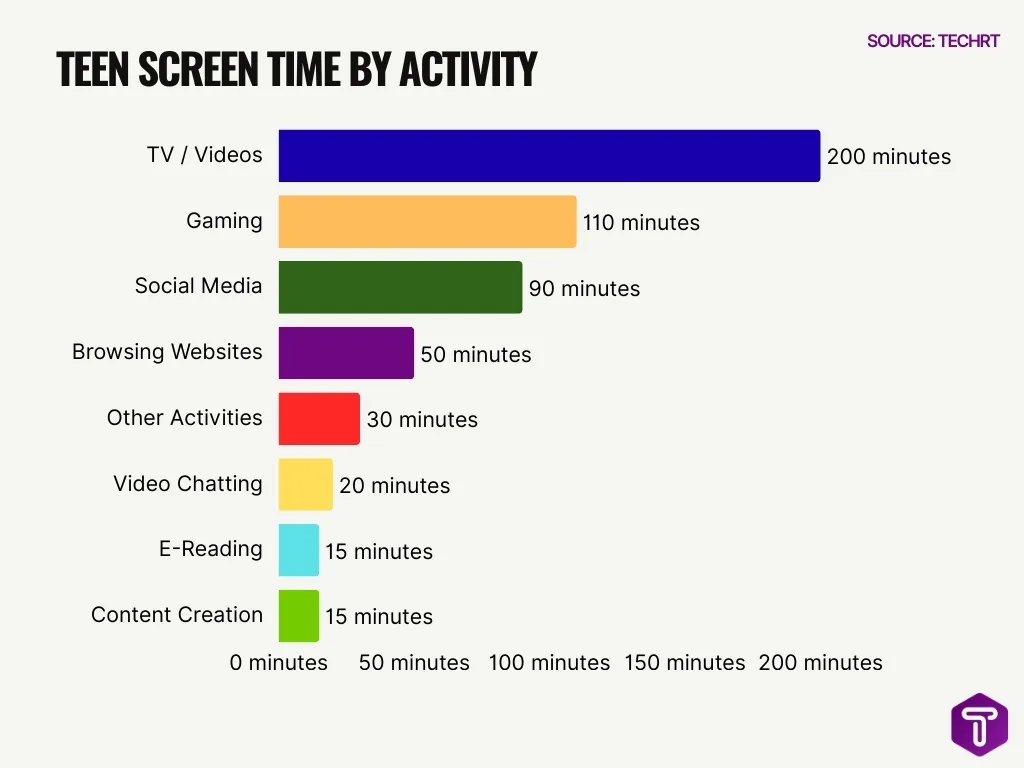
Teen Screen Time by Activity: Daily Usage Breakdown
- TV and video streaming dominate teen screen habits, with teens spending an average of 200 minutes per day, making it the largest share of daily screen time.
- Gaming is the second-most time-consuming activity, accounting for approximately 110 minutes daily, highlighting strong engagement with interactive digital entertainment.
- Social media usage averages around 90 minutes per day, reinforcing its role as a core communication and content-consumption platform for teens.
- Browsing websites accounts for about 50 minutes daily, indicating moderate use for information, entertainment, and casual exploration.
- Other digital activities collectively consume nearly 30 minutes per day, showing a diverse range of secondary screen behaviors.
- Video chatting averages roughly 20 minutes per day, reflecting limited but consistent real-time communication among teens.
- E-reading remains relatively low, with teens spending just 15 minutes per day, suggesting lower adoption of digital reading formats.
- Content creation is also minimal at 15 minutes daily, indicating that passive consumption far outweighs creative digital participation among teens.
Screen Time for Adults 25–34
- Adults aged 25–34 average around 7 hours per day on screens.
- Screen habits include work apps, social apps, and streaming.
- Men and women in this cohort show similar daily screen durations.
- Smartphone use remains the dominant screen interaction mode.
- This age group often blends screens for productivity and entertainment.
- Digital phone checks contribute significantly to total screen time.
- Screen time overlaps with screen use for work, raising eyestrain concerns.
- Screen exposure trends in 2025 are higher than figures reported a decade ago.
Screen Time for Adults 35–44
- Adults 35–44 spend roughly 6–7 hours daily on screens.
- Use includes work computers, phones, tablets, and video content.
- This group often prioritizes productivity alongside leisure.
- Screen habits show incremental increases over recent years.
- Health discussions highlight eye strain and musculoskeletal discomfort.
- Smartphone engagement remains high despite the older cohort age.
- Screen use for news and social media is common in this demographic.
- Screen duration is longer on weekdays than on weekends for this age group.
Screen Time for Adults 45–54
- Adults 45–54 average about 6+ hours per day on screens.
- Work responsibilities and media consumption drive this time.
- Screen use often includes email, news, and social platforms.
- This demographic tilts toward television and desktop screens more than younger groups.
- Mobile phones still account for significant screen hours.
- Screen engagement rises during evenings and weekends.
- Some report intentional limits to preserve work‑life boundaries.
- Adults in this cohort report sleep disruption linked to nighttime screen use.
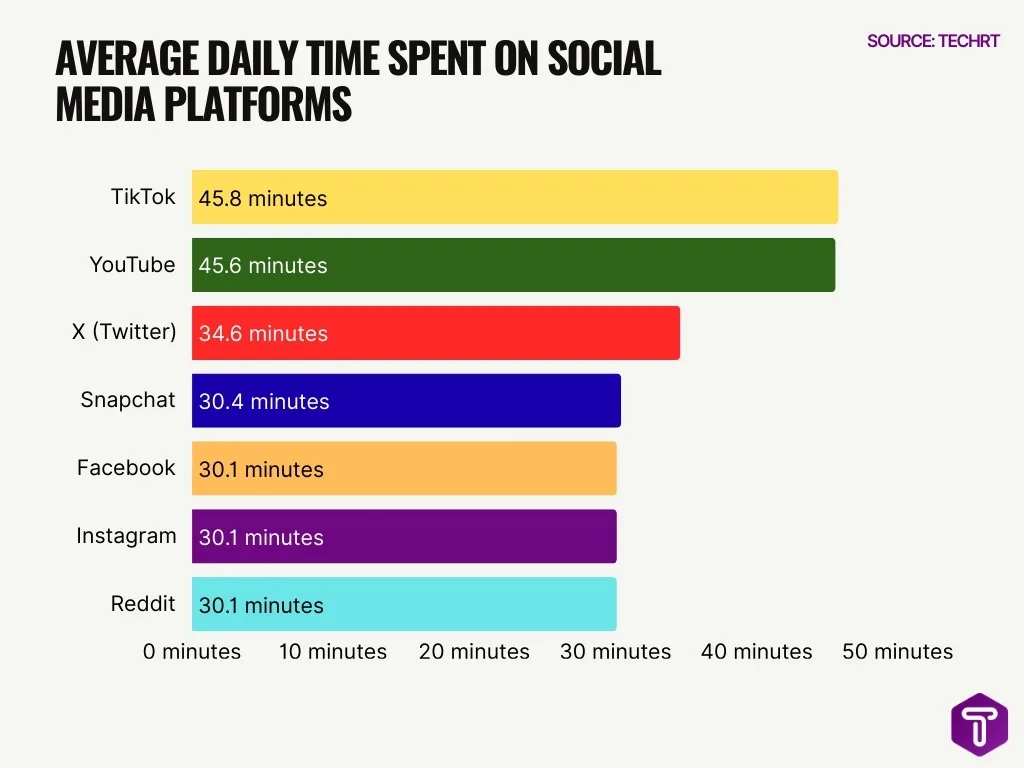
Average Daily Time Spent on Major Social Media Platforms
- TikTok leads all platforms, with users spending an average of 45.8 minutes per day, making it the most engaging social media app in the dataset.
- YouTube follows closely behind, recording 45.6 minutes of daily usage, highlighting its role as a top long-form and short-form video platform.
- X (formerly Twitter) sees moderate engagement, with users spending 34.6 minutes per day, notably lower than video-first platforms.
- Snapchat users spend an average of 30.4 minutes daily, reflecting steady but shorter engagement sessions.
- Facebook reports 30.1 minutes of average daily usage, indicating stable but plateauing user attention.
- Instagram also averages 30.1 minutes per day, aligning closely with Facebook in overall user engagement.
- Reddit matches Instagram and Facebook, with users spending 30.1 minutes daily, placing it among the lowest time-spent platforms in this comparison.
Screen Time for Adults 55–64
- Adults aged 55–64 average roughly 5+ hours of screens daily.
- This group leans more toward TV and video content.
- Smartphones and tablets remain key daily tools.
- Screen time has increased compared to years before the pandemic.
- Health guidance encourages breaks to reduce eyestrain risks.
- Compared with younger adults, this group spends less time on social media.
- Screen use patterns reflect recreational habits more than work demands.
- Evening screen exposure correlates with insomnia reports.
Screen Time for Seniors 65+
- Seniors 65+ average 5.2 hours daily screen time, lower than younger groups.
- Americans 65+ spend nearly 10 hours daily on screens, mostly TV.
- 60+ adults dedicate 4 hours 16 minutes of leisure to screens, up from a decade ago.
- UK seniors 65+ average 3+ hours on smartphones/tablets plus 5.5 hours TV.
- 65+ users log 4 hours 7 minutes (women) vs 3 hours 59 minutes (men) on internet devices.
- Boomers average 3 hours 31 minutes daily screen engagement.
- 81% of 60-69 and 62% of 70+ seniors use smartphones.
- 73% of 65+ are now internet users, up from 14% in 2000.
- TV dominates with 4+ hours daily for 65+ adults.
Screen Time by Generation
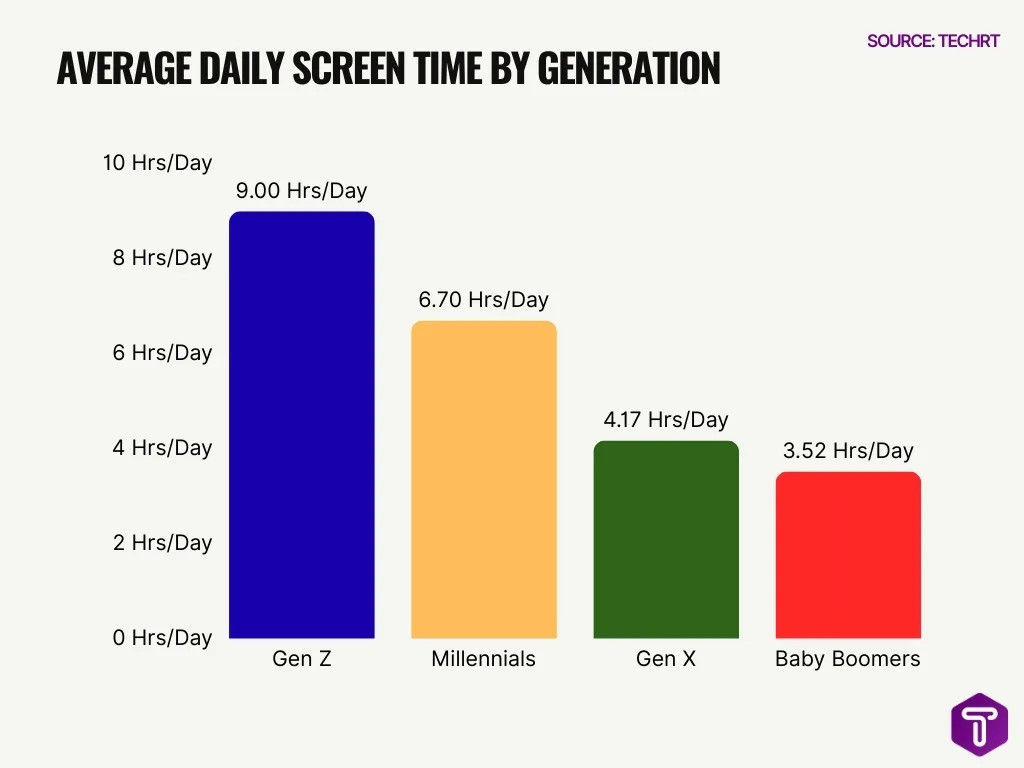
- Gen Z consistently shows the highest screen time, averaging around 9 hours per day on screens.
- Millennials follow with an average of 6 hours and 42 minutes daily.
- Gen X averages roughly 4 hours 10 minutes, indicating a notable drop with age.
- Baby Boomers spend about 3 hours and 31 minutes per day on screens.
- 76% of Gen Z report they spend too much time on their smartphones, the highest among generations.
- Roughly two‑thirds of Millennials (67%) also feel they overuse screens.
- Gen X and Boomers lag but still show high screen use relative to earlier generations.
- Younger generations are also more likely to pursue “digital detox” trends, with many reducing screen time intentionally.
Global Screen Time Averages by Age
- Across the world, individuals spend an average of about 6 hours and 40 minutes per day on screens (ages 16–64).
- In 2025, global average screen time across all devices sits near 7 hours daily.
- Smartphones dominate globally, accounting for roughly 53% of screen time.
- Desktop and laptop use averages around 3 hours and 14 minutes in many regions.
- Regional variations persist; South Africans average over 9 hours and 24 minutes daily.
- In many countries, mobile screen use now exceeds traditional TV time.
- Younger adults (16–24) globally lead screen use, while older cohorts track lower daily usage.
- Global social media screen time also rises, averaging about 2 hours 41 minutes daily.
US Screen Time by Age Group
- In the U.S., average adult screen time hovers near 7 hours and 3 minutes daily.
- Teens 12–17 show that 50.4% spend 4+ hours daily on screens.
- Among teens, older adolescents (15–17) show higher proportions at 55% for 4+ hours daily.
- Screen time prevalence is slightly higher in metropolitan than rural teen populations.
- Anxiety and depression symptoms correlate with 4+ hours of daily screen use among teens.
- U.S. adults report frequent smartphone checks that contribute to daily totals.
- Tablet and desktop use contribute but remain below smartphone usage for most adults.
- Parents report smartphone ownership increases sharply by pre‑teen ages.
Screen Time Recommendations vs Actual Use in Young Children
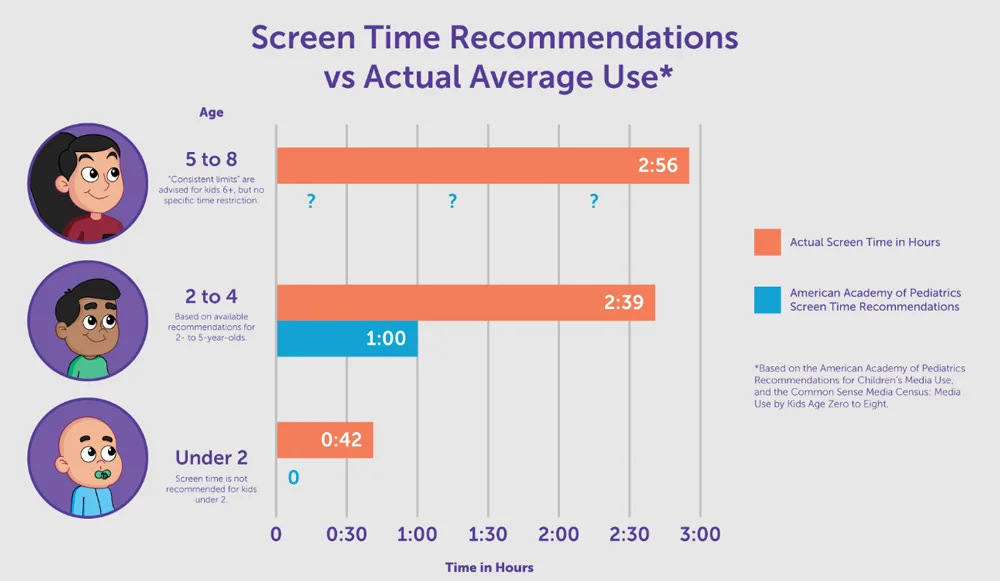
- Children under 2 years record an average of 42 minutes of daily screen time, even though pediatric guidelines recommend zero screen exposure for this age group.
- AAP screen time recommendation for children under 2 is 0 hours, highlighting a clear gap between guidance and real-world behavior.
- Children aged 2 to 4 years spend an average of 2 hours and 39 minutes per day on screens, significantly exceeding the recommended limit of 1 hour.
- Screen use among 2–4-year-olds is nearly 1 hour and 40 minutes higher than what the American Academy of Pediatrics advises.
- Children aged 5 to 8 years average 2 hours and 56 minutes of daily screen time, reflecting heavy digital exposure in early childhood.
- For the 5–8 age group, experts advise consistent screen time limits, although no specific hourly cap is formally defined.
- Across all measured age groups, actual screen time consistently surpasses recommended levels where official guidelines exist.
- The largest relative overuse is observed in the 2–4 age group, where screen exposure is more than double the recommended duration.
- These trends underscore a growing disconnect between pediatric screen time guidelines and household media habits.
- The data is based on American Academy of Pediatrics recommendations and findings from the Common Sense Media Census covering children aged 0 to 8 years.
Device‑Specific Screen Time by Age
- Smartphones lead all age groups, with the U.S. adult average at about 2 hours 21 minutes daily.
- Desktop use trails at around 42 minutes per day for adults.
- Younger users blend gaming consoles and tablets into high screen totals.
- Across many countries, smartphones account for about 92% of social media screen time.
- Tablet usage for social media remains small but meaningful in child and teen demographics.
- Mobile screens contribute most in younger adults, while older adults favor TV and desktop content.
- Screen session lengths on mobile devices increased by about 9% in 2025.
- Device engagement patterns vary by purpose, work vs. entertainment, across age groups.
Health & Well‑Being Correlates by Age & Screen Time
- Among U.S. teens aged 12–17, about 27.1% with ≥4 hours/day screen time reported anxiety symptoms versus 12.3% with less time.
- In the same group, 25.9% of teens with ≥4 hours/day screen time reported depression symptoms compared with 9.5% below 4 hours.
- Adolescents with 4–6 hours/day screen time had a 35% higher prevalence of depressive symptoms, rising to 88% higher with ≥6 hours/day vs ≤2 hours.
- About 48% of adolescents using social media ≥3 hours/day showed heavy use, and 43.7% had moderate–severe psychological distress, with females at 54% vs 31% for males.
- Each extra 1 hour of screen time after going to bed raised the odds of insomnia symptoms by 59% and cut nightly sleep by about 24 minutes in students.
- Youth who left electronic devices on in the bedroom after bedtime showed shorter total sleep and poorer sleep quality, affecting 28% of school‑aged children and 57% of teenagers.
- Excessive screen time of >4 hours/day in adolescents was positively associated with higher depressive, anxiety, and stress symptoms compared with ≤2 hours/day.
- Problematic social media use in adolescents and young adults was significantly linked with higher depression, anxiety, and stress levels across multiple studies.
Frequently Asked Questions (FAQs)
What is the average daily screen time for people globally in 2025?
What percentage of Gen Z report spending too much time on their smartphones?
How many minutes per day do toddlers in Britain spend on screens as of 2026?
On average, how long do people check their smartphones daily in 2025?
What share of children under age 2 in the U.S. or similar contexts have a tablet by age 2?
Conclusion
Understanding screen time patterns across generations and age groups helps contextualize how digital habits shape daily life. Younger cohorts, especially Gen Z, are the most invested in screens, while older adults engage differently, often through varied devices and purposes. Global averages reveal high daily use, with smartphones at the center of most interactions. Importantly, links between extended screen time and health outcomes highlight the need for balanced digital engagement and mindful habits. These patterns will continue evolving as technology and lifestyle expectations shift, inviting ongoing attention from families, educators, and policymakers.

Leave a comment
Have something to say about this article? Add your comment and start the discussion.