



Small businesses power the US economy, shaping local communities and driving innovation across industries. From retail storefronts adapting to e-commerce to service providers leveraging AI tools, their influence spans both traditional and digital markets. They not only create jobs but also fuel competition, encourage entrepreneurship, and bring niche products and services to market that larger corporations often overlook.
In recent years, shifting economic conditions, rising inflation, and rapid technological change have pushed small businesses to evolve faster than ever. Owners now rely on data-driven decisions, digital platforms, and flexible business models to stay competitive. Understanding the latest statistics helps founders, investors, and policymakers identify trends, anticipate challenges, and uncover growth opportunities, so let’s dive into the numbers that define today’s small business landscape.
Editor’s Choice
- The US has 36.2 million small businesses, representing 99.9% of all businesses.
- Small businesses employ 62.3 million workers, accounting for 45.9% of the private workforce.
- Around 9 out of 10 net new jobs are created by small businesses.
- Over 80% of small businesses operate without employees, highlighting the rise of solo entrepreneurship.
- Small businesses generated 1.2 million net new jobs in one year.
- Monthly business applications reached 496,443 in February 2026.
- Small businesses have created 61.1% of all new jobs since 1995.
Recent Developments
- The US recorded 496,443 new business applications in February 2026, signaling continued entrepreneurial activity.
- Projected new business formations reached 28,994 in February 2026.
- Small businesses opened 1.1 million new establishments in a year.
- Closures reached 982,940 establishments, showing ongoing market churn.
- Net job creation from small firms increased by 1.2 million jobs annually.
- Business applications declined 5.8% month-over-month in early 2026, reflecting short-term volatility.
- AI adoption among small businesses rose to 58% in 2025, up from 40% in 2024.
- About 74% of small businesses expect revenue growth in 2026.
- Nearly 60% of owners plan to expand operations in 2026.
Small Business Optimism Trends
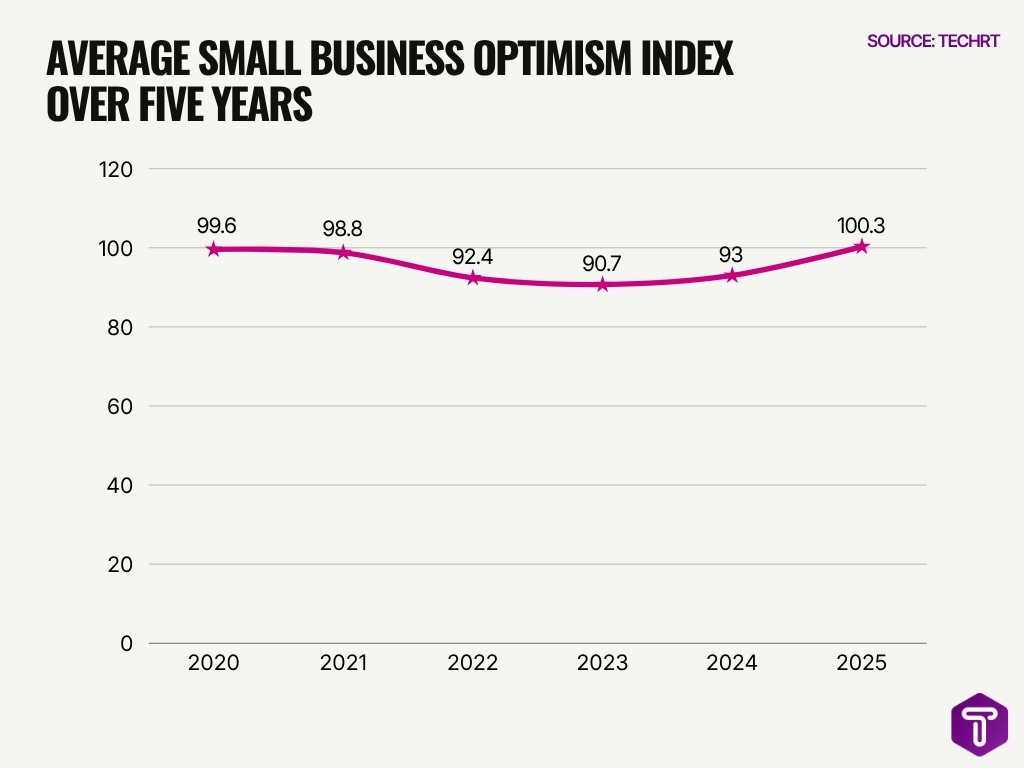
- The Small Business Optimism Index started strong at 99.6 in 2020, indicating a high confidence level among small businesses.
- A slight dip occurred in 2021, with the index falling to 98.8, suggesting early signs of uncertainty.
- The most significant decline was seen in 2022, dropping sharply to 92.4, reflecting economic pressures and market challenges.
- The downward trend continued into 2023, reaching a low of 90.7, the lowest point in the five years.
- Recovery began in 2024, with the index improving to 93.0, signaling a gradual restoration of business confidence.
- A strong rebound is evident in 2025, where the index climbed to 100.3, the highest value in the dataset, surpassing pre-decline levels.
- Overall, the data shows a U-shaped trend, with optimism declining for three consecutive years (2021–2023) before rebounding.
- The total fluctuation range across the period is approximately 9.6 points (from 90.7 to 100.3), highlighting moderate volatility.
- The sharp recovery between 2024 and 2025 (+7.3 points from the 2023 low) indicates renewed economic confidence and improved business conditions.
Percentage of All Businesses
- Small businesses account for 99.9% of all US businesses.
- This share has remained stable for over a decade.
- In 2025, small firms represented nearly all registered enterprises nationwide.
- Nonemployer firms alone make up over 85% of small businesses.
- Employer small businesses represent less than 20% of total SMBs.
- Businesses with fewer than 100 employees account for over 98% of firms.
- About 89% of firms employ fewer than 20 workers.
- Small manufacturers represent 98% of all manufacturing firms.
Employment by Small Businesses
- Small businesses employ 62.3 million people in the United States, representing nearly half of the total workforce.
- That figure equals 45.9% of all private‑sector employment in the US.
- Another estimate places small‑business employment at 59 million workers, still about 45.9% of private‑sector jobs.
- Around 27.1 million small businesses operate with no employees, yet still contribute significantly to the economy.
- Firms with 1–19 employees account for over 5.4 million businesses in the US.
- Small manufacturers alone employ about 4.8 million workers nationwide.
- Small businesses are responsible for roughly half of all net job creation in the US over the last several decades.
- Between 1995 and 2023, small firms generated 20.2 million net new jobs, or 61.1% of total net job growth.
- Small firms with fewer than 20 employees created about 1.1 million of the 1.6 million net new jobs in 2019.
- Small businesses pay 38.7% of total private‑sector payroll while contributing an estimated 43.5% of US GDP.
Small Business Funding Trends
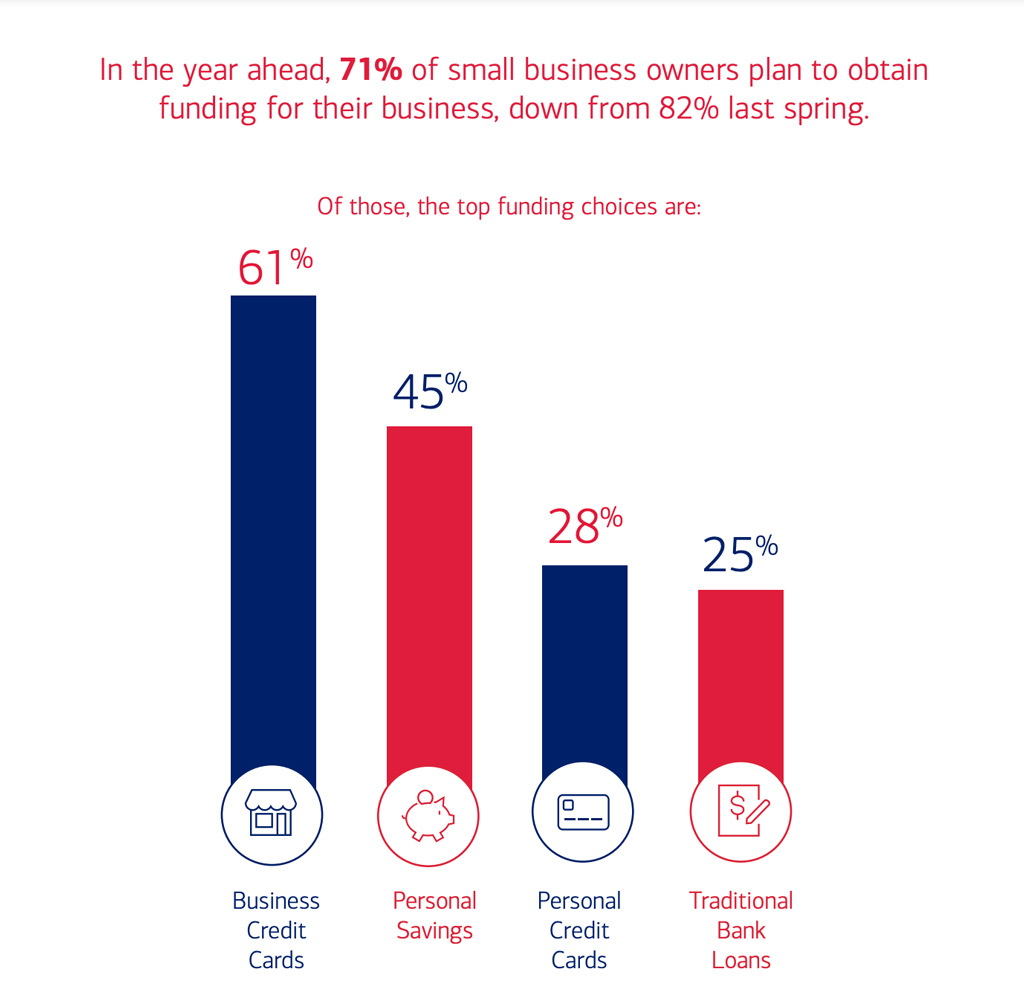
- 71% of small business owners plan to obtain funding in the coming year, showing strong ongoing demand for capital.
- This is a notable decline from 82% last spring, indicating an 11 percentage point drop in funding intent.
- Business credit cards are the most popular funding option, used by 61% of respondents, highlighting their accessibility and flexibility.
- 45% of owners rely on personal savings, making it the second most common funding source, reflecting a preference for self-financing.
- 28% use personal credit cards, suggesting that many entrepreneurs still depend on personal financial tools to support business needs.
- Traditional bank loans are used by only 25%, showing relatively lower reliance on formal lending institutions compared to alternative sources.
- The data indicates a clear trend toward non-traditional and self-funded financing methods, with credit-based and personal funds dominating over bank loans.
- The decline in funding plans may reflect economic uncertainty, tighter lending conditions, or improved cash flow stability among small businesses.
Job Creation Statistics
- Small businesses created 88.9% of net new jobs between 2023–2024.
- They generate around 1.5 million jobs annually.
- Since 1995, SMBs have contributed over 61% of new job creation.
- Small firms produced nearly two-thirds of new jobs over 25 years.
- Between 2022–2023, small businesses created 16 million jobs.
- New establishments added 1.1 million business openings annually.
- Net job gains reached 1.2 million in a single year.
- About 43% of small business owners plan to hire in 2026.
- Only 1% of small businesses plan layoffs, indicating stability.
Revenue and Financial Health
- U.S. small businesses generate about 43.5% of national GDP, contributing nearly $5.9 trillion in output in the latest SBA benchmark year.
- American small businesses earn an average annual revenue of about $1.22 million per firm, highlighting their significant income potential despite modest size.
- Small firms produce roughly 35.6% of all U.S. private‑sector revenue, totaling around $13.3 trillion in annual receipts.
- Nearly 65.3% of U.S. small businesses were profitable in 2022, with typical target profit margins around 7–10%.
- A Bank of America survey found 55% of small business owners reported higher revenues in 2023 compared with 2022.
- In the 2025 Bank of America report, 74% of small and mid-sized business owners expected revenue increases in the following year.
- A 2026 outlook found 94% of small business owners anticipated growth in 2026, while inflation (31%) and cash flow issues (29%) remained the top obstacles.
- A Bluevine survey showed 39% of SMBs have less than one month of operating expenses in cash, with typical buffers around 18 days.
- A 2026 UK study reported 82% of SMEs had experienced cash flow difficulties, often driven by late customer payments (36%) and seasonal sales shifts (35%).
Industry Breakdown
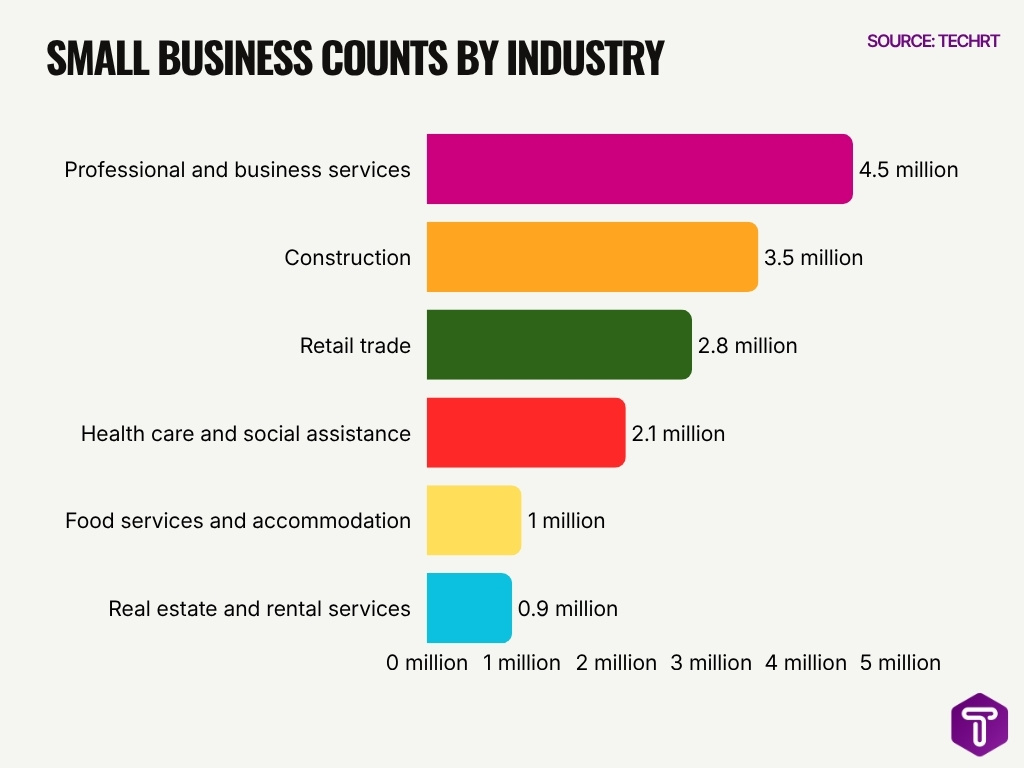
- Professional and business services host over 4.5 million small businesses in the U.S.
- The retail trade sector includes around 2.8 million small businesses.
- The construction industry comprises more than 3.5 million small businesses.
- Health care and social assistance represent about 2.1 million small and medium-sized firms.
- Food services and accommodation sectors include over 1 million small enterprises.
- Manufacturing small businesses make up roughly 98% of all U.S. manufacturing firms.
- Technology-related small businesses grew by approximately 15% from 2023 to 2025.
- E-commerce small business formation rose by over 20% since 2022.
- Local service-based businesses account for nearly 70% of total small business activity.
- Real estate and rental services contribute about 900,000 small businesses nationwide.
Failure and Survival Rates
- About 20% of small businesses fail within the first year.
- Nearly 50% of small businesses close within five years.
- Around 65% of startups survive at least two years, showing early-stage resilience.
- Approximately 30% of businesses remain active beyond 10 years.
- Lack of capital causes around 38% of all business failures.
- Poor market demand contributes to 35% of startup shutdowns.
- Roughly 19% of failed businesses cite competition pressures as the main reason.
- Companies with formal business plans are 16% more likely to succeed.
- Startups with mentorship programs boost survival rates by up to 70%.
- Businesses in the healthcare and real estate sectors have the highest survival rates, exceeding 55% after five years.
Demographics of Owners
- There are over 33 million small business owners in the United States.
- The average small business owner is between 44 and 57 years old.
- About 62% of small business owners are male, while 38% are female.
- Nearly 40% of business owners hold a bachelor’s degree or higher.
- Around 64% of small business owners are White, reflecting national demographic trends.
- Immigrant entrepreneurs own more than 25% of all small businesses in the U.S.
- Roughly 50% of owners launch their businesses after age 40.
- About 29% of entrepreneurs are first-time business owners.
- Over 50% of new startups begin as side businesses, driven by the gig economy.
- Approximately 12% of small business owners identify as Black or Hispanic entrepreneurs.
Small Business Ownership by State
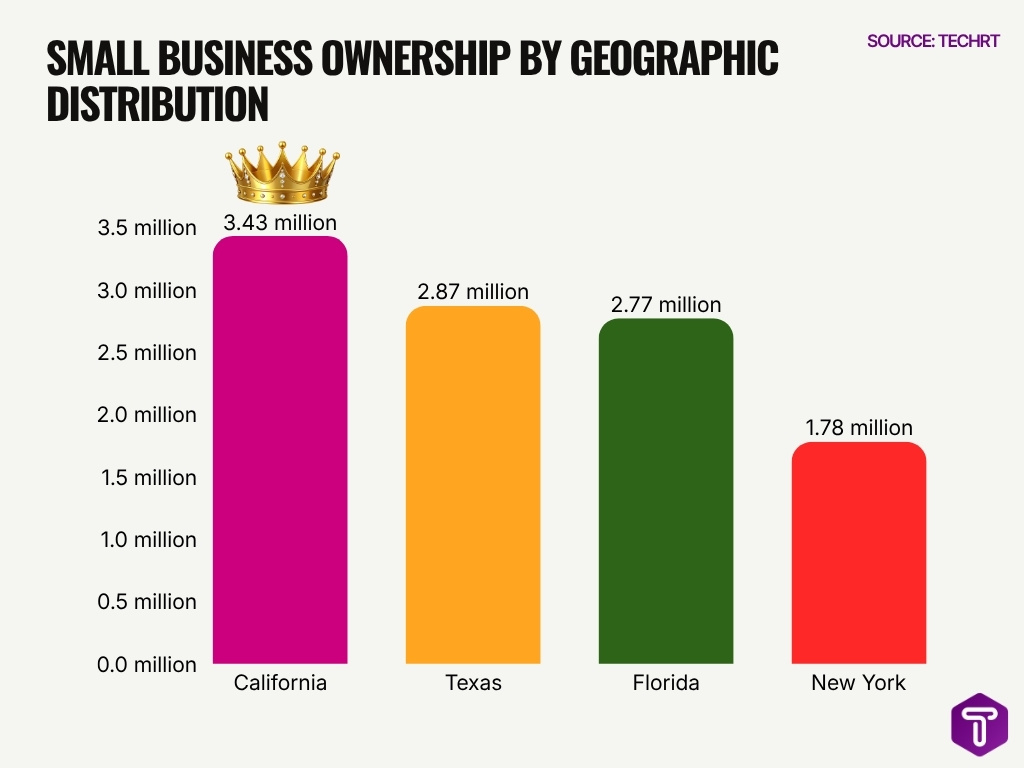
- California leads significantly with 3.43 million firms, making it the top state for small business ownership.
- Texas ranks second with 2.87 million firms, showcasing a strong entrepreneurial ecosystem.
- Florida follows closely at 2.77 million firms, indicating rapid growth and a business-friendly environment.
- New York has 1.78 million firms, placing it fourth among the listed states.
- The gap between California and Texas is حوالي 0.56 million firms, highlighting California’s dominance.
- Texas and Florida are nearly equal, with a minimal difference of just 0.10 million firms.
- California alone accounts for a significantly larger share compared to New York, with a difference of 1.65 million firms.
- The combined total of these four states exceeds 10.85 million small businesses, reflecting their major contribution to the economy.
- The top three states (California, Texas, Florida) all have over 2.5 million firms, showing a concentration of businesses in these regions.
- New York lags behind the others, with fewer than 2 million firms, indicating comparatively lower small business density.
Women-Owned Businesses
- Women own over 12.3 million businesses in the US.
- Women-owned firms represent about 43% of all small businesses.
- These businesses employ over 10.7 million workers.
- Women-owned businesses generate $2.1 trillion in annual revenue.
- Growth of women-owned businesses outpaced male-owned firms by nearly 2x since 2019.
- Around 50% of women entrepreneurs start businesses to gain flexibility.
- Only 4% of venture capital funding goes to women-led startups.
- Women of color represent the fastest-growing segment of entrepreneurs.
- Female founders are less likely to seek external funding, relying more on savings.
Minority-Owned Businesses
- Minority-owned businesses total over 9.7 million in the US.
- These businesses generate over $1.4 trillion in annual revenue.
- Black-owned businesses represent about 3% of all US businesses.
- Hispanic-owned businesses account for over 6 million firms, growing rapidly.
- Asian-owned businesses generate the highest average revenue among minority groups.
- Minority entrepreneurs are twice as likely to be denied loans compared to white owners.
- About 59% of minority-owned firms rely on personal funding sources.
- Minority-owned businesses grew by over 35% in the last decade.
- Nearly 30% of new entrepreneurs in 2025 were minorities, reflecting increasing diversity.
Key Financial Challenges Facing Small Businesses
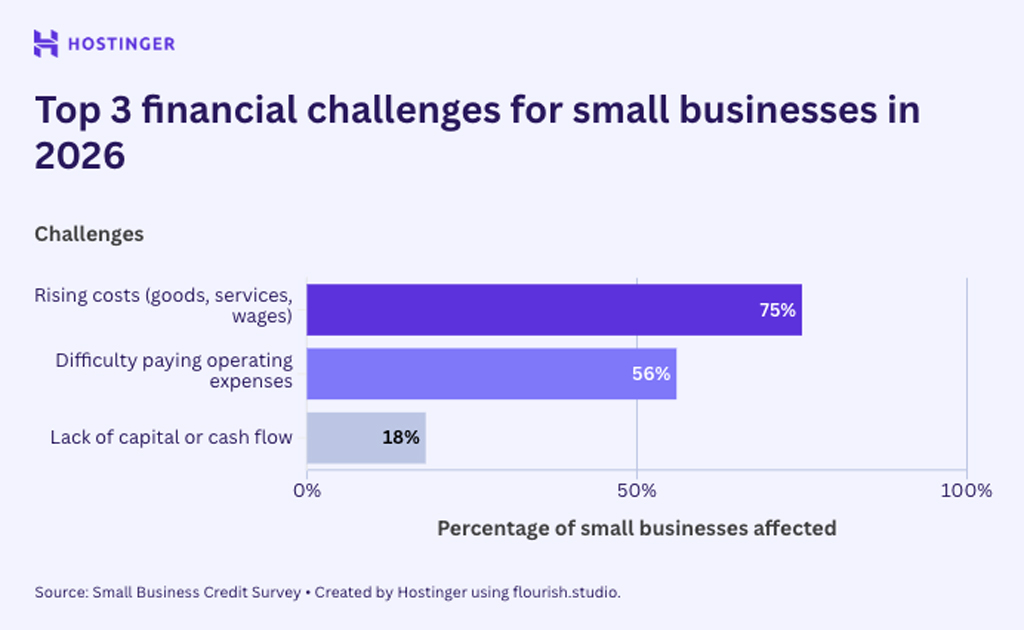
- Rising costs (goods, services, and wages) are the biggest challenge, affecting 75% of small businesses, highlighting widespread inflationary pressure.
- A significant 56% of businesses report difficulty paying operating expenses, indicating ongoing cash flow strain in day-to-day operations.
- Only 18% of small businesses cite lack of capital or cash flow as a primary issue, suggesting funding access is less critical than cost management.
- The gap between rising costs (75%) and cash flow issues (18%) shows that expense inflation, not just liquidity, is the dominant concern.
- More than 3 out of 4 businesses are impacted by cost increases, making it the most urgent financial pressure point in 2026.
- Over half of small businesses (56%) struggling with operating expenses signals potential risks to profitability and sustainability.
- The relatively lower 18% reporting capital shortages may reflect improved access to financing, but not necessarily improved financial stability.
- Combined, these challenges indicate that short-term financial management, especially controlling costs, is more critical than long-term funding strategies.
Inflation Impact on Small Businesses
- About 92% of small businesses experienced increased costs due to inflation in 2025.
- Nearly 70% raised prices to offset inflation-related expenses.
- Around 54% reported reduced profit margins because of rising costs.
- Energy costs increased by over 15% year-over-year for small firms.
- Approximately 60% of SMBs expect inflation to remain a concern in 2026.
- About 48% reduced discretionary spending to maintain financial stability.
- Wage inflation led over 45% of businesses to increase employee salaries.
- Nearly 30% of small businesses delayed expansion plans due to inflation.
- Businesses in food services saw cost increases of up to 20% in raw materials.
Marketing and Social Media Usage
- Around 77% of small businesses use social media for marketing.
- Facebook remains the top platform, used by over 70% of SMBs.
- About 64% of small businesses invest in digital marketing.
- Email marketing delivers an average ROI of $36 for every $1 spent.
- Nearly 49% of small businesses rely on organic search traffic for customer acquisition.
- Around 28% allocate over 20% of their budget to marketing efforts.
- Video marketing adoption reached over 60% among SMBs in 2025.
- Local SEO drives 46% of all Google searches with local intent.
- About 30% of small businesses still lack a formal marketing strategy, limiting growth potential.
Small Businesses Pricing Strategy Trends
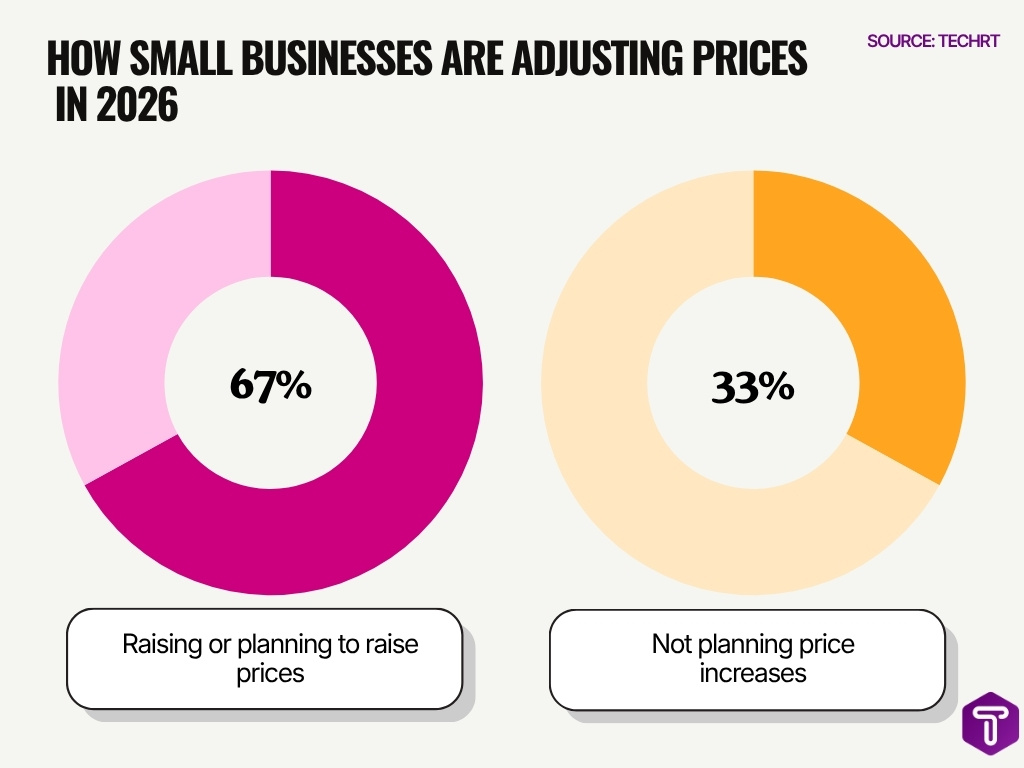
- A significant 67% of small businesses are raising or planning to raise prices, indicating strong inflationary or cost-driven pressure across the sector.
- Only 33% of businesses report no plans for price increases, showing that holding prices steady is now the minority strategy.
- The data suggests that price adjustments have become the norm, with over two-thirds of businesses actively responding to rising operational costs.
- This trend highlights a broader shift toward price optimization and margin protection rather than absorbing cost increases.
- The relatively smaller 33% segment may represent businesses with stable supply chains, higher margins, or competitive pricing strategies.
- With a sample size of approximately 900 respondents, the findings provide a statistically reliable snapshot of current pricing behavior.
- The ±3.3 percentage point margin of error indicates a high confidence level, reinforcing the credibility of the trend.
- Overall, the data reflects a proactive pricing environment in 2026, where most small businesses are adapting quickly to economic pressures.
Technology Adoption and AI Tools
- Approximately 58% of small businesses use AI tools in 2025, up from 40% in 2024.
- Around 65% of SMBs have adopted cloud-based solutions for operations.
- AI-driven customer service tools reduced response times by up to 30%.
- About 47% of businesses use automation tools for marketing and operations.
- Cybersecurity investment increased by over 25% among SMBs.
- Roughly 70% of small businesses use accounting software like QuickBooks or Xero.
- E-signature and digital documentation tools adoption grew by 35% year-over-year.
- About 52% of SMBs say technology improves productivity significantly.
- AI-powered analytics tools helped increase decision-making speed by 20%.
E-Commerce Statistics
- Around 73% of small businesses had a website in 2025.
- E-commerce accounts for over 19% of total retail sales globally.
- About 28% of SMB revenue comes from online sales channels.
- Mobile commerce contributes over 60% of online transactions.
- Nearly 50% of small businesses sell through online marketplaces like Amazon or Etsy.
- Businesses with e-commerce capabilities grow revenue 2x faster than offline-only firms.
- Around 80% of consumers research products online before purchasing.
- Social commerce sales are expected to grow by over 25% annually through 2026.
- Subscription-based e-commerce models grew by over 60% in the past five years.
Small Business Owner Happiness Trends
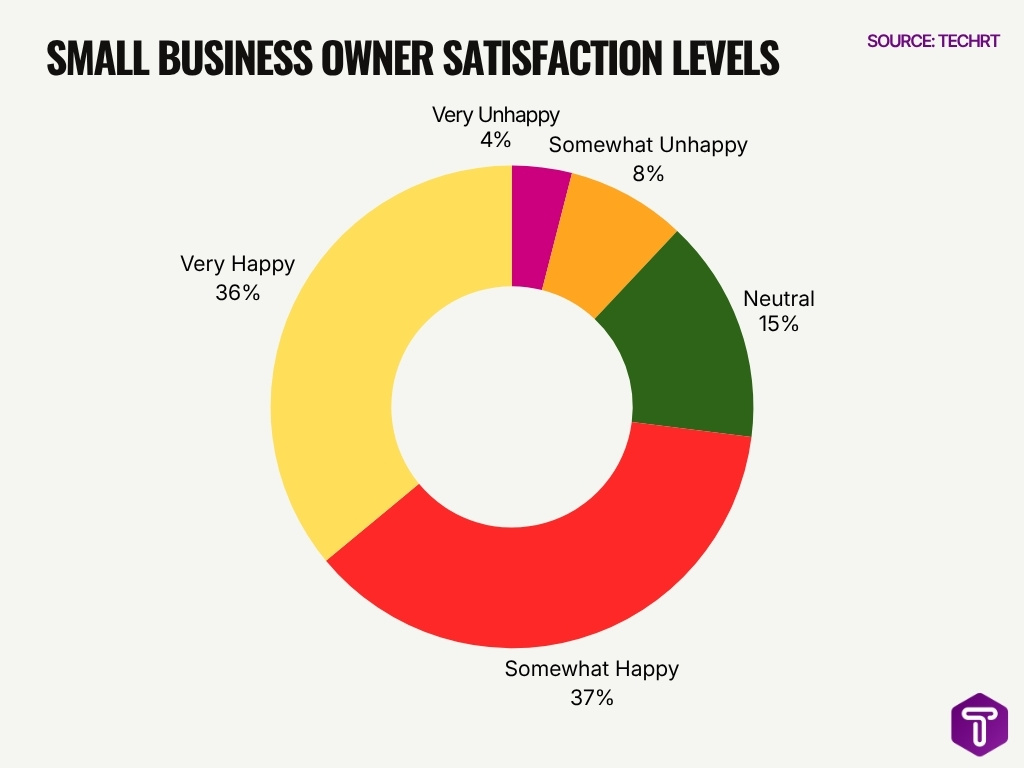
- A strong majority of small business owners report positive sentiment, with 73% saying they are either somewhat happy (37%) or very happy (36%) with their businesses.
- Only a small fraction expresses dissatisfaction, with just 12% identifying as unhappy (4% very unhappy and 8% somewhat unhappy).
- A notable 15% of respondents remain neutral, indicating a segment that may be uncertain or experiencing mixed results.
- The near-equal split between somewhat happy (37%) and very happy (36%) suggests consistent satisfaction rather than extreme optimism.
- The relatively low very unhappy rate (4%) highlights that severe dissatisfaction among business owners is uncommon.
- Overall, the data shows that nearly three out of four owners (73%) feel positively about their business performance and experience.
- The combined unhappy and neutral group (27%) represents a significant minority, pointing to areas where support, resources, or market conditions could be improved.
- The findings indicate a generally healthy entrepreneurial sentiment, despite common challenges faced by small businesses.
Future Growth Trends
- About 74% of small business owners expect revenue growth in 2026.
- Nearly 60% plan to expand operations or launch new products.
- AI adoption is projected to exceed 70% among SMBs by 2027.
- Digital payments are expected to account for over 80% of transactions by 2026.
- Around 45% of small businesses plan to hire new employees in 2026.
- Sustainability initiatives are being adopted by over 50% of SMBs.
- Remote and hybrid work models are used by over 38% of small businesses.
- Small businesses investing in technology report 30% faster growth rates.
- Nearly 35% of entrepreneurs plan to enter new markets internationally.
Frequently Asked Questions (FAQs)
How many small businesses are there in the US in 2026?
There are 36.2 million small businesses in the United States as of 2026.
What percentage of all US businesses are small businesses?
Small businesses make up 99.9% of all US businesses.
How many people do small businesses employ in the US?
Small businesses employ 62.3 million people, accounting for 45.9% of the private workforce.
How many new jobs do small businesses create annually?
Small businesses create approximately 1.2 million net new jobs per year.
What share of US GDP comes from small businesses?
Small businesses contribute about 43.5% of total US GDP.
Conclusion
Small businesses continue to anchor the US economy, contributing significantly to employment, innovation, and local development. Their ability to adapt quickly allows them to respond to changing consumer behavior, adopt new technologies, and explore emerging markets more efficiently than larger organizations.
While challenges such as inflation, hiring constraints, funding limitations, and operational costs persist, many businesses are actively navigating these pressures through technology adoption, digital marketing, and e-commerce expansion. At the same time, increasing diversity among business owners and the rise of solo entrepreneurship signal a shift toward a more inclusive and flexible business environment.
Looking ahead, the data points to a future shaped by resilience, digital transformation, and steady growth. For entrepreneurs, investors, and policymakers, these insights offer a clear view of where small businesses stand today and where they are headed in the coming years.

Leave a comment
Have something to say about this article? Add your comment and start the discussion.