


Smartphones have evolved from communication tools into essential digital hubs that power daily life. People now rely on them to manage banking, stream entertainment, navigate cities, and work remotely. Businesses also depend on smartphone behavior data to shape mobile commerce, app engagement, and digital marketing strategies. Understanding how people use smartphones helps companies design better products, optimize mobile experiences, and reach consumers where they spend the most time, on their phones. Let’s explore the latest smartphone usage statistics shaping digital behavior.
Editor’s Choice
- There were 5.78 billion unique mobile users worldwide in 2025, representing 70.1% of the global population.
- The average person spends 4 hours and 37 minutes per day on their smartphone globally.
- Americans check their phones about 186 times per day in 2025, down slightly from 205 times in 2024.
- Global smartphone users collectively spend roughly 70 days per year looking at their phones.
- 46% of smartphone users spend more than 5 hours daily on their devices.
- 66% of people worldwide say they cannot live without their smartphones, highlighting deep digital dependence.
- About 71% of people check their phone within 10 minutes of waking up, indicating strong morning usage habits.
Recent Developments
- Global smartphone shipments grew about 2% in 2025, reflecting recovering demand after previous slowdowns.
- Apple captured about 20% of the global smartphone market share in 2025, leading the market.
- Samsung held approximately 19% global market share, remaining a close competitor in 2025.
- Xiaomi maintained around 13% global smartphone market share due to strong demand in emerging markets.
- Around 37% of smartphones shipped in 2026 are expected to include generative AI capabilities, signaling a shift toward AI-powered devices.
- Foldable smartphones continue gaining traction as premium devices despite still representing a small portion of total shipments.
- Satellite connectivity features are expanding beyond emergency messaging into broader mobile coverage scenarios.
- Global memory chip shortages may influence smartphone innovation cycles and pricing in 2026 and beyond.
- Manufacturers increasingly prioritize AI processing and advanced battery technology to support new smartphone features.
Daily Smartphone Usage Statistics by Age Group
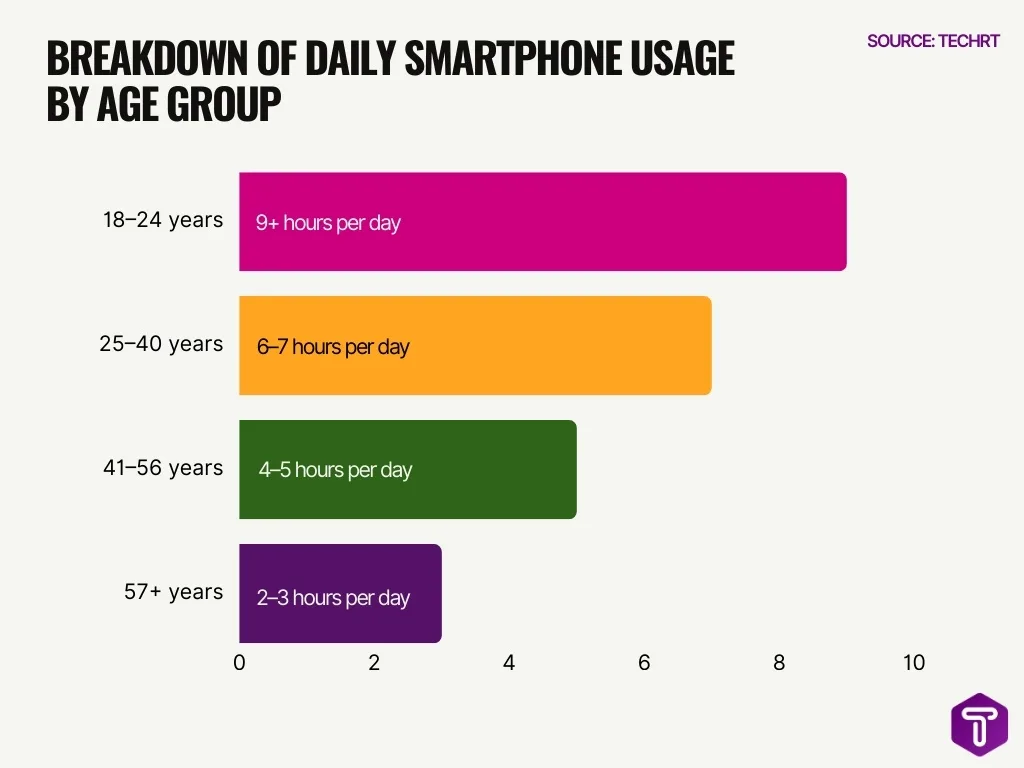
- Gen Z (18–24 years) records the highest smartphone usage, spending 9+ hours per day on their devices on average.
- Millennials (25–40 years) use smartphones for around 6–7 hours daily, making them the second most active mobile users.
- Gen X (41–56 years) spends approximately 4–5 hours per day on smartphones, reflecting moderate digital engagement compared to younger generations.
- Baby Boomers (57+ years) show the lowest smartphone usage, averaging only 2–3 hours daily on mobile devices.
- Overall, smartphone usage declines with age, dropping from 9+ hours among Gen Z to just 2–3 hours among Baby Boomers, highlighting a clear generational gap in mobile behavior.
- Younger users tend to use smartphones more for social media, streaming, gaming, and messaging, while older generations primarily use them for communication, browsing, and essential apps.
Smartphone Adoption and Penetration
- As of 2025, 70.1% of the world’s population owns a mobile phone, reflecting near-global adoption.
- The number of mobile users grew by 108 million between 2024 and 2025, showing steady adoption.
- The United States has one of the highest smartphone penetration rates, with over 85% of adults owning a smartphone.
- Globally, smartphone ownership continues to expand in developing regions as mobile internet becomes more affordable.
- Nearly one-quarter of children own a cellphone by age 8 in some developed markets.
- Around 40% of children have access to a tablet by age 2, signaling early device exposure.
- Smartphone penetration in many developed markets now exceeds 90% among adults aged 18–49.
- Mobile devices now account for nearly half of all daily digital screen time globally.
- Smartphone adoption continues to grow fastest in Asia, Africa, and Latin America, where mobile internet often replaces desktop access.
Global Smartphone User Growth Over Time
- The world had roughly 5.78 billion mobile users in 2025, up from about 5.67 billion in 2024.
- Mobile user growth increased by 1.9% year over year in 2025.
- Smartphone usage has expanded rapidly since 2013, when global screen time was significantly lower than today’s levels.
- Global digital screen time now averages 6 hours and 45 minutes per day, across all connected devices.
- Mobile phones account for roughly 3 hours and 46 minutes of daily screen time worldwide.
- Computer usage averages about 2 hours and 51 minutes daily, indicating smartphones dominate digital access.
- Since 2013, daily digital screen time has increased by more than 50 minutes globally.
- Smartphone use continues to grow fastest in developing regions, where mobile networks provide the primary internet connection.
- Global mobile usage time climbed to roughly 4.9 hours per day in 2025, highlighting rising engagement levels.
Smartphone Usage by Region and Country
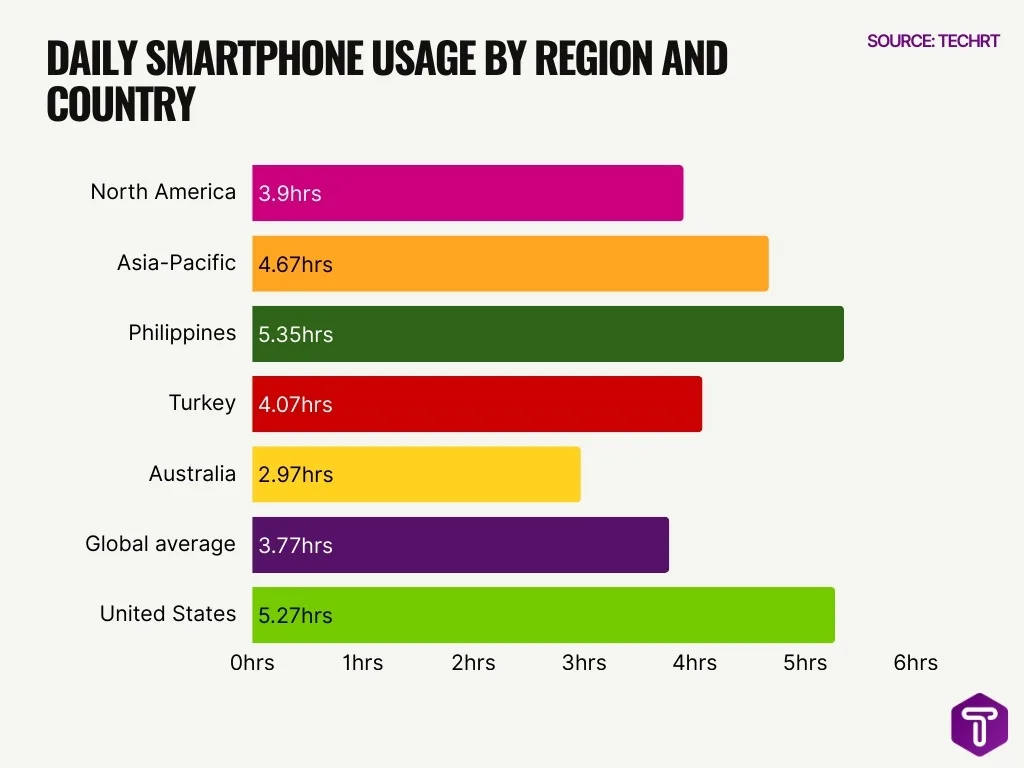
- North America averages 3 hours 54 minutes of daily smartphone usage, leading regional figures.
- United States users spend an average of 5 hours 16 minutes daily on smartphones.
- The US ranks with 3 hours 22 minutes daily smartphone screen time in global surveys.
- Asia-Pacific leads regions at 4 hours 40 minutes average daily smartphone usage.
- The Philippines tops countries with over 5 hours and 21 minutes of daily smartphone time.
- Turkey averages 4 hours 4 minutes of daily smartphone usage, high globally.
- Southeast Asia contributes over 8% to the global smartphone market share in 2025.
- Australia shows a moderate 2 hours and 58 minutes of daily mobile screen time.
- Global average smartphone usage stands at 3 hours 46 minutes per day.
- China has 974.69 million smartphone users, penetration at 68.4%.
Time Spent on Smartphones Per Day
- The global average smartphone usage reached 4 hours and 37 minutes per day in 2025, up slightly from 4 hours and 25 minutes in 2024.
- Americans spend about 5 hours and 16 minutes daily on their smartphones, one of the highest averages globally.
- Mobile users worldwide collectively spend over 8 trillion hours per year on smartphones.
- About 46% of smartphone users spend more than 5 hours per day on their devices.
- The typical user spends around 70 days per year actively using their smartphone.
- Daily smartphone usage increased by roughly 30 minutes compared with pre-2020 levels.
- Younger users aged 18–24 spend an average of nearly 6 hours daily on their smartphones.
- Smartphone usage typically peaks during evening hours between 7 PM and 10 PM, when entertainment and social media activity increase.
- Approximately 30% of users report feeling they spend too much time on their phones, indicating growing awareness of digital habits.
Frequency of Smartphone Checks and Sessions
- Americans check their phones about 186 times per day on average in 2025, reflecting frequent micro-interactions.
- Globally, the average smartphone user unlocks their phone around 80 to 100 times per day.
- The typical smartphone session lasts approximately 1 minute and 15 seconds, reflecting quick bursts of usage.
- Users initiate over 2,600 touch interactions daily, including taps, swipes, and typing actions.
- Around 71% of people check their phone within 10 minutes of waking up.
- Nearly 50% of users check their smartphones during the night after going to sleep.
- Roughly 60% of smartphone sessions last less than 30 seconds, showing that most interactions are brief.
- Users typically engage in more than 50 app sessions per day, depending on their usage habits.
- Notifications trigger over half of smartphone checks, demonstrating the influence of push alerts.
Smartphone Ownership Among Kids by Age
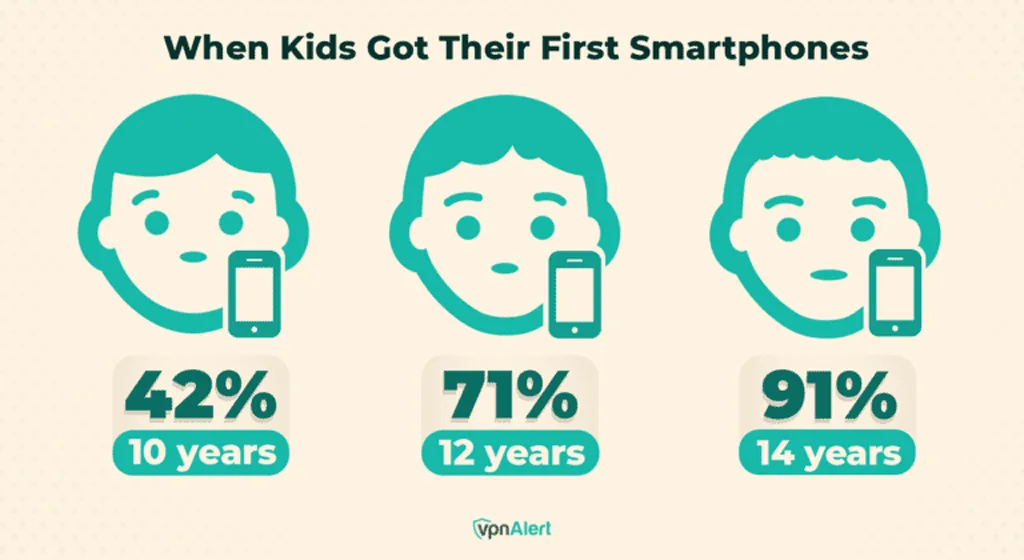
- Around 42% of children receive their first smartphone by the age of 10, showing that a significant portion of kids gain access to mobile devices during late elementary school.
- By 12 years old, smartphone adoption rises sharply, with 71% of kids already owning their first smartphone, indicating that middle school is a key stage for mobile device adoption.
- Smartphone ownership becomes nearly universal during early teenage years, as 91% of children have their first smartphone by age 14.
- The data highlights a rapid increase of 49 percentage points between ages 10 and 14, demonstrating how quickly smartphone access expands during adolescence.
- Overall, the statistics suggest that most kids obtain their first smartphone between the ages of 12 and 14, marking this age range as the primary adoption window for youth smartphone ownership.
Smartphone Screen Time Trends
- Global screen time across devices averages 6 hours and 45 minutes per day, with smartphones accounting for the largest share.
- Smartphone screen time has increased by more than 50 minutes globally since 2013.
- Mobile devices account for approximately 58% of total digital screen time worldwide.
- In the United States, daily screen time averages 6 hours and 40 minutes across devices.
- Teens report spending over 8 hours daily on screens for entertainment, excluding school-related activities.
- Smartphone usage increased significantly during the pandemic and has remained elevated through 2025.
- Video consumption now accounts for the largest portion of smartphone screen time globally.
- Productivity and communication apps saw double-digit growth in engagement between 2024 and 2025.
- Many users now spend over one-third of their waking hours interacting with digital screens, including smartphones.
Smartphone Usage by Activity
- Social media represents about 35% of total smartphone usage time globally.
- Messaging apps account for roughly 20% of mobile engagement worldwide.
- Mobile gaming generates over 50% of global gaming revenue, highlighting its dominance in the gaming industry.
- Video streaming apps represent one of the fastest-growing smartphone activities, especially among Gen Z users.
- Mobile web browsing accounts for more than 60% of global web traffic.
- Navigation apps like GPS services see peak usage during commuting hours.
- Fitness and health apps experienced over 25% growth in engagement between 2023 and 2025.
- Educational app usage increased significantly as smartphones support mobile learning and remote education.
- News consumption via mobile devices continues to rise, with over half of digital news traffic coming from smartphones.
Smartphone Usage for Internet Access vs Other Devices
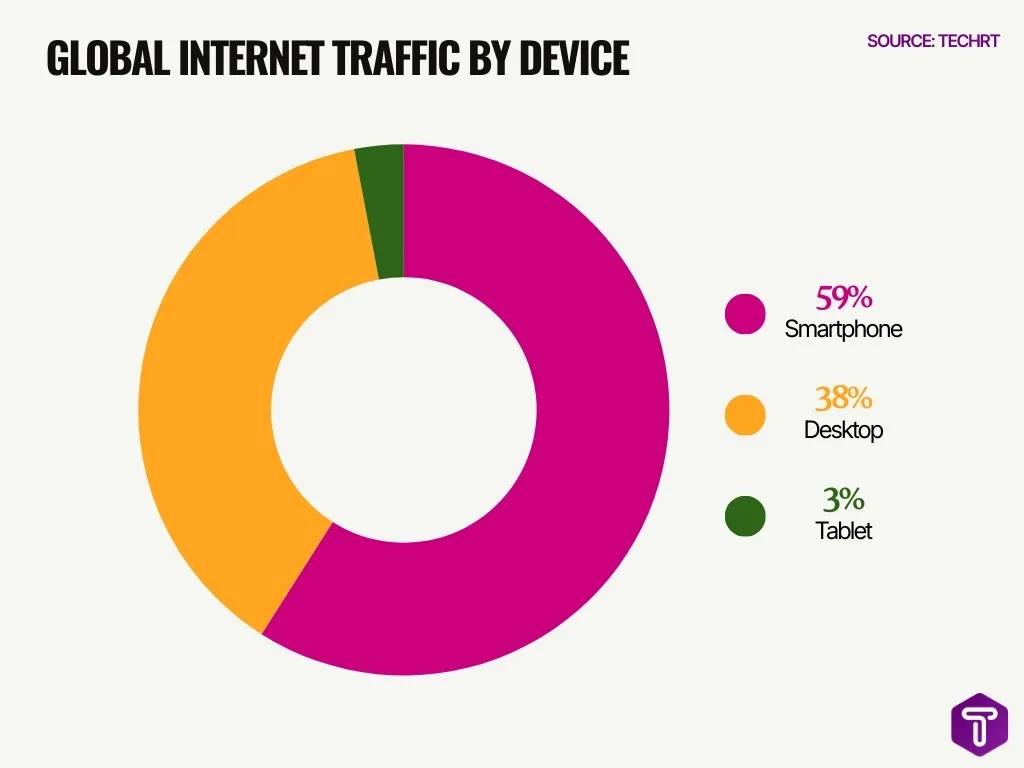
- Smartphones account for about 59% of global website traffic, making them the primary internet access device.
- Desktop devices represent roughly 38% of global web traffic, significantly lower than smartphones.
- Tablets account for only around 3% of global internet traffic.
- In the United States, 85% of adults access the internet using a smartphone.
- Approximately 15% of Americans rely primarily on smartphones for internet access, especially in lower-income households.
- Mobile-first internet usage dominates in developing regions where desktop infrastructure is limited.
- Mobile search queries now account for more than 60% of all search queries worldwide.
- E-commerce browsing increasingly happens on mobile, with over 70% of retail website visits coming from smartphones.
- Mobile internet speeds improved significantly with 5G adoption expanding worldwide since 2024.
Smartphone Usage for Social Media and Messaging
- There were 5.24 billion social media users worldwide in 2025, most accessing platforms via smartphones.
- The average user spends 2 hours and 23 minutes per day on social media, mostly through mobile apps.
- Around 98% of social media users access platforms via smartphones.
- Messaging apps account for billions of daily interactions globally.
- Over 3 billion people use WhatsApp monthly, making it the world’s largest messaging platform.
- Short-form social platforms have driven rapid engagement growth among users aged 16–34.
- Approximately 73% of US adults use YouTube on their smartphones.
- Social messaging apps now serve as primary communication tools for many younger users instead of traditional SMS.
- Social media notifications are among the most common triggers for smartphone interactions.
Smartphone Video Streaming and Short-Form Content Usage
- Mobile video accounts for over 60% of total online video views worldwide.
- The average user spends about 1 hour and 19 minutes daily watching online videos on mobile devices.
- Short-form video platforms have experienced double-digit user growth between 2023 and 2025.
- Over 70% of YouTube watch time comes from mobile devices.
- TikTok users spend an average of 95 minutes per day on the platform, one of the highest engagement rates among apps.
- Mobile streaming apps account for a large portion of global entertainment consumption.
- Live streaming usage on smartphones grew more than 20% between 2023 and 2025.
- Vertical video formats now dominate short-form content consumption on smartphones.
- Mobile video advertising spending surpassed $190 billion globally in 2025, reflecting massive audience engagement.
Smartphone Ownership Increases With Higher Income Levels
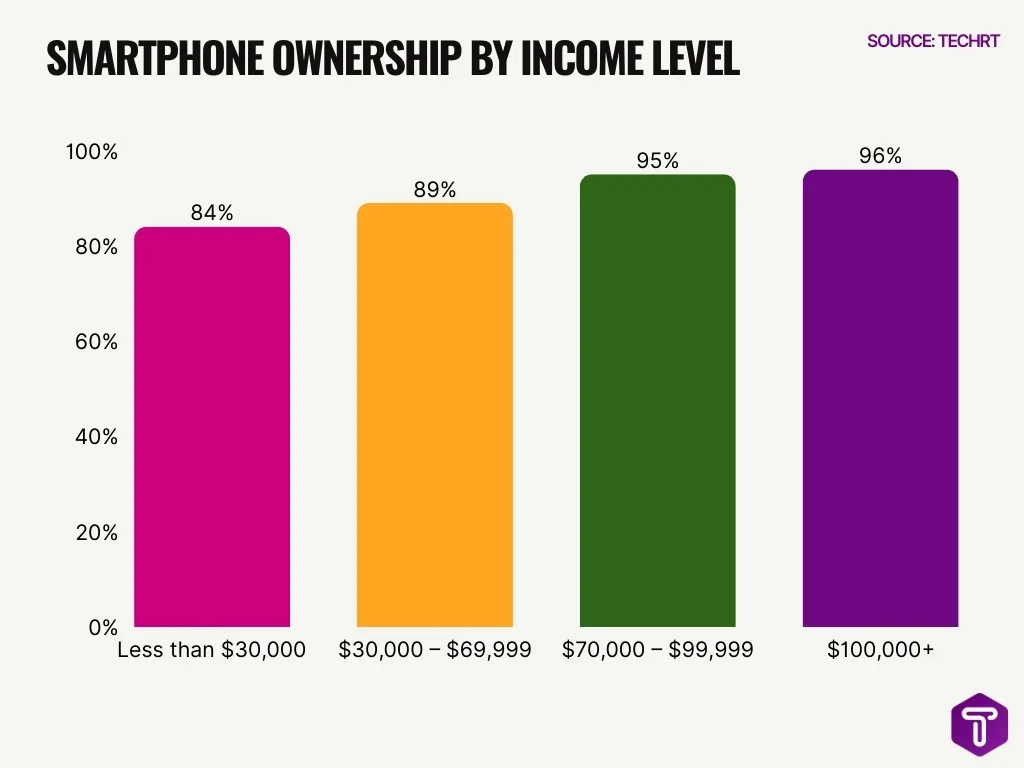
- Smartphone adoption rises significantly with income. Among individuals earning less than $30,000, about 84% own a smartphone, while 10% still rely on non-smartphone mobile phones.
- In the $30,000–$69,999 income group, smartphone ownership increases to 89%, while 8% use basic mobile phones instead of smartphones.
- Higher-income households show near-universal smartphone adoption. Among people earning $70,000–$99,999, approximately 95% own a smartphone, leaving only 3% using non-smartphone devices.
- The $100,000+ income group has the highest smartphone ownership rate at 96%, with just 2% using traditional mobile phones.
- Overall phone ownership remains extremely high across all income groups, ranging from 95% among lower-income households to 99% among higher-income groups.
- The data indicates a clear income-based digital gap, where lower-income users are more likely to depend on basic phones, while higher-income groups overwhelmingly use smartphones.
Mobile App Usage and Engagement on Smartphones
- Global consumers downloaded 257 billion mobile apps in 2023, and downloads remained above 250 billion annually through 2024–2025.
- Users spent approximately $171 billion on mobile apps in 2023, showing continued growth in mobile app economies.
- The average smartphone user actively uses 9–10 apps per day and around 30 apps per month.
- Mobile apps account for about 88% of total smartphone usage time, while mobile web browsing represents the remaining share.
- The typical smartphone user spends over 3 hours per day using mobile apps.
- Gaming apps dominate engagement, generating more than 50% of global gaming revenue.
- The Apple App Store hosted roughly 1.8 million apps in 2025, while Google Play offered more than 3.5 million apps globally.
- Mobile app usage increased during 2024–2025 due to growth in productivity, finance, and health apps.
- Around 21% of millennials open an app more than 50 times per day, demonstrating high engagement among younger users.
5G Smartphone Adoption and Usage Patterns
- Global 5G subscriptions surpassed 1.6 billion in 2023 and are expected to exceed 5 billion by 2029.
- By 2025, more than 30% of smartphone connections globally are expected to use 5G networks.
- 5G smartphone shipments accounted for over 50% of global smartphone shipments in 2024.
- North America has one of the highest 5G adoption rates, with more than 60% of mobile connections expected to use 5G by 2026.
- Faster speeds from 5G networks enable higher mobile video consumption and cloud gaming usage.
- 5G networks deliver up to 10 times faster speeds than typical 4G connections, depending on network conditions.
- Mobile operators invested hundreds of billions of dollars globally in 5G infrastructure between 2020 and 2025.
- Emerging markets are rapidly expanding 5G coverage, with India becoming one of the fastest-growing 5G markets in 2024–2025.
- Many new flagship smartphones released since 2024 include 5G connectivity as a standard feature.
Smartphone Usage While Shopping In-Store: Key Consumer Behavior Insights
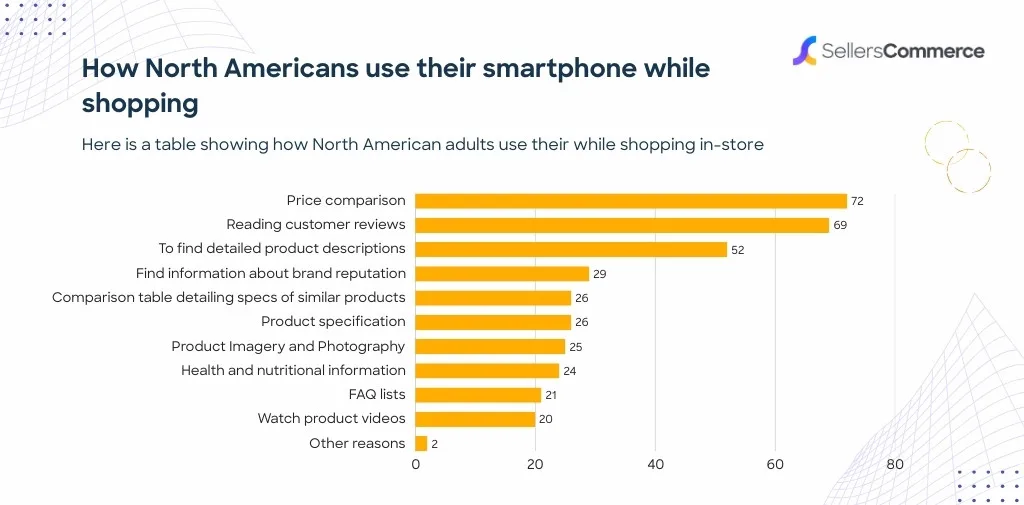
- Price comparison is the most common activity, with 72% of North American shoppers using their smartphones in-store to check prices before making a purchase decision.
- Customer reviews play a critical role in purchase decisions, as 69% of shoppers read reviews on their smartphones while browsing products in physical stores.
- More than half of consumers research product details, with 52% using their smartphones to find detailed product descriptions while shopping.
- Brand reputation matters for nearly one-third of shoppers, as 29% check brand information on their smartphones before deciding to buy.
- Technical comparisons are a common research behavior, with 26% of shoppers viewing comparison tables of similar products and another 26% checking product specifications while in-store.
- Visual information helps guide purchasing decisions, with 25% of consumers viewing product images and photography on their smartphones while shopping.
- Health and nutritional information influences buying choices, as 24% of shoppers look up health-related product details during in-store visits.
- Quick answers matter for shoppers, with 21% accessing FAQ sections on their smartphones to resolve questions about products.
- Video content also supports buying decisions, with 20% of consumers watching product videos while standing inside retail stores.
- Only 2% of shoppers use smartphones for other miscellaneous reasons, indicating that most smartphone usage during in-store shopping is focused on product research and decision-making.
Smartphone Security, Privacy, and Data Sharing Behavior
- Around 81% of Americans feel they have little or no control over the data companies collect about them.
- Approximately 72% of smartphone users worry about their personal data being tracked online.
- Nearly 60% of users say they rarely read privacy policies before installing mobile apps.
- About 43% of smartphone users regularly review app permissions before downloading apps.
- Mobile phishing attacks increased by over 50% between 2022 and 2024, targeting smartphone users through messaging apps.
- Biometric security, such as fingerprint and facial recognition, is now used by more than 70% of smartphone owners.
- Mobile malware attacks represented roughly 30% of global cyberattacks targeting consumer devices in 2024.
- About 52% of smartphone users use two-factor authentication for online accounts.
- Many users share personal data through mobile apps in exchange for personalized services and convenience.
Smartphone Usage in Emerging Markets
- Smartphone adoption in emerging economies has grown rapidly, with over 85% of adults in some developing countries now owning smartphones.
- India surpassed 750 million smartphone users in 2024, making it one of the world’s largest smartphone markets.
- Africa’s smartphone penetration is expected to reach around 65% by 2025, up significantly from previous years.
- Affordable Android devices priced below $200 dominate emerging smartphone markets.
- Mobile internet often serves as the primary internet access method in developing countries, replacing desktop access.
- Mobile payment adoption in countries like Kenya and India has accelerated due to digital wallet ecosystems.
- Social media usage in emerging markets continues to grow rapidly due to mobile-first internet access.
- Governments and telecom companies are investing heavily in expanding mobile broadband infrastructure.
- Smartphone usage supports digital education, telemedicine, and financial inclusion in many developing regions.
Future Trends in Smartphone Usage and Behavior
- Global smartphone subscriptions will exceed 7.9 billion by 2028.
- GenAI smartphone shipments are forecasted at 912 million units in 2028.
- Foldable smartphone shipments are expected to hit 70 million units by 2027.
- Mobile gaming market projected to reach $256 billion by 2030.
- AI-enabled smartphones will comprise 70% of sales by 2029.
- The digital health tracking apps market is expected to grow to $68 billion by 2034.
- Foldable market penetration nears 5% of smartphones by 2028.
- 6G commercial systems are anticipated by 2030 for faster connectivity.
- Over 60% of US smartphones sold in 2025 include digital wellbeing tools.
- Smartwatch health data syncs with apps used by 80% of users.
Frequently Asked Questions (FAQs)
How many smartphone users are there worldwide in 2025?
How many smartphones are expected to exist worldwide by 2026?
How much time do people spend on smartphones each day on average?
What percentage of Americans own a smartphone today?
How often do people check their smartphones daily?
Conclusion
Smartphones continue to reshape how people communicate, work, shop, and consume entertainment. With billions of users worldwide and rapidly evolving technologies such as 5G connectivity, AI-powered features, and mobile commerce, smartphones now function as the primary digital gateway for much of the global population. Businesses increasingly design services with a mobile-first approach, while consumers rely on their devices for everything from payments to video streaming. As smartphone adoption expands in emerging markets and new technologies redefine mobile capabilities, smartphone usage will remain a central force driving digital transformation worldwide.

Leave a comment
Have something to say about this article? Add your comment and start the discussion.