




Social media marketing now drives how brands connect, sell, and grow in a digital-first economy. From retail brands using Instagram for product discovery to SaaS companies generating leads on LinkedIn, social platforms shape modern marketing strategies. With billions of users and rising ad investments, understanding the latest data helps marketers make smarter decisions. Let’s explore the most important social media marketing statistics.
Editor’s Choice
- 5.66 billion people worldwide use social media in 2026, representing nearly 69% of the global population.
- Social media usage grew by 4.87% in 2025, adding over 259 million new users.
- The average user spends about 2 hours and 40 minutes daily on social platforms.
- Global social media ad spend reached approximately $276.7 billion in 2025.
- 76% of users say social media content influences their purchase decisions.
- 82% of consumers now use social media for product discovery.
- Users actively switch between 6–7 platforms per month, reflecting multi-platform engagement.
Recent Developments
- Social media user identities reached 5.66 billion in late 2025, showing continued rapid growth.
- The social media ad market is projected to grow 12% in 2025, driven by digital-first campaigns.
- Brands published an average of 9.5 posts per day across platforms in 2024.
- Influencer partnerships are increasing, with 59% of marketers planning more collaborations in 2025.
- Social media is shifting from distribution to discovery-first platforms, especially on TikTok and Instagram.
- TikTok ad revenue reached $23 billion in 2025, up from $18 billion in 2024.
- AI-driven advertising tools are expanding, with automated ad creation and targeting.
- Global digital ad spending surpassed $1.14 trillion in 2025, fueled by AI adoption.
- Social platforms now act as primary search tools, with nearly 40% of Gen Z preferring TikTok for search.
Social Media Market Growth Trends
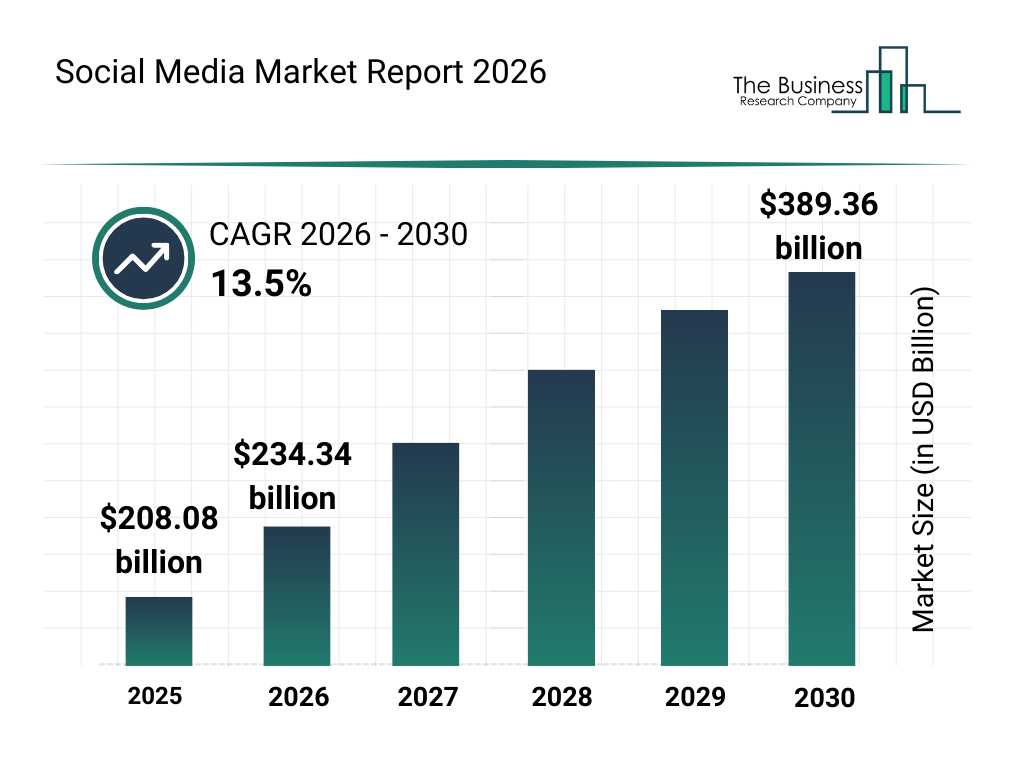
- The global social media market is projected to grow from $208.08 billion in 2025 to $389.36 billion by 2030, showing strong long-term expansion.
- In 2026, the market is expected to reach $234.34 billion, reflecting steady year-over-year growth.
- The industry is forecasted to grow at a CAGR of 13.5% (2026–2030), indicating rapid and sustained momentum.
- Between 2025 and 2030, the market will add over $181 billion in value, highlighting increasing investment and adoption.
- The market shows a consistent upward trajectory, crossing approximately $300 billion by 2028 and $340 billion by 2029.
- The sharp rise toward $389.36 billion by 2030 signals the growing dominance of social platforms in digital advertising, commerce, and content consumption.
- This growth is largely driven by increasing global users, higher ad spend, influencer marketing expansion, and social commerce adoption.
Global Social Media Usage Statistics
- There are approximately 5.17 billion active social media users globally as of 2026.
- Around 63.7% of the global population uses social media.
- Social media added 282 million new users in 2024 alone.
- The U.S. alone has about 302 million social media users.
- Global penetration stands at roughly 63.9%, highlighting near-universal adoption.
- 93% of internet users access social media monthly.
- The average user maintains 7+ social media accounts.
- Social media users grew from 2.08 billion in 2015 to over 5.6 billion in 2026, showing long-term expansion.
- By 2027, global users are projected to reach 6 billion, indicating sustained growth.
User Demographics and Audience Insights
- The 25–34 age group represents the largest share of global social media users at around 31–37% across major platforms.
- 56.6% of Facebook users worldwide are male, indicating a slight gender imbalance.
- 16–24-year-olds are the most active demographic, using social platforms 4.6 days/week for 3.5 hours/day.
- 57% of adults aged 65+ in the U.S. use Facebook, with 49% on YouTube.
- U.S. social media penetration reaches 73.2% of the population with 253.3 million users.
- 39% of consumers use social media for product research.
- Gen Z favors YouTube (91%), Instagram (86%), and TikTok (79%).
- Facebook dominates Gen X (88%) and Baby Boomers (88%) usage.
- India has over 491 million social media users, or 33.7% of its population.
- Global social media users total 5.66 billion, with 93.8% of internet users active.
Key Insights: Social Media Platform Priorities for Marketers in 2026
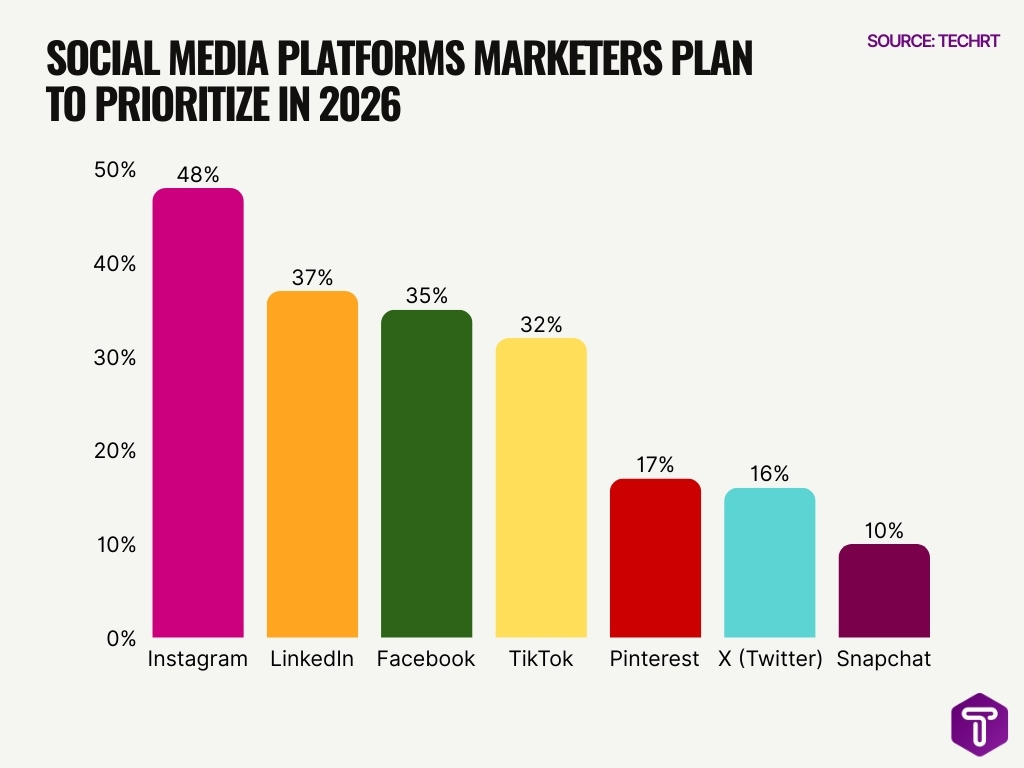
- Instagram leads the landscape, with 48% of marketers prioritizing it, making it the top platform for marketing focus in 2026.
- LinkedIn ranks second at 37%, highlighting its strong importance for B2B marketing and professional audiences.
- Facebook remains highly relevant, with 35% of marketers still prioritizing it despite growing competition from newer platforms.
- TikTok captures 32%, showing its rapid rise and strong appeal for short-form video and younger demographics.
- Pinterest (17%) and X (Twitter) (16%) fall into the mid-tier, indicating niche but valuable use cases in content discovery and real-time engagement.
- Snapchat ranks lowest at 10%, suggesting limited marketer focus compared to other major platforms.
- The gap between Instagram (48%) and Snapchat (10%) is 38 percentage points, showing a significant disparity in platform priority.
- The top four platforms (Instagram, LinkedIn, Facebook, TikTok) all exceed 30% adoption, indicating a clear concentration of marketing efforts on a few dominant platforms.
- Platforms focused on visual and video content (Instagram, TikTok) dominate, reinforcing the growing importance of visual-first marketing strategies.
- Lower-priority platforms still play a role, suggesting marketers are adopting a multi-channel strategy rather than relying on a single platform.
Time Spent on Social Media Platforms
- The average global user spends 2 hours and 23 minutes daily on social media in 2025, slightly down from 2:31 in 2024.
- U.S. users spend around 2 hours and 14 minutes per day on social platforms.
- TikTok leads engagement, with users spending an average of 34 hours per month on the app.
- YouTube users spend about 48.7 minutes per day on the platform.
- Instagram users spend approximately 30 minutes daily, driven by Reels consumption.
- Facebook usage time declined slightly, averaging 33 minutes per day in 2025.
- Gen Z users spend up to 4 hours daily across multiple platforms, the highest among all age groups.
- Users typically visit social platforms 6–7 times per day, reflecting frequent engagement.
- Short-form content consumption accounts for over 60% of total time spent on social apps.
Social Media Advertising Statistics
- Global social media ad spend reached $276.7 billion in 2025 and is projected to exceed $300 billion in 2026.
- Social media accounts for over 33% of total digital ad spending worldwide.
- The U.S. alone contributed $80+ billion in social ad spend in 2025.
- 83% of marketers use paid social advertising regularly.
- Facebook and Instagram together generate over 60% of social ad revenue globally.
- The average social media ad CTR is around 1.21%, varying by platform.
- Video ads generate 2x higher engagement rates than static ads.
- 71% of small businesses rely on social media ads for brand awareness.
- TikTok ad revenue surpassed $23 billion in 2025, growing rapidly year over year.
Influencer Marketing Statistics
- The influencer marketing industry reached $24 billion in 2025, up from $21.1 billion in 2024.
- 89% of marketers say influencer ROI is comparable to or better than other channels.
- Businesses earn an average of $5.78 for every $1 spent on influencer marketing.
- 67% of brands prefer working with micro-influencers due to higher engagement.
- Instagram remains the top influencer platform, used by over 80% of campaigns.
- TikTok influencer campaigns deliver engagement rates of 5–9%, higher than most platforms.
- 49% of consumers depend on influencer recommendations for purchase decisions.
- Long-term influencer partnerships increased by 42% in 2025, showing a shift toward brand loyalty.
- YouTube influencers generate the highest trust levels, with 70% of viewers trusting creator opinions.
Global Social Media Reach Statistics by Region
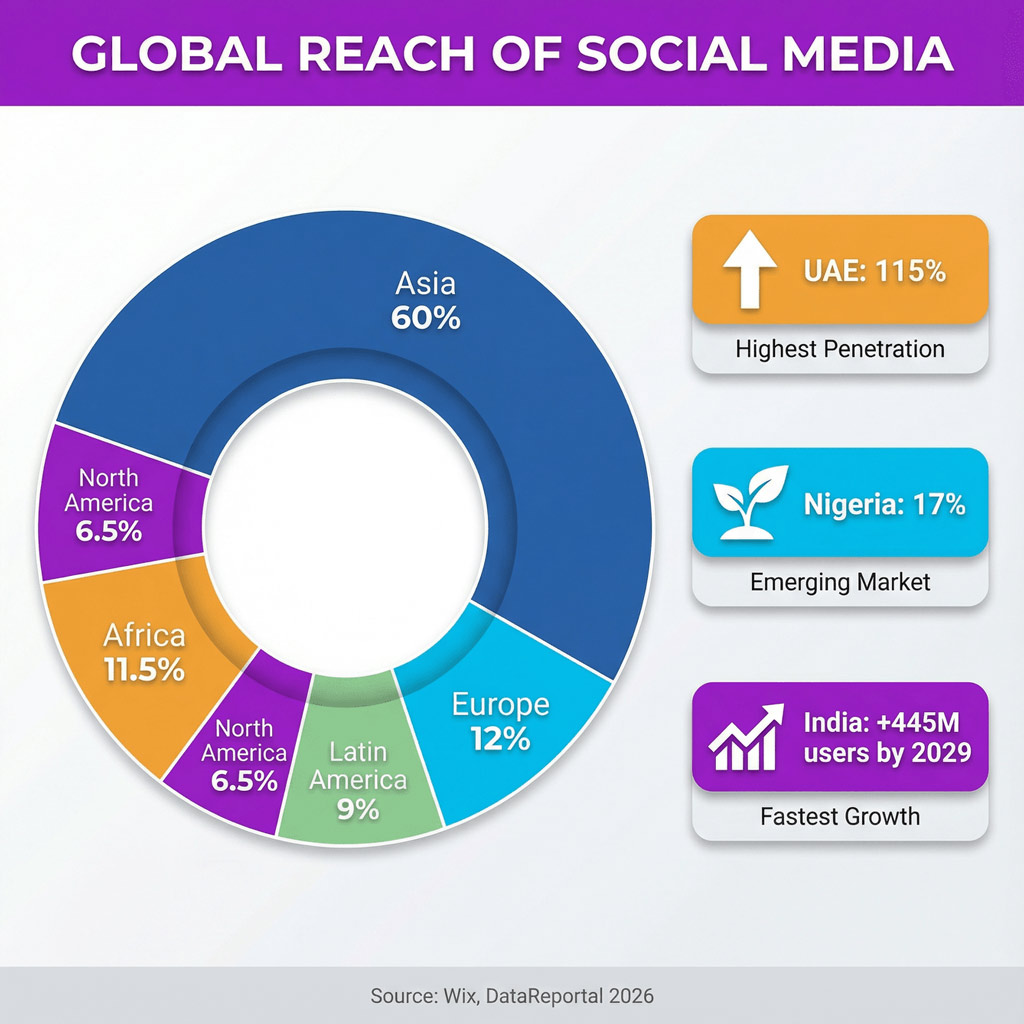
- Asia dominates global social media reach, accounting for a massive 60% share, making it the most influential region in terms of user base and engagement.
- Europe holds the second-largest share at 12%, reflecting a mature and highly saturated social media market.
- Africa contributes 11.5%, highlighting strong growth potential driven by increasing internet penetration and mobile adoption.
- Latin America accounts for 9%, showcasing steady adoption and high engagement levels across platforms.
- North America has a relatively smaller share of 6.5%, indicating a highly saturated market despite advanced digital infrastructure.
- The UAE leads globally in social media penetration at 115%, meaning users often maintain multiple accounts per person.
- Nigeria represents an emerging market with 17% penetration, signaling significant untapped growth opportunities.
- India is projected to add +445 million users by 2029, making it the fastest-growing social media market globally.
- Overall, emerging economies are driving the next wave of growth, while developed regions show saturation but high engagement maturity.
Content Performance and Engagement Rates
- Posts with images receive 2.3x more engagement than text-only posts.
- Video content generates 48% more engagement than other formats.
- Instagram Reels see engagement rates of 1.23% on average, outperforming standard posts.
- Facebook posts have an average engagement rate of 0.07% per post.
- Tweets (X posts) average engagement rates of 0.05%, making content quality critical.
- Carousel posts on Instagram drive 3x higher engagement than single-image posts.
- Content posted during peak hours can increase engagement by up to 30%.
- User-generated content increases engagement by 28% compared to brand content.
- Interactive content like polls and quizzes boosts engagement by up to 50%.
Video Marketing and Short-Form Content Trends
- 91% of businesses use video as a marketing tool in 2025.
- Short-form videos generate the highest ROI, according to over 30% of marketers.
- TikTok has over 1.7 billion monthly active users, driving short-form video growth.
- YouTube Shorts receives 70 billion daily views, showing massive adoption.
- Instagram Reels contribute to over 50% of the time spent on Instagram.
- Videos under 60 seconds have the highest completion rates.
- 78% of consumers prefer learning about products via short videos.
- Live video generates 3x longer watch time than pre-recorded content.
- Brands using video marketing grow revenue 49% faster than those that don’t.
Video Engagement Trends by Length in Social Media Marketing
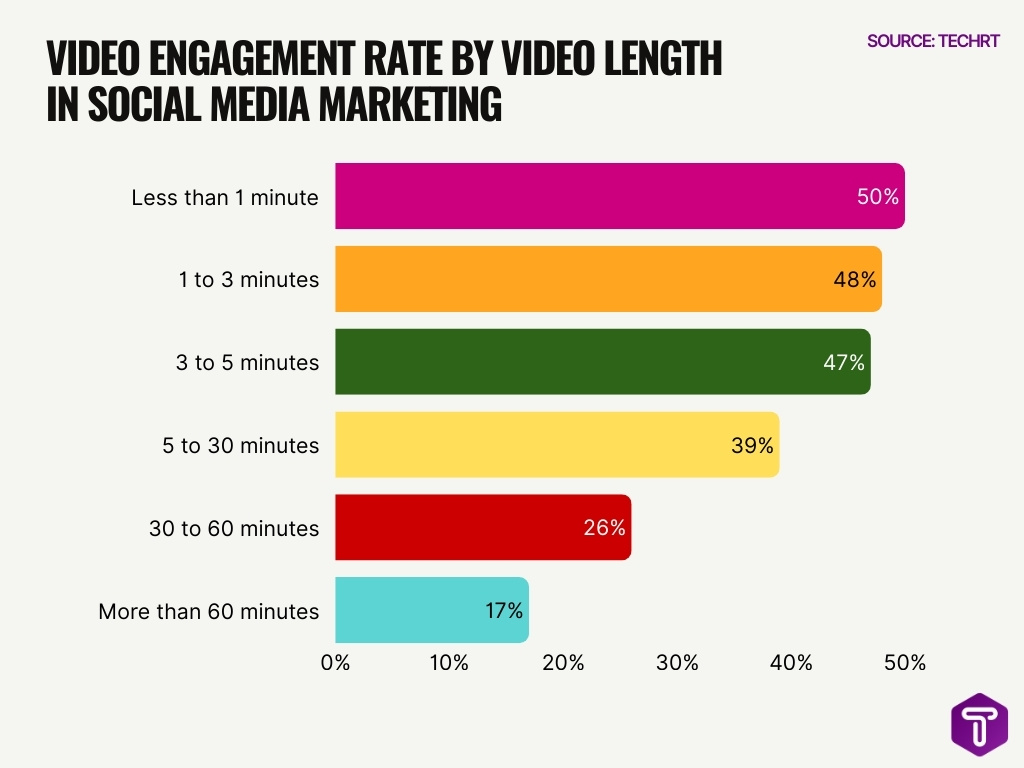
- Short-form videos dominate engagement, with videos under 1 minute achieving the highest rate at 50%, making them the most effective format for capturing audience attention.
- Videos in the 1 to 3 minutes range maintain strong performance at 48%, showing that slightly longer content can still retain high engagement if concise and valuable.
- Engagement remains relatively stable for 3 to 5 minute videos at 47%, indicating a gradual decline of only 3 percentage points from ultra-short videos.
- A noticeable drop occurs for mid-length content (5 to 30 minutes), where engagement falls to 39%, signaling reduced viewer retention as duration increases.
- Long-form videos (30 to 60 minutes) see a sharp decline, with engagement dropping to 26%, highlighting the challenge of maintaining attention over extended durations.
- The lowest engagement is observed in videos longer than 60 minutes at just 17%, representing a 33 percentage point drop compared to sub-1-minute videos.
- Overall, there is a clear inverse relationship between video length and engagement rate, reinforcing that shorter videos consistently drive higher interaction and retention in social media marketing strategies.
Social Commerce and Shopping Behavior
- Global social commerce sales reached $1.3 trillion in 2025.
- Social commerce is projected to hit $2.9 trillion by 2026, driven by mobile-first shopping.
- 79% of consumers have purchased on social media.
- Instagram influences 44% of shopping behaviors among users.
- TikTok drives impulse buying, with 55% of users purchasing after seeing products.
- Facebook Marketplace reaches over 1 billion users monthly.
- Social commerce conversion rates are about 2–3%, comparable to eCommerce benchmarks.
- 71% of consumers are more likely to buy based on social media referrals.
- Livestream shopping is growing rapidly, expected to account for 20% of eCommerce sales in key markets.
Mobile vs Desktop Social Media Usage
- Over 99% of social media users access platforms via mobile devices.
- Mobile accounts for 92% of total internet usage time, including social media.
- Desktop usage accounts for less than 8% of social media access.
- Mobile ad spending represents over 70% of social media ad budgets.
- Users are 3x more likely to watch videos on mobile than on desktop.
- Mobile-first platforms like TikTok and Instagram dominate younger audiences.
- Push notifications increase mobile engagement rates by up to 88%.
- Mobile shopping via social media contributes to over 75% of social commerce transactions.
- Users spend 4.8 hours daily on mobile devices, much of it on social apps.
AI in Social Media Marketing
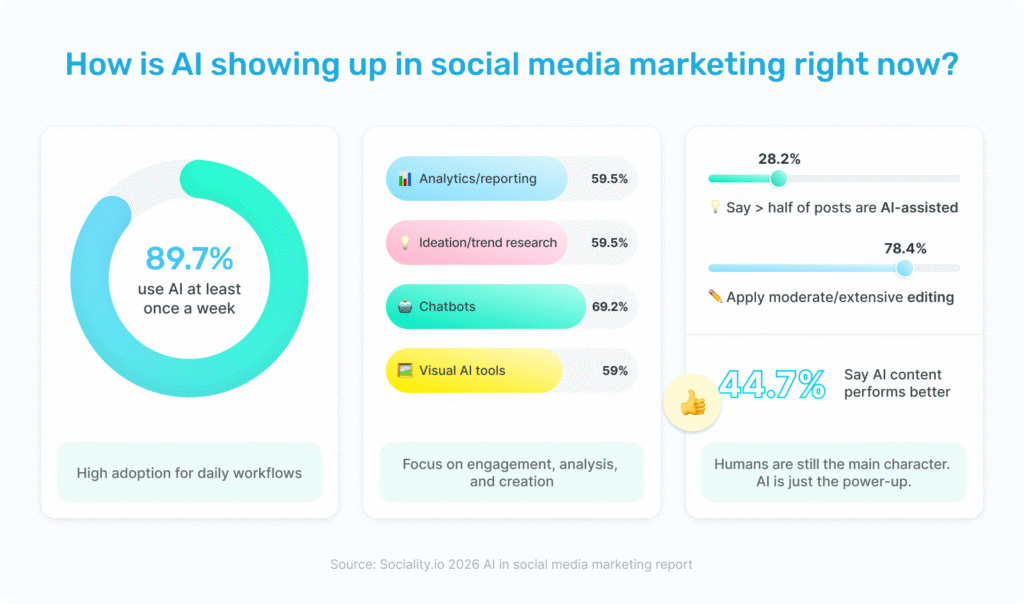
- AI adoption is nearly universal, with 89.7% of marketers using AI at least once a week, highlighting its integration into daily workflows.
- Chatbots lead AI use cases, with 69.2% adoption, showing strong demand for automation and real-time customer interaction.
- Core marketing functions are heavily AI-driven, as 59.5% use AI for analytics/reporting and 59.5% for ideation/trend research, emphasizing AI’s role in data-driven strategy and content planning.
- Visual AI tools are widely used, with 59% adoption, reflecting the growing importance of AI-generated creatives and design efficiency.
- Only 28.2% of marketers say more than half of their posts are AI-assisted, indicating that full automation is still limited.
- A significant 78.4% apply moderate to extensive editing, proving that human oversight remains critical in AI-generated content.
- Less than half (44.7%) believe AI-generated content performs better, suggesting mixed confidence in AI’s effectiveness.
- The overall trend shows that AI acts as a “power-up” rather than a replacement, supporting humans in analysis, creation, and engagement rather than fully automating them.
B2B Social Media Marketing Statistics
- 89% of B2B marketers use social media as a key marketing channel.
- LinkedIn generates over 80% of B2B social media leads, making it the top platform.
- 75% of B2B buyers use social media to research vendors before making decisions.
- B2B companies that post consistently on social media see 67% more leads than those that don’t.
- 84% of C-level executives use social media to support purchasing decisions.
- Video content drives 2x higher engagement in B2B campaigns compared to text.
- 60% of B2B marketers say social media generates their highest-quality leads.
- LinkedIn ads have conversion rates up to 2x higher than other platforms for B2B campaigns.
- 78% of B2B marketers plan to increase investment in social media marketing in 2026.
ROI and Conversion Rate Statistics
- Businesses earn an average ROI of $5.20 for every $1 spent on social media marketing.
- Social media leads have a 100% higher close rate compared to outbound marketing.
- The average social media conversion rate ranges between 2% and 5%, depending on the industry.
- Instagram ads deliver an average conversion rate of 1.08%, higher than many display ads.
- Retargeting campaigns on social media increase conversions by up to 70%.
- 74% of consumers rely on social networks when making purchase decisions.
- Social proof, such as reviews and comments, increases conversions by 34%.
- Brands that respond to social inquiries see a 20–40% increase in customer spend.
- Landing pages optimized for social traffic improve conversion rates by up to 25%.
Key Benefits of Social Media Marketing
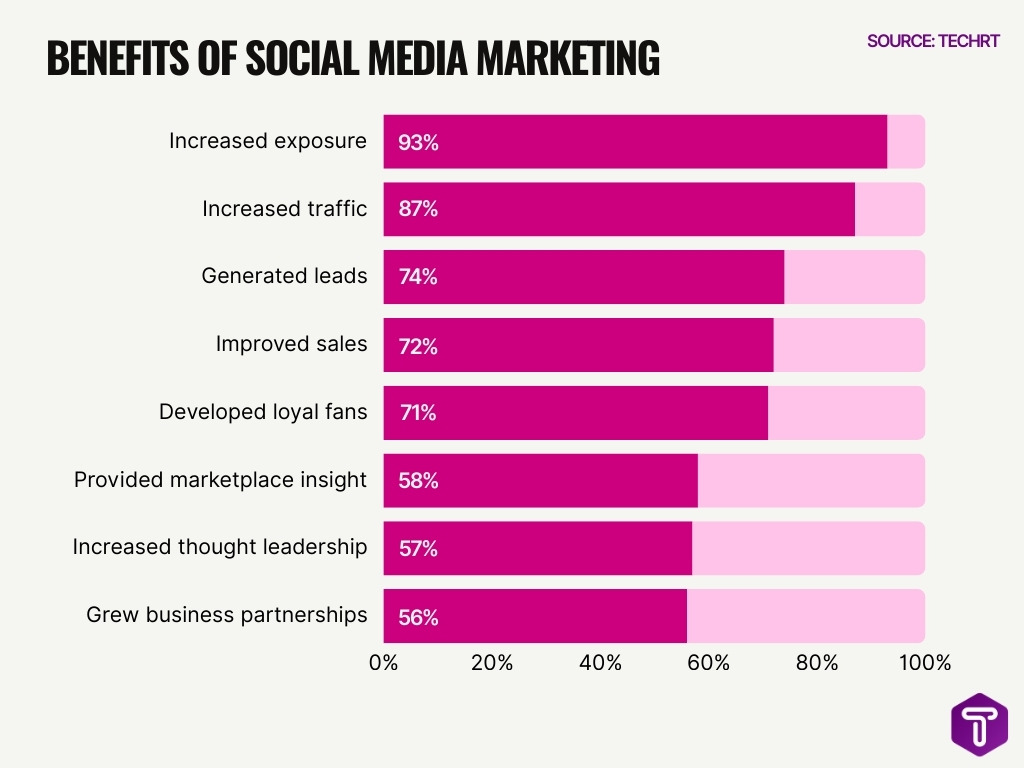
- 93% of marketers report increased exposure, making it the top benefit of social media marketing.
- 87% experience increased traffic, highlighting social media as a major driver of website visits.
- 74% of businesses generate leads through social platforms, proving their strong role in lead acquisition.
- 72% see improved sales, showing a direct impact on revenue growth.
- 71% build loyal fans, emphasizing social media’s role in customer retention and brand loyalty.
- 58% gain valuable marketplace insights, helping brands make data-driven decisions.
- 57% achieve increased thought leadership, positioning brands as industry authorities.
- 56% grow business partnerships, demonstrating social media’s value in networking and collaborations.
Challenges and Privacy Concerns in Social Media
- Around 81% of users say the risks of sharing personal data on social media outweigh the benefits, driving growing privacy concerns across platforms.
- Roughly 76% of Americans say they do not trust social media companies and fear their personal data will be sold without consent.
- About 81% of users feel they have little or no control over the data that social platforms collect about them.
- Surveys show 35% of adults are very concerned and 44% somewhat concerned about how social media platforms collect personal data.
- Due to privacy worries, 38% of users report using social media less often than before to protect their data.
- Some research estimates that bots account for up to 20% of social media traffic, distorting authentic engagement and conversations.
- A recent report finds 51% of all web traffic now comes from bots, with malicious bad bots making up 37% and heavily affecting social platforms.
- In 2024, the EU imposed over $3.1 billion in fines on the five biggest social platforms for GDPR and data privacy violations.
- Globally, 63% of consumers believe companies are not transparent about how they use personal data collected via channels, including social media.
Future Trends in Social Media Marketing
- Social media users are expected to reach 6 billion by 2027.
- AI-generated content will account for over 30% of social media posts by 2026.
- Short-form video will dominate, with over 80% of content consumption driven by video formats.
- Social commerce will grow at a CAGR of over 30% through 2030.
- Augmented reality ads are expected to increase engagement by up to 200%.
- 65% of marketers plan to increase investment in video-first strategies.
- Decentralized social platforms and privacy-focused networks are gaining traction.
- Voice and visual search via social platforms will grow significantly, especially among Gen Z users.
- 70% of brands will integrate AI-driven personalization into social campaigns by 2026.
Frequently Asked Questions (FAQs)
What is the average ROI of influencer marketing in 2025?
Influencer marketing delivers about $5.78 for every $1 spent.
How much is the global influencer marketing industry worth in 2025?
The industry is valued at approximately $23.59 billion in 2025.
What percentage of users say social media influences their purchase decisions?
Around 76% of users report that social media content impacts their buying decisions.
What share of the global population uses social media in 2025–2026?
About 63.9% of the world’s population actively uses social media.
What is the projected social media ad spend for 2026?
Social media advertising spend is expected to reach $317.33 billion in 2026.
Conclusion
Social media marketing continues to evolve at a rapid pace, driven by rising user adoption, AI integration, and changing consumer behavior. From B2B lead generation on LinkedIn to social commerce growth on TikTok and Instagram, platforms now play a central role across the entire customer journey. At the same time, challenges around privacy, measurement, and algorithm shifts require marketers to stay agile. By leveraging data-backed insights and emerging trends, businesses can build more effective, future-ready social media strategies.

Leave a comment
Have something to say about this article? Add your comment and start the discussion.