




The technology sector is growing faster than ever, reshaping industries, consumer behaviors, and the global economy. Businesses and governments alike are investing heavily in digital infrastructure, artificial intelligence, cloud services, and enterprise transformation, fueling innovation and expanding market opportunities. From increased IT spending to rapid digital adoption, technology’s footprint is expanding across sectors, from healthcare to manufacturing. This growth is evident in both enterprise investment strategies and global market forecasts. Read on to explore detailed statistics that highlight where technology stands today and where it’s heading.
Editor’s Choice
- Worldwide IT spending is forecast to reach $6.08 trillion in 2026, up nearly 10% year-over-year.
- The global digital transformation market is projected to reach $3.4 trillion by 2026.
- Cloud computing market expected to top $947.3 billion by 2026, with strong CAGR growth.
- India’s IT spending is set to rise to $176.3 billion in 2026, growing over 10% annually.
- 89% of companies are adopting or plan to adopt digital-first strategies.
- Hybrid cloud adoption is estimated at 61% among enterprises in 2025.
- More than half of IT departments expect to increase budgets in 2026.
Recent Developments
- Tech giants are positioning cloud and AI as core growth drivers through massive infrastructure investments.
- AI workforce strategies and adoption cycles are reshaping hiring, with new models managing business workflows.
- PC market forecasts show potential contraction due to memory pricing and AI infrastructure focus.
- AI hardware markets are forecast to see record revenues from semiconductors and AI accelerators.
- Tech adoption at CES 2026 is spotlighting consumer-level AI and robotics integrations.
- Singapore’s GDP growth in 2025 was bolstered by electronics and AI-related demand.
- Big tech AI capex may exceed $490 billion by 2026, signaling infrastructure bets.
Global Technology Market Size and Growth
- Global IT spending is projected to exceed $6 trillion in 2026, a 9.8% increase from 2025.
- Worldwide technology spending reached approximately $5.43 trillion in 2025, with strong service and software demand.
- Forrester forecasts technology spend growth of 5.6% in 2025 to about $4.9 trillion.
- Global tech investments continue to outpace inflation-adjusted projections, underlining real demand.
- Software investment alone hit $675 billion in 2024, with steady growth into 2025.
- IT services and software compose the lion’s share of tech spend, each driving robust segments.
- Asia-Pacific and North America remain the two largest contributors to global tech expenditures.
Global Information Technology Market Growth Insights
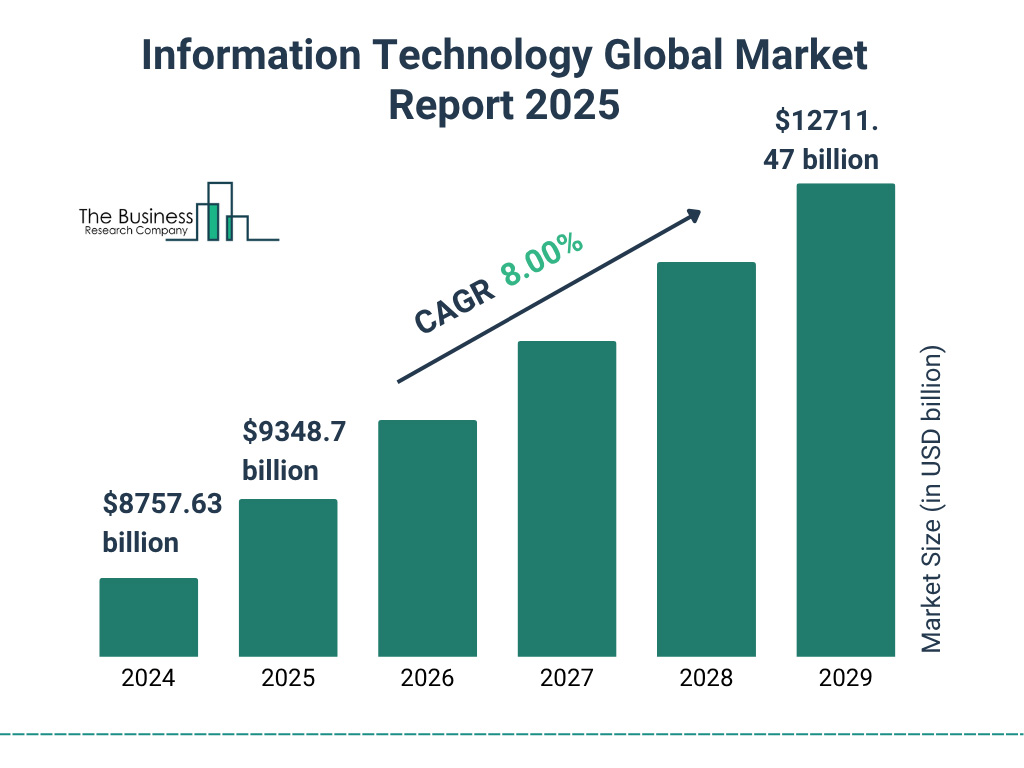
- The global IT market size reached $8,757.63 billion in 2024, reflecting the continued expansion of digital infrastructure worldwide.
- In 2025, the market increased to $9,348.7 billion, showing strong year-over-year growth driven by enterprise IT spending.
- The global IT market is projected to grow at a robust CAGR of 8.00% through the forecast period.
- By 2026, the market is estimated to cross $10 trillion, marking a major milestone for the technology sector.
- The market size is expected to reach over $10.9 trillion in 2027, supported by rising cloud, AI, and cybersecurity investments.
- In 2028, global IT spending is projected to exceed $11.7 trillion, highlighting accelerating digital transformation efforts.
- By 2029, the IT market is forecast to hit $12,711.47 billion, reinforcing technology as a key global economic pillar.
- Between 2024 and 2029, the IT sector is expected to add nearly $4 trillion in total market value.
- The consistent upward trajectory underscores long-term confidence in information technology adoption across industries.
- Strong multi-year growth indicates sustained demand for software, hardware, IT services, and emerging technologies.
Technology Adoption and Digital Transformation Statistics
- The digital transformation market is projected to reach $3.4 trillion by 2026.
- 89% of organizations have adopted or plan to adopt digital-first strategies.
- 57% of companies have integrated AI into select or broad business functions.
- Survey insights show that 92% feel tech investments haven’t fully delivered expected results.
- Digital transformation success rates vary, with about 35% meeting goals globally.
- Global cloud storage now houses 60% of business data, up from 48% earlier.
- Multi-cloud strategies are now used by 92% of enterprises in 2025.
Enterprise IT Investment and Budget Allocation Statistics
- Hybrid cloud adoption stands at 61% across enterprises in 2025.
- Cloud storage represents the majority of enterprise data platforms.
- IT decision-makers report that 99% plan investments in emerging tech within 2 years.
- Cloud, AI, and cybersecurity are top areas for budget allocation growth.
- Increasing talent shortages are impacting IT budget planning and deployment timelines.
- Data center system investment is increasingly prioritized over traditional hardware upgrades.
- The shift to AI-based infrastructure is reshaping IT operational allocations.
Technology Startup Ecosystem and Funding Growth
- The global startup ecosystem continues to be a major engine of innovation, with an estimated 150 million startups worldwide powering niche markets and disruptive technologies.
- The United States leads with 1.14 million startups as of early 2026, underscoring its dominant role in startup creation.
- Only about 10% of startups achieve long‑term success, highlighting the competitive and risky nature of early‑stage ventures.
- In 2025, AI startups in the U.S. collectively raised a record estimated $150 billion in funding, far exceeding previous peaks and fueling expansion.
- Israeli high‑tech firms raised $15.6 billion in private funding in 2025, up from approximately $12.2 billion in 2024, reflecting resilience and investment confidence.
- Although India’s tech funding dipped year‑over‑year, it still ranked third globally with $4.8 billion raised in H1 2025.
- High‑value deals persisted, with several rounds exceeding $100 million in venture capital investment even amid broader fundraising challenges.
- Early‑stage, growth‑stage, and late‑stage investments all showed nuanced shifts, indicating evolving investor priorities and risk appetites.
Sales Technologies With the Highest Projected Growth
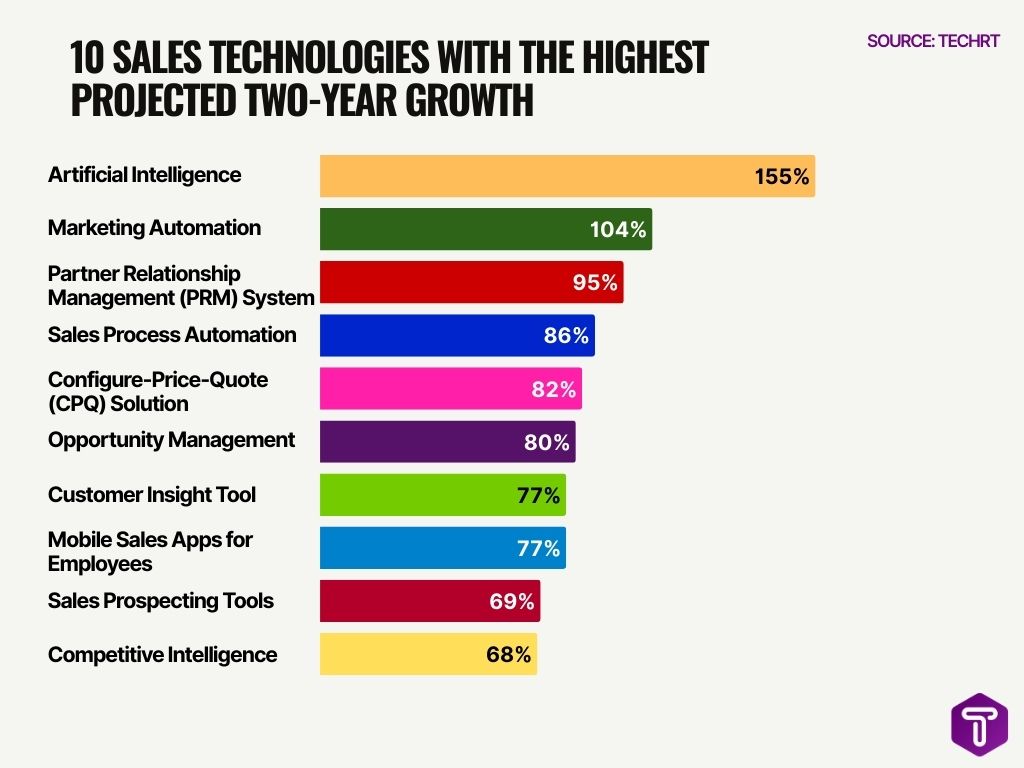
- Artificial Intelligence leads all sales technologies with a projected 155% two-year growth, highlighting its expanding role in predictive analytics, personalization, and automation across sales teams.
- Marketing Automation is expected to grow by 104%, reflecting increased demand for lead nurturing, campaign optimization, and data-driven customer engagement.
- Partner Relationship Management (PRM) systems show a strong 95% growth projection, driven by organizations scaling channel sales and partner ecosystems.
- Sales Process Automation is forecast to rise by 86%, as businesses prioritize efficiency, workflow standardization, and reduced manual effort.
- Configure-Price-Quote (CPQ) solutions are projected to grow 82%, fueled by the need for faster deal cycles, pricing accuracy, and complex product configurations.
- Opportunity Management tools are expected to see 80% growth, emphasizing the focus on pipeline visibility and deal forecasting accuracy.
- Customer Insight tools are projected to expand by 77%, supporting sales teams with real-time behavioral data and actionable intelligence.
- Mobile sales apps for employees also show 77% growth, underscoring the shift toward remote selling and on-the-go sales productivity.
- Sales prospecting tools are forecast to grow 69%, as companies invest in better lead discovery, qualification, and outreach efficiency.
- Competitive Intelligence platforms round out the list with 68% growth, reflecting the importance of market awareness, pricing strategy, and competitor tracking.
Cloud Computing Market Growth Statistics
- The global cloud computing market was valued at around $781 billion in 2025 and is projected to reach approximately $905 billion in 2026.
- Forecasts suggest the cloud market could expand to more than $1 trillion in the mid‑2020s, driven by enterprise transformation and scalable infrastructure demand.
- A CAGR of roughly 15–16% through the latter decade reflects the sustained appetite for cloud services across industries.
- In 2025, 60% of business data was already stored in the cloud, a figure expected to increase steadily through 2026 and beyond.
- Spending on cloud infrastructure services reached more than $100 billion in Q3 2025 alone, marking 25% year‑over‑year growth.
- Hyperscale providers (AWS, Azure, Google) accounted for about 66% of cloud infrastructure spending in late 2025.
- Hybrid and multi‑cloud approaches remain dominant, with over 89% of enterprises using multiple cloud strategies.
- Cloud adoption enables digital transformation in traditional sectors like finance, healthcare, and retail, reducing IT costs and increasing agility.
Artificial Intelligence Adoption and Growth Statistics
- Agentic AI adoption has accelerated, with around 79% of organizations reporting some level of deployment as of 2025.
- Enterprises are now shifting AI from pilot phases into core business functions, improving decision‑making and automation.
- A major global economy (India) is investing ₹10,300 crore (~$1.25 billion) in AI initiatives with 38,000 GPUs deployed to scale innovation.
- AI adoption increases workforce productivity, one study shows, with over 80% of employees in some firms using AI tools regularly, boosting output.
- ChatGPT Enterprise usage data indicates a significant surge in enterprise chat volume, suggesting broader integration in corporate workflows.
- Generative AI technologies are expected to add significant global economic value in the coming years through automation and insights.
- Organizations allocating over half of their AI budgets specifically to AI agents demonstrate targeted investment strategies.
- Projections show widespread increases in ROI expectations for AI investments, with many organizations targeting 100%+ ROI.
Automation, Robotics, and Productivity Growth Statistics
- The global robotics technology market is predicted to grow from $108.43 billion in 2025 to $124.37 billion in 2026.
- From 2026 onward, the robotics market is forecast to reach approximately $416 billion by 2035 at a robust CAGR.
- Industrial and logistics robots are emerging as the fastest‑growing segments, accounting for a majority of market expansion.
- Robotics adoption in manufacturing and fulfillment centers is driving reductions in labor costs and increases in throughput.
- Automation systems markets (including robotics) are expected to expand as digitally connected factories proliferate.
- Collaborative robots (cobots) are contributing to workforce augmentation across sectors, improving safety and flexibility.
- Businesses deploying robotic automation report improvements in delivery times and quality consistency.
- Growth in robotics reflects broader shifts to Industry 4.0 and smart manufacturing paradigms globally.
India’s EdTech Market Growth by Segment
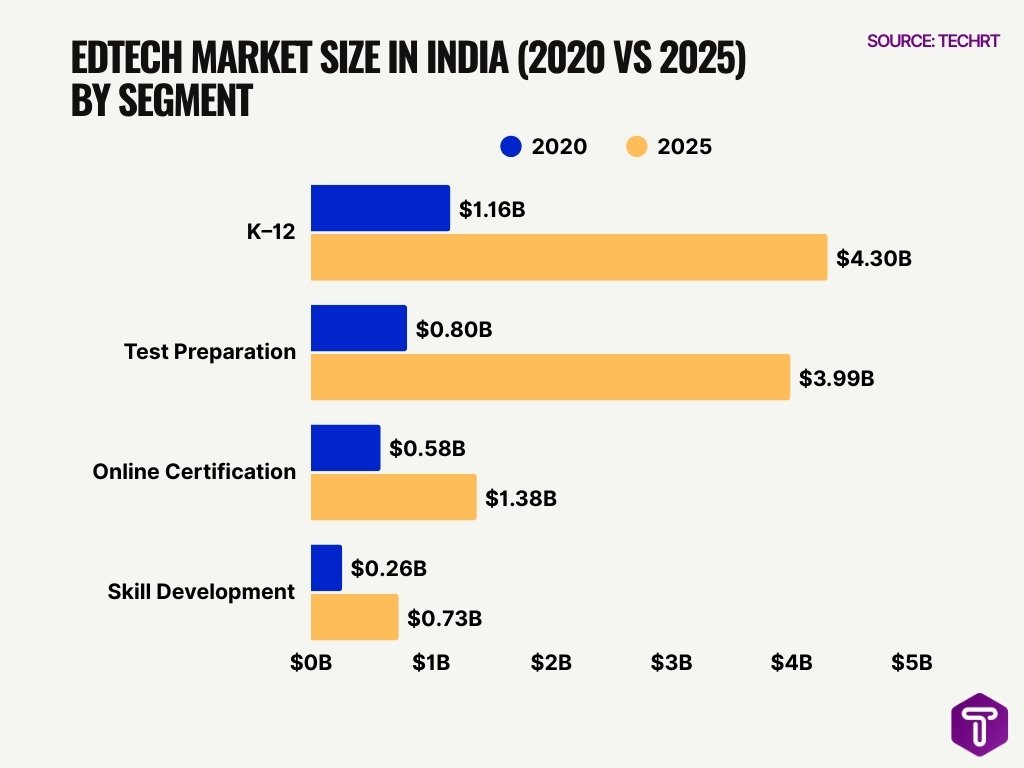
- India’s EdTech market is witnessing rapid expansion, with all major segments recording strong growth between 2020 and 2025.
- The K–12 segment shows the largest market size, growing from $1.16 billion in 2020 to $4.30 billion by 2025, highlighting the surge in digital school education.
- Test preparation emerges as a key growth driver, expanding sharply from $0.80 billion to $3.99 billion, driven by competitive exams and online coaching adoption.
- The online certification market more than doubles, rising from $0.58 billion in 2020 to $1.38 billion in 2025, reflecting increased demand for professional and career-focused credentials.
- Skill development platforms show steady momentum, growing from $0.26 billion to $0.73 billion, supported by upskilling and workforce reskilling trends.
- Overall, the data indicates a shift toward digital-first learning models, with K–12 and test preparation accounting for the largest share of EdTech spending.
- The strong rise across segments underlines India’s position as one of the fastest-growing EdTech markets globally.
Internet and Mobile User Growth Statistics
- By late 2025, 6.04 billion people worldwide were using the internet, representing about 73.2% global penetration.
- Internet user numbers increased by 294 million in the past year, reflecting ongoing digital inclusion.
- Nearly 96% of global internet users access the web via mobile phones, underscoring mobile’s dominance.
- Unique mobile users reached approximately 5.78 billion, highlighting the near‑ubiquity of mobile connectivity.
- Around 70.1% of the world’s population now uses a mobile phone, fueling online engagement and commerce.
- India alone had over 1.03 billion internet users by late 2025, with 70% internet penetration.
- India also had 1.06 billion mobile connections active, indicating widespread network access.
- Social media platforms in large markets like India report hundreds of millions of active identities, illustrating engagement growth.
5G and Connectivity Infrastructure Growth
- The 5G services market was valued at about $185.22 billion in 2025 and is projected to reach $244.49 billion by 2026.
- Forecasts suggest the 5G services sector could surge to over $1.7 trillion by 2033 at a CAGR of ~32%.
- Global 5G industry growth is supported by a network of roughly 1,700 startups focused on connectivity innovation.
- The 5G infrastructure market alone could expand dramatically from $14 billion in 2025 to over $20 billion in 2026, continuing long‑term growth.
- 5G employment and ecosystem growth include an estimated 1.9 million jobs worldwide, reflecting broader economic impact.
- Connectivity enhancements under 5G support ultra‑low latency, mMTC applications, and enterprise digitization efforts.
- Asia‑Pacific and North America lead regional adoption due to strong infrastructure investment.
- Private 5G networks are scaling for smart manufacturing, logistics, and industrial IoT use cases.
Cybersecurity Market Growth and Threat Trends
- The global cybersecurity market is projected to expand from around $248 billion in 2026 to an estimated $699 billion by 2034 at a CAGR near 14%.
- Previous estimates show the market at approximately $272 billion in 2025, growing steadily due to escalating threats.
- Cybercrime is expected to cost the world an estimated $10.5 trillion in 2025, up sharply from $6 trillion in 2021.
- AI‑driven cyberattacks are intensifying as threat vectors evolve and automation enables sophisticated exploits.
- Managed Security Providers and MDR services adoption is rising, with projections showing significant growth in enterprise use.
- India recorded more than 265 million cyberattacks in 2025, demonstrating the scale of digital risk.
- Organizations are increasing security staffing and investment to address advanced threats and ransomware.
- Cybersecurity’s growth is driven by regulatory compliance, remote work security needs, and digital transformation initiatives.
Green and Sustainable Technology Growth
- The green technology and sustainability market is projected to grow from about $25.4 billion in 2025 to over $105 billion by 2032, with a CAGR of around 22.4%.
- The larger sustainability sector is evaluated at roughly $32.6 billion in 2026, expanding rapidly as corporate ESG commitments rise.
- Analysts forecast the green tech market to expand toward about $184.9 billion by 2035 at a 24.2% CAGR, reflecting long‑term demand for eco‑efficient solutions.
- Annual growth in green technology employment reached 14,500 new jobs in the industry, contributing to a workforce of 244,500 globally.
- Over 2,700 patents in green tech signal innovation focus and investment in sustainable solutions in 2025.
- The U.S., India, the UK, Canada, and Italy emerged as major hubs for sustainability tech activity in recent years.
- Emerging use cases include renewable energy systems, carbon accounting tools, and smart grid integration to optimize sustainability outcomes.
- Asia‑Pacific is expected to grow at the highest pace for green tech adoption due to supportive government initiatives and urbanization trends.
Regional Distribution of the Green Technology and Sustainability Market
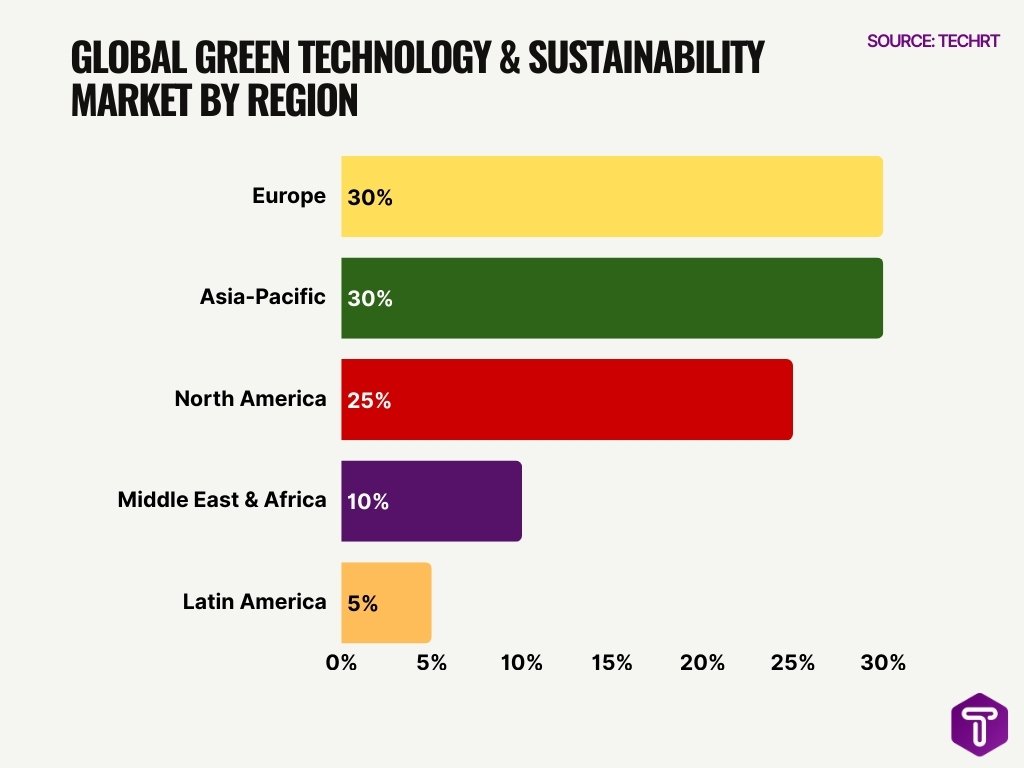
- Europe and APAC remain joint market leaders, with each region accounting for 30% of the total global market share.
- North America comes next, securing a strong 25% market share, reflecting its substantial role in the overall market.
- MEA (Middle East and Africa) contributes a 10% share to the market, representing a moderate but notable regional presence.
- Latin America records the lowest market participation at 5%, clearly indicating significant potential and room for future growth.
Industry‑Specific Technology Adoption Statistics
- In healthcare, the global telehealth market is projected to reach $455–460 billion by 2030, up from about $120 billion in 2023, driven by remote care and AI‑driven diagnostics.
- In manufacturing, around 80% of industrial companies have implemented some form of IoT or smart factory initiative, with digital leaders seeing up to 50% reductions in machine downtime.
- In retail, nearly 57% of retailers plan to increase spending on software and new tech in 2024, prioritizing cloud POS and analytics to boost e‑commerce performance.
- In financial services, global digital payments are expected to surpass $14 trillion by 2027, with mobile wallets accounting for over 50% of e‑commerce transaction value worldwide.
- In transportation and logistics, advanced analytics and telematics can cut fuel consumption by 10–15% and improve on‑time deliveries by up to 20% in digitally mature fleets.
- In education, over 90% of countries adopted some form of online or remote learning platform during the pandemic era, with many universities maintaining hybrid models afterward.
- In agriculture, drones and precision IoT systems can reduce pesticide use by up to 85%, water consumption by 40%, and increase crop yields by 15–20%.
- In energy and utilities, smart electricity meters reached about 43% global penetration by late 2023, with more than 1.06 billion smart meters installed worldwide.
Emerging Technologies (IoT, AR/VR, Blockchain) Growth Statistics
- The global IoT market is expected to reach over $1 trillion by 2025, with continued expansion into 2026 and beyond.
- IoT device installations surpassed 19 billion connected units worldwide in 2025 and are forecast to keep rising.
- The XR (AR/VR) market is projected to achieve $1.7 trillion in revenue by 2030, fueled by enterprise use cases.
- AR/VR headset shipments grew about 10% in 2024 and are expected to continue growth into 2029.
- Blockchain adoption rates are rising in supply chain, identity management, and secure data exchange applications.
- Combined IoT and blockchain systems enhance traceability in industrial ecosystems.
- IoT revenue from manufacturing reached nearly $490 billion in 2025, with substantial growth expected by 2030.
- Connectivity improvements, including 5G and early research on 6G frameworks, support next‑gen IoT performance.
Technology Innovation, Patents, and R&D Spend Statistics
- Firms worldwide are increasing R&D allocations, with tech innovation central to competitive strategies.
- Over 750,000 clean and sustainable technology patent families were documented globally by the early 2020s, reflecting long‑term innovation trends.
- Companies integrating AI and XR are filing new intellectual property to secure competitive edges.
- Investment in quantum computing research continues, with commercial and academic labs racing to develop scalable systems.
- Industry partnerships between enterprises and startups are increasing for co‑developing new tech solutions.
- Global science and tech R&D spending as a percentage of GDP continues higher than historic averages across major economies.
- Growth sectors include biotech, nanotech, advanced materials, and AI accelerators.
Technology Workforce and Skills Demand Growth
- Tech job vacancies rose by 20% year‑over‑year, with the highest demand for AI, cloud, and cybersecurity roles.
- Demand for data scientists is forecast to grow 35−40% by 2026 globally.
- In the U.S. and India, digital and cloud skills are emerging as key predictors of workforce growth.
- Cloud adoption could create 14 million jobs and add nearly $380 billion to India’s GDP by 2026.
- Remote work and distributed teams have increased demand for collaboration and digital infrastructure skills.
- XR‑related positions, including immersive design and spatial computing roles, are gaining traction.
- Cybersecurity roles are expanding due to rising threats and compliance requirements.
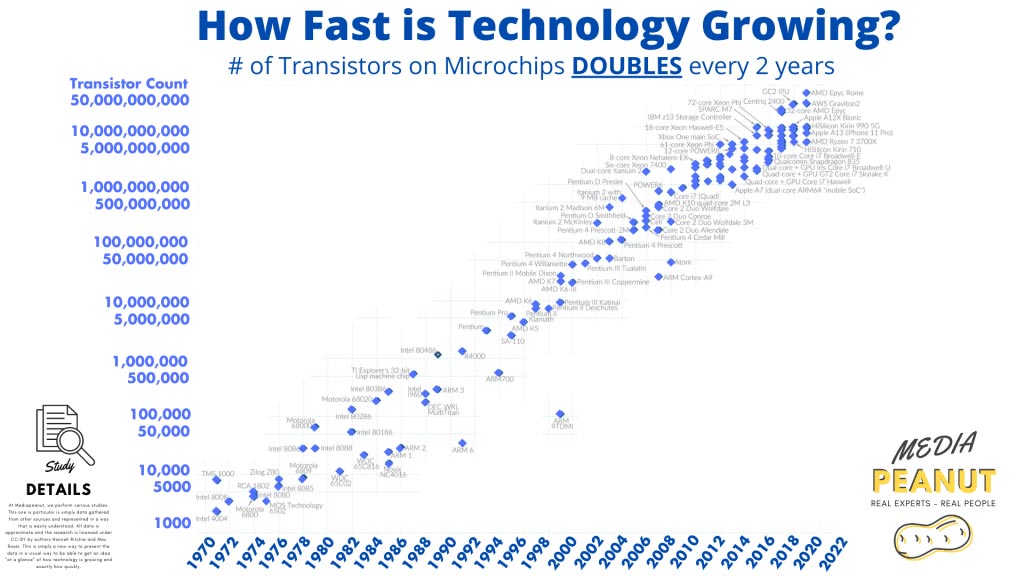
How Fast Is Technology Growing? Key Microchip Growth Insights
- The data confirms Moore’s Law, showing that transistor counts on microchips double every 2 years, driving exponential technology growth.
- In 1971, the first commercial microprocessor contained just ~2,300 transistors, marking the foundation of modern computing.
- By the late 1970s, transistor counts crossed 10,000, enabling more reliable and affordable electronic devices.
- During the 1980s, processors advanced into the 100,000 to 1 million transistor range, powering the rise of personal computers.
- In the 1990s, chips reached 10–50 million transistors, supporting graphical user interfaces and early internet technologies.
- The early 2000s saw processors exceed 100 million transistors, significantly boosting computing speed and efficiency.
- By 2010, leading CPUs and GPUs surpassed 1 billion transistors, accelerating smartphones, cloud platforms, and digital services.
- Between 2015 and 2020, advanced chips crossed 10–50 billion transistors, enabling breakthroughs in AI, machine learning, and data centers.
- By 2022, the most advanced processors reached up to 50 billion transistors, reflecting the peak of current semiconductor innovation.
- The logarithmic upward curve highlights that technology growth is exponential rather than linear, compounding performance gains over time.
- The data spans over 50 years of continuous semiconductor innovation, from 1970 to 2022, with no long-term slowdown visible.
- Leading chipmakers such as Intel, AMD, Apple, NVIDIA, and IBM dominate the upper range, showing intense competition at advanced process nodes.
Technology’s Impact on GDP and Economic Output
- Cloud and data center investments could contribute 10–20 basis points to U.S. GDP in 2025–26.
- Worldwide ICT infrastructure investments have historically shown strong multipliers for economic growth, suggesting further GDP boosts through 2026.
- India’s digital economy is expected to grow to nearly one‑fifth of national income by 2029–30, driven by tech adoption.
- Semiconductor industry turnover is projected to approach $1 trillion in 2026, reflecting broad tech reliance.
- Tech value chains are increasingly tied to national competitiveness and exports, particularly in services.
- AI’s contribution to GDP measurement remains debated, with analysts estimating substantial undeclared economic boosts.
Future Technology Growth Projections and Trends
- Agentic AI markets are projected to grow at 40%+ CAGR through the late 2020s, redefining automation and workflows.
- Edge computing spending may reach $380 billion by 2028, supporting real‑time digital ecosystems.
- Connected devices and sensors will exceed 100 billion global connections by mid‑decade, driving data‑centric growth.
- Quantum computing revenue markets are forecast to reach nearly $100 billion by 2035.
- Immersive XR revenue could exceed $1.7 trillion by 2030.
- Sustainable computing is emerging as a core tech sector, expected to hit $34 billion by 2027.
- Continued digital transformation is projected to keep global tech demand growing through the end of the decade.
Frequently Asked Questions (FAQs)
How much is global IT spending expected to grow in 2026?
Global IT spending is projected to reach $6.08 trillion in 2026, up about 9.8% from 2025.
What is the projected size of the global cloud computing market by 2034?
The global cloud computing market is expected to expand to approximately $2,904.52 billion by 2034 at a 15.7% CAGR.
What increase is forecast for the digital transformation market size by 2031?
The digital transformation market is projected to grow from about $1,107.06 billion in 2025 to $1,864.94 billion by 2031 at a 9.1% CAGR.
How many IoT devices are expected to be connected globally by 2030?
The number of connected IoT devices is forecast to reach 39 billion by 2030, growing from 21.1 billion in 2025.
By what percentage did IT spending in India grow in 2024?
IT spending in India rose by 11.1% in 2024 to an estimated $138.6 billion.
Conclusion
The technology landscape will be defined by rapid growth in sustainable solutions, emerging digital platforms, and workforce‑centric innovations. Green and clean tech markets are accelerating, while IoT, XR, and AI continue to reshape industries. Investment in R&D, expanding employment demand, and productivity gains are closely tied to national economic output and global competitiveness. Even as GDP impacts from tech are still being accurately measured, technology’s role as an economic engine remains undeniable. As enterprises and governments navigate this era of change, the opportunity to harness these growth trends has never been more compelling.

Leave a comment
Have something to say about this article? Add your comment and start the discussion.