



The Unified Payments Interface, UPI, has transformed how money moves across India, turning smartphones into powerful, real-time payment tools. Today, it supports everything from retail checkouts and peer-to-peer transfers to public transport fares, bill payments, and small business transactions, making digital payments seamless and accessible. This rapid adoption has not only simplified everyday transactions but also strengthened financial inclusion by bringing millions of users and merchants into the formal economy. As UPI continues to scale in both volume and innovation, it plays a critical role in shaping digital commerce, fintech ecosystems, and government-led payment infrastructure. Let’s explore the latest UPI statistics shaping and beyond.
Editor’s Choice
- UPI processed over 228.3 billion transactions in 2025, up from 172.2 billion in 2024.
- Total transaction value reached ₹299.7 lakh crore in 2025, reflecting strong economic activity.
- Monthly volume hit a record 21.7 billion transactions in January 2026.
- UPI crossed ₹230 lakh crore in transaction value by December FY26, showing continued growth.
- Daily transaction volumes now exceed 700 million transactions per day.
- UPI accounts for 84.8% of retail digital payment volume in India.
- Annual growth remains strong with ~27% YoY increase in early 2026.
Recent Developments
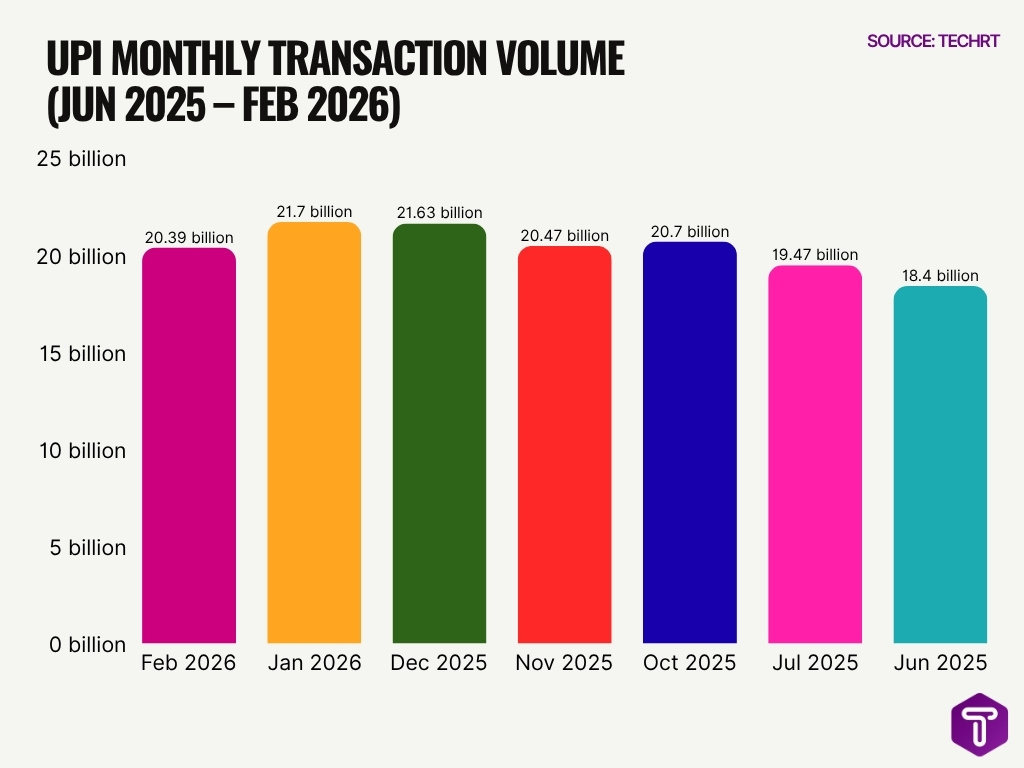
- UPI recorded 20.39 billion transactions in February 2026, maintaining high usage despite a shorter month.
- Year-on-year transaction volume grew 27% in February 2026, indicating sustained adoption.
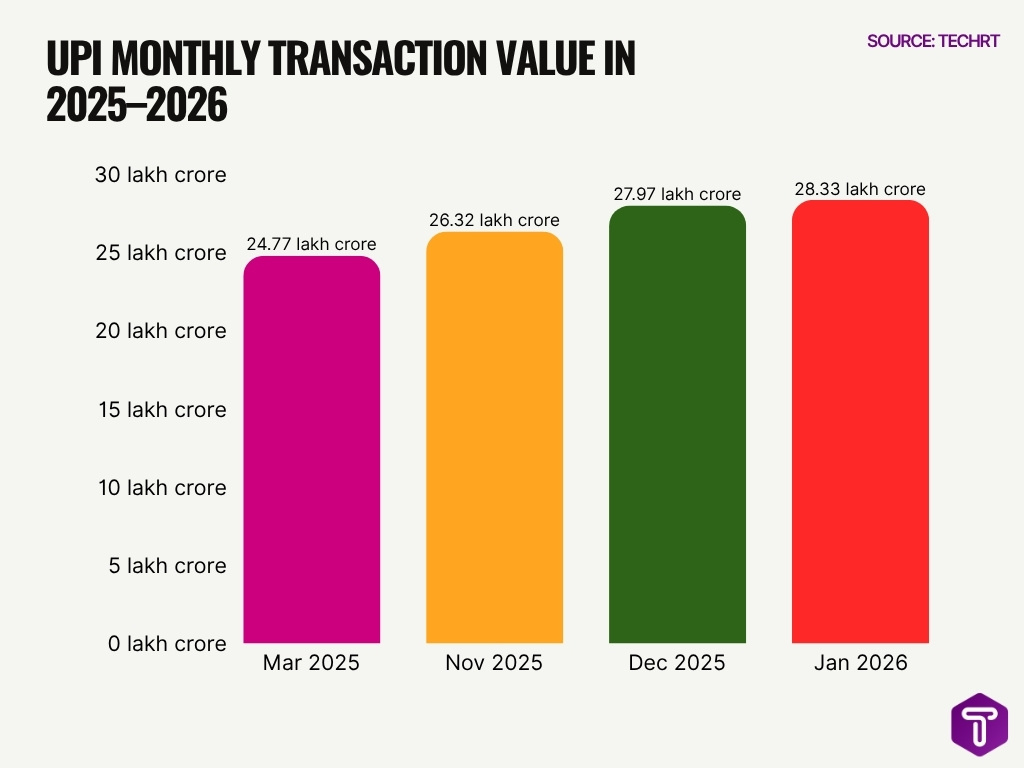
- January 2026 saw ₹28.33 lakh crore in transaction value, a new monthly peak.
- December 2025 closed with 21.63 billion transactions and ₹27.97 lakh crore value.
- Daily transactions reached 728 million in peak periods during 2026.
- UPI growth is projected to moderate to ~25% in FY26, down from 42% in FY25.
- Merchant payments, P2M, dominate usage, with 11.7 billion transactions in June 2025 alone.
- UPI expanded internationally and is now live in multiple countries, including France.
- Average daily transaction value crossed ₹90,000 crore in 2025, highlighting economic scale.
Key UPI Statistics at a Glance
- UPI processed 21,703 million transactions in January 2026 alone.
- The January 2026 transaction value stood at ₹28.33 lakh crore.
- UPI handled over 177 billion transactions by December FY26, YTD.
- Average daily transactions have exceeded 500 million since 2024–25.
- UPI processes more than 5,000 transactions per second at scale.
- Over 690 banks are live on UPI as of 2026.
- UPI monthly transactions consistently exceeded 20 billion since late 2025.
- Growth from 92 crore transactions in 2017–18 to 131+ billion in FY24 shows exponential scale.
- UPI contributes significantly to India’s consumption data tracking and transparency.
Trends in UPI Transaction Value Over Time
- Annual UPI value rose from ₹246.8 lakh crore in 2024 to ₹299.7 lakh crore in 2025.
- December 2025 alone recorded ₹27.97 lakh crore in value.
- January 2026 exceeded this with ₹28.33 lakh crore.
- March 2025 saw ₹24.77 lakh crore, up 25% YoY.
- November 2025 recorded ₹26.32 lakh crore, growing 22% YoY.
- Average daily transaction value reached ₹91,403 crore in January 2026.
- Daily value crossed ₹90,000 crore consistently in 2025.
- Value growth remains slightly slower than volume, indicating low-ticket, high-frequency usage.
- UPI contributes significantly to retail-level payments rather than large-value transfers.
Trends in UPI Transaction Volume Over Time
- UPI annual transactions grew from 172.2 billion in 2024 to 228.3 billion in 2025.
- Monthly volumes crossed 20 billion consistently in 2025, marking maturity.
- October 2025 recorded 20.7 billion transactions, setting a new benchmark.
- July 2025 saw 19.47 billion transactions, reflecting rapid scaling.
- UPI volume grew 29% YoY in December 2025.
- February 2026 volumes still showed 27% YoY growth, despite a seasonal dip.
- Daily transaction count rose from ~50,000 in 2016 to 500+ million in 2025.
- The first half of 2025 alone saw 106 billion transactions, highlighting acceleration.
- CAGR of UPI transactions since the early years exceeds 100%+ growth trajectory.
Daily Trends in UPI Transactions
- UPI processes over 700 million transactions daily in 2026, reflecting widespread adoption.
- Peak days in early 2026 recorded 728 million daily transactions, setting new operational benchmarks.
- Daily transaction value averages around ₹90,000–₹95,000 crore in 2025–2026.
- UPI handled roughly 500 million daily transactions in 2024, showing a sharp rise into 2026.
- Average transactions per second exceed 5,000 TPS, with peak capacity much higher.
- Daily growth correlates strongly with merchant QR adoption and micro-payments.
- Weekend volumes tend to increase due to consumer spending and e-commerce activity.
- Urban regions contribute a higher share of daily value, while rural regions drive volume growth.
- Daily UPI usage surged during festive seasons, often exceeding 20–25% above monthly averages.
Monthly Trends in UPI Transactions
- In January 2026, 21.7 billion transactions were recorded, the highest ever recorded.
- February 2026, 20.39 billion transactions, a slight dip due to fewer days.
- December 2025, 21.63 billion transactions, closing the year strong.
- November 2025, 20.47 billion transactions, steady growth.
- October 2025, 20.70 billion transactions, a major milestone.
- July 2025, 19.47 billion transactions, an early sign of a surge.
- June 2025, 18.4 billion transactions, driven by merchant payments.
- Monthly transaction value regularly exceeds ₹25 lakh crore since mid-2025.
- Monthly growth shows seasonal spikes during festivals and year-end periods.
Insights into UPI User Statistics
- India had over 350 million active UPI users in 2025, with steady growth into 2026.
- More than 500 million bank accounts are linked to UPI platforms.
- UPI user penetration reached over 40% of India’s population, signaling deep adoption.
- Average UPI user conducts 60–80 transactions per month in urban areas.
- Rural user growth outpaces urban growth, contributing to financial inclusion expansion.
- Gen Z and millennials account for over 65% of UPI transactions.
- Female participation in UPI transactions increased by over 20% YoY, improving gender inclusion.
- Over 90% of users access UPI via mobile apps, with minimal desktop usage.
- Tier 2 and Tier 3 cities contribute significantly, accounting for over 50% of new users.
Growth of UPI Adoption in India
- UPI adoption grew from 21 million users in 2017 to 350+ million in 2025.
- The number of participating banks increased from 21 in 2016 to 690+ in 2026.
- UPI transactions grew at a CAGR of over 100% between 2017 and 2023.
- Government initiatives like Digital India and Jan Dhan Yojana accelerated adoption.
- Smartphone penetration crossed 750 million users in India, supporting UPI growth.
- UPI Lite and UPI AutoPay features expanded use cases for low-value and recurring payments.
- Offline UPI solutions enabled payments in low-connectivity regions, boosting rural adoption.
- Merchant onboarding surged, with millions of small businesses joining the ecosystem.
- UPI now serves as the backbone for government subsidy disbursements and welfare payments.
Merchant Category-wise UPI Usage
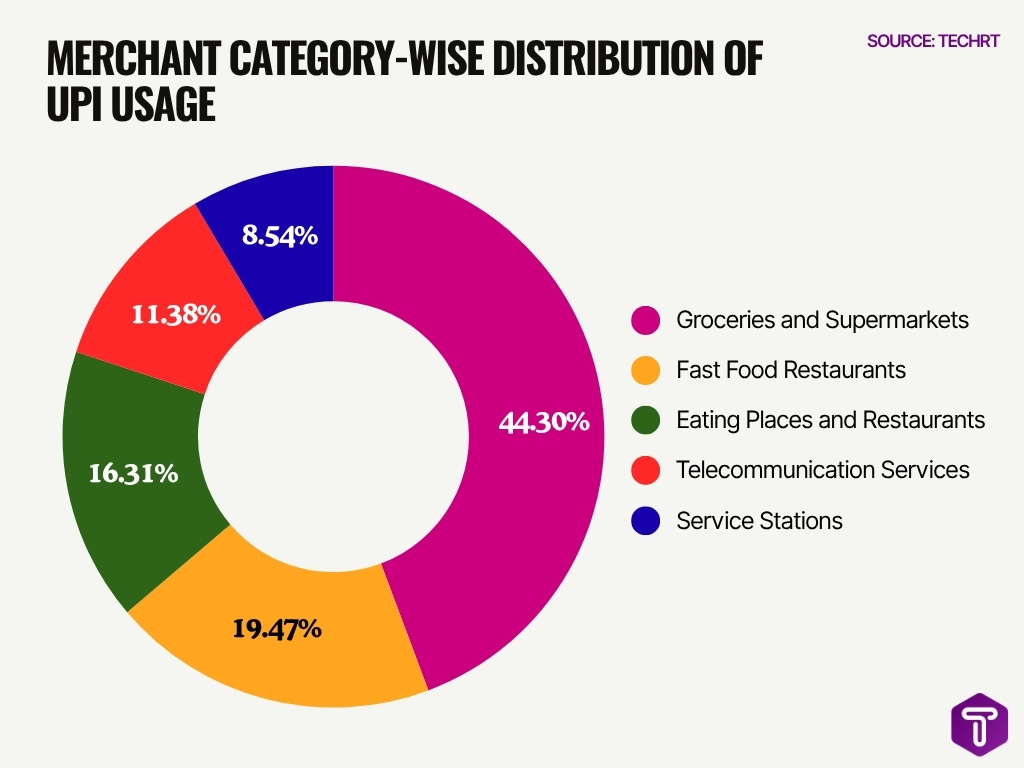
- Groceries and supermarkets dominate UPI usage, accounting for a massive 44.30% share, highlighting that UPI is primarily used for daily essential purchases.
- Fast food restaurants contribute 19.47%, showing strong adoption of UPI in the quick-service and on-the-go food segment.
- Eating places and restaurants hold 16.31%, indicating that dining and casual eating experiences are a major driver of digital payments.
- Combined, food-related categories (fast food + restaurants) make up 35.78% of total UPI usage, reinforcing that food spending is a key UPI use case.
- Telecommunication services account for 11.38%, reflecting consistent usage of UPI for mobile recharges and bill payments.
- Service stations contribute 8.54%, showing moderate adoption of UPI in fuel and vehicle-related expenses.
- The data clearly shows that everyday consumer spending categories dominate UPI transactions, with a strong tilt toward high-frequency, low-to-mid value payments.
- Overall, UPI is heavily embedded in routine lifestyle spending, rather than occasional or luxury purchases.
Share of UPI in the Digital Payments Market
- UPI accounts for 84.8% of total retail digital payment volume in India.
- It contributes over 50% of the total digital payment value in the country.
- Debit and credit cards together account for less than 10% of transaction volume, highlighting UPI dominance.
- UPI’s share has grown from less than 1% in 2016 to over 80% in 2026.
- Mobile wallets now represent a smaller share compared to UPI, declining below 5% volume share.
- UPI drives over 75% of person-to-merchant transactions.
- India leads globally in real-time payment transactions, largely due to UPI.
- UPI processes more transactions than Visa and Mastercard combined in India’s retail segment.
- UPI’s dominance continues to reshape fintech competition and pricing strategies.
UPI App Market Share
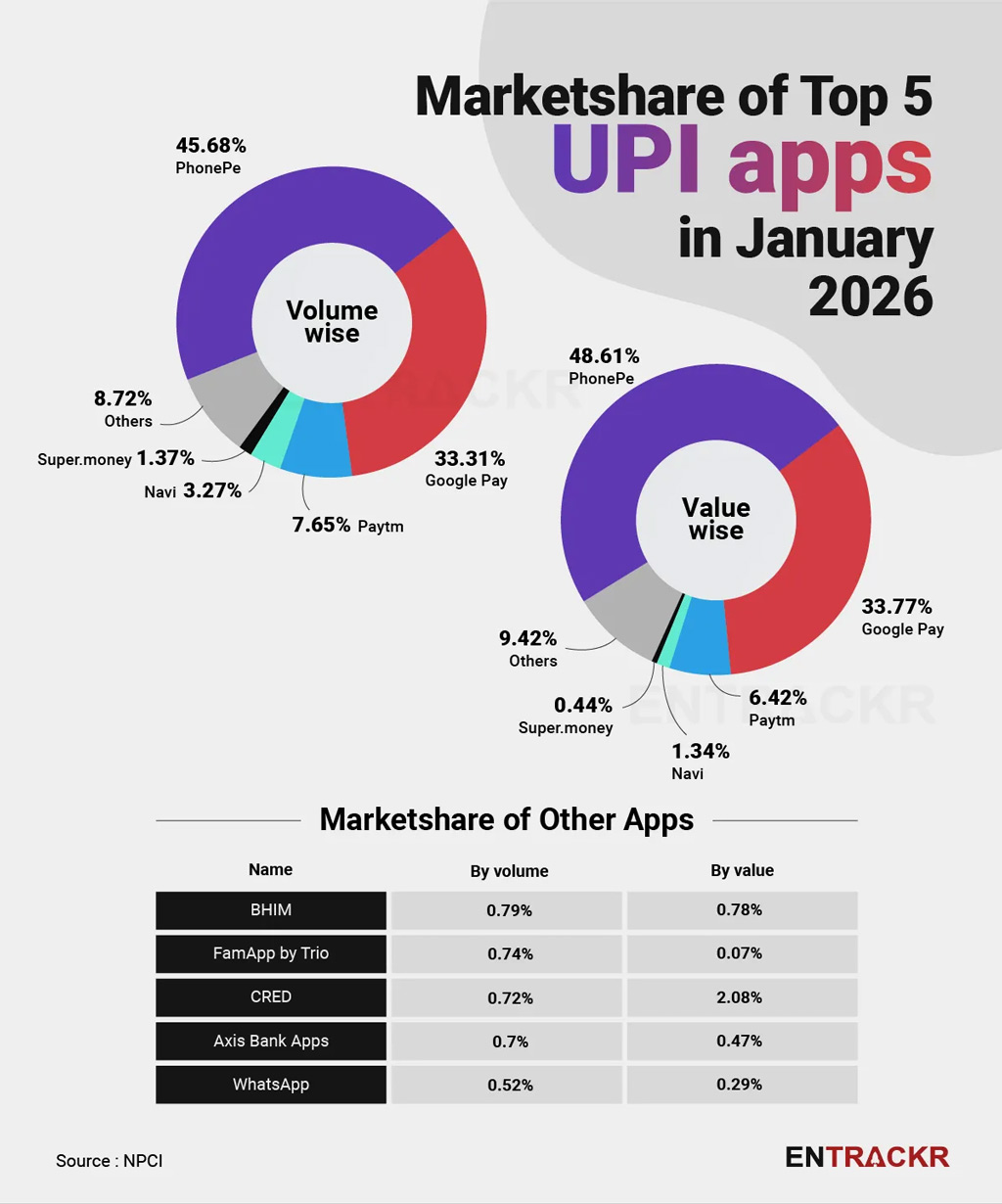
- PhonePe leads the UPI market, capturing 45.68% (volume) and 48.61% (value), making it the dominant player.
- Google Pay follows as the second-largest app, with 33.31% (volume) and 33.77% (value), maintaining a strong market presence.
- Combined, PhonePe and Google Pay control over 79% of total UPI transaction volume, indicating a highly concentrated, duopoly-driven market.
- Paytm ranks third, but with a significantly smaller share at 7.65% (volume) and 6.42% (value).
- Navi shows a drop in value contribution, with 3.27% (volume) but only 1.34% (value), suggesting lower transaction sizes.
- Super.money holds a minimal share, accounting for just 1.37% (volume) and 0.44% (value).
- The “Others” category contributes 8.72% (volume) and 9.42% (value), reflecting fragmented competition among smaller apps.
- Among smaller players, BHIM leads slightly with 0.79% (volume) and 0.78% (value).
- CRED stands out for high-value transactions, contributing 2.08% (value) despite only 0.72% (volume).
- FamApp by Trio shows a low value share, with 0.74% (volume) but just 0.07% (value).
- Axis Bank apps maintain a modest presence, at 0.70% (volume) and 0.47% (value).
- WhatsApp Pay remains limited in adoption, with only 0.52% (volume) and 0.29% (value) despite its large user base.
- Overall, the market is heavily dominated by top players, while smaller apps compete in niche or low-share segments.
Overview of Banks Supporting UPI
- Over 690 banks are live on UPI as of 2026, covering public, private, and small finance banks.
- State Bank of India (SBI) accounts for around 35% of all UPI transaction volume, making it the largest remitter bank.
- HDFC Bank and ICICI Bank together contribute to roughly 25–30% of total UPI transaction volume among private banks.
- Regional rural banks (RRBs) support over 50 million UPI-linked accounts, significantly boosting financial inclusion in rural India.
- UPI AutoPay processed more than 1.27 billion recurring mandates in November 2025, a more than 10‑fold year‑on‑year increase.
- UPI Lite crossed 10 million transactions per month, with individual wallet limits raised to ₹5,000 and per‑transaction caps at ₹1,000.
- Interoperability across 690+ banks and 200+ apps enables instant settlements for over 500 million unique users in India.
- Banking infrastructure upgrades have pushed UPI uptime reliability to 99.9%+ even during peak traffic hours.
- Smaller banks have seen UPI transaction volumes grow 60–80% year‑on‑year, largely driven by digital onboarding and merchant payments.
- Public sector banks collectively handle over 60% of UPI P2P (person‑to‑person) value, while private banks dominate P2M (person‑to‑merchant) volumes.
Key Insights on Bank-wise Transaction Volumes
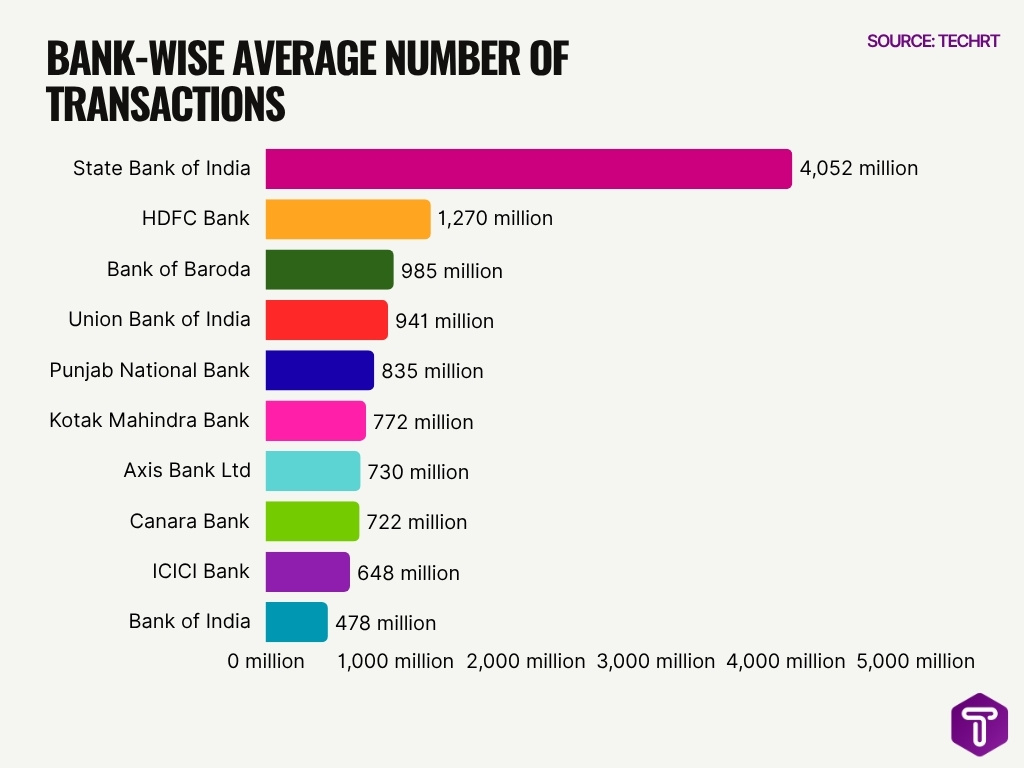
- State Bank of India dominates the list with a massive 4,052 million transactions, far exceeding all other banks.
- HDFC Bank ranks second with 1,270 million transactions, handling less than one-third of SBI’s volume.
- A strong mid-tier group includes Bank of Baroda (985 million) and Union Bank of India (941 million), both nearing the 1 billion transaction mark.
- Punjab National Bank records 835 million transactions, maintaining a solid position among top-performing public banks.
- Among private banks, Kotak Mahindra Bank (772 million) and Axis Bank (730 million) show strong digital transaction volumes.
- Canara Bank (722 million) and ICICI Bank (648 million) fall in the mid-to-lower tier, but still process hundreds of millions of transactions annually.
- Bank of India reports the lowest figure among the top 10, with 478 million transactions, yet it remains a significant contributor to the ecosystem.
- The gap between the top and bottom banks is substantial, with SBI processing over 8× more transactions than Bank of India.
- Public sector banks dominate the rankings, accounting for the majority of high transaction volumes, indicating a strong customer base and reach.
- Overall, the data highlights a highly concentrated transaction landscape, where the top 3–5 banks handle a disproportionately large share of total transactions.
Growth Rate and Year-on-Year Trends in UPI
- UPI transaction volume grew ~32% YoY in 2025, continuing strong momentum.
- Early 2026 data shows ~27% YoY growth, indicating sustained expansion.
- Growth slowed slightly from 42% in FY25 to ~25% projected in FY26, signaling maturity.
- Total transaction value grew by over 20% YoY in 2025, reaching record highs.
- UPI has maintained a multi-year CAGR above 100% since 2017, reflecting exponential scaling.
- Monthly transaction volumes doubled from ~10 billion in 2022 to 20+ billion in 2025.
- Growth in rural areas outpaces urban growth, driven by digital inclusion programs.
- Merchant payments grew faster than P2P, reshaping the transaction mix toward commerce.
- UPI continues to expand despite a high base, indicating long-term scalability and resilience.
Expansion of UPI Cross-Border Payments
- UPI is now live in countries like France, Singapore, the UAE, and Nepal.
- India-Singapore linkage enables real-time cross-border transfers via PayNow-UPI integration.
- Cross-border UPI transactions are projected to grow at 40%+ annually.
- Indian travelers can use UPI for payments in select international retail locations.
- UPI partnerships with global payment systems aim to expand into Europe and Southeast Asia.
- Remittance use cases are emerging, reducing costs compared to traditional channels.
- NPCI International is actively working with over 30 countries for UPI adoption.
- Cross-border merchant acceptance is expected to increase tourism-driven transactions.
- UPI’s global expansion positions India as a leader in real-time payment infrastructure exports.
Breakdown of UPI Transaction Categories
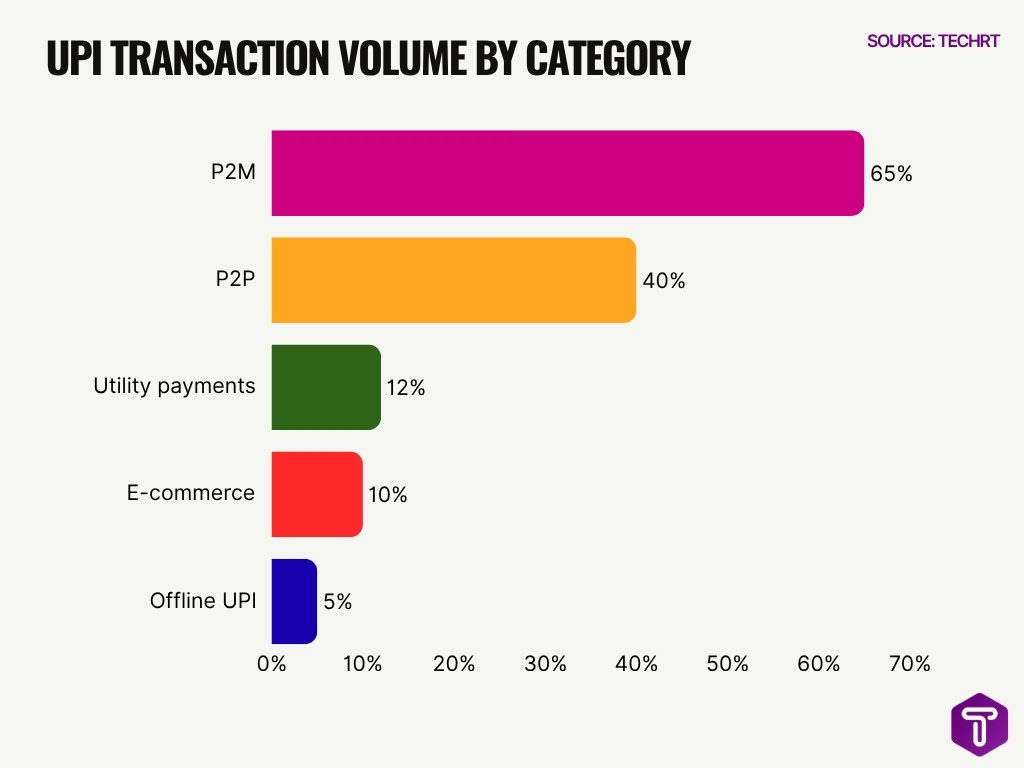
- Person‑to‑merchant P2M transactions account for roughly 60–65% of total UPI transaction volume.
- Person‑to‑person P2P transactions still represent about 35–40% of UPI transaction volume, especially for small‑value transfers.
- Utility payments such as electricity, water, and gas comprise around 10–12% of total UPI transaction volume.
- E‑commerce payments through UPI make up approximately 8–10% of total UPI transaction volume.
- Recurring subscription‑based payments via UPI AutoPay are growing at over 30% annually in transaction count.
- Transit and mobility payments for metro, tolls, and parking are capturing an increasing share of UPI volumes in urban regions.
- Government disbursements and subsidies via UPI now cover over 20% of benefit‑linked digital payments in rural areas.
- Offline UPI payments through UPI Lite and feature‑phone solutions account for roughly 3–5% of total UPI transaction volume.
- Cross‑category usage shows that more than 40% of active UPI users regularly transact across at least three distinct categories.
- Overall, P2M segments such as groceries, restaurants, and telecom now drive close to 70% of new UPI merchant‑category growth.
Analysis of UPI Fraud and Security Statistics
- In FY24, 13.42 lakh UPI fraud cases were reported, worth ₹1,087 crore, amid rising transactions.
- UPI frauds comprised under 0.002% of the total 131 billion transactions in FY24.
- Fraud value stayed below 0.01% of the ₹200 lakh crore total UPI transaction value.
- Phishing and social engineering dominate, forming over 70% of UPI fraud incidents.
- In FY25, 12.64 lakh fraud cases caused ₹981 crore losses despite security upgrades.
- AI-based detection systems by NPCI and banks cut potential fraud rates significantly.
- FY26 (till Mar 2026) saw 1.63 million UPI frauds worth ₹1,226 crore reported.
- UPI transactions hit 185.9 billion in FY25, up 41.7% YoY, with a low fraud ratio.
- 85% surge in UPI fraud cases from FY23 to FY24 due to transaction volume growth.
Frequently Asked Questions (FAQs)
How many UPI transactions were processed in a month in 2026?
UPI processed 21.7 billion transactions in January 2026, the highest monthly volume recorded.
What is the total value of UPI transactions in a peak month?
UPI transactions reached about ₹28.33 lakh crore in January 2026 in total value.
What is the year-on-year growth rate of UPI transactions in 2026?
UPI transaction volumes grew by approximately 27% YoY in February 2026.
How many daily transactions does UPI handle on average?
UPI handles around 728 million transactions per day as of early 2026.
What share does UPI hold in India’s digital payments market?
UPI accounts for about 81% of total retail digital payment volume in India.
Conclusion
UPI has evolved into one of the world’s most advanced real-time payment systems, combining scale, speed, and accessibility in a way few platforms have achieved. It now powers everything from daily retail purchases and micro-transactions to government disbursements, subscription payments, and cross-border use cases, making it a central pillar of India’s digital economy. Moreover, its continued expansion into merchant ecosystems, rural regions, and international markets highlights its adaptability and long-term relevance.
As transaction volumes continue to grow and innovation deepens through features like UPI Lite, AutoPay, and global integrations, the platform is set to influence how digital payments evolve worldwide. For businesses, policymakers, and consumers alike, UPI represents not just a payment system but a scalable infrastructure driving economic activity, transparency, and financial inclusion at unprecedented levels.

Leave a comment
Have something to say about this article? Add your comment and start the discussion.