




Video marketing has moved from a supporting tactic to a central pillar of digital strategy. Brands now use video across product demos, social media campaigns, and educational content to capture attention and explain complex ideas quickly. For example, ecommerce companies rely on product videos to boost conversions, while SaaS firms use explainer videos to simplify onboarding and reduce churn. As audiences consume more video across platforms and devices, marketers continue to increase investment in this format. The statistics below reveal how video marketing shapes engagement, budgets, and growth across industries.
Editor’s Choice
- 91% of businesses use video as a marketing tool in 2026, reflecting near-universal adoption across industries.
- 93% of video marketers say video is a key part of their marketing strategy, highlighting its role in modern digital campaigns.
- 82% of internet traffic is expected to be video by 2026, demonstrating how dominant video has become online.
- 92% of global internet users watch online videos every month, making video one of the most widely consumed digital formats.
- 82% of consumers have purchased a product after watching a marketing video, proving its impact on buying decisions.
- 70% of businesses say they are creating more videos than the previous year, reflecting continuous content expansion.
- 100 minutes per day is the average time people spend watching online video globally, signaling massive engagement levels.
Recent Developments
- Generative AI could power about 40% of video ads by 2026, as marketers automate production and creative testing.
- 86% of digital video ad buyers already use or plan to use generative AI to create video ad content.
- Nearly 69% of businesses create social media videos as part of their marketing strategy in 2026.
- 59% of companies produce marketing videos in-house, indicating strong internal content capabilities.
- 46% of marketers use live video as part of their social media marketing tactics, particularly for events and product launches.
- More than half of companies increased their video marketing budgets in 2025, while only about 5% reduced spending.
- 21% of businesses use freelancers to produce video content, showing a hybrid production model emerging across organizations.
- 16% of businesses rely on dedicated video production agencies, especially for brand campaigns and commercials.
- 18% of marketers now use AI tools for video creation, reflecting growing automation in production workflows.
Global Video Marketing Overview
- Video marketing adoption has grown from 61% of businesses in 2016 to over 90% today, illustrating rapid mainstream adoption.
- The global digital video advertising market reached about $230.41 billion in 2024, highlighting the scale of the industry.
- Video ad spending is projected to grow to roughly $278.8 billion in 2025, reflecting increasing brand investment in video channels.
- The digital video advertising market could exceed $1.28 trillion by 2033, driven by a projected 21% CAGR.
- Nearly 98% of marketers consider video a crucial component of their marketing strategy, emphasizing its strategic importance.
- 70% of brands report producing more videos than the previous year, indicating continuous growth in content output.
- Video marketing adoption surpassed 89% of businesses in 2025, continuing the upward trend toward universal usage.
- Around 93% of marketers say video marketing delivers positive ROI, making it one of the most effective digital channels.
Video Marketing Adoption Has Grown Significantly Over Time
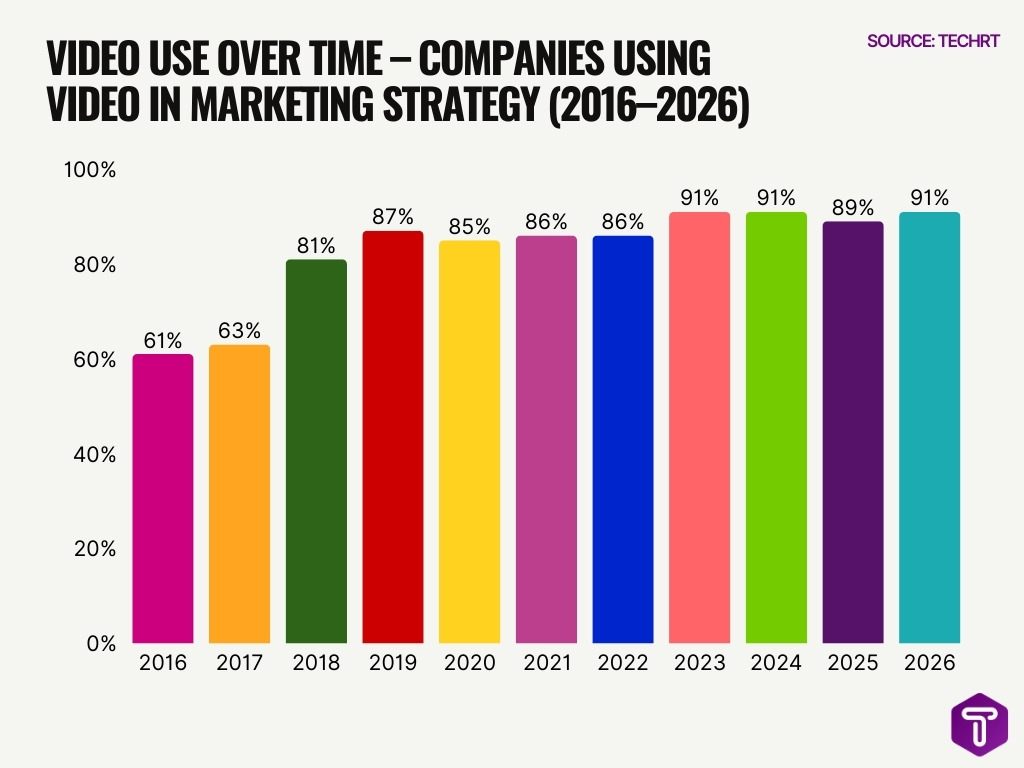
- The share of companies using video as part of their marketing strategy increased from 61% in 2016 to 91% in 2026, showing a 30-percentage-point rise over the decade.
- Adoption saw a major jump between 2017 (63%) and 2018 (81%), marking an 18-point increase in a single year.
- By 2019, 87% of companies had integrated video into their marketing strategies, highlighting how quickly video became a mainstream marketing tool.
- Despite a slight dip during 2020 (85%), video usage remained high and recovered to 86% in 2021 and 2022.
- The highest adoption rate reached 91% in 2023, indicating that nearly 9 out of 10 businesses rely on video marketing.
- Video usage remained consistently strong with 91% in 2024, followed by a minor drop to 89% in 2025.
- In 2026, video marketing adoption returned to 91%, reinforcing video as a core component of modern marketing strategies.
- Overall, the data shows that video has evolved from an emerging tactic in 2016 to a near-universal marketing channel by 2026.
Video Marketing Adoption by Businesses
- 91% of businesses currently use video marketing, making it one of the most widely adopted digital strategies.
- 93% of marketers say video is an essential part of their overall marketing strategy, reflecting strong strategic alignment.
- 65% of marketers who do not currently use video plan to start using it soon, showing continued expansion of adoption.
- 73% of marketers create explainer videos to educate customers about products or services.
- 55% of companies produce video internally, while others outsource or use hybrid production models.
- 31% of businesses use a mix of in-house teams and external agencies for video production.
- Only about 9% of businesses still avoid video marketing, usually due to cost or time constraints.
- Nearly 70% of businesses report increasing video production year over year, reflecting continued adoption and demand.
Video Marketing Budget and Spend
- More than half of businesses increased their video marketing budgets in 2025, reflecting growing confidence in the format.
- Only about 5% of companies reduced their video marketing budgets, indicating sustained investment.
- 14% of marketers plan to increase their video marketing investment in 2025, according to marketing surveys.
- Global digital video advertising spend surpassed $230 billion in 2024, highlighting strong market demand.
- Video advertising spending could reach nearly $278.8 billion in 2025, driven by social media and streaming growth.
- Connected TV advertising continues to attract increasing marketing budgets worldwide, as brands shift from traditional TV.
- Creator economy advertising spending reached about $37 billion in 2025, much of it tied to video content and influencer collaborations.
- Advertisers increasingly prioritize measurable ROI from video campaigns, making performance metrics central to budget decisions.
Most Popular Use Cases for Video Marketing
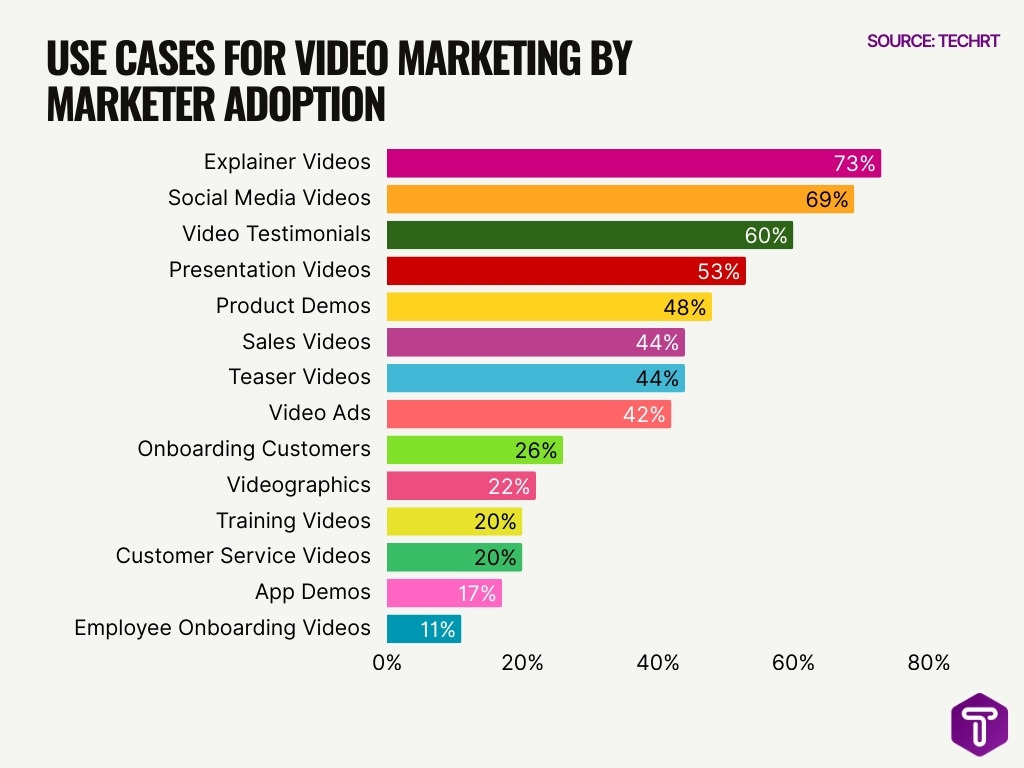
- Explainer videos are the most widely used format, with 73% of marketers using them to simplify products, services, or complex concepts for audiences.
- Social media videos follow closely, adopted by 69% of marketers, highlighting the growing importance of short-form and platform-native video content for engagement.
- Video testimonials are used by 60% of marketers, showing the strong impact of customer trust and social proof in marketing strategies.
- Presentation videos are used by 53% of marketers, indicating that businesses frequently rely on visual storytelling and slide-based content to communicate ideas and strategies.
- Nearly 48% of marketers use product demo videos, demonstrating how video helps showcase product features and functionality effectively.
- Sales videos are used by 44% of marketers, while teaser videos are also used by 44%, reflecting their role in driving interest and supporting sales funnels.
- Video ads are adopted by 42% of marketers, reinforcing video’s importance in digital advertising and paid marketing campaigns.
- About 26% of marketers use onboarding videos to help new customers understand products or services quickly.
- Videographics are used by 22% of marketers, combining visual data storytelling with motion graphics to make information easier to understand.
- Training videos and customer service videos are each used by 20% of marketers, highlighting their value in education, support, and operational efficiency.
- App demo videos are used by 17% of marketers, showing how businesses rely on video to demonstrate app functionality and improve user adoption.
- Employee onboarding videos are the least common, used by 11% of marketers, suggesting that internal training videos are less frequently produced compared to customer-focused content.
Video Advertising Market Size
- The global digital video advertising market reached about $230.4 billion in 2024, reflecting continued growth in video-driven campaigns.
- Analysts estimate the market will reach approximately $278.8 billion in 2025, as brands expand spending on social and streaming platforms.
- The industry could exceed $1.28 trillion by 2033, driven by a projected 21% compound annual growth rate (CAGR).
- In the United States, digital video advertising spending surpassed $78 billion in 2024, making it one of the fastest-growing ad segments.
- Connected TV (CTV) advertising spending exceeded $30 billion in the U.S. in 2024, reflecting the shift from traditional TV to streaming platforms.
- Social video advertising accounted for over 45% of total digital video ad spend globally in 2025.
- The global mobile video advertising market surpassed $180 billion in 2025, highlighting the importance of smartphone-based viewing.
- Programmatic video advertising represented around 87% of U.S. digital video ad spending in 2024, emphasizing automated ad buying.
- Video ads now account for more than one-third of total digital advertising spending worldwide.
Video Marketing ROI Statistics
- 93% of marketers report a positive ROI from video marketing, making it one of the most effective content formats.
- 87% of video marketers say video helped them generate leads, showing its strong performance across the funnel.
- 81% of marketers report that video directly increased sales, highlighting measurable business impact.
- Businesses using video grow revenue 49% faster than those that do not, according to marketing research.
- 90% of marketers say video gives them a strong return on investment, reinforcing its cost-effectiveness.
- 83% of marketers say video helps increase the time visitors spend on their website, improving engagement metrics.
- 88% of marketers say video helps audiences understand products or services better than other formats.
- Landing pages that include video can increase conversions by up to 80%, demonstrating the format’s effectiveness.
- 66% of marketers report better-qualified leads when using video content in campaigns.
Impact of Video on Sales and Conversions
- 82% of consumers say a video convinced them to buy a product or service, highlighting video’s influence on purchasing decisions.
- Product pages with video can increase purchase likelihood by up to 144%.
- 64% of consumers are more likely to purchase after watching a product video online.
- Ecommerce stores that add product videos often see conversion rate improvements between 15% and 80%.
- About 73% of consumers prefer watching a short video to learn about a product instead of reading text.
- 84% of people say they’ve been convinced to buy a product after watching a brand’s video.
- Companies using video in email marketing experience up to 300% higher click-through rates.
- Including video in marketing emails can increase open rates by 19% and reduce unsubscribe rates by 26%.
- Retail brands report conversion increases of 20 to 30% when video demonstrations accompany product listings.
Video Marketing Effectiveness by Platform
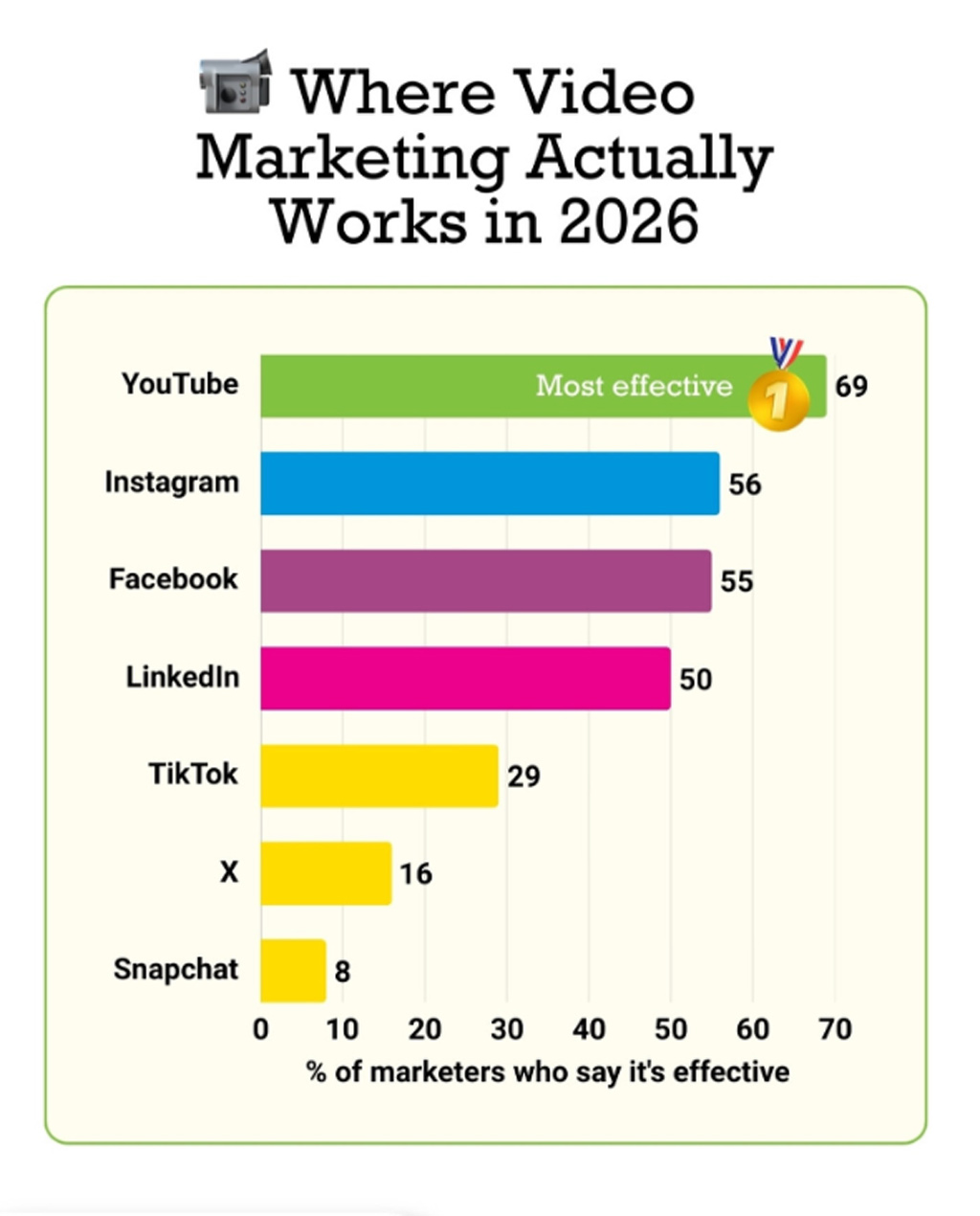
- YouTube leads video marketing effectiveness, with 69% of marketers saying it is the most effective platform for video campaigns in 2026. Its long-form content, search visibility, and strong engagement make it the top choice for brands.
- Instagram ranks second, as 56% of marketers report that video performs effectively on the platform. Features like Reels, Stories, and feed videos help brands reach large audiences and drive engagement.
- Facebook closely follows, with 55% of marketers stating that video marketing works well on the platform. Facebook’s massive user base and advanced ad targeting continue to make it valuable for video campaigns.
- LinkedIn shows strong performance for professional audiences, with 50% of marketers saying video marketing is effective. It is particularly powerful for B2B marketing, thought leadership, and brand storytelling.
- TikTok is considered effective by 29% of marketers, reflecting its role in short-form video content and viral marketing, especially for brands targeting younger audiences.
- X (formerly Twitter) sees relatively lower effectiveness, with 16% of marketers reporting positive video marketing results on the platform.
- Snapchat ranks last, as only 8% of marketers say video marketing works effectively there, suggesting its limited adoption for broader marketing campaigns compared to other social platforms.
Impact of Video on Lead Generation
- 87% of marketers say video helps generate leads, making it one of the most powerful lead generation formats.
- Marketers who use video grow qualified leads by 66% per year on average.
- 74% of B2B marketers say video converts leads better than blog posts or infographics.
- Video landing pages can increase lead capture rates by up to 80%.
- 62% of marketers say video content reduces support queries from prospects, improving sales efficiency.
- Webinar and video-based events generate over 40% more qualified leads than static campaigns.
- Businesses using video in B2B marketing report up to 34% higher lead conversion rates.
- 73% of B2B marketers say video positively impacts lead quality, particularly for educational content.
- Video testimonials can increase lead trust levels by over 70% compared with written testimonials.
Impact of Video on Website Traffic and SEO
- Websites with video are 53 times more likely to rank on the first page of search results.
- Video content can increase organic search traffic by 157%, according to SEO studies.
- 88% of marketers say video increases dwell time on their websites, improving SEO signals.
- Pages with embedded video typically see lower bounce rates and longer session durations.
- Video thumbnails in search results can improve click-through rates by up to 41%.
- Video results appear in over 60% of Google keyword searches, demonstrating strong visibility.
- YouTube is the second-largest search engine globally, making it a major traffic driver for video marketing.
- Websites using video marketing experience 41% more web traffic from search than those without video.
- Adding video to blog posts can increase average time on page by over 2 minutes.
Video Marketing and Brand Awareness
- 96% of marketers say video increases brand awareness, making it one of the most effective branding tools.
- 89% of marketers say video gives them strong brand recall among audiences.
- Social media videos generate 1,200% more shares than text and image content combined.
- 84% of consumers say watching a brand’s video made them feel more connected to the company.
- Video campaigns often generate three times more brand engagement than non-video campaigns.
- 87% of marketers say video helps communicate brand personality more effectively.
- Brand videos on social platforms can increase brand recall by up to 80%.
- 78% of consumers say they prefer learning about a brand through video instead of text.
- Campaigns that include storytelling videos report up to 22 times more engagement compared to standard promotional ads.
Consumer Preference for Video Content Statistics
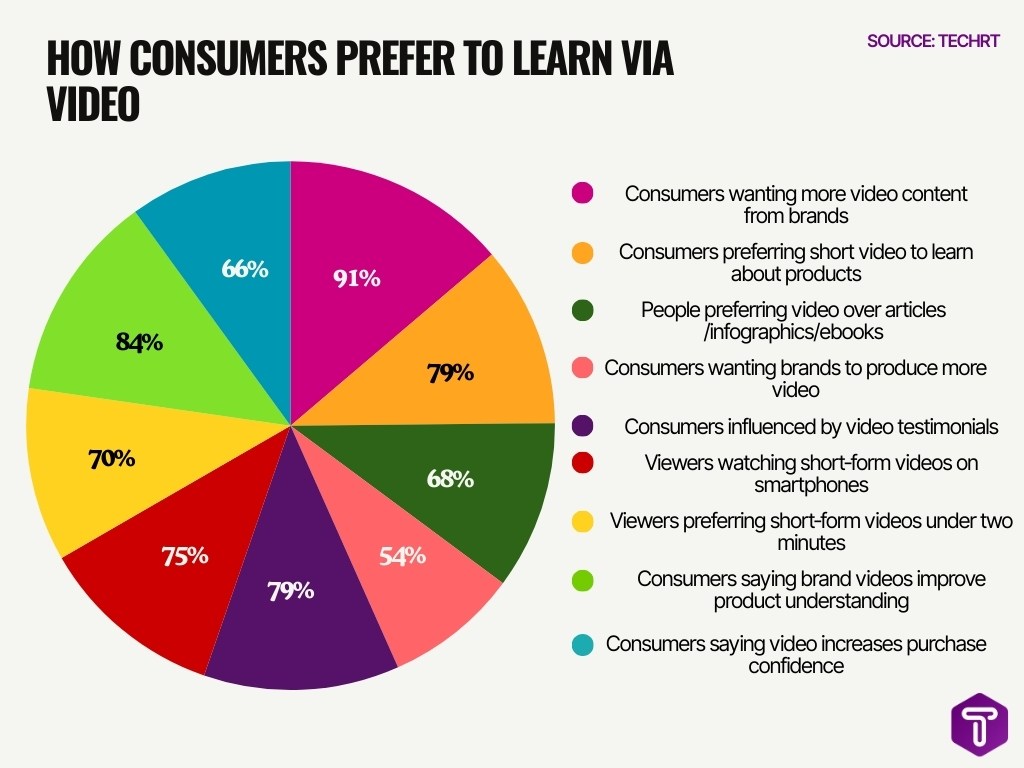
- 91% of consumers want to see more video content from brands, according to recent surveys.
- 73% of consumers prefer watching a short video to learn about a product or service.
- 68% of people prefer video over articles, infographics, or ebooks when learning about products.
- 54% of consumers want brands to produce more video content in the future.
- 79% of consumers say video testimonials influence their purchasing decisions.
- 75% of viewers watch short-form videos on their smartphones, reflecting mobile consumption trends.
- 70% of viewers prefer short-form videos under two minutes, particularly on social media platforms.
- 84% of consumers say brand videos help them better understand products.
- 66% of consumers say video content increases their confidence in purchasing decisions.
Video Engagement Metrics
- The average online video engagement rate across social platforms is about 5.5%, which is significantly higher than most static content formats.
- Videos on social media generate 48% more engagement than image or text posts, highlighting their impact on audience interaction.
- The average video retention rate across digital platforms is around 52% of total watch time, meaning viewers watch over half of most videos.
- Videos under 2 minutes long receive the highest engagement rates, particularly on social platforms.
- Including captions can increase video view time by up to 12%, especially for mobile viewers watching without sound.
- Social media videos generate 1,200% more shares than text and image posts combined.
- The average viewer remembers 95% of a message when watching it in video form, compared with about 10% when reading text.
- Video posts on LinkedIn receive three times more engagement than text-only posts, particularly for B2B content.
- Videos that include storytelling elements can increase engagement by up to 22 times compared with standard promotional content.
Short Form Video Statistics
- Short-form videos now account for over 60% of total social media video engagement worldwide.
- Platforms focused on short-form video have seen massive growth, with over 1.5 billion monthly active users on TikTok in 2025.
- 90% of marketers plan to increase or maintain investment in short-form video, making it one of the fastest-growing formats.
- Short-form videos typically generate 2.5 times more engagement than long-form videos on social media.
- The average length of high-performing short-form marketing videos is between 15 and 60 seconds.
- 73% of consumers say short videos are their preferred format for discovering new products.
- Instagram Reels videos generate about 22% more engagement than standard Instagram posts.
- Short-form video ads can deliver up to 30% higher completion rates than longer ads.
- Brands using short-form videos report up to 20% higher conversion rates in social commerce campaigns.
Key Reasons Businesses Avoid Video Marketing
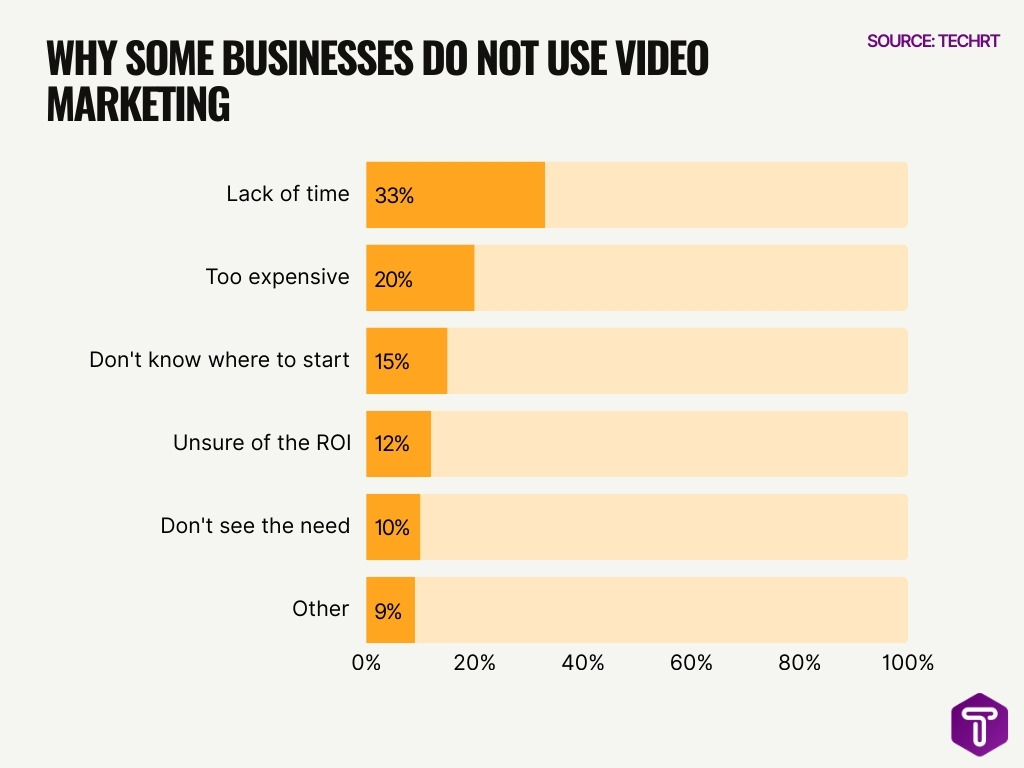
- The biggest barrier to adopting video marketing is a lack of time, cited by 33% of businesses, showing that many companies struggle to allocate resources for video production and strategy.
- Around 20% of businesses say video marketing is too expensive, indicating that production costs, equipment, and editing resources remain a concern for many organizations.
- Approximately 15% of businesses report they don’t know where to start, highlighting a knowledge and strategy gap in planning and executing effective video marketing campaigns.
- Another 12% of businesses are unsure about the return on investment (ROI), suggesting that some marketers still lack clear performance metrics and attribution models for video content.
- About 10% of businesses say they don’t see the need for video marketing, reflecting that a small segment of companies still underestimates the impact of video on engagement and conversions.
- Lastly, 9% of businesses cite other reasons, which may include limited team expertise, lack of internal tools, or competing marketing priorities.
Social Media Video Marketing Statistics
- 93% of marketers say social media video helps them acquire new customers, demonstrating its effectiveness in digital campaigns.
- Social media videos generate 1,200% more shares than text and images combined, boosting reach and virality.
- Facebook video posts receive approximately 59% more engagement than other post types on the platform.
- LinkedIn users are 20 times more likely to share video posts than other types of content.
- Tweets that include video can receive up to 10 times more engagement than tweets without video.
- Instagram video posts often receive 38% more engagement than image posts.
- Over 86% of businesses use video on social media platforms as part of their marketing strategy.
- YouTube remains the world’s largest video platform with over 2.7 billion monthly active users globally.
- More than 70% of YouTube watch time comes from mobile devices, reinforcing the mobile-first nature of video consumption.
Video Use Across the Marketing Funnel
- 96% of marketers say video helps users better understand products or services, making it effective for top-of-funnel awareness.
- Explainer videos are used by around 73% of marketers, primarily to educate prospects during the consideration stage.
- Case study or testimonial videos increase trust and can boost conversions by over 30%.
- Video landing pages can improve conversion rates by up to 80%, particularly for lead generation campaigns.
- 79% of consumers prefer watching video reviews before making purchase decisions.
- Email campaigns that include video increase click-through rates by up to 300%.
- Post-purchase tutorial videos can reduce support inquiries by up to 25%, improving customer retention.
- 84% of marketers say video improves customer understanding across the buyer journey.
- Educational video content helps increase customer retention rates by more than 20%.
How Businesses Create Video Content
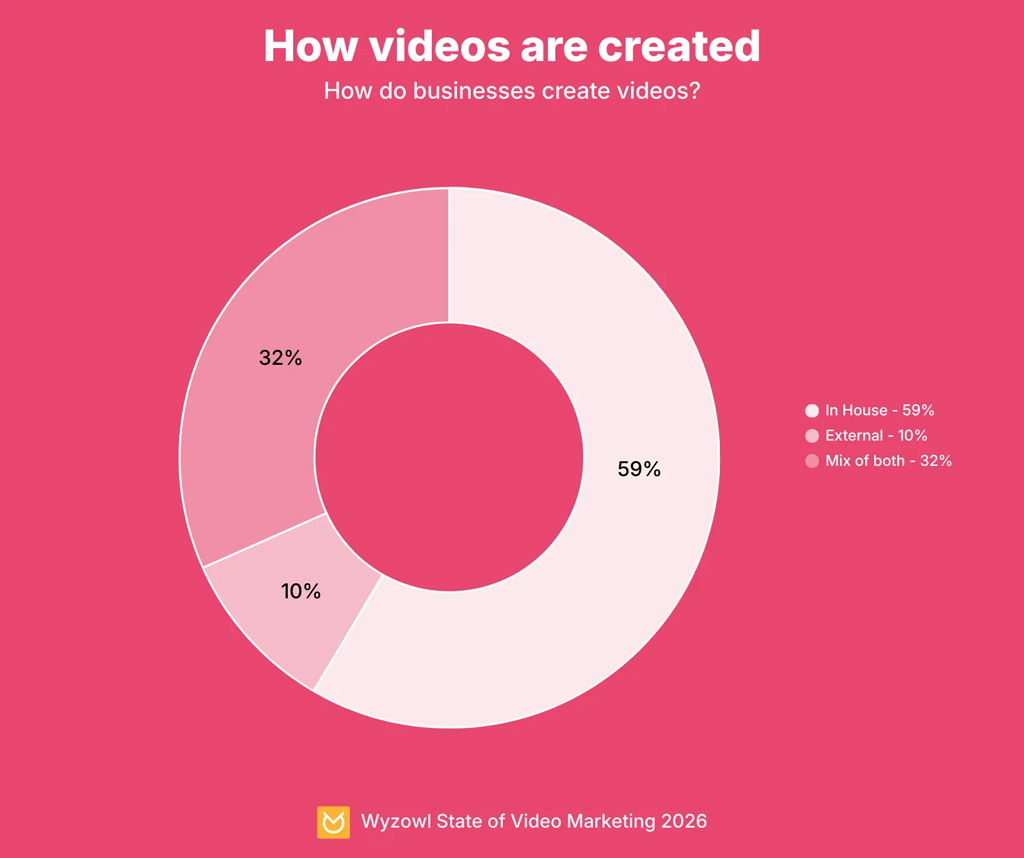
- 59% of businesses create videos in-house, making it the most common video production approach for companies. This indicates that many brands prefer to maintain full creative control and faster production cycles by using internal teams.
- Only 10% of businesses rely entirely on external agencies or creators to produce their videos, showing that fully outsourced video production is relatively uncommon among companies.
- Around 32% of businesses use a mix of both in-house teams and external partners, combining internal expertise with specialized creative or production support when needed.
- The data suggests that over 90% of businesses are involved in video production internally (either fully or partially), highlighting the growing importance of in-house video capabilities in modern marketing strategies.
- The hybrid production model (32%) is also significant, as it allows companies to balance cost efficiency, scalability, and professional production quality.
- Overall, the statistics highlight a clear trend toward internalizing video marketing production, with businesses increasingly building dedicated in-house video teams and resources to support their content strategies.
Video Creation Tools and AI Video Statistics
- 86% of advertisers say they are using or experimenting with AI tools to create video ads.
- The AI video generation market is projected to grow at over 18% CAGR between 2024 and 2030.
- 44% of marketers now use AI tools to assist with video production, including editing and script generation.
- AI-powered editing tools can reduce video production time by up to 60%.
- Automated video creation platforms help marketers produce three times more video content than traditional workflows.
- 38% of marketing teams plan to increase investment in AI video tools in 2026.
- AI-generated captions and subtitles improve accessibility and can increase video engagement by 12% or more.
- AI-based personalization enables brands to create thousands of customized video variations for targeted campaigns.
- Marketing teams using AI video tools report up to 30% lower production costs.
Future Trends in Video Marketing
- By 2027, video could represent over 85% of all consumer internet traffic, further expanding its digital dominance.
- Interactive video experiences are expected to increase engagement by up to 47% compared with standard video formats.
- The global connected TV advertising market is projected to exceed $42 billion by 2027.
- Shoppable video formats are expected to drive billions in ecommerce sales, particularly across social platforms.
- Virtual reality and immersive video experiences are predicted to grow significantly, especially in the retail and education sectors.
- 80% of marketers expect video to remain their most important marketing format over the next five years.
- Personalized video marketing campaigns can increase click-through rates by over 4 times compared with generic videos.
- The creator economy, driven largely by video content, is projected to surpass $480 billion by 2027.
- Live streaming commerce continues to grow globally and is expected to reach hundreds of billions in retail sales within the decade.
Frequently Asked Questions (FAQs)
What percentage of businesses use video marketing today?
Around 91% of businesses use video as a marketing tool, reflecting near-universal adoption across industries.
How many marketers report a positive ROI from video marketing?
Approximately 93% of marketers report a strong ROI from video marketing, making it one of the highest-performing content formats.
What percentage of internet users watch online videos each month?
Roughly 92% of global internet users watch online video every month, highlighting the massive reach of video content.
How much did global digital video advertising spending reach recently?
Global digital video advertising spending exceeded $191.4 billion in 2024, showing the rapid growth of the video advertising market.
What percentage of consumers say video influences their purchasing decisions?
More than 82% of consumers say watching a video has influenced their purchase decision, demonstrating video’s impact on conversions.
Conclusion
Video marketing continues to reshape how brands communicate with audiences across digital platforms. From short-form social clips to long-form educational videos, businesses now rely on video to increase engagement, explain complex products, and influence purchasing decisions. The statistics throughout this report show that video not only drives higher engagement and conversions but also strengthens brand awareness and customer trust.
As technology evolves, with AI-powered production tools, interactive formats, and personalized video campaigns, video marketing will likely become even more central to digital strategy. Businesses that invest in scalable video content and data-driven campaigns will be better positioned to capture attention, build relationships, and drive measurable growth in the coming years.

Leave a comment
Have something to say about this article? Add your comment and start the discussion.