




Voice search has shifted from a novelty tech feature into a mainstay in digital behavior. Nearly 20.5% of the global population uses voice search regularly, signaling that millions of people now prefer speaking to typing. Its influence is clear in everyday tasks; consumers use voice commands to check the weather, find local businesses, and even make purchases. Businesses are responding too, optimizing content and services for hands-free discovery and engagement. Explore the surprising scope of voice search across user adoption, device trends, and market growth below.
Editor’s Choice
- 27% of the global online population uses voice search on mobile devices.
- 8.4 billion voice assistants are expected to be in use globally by 2026.
- 93.7% answer accuracy for queries processed by voice assistants.
- Over 1 billion voice searches are performed every month worldwide.
- 32% of consumers perform daily searches via voice rather than typing.
- Smartphones account for 56–58% of all voice search use.
- About 98 million U.S. households own at least one smart speaker.
- 40% of online searches now happen through voice interfaces.
Recent Developments
- Voice-based AI assistants grew in market value, from $9.05 billion in 2025 to $11.71 billion in 2026.
- Advancements in large language models (LLMs) are making assistants more responsive and conversational.
- Major assistants now support dozens of languages, increasing accessibility worldwide.
- Improvements in speech recognition have pushed accuracy above 90% for many tasks.
- Integration of AI boosts context awareness in responses and follow-ups.
- Smart devices increasingly embed voice control, from phones to TVs and cars.
- Wearables and earbuds are now common voice interaction points, expanding usage scenarios.
- Emerging privacy discussions shape how voice data is collected and used.
U.S. Voice Assistant Users Growth
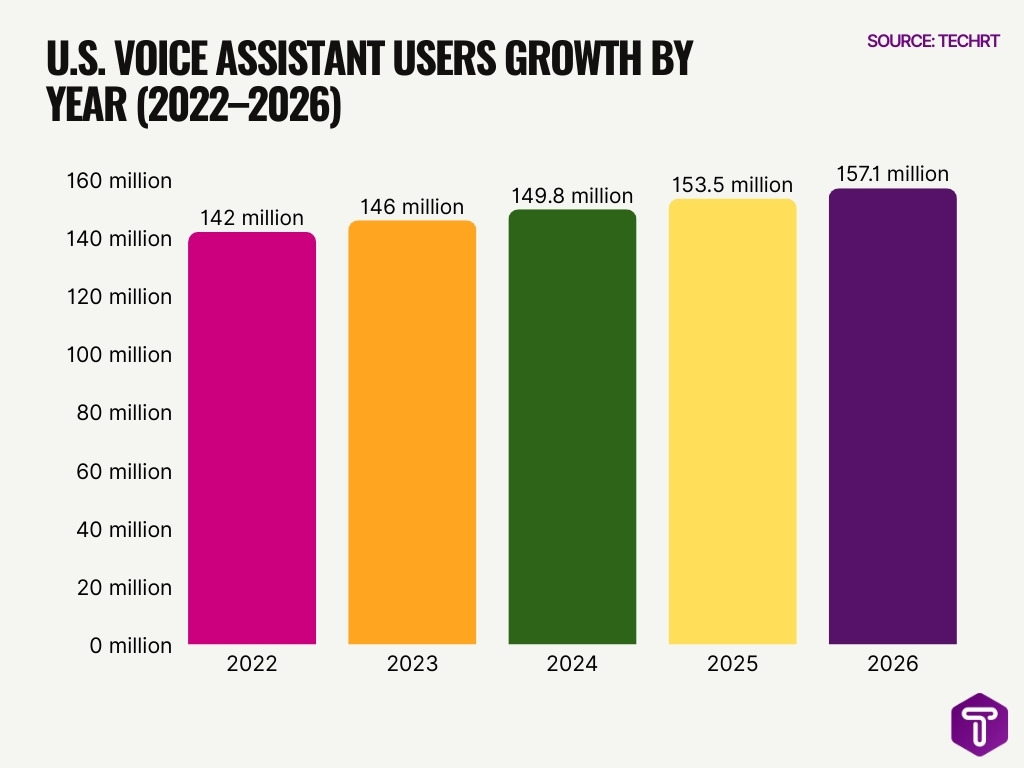
- The number of voice assistant users in the United States reached 142 million in 2022, marking a strong base for continued adoption.
- In 2023, users increased to 146 million, reflecting a 2.8% year-over-year growth, the highest growth rate in this period.
- Adoption continued rising in 2024, with the total climbing to 149.8 million users, representing a 2.5% increase.
- By 2025, the user base is expected to reach 153.5 million, maintaining a steady 2.5% growth rate.
- Projections for 2026 estimate 157.1 million users, although growth is forecast to slow slightly to 1.3%, signaling a maturing market.
- Overall, the U.S. voice assistant market is projected to add 15.1 million new users between 2022 and 2026, highlighting sustained but gradually stabilizing expansion.
Global Voice Search Adoption
- 27% of the global online population uses voice search on mobile devices.
- 27.6% of internet users aged 16-64 worldwide use voice assistants weekly.
- 40.8% of Chinese internet users use voice assistants weekly, the highest globally.
- Asia Pacific sees nearly two-thirds of consumers using voice technology.
- Smartphones drive 56% of voice search interactions worldwide.
- Men report higher voice search usage than women on smartphones (66% vs 55%).
- 35% of U.S. adults (~100 million) own a smart speaker.
- 8.4 billion voice assistants are active globally, surpassing the world population.
- 20.5% of global internet queries are now voice search.
Usage Growth Trends
- Voice search usage has climbed steadily year over year, stabilizing around 20% globally.
- Over 1 billion voice searches per month reflect expanding everyday use.
- 32% of consumers now choose voice over typing for daily searches.
- Use cases have shifted beyond basic tasks to commerce and local discovery.
- Growth in mobile voice searches continues to outpace other platforms.
- Smart speaker adoption is rising alongside voice feature improvements.
- Younger demographics, 16–34, show the highest recurring usage rates.
- AI-enhanced assistants help maintain user engagement and retention.
Why Voice Search Continues to Accelerate in Adoption
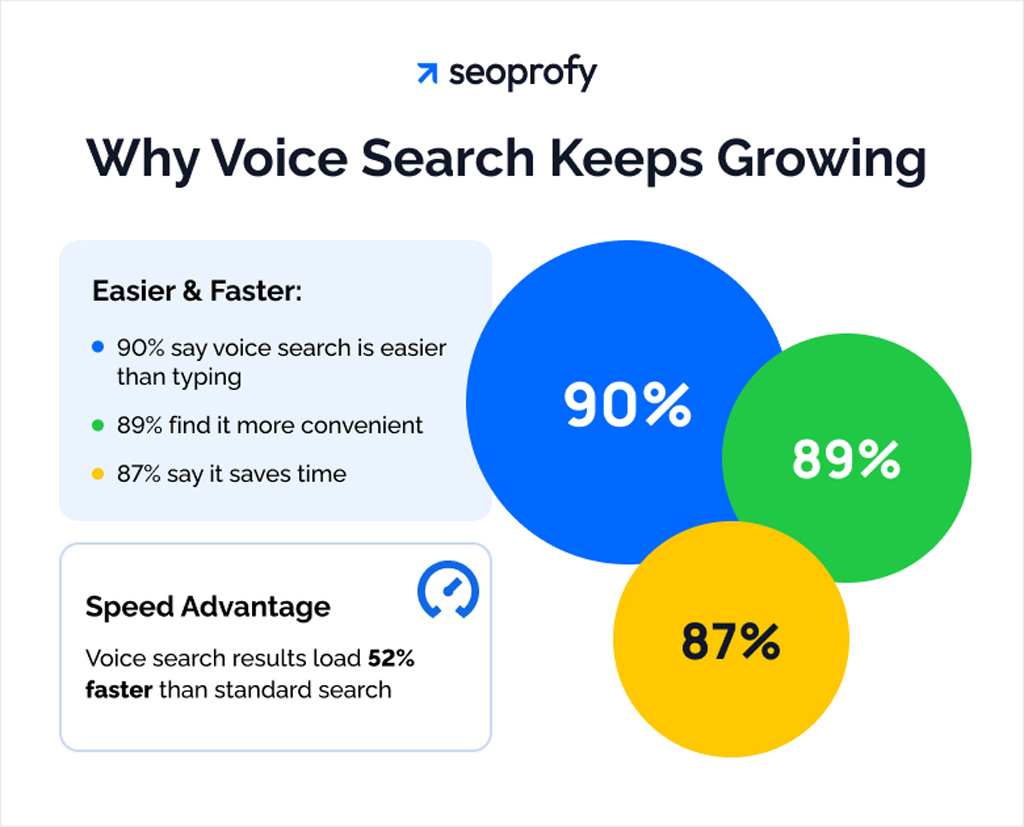
- 90% of users say voice search is easier than typing, highlighting a strong usability advantage.
- 89% of users find voice search more convenient, reinforcing its appeal for hands-free and multitasking scenarios.
- 87% report that voice search saves time, positioning it as an efficiency-driven technology.
- Voice search results load 52% faster than standard search, delivering a measurable performance advantage.
Device Penetration Rates
- Smartphones dominate with 58% of all voice searches.
- Smart speakers capture 26–35% of voice queries globally.
- Smart TVs see 15% of users engaging in voice interactions.
- Wearables represent about 15% of the voice recognition market share.
- In-car systems account for 29–31% of voice assistant usage.
- Computers/laptops/tablets comprise 24% of voice device usage.
- IoT/smart home devices make up 12% of voice commands.
- North America leads with 45.94% of the global voice search market.
Mobile Voice Search Stats
- 27% of the global population uses voice search on mobile devices.
- 20% of all mobile queries are conducted via voice.
- 77% of 18-34 year olds use voice search on smartphones.
- Voice search market grows at a CAGR of 23.8% from 2024-2030.
- 58% of consumers use voice search for local businesses.
- 56% of smartphone users rely on voice for business info.
- Over 1 billion voice searches occur monthly worldwide.
- 61% of 25-64 year olds plan to increase voice device usage.
Popular Voice Assistants
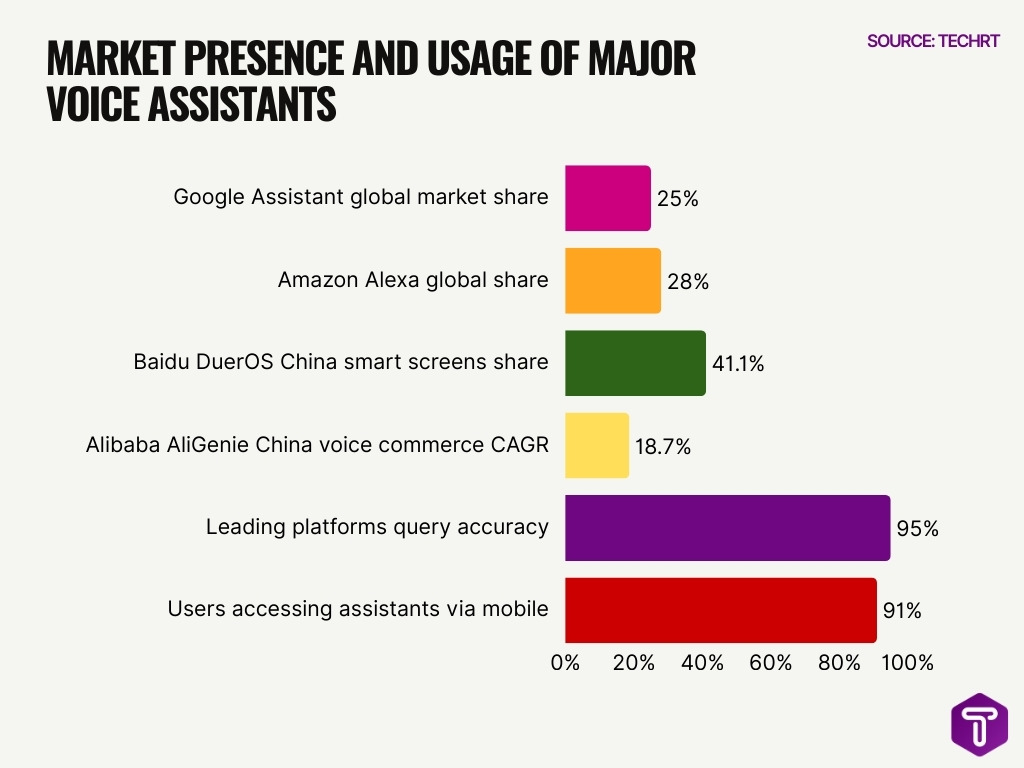
- Google Assistant commands 25% global market share with 2.5 billion daily interactions.
- Siri serves 86.5 million U.S. users across 1.4 billion active devices.
- Amazon Alexa holds 28% global share, dominating smart speaker households.
- Baidu DuerOS controls 41.1% of China’s mobile smart screens market.
- Alibaba AliGenie powers growth in Asia with China voice commerce at 18.7% CAGR through 2035.
- Voice assistants enable 95%+ accuracy rates for leading platforms on common queries.
- 91% of users access voice assistants via mobile devices, expanding wearables touchpoints.
- Over 8.4 billion voice-enabled devices worldwide support third-party app integrations.
Smart Speaker Ownership
- Approximately 98 million U.S. households own at least one smart speaker.
- Around 35% of U.S. households own at least one smart speaker device.
- Amazon Echo devices account for roughly 28% of the U.S. smart speaker market, followed closely by Google Nest.
- Globally, smart speaker shipments surpassed 200 million cumulative units in recent years.
- Nearly 52% of smart speaker owners keep devices in common living spaces, increasing daily usage frequency.
- About 44% of owners use their device daily, primarily for music, weather, and general questions.
- Smart speaker users are more likely to engage in voice commerce, with over 30% having purchased via voice.
- Multi-device households are common, with over 40% of owners reporting two or more smart speakers.
- Ownership continues to grow among adults aged 35–54, expanding beyond early tech adopters.
Demographic Usage Breakdown
- Men use voice assistants weekly at 31.4% compared to 29.9% of women aged 16-24 globally.
- Users aged 16-24 show 31.4% weekly voice assistant usage among men globally.
- Gen Z voice assistant users in the U.S. reach 60.9% in 2026 projections.
- Millennials in the U.S. lead with 61.9% monthly voice assistant usage as of 2024.
- Higher-income households over $100k own smart speakers at over 50% rates.
- Urban smartphone users drive voice search, while rural India shows 78% regular usage.
- 71% of voice users prefer them for quick queries over complex research globally.
- Gen Z consumers shop via voice weekly at 30.4% rates, leading adoption.
- Visually impaired users achieve 50-60% speech recognition accuracy with voice assistants.
- Multilingual support covers 70+ languages in Google mobile voice search.
Voice Search Usage Trends by Age Group and Device
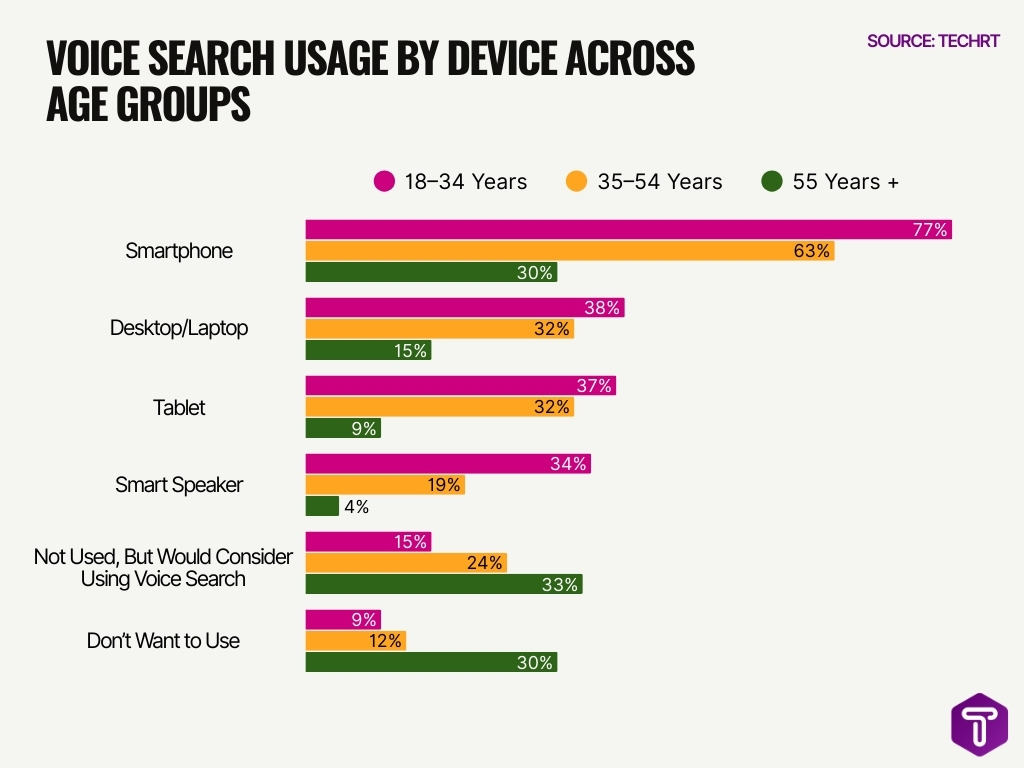
- Smartphones dominate voice search usage, especially among 18–34-year-olds (77%), compared to 63% among 35–54-year-olds and just 30% among 55+ users.
- Desktop/Laptop voice search remains secondary, used by 38% of younger adults, 32% of middle-aged users, and only 15% of seniors.
- Tablet usage for voice search declines sharply with age, from 37% (18–34) to 32% (35–54) and just 9% (55+).
- Smart speaker adoption is heavily skewed toward younger users, with 34% of those aged 18–34 using them, compared to 19% of 35–54-year-olds and only 4% of those 55+.
- Interest among non-users increases with age: 33% of adults aged 55+ say they haven’t used voice search but would consider it, compared to 24% (35–54) and 15% (18–34).
- Resistance to voice search is highest among seniors: 30% of users aged 55+ say they don’t want to use voice search, versus just 12% (35–54) and 9% (18–34).
- The data clearly shows a strong generational divide, with younger demographics leading adoption across every device category, while older users show both lower usage rates and higher reluctance.
Daily and Weekly Usage
- Around 23.7% of internet users aged 16+ use voice assistants weekly.
- Nearly 32% of consumers report using voice search daily.
- Over 50% of smart speaker owners interact with their device at least once per day.
- Approximately 41% of adults use voice search while multitasking.
- Daily voice queries often focus on weather, news, and directions.
- About 70% of voice assistant users say they use the feature for quick facts and simple questions.
- Weekly voice usage among mobile users continues to rise year over year, especially in North America.
- Roughly 48% of users rely on voice commands while cooking or driving.
- Daily engagement correlates strongly with smart home device ownership.
Local Search Behaviors
- 58% of consumers use voice search to find local business information.
- “Near me” voice queries have grown by more than 150% in recent years.
- About 76% of voice searches for local businesses lead to a same-day visit.
- Nearly 28% of voice searches trigger a call to a business.
- Restaurants and retail stores rank among the most common voice search categories.
- Over 60% of smartphone users contact a business directly using search results after a voice query.
- Voice queries are typically more conversational, often framed as full questions.
- About 46% of users search for pricing or availability information through voice.
- Local voice searches frequently occur during travel and commuting hours.
Most Searched Industries via Voice Search
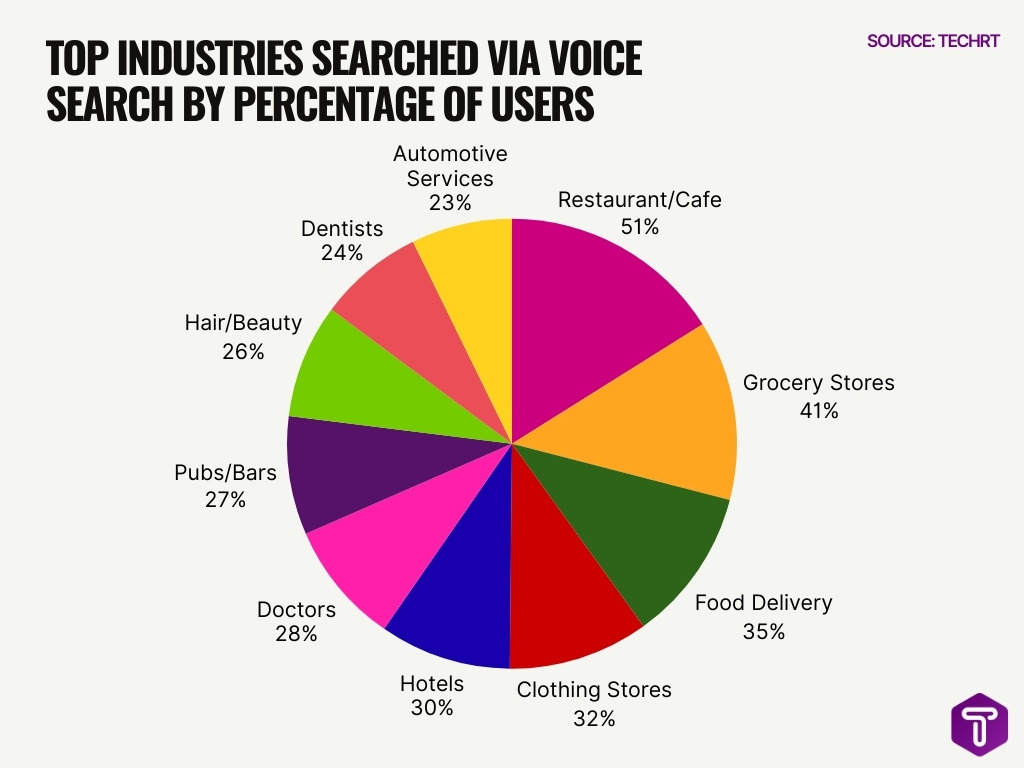
- Restaurants & Cafés dominate voice search, with 51% of users searching for them, making it the #1 industry for voice-based local intent queries.
- Grocery stores rank second at 41%, showing strong consumer reliance on voice search for everyday shopping needs.
- Food delivery services capture 35%, highlighting how convenience-driven industries benefit significantly from voice-enabled searches.
- Clothing stores account for 32%, indicating that retail discovery is increasingly happening through voice assistants.
- Hotels reach 30%, demonstrating strong usage of voice search in the travel and hospitality sector.
- Healthcare-related searches remain strong, with Doctors at 28% and Dentists at 24%, reflecting growing trust in voice search for medical information and local providers.
- Pubs/Bars (27%) and Hair/Beauty services (26%) show that lifestyle and personal care industries are heavily influenced by voice-based local discovery.
- Automotive services (23%), while lowest on the list, still represent nearly 1 in 4 voice search users, signaling steady demand for voice-enabled service searches.
Voice Commerce Statistics
- Voice commerce sales are projected to exceed $80 billion globally within the next few years.
- In the U.S., voice shopping surpassed $40 billion annually, up significantly from pre-pandemic levels.
- Around 30% of smart speaker owners have made at least one purchase using voice commands.
- 43% of voice-enabled device owners use voice to add items to shopping lists.
- Approximately 20% of consumers feel comfortable making regular purchases via voice assistants.
- Retail remains the leading voice commerce category, followed by grocery and household essentials.
- Over 50% of consumers say convenience drives their willingness to shop via voice.
- Repeat purchases account for a large share of voice transactions due to ease of reordering.
- Security and privacy concerns remain a barrier for nearly 40% of consumers, slowing broader adoption.
Business Impact Metrics
- Over 58% of consumers have used voice search to find local business information, directly influencing foot traffic and inquiries.
- About 76% of smart speaker users perform local voice searches at least weekly, signaling consistent commercial intent.
- Businesses optimized for voice are 2X more likely to appear in featured snippets, which assistants often pull from.
- Roughly 28% of local voice searches result in a phone call to the business.
- Voice-driven commerce in the U.S. surpassed $40 billion annually, impacting retail and grocery sectors.
- Around 52% of smart speaker owners say voice makes it easier to interact with brands.
- Nearly 46% of voice users look up pricing and product details via assistants before purchasing.
- Voice search users show higher intent, with 22% completing a purchase immediately after a voice query in certain retail categories.
- Brands that integrate conversational AI report improved engagement metrics and longer session durations.
SEO Optimization Insights
- Approximately 40% of voice search answers come from featured snippets.
- The average voice search result page loads in under 4.6 seconds, emphasizing speed optimization.
- Voice search queries average 29 words, significantly longer than text searches.
- Nearly 70% of voice results use conversational language structures.
- Local SEO plays a major role, with 58% of consumers using voice for nearby business discovery.
- Mobile-first indexing directly impacts voice rankings since most queries originate on smartphones.
- Schema markup increases the likelihood of appearing in rich results, improving voice response inclusion.
- HTTPS-secured domains account for over 70% of voice search results, reinforcing trust signals.
- Pages ranking in the top three organic positions dominate voice answers.
Voice vs. Online Shopping: Customer Satisfaction Breakdown by Category
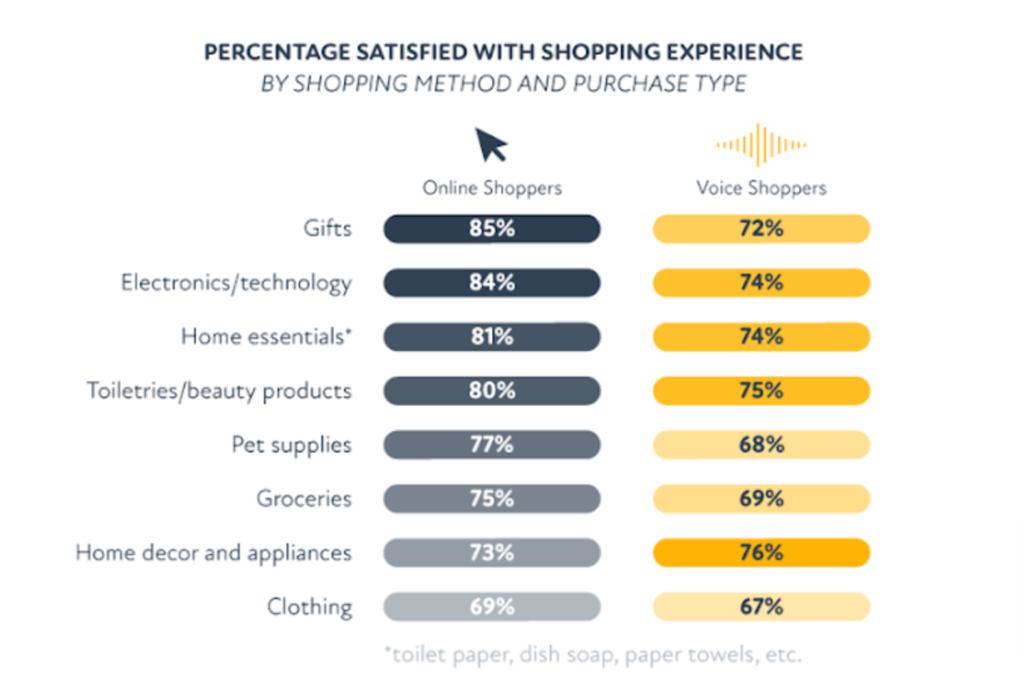
- Online shoppers report higher overall satisfaction, leading in 7 of 8 product categories.
- The highest satisfaction rate is for Gifts, with 85% of online shoppers satisfied compared to 72% of voice shoppers, a 13 percentage point gap.
- Electronics/Technology also shows a strong preference for online shopping, with 84% satisfaction vs. 74% for voice shopping.
- For Home Essentials (toilet paper, dish soap, paper towels, etc.), 81% of online shoppers are satisfied, compared to 74% of voice shoppers.
- In the Toiletries/Beauty Products category, online shopping leads at 80%, while voice shopping reaches 75%.
- Pet Supplies shows a noticeable difference, with 77% satisfaction online versus 68% via voice assistants.
- For Groceries, 75% of online shoppers report satisfaction, compared to 69% of voice shoppers.
- The only category where voice shopping outperforms online shopping is Home Decor and Appliances, with 76% satisfaction for voice shoppers versus 73% for online shoppers.
- Clothing has the lowest satisfaction across both methods, with 69% (online) and 67% (voice), indicating room for improvement in this category.
Voice Search Accuracy & Performance
- Google Assistant achieves 92.9% correct-answer rate with 100% question understanding in benchmarks.
- Siri delivers 83.1% correct answers with 99.8% question understanding.
- Major voice assistants average 93.7% query accuracy across benchmarks.
- Speech recognition error rates average 3.5% for clean English speech.
- Modern ASR systems like Google achieve ~15% WER overall.
- The voice biometrics market grew from $2.07B in 2023 to a projected $11.14B by 2032.
- Real-time voice APIs process input with latency under 300ms.
- Google Assistant interprets commands at 94.6% accuracy in noisy homes.
- 93% of users report satisfaction with voice assistants.
- Voice search results load in 4.6 seconds, 52% faster than text pages.
Regional Usage Insights
- In North America, smart speakers now reach around 35% of U.S. adults and account for about 41.3% of the global smart speaker market share, underscoring the region’s leadership in penetration.
- In the U.S., voice assistant users climbed to about 149.8 million in 2024, with projections of 157.1 million users by 2026, reflecting steady monthly adoption growth.
- Across devices, an estimated 8.4 billion voice assistants were in use worldwide in 2024, nearly doubling from 4.2 billion in 2020, driven heavily by mobile usage in Asia-Pacific.
- In China, AI and voice ecosystems now engage more than 500 million users, positioning the country as one of the largest single markets for conversational and voice-driven interfaces.
- In Latin America, the voice assistant market was valued at $170.4 million in 2024 and is forecast to hit about $768.1 million by 2030 at a rapid 28.5% CAGR, indicating strong regional growth.
- Urban users report significantly higher voice assistant usage, with about 68% adoption compared to 48% in rural regions, largely due to better broadband and device availability.
- Smartphones dominate device share for voice search, with roughly 72% of users preferring mobile compared to 35% using smart speakers, highlighting strong mobile-led growth in markets like India.
- In the U.S., around 33.6% of internet users aged 16–64 use voice assistants weekly, with adoption exceeding 60% among Millennials, showing strong penetration in key demographics.
- As of 2026, about 20.5% of global internet users actively use voice search, aligning with the installed base of 8.4 billion voice assistants deployed across regions and devices.
Voice Search Is Deeply Integrated with Local Intent
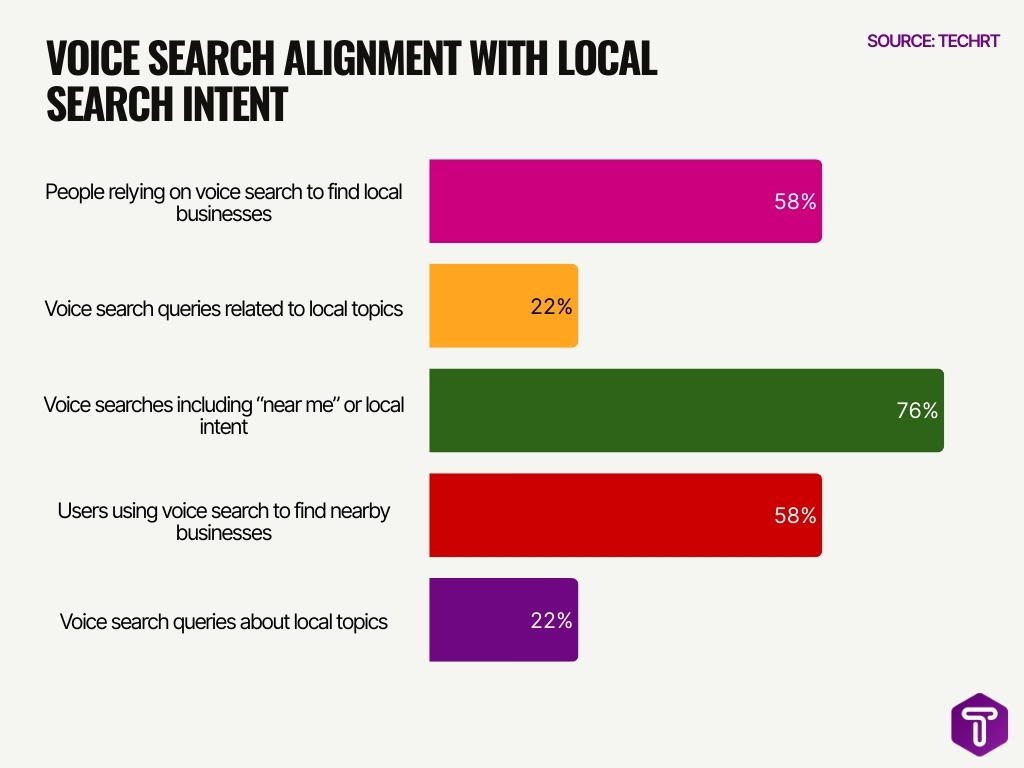
- 58% of people rely on voice search to find local businesses, highlighting its critical role in local discovery.
- 22% of all voice search queries are focused on local topics, indicating that nearly 1 in 5 voice searches has geographic intent.
- A massive 76% of voice searches include “near me,” or local intent phrases, showing that voice is heavily used for location-based queries.
- More than 58% of users specifically use voice search to find nearby businesses, reinforcing its importance in local SEO strategy.
- The repeated 22% share of local-topic queries confirms that local relevance is a core driver of voice search behavior.
Future Growth Projections
- The global voice assistant market is projected to exceed $30 billion by 2030, growing at a double-digit CAGR.
- The number of voice assistants in use is expected to surpass 8.4 billion devices worldwide.
- Voice commerce transactions could exceed $100 billion globally within the next few years.
- AI integration will drive smarter contextual responses and predictive recommendations.
- Smart home adoption will continue fueling voice-enabled interactions.
- Automotive voice systems are projected to grow significantly as connected vehicle adoption expands.
- Healthcare and banking sectors are piloting secure voice authentication systems.
- Enterprise adoption of conversational AI tools is expected to rise across customer service channels.
- Improved multilingual capabilities will accelerate adoption in emerging markets.
Frequently Asked Questions (FAQs)
What percentage of people worldwide actively use voice search as of 2026?
About 20.5% of global internet users actively use voice search.
How many voice assistant devices are projected to be in use globally by 2026?
Voice assistant adoption is expected to reach approximately 8.4 billion devices worldwide.
How many adults in the United States are estimated to use voice assistants in 2026?
An estimated 153.5 million U.S. adults will be using voice assistants in 2026.
What share of consumers use voice search for local business information?
Approximately 58% of consumers use voice search to find details on local businesses.
What is the projected value of the global voice commerce market by 2034?
The global voice commerce market is expected to reach $693.0 billion by 2034, growing at a 25.5% CAGR.
Conclusion
Voice search reflects a mature but still expanding ecosystem. With billions of devices in use, rising commerce integration, and accuracy rates above 90%, voice interfaces now influence how consumers search, shop, and interact with brands. For businesses, this shift requires faster websites, conversational content, strong local SEO, and structured data implementation. Meanwhile, AI advancements continue to refine performance and expand global adoption.
Voice search no longer sits on the edge of digital marketing strategy. It actively shapes discovery, purchase decisions, and customer engagement. Organizations that align with these behavioral and technical trends will remain visible in an increasingly voice-first environment.

Leave a comment
Have something to say about this article? Add your comment and start the discussion.