




WhatsApp Business has become a cornerstone of digital communication for companies large and small. The platform reported over 200 million businesses actively using its tools to connect with customers, drive sales, and support operations, a dramatic rise from its early years. Its popularity stems from WhatsApp’s massive global messaging ecosystem, which counts more than 3 billion monthly active users worldwide.
Today, brands in retail and financial services use WhatsApp to send updates, manage enquiries, and complete purchases entirely within chat. In other sectors, companies are integrating WhatsApp Business into CRM systems to streamline workflows and personalize engagement. This article dives into the key statistics shaping WhatsApp Business usage.
Editor’s Choice
- 3 billion+ global WhatsApp monthly active users as of 2025, the highest of any messaging platform.
- 200 million+ WhatsApp Business monthly active accounts worldwide.
- WhatsApp Business adoption has increased by more than 4× since 2020.
- 50 million+ businesses globally use WhatsApp Business for sales and support.
- WhatsApp messages achieve up to 98% open rates.
- Over 100 billion messages are sent daily across WhatsApp.
- 70% of users have messaged a business on WhatsApp.
Recent Developments
- Meta reported that WhatsApp has crossed the 3 billion monthly active user mark as of mid‑2025.
- Meta is rolling out advertising in the Updates tab, expanding business revenue options while keeping chats private.
- Paid subscriptions for channels and promotional boosts were introduced for business tools.
- Increased regulatory oversight in the EU after WhatsApp’s “very large online platform” designation highlights its influence.
- Businesses can now integrate WhatsApp messaging with CRM and automation systems via API.
- WhatsApp’s updates also support status ads and boosted content, increasing business visibility.
- Real‑time analytics and catalog performance dashboards have improved insights for brands.
WhatsApp Business Overview
- WhatsApp Business launched as a standalone app in 2018 to help companies communicate with users.
- Today, it supports text, voice, catalog, and automation tools tailored to business needs.
- The WhatsApp Business API enables multi‑agent management and CRM integration.
- Over 200 million businesses use WhatsApp Business monthly as of 2025.
- 50 million+ businesses actively use the app for sales and support.
- Catalog and shopping features allow users to browse and purchase without leaving the app.
- The platform supports automated greetings, quick replies, and labels to streamline workflows.
- WhatsApp Business integrates with other Meta tools, including Facebook Shops and Instagram.
WhatsApp Business User Growth Statistics
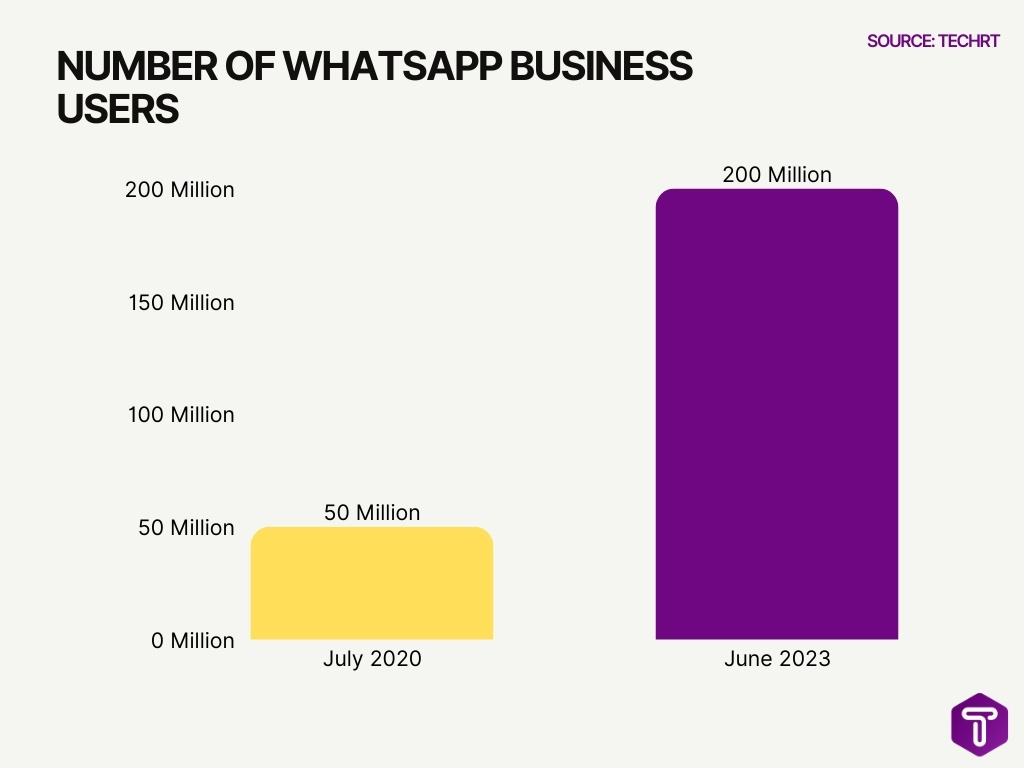
- WhatsApp Business monthly active users reached 200 million in June 2023, up from 50 million in July 2020.
- The platform recorded a 4× increase in business users within just three years.
- Over 150 million new business users joined WhatsApp Business between 2020 and 2023.
- This rapid expansion highlights strong global adoption of WhatsApp Business by small and medium-sized businesses (SMBs).
- The surge in users underscores WhatsApp Business’s growing importance as a primary customer communication and engagement platform.
- The growth trend reflects increasing reliance on messaging-based commerce, customer support, and marketing via WhatsApp Business.
- Rising user numbers indicate WhatsApp Business’s evolution into a key digital channel for business-to-customer interactions worldwide.
Business Adoption Numbers
- 200 million+ businesses use WhatsApp Business monthly.
- The number of business accounts has increased significantly since 2020, when the figure was ~50 million+.
- WhatsApp Business adoption rates grew most rapidly in India and Brazil.
- 73% of Indian businesses use WhatsApp for customer communication.
- Over 40 million users view business catalogs monthly.
- 54% of consumers prefer receiving marketing updates via WhatsApp.
- 39% of consumers rely on WhatsApp as a preferred support channel.
- 70% of WhatsApp users report messaging a business at least once.
WhatsApp Business App Downloads by Country
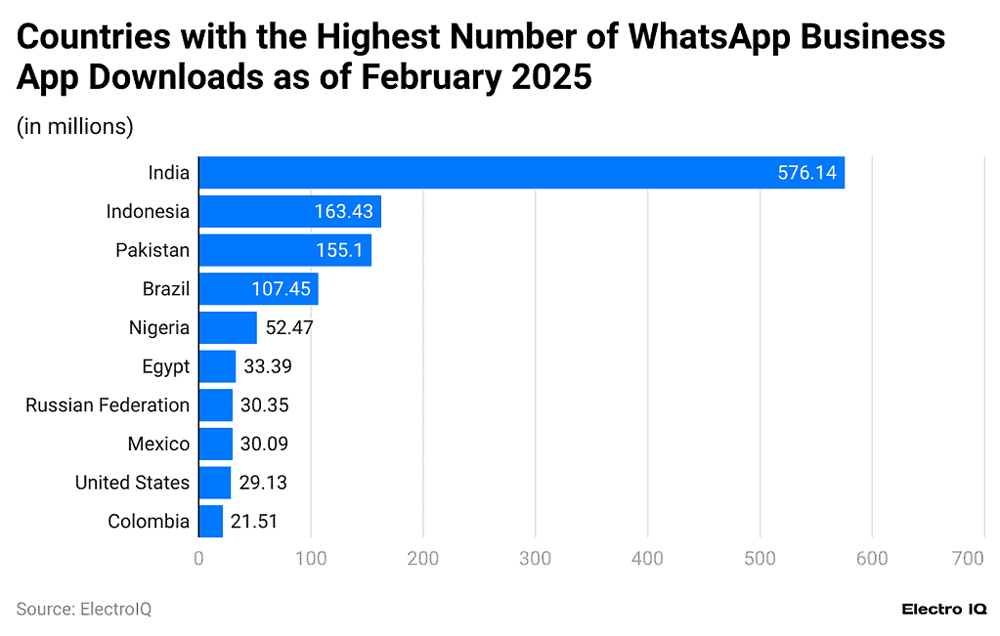
- India leads globally with 576.14 million WhatsApp Business app downloads, making it the largest market worldwide by a wide margin.
- Indonesia ranks second with 163.43 million downloads, reflecting strong SME and mobile-commerce adoption.
- Pakistan follows closely at 155.1 million downloads, highlighting rapid small business digitalization.
- Brazil records 107.45 million downloads, positioning it as the top WhatsApp Business market in Latin America.
- Nigeria tops Africa with 52.47 million downloads, underlining WhatsApp’s role in informal and micro-business commerce.
- Egypt reports 33.39 million downloads, showing steady business messaging adoption in North Africa.
- Russia accounts for 30.35 million downloads, maintaining moderate usage despite regional platform shifts.
- Mexico logs 30.09 million downloads, indicating consistent SMB engagement across Latin America.
- The United States records 29.13 million downloads, significantly lower than emerging markets, despite a large business ecosystem.
- Colombia closes the top ten with 21.51 million downloads, reinforcing WhatsApp Business’s presence in South American commerce.
Daily Active Users
- WhatsApp counts approximately 2.3 billion daily active users as a percentage of MAU.
- Daily engagement translates to around 3–4 sessions per user per day on average.
- Daily message volume exceeds 100 billion sent messages.
- Business messages contribute significantly to the daily messaging load.
- Regions like Latin America and South Asia see the highest daily use intensity.
- Businesses respond to inquiries typically within the same day to maintain engagement.
- WhatsApp statuses (Updates) reach 1.5 billion daily users across global markets.
Monthly Active Users
- WhatsApp now boasts over 3 billion monthly active users worldwide as of early 2025.
- Projections indicate the platform could reach 3.14 billion to 3.2 billion MAUs by the end of 2025, driving its utility for business outreach.
- Approximately 83% of WhatsApp users open the app daily, reflecting strong stickiness.
- WhatsApp represents roughly 69% of internet users outside China, making it one of the most widespread messaging platforms globally.
- The platform is available in over 180 countries and supports 60+ languages, widening its monthly reach.
- MAU growth remains consistent, rising by an estimated 6–8% year‑over‑year into 2025.
- In markets like North America and Europe, WhatsApp MAUs continue to climb, especially among younger demographics.
- The MAU base expanded by more than 1 billion users since 2020, showing rapid global adoption.
Top Countries by Users
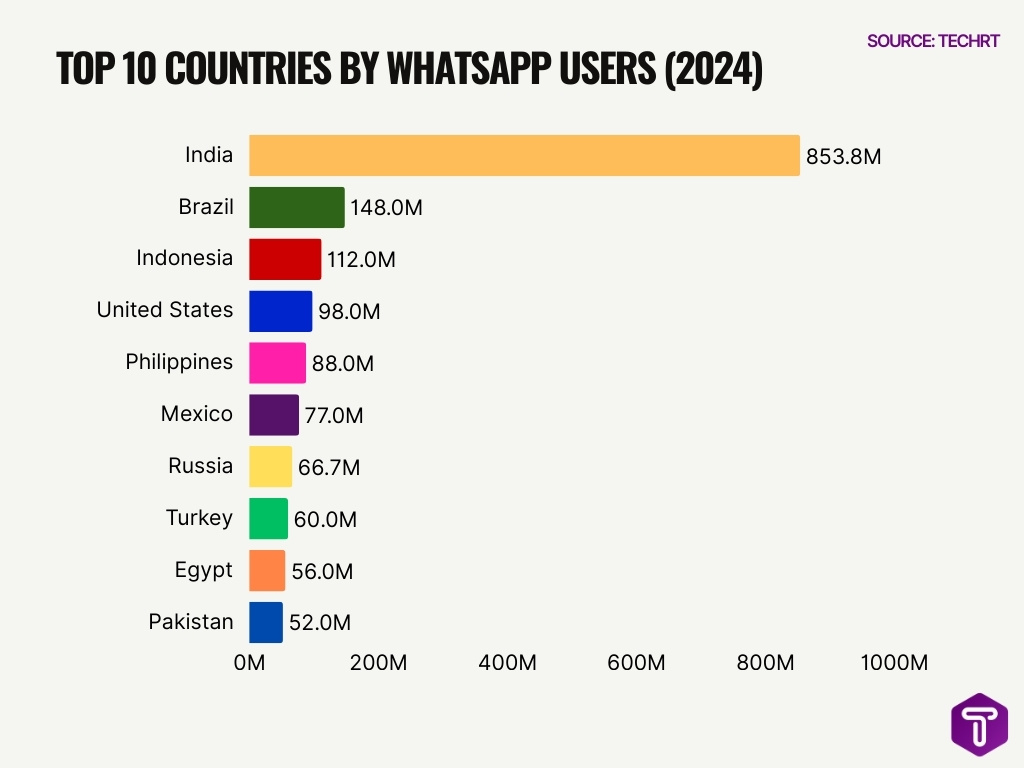
- India leads by far with ~853.8 million WhatsApp users in 2024, making it the largest user base globally.
- Brazil ranked second with ~148 million users in 2024, showing deep market penetration.
- Indonesia recorded around 112 million WhatsApp users in 2024.
- The United States had about 98 million users in 2024, growing steadily year over year.
- The Philippines (~88 million) and Mexico (~77 million) also rank in the top six markets.
- Russia (~66.7 million) and Turkey (~60 million) round out significant national user counts.
- Countries like Egypt (~56 million) and Pakistan (~52 million) reflect adoption across MENA and South Asia.
- India’s user count nearly doubled from 487 million in 2021 to 853 million in 2024, underscoring rapid growth.
Regional Adoption Rates
- WhatsApp penetration in the DACH region reaches over 94% of internet users, with Germany at 95.5%.
- Latin America sees nearly 80% adult usage, led by Brazil at 82.8%.
- In India, 97% of internet users engage with WhatsApp, representing 535.8 million monthly active users.
- US WhatsApp users hit 100 million MAUs in 2025, up 2 million year-over-year.
- Kenya leads Africa with 97% penetration, followed by South Africa at 96%.
- Sub-Saharan African countries show 95-97% adoption rates among internet users.
- Middle East nationals across seven countries use WhatsApp at 75%, with retail messaging up 63% YoY.
- Indonesia in Southeast Asia boasts 87-91% penetration, and Malaysia at 92%.
- Spain tops Europe with 91% penetration rate in Q3 2024.
- WhatsApp leads communications in over 70 countries with top penetration rates exceeding 90%.
User Demographics by Gender
- WhatsApp usage shows near gender parity, with about 52.4% male users and 47.5% female users globally.
- Some regional deviations occur, with male dominance stronger in select markets.
- Female engagement levels on WhatsApp are closing gaps in North America and Europe.
- Gender usage differences are less pronounced than on many other social platforms.
- Business messaging adoption also skews slightly male in certain sectors, such as tech.
- Younger female cohorts often show higher responsiveness to WhatsApp communications.
- Global gender demographics remain stable as the overall monthly active user base expands.
- Gender distribution among business users reflects broader platform trends rather than specific imbalances.
User Demographics by Age
- The 26–35 age group is the largest WhatsApp segment globally, driving core engagement.
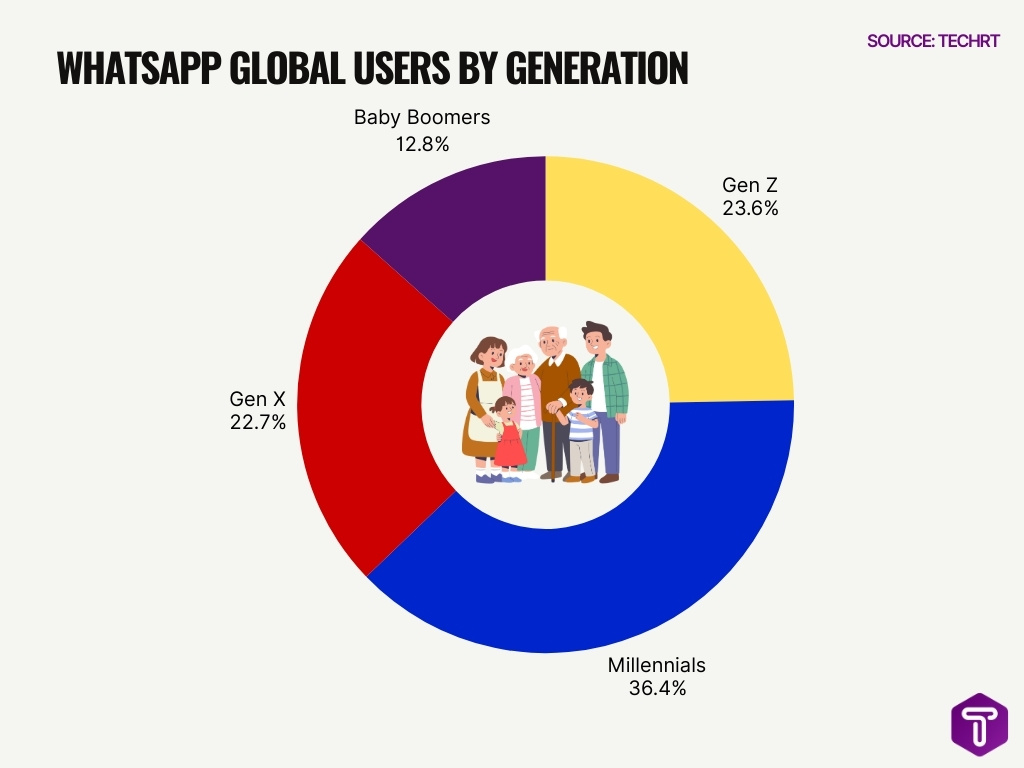
- Gen Z also uses WhatsApp widely, with about 23.6% of users, though competitors like Snapchat have a stronger share in the U.S.
- Millennials make up around 36.4% of the platform’s audience, representing the biggest generation cohort.
- Gen X accounts for about 22.7% of users, showing cross‑age engagement.
- Baby Boomers contribute roughly 12.8% of WhatsApp’s user base, indicating older adults’ adoption.
- In the U.S., 18–34-year-olds make up 31–37% of the platform’s audience, highlighting its youthful tilt.
- Users 65 and older represent 11–20% in the U.S., signifying growing senior engagement.
- Adoption trends show a broader age spread in developing markets, where WhatsApp is often the default messaging app.
Message Volume Statistics
- WhatsApp users send over 100 billion messages daily worldwide.
- Some industry trackers estimate daily message flows approaching 140–150 billion, with voice and media overlapping chat volumes.
- Daily voice note exchanges exceed 7 billion, underscoring multimedia messaging.
- Daily photo sharing approaches 6.9 billion images, highlighting content richness.
- Users check WhatsApp an average of 20–30 times per day in key markets.
- Weekly, users open WhatsApp around 23–25 times per week, or roughly 3–4 times daily.
- Message volume patterns indicate peak business messaging during workdays and evenings.
- Multimedia messaging (photos, video, voice notes) accounts for a growing share of overall volume.
Engagement Metrics
- WhatsApp Business messages have exceptionally high open rates near 98%, far above email benchmarks.
- Click‑through rates for business messaging are estimated between 45% and 60% in many studies.
- Automated and personalized messages can boost user engagement by more than 45%.
- Around 54% of users prefer receiving marketing messages via WhatsApp versus other channels.
- Messaging campaigns often outperform email with 5–10× higher engagement.
- Businesses can drive higher interaction rates with rich media than plain text alone.
- Personalized WhatsApp communication increases response likelihood by over 70% in some markets.
- Message engagement remains strongest when timed around peak user activity.
Open and Read Rates
- WhatsApp Business messages achieve up to 98% open rates, far exceeding email and SMS benchmarks.
- This read rate dwarfs email open rates (~20%) and SMS rates (~21%).
- Nearly every WhatsApp message sent to users is seen within minutes on average.
- Users are 7× more likely to respond to a WhatsApp message than an email.
- Daily business messaging visibility strengthens brand recall and reduces “missed communication” risk.
- WhatsApp open rates remain consistently high across regions thanks to the platform’s ubiquity and notification system.
- Broadcast messaging for updates and offers regularly achieves read rates above 90% in global campaigns.
- Manager dashboards often report that most reads occur within the first 10–15 minutes after delivery.
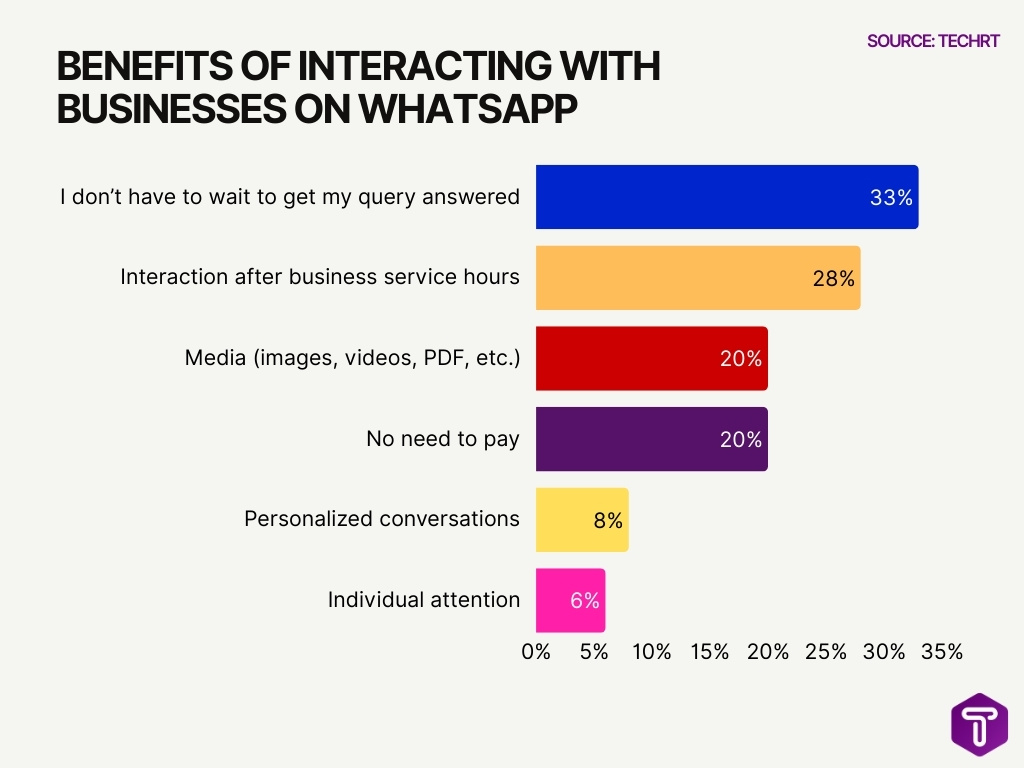
Benefits of Interacting With Businesses on WhatsApp
- 33% of users say they don’t have to wait to get their queries answered, making instant responses the top benefit of WhatsApp business interactions.
- 28% of users value the ability to interact with businesses after service hours, highlighting the importance of 24/7 availability.
- 20% of users prefer WhatsApp because it supports rich media sharing, including images, videos, and PDFs, improving communication clarity.
- 20% of users appreciate that there is no need to pay, positioning WhatsApp as a cost-effective customer support channel.
- 8% of users favor personalized conversations, showing growing interest in customized business interactions.
- 6% of users highlight individual attention as a benefit, emphasizing WhatsApp’s role in enabling one-to-one customer engagement.
Click‑Through Rates
- Click‑through rates (CTR) for WhatsApp Business campaigns commonly range from 45% to 60%, far above typical email CTRs.
- Industry data suggests even 15% to 80% CTR, depending on message structure and CTA strength.
- Personalized links and buttons improve CTR performance dramatically.
- SMS CTRs generally land below WhatsApp’s performance, highlighting WhatsApp’s engagement advantage.
- Campaigns with rich media (images, videos) often exceed 50% CTR benchmarks.
- Optimized CTA placement boosts click activity during peak user hours.
- CTA‑driven catalogs and product links convert browsers into buyers more efficiently.
- Even modest business campaigns often report double‑digit CTRs, far above email averages.
Conversion Rates
- WhatsApp campaigns can achieve conversion rates between 45% and 60%, outperforming traditional email conversions.
- Two‑thirds of users (≈66%) have made purchases after communicating with brands on WhatsApp.
- Personalized WhatsApp messages encourage product purchases more effectively than generic outreach.
- Cart abandonment recovery rates can improve with WhatsApp follow‑ups.
- Campaigns with immediate responses and clear CTAs show better funnel progression.
- Retail and D2C brands note stronger conversion when WhatsApp is integrated into checkout flows.
- Automated messaging for abandoned carts can add up to double‑digit sales lifts.
- Targeted conversational commerce (chat‑to‑buy) shows conversion lift across markets.
Catalog Views
- Business catalog views on WhatsApp reach tens of millions per month, driven by shopping and discovery behavior.
- Users browsing catalogs often signal purchase intent before direct inquiry.
- Catalogs help SMBs showcase inventory without external e‑commerce links.
- Daily catalog interactions sustain product visibility for frequent users.
- Catalog views correlate with messaging replies when images and prices are present.
- Interactive product views blend discovery with conversational selling.
- Many retailers report catalog views as the first step in purchase journeys.
- Enhanced shopping features such as “View in chat” drive deeper engagement.
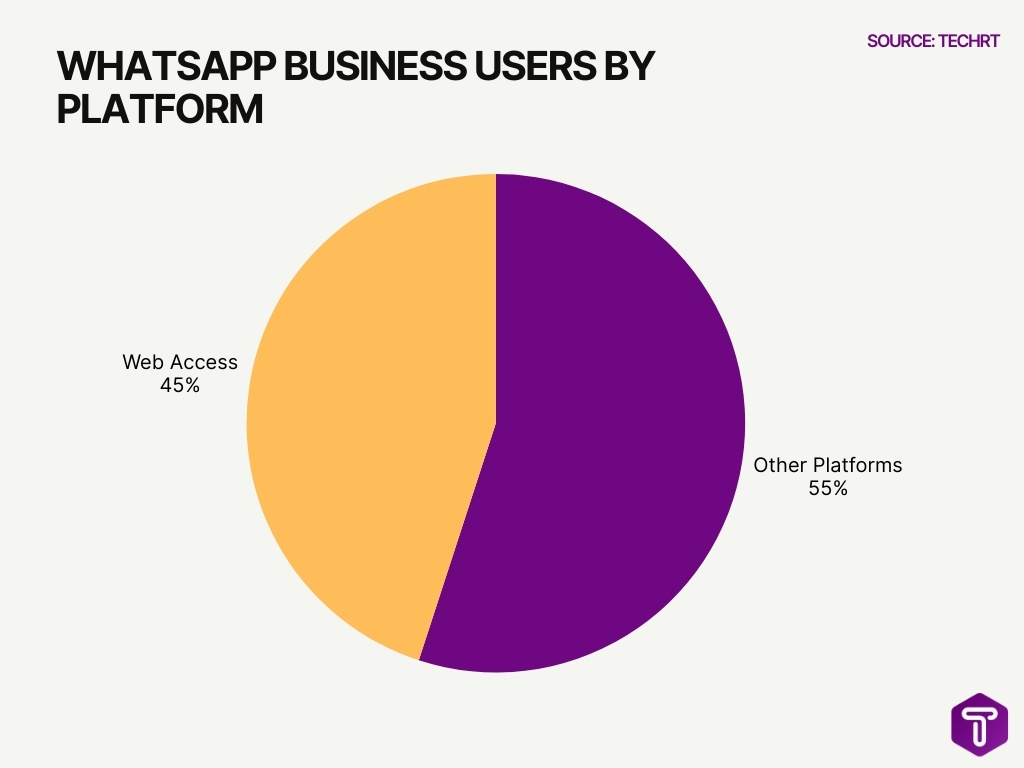
WhatsApp Business Users by Platform Breakdown
- Other Platforms account for 55% of total WhatsApp Business users, showing that the majority of businesses rely on non-web access channels such as mobile apps and integrated tools.
- Web Access represents 45% of overall usage, highlighting the continued importance of browser-based communication for customer support and business operations.
- The near-even split between platforms indicates strong multi-platform adoption among WhatsApp Business users.
- Businesses leveraging both web and other platforms are better positioned to ensure wider reach, flexibility, and operational efficiency.
Revenue and Economic Impact
- WhatsApp Business is a significant revenue source for Meta, contributing to the platform’s business monetization strategy after years of limited ad income.
- Meta’s introduction of ads in the Updates tab aims to boost revenue streams from business engagement.
- Analysts project that ads and paid business features could generate $10 billion+ annually within a few years.
- WhatsApp Business enables cost savings in support, with some companies reducing service costs by up to 30–40%.
- Business messaging contributes to higher direct sales and repeat purchases due to conversational commerce.
- Retailers integrating WhatsApp as a sales channel often see higher revenue per user than via email alone.
- SMBs credit WhatsApp for expanding customer reach in emerging markets like India and Brazil.
- Automation via APIs and CRM boosts business efficiency and revenue attribution.
Growth Projections 2026
- WhatsApp’s global user base is forecast to push past 3.2 billion monthly active users by the end of 2025 and into 2026.
- Business adoption is expected to rise as more enterprises embrace the WhatsApp Business API.
- More brands will integrate commerce features directly within chat flows to boost conversion.
- Messaging revenue streams (ads, subscriptions, promotions) are projected to grow significantly.
- Automation, personalization, and generative AI are likely to expand business capabilities on the platform.
- Emerging markets will continue to drive new business sign‑ups and user engagement.
- WhatsApp will remain central to omnichannel customer experiences, linking social, chat, and sales.
- Growth in conversational commerce could see chat‑first sales strategies become industry standard.
Frequently Asked Questions (FAQs)
How many monthly active users does WhatsApp have in 2025?
~3.3 billion monthly active users, indicating continued global growth for WhatsApp, including business interactions.
How many businesses use WhatsApp Business globally?
Over 50 million businesses are actively using WhatsApp Business worldwide to interact with customers.
What open rate do WhatsApp Business messages achieve?
WhatsApp Business messages have an open rate of approximately 98%, far above typical email or SMS rates.
What range of click‑through rates (CTR) do WhatsApp Business campaigns see?
Click‑through rates for WhatsApp Business campaigns commonly range from 45% to 60% in promotional content.
How many individual users message businesses daily on WhatsApp?
More than 175 million people send messages to WhatsApp Business accounts on a daily basis.
Conclusion
WhatsApp Business is no longer just a messaging tool; it’s a powerful engagement and revenue engine for companies of all sizes. With open rates near 98%, robust click‑through and conversion statistics, and catalog views that drive discovery, brands have unprecedented access to customer interactions that convert. As Meta evolves its business offerings with ads and premium features, and automation continues to scale, WhatsApp’s economic role will only deepen across global markets. Whether used for support, promotions, or direct sales, the platform’s performance benchmarks make it an essential part of any business communication strategy.

Leave a comment
Have something to say about this article? Add your comment and start the discussion.