



WordPress continues to shape how businesses, publishers, and creators build and scale their digital presence. What began as a simple blogging platform has evolved into a powerful content management system that supports everything from small business websites to enterprise-grade applications and global media platforms. Today, companies use WordPress to manage high-traffic news portals, run eCommerce stores through WooCommerce, and execute SEO-driven content strategies that generate measurable growth.
Moreover, its open-source nature and vast ecosystem of plugins and themes allow developers, marketers, and entrepreneurs to customize websites without heavy technical barriers. As industries increasingly rely on digital infrastructure, WordPress plays a critical role in enabling fast deployment, content scalability, and global reach. Understanding the latest WordPress statistics offers valuable insight into its dominance, adoption trends, and future trajectory, so let’s dive deeper into the data that defines the modern web.
Editor’s Choice
- 43.4% of all websites globally run on WordPress as of 2025, making it the most widely used CMS.
- WordPress holds over 60% of the CMS market share, far ahead of competitors.
- More than 590 million websites worldwide were powered by WordPress in 2026.
- WordPress dominates with 59.9% share among CMS-based websites in 2026.
- The platform supports 200+ languages, enabling global adoption.
- Over 2 million new WordPress websites are created annually, reflecting steady growth.
- WordPress powers over 30% of the top 1 million websites, showing strong enterprise adoption.
Recent Developments
- WordPress has maintained a stable market share above 43% through 2026, showing resilience despite new competitors.
- WordPress Version 6 now powers around 85% of all WordPress sites, indicating rapid adoption of updates.
- WooCommerce continues to expand, powering up to 34% of online stores globally.
- The WordPress plugin ecosystem has grown to 60,000+ free plugins, supporting diverse functionality.
- AI-driven features and automation tools are increasingly integrated into WordPress workflows.
- WordPress supports real-time collaboration features, improving content team productivity.
- The number of WordPress users has exceeded 472 million globally in 2026.
- WordPress continues to evolve beyond blogging into enterprise-grade CMS and application frameworks.
- The platform hosts major brands like TechCrunch, CNN, and Microsoft, reinforcing enterprise trust.
Key WordPress Statistics
- WordPress powers 43.2%–43.6% of all websites worldwide, depending on the dataset.
- Among CMS platforms, WordPress commands over 62% market share globally.
- There are over 810 million WordPress websites tracked across different datasets.
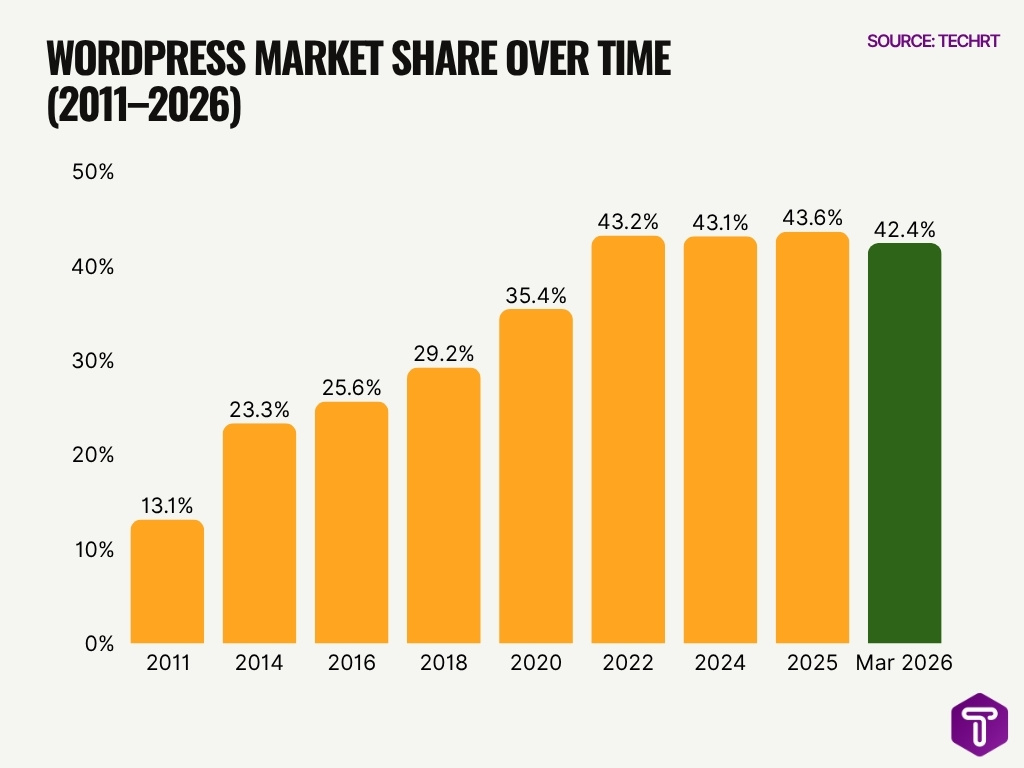
- WordPress has grown from 13.1% market share in 2011 to over 43% in 2025, showing long-term dominance.
- Around 29% of websites do not use any CMS, highlighting WordPress’s strong relative dominance.
- WordPress websites receive millions of monthly comments and interactions, with over 77 million comments monthly.
- WordPress is used in 190+ countries, making it a truly global platform.
- WooCommerce alone accounts for a significant share of global eCommerce platforms, reinforcing WordPress’s versatility.
- WordPress has remained the fastest-growing CMS for over a decade, maintaining consistent expansion.
WordPress Market Share Growth Trends
- WordPress market share grew from 13.1% in 2011 to 42.4% in March 2026, showing massive long-term adoption.
- The platform nearly tripled its market share between 2011 (13.1%) and 2020 (35.4%), highlighting rapid early growth.
- A major surge occurred between 2018 (29.2%) and 2022 (43.2%), with an increase of over 14 percentage points in just four years.
- WordPress reached its peak market share of 43.6% in 2025, marking its highest dominance among all websites.
- After steady growth, the market slightly declined to 42.4% in March 2026, indicating the first sustained drop in years.
- Growth slowed significantly after 2022 (43.2%), suggesting the market is approaching saturation.
- Between 2022 (43.2%) and 2024 (43.1%), growth plateaued, showing minimal change in adoption.
- Despite the recent dip, WordPress still powers over 4 out of every 10 websites globally, reinforcing its leadership position.
- The consistent rise from 2011 to 2025 reflects strong ecosystem support, including themes, plugins, and community adoption.
- The slight decline in 2026 (42.4%) may signal increasing competition from alternative CMS platforms or shifts toward custom solutions.
WordPress General Statistics
- WordPress was launched in 2003 and has evolved into a full-scale CMS platform.
- The platform is open-source and free, making it accessible to individuals and enterprises alike.
- WordPress is translated into 200+ languages, supporting global localization.
- It is used by millions of contributors and developers worldwide, forming one of the largest open-source communities.
- WordPress supports multiple use cases, including blogs, eCommerce, SaaS platforms, and enterprise portals.
- The platform has over 60,000 plugins and 12,000+ themes available in its directory.
- WordPress is used by Fortune 500 companies and global media brands, highlighting enterprise trust.
- Over 1,200 WordCamps have been held globally, showcasing strong community engagement.
- The CMS continues to receive regular updates and security improvements, ensuring long-term sustainability.
WordPress Usage Statistics
- WordPress powers over 40% of all websites, maintaining dominance year over year.
- More than 500 new WordPress sites go live every day, showing continuous adoption.
- Around 69% of users use WordPress primarily as a CMS, not just a blogging tool.
- Only 6% of users use WordPress purely for blogging, reflecting its expanded use cases.
- WordPress is used by 30%+ of the top 1,000 high-traffic websites.
- The platform is active in 200+ countries, demonstrating global reach.
- WordPress users generate billions of posts annually, showing massive content output.
- Over 77 million comments are posted monthly, indicating strong user engagement.
- WordPress remains the preferred platform for bloggers, with up to 97% adoption among bloggers.
WordPress vs Competitors (CMS Comparison)
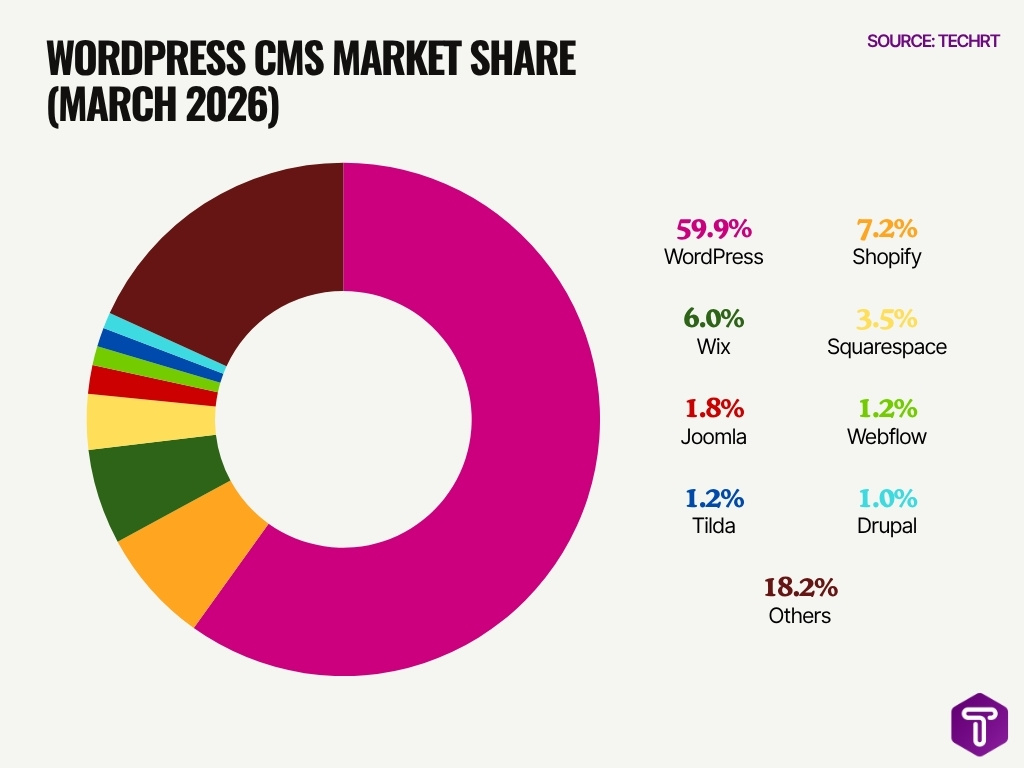
- WordPress dominates the CMS market with a massive 59.9% share, making it the undisputed leader in website management systems.
- The combined market share of all other major CMS platforms (Shopify, Wix, Squarespace, etc.) still does not surpass WordPress alone, highlighting its overwhelming popularity.
- Shopify ranks second with 7.2%, but trails far behind WordPress by over 50 percentage points.
- Wix holds 6%, securing the third position, showing strong adoption among beginners and small businesses.
- Squarespace accounts for 3.5%, indicating a niche but steady presence in the CMS ecosystem.
- Traditional CMS platforms like Joomla (1.8%) and Drupal (1%) have relatively low market shares, reflecting declining usage compared to modern platforms.
- Emerging platforms such as Webflow (1.2%) and Tilda (1.2%) are still in early growth stages, with limited but growing adoption.
- The “Others” category holds 18.2%, suggesting a fragmented market of smaller or custom CMS solutions.
- WordPress alone has a market share that is over 8× larger than Shopify and nearly 10× larger than Wix, reinforcing its dominance.
- The data clearly shows a highly concentrated CMS market, where one platform (WordPress) controls the majority while others compete for smaller shares.
WordPress Market Share
- WordPress controls 43.4% of all websites globally, making it the leading CMS.
- Among CMS-based websites, WordPress holds over 60% market share, far ahead of competitors.
- Shopify follows distantly with around 4.8% market share, highlighting the gap.
- Wix accounts for approximately 3.7% of websites, making it a distant competitor.
- Squarespace holds about 2.3% market share globally.
- Joomla and Drupal together account for less than 3% of total websites.
- Websites without a CMS make up around 29% of the web, still trailing WordPress alone.
- WordPress has maintained market leadership for over a decade, with consistent growth trends.
- The CMS market includes 60+ competing platforms, yet WordPress dominates the majority share.
How Many Websites Use WordPress
- WordPress powers over 590 million websites globally in 2026.
- Some datasets estimate over 810 million WordPress websites, depending on the tracking methodology.
- Around 43% of all websites use WordPress, making it the most used platform worldwide.
- WordPress is used by over 30% of the top 1 million websites, reflecting strong enterprise adoption.
- More than 2 million new WordPress sites are created annually, showing continuous growth.
- WordPress websites account for over 70% of all CMS-powered websites, highlighting dominance in the CMS segment.
- Approximately 500+ WordPress websites are launched daily, contributing to rapid expansion.
- WordPress powers websites across industries, including media, eCommerce, education, and government sectors.
- The platform supports both small personal blogs and large-scale enterprise portals, increasing its total website count.
WordPress Usage by Country: Key Insights & Trends
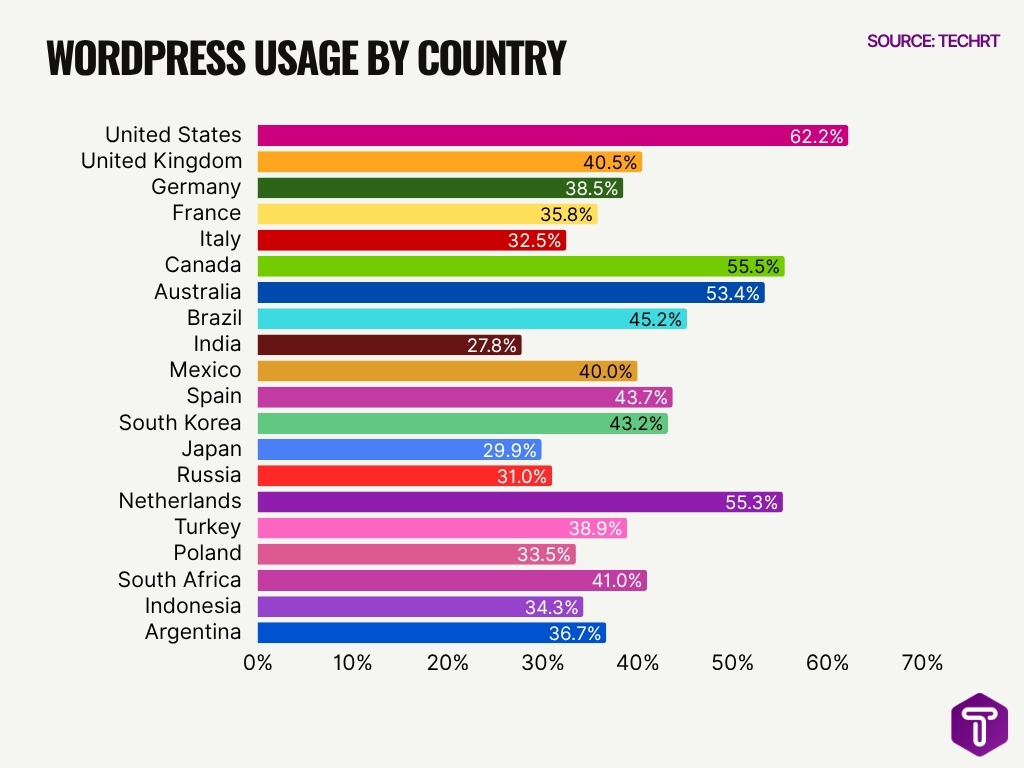
- The United States leads globally with the highest WordPress usage at 62.2%, making it the dominant market.
- Among developed nations, Canada (55.5%), the Netherlands (55.3%), and Australia (53.4%) show consistently high adoption rates above 50%.
- European countries display moderate usage levels, with Spain (43.7%), South Korea (43.2%), and the United Kingdom (40.5%) forming the mid-tier.
- Germany (38.5%), Turkey (38.9%), and France (35.8%) fall slightly below the 40% mark, indicating steady but not dominant adoption.
- Emerging markets such as Brazil (45.2%) and Mexico (40.0%) demonstrate strong WordPress penetration, competing closely with developed regions.
- India records the lowest usage at 27.8%, highlighting significant growth potential in a large digital market.
- Other lower adoption countries include Japan (29.9%) and Russia (31.0%), both under the 32% threshold.
- In Africa, South Africa stands at 41.0%, indicating above-average adoption compared to several Asian markets.
- Countries like Indonesia (34.3%), Poland (33.5%), and Italy (32.5%) fall into the lower-mid usage bracket (30–35%).
- The overall global spread suggests that WordPress usage typically ranges between 30% and 55% in most countries, with only a few outliers like the United States exceeding 60%.
- The data highlights a clear pattern: Western countries and English-speaking markets tend to have higher WordPress adoption rates compared to some Asian regions.
- This variation indicates regional differences in CMS preferences, digital maturity, and local platform competition.
WordPress Blogging Statistics
- WordPress users publish over 70 million new blog posts each month.
- Approximately 77 million comments are generated monthly, showing high engagement.
- WordPress powers over 97% of blogs that use a CMS, making it the leading blogging platform.
- Around 6% of WordPress users use it exclusively for blogging, reflecting its expanded functionality.
- Bloggers using WordPress benefit from thousands of SEO and content plugins, improving visibility.
- WordPress blogs generate billions of page views monthly, driven by global audiences.
- The platform supports multimedia blogging, including video, audio, and interactive content.
- WordPress.com alone hosts millions of active blogs, contributing to global content output.
- Blogging remains a key entry point for WordPress adoption among individuals and small businesses.
WordPress Content and Publishing Statistics
- WordPress users publish over 70 million posts and 77 million comments each month.
- The platform supports real-time publishing and scheduling, enabling efficient content workflows.
- WordPress handles billions of page views monthly, reflecting its scale in content delivery.
- Content creators use WordPress for SEO-driven publishing, supported by tools like Yoast SEO and Rank Math.
- WordPress enables multi-author collaboration, making it ideal for editorial teams.
- The CMS supports custom post types, allowing diverse content formats beyond blogs.
- WordPress integrates with content distribution channels such as email and social media.
- Many publishers rely on WordPress for high-traffic news websites and digital magazines.
- The platform supports API-based content delivery, enabling headless CMS architectures.
WordPress Gutenberg and Block Editor Statistics
- Gutenberg editor adoption reached over 60% of WordPress sites in 2026, up from 37% in 2020.
- Full Site Editing (FSE) adoption grew by 145% in 2025 alone.
- 19 million active installations of the block editor with 157,000+ posts created daily.
- 75%+ of new WordPress themes now support Full Site Editing.
- 4+ million sites still use the Classic Editor despite Gutenberg’s dominance.
- Gutenberg enables faster page loads with 150-300ms PHP execution vs builders’ 500-700ms.
- WordPress block directory hosts thousands of custom block plugins for expanded flexibility.
- Over 40% of themes are fully optimized for the Gutenberg block editor.
- AI integrations like Kadence Blocks enhance Gutenberg with inline content generation.
- Block editor accounts for 18% of page builder usage among 59.9% of sites using builders.
Key Insights on WordPress Hacking Methods
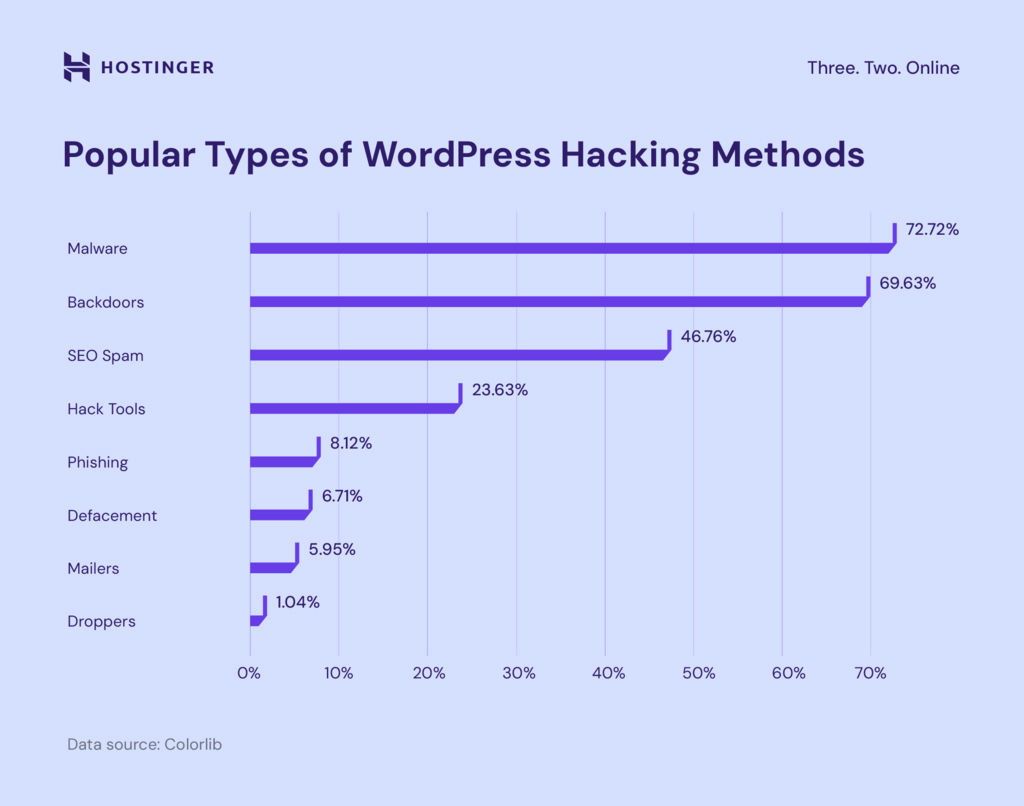
- Malware dominates WordPress attacks, accounting for a massive 72.72%, making it the most prevalent threat websites face today.
- Backdoors are nearly as common, used in 69.63% of attacks, indicating that hackers prioritize persistent access even after initial breaches.
- SEO spam ranks third at 46.76%, showing how attackers frequently exploit websites to manipulate search rankings and drive malicious traffic.
- Hack tools contribute to 23.63% of attacks, highlighting the widespread availability and use of automated hacking software.
- Phishing attacks account for 8.12%, reflecting targeted attempts to steal credentials rather than directly exploit the site itself.
- Website defacement appears in 6.71% of cases, often used for visibility, protest, or reputational damage.
- Mailers are involved in 5.95% of incidents, typically used to send spam emails from compromised websites.
- Droppers are the least common at just 1.04%, but they still pose a risk as they install additional malicious payloads.
- The data clearly shows that over two-thirds of attacks involve malware and backdoors, emphasizing the need for strong security measures like malware scanning and access control.
- Overall, the trend suggests that automation and persistence are key strategies in WordPress hacking, rather than one-time attacks.
WordPress Theme Statistics
- WordPress.org hosts over 14,000 free themes in its directory.
- ThemeForest offers around 12,000 premium WordPress themes.
- Divi powers 2.16 million live websites as the top premium theme.
- Astra and OceanWP each boast over 500,000 active installations.
- Hello Elementor leads free themes with 7.3 million installations.
- Over 90% of modern WordPress themes are mobile-responsive.
- 60%+ of new themes support Full Site Editing (FSE).
- 75%+ of recent themes integrate block-based FSE features.
- Lightweight themes like Neve cut LCP to under 800ms.
- The WordPress theme market contributes to a $596.7 billion ecosystem.
WordPress Plugin Statistics
- The official WordPress repository hosts 60,000+ free plugins, supporting nearly every use case.
- Over 90% of WordPress websites use at least one plugin, highlighting dependency on extensions.
- The top plugins, such as Yoast SEO, have 5+ million active installations each.
- WooCommerce alone has over 5 million active installs, making it the leading eCommerce plugin.
- The plugin ecosystem processes millions of updates monthly, ensuring security and compatibility.
- Security plugins like Wordfence are installed on over 4 million websites, reflecting rising security awareness.
- Premium plugins contribute to a multi-billion-dollar WordPress ecosystem, driven by SaaS integrations.
- Plugin-related vulnerabilities account for over 90% of WordPress security issues, emphasizing the importance.
- Developers release thousands of new plugins annually, expanding functionality across niches.
Top WordPress Plugins Statistics and Key Insights
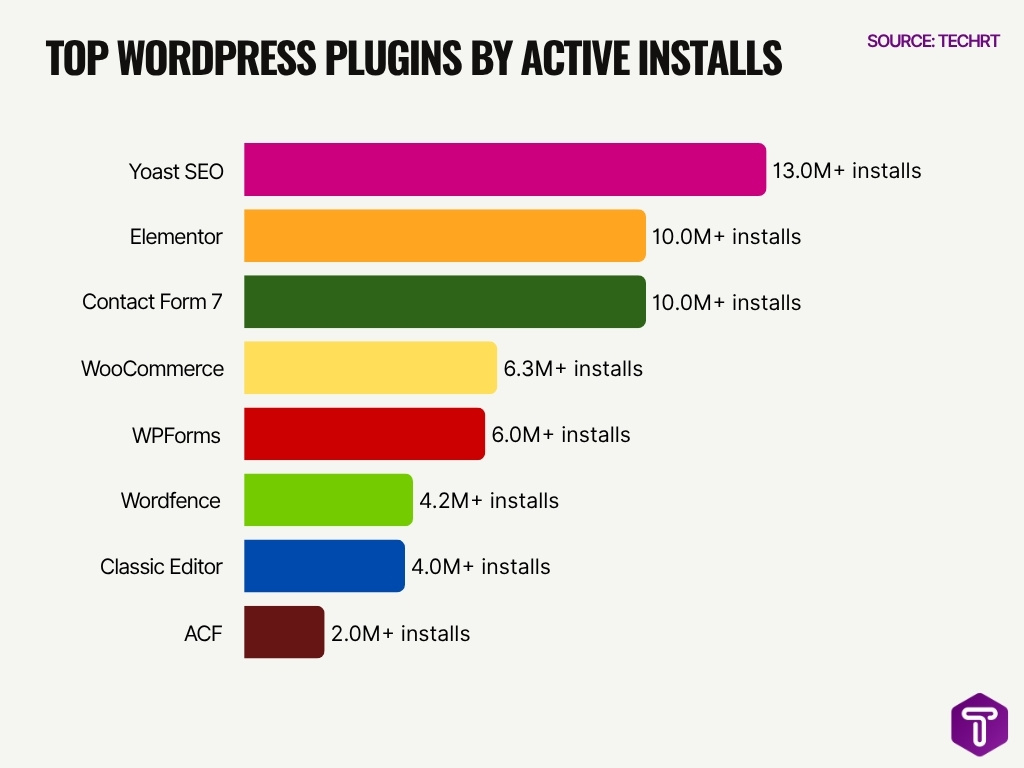
- Yoast SEO leads the market with over 13M+ active installs, making it the most widely used WordPress plugin for SEO optimization.
- Both Elementor and Contact Form 7 hold strong positions with 10M+ installs each, highlighting the importance of website design and form functionality.
- WooCommerce, with 6.3M+ installs, dominates the eCommerce segment, showing WordPress’s strength in online store creation.
- WPForms reaches 6M+ installs, indicating growing demand for user-friendly drag-and-drop form builders.
- Wordfence, at 4.2M+ installs, reflects rising concerns around website security and protection among WordPress users.
- The Classic Editor still maintains 4M+ installs, proving that a significant number of users prefer the traditional editing experience over Gutenberg.
- Advanced Custom Fields (ACF), with 2M+ installs, highlights the need for customization and advanced content management capabilities.
- A clear trend shows that SEO, design, security, and eCommerce plugins dominate, collectively accounting for the majority of top installs.
- The gap between the top plugin (13M+ installs) and lower-ranked ones (2M+ installs) indicates a highly competitive but top-heavy plugin ecosystem.
- Overall, plugins with core functionality (SEO, forms, design, security) consistently achieve the highest adoption rates in the WordPress ecosystem.
WordPress Hosting Statistics
- Shared hosting remains the most common choice, used by over 60% of WordPress websites.
- Managed WordPress hosting is growing, with providers like WP Engine and Kinsta gaining adoption.
- Bluehost powers over 2 million WordPress websites, making it one of the largest hosting providers.
- SiteGround and Hostinger are among the top recommended hosting providers for WordPress users.
- Cloud hosting adoption has increased by 30%+ in recent years, driven by scalability needs.
- WordPress hosting accounts for a significant share of the global web hosting market, valued in billions.
- Over 70% of WordPress users prioritize uptime and speed when selecting hosting providers.
- Managed hosting services often include automatic updates, backups, and enhanced security features.
- The demand for optimized hosting continues to grow as WordPress sites scale in complexity.
WordPress Performance and Speed Statistics
- A 1-second delay in page load time can reduce conversions by 7%, impacting WordPress sites directly.
- Around 53% of users abandon a site if it takes more than 3 seconds to load.
- Optimized WordPress sites can achieve load times under 2 seconds, improving user experience.
- Caching plugins can improve performance by up to 3x faster load speeds.
- Image optimization reduces page size by 30–70%, significantly improving speed.
- CDN usage among WordPress sites has increased, improving global load times.
- Core Web Vitals optimization is now a priority for over 50% of WordPress site owners.
- Lightweight themes and plugins contribute to better performance scores in Google PageSpeed Insights.
- Faster WordPress websites see higher engagement and lower bounce rates, improving SEO outcomes.
WordPress Version Usage Trends and Insights
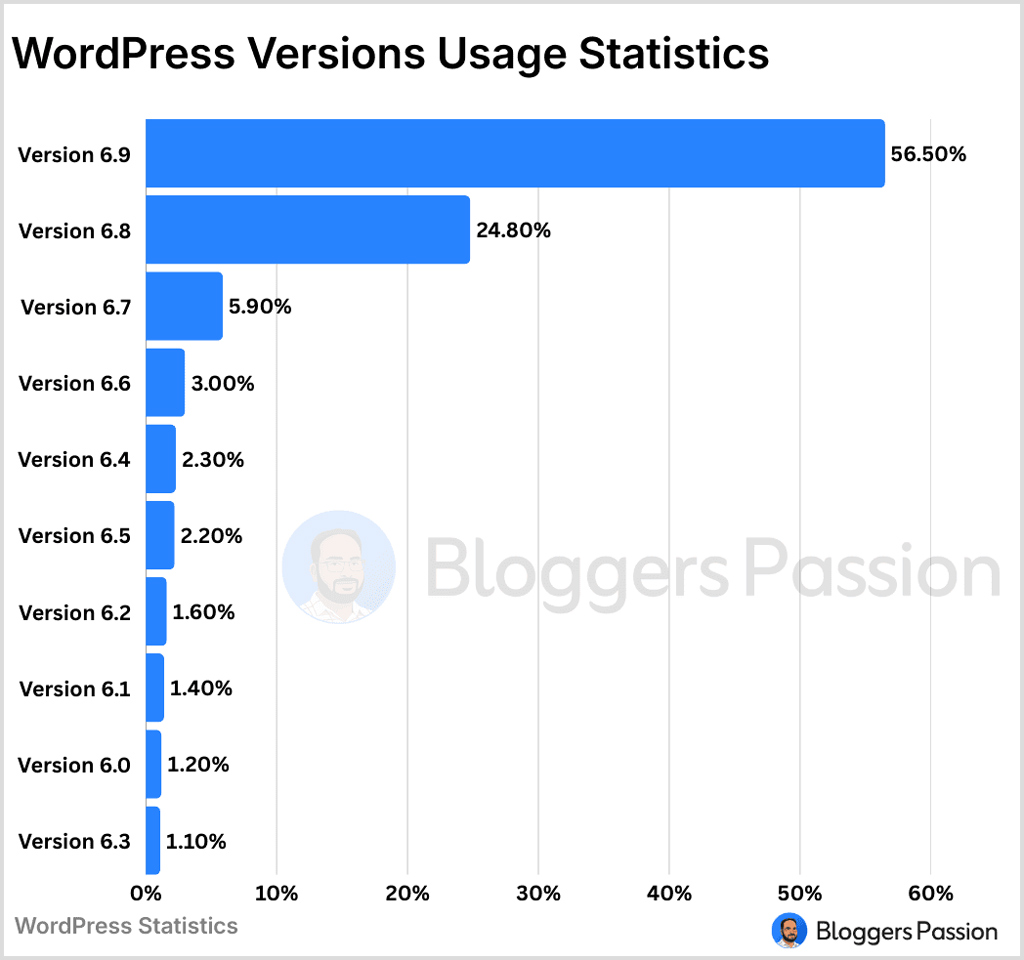
- Version 6.9 dominates the ecosystem, accounting for a massive 56.50% of all WordPress installations, indicating rapid adoption of the latest release.
- Version 6.8 holds the second position with 24.80% usage, showing that a significant portion of users stay slightly behind the newest version.
- Combined, Versions 6.9 and 6.8 control over 81% of the market, highlighting a strong trend toward recent version adoption.
- Version 6.7 is used by 5.90% of websites, marking a sharp drop compared to the top two versions.
- Older versions like 6.6 (3.00%), 6.4 (2.30%), and 6.5 (2.20%) show a gradual decline, indicating users are consistently upgrading.
- Very old versions, such as 6.2 (1.60%), 6.1 (1.40%), and 6.0 (1.20%), have minimal usage, suggesting limited long-term retention of outdated versions.
- Version 6.3 has the lowest share at just 1.10%, making it the least adopted among the listed versions.
- The data clearly reflects a strong preference for newer WordPress versions, driven by security updates, performance improvements, and new features.
- Overall, the distribution indicates a healthy update culture within the WordPress community, with most users keeping their sites up-to-date and secure.
WordPress SEO Statistics
- WordPress powers roughly 43% of all websites globally, making it the dominant SEO‑friendly CMS.
- Among sites using a CMS, WordPress holds over 60% market share, underlining its SEO-focused advantage.
- SEO plugins like Yoast SEO have over 5 million active installations, highlighting their widespread SEO‑optimization use.
- All-in-One SEO and similar plugins together exceed 3 million active installations, demonstrating strong plugin‑driven SEO adoption.
- Global studies show that about 53% of all website traffic comes from organic search, benefiting properly optimized WordPress sites.
- Research on large traffic volumes suggests organic search may account for up to 64% of visits, when “direct” traffic is reattributed.
- Faster‑loading WordPress sites with good Core Web Vitals scores are significantly overrepresented in top‑ranking positions.
- Websites using WordPress SEO plugins are more likely to implement XML sitemaps and schema markup, improving indexing and rich‑snippet visibility.
- Businesses choosing WordPress for SEO often report higher short‑term ROI compared with custom‑built CMS solutions due to lower setup costs.
- Content‑rich WordPress blogs with proper internal linking can increase organic traffic by 30–50% within 6–12 months of SEO optimization.
WordPress Security Statistics
- WordPress accounts for over 90% of CMS-based hacked websites, mainly due to its popularity.
- Plugin vulnerabilities contribute to over 90% of WordPress security issues.
- Weak passwords are responsible for 8% of WordPress security breaches.
- Regular updates can prevent over 80% of common WordPress vulnerabilities.
- Security plugins like Wordfence and Sucuri are installed on millions of websites globally.
- Two-factor authentication adoption has increased across WordPress sites.
- Managed hosting providers offer built-in security layers, reducing risks for users.
- Daily backups are used by a majority of WordPress site owners, ensuring data recovery.
- Security awareness among WordPress users has increased significantly in recent years.
Frequently Asked Questions (FAQs)
What percentage of all websites use WordPress in 2026?
Around 42.6% to 43.5% of all websites globally use WordPress.
How many websites are powered by WordPress worldwide?
More than 590 million websites run on WordPress globally.
What is WordPress’s share of the CMS market?
WordPress holds approximately 59.9% to 62.8% of the CMS market.
How many new WordPress websites are created daily?
Around 500 to 661 new WordPress sites are launched every day.
What percentage of eCommerce websites use WooCommerce (WordPress)?
WooCommerce powers about 33% to 34% of global online stores.
Conclusion
WordPress continues to dominate the web ecosystem with unmatched scale, flexibility, and community-driven innovation. Powering over 43% of all websites, it remains the backbone of digital publishing, eCommerce, and online business operations across industries. Its strength lies not just in numbers, but in its adaptability, from supporting simple blogs to managing complex enterprise platforms and headless CMS architectures.
In addition, the platform’s extensive ecosystem of plugins, themes, and hosting solutions enables users to build highly customized, performance-driven websites without starting from scratch. As trends like AI integration, Core Web Vitals optimization, and no-code development continue to evolve, WordPress consistently adapts to meet modern demands. For businesses, marketers, and developers alike, these statistics highlight why WordPress remains a strategic choice for building scalable, future-ready digital experiences.

Leave a comment
Have something to say about this article? Add your comment and start the discussion.