




Workplace device usage is evolving rapidly, driven by remote and hybrid work, mobile technologies, and shifting employee expectations. Companies of all sizes now juggle a mix of employer‑issued devices and personal hardware for daily tasks, collaboration, and communication. In sectors like technology and healthcare, employees often use personal smartphones or laptops to access work systems, while industries like finance still emphasize tightly controlled work devices for compliance. The contrast between personal and work device usage has real implications for productivity, security, and corporate policy. Let’s dive into the latest work vs personal device statistics and what they mean for organizations today.
Editor’s Choice
- 95%+ of organizations permit some level of personal device use for work tasks.
- 82% of companies have a formal BYOD policy in place.
- 67% of workers use personal devices for work, even if unofficially.
- Employees use an average of 2.5 devices for work tasks.
- BYOD adoption boosts productivity by up to 55%.
- The personal device security market is estimated at ~$59.3 billion in 2026.
- 70% of employees under BYOD policies use personal devices for work.
Recent Developments
- A 2025 report shows that personal devices like smartphones are now essential for workplace productivity and communication.
- The BYOD security market is expanding rapidly, with security solutions now a priority for organizations.
- Hybrid work models are accelerating personal device integration into corporate systems.
- Nearly 44% of employees use personal phones for work even when official policy doesn’t allow it.
- Security frameworks such as Zero Trust are being adopted slowly, with less than half of companies using them fully.
- Case studies highlight an increase in shadow IT due to unmanaged personal devices.
- Employers rethink BYOD policies as security concerns grow alongside hybrid work demands.
- Organizations emphasize employee privacy and data control in updated BYOD frameworks.
Global Work vs Personal Device Adoption Overview
- Over 95% of organizations globally allow some personal device access to work systems.
- 82% formal BYOD adoption rate among companies in recent surveys.
- Around 67% of workers use personal devices at work, regardless of policy.
- The average employee uses 2.5 devices for professional tasks.
- Smartphones constitute the largest share of devices in BYOD setups, nearly half of the BYOD market.
- North America held about 38.1% of the global BYOD market share in 2025.
- BYOD policies are more common in developed economies, but are growing worldwide.
- Hybrid work trends are contributing to increased personal device dependency.
BYOD Security Market Growth Statistics
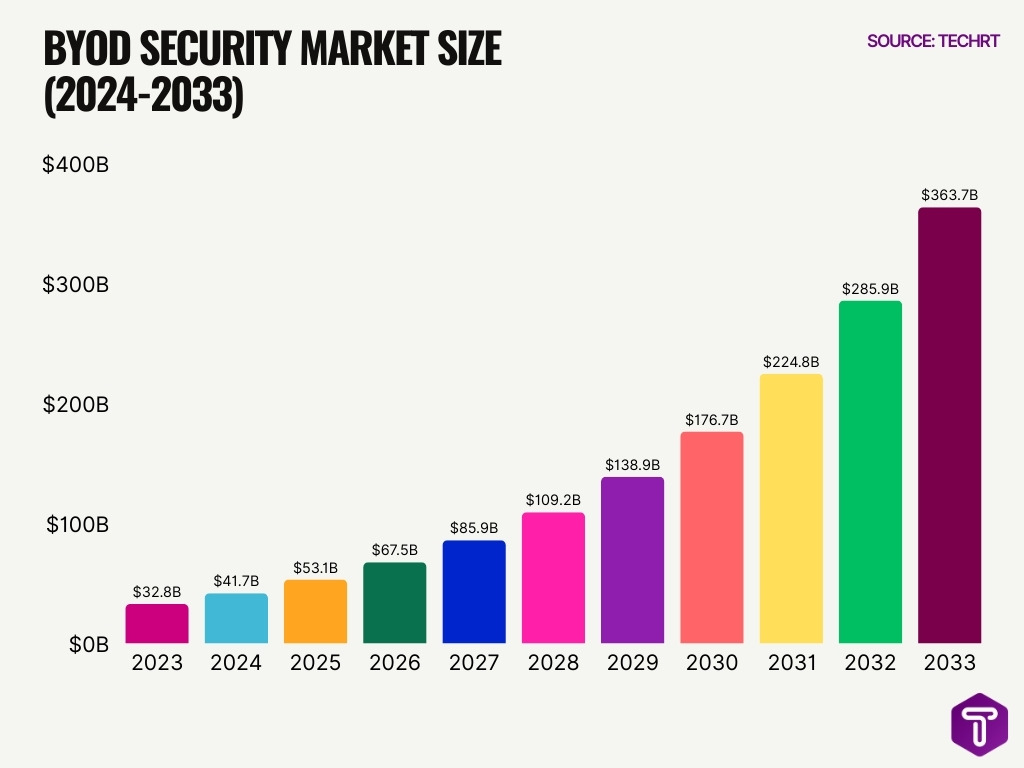
- The global BYOD security market was valued at $32.8 billion in 2023, highlighting the early but accelerating adoption of enterprise mobile security solutions.
- Market size is projected to reach $41.7 billion in 2024, reflecting growing concerns around data privacy, endpoint security, and remote work risks.
- By 2025, the BYOD security market is expected to expand to $53.1 billion, driven by increased BYOD adoption across enterprises.
- The market is forecast to grow to $67.5 billion in 2026, indicating stronger investment in mobile device management (MDM) and zero-trust security models.
- In 2027, BYOD security spending is estimated at $85.9 billion, supported by rising cyberattack frequency and stricter regulatory compliance.
- The market is projected to surpass $109.2 billion in 2028, crossing the $100 billion milestone as enterprises scale security across distributed workforces.
- By 2029, the BYOD security market size is expected to reach $138.9 billion, fueled by cloud security integration and AI-driven threat detection.
- The market is forecast to climb to $176.7 billion in 2030, reflecting widespread adoption of secure access service edge (SASE) frameworks.
- In 2031, global BYOD security revenue is projected at $224.8 billion, as organizations prioritize endpoint visibility and identity-based access controls.
- The market is expected to grow to $285.9 billion in 2032, driven by enterprise demand for scalable mobile and IoT security solutions.
- By 2033, the BYOD security market is projected to reach $363.7 billion, underscoring long-term, exponential growth in enterprise cybersecurity investments.
BYOD (Bring Your Own Device) Adoption Statistics
- 95%+ organizations now permit personal devices in some capacity.
- 82% of companies have formal BYOD programs.
- 67% of employees use personal devices for work, even unofficially.
- 70% of BYOD employees regularly use personal smartphones for work tasks.
- 36.1% of workers use a mix of personal and work devices.
- Only ~14.4% rely solely on personal devices for work.
- Industry surveys indicate 39% of companies cite security as a BYOD barrier.
- BYOD markets are expected to grow strongly through the late 2020s, driven by flexibility and cost savings.
Corporate-Owned Device (COPE/CYOD/COBO) Usage Statistics
- Nearly 50% of employees use only employer‑provided devices for work.
- ~15% of companies provide company‑issued smartphones to employees.
- Among corporate device users, security investments are more consistent than in BYOD setups.
- A notable segment, ~24%, provides devices to less than 20% ofthe workforce.
- Around 28% provide mobile devices to over 20% of staff.
- Only 17% offer employer devices to all workers.
- COPE/CYOD users often see higher rates of security compliance.
- Corporate device usage remains strong in regulated sectors like finance and defense.
Preference for Separate Devices for Work and Personal Use
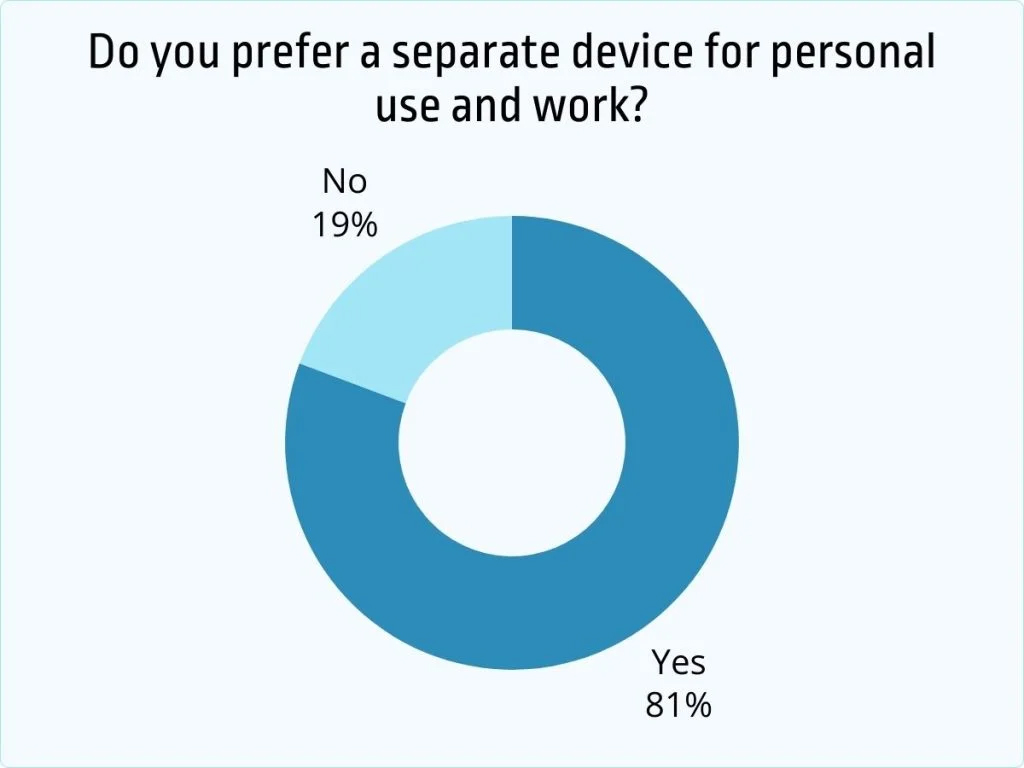
- 81% of respondents prefer using separate devices for work and personal activities, highlighting a strong demand for clear work–life boundaries.
- Only 19% of users are comfortable using a single device for both professional and personal use, indicating limited acceptance of mixed-use devices.
- The overwhelming majority (over four-fifths) favor device separation, suggesting privacy, security, and focus are key concerns.
- The relatively small 19% minority reflects users who prioritize convenience and simplicity over device separation.
- Overall, the data shows a clear preference toward dual-device usage, reinforcing the trend of dedicated work devices in modern work environments.
Employer-Issued Devices vs Personal Devices at Work
- ~49.7% of employees use only employer-issued devices at work.
- 36.1% use both personal and corporate devices.
- Only around 14.4% rely exclusively on personal devices for work.
- 67% of workers use personal devices for work, regardless of company policy.
- 95%+ of organizations allow BYOD in some capacity.
- 90% of employees use a mix of company-issued and personal devices.
- BYOD can improve productivity by 55%.
- 82% of companies have formal or informal BYOD frameworks.
- Employees use an average of 2.5 devices for work.
- 80%+ of businesses actively promote BYOD adoption.
Hybrid Work and Device Usage Trends
- As of early 2025, ~80% of remote‑capable employees were working in hybrid, 52%, or fully remote, 26%, setups, a strong indicator of ongoing hybrid work adoption.
- In the U.S., ~24% of new job postings in late 2025 were for hybrid roles, while 11% were fully remote, reflecting employer demand for flexible work models.
- Hybrid work continues to be preferred by employees, with ~83% expressing a desire for a mix of in‑office and remote days in 2025.
- Hybrid employees often rely on a mix of work and personal devices each week to stay connected and productive across locations.
- Mobile devices are key in hybrid workflows; ~70% of employees under BYOD policies use personal devices daily for work.
- Hybrid work models increase dependency on secure network tools, with VPN usage and collaboration apps becoming standard.
- Among hybrid workers, personal device use for communication and messaging is prevalent even where employer policies limit it.
- The ongoing shift toward remote‑friendly schedules fuels IT investment in endpoint security to support secure hybrid device usage.
Remote and Hybrid Employees’ Device Usage Statistics
- Nearly 23% of the U.S. workforce teleworked in late 2025, translating to millions using devices remotely for work tasks.
- Among remote/hybrid workers, smartphones and laptops are the most commonly used devices for work‑related access.
- ~70% of BYOD employees report using personal devices for daily work tasks.
- Remote employees typically log into work systems multiple times per day via personal devices, reflecting deeper integration between remote work and BYOD.
- Hybrid workers often use company VPNs to access internal resources on personal devices, with adoption rates growing every year.
- Security awareness training is more common in hybrid environments, but gaps remain in personal device best practices.
- Many remote and hybrid employees manage work notifications on personal devices to keep pace with collaboration tools.
- Remote employees report higher satisfaction when personal and work devices interoperate seamlessly, pointing to device choice as a factor in productivity.
Number of Devices Used per Employee Statistics
- The average employee now uses 2.8 connected devices daily for work tasks.
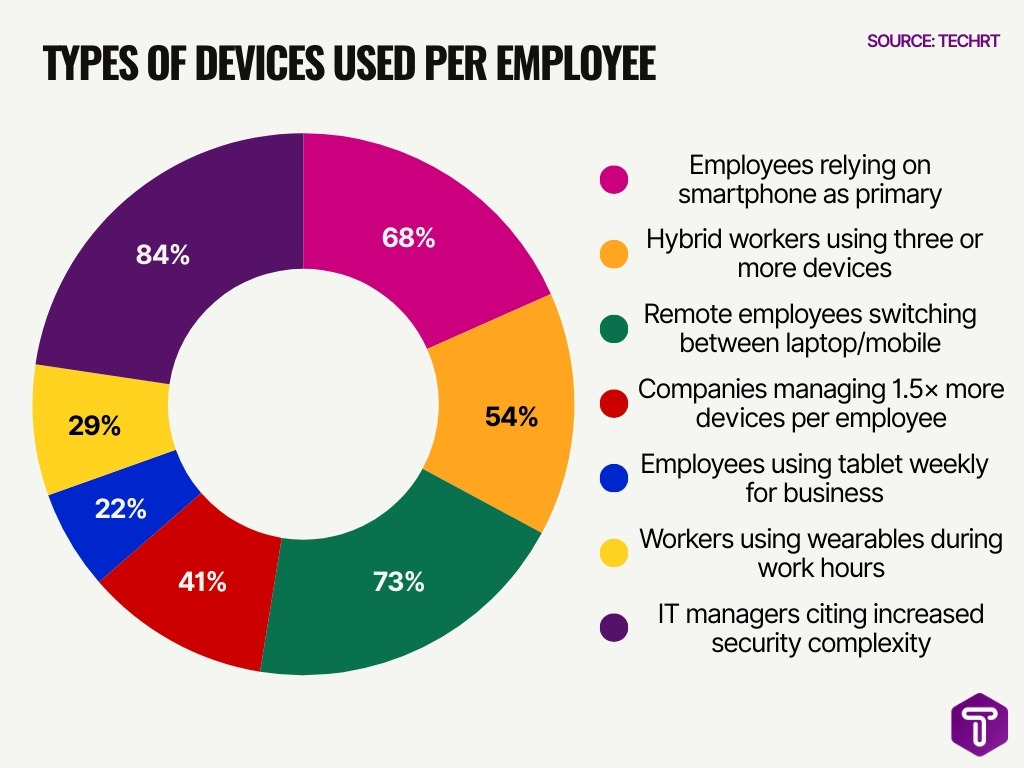
- 68% of employees rely on a smartphone as one of their primary work devices.
- 54% of hybrid workers actively use three or more devices during a typical workday.
- 73% of remote employees switch between a laptop and a mobile device for work-related tasks.
- 41% of companies report managing over 1.5× more devices per employee since adopting hybrid work models.
- 22% of employees use a tablet for at least one business function or meeting weekly.
- 29% of workers use wearables for notifications or productivity tracking during work hours.
- BYOD environments show an average of 2.9 devices per user, compared to 2.1 in company-issued setups.
- 84% of IT managers say multi-device use has increased security management complexity in the past two years.
- The global enterprise device-per-employee ratio is expected to hit 3.1 by 2027, driven by remote and AI-assisted work.
Work Activities on Personal Devices Statistics
- ~67% of employees use personal devices for work‑related tasks such as email, messaging, and apps.
- Employees check work apps on smartphones hundreds of times a day during hybrid work patterns.
- Over 80% of employees report using personal devices for tasks like email access, scheduling, and notifications under BYOD policies.
- Nearly 50% of professionals admit to checking phones during meetings, often for work content.
- Personal devices help hybrid teams stay responsive, especially for real‑time collaboration outside office hours.
- Despite productivity gains, ~60% of employees find smartphone use distracting during work time.
- A majority of hybrid workers use personal devices to manage cloud‑based work platforms.
- Remote and flexible employees increasingly use personal devices for project apps, calendar syncing, and cloud storage interactions.
Personal Activities on Work Devices Statistics
- 90% of employees use company-provided laptops for personal activities.
- 63% access the dark web weekly on work laptops.
- 17% access the dark webdaily using work devices.
- 20% of employees view adult contentdaily on work laptops.
- 20% engage in online gamblingdaily on company devices.
- 36% of workers see employer monitoring of personal activity on work laptops as a privacy violation.
- 18% have no cybersecurity software installed on their work laptops.
- Younger employees aged 16-24 show higher rates of risky personal behaviors on work devices.
Mobile Device Management: Employee Device Provisioning Trends
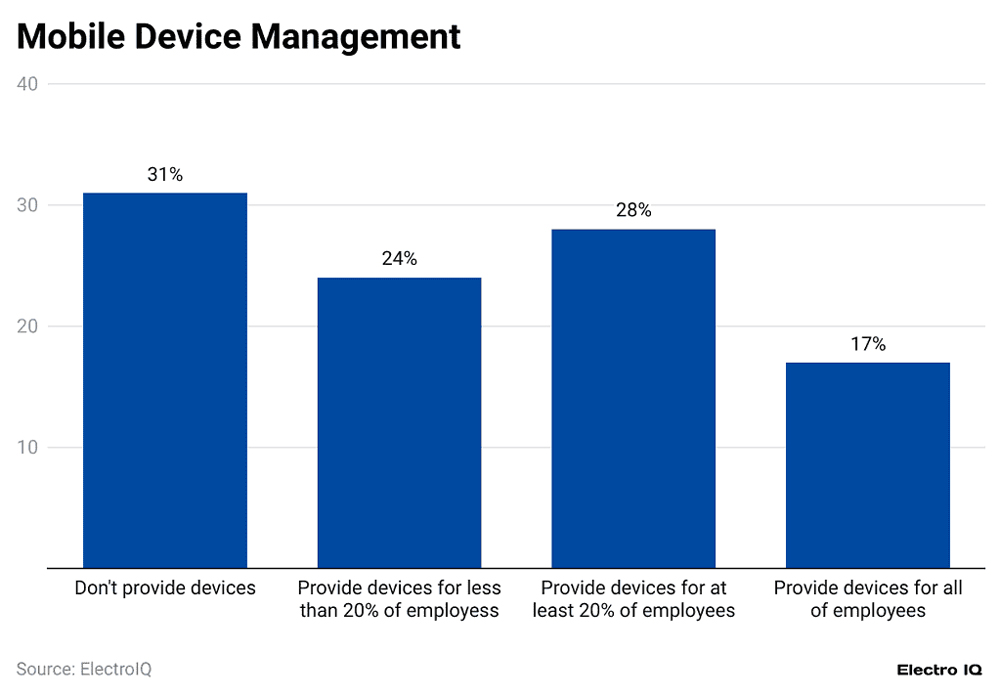
- 31% of organizations do not provide devices to employees, highlighting widespread reliance on BYOD (Bring Your Own Device) policies.
- 24% of companies provide devices to less than 20% of employees, indicating limited, role-specific device distribution.
- 28% of organizations provide devices to at least 20% of employees, reflecting a hybrid approach to mobile device management.
- Only 17% of companies provide devices to all employees, showing that full-scale device provisioning is still relatively uncommon.
Security Risks of Personal Devices at Work
- Over 80% of BYOD devices remain unmanaged, heightening security vulnerabilities.
- 71% of employees store sensitive work passwords on personal phones.
- 92% of ransomware attacks in 2024 involved unmanaged devices.
- More than 17% of workers use personal devices for work without IT knowledge.
- Over 1 in 5 organizations faced malware from unsecured BYOD devices.
- 90% of lost or stolen device incidents lead to unauthorized data breaches.
- 84% of IT leaders worry about shadow IT risks from personal devices.
- 39% of security pros cite lack of device visibility as top concern.
- The BYOD security market is expected to reach $210.4 billion by 2033 at 12.5% CAGR.
- 43% of employees targeted by work-related phishing on personal devices.
Compliance and Regulatory Concerns with BYOD
- 48% of organizations reported suffering a data breach tied to unsecured or unmanaged personal devices in the past year, highlighting compliance risk.
- BYOD introduces regulatory concerns around data protection laws when personal devices access corporate data.
- Many companies lack robust compliance frameworks specifically tailored for BYOD governance.
- ~80% of organizations allowing BYOD also cite compliance workload as a key operational challenge.
- Data privacy regulations require visibility and auditing, which personal devices complicate unless properly managed.
- Failure to comply with regulations tied to employee personal devices can result in fines and reputational damage.
- Regulatory compliance now often intersects with endpoint security policy requirements, forcing stronger BYOD controls.
- Zero‑trust and identity‑based network access models are increasingly recommended by regulators to ensure compliance with BYOD scenarios.
Industry‑Wise BYOD and Work Device Usage Statistics
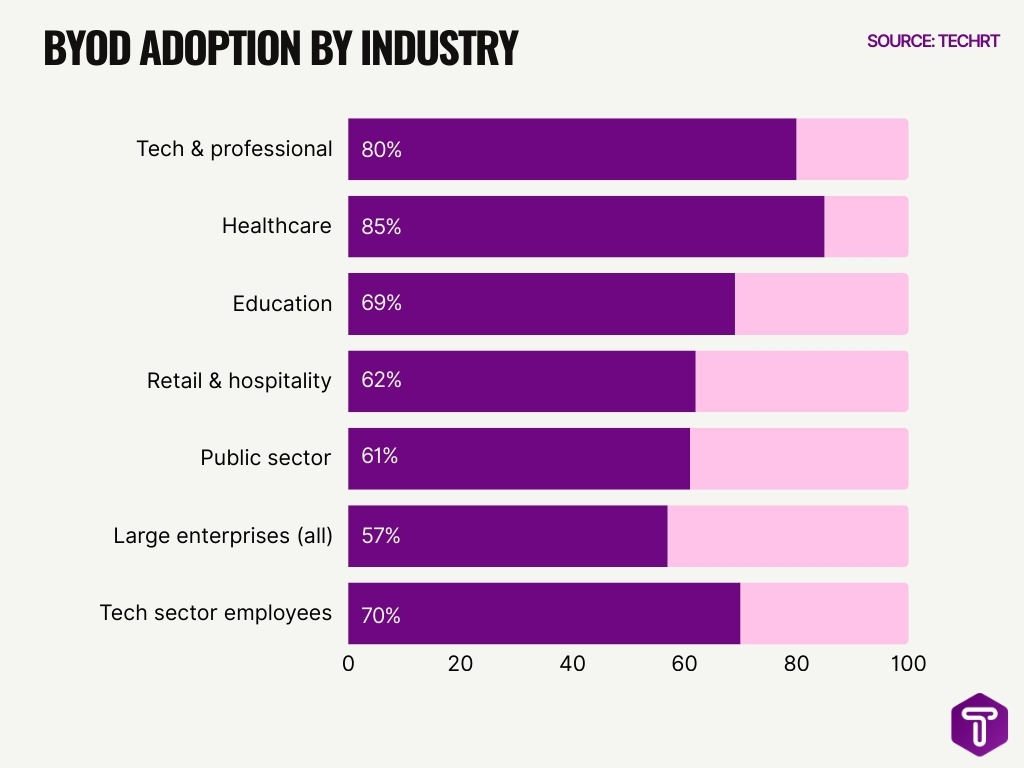
- Tech and professional services lead with the highest BYOD adoption at over 80% of organizations allowing personal devices.
- The finance sector shows high BYOD uptake despite compliance hurdles, ranking second after education.
- Healthcare professionals use BYOD at 85%, prioritizing mobility for patient data access.
- The education sector boasts 69% BYOD adoption, with 85% of institutions permitting personal devices on networks.
- Retail and hospitality leverage BYOD for mobile POS, with 62% hotels adopting contactless personal tech.
- Manufacturing and engineering lag in BYOD, favoring secure corporate devices amid slower adoption trends.
- Public sector exhibits cautious BYOD growth, with 61% organizations extending access to hybrid workforces.
- In tech, 70% of employees prefer personal devices for daily tasks when permitted.
- Large enterprises across sectors hold 57% BYOD market share, driven by mature security programs.
Employee Privacy Concerns on Work and Personal Devices
- 74% of U.S. employers use online tracking tools for digital surveillance of websites, apps, or screens.
- 71% of employees worldwide report being digitally monitored at work.
- 56% of monitored workers feel tense or stressed compared to 40% of non-monitored employees.
- 59% of employees experience stress or anxiety from workplace surveillance.
- 93.9% of remote workers have faced at least one privacy-invasive scenario while working from home.
- 15% of BYOD respondents cite employee privacy concerns as a key adoption barrier.
- 43% of employees view workplace surveillance as a violation of trust.
- 80% of executives believe company monitoring of personal device usage invades privacy.
- 47% of organizations identify employee privacy violations as a top BYOD risk.
- More than half of monitored employees report higher stress or tension from tracking.
IT Visibility and Control over Personal vs Work Devices
- IT departments report limited visibility into personal devices, compared with corporate‑owned endpoints.
- Shadow IT, where employees install apps or services unknown to IT, increases with personal device usage.
- 38% of IT professionals admit they lack sufficient data about devices connected to their networks, a challenge amplified by BYOD.
- Less than half of companies have tools that unify visibility across BYOD and corporate devices.
- Lack of complete endpoint control increases the risk of undetected breaches from personal devices.
- Employers often adopt UEM and other tools to increase visibility into BYOD environments.
- Growing adoption of cloud‑based security platforms helps bridge visibility gaps between device types.
- Organizations with robust device control see improved compliance outcomes and lower breach rates.
Cell Phones at Workplace Usage Share by Country
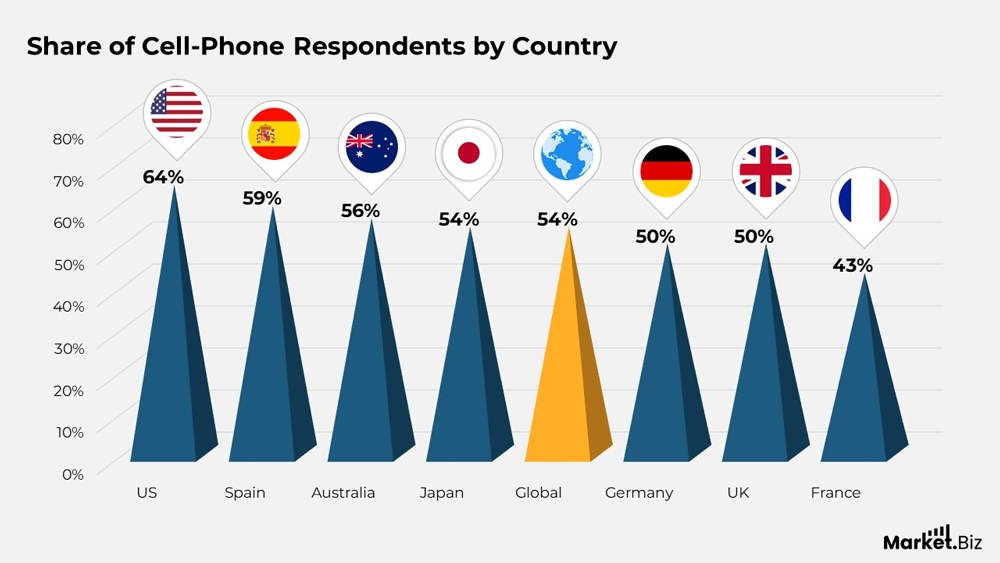
- The United States leads globally, with 64% of respondents reporting cell-phone usage, marking the highest adoption rate among all countries surveyed.
- Spain follows closely, where 59% of respondents rely on cell phones for participation.
- In Australia, 56% of respondents use cell phones, reflecting strong mobile engagement.
- Japan aligns exactly with the global average, with 54% of respondents reporting cell-phone usage.
- At a global level, 54% of respondents participate via cell phones, highlighting mobile as a dominant access channel worldwide.
- Germany reports 50% cell-phone usage, indicating a balanced split between mobile and other devices.
- The United Kingdom also shows 50% adoption, matching Germany’s mobile usage rate.
- France records the lowest share, with only 43% of respondents using cell phones, showing slower mobile adoption compared to other major markets.
Future Trends in Work vs Personal Device Usage
- The BYOD market is projected to exceed $152 billion in 2026 and is expected to grow at a CAGR of around 15‑16% CAGR through 2031.
- The BYOD security market value is forecast to rise substantially as organizations invest in risk management tools.
- Zero‑trust access solutions are expected to replace legacy mobile security approaches for personal device policies.
- Workplace tech will likely leverage AI‑driven security automation to monitor and secure BYOD endpoints.
- Expect stronger privacy‑forward policies balancing employee autonomy and corporate safeguards.
- Increased adoption of cloud‑native management platforms will unify personal and employer devices.
- Wearables and IoT endpoint integration into work environments will expand personal device portfolios.
- Regulations and compliance frameworks will evolve to explicitly address hybrid and device‑agnostic workplaces.
Frequently Asked Questions (FAQs)
What percentage of employees use personal devices for work tasks in 2025–2026?
About 67% of workers use personal devices for work, even when a formal BYOD policy isn’t in place.
What share of organizations now allow personal devices to be used for work?
More than 95% of organizations allow BYOD in some capacity.
What proportion of employees use only employer‑issued devices, both work and personal devices, or only personal devices?
Approximately 49.7% use only employer devices, 36.1% use both personal and work devices, and 14.4% use only personal devices at work.
How many employees under BYOD policies use their personal devices for work purposes daily?
Around 70% of employees under BYOD policies use their personal devices for work activities.
What is the projected global BYOD security market growth by 2029?
The global BYOD security market is projected to grow from $76.9 billion in 2024 to $361.03 billion by 2029, with an estimated CAGR of 37%.
Conclusion
As workplace device landscapes shift, personal and corporate devices coexist, bringing efficiency and complexity in equal measure. Employee preferences now shape device policies, and adoption rates reflect a reality where flexibility boosts productivity and broad access to tools across locations. Yet, this freedom introduces significant compliance, privacy, and security challenges that organizations must manage proactively.
Understanding regional differences, industry risk profiles, and emerging tech trends is vital for crafting policies that protect data while respecting employee autonomy. As BYOD and hybrid work continue to rise, strong governance and smart security practices will define which organizations stay resilient and which fall behind.

Leave a comment
Have something to say about this article? Add your comment and start the discussion.