


Xbox has evolved from a traditional console brand into a multi-platform gaming ecosystem that spans consoles, PC, mobile, and cloud-based services. What started as a hardware-focused business now drives a broader digital strategy built on subscriptions, cross-platform access, and content distribution. Services like Game Pass have changed how players discover and consume games, while cloud gaming enables instant access without high-end hardware.
In practical terms, Xbox powers entertainment across millions of US households and supports enterprise-grade cloud infrastructure through Microsoft Azure, which game developers rely on for scalable multiplayer experiences. At the same time, its ecosystem connects console players, PC gamers, and mobile users into a single network, increasing engagement and lifetime value. As the gaming industry shifts toward digital ownership and recurring revenue models, Xbox stands at the center of this transition. Let’s explore the latest Xbox statistics to understand its growth, user behavior, and market impact.
Editor’s Choice
- Xbox has reached 500 million monthly active users across its ecosystem as of 2026.
- Xbox Game Pass surpassed 40 million subscribers in early 2026, up from 37 million in 2025.
- Microsoft’s gaming division generated approximately $21.5 billion in annual revenue in FY2025.
- Game Pass alone generated nearly $5 billion in annual revenue in FY2025.
- Xbox Series X|S has sold over 34–35 million units globally since launch.
- Xbox Live (now integrated into Game Pass Core) serves over 130 million monthly active users.
- Xbox holds roughly 31% of the global console market share, trailing PlayStation.
Recent Developments
- Xbox introduced new hardware like the Elite Controller Series 3 in 2026.
- Microsoft expanded Game Pass partnerships to 150+ developers and studios in 2025.
- Xbox launched cloud-native development tools such as Xbox Game Package Manager (XGPM).
- AI-driven game development tools improved developer efficiency by 30%.
- Xbox Play Anywhere expanded to more third-party titles, enabling cross-platform ownership.
- Game Pass Friends & Family plan now supports up to 5 users per subscription.
- Over 85 new titles were added to Game Pass in 2025, including 28 day-one releases.
- Xbox supports Dolby Vision in 200+ games, enhancing visual performance.
- Microsoft shifted focus toward content and services as hardware sales declined 29% YoY in 2026.
Xbox Key Statistics Overview
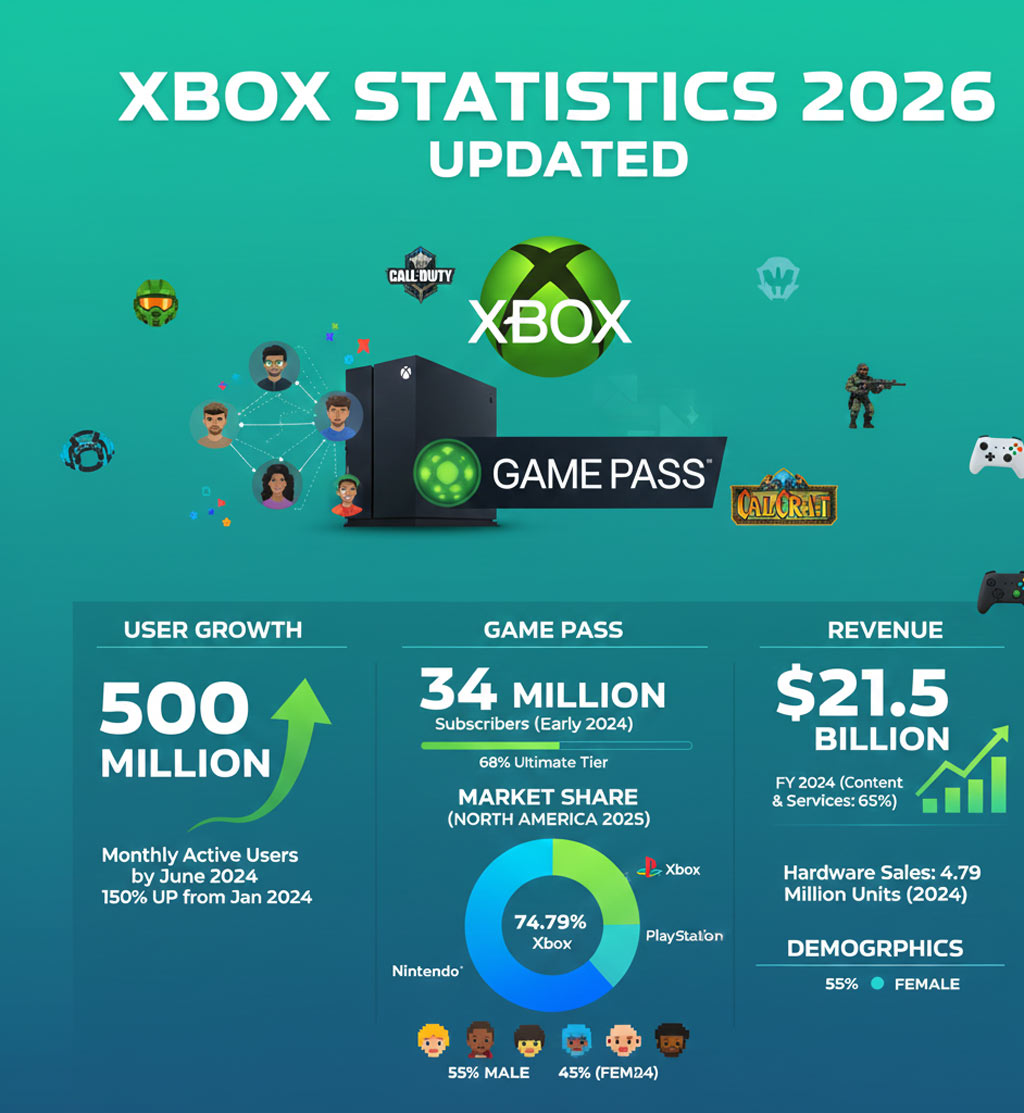
- Xbox has reached 500 million monthly active users (June 2024), reflecting a massive 150% growth since January 2024, signaling rapid platform expansion.
- Xbox Game Pass continues to scale with 34 million subscribers (early 2024), with a dominant 68% of users on the Ultimate tier, highlighting strong premium adoption.
- In North America (2025), Xbox holds a leading 74.79% market share, outperforming competitors like PlayStation and Nintendo.
- Xbox generated $21.5 billion in revenue in FY 2024, with 65% coming from content and services, emphasizing a shift toward recurring digital revenue.
- Hardware performance shows 4.79 million units sold in 2024, indicating steady demand for Xbox consoles.
- The Xbox user base is slightly male-dominated, with 55% male users compared to 45% female users, reflecting a relatively balanced demographic split.
- Overall, Xbox’s growth is driven by subscription services, digital content, and expanding user engagement, positioning it as a strong player in the gaming ecosystem.
Xbox User Base and Active Players
- The Xbox ecosystem reached 500 million monthly active users in 2026, reflecting rapid growth.
- The user base grew by nearly 150% from 2024 to 2026.
- Xbox Live alone supports over 130 million active monthly users.
- Xbox had approximately 200 million active users in 2025, showing strong YoY growth.
- The platform added over 80–100 million new users within two years, driven by cloud and PC expansion.
- Xbox Game Pass accounts for a significant portion of active users, with 70% on the Ultimate tier.
- Cross-platform integration (console, PC, cloud) contributed to higher global adoption rates.
- Over 120 million gamers globally subscribe to gaming services, with Xbox leading the segment.
Xbox Engagement and Playtime Statistics
- Xbox cloud gaming surpassed 500 million hours streamed annually.
- Game Pass subscribers play 36% more hours than non-subscribers.
- Average Game Pass user engages with 20 games per year, up from 18 in 2024.
- Xbox players increasingly adopt multi-device gaming, boosting session frequency.
- Popular franchises like Call of Duty reached 50 million players globally on the Xbox ecosystem.
- Total gameplay hours for major titles exceeded 2 billion hours annually.
- Subscription-based users demonstrate higher retention rates and longer sessions.
- Cross-play functionality increases daily active engagement across platforms.
Xbox Age Demographics: Majority of Users Are Aged 25–44
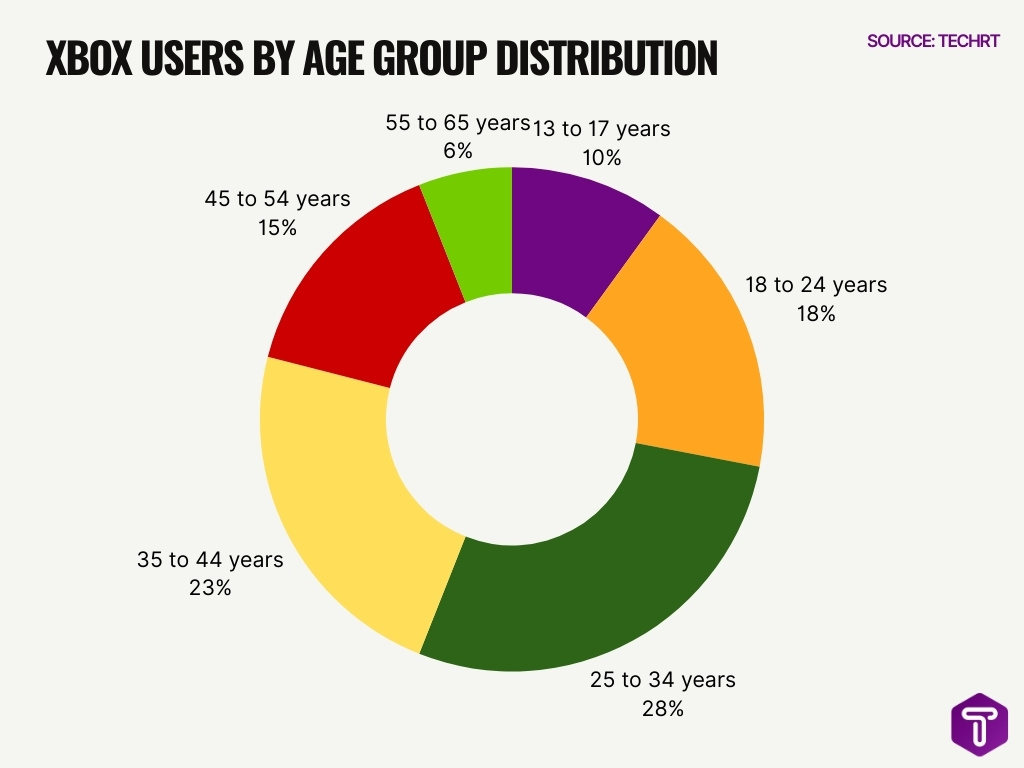
- The largest share of Xbox users falls in the 25 to 34 years age group, accounting for 28%, making it the dominant segment.
- Users aged 35 to 44 years represent the second-largest group at 23%, highlighting strong engagement among mid-age gamers.
- The 18 to 24-year segment contributes 18%, showing a solid presence of younger adult players.
- Combined, users aged 25 to 44 years make up 51% of the total Xbox audience, indicating a core demographic of mature gamers.
- The 45 to 54 years group holds 15%, reflecting continued participation from older adults.
- Teen users aged 13 to 17 years account for 10%, a relatively smaller but still notable segment.
- The 55 to 65 years category represents the smallest share at 6%, showing limited adoption among older age groups.
- Overall, Xbox’s audience skews toward young and middle-aged adults (18–44 years), who collectively account for 69% of users.
Xbox Game Pass Statistics
- Xbox Game Pass surpassed 40 million subscribers in 2026, growing from around 37 million in 2025.
- Game Pass generated nearly $5 billion in annual revenue for Microsoft’s gaming division.
- Over 70% of subscribers use the Ultimate tier, which bundles cloud gaming and EA Play.
- Microsoft adds an average of 7–10 new titles per month to Game Pass.
- In 2025, more than 85 new games were added, including several day-one AAA releases.
- Game Pass users are 36% more engaged compared to non-subscribers.
- Subscribers play an average of 20 games annually, reflecting higher content discovery.
- The Friends & Family plan allows up to 5 users per subscription, expanding shared usage.
- Game Pass availability spans 40+ countries, with expansion into emerging markets via cloud.
Xbox Cloud Gaming and xCloud Statistics
- Xbox Cloud Gaming (xCloud) recorded over 500 million hours streamed annually.
- The service is available in 28+ countries, with expansion planned across Asia and Latin America.
- More than 25 million users have tried cloud gaming services through the Xbox ecosystem.
- Xbox Cloud Gaming supports hundreds of titles via browser and mobile devices.
- Microsoft Azure powers Xbox Cloud Gaming across 60+ global data center regions.
- Cloud gaming reduces hardware dependency, contributing to rapid user base expansion post-2024.
- Mobile cloud gaming sessions increased by over 40% year-over-year in 2025.
- Xbox integrates cloud saves and cross-play, enabling seamless device switching.
Xbox Market Share Worldwide
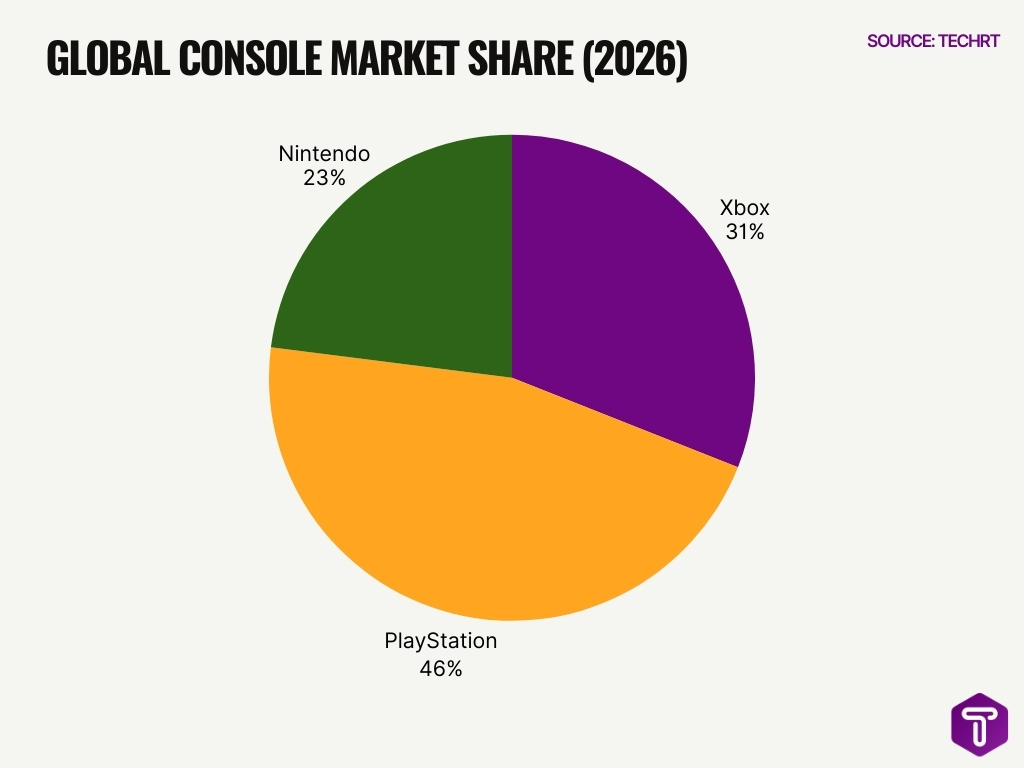
- Xbox holds approximately 30–31% of the global console market share as of 2026.
- Sony’s PlayStation leads with around 45–47% market share, while Nintendo accounts for ~20–25%.
- In the United States, Xbox commands a stronger position with 40%+ market share in some years.
- Europe remains more PlayStation-dominated, where Xbox holds roughly a 25–30% share.
- Xbox’s share improved slightly due to Game Pass expansion and cloud gaming adoption.
- Subscription-based gaming is projected to account for over 20% of industry revenue by 2027, benefiting Xbox.
- Xbox’s presence in emerging markets is growing via cloud-first strategies, especially in Asia and Latin America.
- Global console market competition remains tight, with no single platform exceeding 50% share.
Xbox Console Sales and Hardware Performance
- Xbox Series X|S has sold approximately 34–35 million units globally as of 2026.
- Hardware revenue declined by 29% year-over-year in 2026, reflecting a shift toward services.
- Xbox Series S accounts for a significant share of total sales, driven by its lower price point.
- Microsoft sold over 2.5 million consoles during peak holiday quarters in 2025.
- Supply chain improvements in 2024–2025 increased console availability globally.
- Digital game purchases account for over 70% of Xbox software sales, reducing reliance on physical discs.
- Xbox hardware margins remain lower compared to the software and services segments.
- Backward compatibility supports thousands of legacy titles, enhancing console value.
Xbox Series X|S Sales Statistics
- Xbox Series X|S reached over 30 million units sold by late 2025, continuing steady growth into 2026.
- Sales increased by 15–18% year-over-year between 2024 and 2025.
- The Xbox Series S contributes nearly 55% of total Series sales due to affordability.
- North America represents the largest market, accounting for over 45% of total sales.
- Europe contributes roughly 30% of Xbox Series sales, showing stable demand.
- Asia-Pacific remains a smaller but growing market, with double-digit growth rates.
- Xbox Series X demand remains strong among hardcore gamers seeking high performance.
- Bundled Game Pass offers increased console adoption by 20% in promotional periods.
Historical Xbox Console Sales
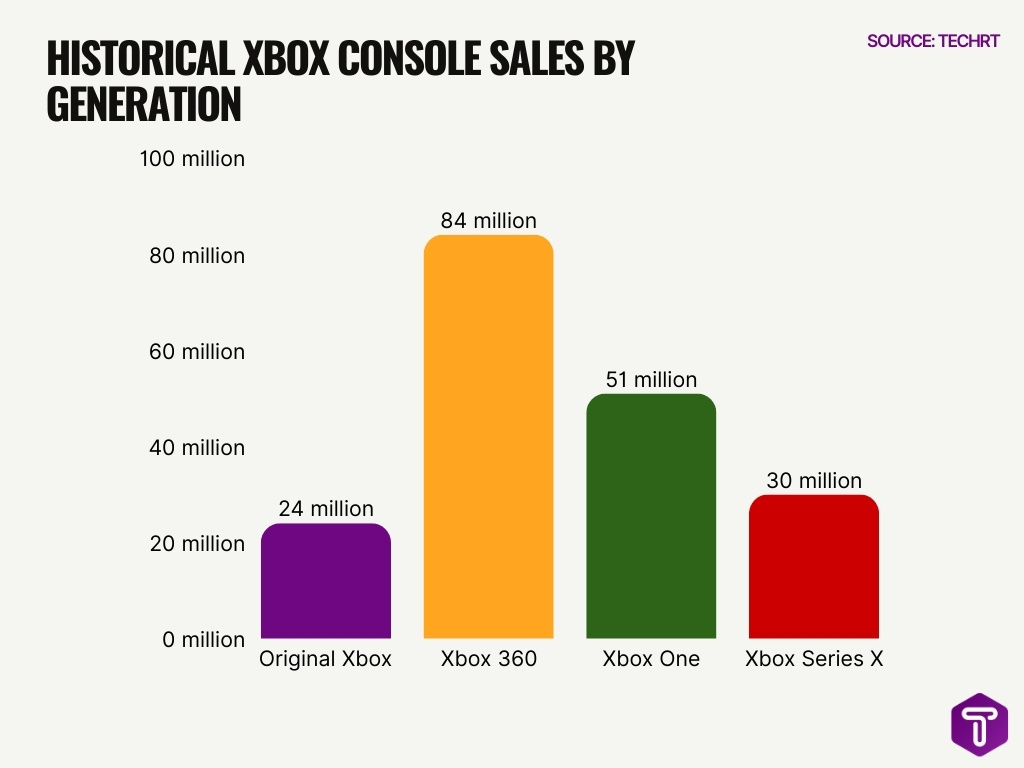
- The original Xbox sold over 24 million units worldwide during its lifecycle.
- Xbox 360 remains the best-selling Xbox console with 84 million units sold globally.
- Xbox One sold approximately 51 million units worldwide before discontinuation.
- Xbox Series X|S has surpassed 30 million units, narrowing the gap with previous generations.
- Xbox 360 dominated the US market during its peak, holding over 50% market share in some years.
- Xbox One sales slowed due to strong competition from PlayStation 4.
- Backward compatibility has extended the lifespan of older Xbox titles across generations.
- The Xbox brand has sold over 190 million consoles cumulatively across all generations.
Xbox Revenue and Financial Performance
- Microsoft’s gaming division generated approximately $21.5 billion in annual revenue in FY2025.
- Xbox content and services revenue accounts for over 65% of total gaming revenue.
- Quarterly gaming revenue exceeded $5.5 billion in Q4 FY2025.
- Game Pass contributes a growing share of recurring revenue within the Xbox ecosystem.
- Microsoft completed the Activision Blizzard acquisition, significantly boosting revenue streams.
- Digital sales and microtransactions drive higher margins compared to hardware sales.
- Xbox revenue grew by over 10% year-over-year between 2024 and 2025.
- First-party titles and subscriptions form the backbone of Microsoft’s gaming profitability.
Xbox Subscription and Recurring Revenue Metrics
- Xbox Game Pass generated nearly $5 billion in annual subscription revenue for FY2025.
- Xbox content and services revenue grew 13% year-over-year in Q4 2025.
- Game Pass and cloud gaming drive 65% of Xbox recurring revenue from subscriptions.
- Xbox Live Gold transitioned to Game Pass Core, bundling 25 titles at the same price.
- Over 35 million subscribers use Xbox Game Pass as of mid-2025.
- Game Pass Ultimate comprises 68% of total subscribers, boosting ARPU.
- Xbox Game Pass ARPU rose 15% to $151 per user in 2025.
- Subscription attach rates hit 70% for Xbox Series S new console buyers.
- Xbox digital-only consoles reached 66% of US sales in 2025.
Xbox Console OS Market Share Trends in the United States
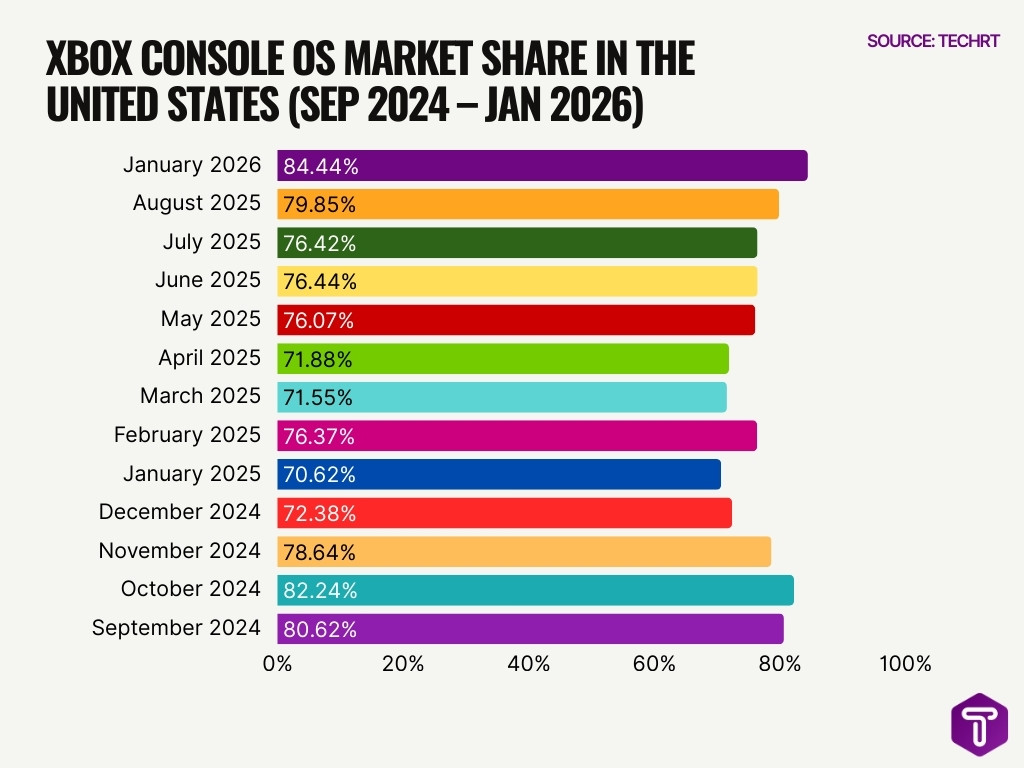
- Xbox market share peaked at 84.44% in January 2026, marking the highest level recorded in the observed period.
- The platform showed a strong upward trajectory from 70.62% in January 2025 to 84.44% in January 2026, reflecting a +13.82 percentage point growth year-over-year.
- Throughout mid-2025 (May–July), Xbox maintained a stable range around 76%, indicating a consistent user base and platform dominance.
- A notable dip occurred in March 2025 at 71.55%, followed by a quick recovery to 76.07% in May 2025, highlighting short-term volatility but strong rebound capability.
- In late 2024, Xbox already held a dominant position, with shares ranging between 72.38% (December 2024) and 82.24% (October 2024).
- The period from September to November 2024 showed high fluctuations, moving from 80.62% → 82.24% → 78.64%, suggesting seasonal or competitive shifts.
- The data indicates that Xbox consistently controlled over 70% of the console OS market, reinforcing its market leadership in the United States.
- The jump from 79.85% in August 2025 to 84.44% in January 2026 signals renewed growth momentum, possibly driven by content releases, ecosystem expansion, or hardware adoption.
- Overall, the trend reflects strong market consolidation, with Xbox strengthening its dominance over time despite minor fluctuations.
Xbox vs PlayStation vs Nintendo Statistics
- PlayStation 5 has sold over 50 million units, compared to Xbox Series X|S at ~35 million.
- Nintendo Switch leads current-gen hardware sales with 130+ million units lifetime.
- Xbox Game Pass (~40M users) outpaces PlayStation Plus (~47M users) in engagement per user, though not total subscribers.
- Xbox focuses heavily on subscription and cloud services, while PlayStation prioritizes exclusive titles.
- Nintendo dominates family-friendly and handheld gaming segments globally.
- Xbox has a stronger integration with PC gaming via the Windows ecosystem, unlike competitors.
- PlayStation generates higher console revenue, but Xbox leads in service-based revenue growth.
- Cross-platform gaming adoption is highest on Xbox due to Play Anywhere and cloud gaming features.
Xbox Multiplayer and Online Gaming Statistics
- Xbox Live (Game Pass Core) supports over 130 million monthly active users.
- Multiplayer gaming accounts for over 60% of total playtime on Xbox platforms.
- Cross-play features connect Xbox users with millions of players across PC and PlayStation.
- Popular multiplayer titles like Call of Duty and Fortnite dominate engagement metrics.
- Xbox network uptime exceeds 99.9% reliability, ensuring stable online gaming experiences.
- Voice chat and party features drive higher social engagement among players.
- Competitive gaming and esports participation continue to grow on Xbox platforms.
- Multiplayer sessions average longer durations compared to single-player gameplay.
Top-Selling Original Xbox Games: Key Insights
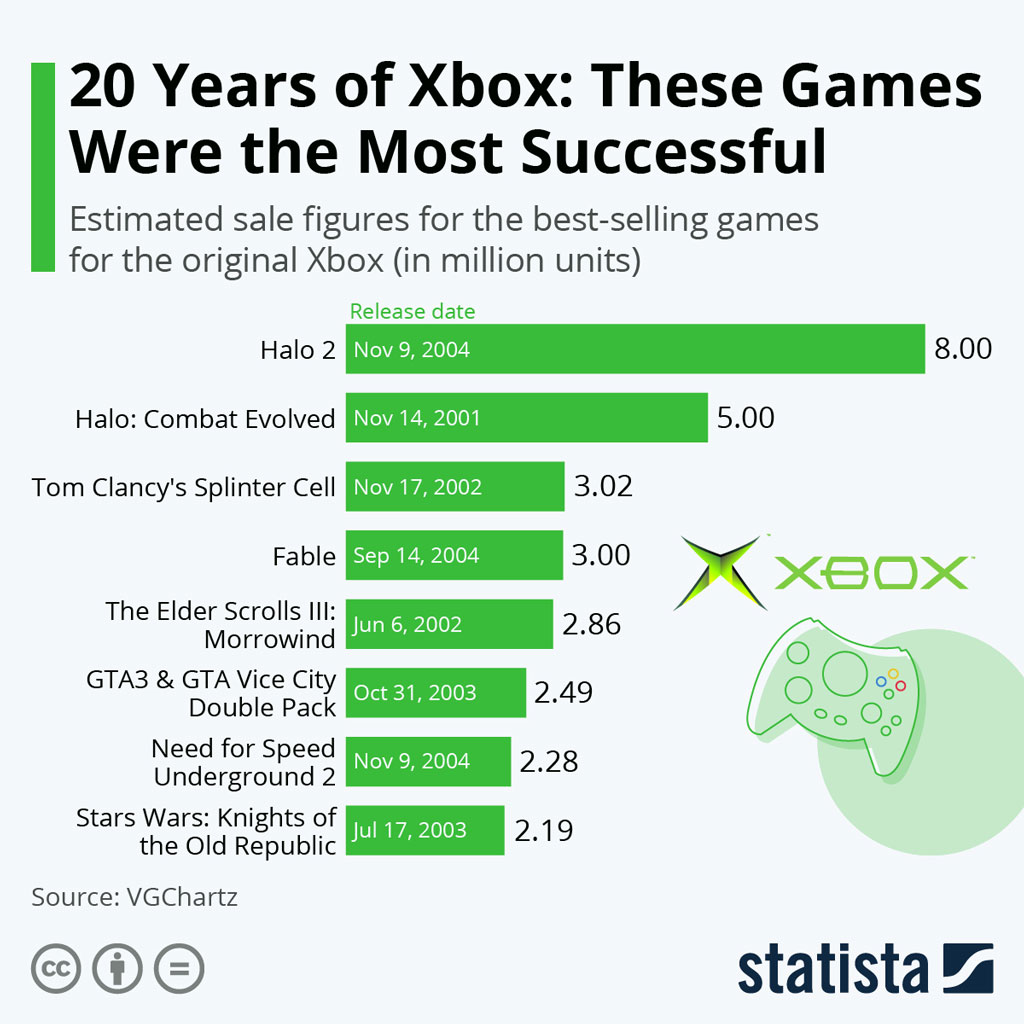
- Halo 2 dominates as the best-selling title with 8.00 million units sold, making it the most successful game on the original Xbox.
- The original Halo: Combat Evolved follows strongly with 5.00 million units, highlighting the massive popularity of the Halo franchise.
- A noticeable drop occurs after the top two, with Tom Clancy’s Splinter Cell selling 3.02 million units, securing the third position.
- Fable closely trails with 3.00 million units, showing strong demand for RPG titles on Xbox.
- The Elder Scrolls III: Morrowind reached 2.86 million units, reinforcing the appeal of open-world RPG experiences.
- Rockstar’s bundle, GTA 3 & GTA Vice City Double Pack, achieved 2.49 million units, reflecting the franchise’s cross-platform popularity.
- Racing genre presence is evident with Need for Speed: Underground 2, selling 2.28 million units.
- Star Wars: Knights of the Old Republic rounds out the list with 2.19 million units, proving the strength of licensed and story-driven RPGs.
- The top 2 games alone account for 13 million units, significantly outperforming the rest of the list.
- Most of the top-selling titles were released between 2002 and 2004, indicating the peak commercial period of the original Xbox lifecycle.
Xbox Player Retention and Growth Trends
- Xbox monthly active users reached 500 million in 2026, up 150% from 200 million in 2024.
- Game Pass users play 34% more hours than non-subscribers.
- Cross-platform games boost player retention by 25%.
- The Xbox ecosystem grew from ~200 million users in 2025 to 500 million in 2026.
- Cloud gaming hours from Game Pass subscribers rose 45% year-over-year.
- Ultimate tier accounts for 68% of Game Pass subscribers with high retention.
- Game Pass subscribers average 18 titles per year, up from 15 in 2023.
- Games on Game Pass Day One see 3.5x higher daily active users in the first 30 days.
- Xbox Cloud Gaming expanded to 29 countries, driving growth in emerging markets like India.
Future Outlook and Xbox Growth Projections
- The global gaming market is projected to exceed $250 billion by 2027, creating growth opportunities for Xbox.
- Cloud gaming is expected to grow at a CAGR of over 40% through 2030.
- Xbox plans to expand Game Pass to new regions and devices, including smart TVs.
- AI-driven game development tools will continue improving production efficiency and personalization.
- Subscription gaming could represent a major share of digital game revenue by 2030.
- Microsoft’s investment in studios and acquisitions strengthens its first-party content pipeline.
- Xbox cloud infrastructure will expand through Azure global data centers.
- Cross-platform gaming and ecosystem integration will remain key competitive differentiators.
Frequently Asked Questions (FAQs)
How many monthly active users does Xbox have in 2026?
Xbox has approximately 500 million monthly active users across its ecosystem.
How many subscribers does Xbox Game Pass currently have?
Xbox Game Pass has around 35–37 million subscribers as of 2025–2026.
What is Xbox’s annual gaming revenue?
Microsoft’s gaming division generated about $21.5 billion in annual revenue in FY2025.
How many Xbox Series X|S units have been sold globally?
Xbox Series X|S has sold approximately 33–35 million units worldwide.
How much revenue does Xbox Game Pass generate annually?
Xbox Game Pass generates nearly $5 billion in annual revenue, making it a major contributor to Xbox’s business.
Conclusion
Xbox continues to shift from a hardware-centric brand to a service-driven gaming ecosystem built on subscriptions, cloud gaming, and cross-platform access. The rise of Game Pass, steady user growth, and expanding cloud infrastructure show how Microsoft adapts to changing player expectations and digital consumption habits.
As competition intensifies with PlayStation and Nintendo, Xbox’s long-term advantage lies in its ecosystem strategy rather than console dominance alone. For US audiences and global markets alike, Xbox remains a key player shaping how games are distributed, played, and monetized.

Leave a comment
Have something to say about this article? Add your comment and start the discussion.