



Digital engagement continues to shift from desktops toward mobile devices as our primary window to the web. This ongoing transition affects everything from how consumers browse and shop online to how businesses prioritize digital strategy and allocate advertising budgets. For example, marketers now invest strongly in mobile-first website design to meet audiences where they spend the most time, and media platforms increasingly tailor video and social content for smaller screens.
Across enterprise environments, productivity tools are also adapting to hybrid work patterns that blend mobile and desktop use. Explore the full article below for the latest data comparing mobile vs. desktop usage trends across key metrics.
Editor’s Choice
- ~64.35% of global web traffic now comes from mobile devices as of mid‑2025, compared with about 35.96% from desktops.
- Mobile currently holds ~52–54% of the global device market share vs desktop’s ~46–48%.
- 15% of U.S. adults access the internet only via mobile devices.
- Mobile web traffic first surpassed desktop back in 2016 and continues to grow.
- In Africa and Asia, mobile traffic often exceeds 70% of total internet usage.
- Global smartphone adoption stands at roughly 53% of the world’s population.
- Daily average screen time on mobile often outstrips desktop usage by over 2 hours.
Recent Developments
- Mobile devices accounted for approximately 64.35% of all global web traffic in July 2025, up slightly from earlier in the year.
- Desktop devices made up the remaining ~35.96% of web traffic in late 2024.
- Mobile web traffic has stayed above 50% since early 2020, reinforcing long‑term dominance.
- The mobile share of web traffic increased from under 1% in 2009 to over 60% by 2025.
- Monthly mobile traffic growth consistently edges upward quarter over quarter.
- In 2025, mobile traffic growth outpaced desktop growth in most regions.
- New mobile technologies (5G expansion and app optimization) continue to attract traffic away from desktops.
- Desktop usage remains relevant for professional or productivity‑heavy tasks, even as mobile use rises.
Overview of Mobile vs Desktop Statistics
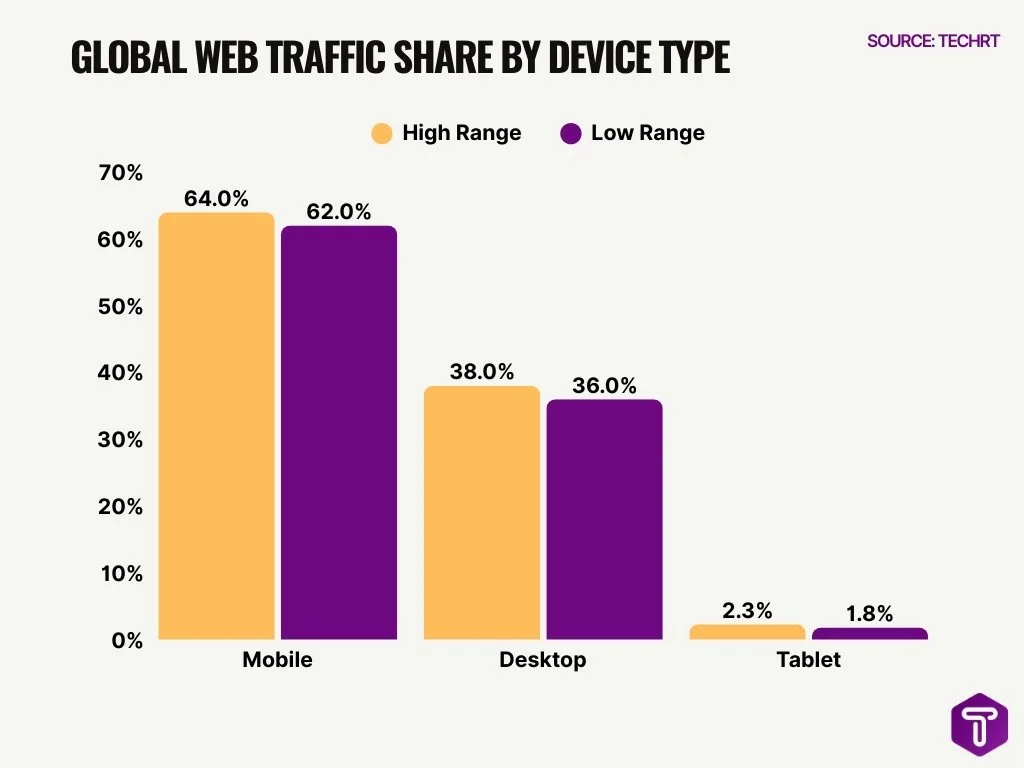
- As of mid‑2025, roughly 62–64% of web traffic worldwide comes from mobile devices.
- Desktop traffic accounts for about 36–38% globally.
- Tablet traffic remains minimal, around 1.8–2.3% of total web use.
- Around 15% of adults in the U.S. are mobile‑only internet users.
- Average global internet adoption reached approximately 74% of the world’s population by 2025.
- Smartphones dominate primary device counts, with 53% of people worldwide owning one.
- Desktop and laptop use continues to decline relative to mobile, especially in consumer browsing.
- Emerging markets show higher mobile dominance compared with developed countries.
Global Market Share: Mobile vs Desktop
- In November 2025, Statcounter reported mobile with ~52–54% market share versus desktop at ~46–48%.
- Global web traffic figures vary slightly by data provider, but all show mobile in the clear majority.
- Mobile web traffic in Africa often tops 70% of usage.
- Asia‑Pacific markets also seea strong mobile preference, often above 65%.
- Europe and North America show more balanced figures, but mobile still leads.
- In some regions like Canada and Japan, desktop use remains relatively robust.
- Across global web platforms, mobile continues to gain incremental share each year.
Web Traffic Share Between Mobile vs Desktop
- Mobile contributes ~64% of global internet traffic as of mid‑2025.
- Desktop traffic accounts for the remaining roughly 36%.
- Mobile web first surpassed desktop in total global traffic back in 2016.
- Traffic growth on mobile has increased significantly since the early 2010s.
- Within the U.S., mobile traffic was approximately 56–57% while desktop accounted for about 43–44%.
- Some regions like India and Nigeria show very high mobile traffic levels, exceeding 80–90%.
- Average global web traffic trends show mobile’s lead strengthening year over year.
- Even desktop‑heavy industries see rising mobile traffic across social and content platforms.
Mobile vs Desktop Average Time Spent on Websites
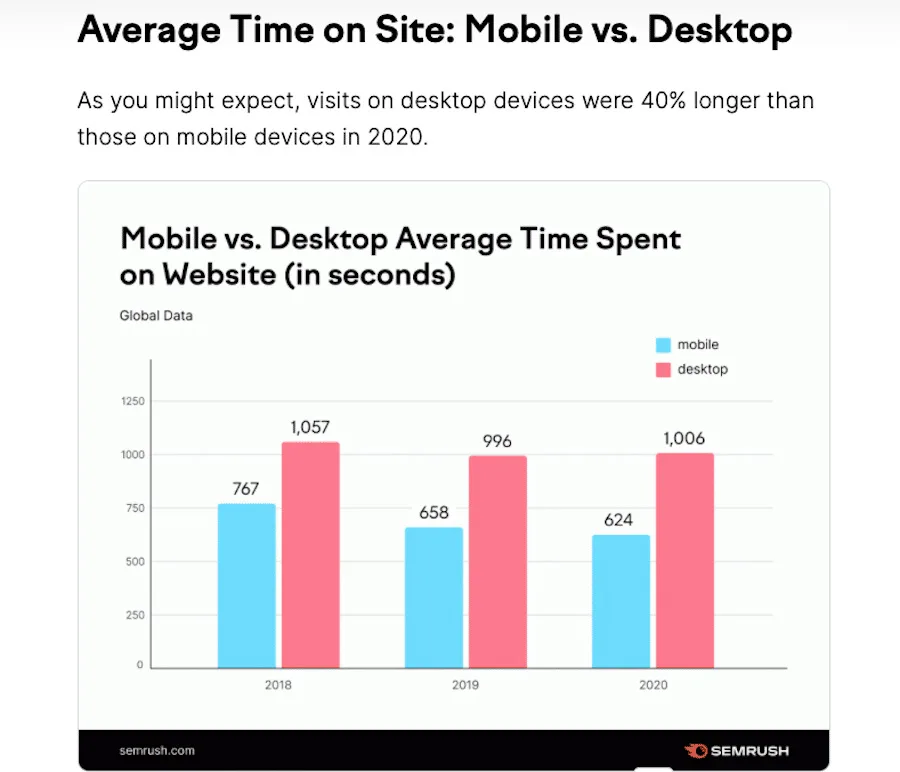
- Desktop users spent 1,057 seconds on websites in 2018, compared to 767 seconds for mobile users, highlighting significantly longer desktop engagement.
- In 2019, average mobile session duration dropped to 658 seconds, while desktop users still averaged a high 996 seconds per visit.
- By 2020, mobile time on site further declined to 624 seconds, whereas desktop usage remained strong at 1,006 seconds.
- Desktop visits were approximately 40% longer than mobile visits in 2020, reinforcing desktop’s advantage in sustained user engagement.
- Mobile website engagement showed a consistent downward trend from 2018 to 2020, while desktop engagement stayed relatively stable.
- Across all three years, desktop users spent 300–380 seconds more per session than mobile users, indicating deeper browsing behavior on desktop devices.
- The data suggests that content-heavy and research-driven activities are more likely to occur on desktop devices than on mobile.
User Demographics in Mobile vs Desktop Usage
- Approximately 15% of U.S. adults use mobile as their only internet access method.
- Younger age groups (18–34) globally prefer mobile devices for browsing 72% more than older brackets.
- Older demographics (55+) conduct 65% of product research and transactions on desktop devices.
- In many regions, urban users skew mobile-heavy, with 83% internet usage due to better connectivity.
- Desktop usage remains stronger among professional users (68%) in workplace contexts.
- Teenagers and college-age users spend 85% of their online time on mobile apps.
- Mobile internet adoption rises fastest (26% growth) in rural communities with affordable devices.
- Gender and age variances show that younger women and men are equally active on mobile (95%).
Conversion Rate Differences in Mobile vs Desktop
- Desktop eCommerce conversion rates average ~3.9%, significantly higher than mobile’s ~1.8–2.8%.
- Some benchmarks show desktop converting ~1.7× more effectively than mobile.
- On mobile, optimized experiences with speed and UX improvements can boost conversion up to ~3.3%.
- Mobile shoppers often browse longer but convert later or on desktop for final purchases.
- Desktop users typically exhibit higher purchase intent when engaging with full‑screen sites.
- Bounce rates on mobile are often higher than on desktop, affecting conversions negatively.
- Many brands report that mobile conversions increase with features like one‑tap checkout or saved payment info.
- Mobile conversion performance varies by industry, with retail and fast‑moving consumer goods showing stronger mobile results.
Ecommerce and Online Shopping Trends on Mobile vs Desktop
- Mobile now drives ~70.92% of global ecommerce traffic, dwarfing desktop at ~27%.
- On revenue, mobile brings in roughly ~59.9% globally, with desktops accounting for ~37.5%.
- In the U.S., ~75% of online retail visits originate from mobile devices.
- Mobile commerce is predicted to account for ~44% of total U.S. online sales by 2025.
- Mobile traffic dominance influences checkout behavior; many users start on mobile and complete on desktop.
- Cart abandonment rates remain high on mobile, often above 70% globally.
- Mobile apps now contribute significantly to transactions, especially through one‑tap wallets and streamlined flows.
- Retailers increasingly integrate social shopping features to blend browsing and purchase behavior on mobile.
Device Preference by Region: Mobile vs Desktop
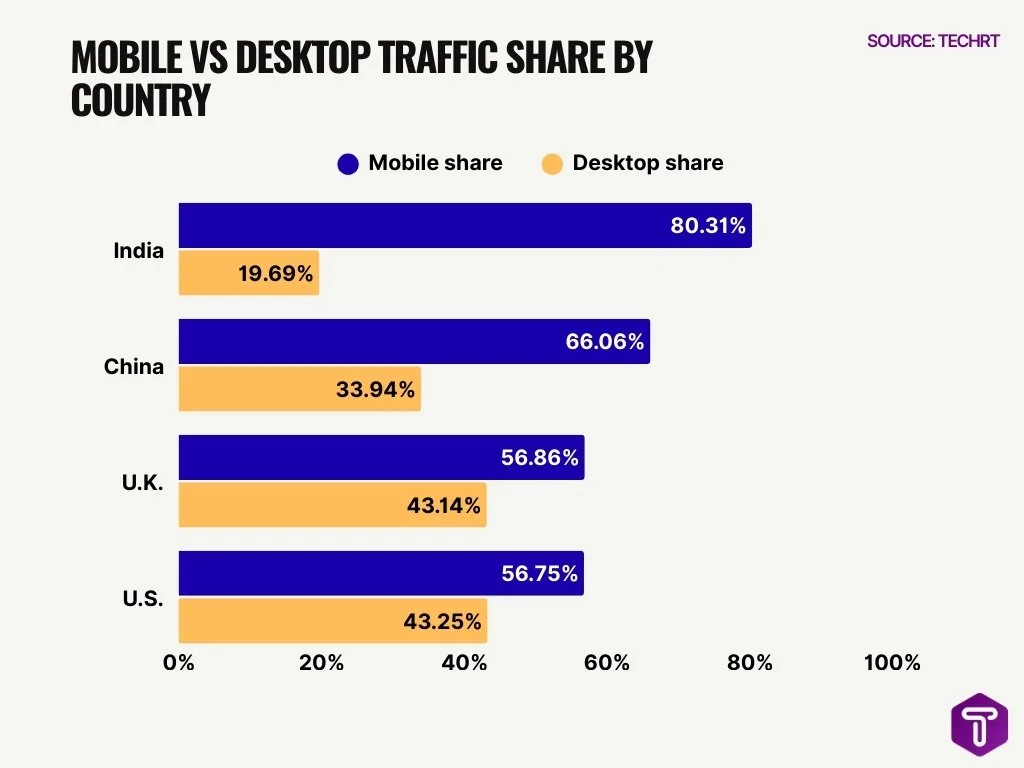
- In India, mobile devices generate ~80.31% of all internet traffic, with desktops at only ~19.69%.
- China shows mobile with ~66.06% web traffic share versus desktops at 33.94%.
- In the U.K., mobile contributes ~56.86% of traffic, desktops 43.14%.
- The U.S. splits more evenly, with mobile at 56.75% against 43.25% desktop usage.
- Japan uniquely leans toward desktops, with 55.77% of traffic coming from computers.
- Africa and many parts of Asia widely favor mobile, often above 70–75% of all usage.
- In Europe overall, mobile usage is strong but more balanced, often hovering around 50–55% vs desktop’s 40–45%.
- Emerging markets consistently show higher mobile preference, largely due to smartphone accessibility and lower desktop adoption.
Social Media Usage Patterns: Mobile vs Desktop
- In 2024, an estimated 93.7% of internet users go online via smartphones, while just 65.6% use laptops or desktops for any online activity, underscoring mobile‑first social engagement.
- Globally, mobile devices account for about 53.43% of all web traffic versus 45.25% for desktop, reflecting a clear tilt toward mobile access for social platforms.
- Around 70% of all US digital media time is spent in mobile apps, with only about 30% left for desktop and mobile web combined, highlighting app‑centric social usage.
- The typical social media user spends roughly 2 hours 23 minutes per day on social platforms on any device, with the majority of this time concentrated in mobile apps like TikTok and Instagram.
- TikTok’s Android app alone captures about 34 hours per month per user, meaning more than 1 hour daily of primarily mobile social engagement versus minimal desktop use.
- Smartphone owners use about 10 apps per day and 30 per month, and social media apps rank among the most used, pushing mobile social interactions far beyond desktop browsing sessions.
- As of mid‑2024, roughly 5.17 billion people use social media, and mobile‑optimized platforms like Instagram and TikTok dominate usage among these users compared with desktop‑heavy networks.
- In global screen‑time studies, users average about 3 hours and 30 minutes on mobile devices versus 3 hours and 34 minutes on computers daily, yet social apps capture a disproportionate share of that mobile time.
- TikTok, Instagram, and Snapchat together generated over 1.97 billion downloads in 2024, with usage overwhelmingly via their mobile apps rather than desktop interfaces.
Video and Streaming Consumption on Mobile vs Desktop
- Mobile devices now account for the large majority of video streaming viewership globally.
- Short‑form video, such as clips under 5 minutes, is primarily consumed on smartphones.
- Desktop video usage remains strong for longer, productivity, or work‑related content.
- Mobile viewers often stream during commutes and in breaks, adding to cumulative watch time.
- Platforms like YouTube report mobile’s dominance in daily watch sessions.
- Subscription streaming apps see higher mobile engagement in non‑home settings.
- Cross‑device behavior shows users start on mobile and sometimes switch to desktop for bigger screens.
App Usage vs Desktop Web Browsing
- Mobile apps account for 90% of mobile internet time vs 10% in browsers.
- 88% of mobile users spend more time in apps than in web browsers.
- Social media, messaging, and video apps drive over 75% of mobile data usage.
- Desktop users view 100% more pages per session than mobile users.
- Desktop sessions last 37.7% longer than mobile sessions for research tasks.
- 55% of banking customers prefer mobile apps over 22% using desktop web.
- Mobile apps convert at 157% higher rates than mobile web commerce.
- Desktop users average 11.4 tabs open for multi-tasking.
- App retention hits 32% at 90 days vs 20% for web apps.
- 52% of mobile web users bounce after one session vs lower desktop rates.
Mobile vs. Desktop Search Traffic Distribution
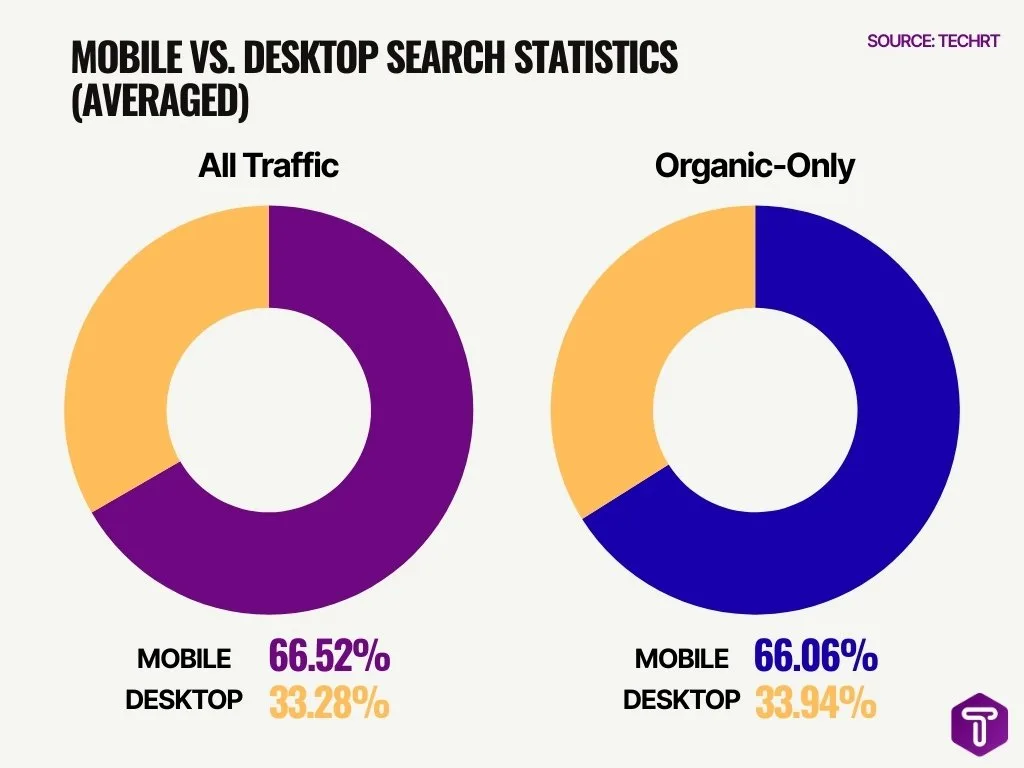
- Mobile search dominates overall traffic, accounting for 66.52% of all search visits, compared to 33.28% from desktop devices.
- In organic-only search traffic, mobile users still lead with 66.06%, while desktop contributes 33.94% of visits.
- The mobile share remains consistently above two-thirds, showing a strong preference for mobile search across traffic types.
- Desktop search maintains a stable one-third share, proving it continues to be relevant despite mobile growth.
- The difference between all traffic and organic-only traffic is minimal, with mobile varying by just 0.46 percentage points, indicating consistent user behavior.
- Organic search does not significantly change device usage patterns, reinforcing that mobile-first optimization is critical for search visibility.
- These figures highlight why search strategies must prioritize mobile experience, while still supporting desktop performance.
Bounce Rate Analysis in Mobile vs Desktop Traffic
- Average mobile bounce rates tend to be higher than desktop, often around 54.3% vs 42.8%, respectively.
- Data shows mobile bounce can exceed desktop by roughly 10–12 percentage points.
- Higher mobile bounce often correlates with slower load times and UX friction.
- Desktop sessions tend to be longer and deeper, lowering bounce rates.
- Optimized mobile sites can reduce bounce rates, with responsive design showing ~22% improvement.
- Fast‑loading mobile pages often see reduced exits and improved engagement.
- Content‑heavy sites like blogs and research portals retain users longer on desktop.
- Bounce disparities can vary significantly by industry and user intent.
Email and Productivity Tool Usage: Mobile vs Desktop
- Around 46–50% of all email opens now occur on mobile, while roughly 33% happen on desktop, making mobile the leading email channel.
- Mobile users spend about 3.5 minutes per average session, favoring quick checks of email and notifications, compared with longer, more focused desktop sessions.
- Studies show users rate activities on desktop/laptop as more important and complex, turning to larger screens for in‑depth work like reports and spreadsheets.
- Productivity platforms such as Teams and Slack still see about 70% of their usage on desktop, despite strong mobile apps, highlighting the desktop’s role in heavy collaboration tasks.
- Mobile accounts for more than half of global web traffic, reinforcing its role in on‑the‑go email checks and light productivity tasks.
- In surveys, 68% of office workers report preferring desktops for complex professional tasks like data analysis and large document editing.
- Users spend about 87% of their mobile time inside apps, boosting engagement with mobile email, calendar, and task tools throughout the day.
- Desktop sessions average about 3 minutes 46 seconds versus 2 minutes 19 seconds on mobile, aligning desktops with longer reading and editing of email and documents.
- Mobile click‑to‑open rates in email are roughly 30% higher than desktop, reflecting faster interaction with messages and alerts on phones.
Performance, Speed, and Core Web Vitals for Mobile vs Desktop
- Mobile pages often load longer than desktop, with averages around 8.6s vs ~2.5s.
- Slow mobile load times frequently hurt engagement and conversions.
- Only about 43.4% of mobile sites meet Core Web Vitals metrics compared with more desktop sites.
- Average mobile performance lags in Largest Contentful Paint (LCP) scores vs desktop.
- User experience metrics such as INP and CLS are key to search ranking and retention.
- Faster mobile pages see lower bounce rates and higher conversions.
- Desktop pages generally show more stable loading and UI responsiveness.
- Performance optimization remains crucial as more web engagement shifts to mobile.
Global Devices Used to Access the Internet
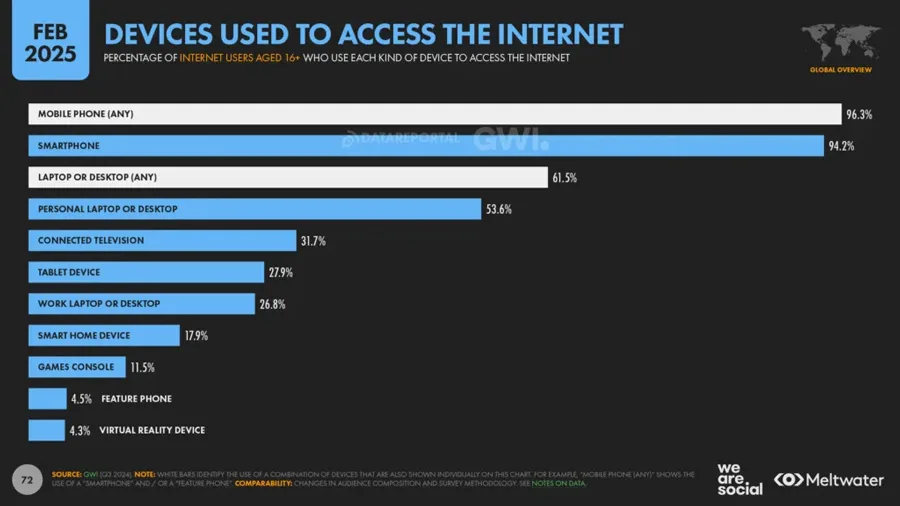
- Mobile phones dominate internet access, with 96.3% of global users aged 16+ using a mobile phone (any type) to go online, confirming mobile-first behavior worldwide.
- Smartphones alone account for 94.2% usage, highlighting that nearly all mobile internet activity is driven by smartphone adoption.
- Laptops and desktops remain highly relevant, with 61.5% of users accessing the internet via any laptop or desktop, supporting continued demand for larger-screen devices.
- Personal laptops and desktops are used by 53.6% of users, indicating strong reliance on home-based computing for browsing, work, and content consumption.
- Connected televisions reach 31.7% of internet users, showing rapid growth in big-screen internet usage for streaming and digital entertainment.
- Tablets are used by 27.9% of users, positioning them as a secondary but consistent internet access device globally.
- Work laptops and desktops account for 26.8% usage, reflecting the sustained impact of remote and hybrid work environments.
- Smart home devices are used by 17.9% of users, underscoring the expansion of IoT-powered internet interactions beyond traditional screens.
- Gaming consoles connect 11.5% of users to the internet, highlighting their role in entertainment-focused online activity.
- Feature phones still contribute 4.5%, demonstrating that basic mobile devices remain relevant in certain regions and demographics.
- Virtual reality devices are used by 4.3% of users, indicating that immersive internet access is emerging but still niche in 2025.
Security and Privacy Behavior in Mobile vs Desktop Environments
- Mobile security features like biometric locks and app sandboxing enhance user protection.
- Desktop environments rely more on software firewalls and antivirus tools for safety.
- Users on both platforms exhibit cautious behavior with sensitive tasks like banking.
- Mobile OS updates frequently include improved permissions and app‑level privacy features.
- Desktop browsers support extensions for privacy and ad‑blocking.
- Phishing and social engineering remain common threats across devices.
- Mobile apps regularly ask for location and permission consent, influencing privacy behavior.
- Corporate environments often enforce device‑specific security protocols.
Historical Trends in Mobile vs Desktop Usage
- Desktop dominated web traffic in the early years, with 99.3% in 2009, and mobile only 0.7%.
- By 2016, mobile traffic had overtaken desktop globally for the first time.
- In 2023–2024, mobile share consistently stayed above 55–60% of global traffic.
- Desktop share declined gradually from the 90s in the 2010s to below 40% by 2025.
- Smartphone adoption rose sharply alongside affordable networks in the 2010s.
- App ecosystems fueled mobile engagement and replaced many desktop tasks.
- Desktop usage remains important for work and productivity, but at lower traffic shares.
- Historical momentum continues pushing toward mobile-first design and access.
Future Outlook for Mobile vs Desktop Adoption
- As of July 2025, mobile accounts for 64.35% of global web traffic, while desktop has fallen to 35.96%, reinforcing a long‑term shift toward mobile‑first adoption.
- Global mobile devices already drive about 60.5% of web browsing versus 39.5% for desktops, and this mobile dominance has persisted since at least 2023.
- Mobile internet users in APAC are projected to grow from 1.4 billion (51% penetration) in 2023 to 1.8 billion (61% penetration) by 2030, deepening mobile‑centric behavior.
- 5G networks are expected to carry about 80% of total mobile data traffic by 2030, up from 34% in 2024, sharply boosting mobile performance and responsiveness.
- Global 5G subscriptions are forecast to reach 6.3 billion by 2030, representing roughly one‑third of all mobile subscriptions by 2025 and enabling richer mobile workflows.
- In India, mobile already generates about 80.31% of all internet traffic compared with 19.69% for desktop, illustrating how emerging markets leapfrog directly to mobile.
- In Europe, traffic share has converged to 52.8% mobile and 44.9% desktop, showing that desktops still retain a substantial role for professional and specialized tasks.
- Mobile data traffic in the Asia Pacific is expected to quadruple between 2023 and 2030, driven by data‑intensive content, 5G, and expanding app ecosystems.
- As of November 2024, mobile devices drive 64.04% of global internet traffic versus 35.96% from desktops, a reversal from 2013 when desktops held 72.6% of traffic.
- From Q1 2009 to Q3 2025, mobile web traffic jumped from 0.72% to 64.35%, while desktop traffic shrank from 99.28% to 35.96%, underscoring a long‑term structural shift in device adoption.
Frequently Asked Questions (FAQs)
What percentage of global web traffic comes from mobile devices in 2025?
What share of global ecommerce traffic is generated by mobile devices?
How much of global ecommerce revenue is attributed to mobile purchases?
What portion of U.S. online shopping traffic comes from mobile devices?
What percentage of internet users in India access ecommerce via mobile compared to desktop?
Conclusion
The data shows mobile usage has firmly established itself as the global leader in internet access, app engagement, and everyday interactions, while desktop remains indispensable for complex work and deep browsing. Across bounce rates, performance metrics, and security behaviors, each platform presents strengths that inform digital strategy and user experience decisions.
As performance standards rise and hybrid workflows expand, the future will be shaped by a complementary balance of mobile convenience and desktop precision. Understanding these evolving trends equips businesses and users alike to make informed decisions in a landscape defined by both agility and depth.

Leave a comment
Have something to say about this article? Add your comment and start the discussion.