


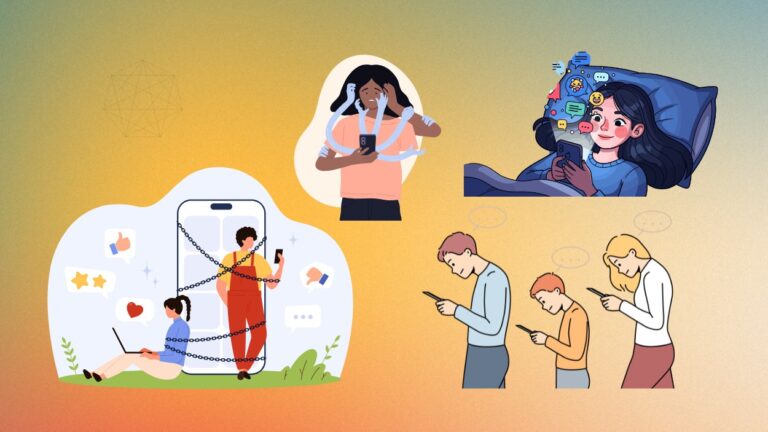

Social media has become a daily habit for billions of people, but the line between regular use and addictive behavior continues to blur. Platforms designed for engagement, such as short-form video feeds and endless scrolling, can keep users online for hours, affecting productivity, mental health, and sleep patterns. Businesses also feel the impact; marketers depend on these platforms for outreach, while employers and educators increasingly report productivity losses linked to excessive use. The statistics below reveal how widespread social media addiction has become and what it means for individuals, organizations, and society.
Editor’s Choice
- Around 210 million people worldwide are estimated to be addicted to social media as of 2025.
- Approximately 33.19 million Americans, or about 10% of the U.S. population, show signs of social media addiction.
- Globally, about 5.24 billion people actively use social media, representing nearly 63.9% of the world’s population.
- The average person spends roughly 2 hours and 21 minutes per day on social media platforms.
- Nearly 30% of American adults say they feel addicted to social media.
- About 47% of teenagers report feeling addicted to social media, highlighting a strong youth trend.
- Among young adults aged 18–22 in the U.S., roughly 40% show signs of social media addiction.
- Studies estimate 4–5% of all social media users globally meet the criteria for addiction.
Recent Developments
- In 2026, several lawsuits in the United States accused major platforms of designing addictive features such as infinite scroll and autoplay.
- A 2025 study tracking adolescents found nearly one-third showed increasing addictive screen use patterns over several years.
- Australia implemented a 2025 ban on social media for users under 16, with penalties for platforms that fail to enforce age restrictions.
- Despite restrictions, over 20% of Australian teens aged 13–15 still accessed platforms like TikTok and Snapchat after the ban.
- The number of global social media users surpassed 5 billion in 2024–2025, increasing the risk of problematic use worldwide.
- Researchers now classify problematic social media behavior as a behavioral addiction, similar to gaming disorder.
- Platforms like TikTok have introduced digital well-being tools, including screen-time reminders and usage limits, to address addiction concerns.
- Governments in multiple countries are evaluating algorithm transparency regulations to limit addictive design patterns.
Social Media Addiction Overview
- Social media addiction affects about 210 million people globally, making it one of the fastest-growing behavioral addictions.
- Approximately 4.69% of all social media users worldwide struggle with addictive usage patterns.
- The global number of social media users reached over 5.24 billion in 2025, dramatically increasing exposure to addictive platforms.
- Research shows 5–10% of users exhibit behavioral addiction symptoms, such as cravings or loss of control over usage.
- Many experts link addiction risks to algorithm-driven content feeds that reward frequent engagement.
- Roughly 38% of users say they cannot go a few hours without checking social media.
- Younger demographics show the highest addiction rates, particularly Gen Z and young millennials.
- Behavioral studies indicate addiction correlates with fear of missing out (FOMO) and peer pressure.
Global Social Media Addiction by Country
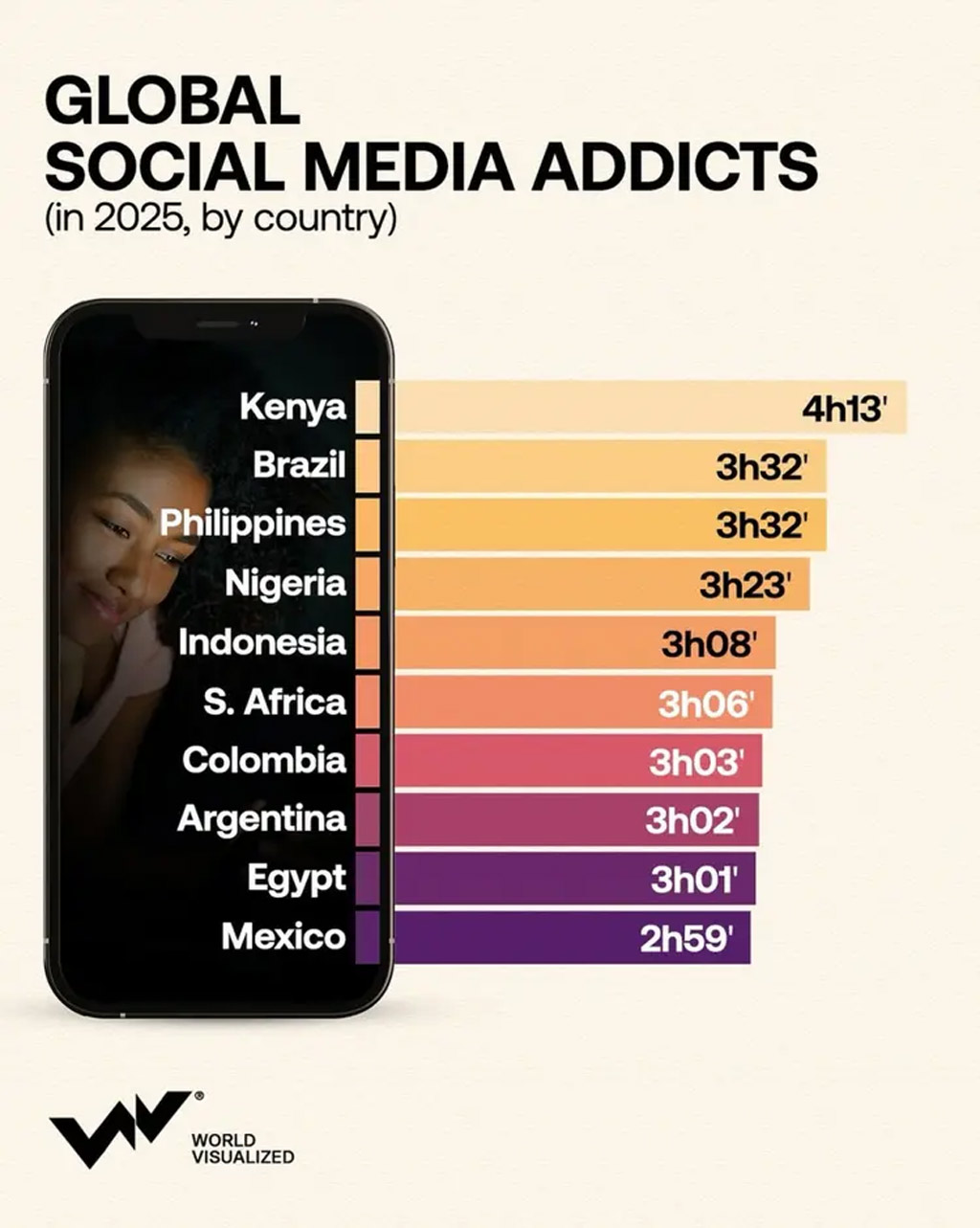
- Kenya ranks first globally, with users spending an average of 4 hours 13 minutes per day on social media, making it the highest social media usage among the listed countries.
- Brazil and the Philippines share the second spot, where users spend 3 hours 32 minutes daily on social platforms.
- Nigeria follows closely, with an average of 3 hours 23 minutes per day, highlighting strong social media engagement in West Africa.
- Indonesia ranks fifth, with users spending around 3 hours 8 minutes daily, reflecting high mobile and social media penetration in Southeast Asia.
- South Africa records about 3 hours and 6 minutes per day, placing it sixth among the countries with the highest social media usage.
- Colombia and Argentina show similar engagement, with 3 hours 3 minutes and 3 hours 2 minutes per day, respectively.
- Egypt averages 3 hours 1 minute daily, indicating high social media adoption across North Africa and the Middle East.
- Mexico rounds out the top 10, where users spend 2 hours 59 minutes per day on social media.
- Notably, 9 out of the 10 countries listed exceed 3 hours of daily social media usage, signaling widespread digital engagement and potential social media dependency trends.
- The data also shows that emerging markets dominate the list, suggesting higher mobile-first internet usage and social platform reliance in developing economies.
Global Prevalence of Social Media Addiction
- Meta-analyses estimate 18.4% of students worldwide experience social media addiction symptoms.
- Asia shows the highest prevalence rate at 22.8% among students in some studies.
- Global social media adoption has reached over 63% of the world’s population, increasing addiction exposure.
- Research suggests 5–20% of teenagers globally show signs of social media addiction, depending on the diagnostic criteria used.
- In certain regional studies, 24.4% of adolescents were classified as social media addicts.
- Approximately 90% of millennials and 95% of Gen Z use at least one social media platform, increasing the risk of habitual use.
- Around 36% of teens admit they spend too much time on social media.
- The global average social media usage time exceeds 2.5 hours daily, reflecting widespread digital dependence.
Social Media Addiction by Age Group
- Gen Z shows the highest dependency, with 82% saying they feel addicted to social media.
- Nearly 90% of people aged 18–29 use social media, making them the most active demographic group.
- About 40% of Americans aged 18–22 show signs of social media addiction.
- Children aged 8–12 spend around 4–6 hours per day on screens, often including social media.
- Teenagers average up to 9 hours of screen time daily, excluding schoolwork.
- 46% of U.S. teens say they are online almost constantly.
- Around 36% of teens report spending too much time on social media, acknowledging problematic use.
- Young adults aged 23–38 report about 15% admitted addiction rates.
Social Media Addiction by Gender
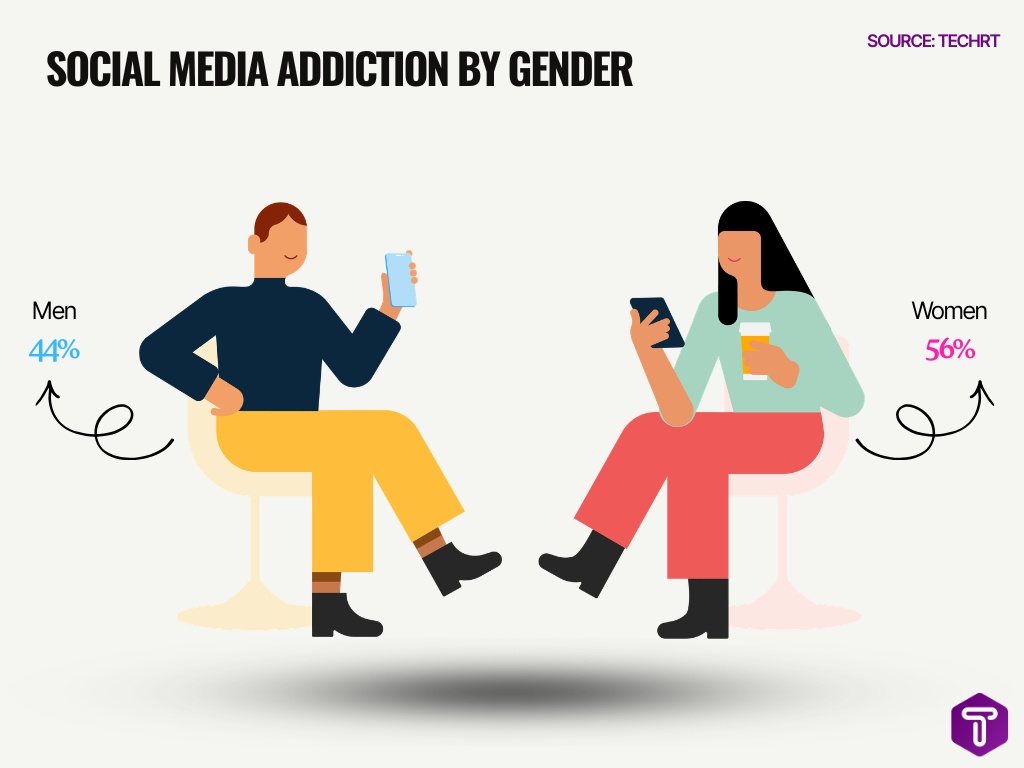
- Studies show women report slightly higher social media addiction rates (around 56%) compared to men at 44% in global behavioral surveys.
- A global meta-analysis found female students were 1.3 times more likely to develop problematic social media use than male students.
- In the United States, 34% of women say they feel addicted to social media, compared with about 26% of men.
- Surveys indicate young women aged 18–29 spend about 30 minutes more per day on social platforms than men in the same age group.
- Research suggests men are more likely to develop addiction related to online gaming communities, while women show higher dependency on image-based platforms.
- A university behavioral study found 23% of female college students displayed high social media addiction scores, compared with 15% of male students.
- Women are also more likely to experience emotional distress tied to social media interactions, which correlates with compulsive checking behavior.
- Globally, female adolescents report higher levels of FOMO (fear of missing out), which strongly predicts social media addiction risk.
Social Media Addiction Among Teens and Young Adults
- Approximately 47% of teenagers say they feel addicted to social media, according to recent youth surveys.
- About 46% of U.S. teens report being online almost constantly, indicating persistent digital engagement.
- Teenagers spend an average of 4.8 hours per day on social media alone, excluding other screen activities.
- Studies show one in five adolescents exhibits problematic social media behavior consistent with addiction symptoms.
- Among U.S. young adults aged 18–24, roughly 71% say they check social media multiple times per hour.
- Around 32% of teenagers say they feel anxious if they cannot access social media, demonstrating psychological dependence.
- Research indicates that early smartphone ownership before age 13 significantly increases the risk of social media addiction later in adolescence.
- Surveys reveal 60% of teens say social media notifications distract them during schoolwork.
- Globally, Gen Z users spend the most time on social media compared with any other generation.
Social Media Addiction Among College and University Students
- Meta-analysis studies estimate 18.4% of university students worldwide experience social media addiction.
- In the United States, about 40% of college students report problematic social media use affecting academic focus.
- Surveys show 70% of college students check social media immediately after waking up.
- Research from multiple universities indicates that students spend an average of 3–4 hours daily on social platforms.
- About 55% of college students admit that social media distracts them during lectures or study sessions.
- In certain regional studies, over 30% of university students showed moderate to severe addiction symptoms.
- Behavioral studies link high social media use among students to reduced GPA scores and lower academic performance.
- Approximately 75% of students report using social media primarily for entertainment rather than academic collaboration.
Key Insights: Social Media Dependency Among 18–24-Year-Olds
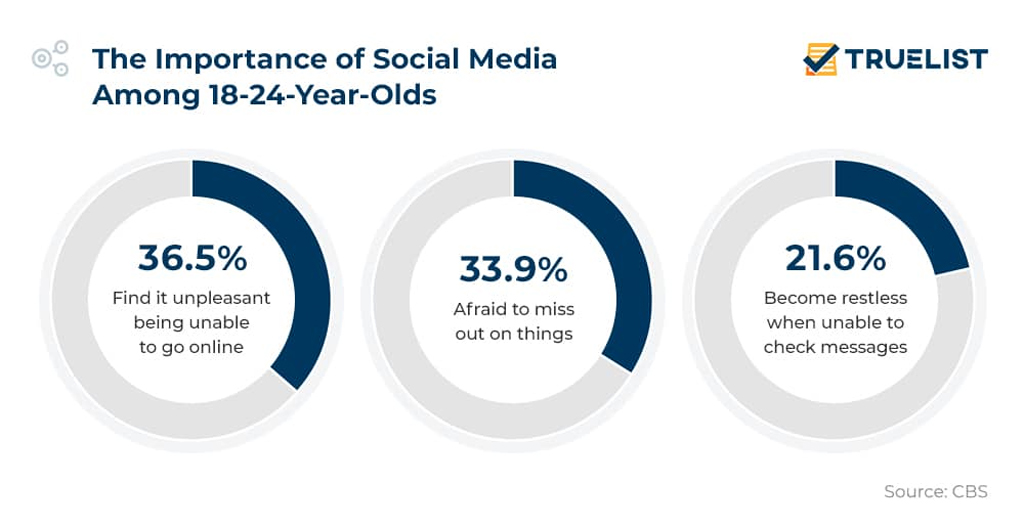
- 36.5% of young adults aged 18–24 say they find it unpleasant when they are unable to go online, indicating a strong emotional reliance on internet connectivity and social platforms.
- Around 33.9% of respondents report feeling afraid of missing out (FOMO) when they are not active online, highlighting how social media influences their sense of participation in social events and trends.
- Approximately 21.6% of young users say they become restless when they cannot check their messages, suggesting habitual checking behavior and constant engagement with social apps.
- The data shows that over one-third of young adults experience discomfort or anxiety when disconnected from the internet, reinforcing the growing role of social media in daily routines and social validation.
- Compared to other behaviors, FOMO (33.9%) is nearly as common as the discomfort of being offline (36.5%), indicating that social awareness and staying updated are key drivers of social media usage among young people.
- Even though a smaller share (21.6%) reports restlessness without checking messages, the statistic still represents more than one in five young adults, emphasizing how messaging and notifications contribute to social media dependency.
Time Spent on Social Media Daily
- The global average user spends about 2 hours and 21 minutes per day on social media.
- U.S. users spend roughly 2 hours and 16 minutes daily on social platforms.
- In some countries, such as Brazil and the Philippines, average daily usage exceeds 3.5 hours per day.
- Teenagers in the United States spend 4.8 hours per day on social media apps alone.
- About 30% of internet users globally spend more than 3 hours daily on social media.
- Gen Z users spend the most time online, averaging nearly 4 hours per day on social platforms.
- Research suggests heavy users may check social media over 150 times per day.
- Around 40% of users say social media is the first thing they check after waking up.
Frequency and Compulsivity of Social Media Use
- About 38% of users say they check social media every few minutes.
- Surveys show 71% of young adults check social media multiple times per hour.
- Behavioral research indicates many heavy users unlock their phones more than 80 times daily, often to access social media apps.
- Nearly 36% of teens admit they spend too much time scrolling social media feeds.
- Studies show push notifications significantly increase compulsive checking behavior, often interrupting work or school activities.
- Approximately 45% of users say they feel the urge to check social media even when they are busy with other tasks.
- Research indicates that problematic users often feel anxious when they cannot access social media for extended periods.
- A behavioral study found that over 50% of users check social media within five minutes of receiving a notification.
Social Media Addiction by Platform Among Teens
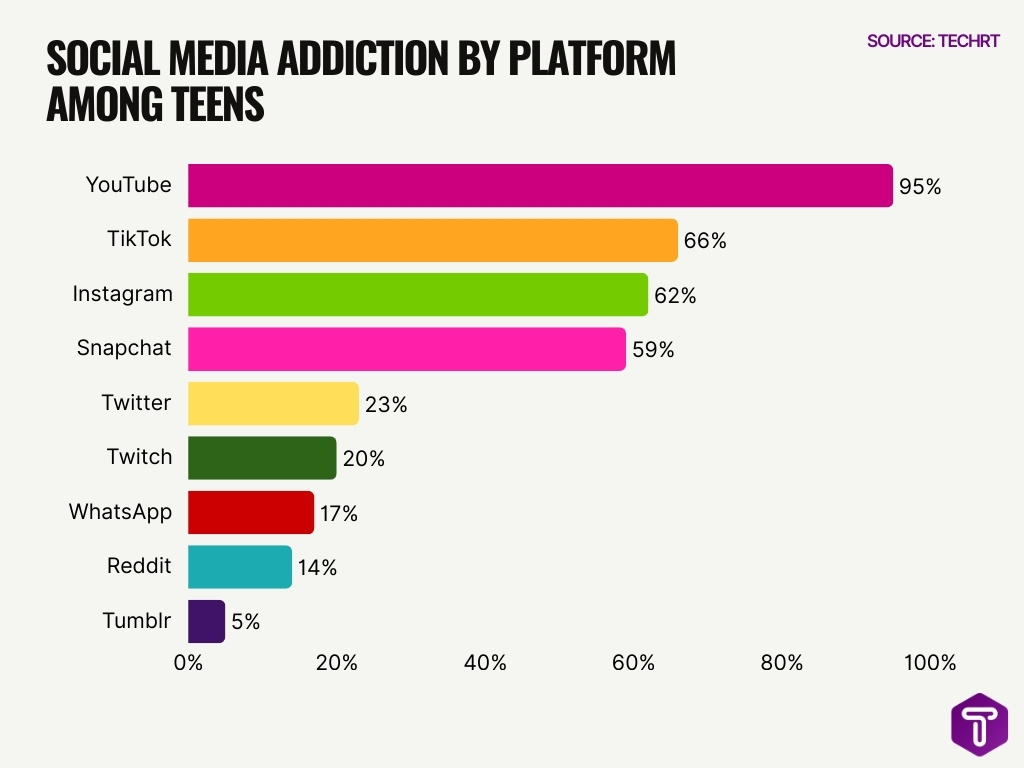
- YouTube is the most widely used platform among teenagers, with 95% of teens reporting usage, making it the dominant platform in teen social media consumption.
- TikTok ranks second, with 66% of teens using the platform, highlighting its strong appeal due to short-form video content and highly engaging algorithms.
- Instagram follows closely, with 62% of teens using it, driven by features like Reels, Stories, and influencer content.
- Snapchat is used by 59% of teens, maintaining popularity due to its private messaging, disappearing content, and streak features.
- Twitter (now part of X (Twitter)) has a significantly lower teen user share, with 23% of teens using the platform.
- Twitch, the live-streaming platform owned by Amazon, is used by 20% of teens, largely for gaming streams and esports content.
- WhatsApp, owned by Meta Platforms, is used by 17% of teens, primarily for private messaging and group chats.
- Reddit attracts 14% of teen users, largely for community discussions, niche interests, and topic-based forums.
- Tumblr has the lowest teen usage in the dataset, with only 5% of teens using the platform.
- Overall, the data shows that video-centric platforms dominate teen engagement, with YouTube, TikTok, and Instagram accounting for the highest usage rates among younger audiences.
Psychological Effects of Social Media Addiction
- Research indicates that up to 32% of heavy social media users report symptoms of anxiety or depression linked to platform usage.
- A meta-analysis found problematic social media use increases the risk of depression by roughly 13–20% among adolescents.
- Around 41% of young adults say social media negatively affects their mental health, especially when comparing themselves to others.
- Studies show fear of missing out (FOMO) affects nearly 56% of frequent social media users, driving compulsive engagement.
- Research suggests excessive scrolling and algorithmic content exposure may increase stress levels and emotional fatigue.
- Surveys report that about 37% of users feel overwhelmed by the amount of information and content on social platforms.
- Approximately 25% of adolescents report feeling worse about their lives after browsing social media feeds.
- Mental health researchers estimate nearly one in five teenagers experiences psychological distress linked to social media habits.
Impact on Self-Esteem and Body Image
- Surveys reveal 35% of teenage girls say social media harms their body image, particularly on image-based platforms.
- About 40% of young adults report comparing their appearance to others on social media, which can reduce self-esteem.
- Research shows that exposure to edited or filtered images significantly increases body dissatisfaction among adolescents.
- Approximately 30% of social media users say online comparisons negatively affect their confidence.
- Studies suggest that teen girls who spend more than three hours per day on social media are twice as likely to report poor mental health.
- Surveys indicate that around 45% of users feel pressure to present a perfect life online, which contributes to emotional stress.
- Behavioral research found that heavy Instagram usage correlates with higher levels of body dissatisfaction among young adults.
- Globally, nearly 50% of teenagers say social media influences their perception of beauty standards.
Social Media’s Negative Impact on Teen Sleep and Mental Health
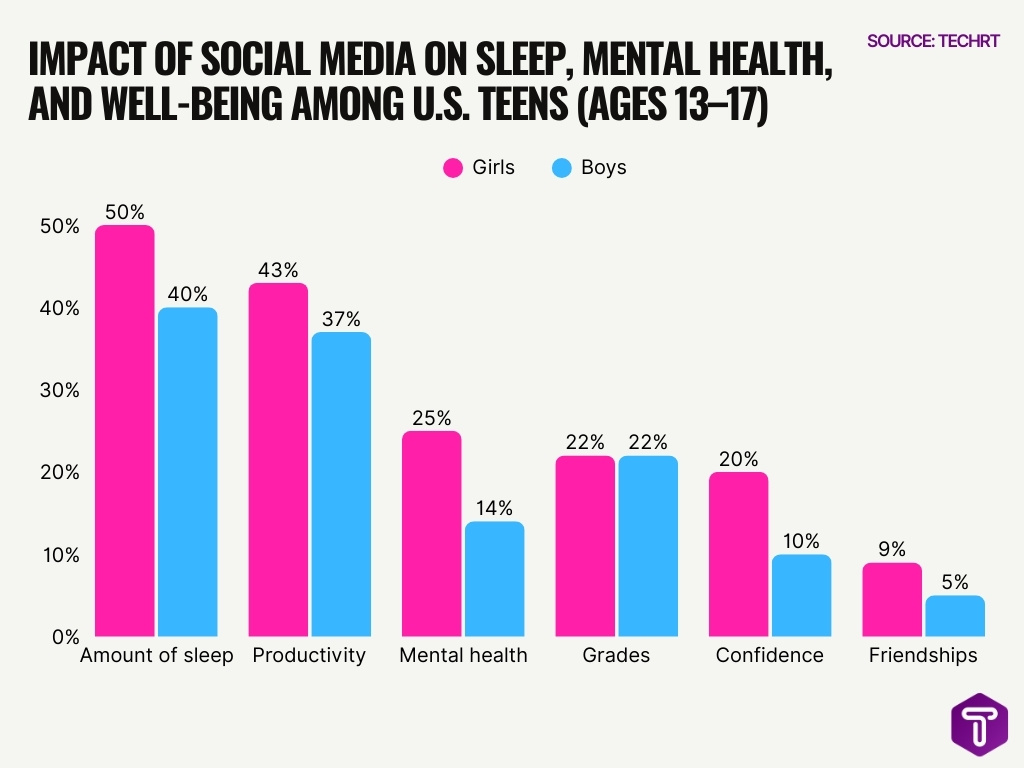
- Half of teenage girls (50%) report that social media reduces the amount of sleep they get, compared to 40% of boys, making sleep disruption the most commonly reported negative effect.
- Productivity is the second-most affected area, with 43% of girls and 37% of boys saying social media use hurts their ability to stay productive.
- Social media appears to have a significantly stronger mental health impact on girls, with 25% of girls reporting harm compared to 14% of boys.
- When it comes to academic performance, both genders report equal impact, as 22% of girls and 22% of boys say social media negatively affects their grades.
- Confidence levels are twice as likely to be affected among girls, with 20% of girls reporting lower confidence due to social media compared to 10% of boys.
- Social media also impacts friendships and relationships, though at lower rates, with 9% of girls and 5% of boys saying their friendships suffer because of social media use.
- Overall, the data show that teen girls consistently report higher negative effects across most categories, highlighting a gender gap in how social media impacts well-being and mental health.
Impact on Productivity, Work, and Academic Performance
- 70% of employees say productivity would improve if social media were restricted at work.
- Employees spend at least 1 hour daily on social media during work hours.
- Companies lose $650 billion annually due to workplace social media distractions.
- It takes employees an average of 23 minutes to refocus after social media distractions.
- 88% of employees browse social media while at work.
- 18% of workers check social media more than 10 times per day at work.
- 60% of students report that social media negatively affects study concentration.
- Students checking social media over 5 times daily are 35% more likely to have lower grades.
- 33% of employees admit to spending at least 1 hour daily on social media at work.
Social Media Detox and Digital Wellbeing Trends
- Surveys show that about 47% of social media users have attempted a digital detox at least once.
- Around 34% of users say they actively track their screen time using built-in digital wellbeing tools.
- Studies report that people who take a one-week social media break experience measurable improvements in mood and stress levels.
- Major platforms have introduced screen-time reminders and daily usage limits to address addiction concerns.
- Surveys show 28% of Gen Z users say they plan to reduce their social media usage in the next year.
- Approximately 22% of users report deleting social media apps temporarily to improve productivity or mental health.
- Digital well-being initiatives in workplaces have grown, with many companies encouraging employees to limit personal social media use during work hours.
- Health experts recommend screen-free hours before sleep as one of the most effective strategies for reducing addiction.
Key Reasons Why People Use Social Media
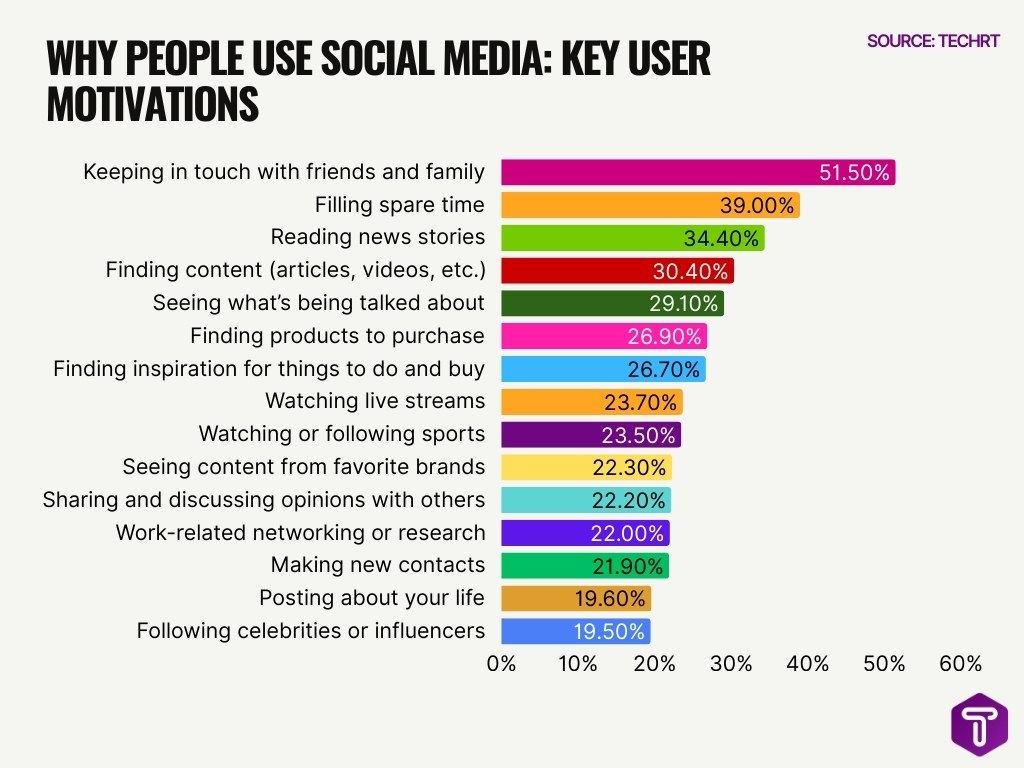
- The most common reason people use social media is keeping in touch with friends and family, cited by 51.5% of users, making it the top motivation globally.
- 39% of users say they use social platforms mainly for filling spare time, highlighting social media’s role as a major source of entertainment and casual browsing.
- 34.4% of users rely on social media for reading news stories, showing how platforms increasingly function as informal news distribution channels.
- Around 30.4% of users use social media to discover content such as articles and videos, indicating its role as a content discovery engine.
- 29.1% of users use social media to see what people are talking about, reflecting the platforms’ role in tracking trends and public conversations.
- Social commerce is growing, with 26.9% of users using social media for finding products to purchase.
- Similarly, 26.7% of users look to social media for inspiration on things to do or buy, highlighting its influence on consumer decision-making.
- 23.7% of users watch live streams, showing the rising popularity of real-time content and creator-driven broadcasts.
- Sports engagement is another key activity, as 23.5% of users use social media to watch or follow sports content.
- 22.3% of users follow content from their favorite brands, indicating the growing importance of brand presence on social platforms.
- 22.2% of users use social media for sharing and discussing opinions, making platforms important spaces for public discussion and debate.
- Professional purposes are also notable, with 22% of users using social media for work-related networking or research.
- 21.9% of users use social platforms for making new contacts, demonstrating the platforms’ role in social networking and relationship building.
- 19.6% of users actively post updates about their lives, contributing to the user-generated content ecosystem.
- Finally, 19.5% of users use social media to follow celebrities or influencers, highlighting the continued impact of the creator and influencer economy.
Government and Policy Responses to Social Media Addiction
- In 2025, Australia’s under‑16 social media law threatened platforms with fines up to A$49.5 million for serious or repeated violations to curb youth addiction.
- By early 2025, at least 5+ U.S. states had passed or enacted age‑verification laws requiring parental consent for minors’ social media accounts.
- Under the EU Digital Services Act, very large platforms serving over 45 million users in the EU must explain their recommender algorithms and offer less personalized feeds.
- In 2026, EU regulators found that TikTok’s infinite scroll, autoplay, and recommender system formed an “addictive design” breaching online‑safety rules for minors.
- A 2025 UNESCO/UN report noted that at least 79 education systems worldwide now restrict or ban smartphones in schools to reduce distraction and problematic use.
- In the U.S., 20 of 50 states had classroom smartphone regulations by 2025, including “phone‑free school” laws in major states.
- WHO Europe data show problematic social media use among adolescents rose from 7% in 2018 to 11% in 2022, prompting stronger public‑health policy interest.
- The WHO also reports that around 12% of adolescents are at risk of problematic gaming, reinforcing calls to regulate digital addictive behaviors together.
- A 2013–2023 review found 76.3% of digital mental‑health studies were published after 2019, reflecting a surge in research funding for youth digital wellbeing.
Future Outlook and Emerging Trends in Social Media Addiction Statistics
- Global social media users are forecast to reach 5.85 billion by 2027, meaning roughly 70% of the world’s population could be exposed to potentially addictive platforms.
- Active social media user identities have already passed 5.04 billion in 2024, equivalent to 62.3% of the global population spending time on algorithm-driven feeds.
- Around 61% of consumers say short-form video is more engaging than other formats, helping explain why platforms like TikTok and Reels are seen as more addictive than traditional social networks.
- A survey found 73% of users watch short-form video multiple times per day and 68% engage with ads in these feeds, signaling powerful habit-forming engagement loops.
- AI-powered recommendation systems now optimize for watch time, dwell time, and repeat views, with platforms explicitly ranking content by predicted engagement probability for each user.
- Among youth, 31%–29% report spending 2–4 hours daily on social media, and 17% admit 5+ hours a day, indicating rising risks of behavioral addiction in Gen Z and Gen Alpha.
- In 2025, people spend over 2 hours per day on social media on average, with teens logging the most time, pushing policymakers to focus more on digital wellness.
- India and other countries are considering age-based limits and time-based restrictions for minors on social media, directly citing research linking excessive use to addiction, anxiety, and depression.
- A systematic review of digital self-control tools found growing investment in digital wellbeing features (such as usage limits and dashboards) to curb excessive technology use.
- Recent clinical trials show electronic digital activity dashboards increased discussions of patients’ social media use in therapy (mean 1.07 vs 0.18 discussions), suggesting future growth in behavioral addiction monitoring tools.
Frequently Asked Questions (FAQs)
How many people are addicted to social media worldwide?
Around 210 million people globally are estimated to suffer from social media addiction.
What percentage of social media users are considered addicted?
Approximately 4–5% of all social media users worldwide are believed to have social media addiction.
How many Americans are addicted to social media?
Roughly 33.19 million Americans, or about 10% of the U.S. population, are estimated to be addicted to social media.
How much time does the average person spend on social media daily?
The average global user spends about 2 hours and 21 minutes per day on social media platforms.
What percentage of teenagers show signs of social media addiction?
Studies suggest 5–20% of teenagers show symptoms of social media addiction, depending on the criteria used.
Conclusion
Social media continues to reshape how people communicate, work, and consume information. However, the statistics show that excessive use has created measurable psychological, social, and productivity challenges worldwide. Teenagers, college students, and young adults remain the most vulnerable groups, while algorithm-driven content feeds and short-form video platforms amplify engagement and dependency.
At the same time, governments, educators, and technology companies are beginning to respond with digital well-being initiatives, regulations, and awareness campaigns. As social media adoption continues to grow globally, understanding these statistics will help policymakers, businesses, and individuals develop healthier digital habits and mitigate the risks of addiction.

Leave a comment
Have something to say about this article? Add your comment and start the discussion.