




Employee productivity sits at the center of business performance, shaping everything from company profits to employee well-being. In sectors like technology and finance, even small improvements in output per worker can translate into billions in added value, while in industries like healthcare and retail, productivity directly affects service quality, patient outcomes, and customer satisfaction.
Moreover, productivity trends influence hiring decisions, operational strategies, and long-term economic growth. As organizations increasingly adopt AI, hybrid work models, and digital collaboration tools, the way employees work and deliver results continues to evolve. Understanding these shifts helps leaders make smarter decisions about workforce planning, technology investments, and employee experience. Let’s explore the latest employee productivity statistics and what they reveal about the modern workforce.
Editor’s Choice
- Global labor productivity growth reached just 0.4% in 2024, signaling a slow recovery compared to pre-pandemic levels.
- U.S. labor productivity increased by around 1.5% in 2024, outperforming many developed economies.
- Productivity in the U.S. nonfarm business sector rose 1.8% in Q4 2025.
- Year-over-year U.S. productivity growth reached 2.5% in 2025, indicating sustained gains.
- Around 77% of remote employees report higher productivity when working from home.
- Hybrid teams are approximately 5% more productive than fully remote or office-based teams.
- Only 21% of employees globally feel engaged at work, a key factor impacting productivity.
Recent Developments
- AI adoption has driven productivity gains, with 86% of organizations reporting improved productivity.
- Weekend work has increased by over 40% in 2026, reflecting extended work cycles due to digital tools.
- AI usage among employees reached nearly 80% adoption in workplace tools.
- Email activity has surged by 104%, reflecting increased digital workload.
- Messaging activity has increased by 145%, indicating higher collaboration intensity.
- Focus time has dropped to a three-year low, affecting deep work quality.
- Around 23% of employees are at risk of disengagement, up from 19%.
- Hybrid work adoption continues to rise, with over 40% of workers using remote or hybrid models.
Key Employee Productivity Insights and Statistics
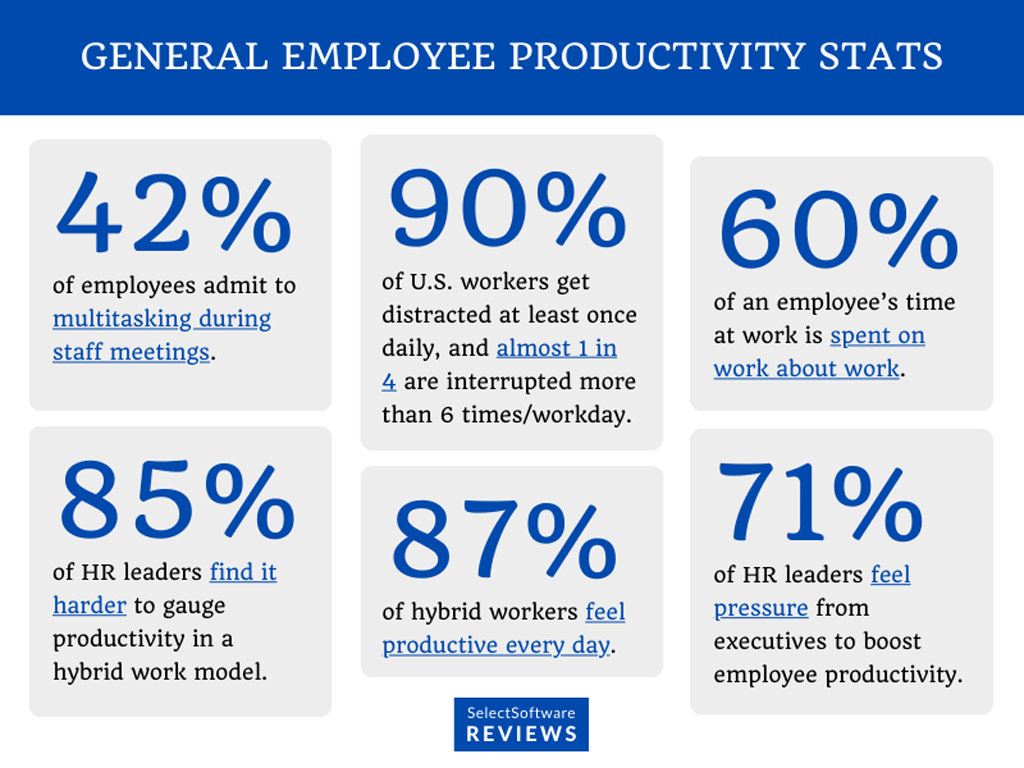
- 42% of employees admit to multitasking during meetings, indicating low engagement and potential productivity loss during collaborative sessions.
- A massive 90% of U.S. workers experience daily distractions, with nearly 1 in 4 employees being interrupted more than 6 times per day, highlighting a major barrier to deep work.
- Around 60% of an employee’s time is spent on “work about work” (emails, meetings, coordination), leaving less time for meaningful, high-impact tasks.
- 85% of HR leaders say it is harder to measure productivity in a hybrid work environment, showing a growing challenge in performance tracking.
- Despite challenges, 87% of hybrid workers report feeling productive every day, suggesting hybrid models can still drive strong output when managed effectively.
- 71% of HR leaders feel pressure from executives to improve employee productivity, reflecting increasing organizational focus on performance and efficiency.
Global and Regional Productivity Trends
- Global productivity growth averaged 1.5% in 2024, still below the 1.8% pre-pandemic average.
- North America recorded only 0.2% productivity growth in 2024, highlighting stagnation.
- The U.S. led productivity gains compared to Canada, which saw a decline in productivity levels.
- Retail trade productivity in the U.S. increased by 4.6% in 2024.
- Wholesale trade productivity grew 1.8% in 2024, reversing previous declines.
- Manufacturing productivity declined by 2.5% in 2025, indicating sector-specific challenges.
- Productivity gains remain uneven, with emerging markets lagging behind developed economies.
- Countries with higher digital adoption show faster productivity growth rates, especially in services.
U.S. Labor Productivity Growth
- U.S. productivity rose 1.8% in Q4 2025, driven by output gains.
- Year-over-year productivity growth reached 2.5% in 2025.
- Productivity surged by 4.9% in Q3 2025, one of the highest recent spikes.
- Output increased 5.4% in Q3 2025, while hours worked rose only 0.5%.
- Average annual productivity growth since 2019 stands at 2.1%.
- Unit labor costs increased by 4.4% in Q4 2025, affecting efficiency margins.
- Compensation grew by 5.0% year-over-year, impacting productivity-cost balance.
- AI-driven productivity improvements are expected to sustain growth through 2026.
Remote Work Productivity Statistics
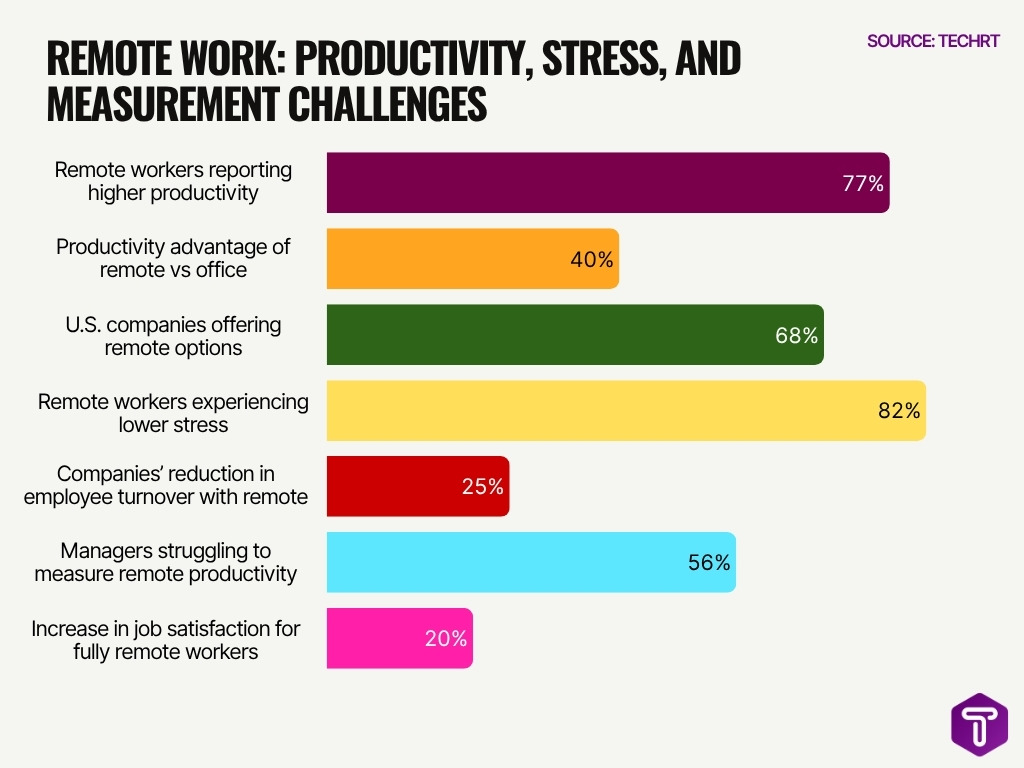
- Around 77% of remote workers report higher productivity when working from home.
- Remote employees are 35% to 40% more productive compared to office workers in controlled studies.
- Nearly 68% of U.S. companies offer remote work options from 2025 to 2026.
- Employees working remotely save an average of 72 minutes daily from commuting, boosting effective work hours.
- About 82% of remote workers say they experience lower stress levels, improving focus and output.
- Companies report 25% lower employee turnover when offering remote work flexibility.
- Remote workers log an additional 1.4 working days per month compared to office workers.
- However, 56% of managers struggle to measure remote productivity, highlighting visibility challenges.
- Employees working fully remotely report higher job satisfaction by 20%, which correlates with better performance.
Employee Engagement and Productivity
- Only 21% of employees worldwide are engaged at work, directly impacting productivity.
- Disengagement risk rose to 23% in 2026, signaling declining morale.
- Employees with high engagement levels show up to 18% higher productivity.
- Remote workers with strong well-being habits report 24% higher productivity.
- About 85% of managers doubt remote productivity, creating a productivity paranoia gap.
- Companies that implement transparent monitoring see significant productivity gains within days.
- Poor workplace tools can reduce productivity due to meeting inefficiencies and tech issues.
- Employees who feel supported by management demonstrate higher output and retention rates.
Hybrid Work Productivity Statistics
- Hybrid teams are approximately 5% more productive than fully remote or in-office teams.
- Around 58% of U.S. employees prefer hybrid work models in 2025.
- Companies adopting hybrid work see up to 21% higher profitability, linked to productivity gains.
- Employees working hybrid schedules report 12% higher engagement levels than fully on-site workers.
- Hybrid setups reduce office costs by up to 30%, enabling reinvestment in productivity tools.
- About 74% of companies plan to permanently adopt hybrid work models.
- Workers in hybrid environments report improved work-life balance by 70%, which supports sustained productivity.
- Collaboration tools usage increased by over 40% in hybrid teams, enhancing workflow efficiency.
- Hybrid employees spend less time in meetings by 10 to 15%, allowing more focus time.
Workplace Collaboration and Productivity
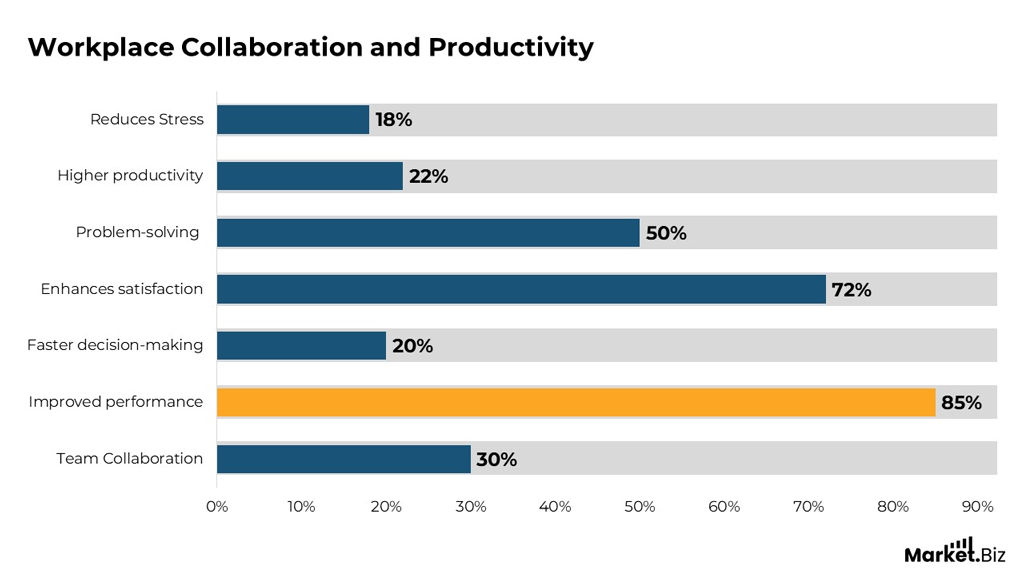
- Improved performance is the most significant benefit, with a striking 85%, showing collaboration directly drives better outcomes.
- Employee satisfaction is highly impacted, with 72% reporting enhanced satisfaction through collaborative work environments.
- Problem-solving capabilities improve notably, with 50% indicating better solutions when teams collaborate.
- Team collaboration itself is recognized by 30%, suggesting room for organizations to further strengthen teamwork practices.
- Only 22% associate collaboration directly with higher productivity, indicating productivity gains may be indirect or influenced by other factors.
- Faster decision-making is reported by 20%, showing collaboration helps but may also introduce delays in some cases.
- Stress reduction is the least reported benefit at 18%, suggesting collaboration alone may not significantly alleviate workplace stress.
Productivity by Industry and Sector
- The technology sector leads productivity growth, with gains exceeding 3% annually.
- Manufacturing productivity declined by 2.5% in 2025, reflecting supply chain challenges.
- Healthcare productivity improved by 1.2% annually, driven by digital tools.
- Retail sector productivity rose 4.6% in 2024, boosted by automation and e-commerce.
- Finance and insurance sectors show high productivity per employee, often exceeding $200,000 output annually.
- Construction productivity remains low, growing at less than 1% annually.
- Education sector productivity growth stagnates at around 0.5% annually, due to structural challenges.
- Logistics and supply chain sectors saw efficiency gains of 6% with AI and automation.
- Hospitality productivity dropped by over 3% during recent years, reflecting labor shortages.
Productivity by Job Type and Role
- Knowledge workers spend only 39% of their time on core job tasks, with the rest on admin work.
- Managers spend over 60% of their time in meetings, limiting strategic productivity.
- Developers report productivity gains of 20% to 45% when using AI coding tools.
- Sales professionals see 30% higher productivity with CRM automation tools.
- Customer support roles improve efficiency by 25% using AI chatbots.
- Creative roles benefit from flexible work, with up to 15% higher output in hybrid environments.
- Administrative staff spend up to 50% of their time on repetitive tasks, reducing efficiency.
- Frontline workers report lower productivity due to manual processes, with automation improving output by 20%.
- Data analysts using automation tools report 40% faster task completion.
AI’s Impact on Workplace Productivity
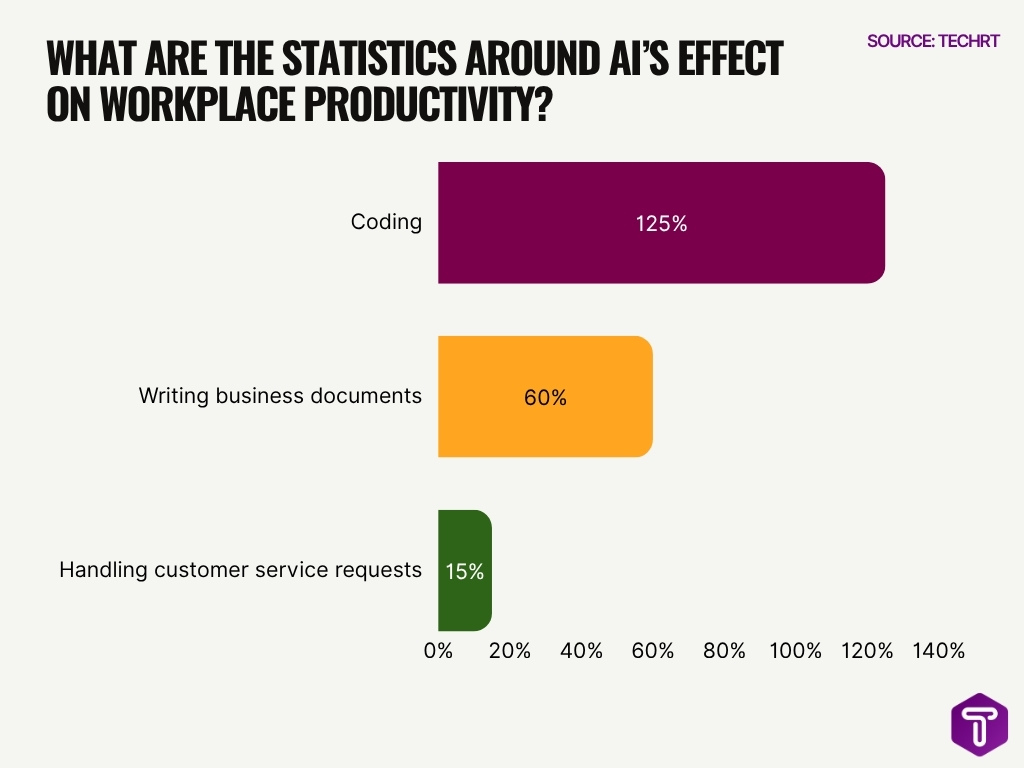
- AI delivers the highest productivity boost in coding, with an impressive 125% increase, making it the most AI-augmented task.
- Writing business documents sees a strong uplift of 60%, showing AI’s effectiveness in content creation and documentation workflows.
- Customer service tasks experience a modest 15% improvement, indicating limited but still meaningful efficiency gains.
- The data highlights a clear trend: AI performs best in structured, technical tasks (like coding) compared to more human-interaction-heavy roles.
- There is a massive 110 percentage point gap between coding (125%) and customer service (15%), emphasizing uneven AI impact across job functions.
- Knowledge-based and repetitive tasks benefit the most, while tasks requiring empathy and real-time human judgment see lower gains.
- These insights suggest businesses should prioritize AI adoption in high-impact areas like development and documentation to maximize ROI.
Time Lost to Distractions and Multitasking
- Employees are productive for only 2 hours and 53 minutes per workday on average.
- Workers check email or messaging apps every 6 minutes, disrupting focus cycles.
- It takes approximately 23 minutes to regain focus after an interruption.
- Multitasking can reduce productivity by up to 40%, according to cognitive research.
- Around 98% of employees multitask daily, leading to reduced efficiency.
- Digital distractions account for nearly 60% of lost productivity time.
- Social media alone consumes over 2 hours daily per user, often during work hours.
- Employees switch tasks over 300 times per day, fragmenting attention.
- Workplace interruptions cost businesses an estimated $650 billion annually in the U.S.
Time Lost to Meetings and Interruptions
- Employees spend an average of 31 hours per month in unproductive meetings.
- About 71% of meetings are considered inefficient by employees.
- Workers attend 60+ meetings per month, limiting deep work time.
- Meetings increased by 153% since 2020, driven by remote collaboration.
- Employees report that 50% of meeting time is wasted, reducing productivity.
- Interruptions during meetings reduce comprehension by over 20%, affecting outcomes.
- Managers spend nearly 35% of their time in meetings, limiting execution time.
- Reducing meeting time by 40% can increase productivity by up to 20%.
- Employees experience interruptions every 11 minutes, often due to meetings or communication tools.
Digital Friction in the Employee Experience
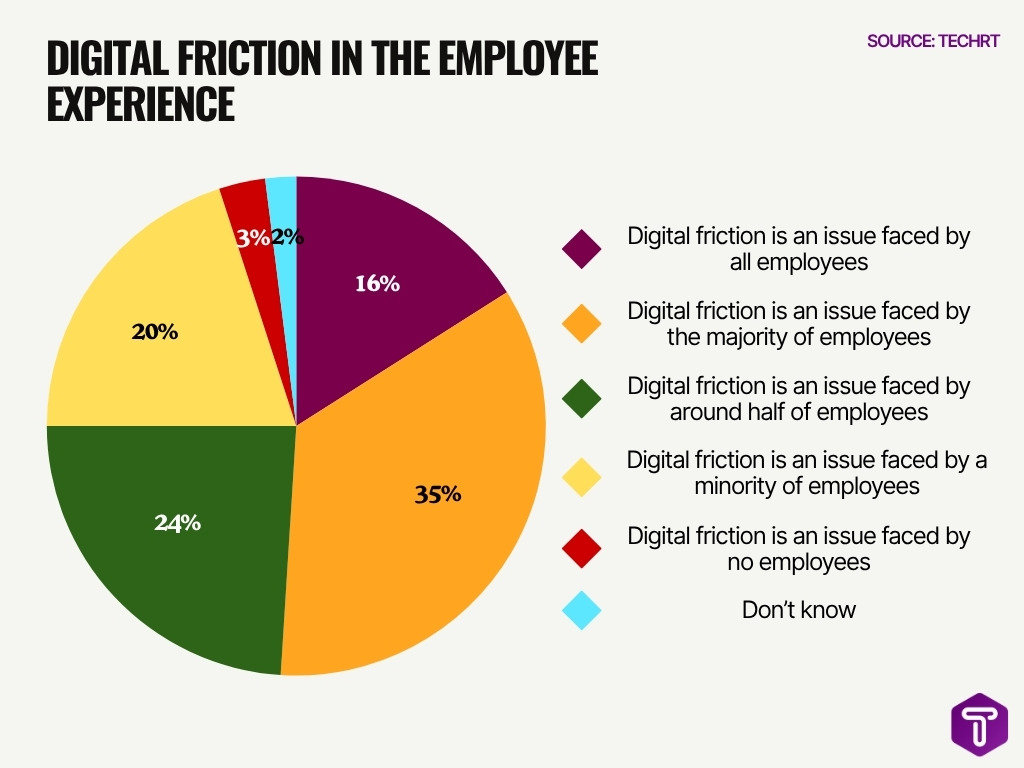
- Digital friction is widespread, with 75% of respondents saying it affects at least half or more employees (16% all + 35% majority + 24% around half).
- The largest segment (35%) reports that digital friction impacts the majority of employees, highlighting a significant organizational challenge.
- 24% of respondents believe that around half of employees face digital friction, indicating it is a common workplace issue, not isolated.
- A notable 20% say only a minority are affected, suggesting variation across teams, roles, or companies.
- Only 3% report no digital friction, reinforcing that completely frictionless digital environments are rare.
- Just 2% are unsure, indicating that most organizations have clear visibility into digital experience challenges.
- Overall, the data shows that digital friction is nearly universal, with 98% acknowledging its presence to some degree.
Use of Productivity Tracking and Monitoring Tools
- Around 78% of companies use productivity monitoring tools to track employee performance.
- Businesses using monitoring tools report 20% to 30% productivity improvements.
- Time tracking software reduces idle time by up to 18%.
- About 61% of employees feel monitoring improves accountability, boosting output.
- However, 32% of employees feel micromanaged, which can negatively impact productivity.
- Companies using analytics dashboards improve decision-making efficiency by 25%.
- Automated reporting tools save managers 5 to 10 hours per week.
- Employee productivity tools adoption has increased by over 50% since 2020, reflecting digital transformation.
- Organizations using integrated productivity platforms see higher engagement and performance metrics.
Workplace Environment and Productivity
- Employees working in optimized environments show up to 20% higher productivity.
- Poor office lighting can reduce productivity by as much as 23%.
- Access to natural light improves productivity by 15% and well-being by 13%.
- Noise distractions in offices reduce performance by up to 66% in complex tasks.
- Comfortable workplace design increases productivity by 17%, especially in knowledge roles.
- Employees with flexible workspaces report higher engagement and focus levels.
- Temperature discomfort can lower productivity by 10% or more.
- Around 87% of employees want flexible workspace options, linking environment to performance.
- Clean and organized workspaces improve task completion rates by up to 12%.
Freelancer Work Hours Breakdown
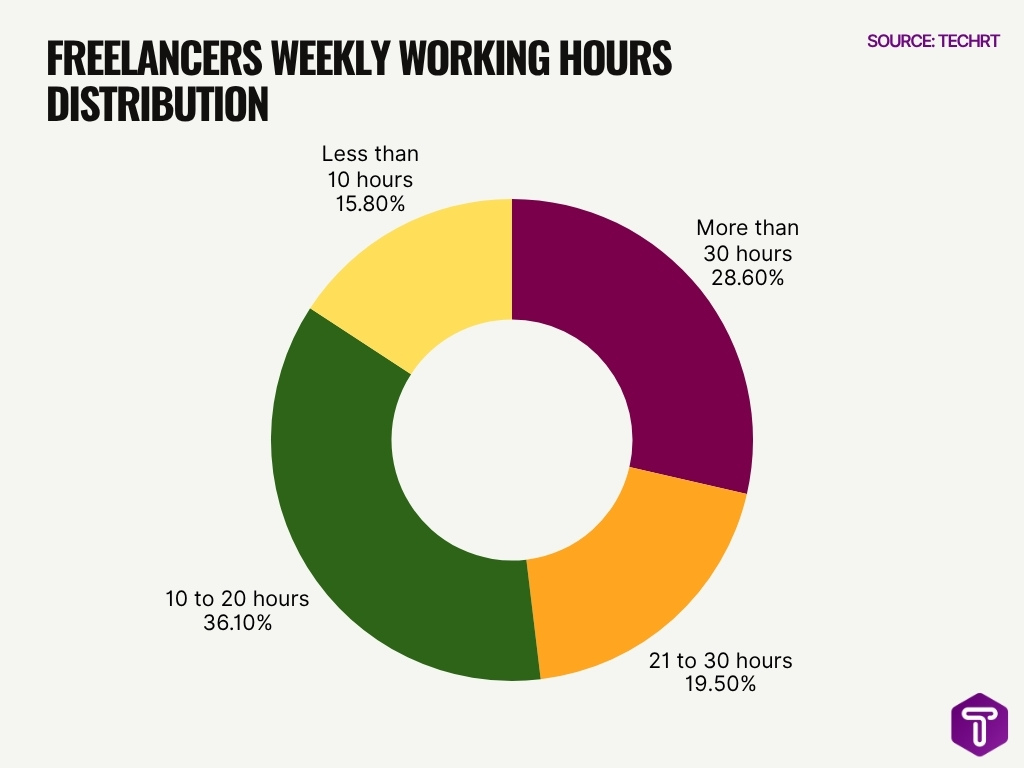
- The largest segment of freelancers (36.10%) works 10 to 20 hours per week, indicating a strong preference for part-time or flexible workloads.
- A significant portion (28.60%) works more than 30 hours weekly, showing that nearly 3 in 10 freelancers operate at near full-time capacity.
- Around 19.50% of freelancers fall into the 21 to 30 hours range, representing a mid-level commitment between part-time and full-time work.
- A smaller group (15.80%) works less than 10 hours per week, highlighting a segment engaged in side gigs or occasional freelancing.
- Overall, over 55% of freelancers (combining 10–20 hours and <10 hours) work 20 hours or less, reinforcing the trend toward flexibility and supplemental income streams.
- Meanwhile, nearly 48% of freelancers (combining 21–30 hours and 30+ hours) dedicate over 20 hours weekly, indicating a substantial portion relies on freelancing as a primary income source.
Employee Satisfaction and Retention
- Companies with high employee satisfaction report 21% higher profitability.
- Highly engaged teams show 18% higher productivity and lower turnover.
- Organizations with strong cultures experience up to 72% higher employee engagement.
- Employees who feel valued are 87% less likely to leave their jobs.
- Replacing an employee can cost up to 33% of their annual salary, impacting productivity.
- Companies with high retention rates achieve more consistent productivity growth.
- Employees with career development opportunities are 34% more likely to stay, improving long-term output.
- Around 60% of employees prioritize flexibility over salary, influencing retention and performance.
- Positive workplace culture increases productivity by up to 12%, especially in collaborative teams.
Workload, Burnout, and Productivity
- Nearly 77% of employees report experiencing burnout at some point.
- Burnout leads to a 63% higher likelihood of taking sick days, reducing productivity.
- Employees experiencing burnout are 2.6 times more likely to seek new jobs.
- High workloads reduce productivity by up to 68% due to fatigue and errors.
- Around 44% of employees feel overworked, impacting output levels.
- Chronic stress reduces cognitive performance by 30%, affecting decision-making.
- Companies with burnout prevention programs see up to 25% productivity improvements.
- Employees working over 50 hours per week show declining productivity per hour.
- Work-life imbalance contributes to higher absenteeism and lower engagement.
Burnout Levels Among Mothers vs Non-Mothers
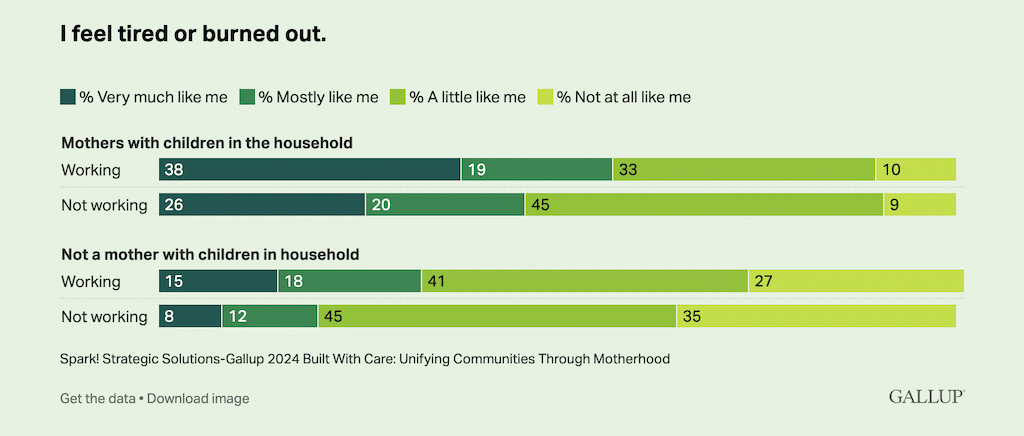
- Over half of working mothers (57%) report feeling burned out (38% very much + 19% mostly), making them the most affected group in the dataset.
- Non-working mothers (46%) also report high burnout levels, but notably lower than working mothers, showing that employment adds significant pressure.
- Among working women without children, only 33% feel burned out (15% very much + 18% mostly), which is 24 percentage points lower than working mothers.
- Non-working women without children report the lowest burnout levels (20%), highlighting that both work and motherhood together amplify stress.
- A large share of non-working mothers (45%) and non-mothers (45%) say burnout feels only “a little like me,” suggesting moderate but widespread fatigue even outside high-risk groups.
- 27% of working non-mothers and 35% of non-working non-mothers say burnout does “not at all” describe them, the highest resistance to burnout across all segments.
- The data clearly shows a compounding effect: combining work + motherhood nearly doubles intense burnout levels compared to women without children.
- Overall, working mothers stand out as the most vulnerable group, emphasizing the need for better work-life balance, support systems, and flexible policies.
Frequently Asked Questions (FAQs)
What percentage of the workday is employees actually productive?
How much did U.S. labor productivity grow recently?
What percentage of companies report productivity gains from AI?
How much productivity is lost due to low employee engagement?
How much can multitasking reduce employee productivity?
Conclusion
Employee productivity reflects a workplace in transition, shaped by rapid technological adoption and changing employee expectations. While AI, hybrid work, and digital tools continue to unlock measurable efficiency gains, challenges such as burnout, constant distractions, and excessive meetings still limit overall performance.
At the same time, the data makes one trend clear: organizations that invest in employee well-being, flexible work environments, and streamlined workflows consistently outperform their peers. Productivity is no longer just about output; it is closely tied to engagement, satisfaction, and sustainable work practices. As businesses move forward, balancing technology with human-centric strategies will be critical to maintaining long-term productivity, retaining talent, and driving consistent growth.

Leave a comment
Have something to say about this article? Add your comment and start the discussion.