




Artificial intelligence (AI) agents are transforming how work gets done across industries. From automated task management to advanced decision support, these systems are designed to improve efficiency, cut costs, and free up human workers for higher‑value activities. Businesses deploying AI agents have seen measurable gains in productivity and time savings, while individuals increasingly rely on them to streamline daily work. Below, we unpack the latest statistics that show just how widespread and impactful AI agent productivity tools are in today’s economy.
Editor’s Choice
- 79% of organizations now report adopting AI agents to some extent in their operations.
- 23% of enterprises have scaled agentic AI systems into production workflows.
- The global AI agents market size reached approximately $7.8 billion in 2025.
- Projected growth through 2030 shows a ~45% compound annual growth rate (CAGR).
- 66% of enterprises report measurable productivity increases from AI agent use.
- Employees using AI tools save on average 40–60 minutes per day on routine tasks.
- 38% of U.S. workers say their organization uses AI to improve productivity, efficiency, or quality.
Recent Developments
- OpenAI launched Frontier, a platform aimed at enterprise AI agent deployment in early 2026, signaling wider business integration.
- Claude Code by Anthropic has surged in popularity, with reports of tripled engineer productivity in some contexts.
- CIO surveys show 81% believe AI agents necessitate tighter collaboration across departments.
- Gallup found that 12% of U.S. employees use AI daily at work, up sharply from prior years.
- A Clutch study shows 74% of workers use AI regularly on the job, though many lack formal training.
- Despite enthusiasm, some industry voices caution that the quantity of AI agents doesn’t equal quality outcomes.
- Research from OpenAI and Anthropic suggests users save 40–60 minutes daily via AI tools.
- Gartner projects AI agents will far outnumber human sellers by 2028, but under 40% of sellers expect productivity gains.
What Are AI Productivity Agents?
- AI productivity agents are programs that autonomously perform tasks, often bridging between software tools and workflow needs.
- They act on multi‑step workflows without continuous user intervention.
- Agents can integrate with CRM, data warehouses, and internal systems to execute business logic.
- These systems are used for scheduling, response automation, data extraction, and more.
- They range from simple assistant bots to complex agentic AI with decision capabilities.
- Modern AI agents can access and understand contextual business data to complete tasks.
- They are distinct from basic AI tools because agents can plan and execute steps toward goals.
- Use cases span customer service, development automation, and personal assistance.
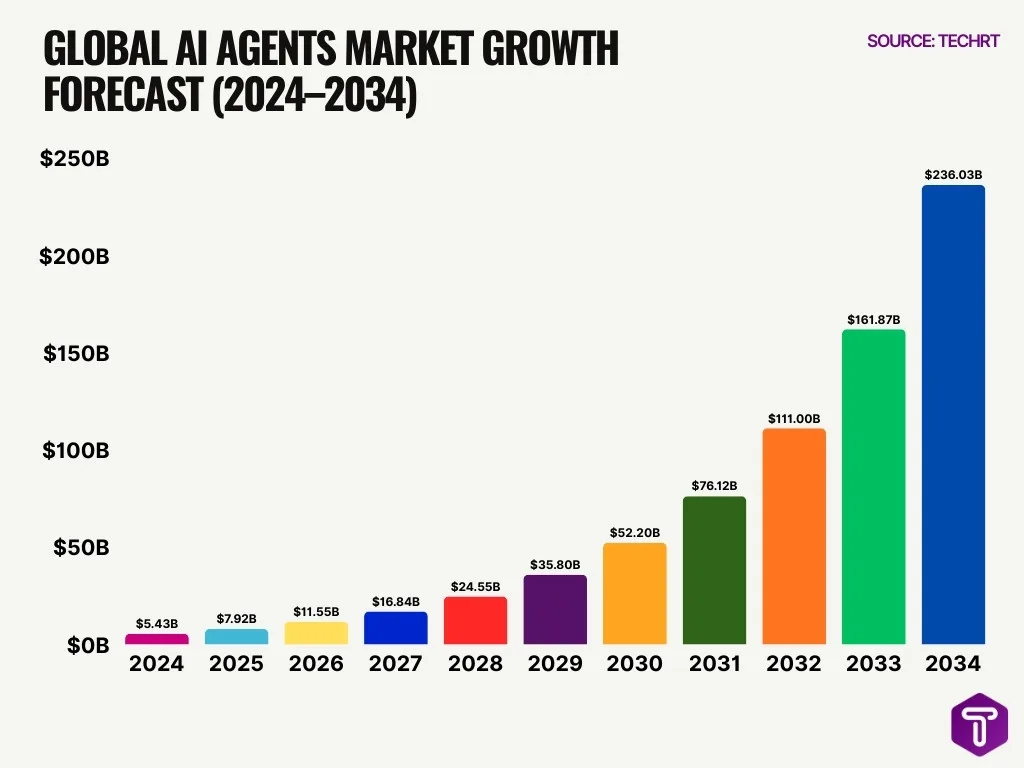
Global AI Agents Market Growth (2024–2034)
- The global AI agents market is projected to grow from $5.43 billion in 2024 to $236.03 billion by 2034, reflecting massive long-term industry expansion.
- Between 2024 and 2026, the market size is expected to more than double, rising from $5.43B to $11.55B, signaling early-stage acceleration.
- By 2028, the market is forecast to reach $24.55 billion, showing strong adoption across enterprises and digital platforms.
- In 2029, global revenue is estimated at $35.80B, highlighting increasing investments in automation and intelligent systems.
- The market is projected to cross $50 billion in 2030, reaching $52.20B, marking a major industry milestone.
- By 2031, AI agents’ revenue is expected to surge to $76.12B, driven by wider enterprise deployment.
- In 2032, the market is forecast to exceed $100B, hitting $111.00B, indicating mainstream global adoption.
- Growth is expected to accelerate further in 2033, reaching $161.87B, supported by advanced AI integrations.
- By 2034, the global AI agents market is projected to peak at $236.03B, representing over 43× growth compared to 2024.
- Overall, the decade-long trend shows a consistent pattern of compounding growth, fueled by rising demand for autonomous AI systems, productivity tools, and digital transformation.
AI Agent Adoption and Usage Rates
- 23% of enterprises are beyond the pilot stage and are scaling AI agents.
- Another 39% are experimenting with agent deployments.
- 38% of U.S. employees say their organization uses AI for productivity.
- 81% of CIOs highlight cross‑team collaboration needs due to AI.
- Worker surveys show that about 69% believe AI agents improved personal productivity.
- A Clutch report found 74% of workers use AI tools on the job.
- Formal enterprise adoption surveys show wide variability by industry maturity.
- Many organizations still lack governance structures for agent deployment.
Enterprise Investment and Budget Trends for AI Agents
- 66% of organizations adopting AI agents report higher productivity, while 57% report cost savings from agent deployments.
- AI spending remains a priority, 88% of teams plan to increase AI‑related budgets over the next 12 months.
- Nearly 43% of companies allocate more than half of their AI budget specifically to agentic capabilities.
- Surveys show 97% of telecom specialists are adopting or assessing AI, with about 49% actively using it in operations.
- 79% of surveyed executives say their firms use AI agents, signaling broad strategic emphasis.
- IDC forecasts that agentic AI budget share will dominate IT spending growth, reflecting strategic prioritization.
- Companies in customer service, operations, and sales are earmarking larger portions of their digital budgets for agentic automation tools.
- Leaders increasingly require governance frameworks and performance metrics to justify continued investment in AI agent programs.
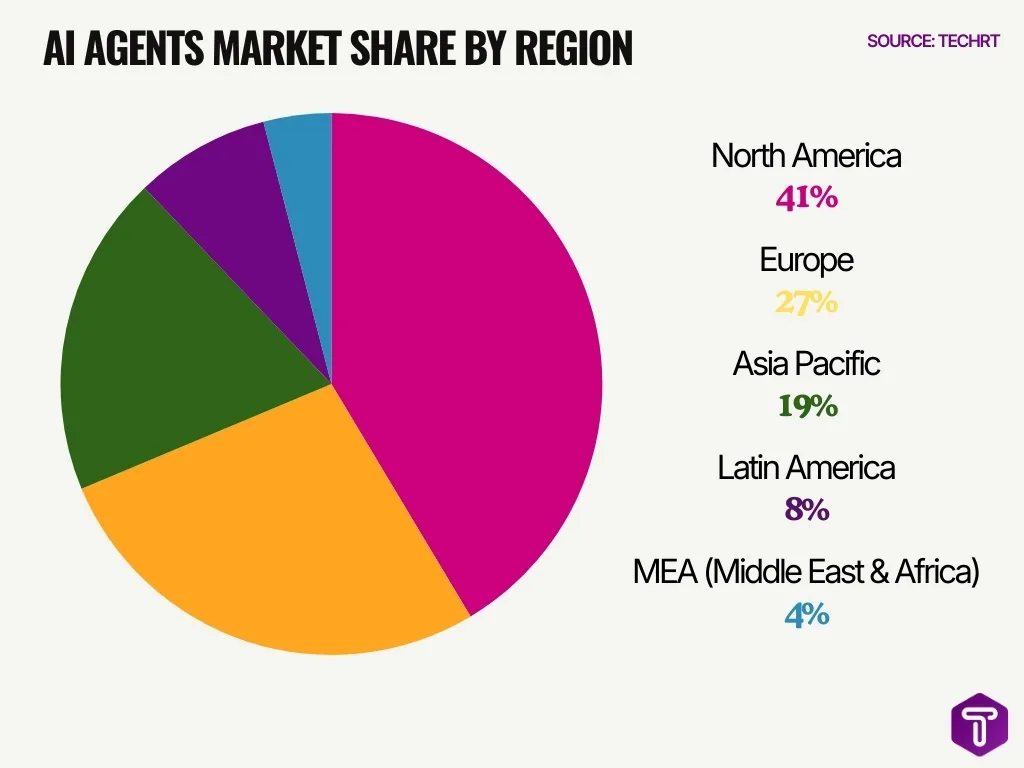
AI Agents Market Share by Region
- North America dominates the AI agents market with a leading 41% share, driven by strong enterprise adoption, advanced infrastructure, and high AI investment levels.
- Europe holds the second-largest position at 27%, supported by growing digital transformation initiatives and regulatory-backed AI development.
- Asia Pacific captures 19% of the global market, reflecting rapid AI adoption across emerging economies and major technology hubs.
- Latin America contributes 8%, indicating steady growth fueled by increasing cloud adoption and digital innovation.
- The Middle East & Africa account for 4%, highlighting early-stage market development and expanding interest in AI-driven solutions.
Time Savings and Task Automation Statistics
- AI agents help employees save an average of 40–60 minutes per day when integrated into daily work processes.
- A Google‑linked study found workers could save up to 122 hours per year by automating administrative tasks with AI tools.
- Industry estimates suggest that AI automation can reduce repetitive task workloads by 25–40% in many business functions.
- Reports highlight that administrative tasks like email, data entry, and note‑taking consume an average of 5–6 hours weekly, time AI agents could reclaim.
- Businesses losing productivity due to manual admin work could be losing hundreds of billions annually without AI intervention.
- Automated support systems handle 50–65% of customer inquiries without human involvement in many enterprises.
- AI agents can decrease average resolution time for routine tasks by 25–40%.
- Integration of AI saves time not just at the task execution level but also accelerates decision‑making cycles across teams and functions.
Impact of AI Agents on Employee Workload and Focus Time
- 62% of knowledge workers prefer AI to handle repetitive tasks, escaping mundane work.
- 44% of workers hate repetitive job aspects, driving AI demand for admin relief.
- AI agents boost team productivity by 60% per employee in collaborative tasks.
- Human-AI teams focus 23% more on content creation, cutting editing time by 20%.
- 91% of businesses use AI to cut admin workloads by over 3.5 hours weekly per employee.
- AI scheduling increases uninterrupted focus time by 30%, reducing task-switching by 25%.
- 39% of employees report lower stress levels from AI-enabled reduced hours and a drop.
- 79% of employees say AI agents improve personal performance by minimizing manual work.
- 65% of HR executives report that AI agents greatly enhance productivity in operations.
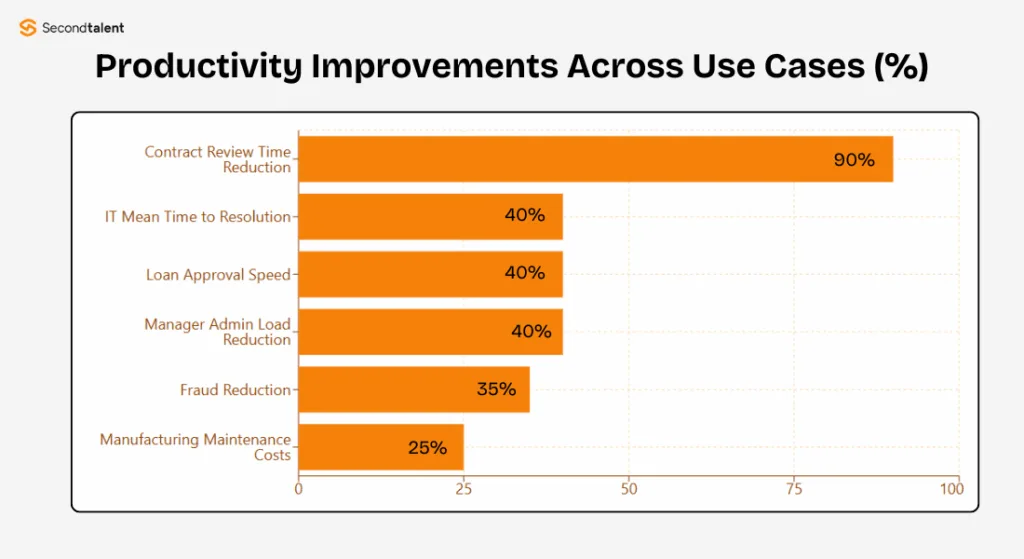
Key Productivity Improvements Across Business Use Cases
- Contract Review Time Reduction leads with a massive 90% improvement, showing how automation and AI tools dramatically accelerate legal and compliance workflows.
- IT Mean Time to Resolution improves by 40%, enabling faster issue handling and minimizing system downtime.
- Loan Approval Speed increases by 40%, helping financial institutions deliver quicker decisions and enhance customer satisfaction.
- Manager Admin Load Reduction drops by 40%, allowing leaders to spend more time on strategic and high-value activities.
- Fraud Reduction achieves a 35% improvement, strengthening risk management and improving organizational security.
- Manufacturing Maintenance Costs decline by 25%, helping companies optimize operations and reduce equipment-related expenses.
AI Agent Productivity in Customer Service and Support
- 94% of customer service teams using conversational AI report increased productivity in resolution or handling tasks.
- 92% say AI speeds issue resolution for customer inquiries.
- 87% of teams report reduced workload due to AI‑based task automation.
- Over 50% of companies with AI support technology cut operational costs in service centers.
- 59% of consumers believe AI will reshape customer interactions in the next two years.
- The AI for customer service market size is expected to grow from ~$12.1 billion (2024) to $117.87 billion by 2034 (25.6% CAGR).
- Many AI support tools now handle up to 65% of inquiries without human involvement.
- Salesforce reported using AI to automate millions of support interactions weekly.
- Gartner warns that over 40% of agentic AI projects may be scrapped by 2027, underlining the need for thoughtful implementation.
AI Agent Productivity in Software Development and IT Operations
- AI coding assistants have boosted engineer productivity by up to 20% at major financial firms like JPMorgan.
- Agentic tools are shifting engineers from line‑by‑line coding to orchestrating AI workflows.
- Gartner predicts 40% of enterprise apps will embed task‑specific agents by 2026, increasing dev productivity.
- In some IT modernization efforts, AI agents have increased productivity by ~40%.
- Autonomy in agent tools can reduce manual QA and debugging cycles significantly.
- Agent integration often accelerates deployment pipelines and reduces cycle times.
- A substantial share of development teams now use AI for automated testing and code suggestions.
- In progressive AI organizations, engineers increasingly oversee multiple agent workflows concurrently.
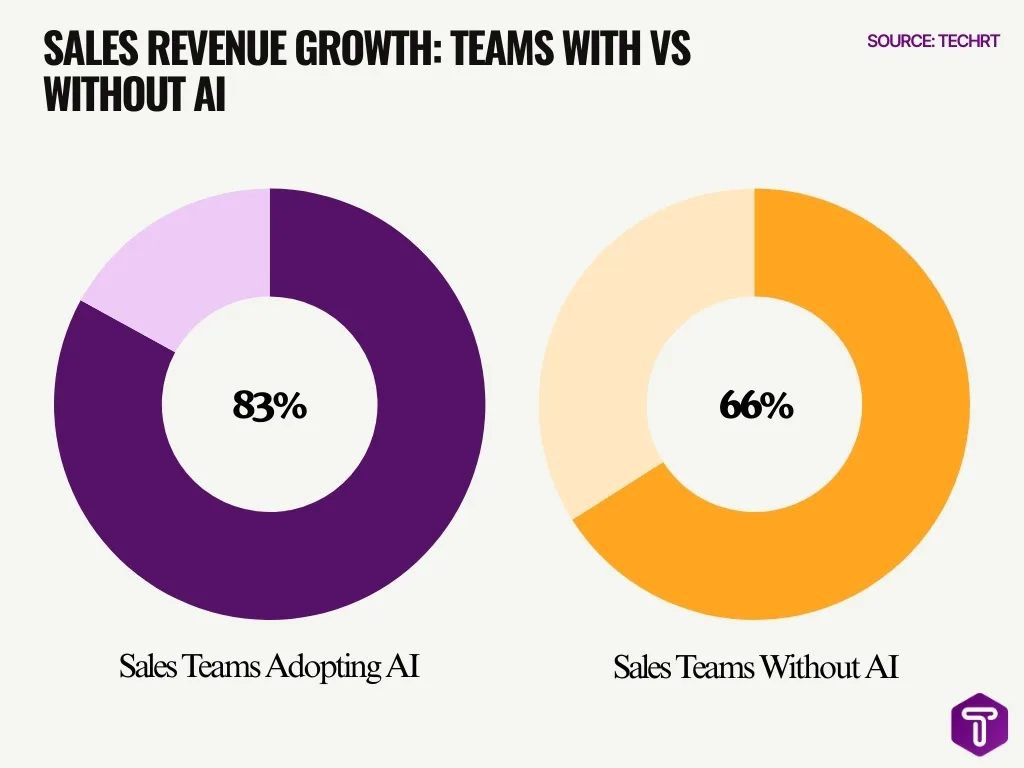
AI Agent Productivity in Sales and Marketing
- Sales teams that adopt AI see ~83% revenue growth, compared with 66% without AI.
- Marketing and ecommerce teams report AI as a top strategic priority.
- Agentic lead scoring and CRM integrations can accelerate lead response times.
- AI‑assisted conversion tools improve lead qualification metrics significantly.
- Many brands automate social and digital ad targeting with AI, improving engagement rates.
- Agentic analytics dashboards help teams analyze campaign ROI faster.
- AI can personalize content recommendations at scale, lifting conversion efficiency.
- Consumer adoption trends show 44% willing to use AI as a personal digital assistant.
AI Agent Productivity in Finance, Banking, and Insurance
- AI-driven underwriting cuts loan processing by up to 40%.
- Banks using AI report 50-75% reductions in commercial loan decision times.
- AI agents reduce month-end cycle times by up to 40% in finance teams.
- 90% of financial institutions use AI for real-time fraud detection.
- AI fraud systems achieve 99.1% detection accuracy, cutting false positives by 80%.
- AI cuts AML compliance manual efforts by up to 87%, saving 115 minutes daily.
- Insurance AI reduces claims processing from 19 days to 4 days.
- 64% of insurers prioritize AI for claims, achieving 55-75% time reductions.
- 54% of banks have AI in production for risk management.
- Over 85% of financial firms apply AI in fraud detection and risk modeling.
Personal Productivity Gains From AI Assistants and Copilots
- AI assistants boost writing task completion speed by 40% while improving output quality by 18%.
- GenAI access raises customer support resolutions per hour by 15% on average across agents.
- Copilot users save an average of 1.2 hours per week on tasks, focusing on higher-value work.
- Workers using AI assistants save 26 minutes daily on routine tasks, according to a UK government study.
- Lower-skilled workers gain 14% productivity from AI, tripling efficiency on one-third of tasks.
- ChatGPT improves white-collar task speed by 37% without quality loss in an MIT study.
- GitHub Copilot accelerates developer coding by up to 51% on repetitive tasks.
- AI triples task efficiency for one-third of jobs, cutting 90-minute tasks to 30 minutes.
- Less experienced agents see 30% higher resolutions per hour with AI assistance.
- 75% of knowledge workers now use AI tools regularly for productivity.
Consumer Adoption of AI Agents in Online Shopping
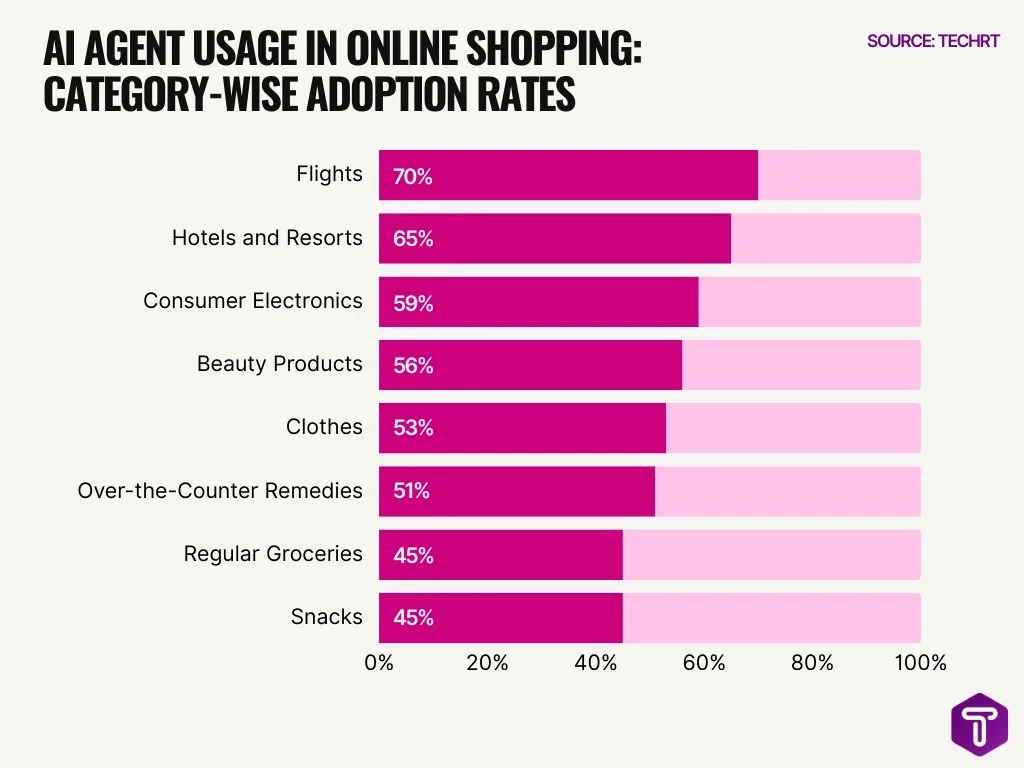
- Flights lead AI-assisted shopping, with 70% of consumers using AI agents to compare prices, book tickets, and manage travel plans.
- Hotels and resorts follow closely, as 65% of shoppers rely on AI tools to find deals, reviews, and personalized stay options.
- Consumer electronics show strong adoption, with 59% of buyers using AI agents to research specifications, compare brands, and track discounts.
- Beauty products attract significant AI usage, with 56% of consumers depending on AI for product recommendations and reviews.
- Clothing purchases benefit from AI assistance, as 53% of shoppers use AI tools for size guidance, styling tips, and price comparisons.
- Over-the-counter remedies see growing AI adoption, with 51% of consumers using AI to compare ingredients, prices, and health reviews.
- Regular groceries have moderate AI usage, with 45% of shoppers relying on AI for shopping lists, deals, and repeat purchases.
- Snacks match grocery trends, with 45% of consumers using AI agents to discover offers, brands, and popular products.
Business Process Automation and Workflow Efficiency Statistics
- 92% of executives plan to embed AI automation in core workflows by 2025.
- 79% of enterprises adopted AI agents for cross-functional workflows.
- 77% of manufacturers leverage AI agents in supply chain operations.
- BPA market valued at $15.3 billion in 2025, growing at 11.7% CAGR.
- Automation cuts manual workload by 12–16% across processes.
- AI workflows deliver 240% ROI in 6–9 months for adopters.
- Orchestrated workflows boost accuracy to 97% with AI-human synergy.
- AI supply chains reduce logistics costs by 15% and inventory by 35%.
- 73% of IT leaders see 50% time savings from automation.
Key Benefits and Challenges of Agentic AI Adoption
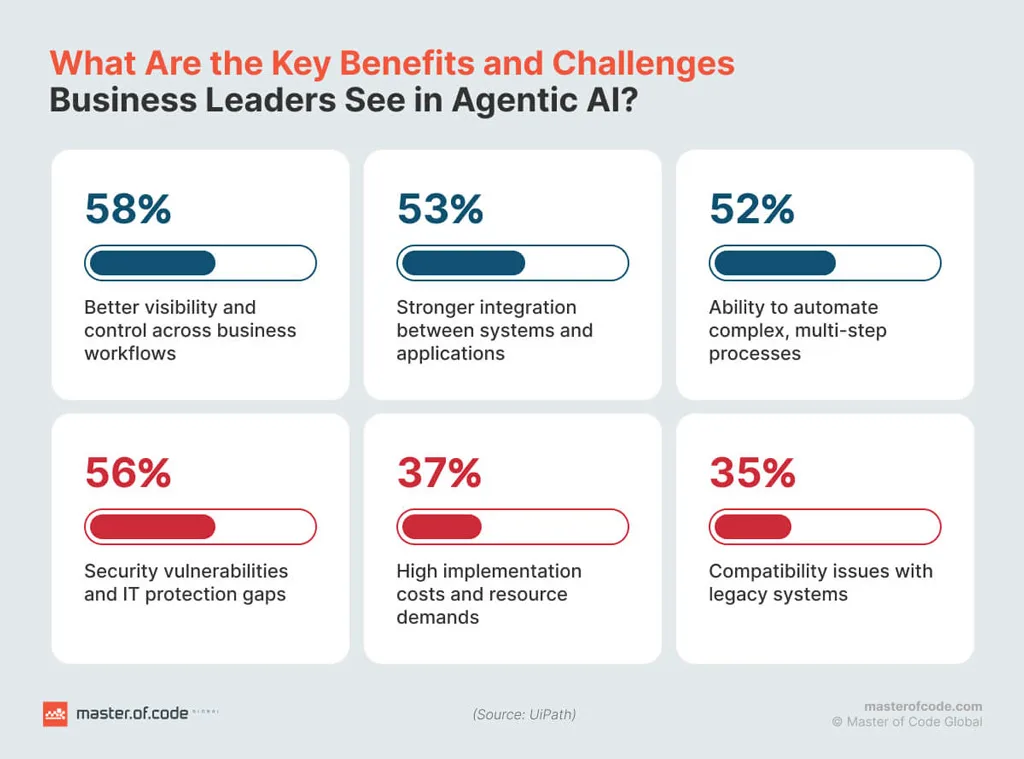
- 58% of business leaders highlight better visibility and control across workflows, showing how Agentic AI improves operational transparency and management efficiency.
- 53% of organizations report stronger integration between systems and applications, enabling seamless data flow and cross-platform automation.
- 52% of decision-makers value the ability to automate complex, multi-step processes, helping businesses reduce manual effort and scale operations faster.
- 56% of executives cite security vulnerabilities and IT protection gaps as a major concern, emphasizing the need for robust cybersecurity frameworks.
- 37% of companies face high implementation costs and resource demands, making Agentic AI adoption challenging for budget-conscious enterprises.
- 35% of firms experience compatibility issues with legacy systems, highlighting the importance of modernizing IT infrastructure for successful integration.
Future Outlook: AI Agent Productivity Forecasts to 2030
- Gartner predicts 15% of daily business decisions will be autonomously made by agentic AI by 2028.
- 33% of enterprise software is expected to include agentic capabilities by 2028.
- Market projections indicate continued high‑growth for agent automation across sectors.
- By 2030, consumer adoption of shopping AI agents may add $115 billion to U.S. e‑commerce.
- Analysts foresee steady integration of agents in CRM, ERP, and analytics platforms.
- Agentic AI adoption in knowledge management and R&D is expected to grow rapidly.
- Increased human‑agent collaboration models will shape job roles by 2030.
- Widespread governance frameworks will differentiate successful deployments from canceled initiatives.
Frequently Asked Questions (FAQs)
What percent of enterprises plan to increase AI‑related budgets due to agentic AI in the next 12 months?
How large was the global AI agents market estimated in 2025, and what is its projected value by 2030?
What productivity improvement do enterprises adopting AI agents report?
By what year do analysts predict AI agents will deploy autonomously in half of enterprise Generative AI use cases?
What proportion of organizations that implemented AI agents report measurable value in productivity?
Conclusion
AI agent technology is no longer an experiment; it’s a foundational productivity driver across the economy. From customer support and sales growth to software development and operations, measurable gains highlight AI’s ability to save time, cut costs, and scale workflows. While forecasts show both exciting expansions in market reach and growing pains in implementation, enterprises that invest in governance, orchestration, and outcome‑focused integrations are positioned to lead.
As AI agents become more autonomous and embedded in daily work, their role in shaping competitive advantage and workforce transformation through 2030 will only deepen.

Leave a comment
Have something to say about this article? Add your comment and start the discussion.