




Gaming has evolved into one of the most influential digital industries, shaping how people interact, relax, and spend money. Today, it powers everything from mobile app ecosystems generating billions in in-app purchases to esports events that attract global audiences and brand sponsorships. Businesses use gaming to drive engagement, advertisers tap into immersive experiences, and creators build full-time careers through streaming and competitive play.
As technology advances and audiences diversify, the scale and impact of gaming continue to grow across every region and demographic. Understanding the numbers behind this growth helps uncover where the industry is heading next, so let’s explore the latest gamer statistics.
Editor’s Choice
- The global gaming industry generated $188.8 billion in revenue in 2025, reflecting a 3.4% year-over-year increase.
- The industry is projected to surpass $205 billion in total revenue by 2026.
- There are approximately 3.32 billion active gamers worldwide in 2026.
- Mobile gaming accounts for roughly 55% of global gaming revenue, making it the dominant segment.
- Global online gaming revenue reached $119.55 billion in 2026, growing at a nearly 9.8% CAGR.
- Players spent over $82 billion on mobile in-app purchases in 2024, with continued growth into 2025.
- The gaming market is expected to reach $618.82 billion by 2030, showing long-term expansion potential.
Recent Developments
- Mobile game downloads hit 50+ billion in 2025, despite a slight decline from the previous year.
- The industry saw over 225,000 new mobile games released in 2025, intensifying competition.
- Mobile gaming generated approximately $81.7 billion in consumer spending in 2025, growing 1.3% YoY.
- Global gaming revenue reached an all-time high of $195 billion in 2025.
- Mobile in-app purchases are expected to reach $130 billion in 2025, nearly half of total industry revenue.
- Hybrid-casual mobile games saw a 37% increase in in-app purchase revenue in 2024.
- Global mobile gaming hours reached 444 billion hours in 2025, showing steady engagement growth.
- Subscription-based gaming services now attract over 52% of gamers globally.
- Console revenue declined slightly by 2.5% in 2024, but stabilized through subscriptions and third-party titles.
Global Gaming Market Size Statistics
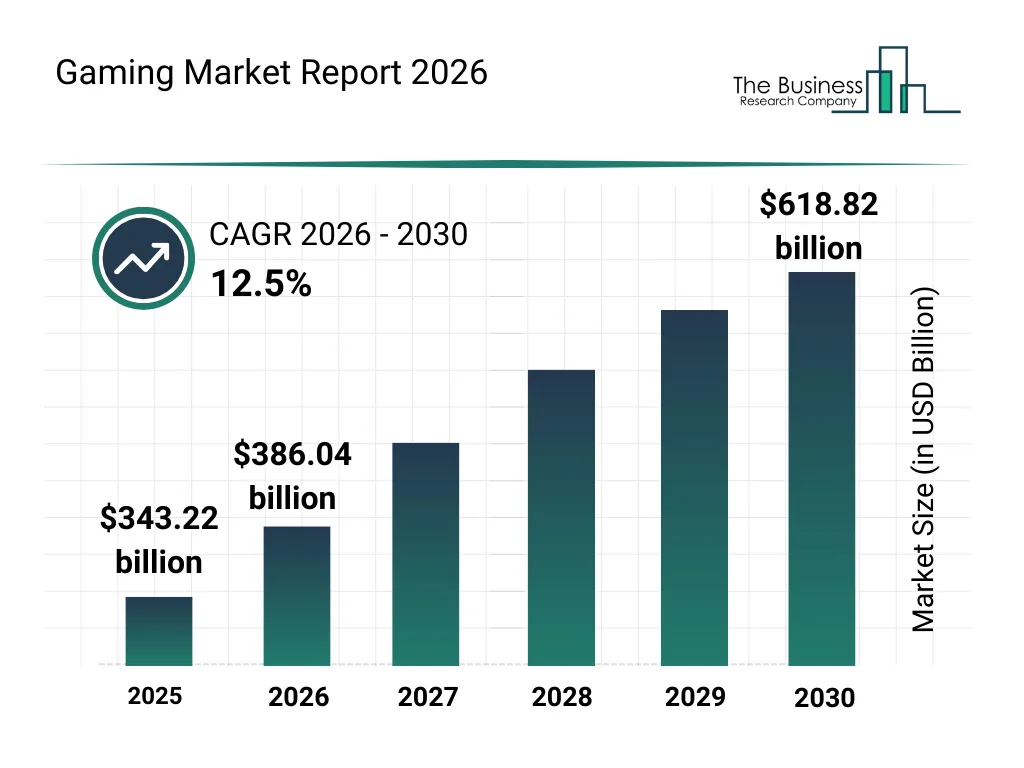
- The global gaming market was valued at $343.22 billion in 2025, showing strong baseline industry demand.
- Market size is projected to reach $386.04 billion in 2026, reflecting steady year-over-year expansion.
- The industry is expected to grow at a CAGR of 12.5% from 2026 to 2030, indicating rapid long-term growth potential.
- By 2027, the market is estimated to surpass $430 billion, highlighting the accelerating adoption of gaming worldwide.
- In 2028, the market is projected to approach $490 billion, driven by mobile gaming and digital distribution growth.
- The market is expected to exceed $550 billion in 2029, fueled by advancements in cloud gaming and immersive technologies.
- By 2030, the global gaming market is forecasted to reach $618.82 billion, marking a significant milestone for the industry.
- The total market is projected to grow by over $275 billion between 2025 and 2030, showcasing massive revenue expansion.
- Consistent annual increases indicate a strong upward trend with no projected decline years during the forecast period.
- This growth trajectory reflects a rising global gamer population, increased spending, and technological innovation in the gaming ecosystem.
Global Gamer Population
- The global gamer population reached 3.6 billion players in 2025.
- In 2026, the number stands at around 3.32 billion active gamers worldwide.
- The gaming audience is expected to grow to 3.58 billion players by 2025, showing steady expansion.
- Mobile gamers alone exceed 3.2 billion users globally, making it the largest segment.
- Mobile gamer count is projected to reach 3.5 billion by 2025–2026.
- Over 60% of internet users worldwide engage in gaming activities.
- Asia leads the global gamer population, followed by Europe and Latin America.
- The U.S. alone hosts thousands of esports players, contributing to professional gaming growth.
Gamer Demographics by Gender
- Approximately 53% of gamers globally are male, while 47% are female.
- In the UK, 50% of women identify as gamers, compared to 57% of men.
- Female participation continues to grow, especially in mobile and casual gaming segments.
- Women are more likely to engage with puzzle, simulation, and casual games.
- Male gamers dominate competitive and esports titles, particularly in FPS and sports genres.
- Gender parity is increasing as mobile gaming lowers barriers to entry globally.
- Social and cooperative gaming modes attract a more balanced gender mix.
- The rise of inclusive game design has contributed to higher female engagement rates in 2024–2026.
Gamer Demographics by Age
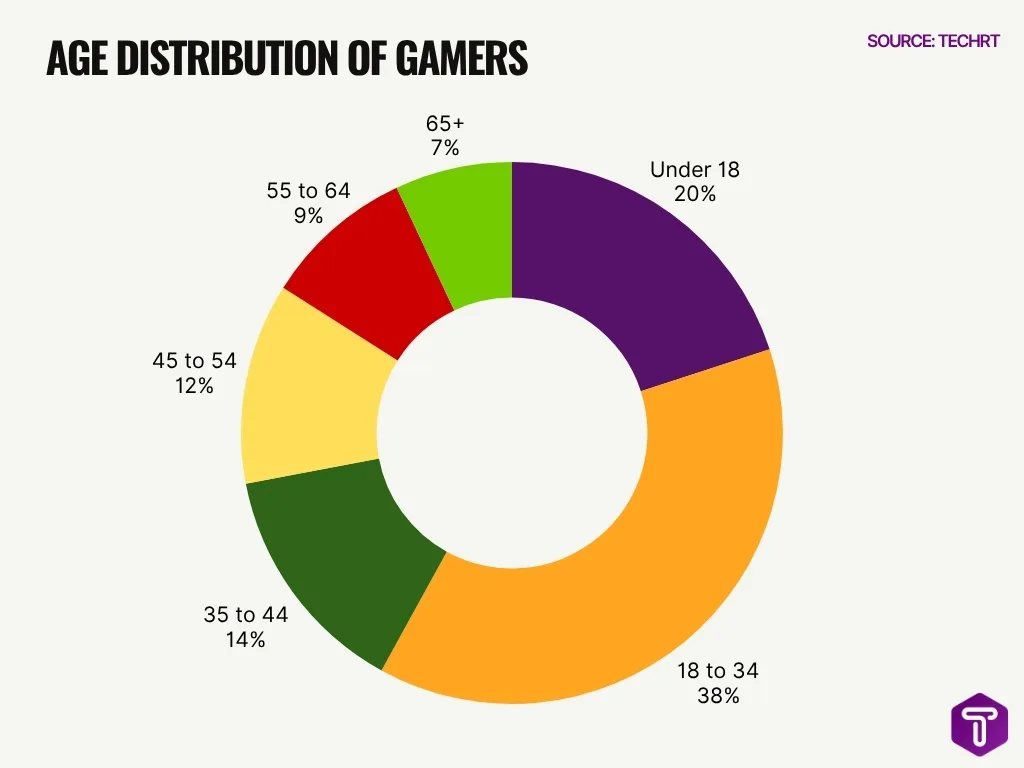
- The largest segment of gamers falls within the 18 to 34 age group, accounting for a dominant 38%, highlighting that gaming is most popular among young adults.
- A significant 20% of gamers are under 18, indicating a strong presence of Gen Z and younger players in the gaming ecosystem.
- Combined, players aged under 34 make up 58% of the total gaming population, showing that younger audiences dominate the industry.
- The 35 to 44 age group contributes 14%, reflecting that gaming remains relevant among mid-career adults.
- Gamers aged 45 to 54 represent 12%, proving that gaming is not limited to younger generations and has broad demographic appeal.
- The 55 to 64 segment accounts for 9%, showing a steady participation of older adults in gaming activities.
- Even the 65+ age group makes up 7%, highlighting that gaming is increasingly embraced by senior players.
- Overall, nearly 42% of gamers are aged 35 and above, demonstrating that gaming has evolved into a cross-generational form of entertainment.
- The data clearly indicates a diverse age distribution, with participation spanning from teenagers to seniors, reinforcing gaming as a mainstream global activity.
Gaming Industry Revenue
- The global gaming industry generated approximately $188–195 billion in 2025, continuing steady growth.
- Mobile gaming contributed over $103 billion, making up the largest share.
- Console gaming generated about $45–50 billion, supported by subscriptions and digital sales.
- PC gaming contributed nearly $40 billion globally, driven by esports and free-to-play titles.
- The U.S. gaming industry alone generated over $56 billion in 2025, one of the largest markets.
- Digital sales account for over 90% of total gaming revenue globally, reflecting a shift from physical formats.
- Subscription services contribute an increasing share, with over 500 million users globally.
- In-game advertising revenue is projected to exceed $20 billion annually by 2026.
- Cloud gaming revenue is expected to grow at a CAGR above 20% through 2030.
Game Development Platform Usage
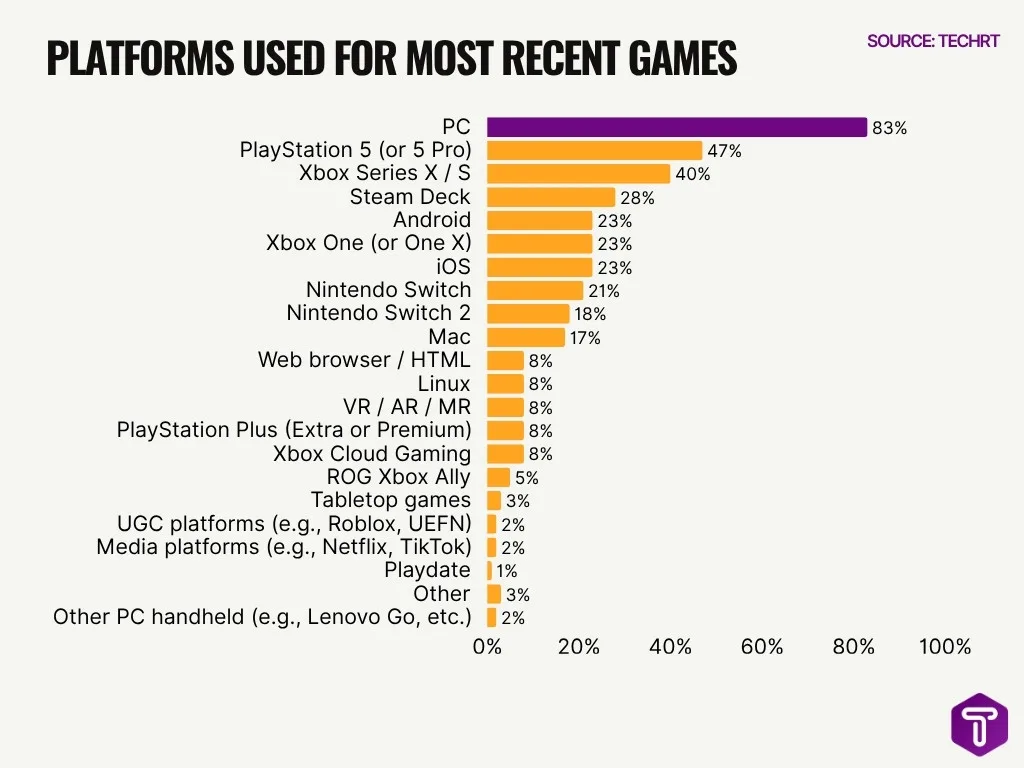
- PC dominates development, with a massive 83% of developers using it for their most recent game or project, making it the clear industry standard.
- Console development remains strong, led by PlayStation 5 at 47% and Xbox Series X/S at 40%, highlighting continued investment in high-performance gaming ecosystems.
- Steam Deck adoption is notable at 28%, signaling rapid growth in portable PC gaming development.
- Mobile platforms maintain steady relevance, with Android, iOS, and Xbox One each at 23%, showing consistent demand for cross-platform and legacy device support.
- Nintendo platforms show mixed traction, with Switch at 21% and Switch 2 at 18%, indicating a transition phase toward newer hardware.
- Mac usage stands at 17%, reflecting a niche but stable segment in development environments.
- Emerging and alternative platforms like Web/HTML, Linux, VR/AR/MR, and cloud services each hold 8%, pointing to diversification in development channels.
- Cloud gaming and subscription ecosystems (e.g., Xbox Cloud Gaming and PlayStation Plus at 8%) are gaining gradual traction among developers.
- Handheld gaming PCs like ROG Xbox Ally (5%) are still early-stage but indicate growing interest in hybrid gaming devices.
- Tabletop games (3%) and UGC platforms (2%), such as Roblox and UEFN, highlight niche but emerging creative ecosystems.
- Media platforms (2%) like Netflix and TikTok are beginning to intersect with gaming, suggesting cross-industry experimentation.
- Ultra-niche platforms like Playdate (1%) and other handheld PCs (2%) remain minimal but showcase innovation at the margins.
- Overall, the data reflects a highly PC-centric ecosystem, with consoles and mobile platforms forming the secondary tier, while emerging technologies and niche platforms continue to expand the landscape.
Mobile Gaming Statistics
- Mobile gaming generated over $103 billion in revenue in 2025, dominating the market.
- It represents around 55% of total global gaming revenue, the largest segment.
- There are more than 3.2 billion mobile gamers worldwide, accounting for most players.
- Average mobile gamer session time increased by 7% year-over-year in 2025.
- Hyper-casual and hybrid games drove over 40% of downloads globally.
- Mobile gamers spend an average of $20–$50 annually per user, depending on region.
- In-app purchases contribute over 90% of mobile gaming revenue.
- The U.S. leads in mobile gaming revenue, contributing over $25 billion annually.
- India ranks among the top in downloads, exceeding 9 billion installs annually.
Console Gaming Statistics
- Console gaming generated approximately $45–50 billion in revenue in 2025.
- There are over 900 million console gamers globally, showing sustained demand.
- The U.S. console market remains one of the largest, with over 50% of gamers using consoles.
- Subscription services like console game passes account for over 30% of console revenue.
- Average console player spending exceeds $120 per year on games and services.
- Console hardware sales saw a slight decline of 2–3% in 2024, stabilizing in 2025.
- Digital game purchases now account for over 70% of console sales.
- Multiplayer console gaming engagement increased by 15% post-2023.
- Next-gen consoles continue to drive performance-based gaming demand, especially in AAA titles.
PC Gaming Statistics
- PC gaming revenue reached approximately $40 billion globally in 2025.
- There are over 1.1 billion PC gamers worldwide, especially in Asia and Europe.
- PC gaming accounts for roughly 21% of total gaming revenue globally.
- Free-to-play games dominate PC gaming, generating over 80% of PC revenue.
- Esports titles such as FPS and MOBA games drive high engagement on PC platforms.
- The average PC gamer spends around 6–8 hours weekly gaming.
- Digital distribution platforms account for over 90% of PC game sales.
- High-performance gaming hardware spending continues to rise, especially for GPUs and accessories.
- Indie games contribute significantly, with thousands of new PC titles released annually.
Number of Gamers by Game Type
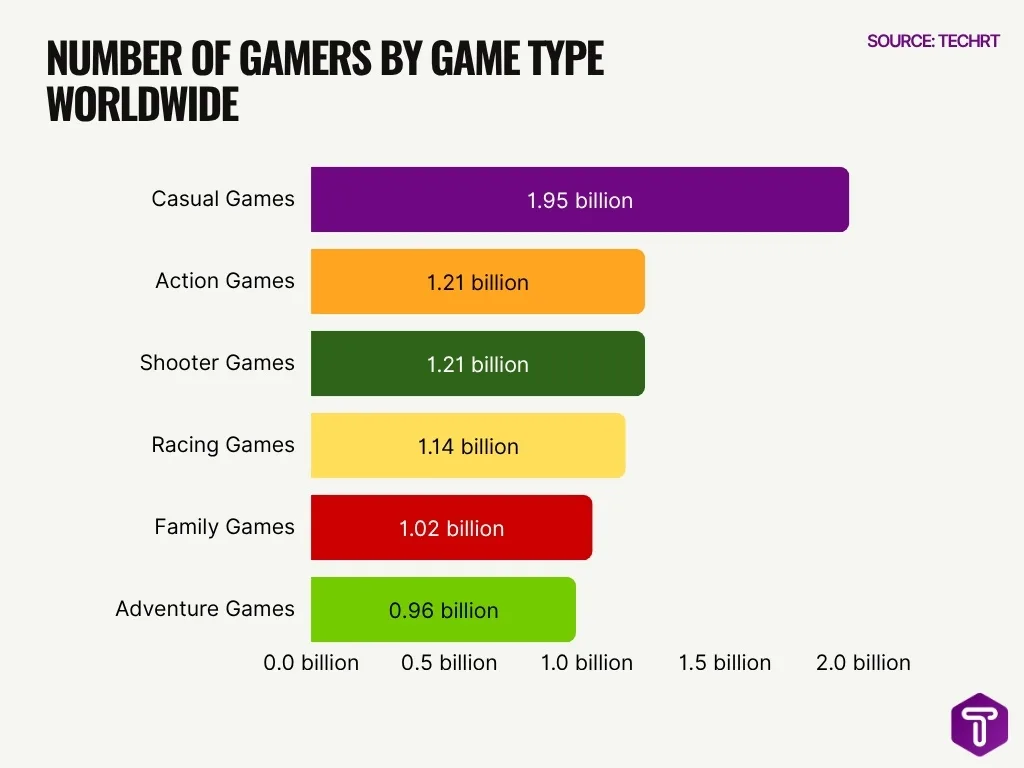
- Casual games dominate the market with 1.95 billion gamers, making them the most popular category globally.
- Action and shooter games are tied, each attracting 1.21 billion players, highlighting strong demand for high-intensity gameplay.
- Racing games have a solid audience of 1.14 billion gamers, showing continued interest in competitive and simulation-based experiences.
- Family games engage around 1.02 billion users, indicating their appeal across multiple age groups and social settings.
- Adventure games have 0.96 billion players, slightly lower but still representing a significant global audience.
- The gap between casual games (1.95B) and the next category (1.21B) shows a massive lead of over 700 million gamers.
- Overall, all listed categories surpass 900 million players, emphasizing the scale and diversity of the global gaming audience.
- The data reflects a clear trend: accessible and easy-to-play games outperform more complex genres in total user base.
Weekly Time Spent Gaming
- The average gamer spends 7–8 hours per week gaming globally.
- In the U.S., gamers average around 8.6 hours weekly, slightly above global levels.
- Mobile gamers spend approximately 4–5 hours per week on games, often in shorter sessions.
- PC gamers tend to spend more time, averaging 6–10 hours weekly.
- Console gamers report around 7–9 hours per week, especially for multiplayer games.
- Younger gamers (Gen Z) often exceed 10 hours per week, driven by online and competitive play.
- Casual gamers typically spend less than 5 hours weekly, focusing on short sessions.
- Esports players and streamers may spend 20–40+ hours weekly, reflecting professional engagement.
- Weekend gaming sessions account for the majority of playtime, especially in working adults.
Top Reasons Why People Play Games
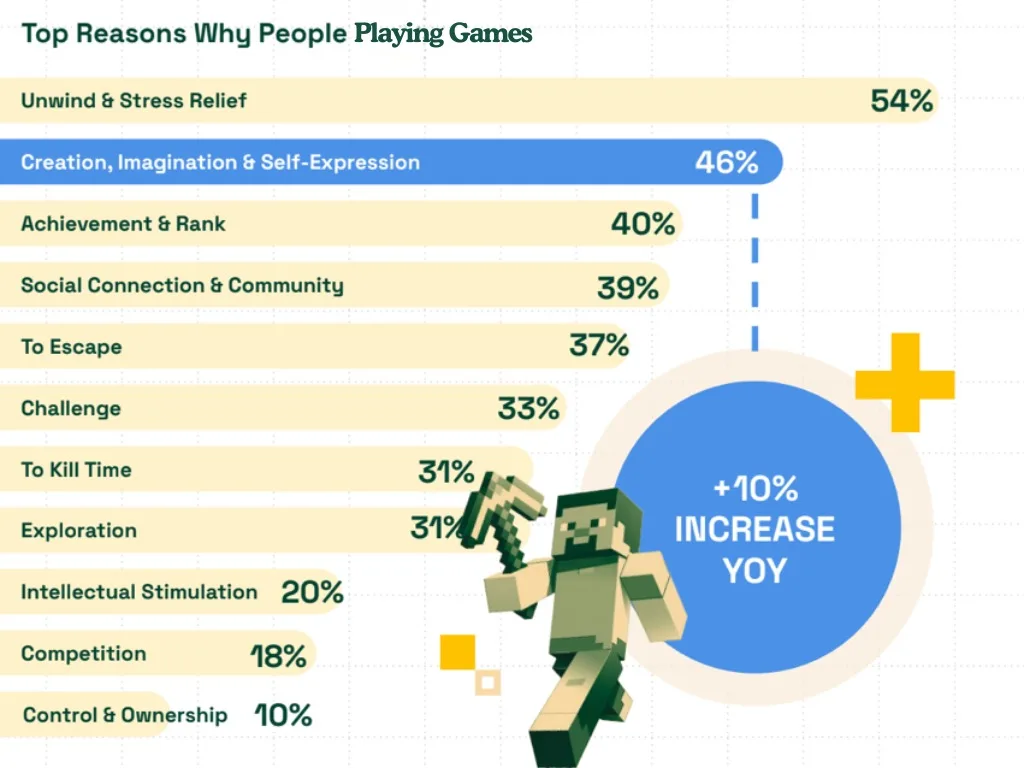
- Stress relief dominates gaming motivations, with 54% of gamers playing to unwind and relax, making it the top reason globally.
- Creativity-driven gameplay is significant, as 46% of players engage in gaming for creation, imagination, and self-expression.
- Achievement-oriented gaming remains strong, with 40% of gamers motivated by rank progression and accomplishments.
- Social gaming continues to rise, with 39% of players valuing community interaction and social connections.
- Escapism is a major factor, as 37% of gamers play to escape from real-world stress or routine.
- Challenge-based engagement attracts 33% of players, highlighting the importance of skill-building and competitive difficulty.
- Casual gaming behavior is evident, with 31% of users playing simply to kill time, showing widespread accessibility of games.
- Exploration-driven gameplay also accounts for 31%, indicating strong interest in open-world and discovery experiences.
- Cognitive benefits play a smaller but notable role, with 20% of gamers seeking intellectual stimulation.
- Competitive gaming appeals to 18%, reflecting interest in PvP and esports-style environments.
- Control and ownership are niche motivators, with only 10% of players driven by customization or in-game control mechanics.
- The gaming industry is experiencing strong momentum, with a +10% year-over-year growth, signaling increasing global engagement and demand.
Professional Gamers and Esports
- The global esports market generated $1.8 billion in revenue in 2025, with steady growth projected.
- Esports audiences surpassed 640 million viewers worldwide in 2025.
- The U.S. esports audience reached over 50 million viewers, reflecting strong regional growth.
- Professional esports players can earn $50,000 to $500,000 annually, depending on sponsorships and winnings.
- Top esports tournaments offer prize pools exceeding $40 million, such as major international events.
- Sponsorship accounts for over 40% of esports revenue, making it the largest income stream.
- Mobile esports is expanding rapidly, contributing to over 15% of total esports revenue.
- Asia-Pacific dominates esports, with more than 55% of global viewership.
- Collegiate esports programs have grown by over 20% annually since 2023, especially in the U.S.
Gamer Spending Habits
- Average gamer spending ranges from $50 to $150 annually, depending on platform and region.
- In the U.S., gamers spend an average of $90+ per year on gaming content and services.
- In-app purchases account for over 70% of total gaming revenue globally.
- Around 60% of gamers make at least one in-game purchase annually.
- Microtransactions dominate spending, especially in free-to-play games.
- Subscription services attract consistent spending, with over 50% of gamers subscribed to at least one service.
- High-spending users (“whales”) contribute up to 50% of total in-game revenue in some games.
- Cosmetic items and battle passes drive significant revenue, particularly in multiplayer games.
- Mobile gamers in the U.S. spend significantly more than global averages, exceeding $25 billion annually.
Gamer Demographics by Region
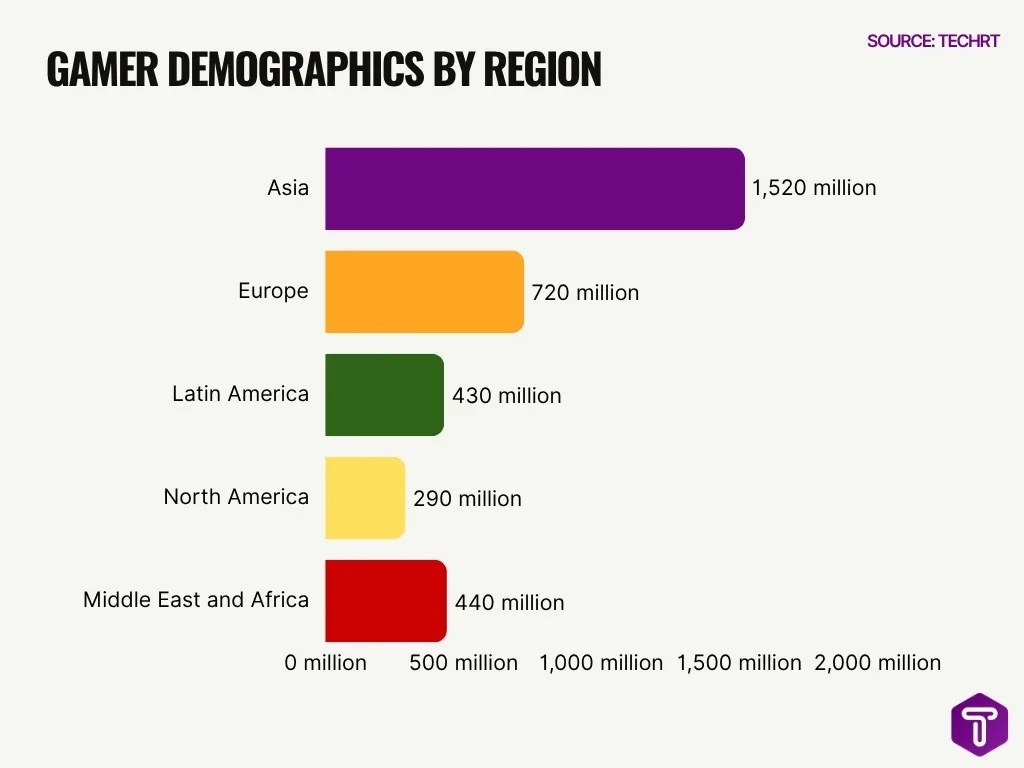
- Asia dominates the global gaming market with 1,520 million gamers, making it the largest gaming population worldwide.
- Europe ranks second, contributing 720 million gamers, highlighting its strong and mature gaming ecosystem.
- The Middle East and Africa region shows significant growth with 440 million gamers, indicating emerging market potential.
- Latin America follows closely with 430 million gamers, reflecting the rapid adoption of mobile and online gaming.
- North America has 290 million gamers, showcasing a high-value market with strong spending power despite a smaller population.
- Combined, emerging regions (Latin America + Middle East & Africa) account for 870 million gamers, signaling future growth opportunities.
- The data clearly shows that Asia alone accounts for a massive share, exceeding the combined total of Europe and North America (1,010 million).
- Global gaming expansion is heavily driven by developing regions, where internet penetration and smartphone usage are rising rapidly.
Gaming Trends and Growth
- The global gaming market is projected to reach $205 billion by 2026, continuing steady expansion.
- Cloud gaming adoption is increasing, with over 45 million users globally in 2025.
- Cross-platform gaming has grown by over 35% since 2023, improving accessibility.
- AI-driven game development is accelerating, improving personalization and gameplay experiences.
- Virtual reality (VR) gaming is expected to grow at a CAGR above 30% through 2030.
- Blockchain gaming and NFTs continue to evolve, though adoption remains volatile.
- Mobile gaming continues to dominate, accounting for over half of global revenue.
- Esports and streaming platforms are driving engagement, especially among Gen Z users.
- Indie game development is rising, with thousands of new titles released annually.
Frequently Asked Questions (FAQs)
How many gamers are there worldwide in 2026?
What is the total value of the global gaming market in 2025–2026?
What percentage of gaming revenue comes from mobile gaming?
How much time do gamers spend playing each week on average?
What share of gamers spend money on in-game purchases?
Conclusion
Gaming reflects a mature yet rapidly evolving industry. Mobile platforms lead revenue, while esports, subscriptions, and cloud gaming reshape how players engage and spend. At the same time, diverse demographics and global expansion continue to push gaming into mainstream culture.
Looking ahead, trends such as AI-driven experiences, cross-platform play, and immersive technologies will define the next phase of growth. For businesses, developers, and marketers, these statistics offer a clear roadmap to understand player behavior, optimize monetization, and stay competitive in a dynamic digital landscape.

Leave a comment
Have something to say about this article? Add your comment and start the discussion.