



B2B marketing operates in a landscape defined by data, automation, and highly targeted digital engagement. Companies no longer rely on broad messaging; instead, they use AI-driven insights, predictive analytics, and personalized content to reach decision-makers across complex buying groups. Industries such as SaaS, manufacturing, and enterprise services now depend on multi-channel strategies, including SEO, email, and account-based marketing, to drive measurable pipeline growth.
At the same time, buyer behavior has shifted. Most B2B customers complete a significant portion of their research online before speaking with sales, which places greater emphasis on content, search visibility, and digital experiences. As marketing and sales teams align more closely and invest in technology, performance tracking and ROI measurement have become central to decision-making. This article brings together the latest B2B marketing statistics to help you understand current trends, benchmark your efforts, and identify growth opportunities.
Editor’s Choice
- 91% of B2B marketers use content marketing as a core strategy.
- The global B2B marketing market reached $20.44 billion in 2025, up from $18.89 billion in 2024.
- 75% of B2B marketers use AI tools for marketing activities, especially content creation.
- Digital channels now account for 61% of total marketing budgets.
- Account-based marketing (ABM) delivers 208% higher ROI than traditional campaigns.
- 67% of B2B buyers prefer digital channels over traditional sales interactions.
- The average B2B lead conversion rate is 13%, with a sales cycle of ~84 days.
Recent Developments
- AI-driven marketing adoption reached 80% among B2B marketers in 2025.
- U.S. B2B tech sales hit $65.8 billion in 2025, growing 4% year-over-year.
- Digital ad spending globally reached $678.7 billion in 2025, with B2B contributing significantly.
- High digital maturity companies exceed sales goals by 110% more than low-maturity peers.
- AI-assisted content is expected to power 85% of B2B content production.
- Video marketing adoption continues to rise, with 91% reporting improved engagement.
- Personalization can increase revenue by up to 15% in B2B marketing.
- Marketing teams using intent data achieve 70% higher conversion rates.
B2B Marketing Overview
- B2B marketing focuses on multi-stakeholder decision-making, unlike B2C’s single buyer model.
- 61% of marketers track website traffic as a primary KPI.
- 53% of B2B marketers measure ROI as a key success metric.
- Buyers now complete most research independently before contacting sales.
- Digital-first experiences dominate, replacing traditional sales outreach.
- Content marketing remains the top channel for lead nurturing and awareness.
- B2B marketing relies heavily on data analytics and personalization.
- Long buying cycles require multi-touch attribution models.
Global B2B Marketing Market Size Statistics
- The global B2B marketing market grew to $20.44 billion in 2025.
- It is projected to reach $30.79 billion by 2030 at a CAGR of 8.48%.
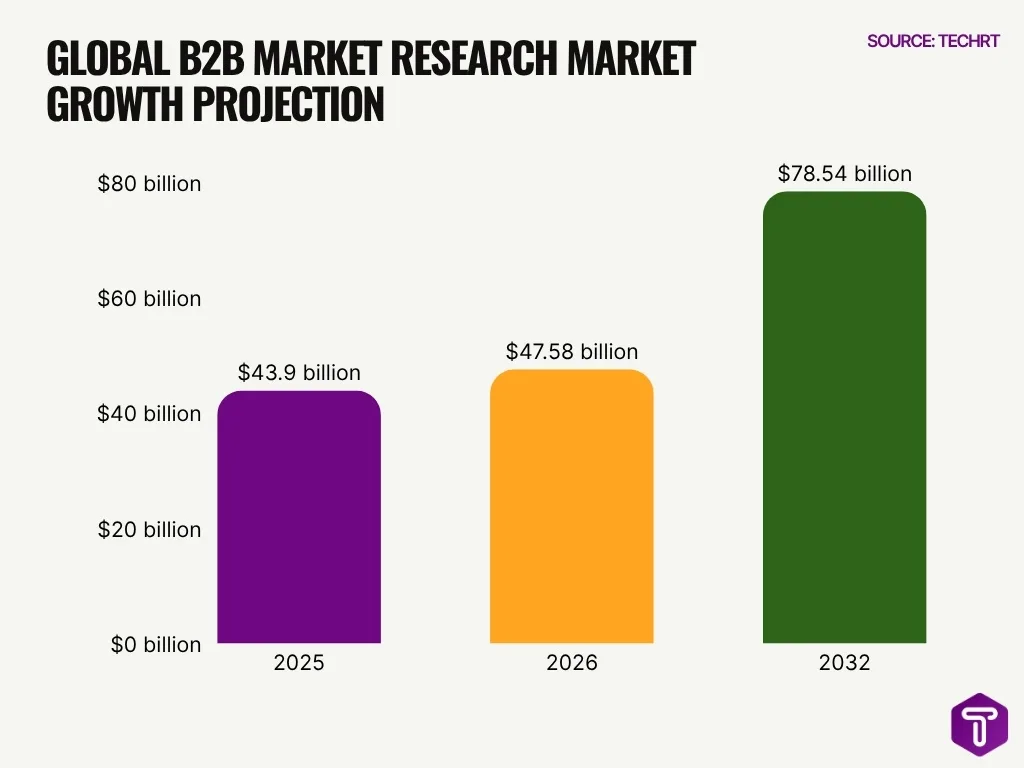
- The B2B market research segment reached $43.9 billion in 2025.
- It is expected to grow to $47.58 billion in 2026.
- The same market could hit $78.54 billion by 2032.
- U.S. B2B digital ad spending alone reached $19.22 billion.
- B2B tech sector revenue is forecast to grow 3% in 2026.
- Global marketing budgets continue shifting toward digital-first ecosystems.
B2B Digital Marketing Adoption Statistics
- 67% of B2B buyers prefer digital self-service channels.
- 80% of marketers use AI-driven automation tools.
- Chatbots now handle up to 80% of B2B interactions.
- 60% of B2B buyers use mobile devices for purchases.
- Digital marketing accounts for over half of total B2B budgets.
- AI improves marketing output efficiency by up to 80%.
- Predictive analytics adoption continues to rise across B2B firms.
- Companies adopting digital commerce outperform peers significantly.
Content Marketing Statistics
- 91% of B2B marketers use content marketing strategies.
- Content marketing generates 3x more leads than traditional marketing.
- Video content drives higher engagement for 91% of marketers.
- Thought‑leadership content influences 74% of B2B buying decisions.
- AI‑generated content is used regularly by 58% of B2B teams.
- Blogs and long‑form content boost organic traffic by 55% year‑over‑year.
- Interactive content delivers 40% higher engagement rates vs static content.
- Personalized content improves conversion rates by 20% on average.
- 73% of marketers say content marketing increases brand awareness.
Effective B2B Marketing Channels
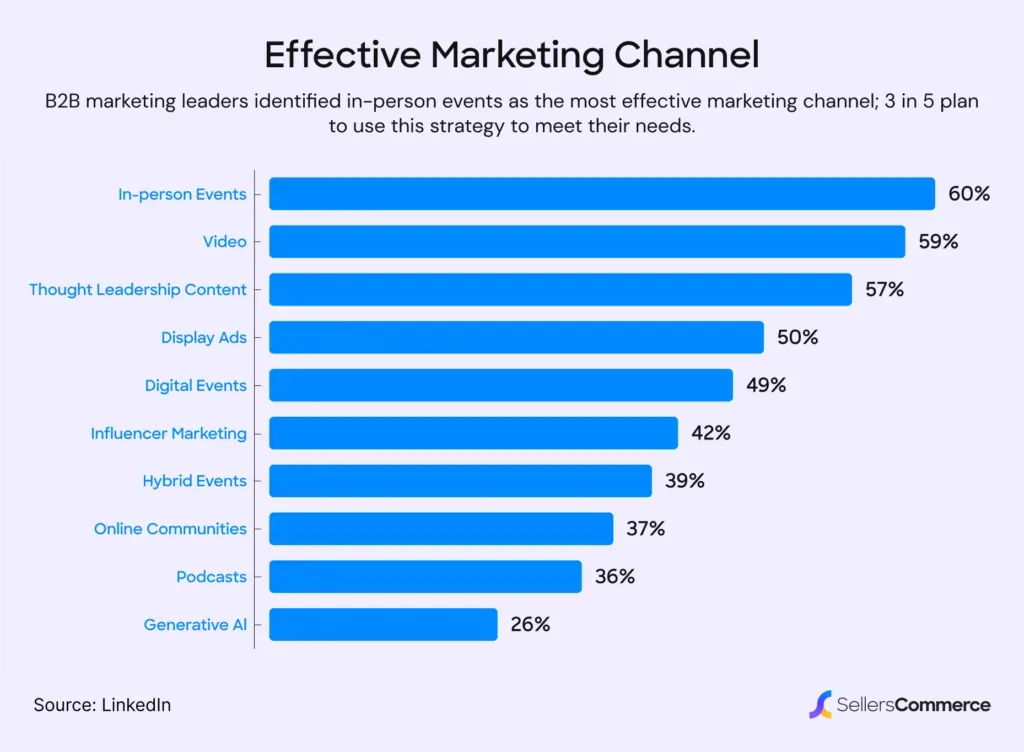
- In-person events lead the pack at 60%, making them the most effective marketing channel, highlighting the continued importance of face-to-face engagement in B2B.
- Video marketing follows closely at 59%, proving that visual content remains a dominant force for engagement and communication.
- Thought leadership content ranks third at 57%, showing that authority-building and expertise-driven content are critical for influencing B2B buyers.
- Display ads (50%) and digital events (49%) still play a strong role, indicating that paid media and virtual experiences continue to deliver measurable results.
- Influencer marketing stands at 42%, reflecting a growing reliance on trusted voices and industry experts to drive credibility.
- Hybrid events (39%) demonstrate the shift toward blended online + offline experiences, offering flexibility and broader reach.
- Online communities (37%) and podcasts (36%) highlight the rising value of engaged audiences and long-form content consumption.
- Generative AI ranks lowest at 26%, suggesting that while it’s emerging and promising, it has not yet reached mainstream effectiveness in B2B marketing.
- Notably, 3 in 5 marketers plan to use in-person events, reinforcing their strategic importance for future campaigns.
SEO Statistics
- 68% of online experiences begin with a search engine, making SEO critical for B2B visibility.
- Organic search drives 53% of all website traffic, outperforming paid and social channels.
- 70% of B2B buyers start their research with Google searches.
- Long-form content (3,000+ words) gets 3.5x more backlinks and traffic.
- 75% of users never scroll past the first page of search results.
- SEO leads have a 14.6% close rate, compared to 1.7% for outbound leads.
- Companies that blog receive 55% more website visitors.
- Mobile-optimized websites account for over 60% of B2B search traffic.
- Page speed improvements can increase conversions by up to 7%.
Social Media Statistics
- 89% of B2B marketers use LinkedIn for lead generation.
- LinkedIn generates 80% of B2B social media leads.
- 73% of B2B marketers report positive ROI from social media marketing.
- Video posts on social platforms receive 2x higher engagement than static posts.
- 64% of B2B buyers review social profiles before making decisions.
- Social selling leaders create 45% more opportunities than peers.
- Twitter (X) remains relevant, with 67% of B2B brands using it for promotion.
- Employee advocacy programs can increase brand reach by up to 561%.
Email Marketing ROI by Industry
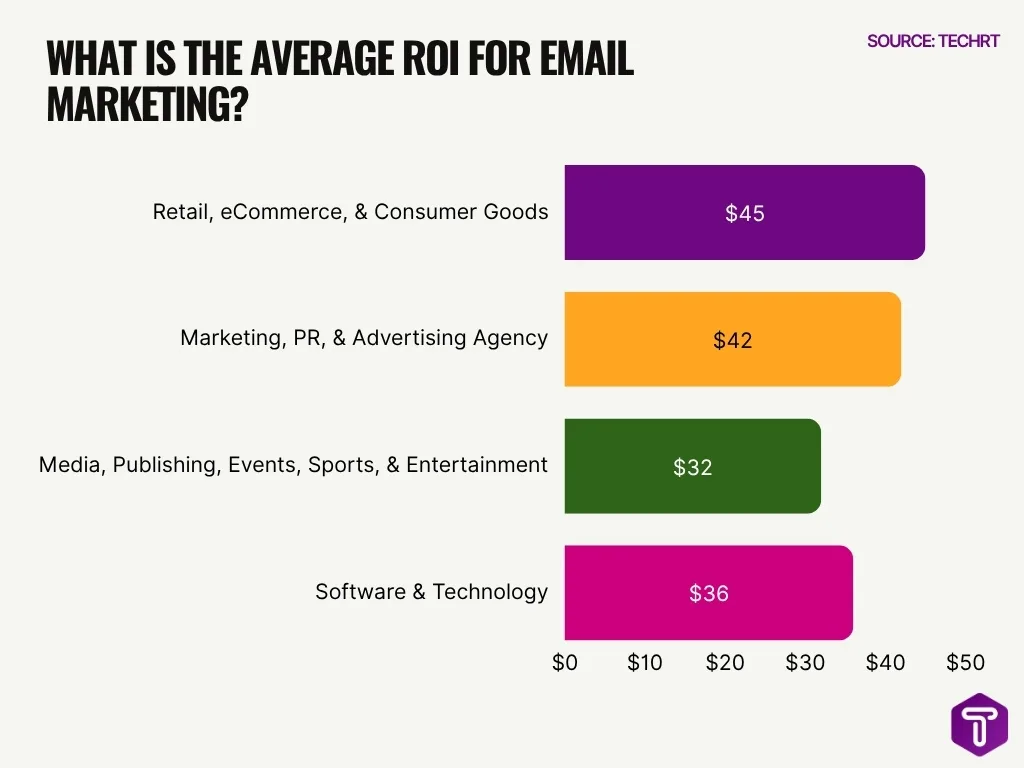
- Email marketing delivers exceptional returns, with industries generating between $32 to $45 ROI for every $1 spent.
- The Retail, eCommerce, & Consumer Goods sector leads significantly, achieving the highest ROI at $45, highlighting its strong dependence on email-driven conversions and repeat purchases.
- Marketing, PR, & Advertising agencies follow closely with an ROI of $42, indicating that even service-based industries benefit heavily from email campaigns.
- The Software & Technology industry reports a solid ROI of $36, showcasing the effectiveness of email in nurturing leads and driving SaaS conversions.
- Media, Publishing, Events, Sports, & Entertainment record the lowest among the group, yet still impressive at $32 ROI, proving email remains a profitable channel across all sectors.
- The ROI gap of $13 between the highest ($45) and lowest ($32) industries suggests varying levels of email marketing maturity and audience engagement strategies.
- Overall, the data reinforces that email marketing remains one of the highest ROI digital channels, consistently outperforming many other marketing tactics across industries.
Lead Generation Statistics
- 61% of marketers say generating traffic and leads is their biggest challenge.
- Companies with mature lead generation processes generate 133% more revenue.
- 68% of B2B businesses use landing pages to capture leads.
- Organizations with 30+ landing pages generate 7x more leads than those with fewer than 10.
- Interactive content converts 2x better than passive content.
- 53% of marketers spend at least half their budget on lead generation.
- Companies that nurture leads make 50% more sales at 33% lower cost.
- Only 27% of leads are sales-ready, highlighting the need for nurturing.
Advertising and Paid Media Statistics
- Global digital ad spend reached $678.7 billion in 2025.
- Paid search accounts for 28% of total website traffic.
- Businesses earn an average of $2 for every $1 spent on Google Ads.
- LinkedIn Ads can reach over 900 million professionals globally.
- Retargeting ads can increase conversion rates by up to 150%.
- Programmatic advertising accounts for over 90% of digital display ad spend.
- Video ads have a 34% higher conversion rate than other formats.
- B2B companies allocate 40% of their budgets to paid media channels.
Account-Based Marketing (ABM) Statistics
- 87% of marketers say ABM delivers higher ROI than other marketing strategies.
- ABM campaigns improve engagement rates by over 3x.
- 70% of marketers use ABM programs in 2025.
- Companies using ABM see 171% uplift in average deal size.
- ABM shortens sales cycles by up to 30%.
- Personalized ABM campaigns increase response rates by 200%.
- 84% of marketers report improved customer relationships through ABM.
- Alignment between sales and marketing improves by 67% with ABM strategies.
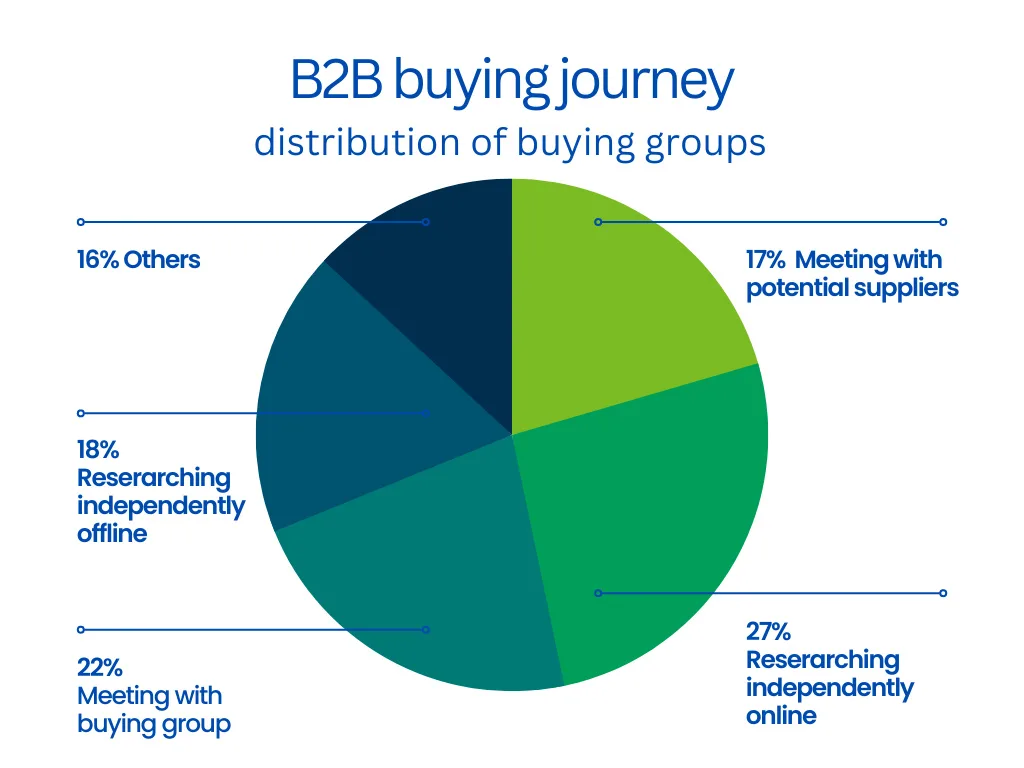
B2B Buying Journey Distribution
- Independent research dominates the journey, with a combined 45% of buyers researching on their own (27% online + 18% offline), highlighting a strong shift toward self-directed decision-making.
- Online research is the single largest activity, accounting for 27%, indicating that digital channels, content marketing, and SEO play a critical role in influencing B2B buyers.
- Offline research still holds relevance at 18%, showing that traditional sources, events, and personal networks continue to impact purchasing decisions.
- Collaborative decision-making remains significant, with 22% of buyers engaging in meetings with their buying group, emphasizing the importance of multi-stakeholder alignment.
- Direct interaction with suppliers contributes 17%, suggesting that sales conversations, demos, and consultations are still key touchpoints in the journey.
- The “Others” category accounts for 16%, indicating a diverse mix of additional activities such as peer recommendations, third-party reviews, and informal research.
- Overall, the data reflects a hybrid buying behavior, where digital research, offline insights, and group collaboration collectively shape B2B purchasing decisions.
Marketing Technology and Automation Statistics
- The global marketing automation market reached $6.62 billion in 2024 and is projected to exceed $9.5 billion by 2027.
- 76% of companies use marketing automation to streamline campaigns and workflows.
- Businesses using automation see a 14.5% increase in sales productivity.
- 80% of marketers report more leads due to automation tools.
- CRM platforms drive 29% higher sales and 34% better forecasting accuracy.
- 58% of B2B marketers use marketing automation for email campaigns.
- Companies using automation for lead nurturing generate 50% more sales-ready leads.
- Integration of martech stacks improves campaign efficiency by up to 30%.
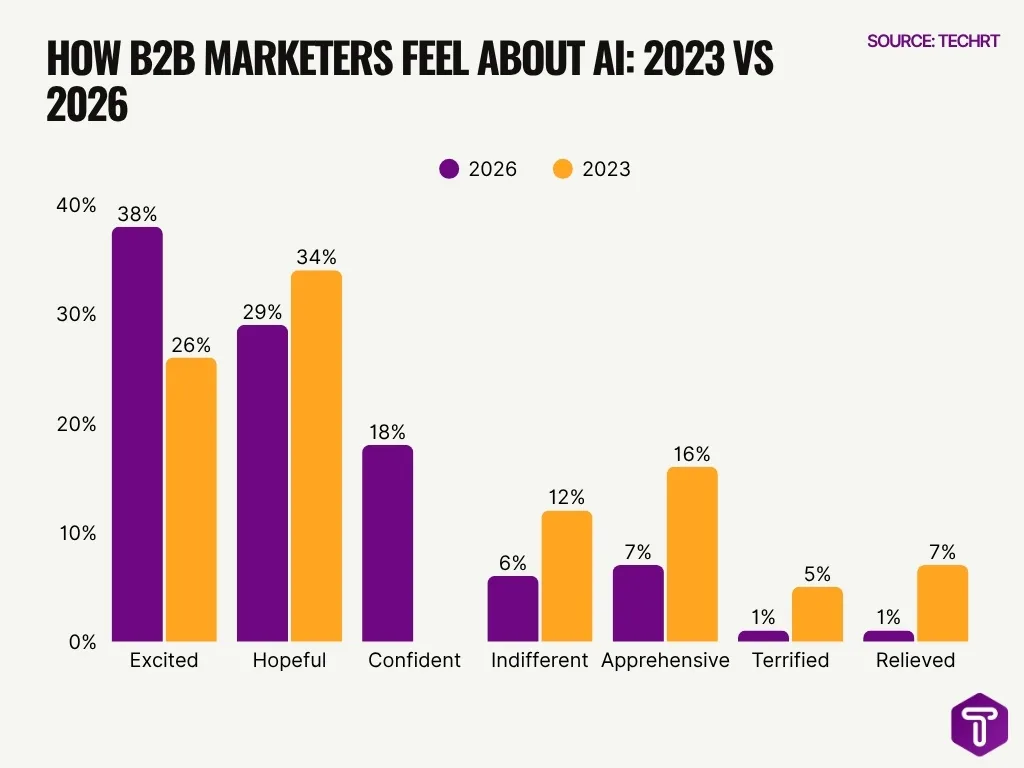
How B2B Marketers’ Sentiment Toward AI Is Shifting
- Excitement is surging, rising from 26% in 2023 to 38% in 2026, making it the dominant sentiment among B2B marketers.
- Hopefulness is declining, dropping from 34% to 29%, suggesting a shift from cautious optimism to more defined expectations.
- Confidence emerges strongly, with 18% in 2026 (up from N/A in 2023), indicating growing trust and maturity in AI adoption.
- Indifference is cut in half, falling from 12% to 6%, showing that fewer marketers are ignoring AI.
- Apprehension drops significantly, decreasing from 16% to 7%, highlighting reduced fear of uncertainty and risks.
- Fear is nearly eliminated, with “Terrified” shrinking from 5% to just 1%, signaling greater comfort with AI technologies.
- Relief also declines, from 7% to 1%, implying that AI is no longer seen as a temporary solution but a long-term strategic tool.
- Overall, sentiment is clearly shifting from mixed and cautious emotions in 2023 to a more positive, confident, and acceptance-driven mindset in 2026.
Emerging Trends and AI Statistics
- 76% of marketing teams now use AI in core operations, up from 29% in 2021.
- The AI marketing market is valued at $47.32 billion in 2025, projected to reach $107.5 billion by 2028.
- ChatGPT referrals convert at 15.9%, while Google organic sits at 1.76%.
- AI referral traffic grew 357% year‑over‑year.
- 35% of Gen Z use AI tools as their first research stop.
- 75–85% of marketing teams report using at least one AI‑powered tool by 2026.
- Over 60% of marketers use AI weekly; 35–45% rely on AI daily for content, analytics, or optimization.
- AI and machine learning power 17.2% of all marketing activities (Spring 2025), up 100% since 2022.
- Generative AI adoption in marketing surged 116% YoY, now at 15.1% of activities vs 7.0% in Spring 2024.
- 69.1% of marketers have integrated AI into operations (2024), up from 61.4% prior year.
Budget and ROI Statistics
- B2B companies allocate an average of 9.1% of revenue to marketing budgets.
- Digital marketing accounts for over 60% of total marketing spend.
- 49% of marketers say ROI measurement is their top challenge.
- Companies that track ROI effectively are 1.6x more likely to secure higher budgets.
- Content marketing delivers 3x more leads per dollar spent than paid advertising.
- Organizations with strong alignment between marketing and sales achieve 20% annual revenue growth.
- 44% of marketers plan to increase budgets in 2026.
- High-performing companies allocate 70% of their budgets to digital-first strategies.
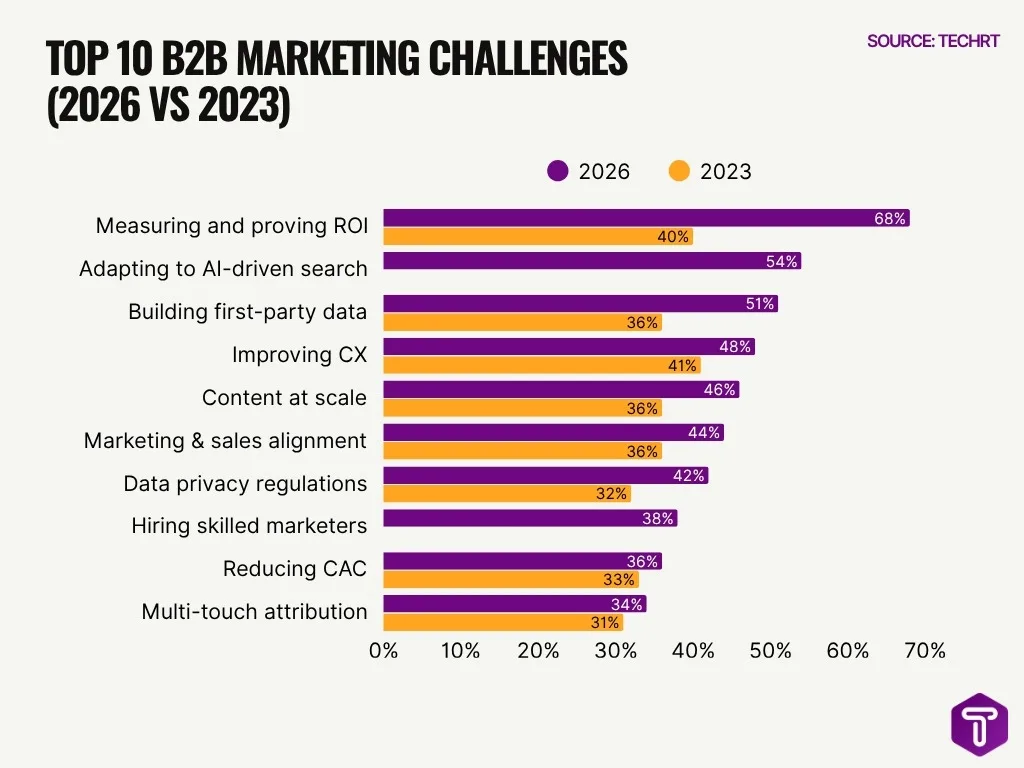
Top B2B Marketing Challenges (2026 vs 2023)
- ROI measurement dominates as the #1 challenge, rising sharply to 68% in 2026 from 40% in 2023, highlighting increasing pressure on marketers to prove business impact.
- AI-driven search emerges as a major new hurdle, with 54% of marketers in 2026 identifying it as a challenge, compared to 0% in 2023, signaling a rapid shift toward AI-powered discovery.
- First-party data strategy is gaining urgency, climbing to 51% in 2026 from 36% in 2023, as privacy changes and cookie deprecation reshape data collection.
- Customer Experience (CX) remains consistently important, increasing moderately to 48% in 2026 from 41% in 2023, reinforcing its role in competitive differentiation.
- Scaling content continues to challenge marketers, with 46% in 2026 vs 36% in 2023, reflecting the demand for high-volume, high-quality content.
- Marketing and sales alignment is still a key friction point, rising to 44% in 2026 from 36% in 2023, emphasizing the need for better cross-team integration.
- Data privacy regulations are becoming more impactful, growing from 32% in 2023 to 42% in 2026, driven by stricter global compliance requirements.
- Talent shortage is a growing concern, with 38% of marketers in 2026 citing hiring skilled marketers as a challenge, up from 0% in 2023.
- Customer Acquisition Cost (CAC) pressures persist, increasing slightly to 36% in 2026 from 33% in 2023, indicating ongoing efficiency concerns.
- Multi-touch attribution remains difficult, with 34% in 2026 vs 31% in 2023, showing limited progress in tracking complex buyer journeys.
Sales and Alignment Statistics
- Companies with strong sales and marketing alignment achieve 36% higher customer retention rates.
- Misalignment costs businesses 10% or more in annual revenue loss.
- 87% of sales and marketing leaders say collaboration drives growth.
- Organizations with aligned teams close deals 38% faster.
- Shared KPIs improve performance across teams by up to 32%.
- 79% of leads never convert due to a lack of nurturing and alignment.
- Companies with integrated CRM and marketing systems see 41% higher revenue per salesperson.
- Alignment increases win rates by over 15%.
Data and Analytics Statistics
- 64% of B2B marketers rely on data analytics for decision-making.
- Data-driven organizations are 23x more likely to acquire customers.
- 57% of companies use advanced analytics tools for marketing optimization.
- Real-time data usage improves campaign performance by up to 25%.
- Businesses using data personalization see 5-8x ROI on marketing spend.
- Data privacy concerns impact over 70% of marketing strategies.
- Companies leveraging first-party data outperform competitors significantly in conversions.
- Predictive analytics adoption continues to grow across more than 60% of enterprises.
Frequently Asked Questions (FAQs)
What percentage of B2B marketing budgets goes to digital channels?
How much is projected B2B advertising spend in the U.S. by 2026?
What percentage of marketers say lead generation is their biggest challenge?
What ROI can SEO deliver in B2B marketing?
What percentage of B2B marketers use LinkedIn for lead generation?
Conclusion
B2B marketing reflects a clear shift toward data-driven strategies, AI integration, and digital-first engagement. Companies that invest in automation, align sales with marketing, and leverage analytics consistently outperform their peers. At the same time, evolving buyer behavior demands more personalized, transparent, and value-driven interactions across every touchpoint.
As budgets expand and technologies mature, marketers who focus on measurable ROI and customer-centric experiences will lead the next phase of B2B growth. Use these statistics to benchmark your strategy, identify gaps, and uncover new opportunities in an increasingly competitive landscape.

Leave a comment
Have something to say about this article? Add your comment and start the discussion.