




Virtual private networks (VPNs) have evolved from niche cybersecurity tools into essential components of modern internet usage. Today, individuals rely on VPNs to secure sensitive data on public Wi-Fi, protect their browsing activity from trackers, and access content that may be restricted in their region. At the same time, businesses use VPNs to enable secure remote work, safeguard internal communications, and maintain compliance with data protection standards.
As digital transformation accelerates across industries, concerns around privacy, surveillance, and cyber threats continue to grow. This shift has pushed VPN adoption into the mainstream, with billions of users worldwide now integrating these tools into their daily online routines. Whether it’s a remote employee accessing company systems or a consumer streaming international content, VPNs play a critical role in shaping how people interact with the internet. Let’s explore the latest statistics and trends to better understand the scale, growth, and real-world impact of VPN usage.
Editor’s Choice
- 23.1% of global internet users actively use a VPN as of 2024–2025, highlighting mainstream adoption.
- Over 1.7–1.8 billion people worldwide use VPNs in 2025, reflecting rapid global expansion.
- Around 31% of internet users globally rely on VPN services in 2025.
- The global internet population reached 6 billion users (74% penetration) in 2025, driving VPN demand.
- In the U.S., 42% of users reported VPN usage, nearly double the global average.
- About 61% of mobile users use VPNs at least weekly, showing strong engagement.
- Nearly 68% of Americans remain unaware or don’t use VPNs, indicating room for growth.
Recent Developments
- VPN downloads surged in multiple countries, with spikes as high as 35,000% during political or regulatory events in 2025.
- Proton VPN expanded its infrastructure into 5 new countries, improving global accessibility.
- Independent audits now validate “no-logs” claims, increasing user trust in VPN providers.
- Over 700 million VPN app downloads were linked to security concerns, pushing for stricter scrutiny.
- VPN adoption stabilized globally between 22.7% and 24.7% from 2022 to 2024, indicating market maturity.
- Global VPN downloads reached 130 million in just six months (2023), showing sustained demand.
- Remote and hybrid work continue to drive enterprise VPN usage growth.
- VPN adoption rates rose from 6.95% in 2020 to 12.35% in 2024, showing steady growth.
Key VPN Statistics Overview
- VPN usage globally averages ~23% of internet users, indicating widespread adoption.
- Total VPN users exceeded 1.5 billion worldwide in 2025.
- VPN usage is considered mainstream rather than niche as of 2024.
- About half of VPN users use the service at least monthly, showing moderate engagement.
- 43% of users cite security as their primary reason for VPN usage.
- Only 9% use VPNs mainly for entertainment, indicating a security-first mindset.
- Around 60% of VPN users are male, compared to 40% female globally.
- VPN usage correlates strongly with rising cybersecurity awareness globally.
How People Use VPNs
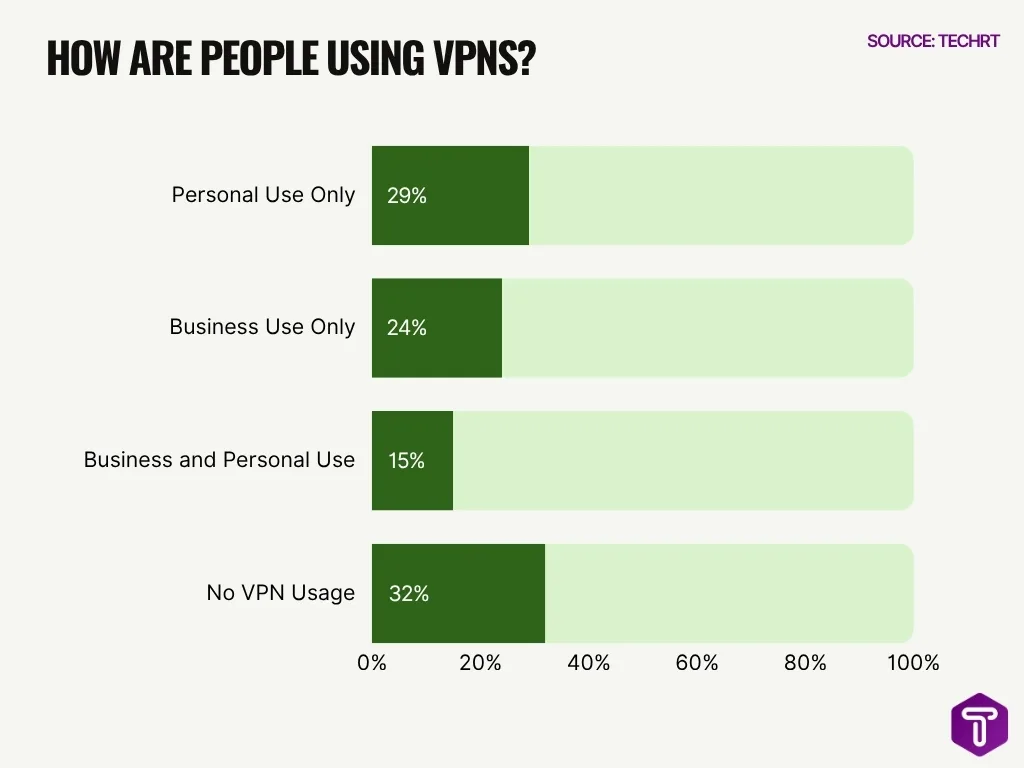
- 32% of respondents report no VPN usage, making it the largest segment, indicating a significant untapped market for VPN adoption.
- 29% use VPNs for personal purposes only, showing strong demand driven by privacy, streaming, and online security needs.
- 24% rely on VPNs exclusively for business use, highlighting their importance in remote work, secure access, and corporate data protection.
- Only 15% use VPNs for both personal and business, suggesting a gap in unified usage behavior across contexts.
- Overall, 68% of users engage with VPNs in some capacity, indicating a majority adoption but still room for growth.
- The relatively low combined usage segment (15%) may point to a lack of awareness or separate tools for work and personal use.
- Businesses account for a substantial share (24% + part of 15%), reinforcing VPNs as a critical enterprise security tool.
- The dominance of personal-only users (29%) over business-only (24%) suggests that consumer VPN markets remain slightly stronger than enterprise-only usage.
Number of VPN Users Worldwide
- Global VPN users reached approximately 1.7–1.8 billion in 2025.
- Estimates suggest over 1.75 billion VPN users globally, representing about one-third of internet users.
- Another dataset places VPN users at 1.5 billion+ globally.
- The VPN user base has grown in parallel with global internet penetration, reaching 74%.
- The U.S. alone accounts for over 100 million VPN users.
- VPN adoption continues to rise in emerging markets due to censorship and mobile internet growth.
- VPN user growth has slowed slightly, indicating a shift from rapid adoption to consistent usage patterns.
- Millions of new users adopt VPNs annually as internet access expands globally.
VPN App Users Distribution by Platform
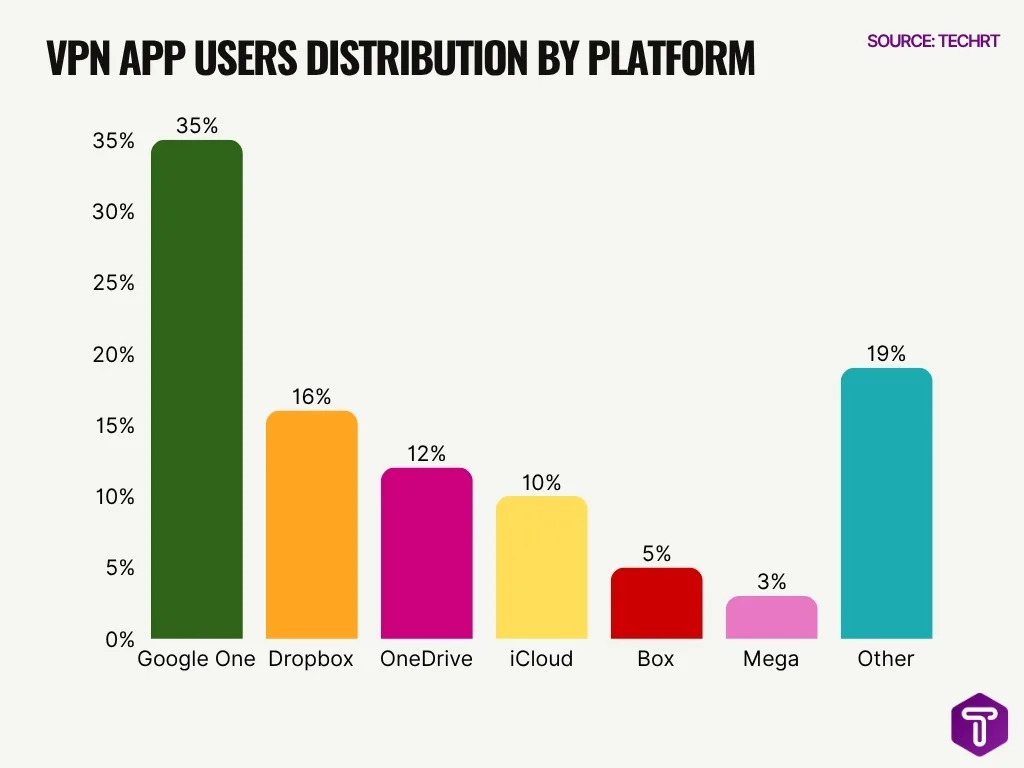
- Google One dominates the market, accounting for the largest share at 35%, significantly ahead of all other platforms.
- Dropbox ranks second with 16%, capturing less than half of Google One’s user share.
- OneDrive holds 12%, showing moderate adoption but still trailing behind the top two platforms.
- iCloud accounts for 10%, indicating a solid but smaller user base compared to competitors.
- “Other” platforms collectively make up 19%, highlighting a fragmented market beyond the major players.
- Box (5%) and Mega (3%) have minimal market share, suggesting limited adoption among users.
- The top four platforms (Google One, Dropbox, OneDrive, iCloud) together represent 73% of total users, showing strong market concentration.
- There is a clear dominance gap, with Google One leading by a wide margin of 19 percentage points over Dropbox.
- The data indicates a highly competitive mid-tier segment, where platforms like Dropbox, OneDrive, and iCloud are relatively close in share.
- Smaller providers face significant scalability challenges, as seen in their single-digit market shares.
VPN Adoption Rates by Region
- The United States reports ~42% VPN usage, significantly above the global average.
- The UAE leads globally with over 65% VPN adoption.
- Indonesia shows 61% penetration, among the highest worldwide.
- Russia reports VPN usage rates above 37%, driven by restrictions.
- European markets show ~49% usage in some countries, reflecting privacy awareness.
- Asia-Pacific regions show strong growth due to mobile-first internet usage.
- Latin America shows lower adoption rates due to infrastructure and awareness gaps.
- Regions with censorship or surveillance laws consistently show higher VPN demand spikes.
VPN Users by Country
- The United States boasts around 75 million VPN users in 2025, with 32% of adults reporting usage despite a decline from prior years.
- Indonesia exhibits one of the highest adoption rates at about 55% of internet users employing VPNs for privacy and access.
- India leads in absolute numbers with over 403 million VPN users, fueled by its massive population and content demands.
- China has an estimated 15-35% VPN adoption rate among its population, translating to 210-490 million users despite restrictions.
- UAE tops global charts with an average 65.78% VPN adoption from 2020-2025, peaking at 85.5% in 2025.
- Brazil sees around 31-35% VPN usage among internet users, driven by streaming needs and recent privacy surges.
- Germany reports strong awareness, with approximately 30% VPN penetration, particularly in the cloud and enterprise sectors.
- UK VPN adoption stands at 19.63-24% average, with 10.7 million downloads in H1 2025 alone showing growth.
VPN User Demographics by Age
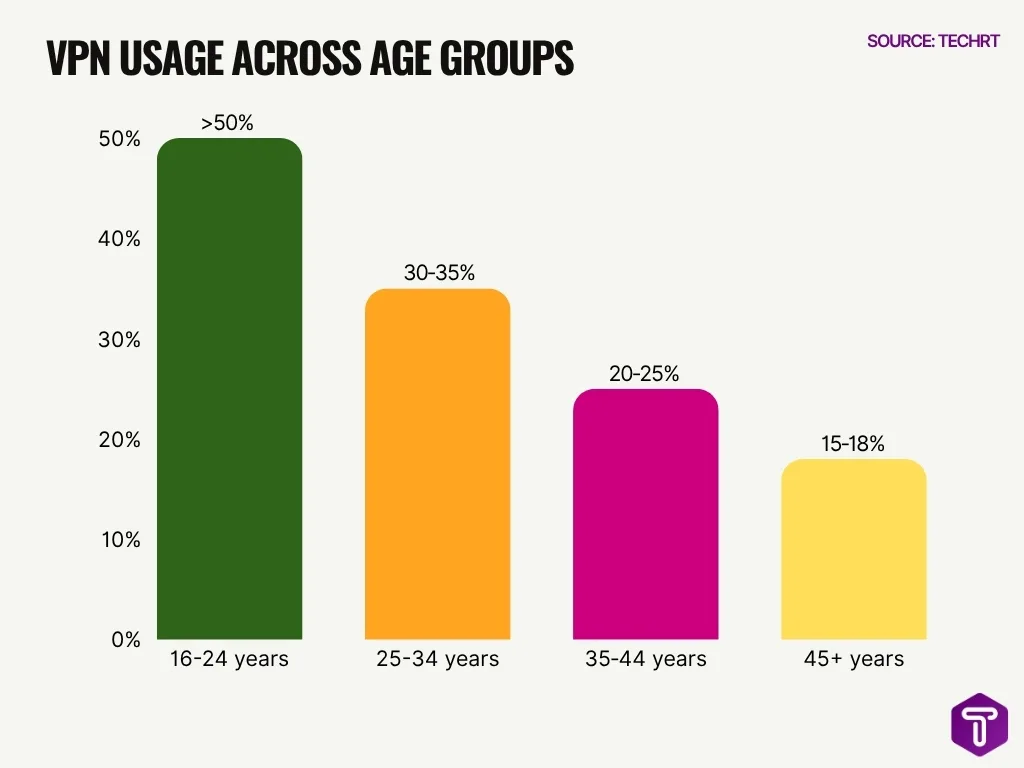
- Users aged 16–24 represent the largest VPN user group globally, often exceeding 35% share.
- Around over 50% of Gen Z users report using a VPN regularly.
- Millennials (25–34) account for roughly 30%–35% of VPN users, making them a key demographic.
- Users aged 35–44 represent about 20%–25% of total VPN users.
- Only 15%–18% of users aged 45+ actively use VPN services.
- Younger users are twice as likely to use VPNs compared to older demographics.
- Students and early-career professionals drive adoption due to streaming and privacy needs.
- VPN awareness among users over 55 remains below 30%, showing a major adoption gap.
VPN User Demographics by Gender
- Approximately 60% of VPN users are male, compared to 40% female globally.
- In the U.S., 62% of VPN users are men, while women account for 38%.
- Female VPN usage has grown steadily, increasing by over 10% in the past 3 years.
- Men are more likely to use VPNs for gaming and torrenting, while women prioritize privacy.
- Gender gaps are narrowing in Europe, where female usage now reaches 45%+ in some regions.
- Younger female users (18–34) show higher adoption compared to older female demographics.
- Workplace VPN usage shows a more balanced gender distribution, especially in corporate settings.
- Awareness campaigns have increased female adoption in emerging markets.
VPN Usage by Device
- Over 60% of VPN usage occurs on mobile devices, reflecting smartphone dominance.
- Android accounts for the majority of VPN downloads, with over 70% market share.
- iOS users represent about 25%–30% of VPN app usage globally.
- Desktop VPN usage remains strong, with over 40% of users accessing VPNs on PCs or laptops.
- Around 35% of users install VPNs on multiple devices, including routers and smart TVs.
- Smart TV and streaming device VPN usage grew by over 20% year-over-year.
- Browser-based VPN extensions account for 15%–20% of usage, especially for quick access.
- Enterprise environments often deploy VPNs across entire networks, not just individual devices.
VPN Usage Frequency
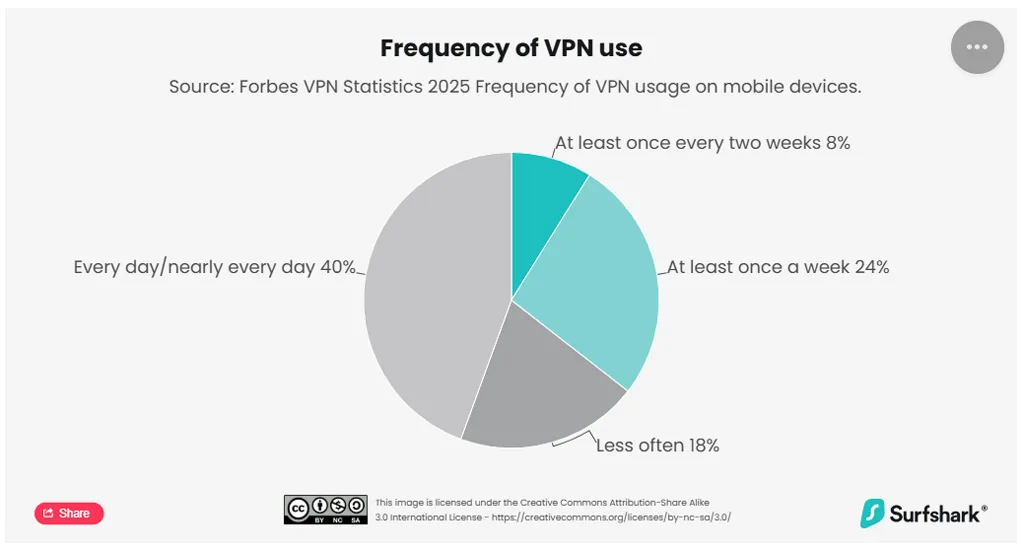
- A significant 40% of users rely on VPNs every day or nearly every day, indicating strong habitual usage and high dependency on privacy tools.
- Around 24% of users access VPNs at least once a week, showing consistent but not daily engagement.
- Approximately 18% of users use VPNs less frequently, suggesting occasional or need-based usage patterns.
- Only 8% of users report using VPNs once every two weeks or less, highlighting a relatively small segment of infrequent users.
- Overall, more than 64% of users (daily + weekly) use VPNs regularly, demonstrating widespread adoption and routine usage behavior.
- The data indicates that VPNs are no longer niche tools but are becoming a mainstream digital necessity for privacy, security, and access.
Personal vs Business VPN Usage
- Personal use accounts for roughly 70% of total VPN usage, compared to 30% business use.
- Over 68% of businesses worldwide use VPNs to secure remote work.
- Enterprise VPN adoption increased significantly after 2020, driven by hybrid work models.
- Small businesses report VPN usage rates of over 50%, especially in the IT and finance sectors.
- Corporate VPN usage often involves centralized network security systems rather than standalone apps.
- Personal users primarily use VPNs for privacy, streaming, and bypassing restrictions.
- Business users focus on data encryption and secure remote access.
- Around 40% of remote employees depend on VPNs daily for work-related tasks.
VPN Usage for Streaming and Entertainment
- Nearly 1 in 4 (23%) VPN users rely on them for international streaming content.
- 46% of personal VPN users employ them to access streaming services like Netflix and Hulu.
- Over 40% of Netflix subscribers worldwide use VPNs to bypass geo-restrictions on libraries.
- 51% of global VPN users cite access to entertainment content as their primary motivation.
- 23% of VPN users specifically target geo-restricted streaming for platforms like Disney+.
- Asia-Pacific regions show the highest VPN adoption for entertainment, surpassing North America.
- Video streaming VPN market valued at $2.5 billion in 2025, growing at 15% CAGR.
- 26% of VPN users actively seek region-locked content for enhanced viewing options.
Top Reasons People Use VPNs
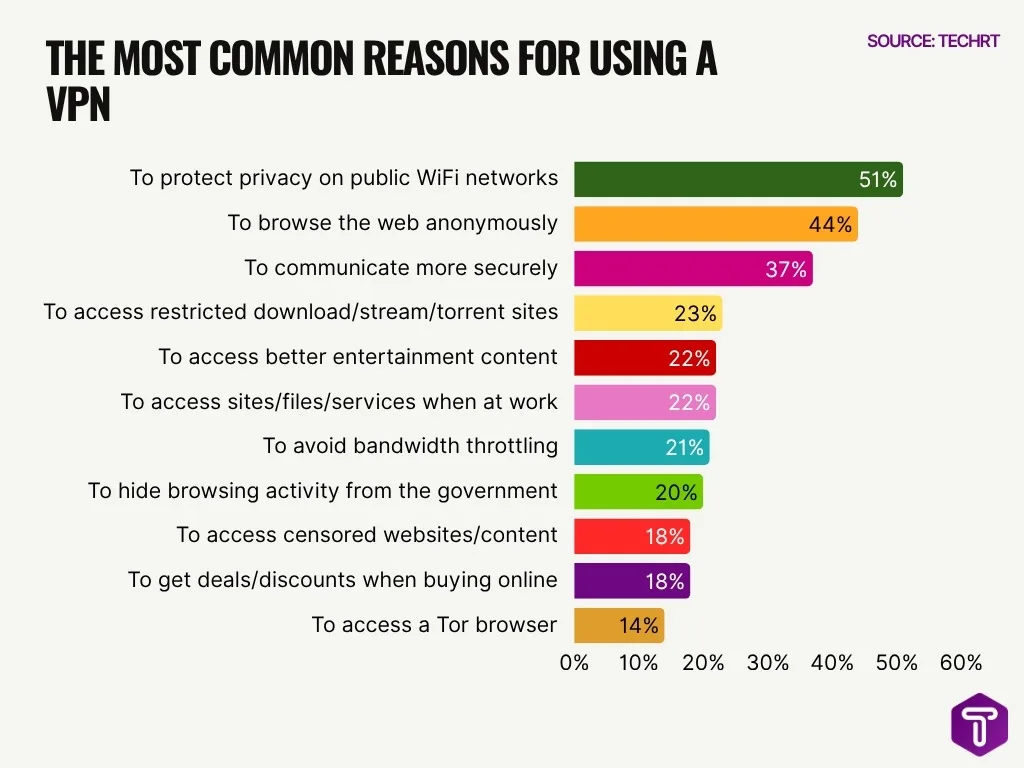
- The top reason for VPN usage is protecting privacy on public WiFi, cited by 51% of users, highlighting strong concerns around unsecured networks.
- A significant 44% of users rely on VPNs to browse anonymously, showing that online anonymity remains a major priority.
- Around 37% use VPNs to enhance communication security, indicating growing awareness of data protection in messaging and online interactions.
- Access-related motivations are also prominent, with 23% using VPNs to reach restricted download or streaming sites.
- Entertainment plays a key role, as 22% of users use VPNs to unlock better content, such as region-locked streaming services.
- Similarly, 22% use VPNs to access work-related sites or files, suggesting workplace restrictions drive adoption.
- About 21% of users aim to avoid bandwidth throttling, pointing to performance optimization as a use case.
- Privacy from authorities is a concern for 20%, who use VPNs to hide browsing activity from the government.
- Circumventing censorship is another factor, with 18% accessing blocked websites or content using VPNs.
- Price sensitivity appears as well, with 18% using VPNs to find better deals or discounts online by changing virtual locations.
- A smaller segment (14%) uses VPNs to access the Tor browser, indicating niche use for deeper anonymity.
- Overall, the data shows VPN usage is driven primarily by privacy (51%), anonymity (44%), and security (37%), while content access and performance benefits form secondary motivations.
Motivations to Use a VPN for Privacy and Security
- 43% of users cite privacy as their main reason for using a VPN.
- Over 50% of users rely on VPNs to secure public Wi-Fi connections.
- Around 30% of users use VPNs to avoid tracking by advertisers.
- Data breaches impacted over 3 billion records globally in 2024, increasing demand for privacy tools.
- Nearly 70% of users express concern about online privacy, fueling VPN adoption.
- About 20% of users rely on VPNs to bypass censorship, especially in restricted regions.
- VPN encryption helps protect sensitive data, especially for remote workers and businesses.
- Cybersecurity awareness campaigns have contributed to double-digit growth in VPN adoption.
Free vs Paid VPN Usage Statistics
- Approximately 55% of VPN users prefer free VPN services, while 45% use paid options.
- Paid VPN adoption has increased by over 20% in the past three years, driven by trust concerns.
- Free VPNs dominate in emerging markets, accounting for over 70% of usage in some regions.
- Around 35% of users switch from free to paid VPNs after experiencing limitations.
- Paid VPN users report higher satisfaction and performance reliability.
- Over 700 million users were affected by insecure free VPN apps, raising awareness.
- Subscription-based VPN revenue models dominate developed markets like the U.S.
- Privacy concerns push enterprise users almost exclusively toward paid VPN solutions.
VPN Market Growth Statistics
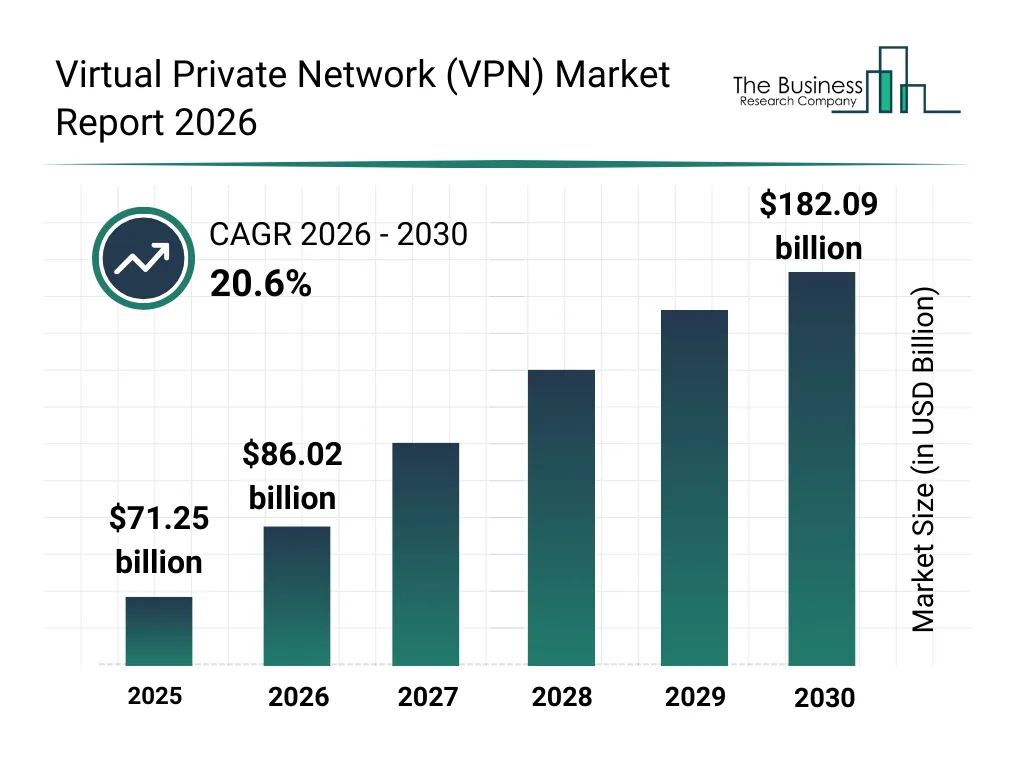
- The global VPN market is projected to grow from $71.25 billion in 2025 to $182.09 billion by 2030, highlighting a strong upward trajectory.
- The market is expected to expand at a rapid CAGR of 20.6% between 2026 and 2030, indicating accelerated industry growth.
- In 2026, the market reaches approximately $86.02 billion, marking a significant year-over-year increase from 2025.
- By 2027, the VPN market is estimated to surpass $100 billion, signaling widespread adoption across industries and consumers.
- The market continues its steady rise to around $130 billion in 2028, driven by increasing cybersecurity concerns and remote work trends.
- In 2029, the market is projected to approach $160 billion, reflecting strong enterprise and individual demand.
- The overall growth between 2025 and 2030 represents an increase of over $110 billion, showcasing the expanding importance of VPN solutions globally.
- This consistent growth trend highlights VPNs as a critical tool for privacy, security, and unrestricted internet access in the digital economy.
VPN Downloads and Adoption Trends Over Time
- Global VPN downloads hit a peak of 487 million in 2022 amid pandemic demand.
- VPN adoption rates rose from 6.95% in 2020 to 12.35% in 2024 across 106 countries.
- Downloads reached 130 million in the first half of 2023, showing sustained interest.
- Proton VPN signups spiked up to 182,890% in Mauritius during the 2024 election censorship.
- VPN app downloads were 75% on Android (358 million) vs 25% on iOS in recent yearly data.
- Global downloads surged to 464 million in 2024, rebounding from the 2023 dip.
- Asia-Pacific VPN market grows at 16% annually through 2027, the fastest emerging region.
- Middle East VPN downloads rose 22% in 2024 amid cybersecurity threats.
- H1 2025 saw 282 million downloads globally, continuing the upward trend.
Frequently Asked Questions (FAQs)
What percentage of global internet users use a VPN?
How many people worldwide use VPN services?
What is the global VPN market size in 2026?
What is the expected CAGR of the VPN market?
How much revenue do VPN apps generate annually?
Conclusion
VPN usage clearly reflects a transition from optional privacy tools to a foundational layer of digital infrastructure. Individuals increasingly depend on VPNs to protect personal data, reduce exposure to cyber threats, and maintain control over their online identity. Meanwhile, businesses continue to integrate VPN solutions into their security frameworks to support remote workforces, prevent data breaches, and ensure secure access to internal systems.
At the same time, evolving use cases such as streaming, bypassing geo-restrictions, and mobile-first internet access highlight how VPNs now serve both functional and lifestyle needs. As cybersecurity risks grow more sophisticated and global internet regulations become more complex, the demand for reliable and transparent VPN services will continue to rise. Moving forward, understanding how VPNs are used and why they matter will help both individuals and organizations make informed decisions in an increasingly privacy-driven digital landscape.

Leave a comment
Have something to say about this article? Add your comment and start the discussion.