



Software-as-a-Service (SaaS) continues to redefine how organizations build, deliver, and scale software across industries. From CRM platforms that streamline sales pipelines to cloud-based collaboration tools that power distributed teams, SaaS plays a central role in modern business operations. Companies now rely on SaaS not only to reduce infrastructure costs but also to accelerate innovation, improve agility, and deliver seamless user experiences.
Moreover, SaaS has become a critical driver of digital transformation in sectors like healthcare, finance, retail, and education. For example, hospitals use SaaS platforms for patient data management and telehealth services, while eCommerce businesses depend on SaaS tools for inventory, analytics, and customer engagement. As AI integration, usage-based pricing, and vertical SaaS solutions continue to evolve, the industry is entering a more mature and competitive phase. Understanding the latest SaaS statistics helps businesses make smarter investment decisions, optimize operations, and stay ahead of market shifts. Let’s dive into the data shaping SaaS
Editor’s Choice
- The global SaaS market is expected to reach $465 billion in 2026, up from $408 billion in 2025.
- SaaS accounted for nearly 85% of all business software usage by 2025.
- The market is projected to grow at a 13.32% CAGR from 2025 to 2034.
- Companies use an average of 106 SaaS applications, down from 130 in 2022.
- Global SaaS revenue could exceed $793 billion by 2029.
- Around 99% of organizations use at least one SaaS solution.
- Worldwide IT spending is projected to surpass $6 trillion in 2026, with SaaS as a key driver.
Recent Developments
- Enterprise SaaS investments reached $1.38 billion in early 2025, up from $833 million in 2024.
- AI-powered SaaS adoption is expected to reach 95% of organizations by 2025.
- AI SaaS markets are growing at over 38% CAGR, signaling rapid transformation.
- Public cloud spending is projected to hit $723.4 billion in 2025, heavily supporting SaaS expansion.
- Generative AI integration is now used by over 50% of SaaS companies.
- SaaS companies are increasingly shifting to usage-based pricing models, with 61% adjusting pricing recently.
- AI-driven SaaS revenue is expected to reach $775 billion by 2031.
- SaaS consolidation is rising, with acquisitions increasing 6% year-over-year in 2025.
Key SaaS Statistics Overview
- The SaaS market was valued at approximately $390–$408 billion in 2025.
- It is forecast to reach $466 billion in 2026, reflecting steady growth.
- The global SaaS industry could exceed $1.2 trillion by 2032.
- SaaS makes up roughly 41% of total public cloud spending.
- Over 70% of organizational software is now SaaS-based.
- Around 78% of organizations store critical data in SaaS platforms.
- SaaS companies reported a median growth rate of 30% in recent surveys.
- Vertical SaaS solutions grow faster at 31% compared to 28% for horizontal SaaS.
- The number of SaaS companies globally exceeds 30,000+ businesses.
Global SaaS Market Size and Growth
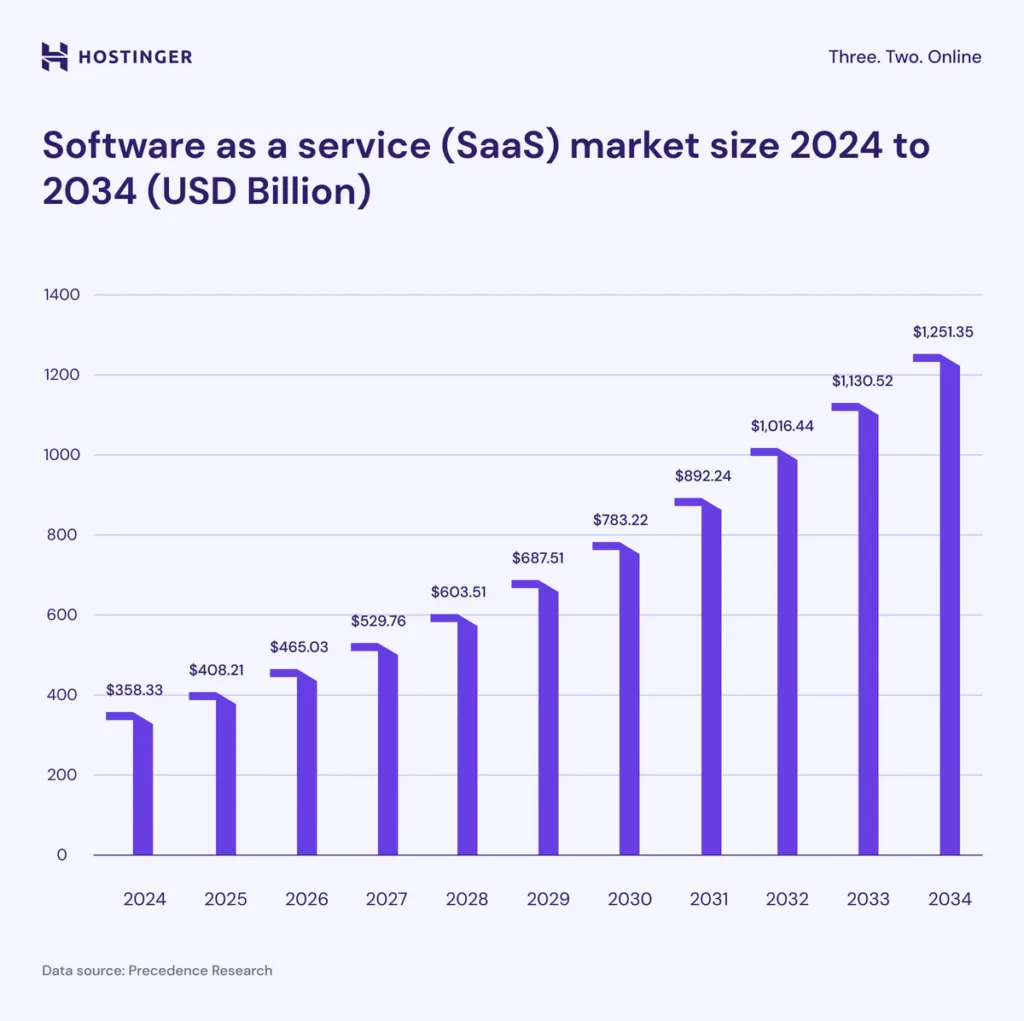
- The global SaaS market is projected to grow from $358.33 billion in 2024 to $1,251.35 billion by 2034, highlighting massive long-term expansion.
- The market will add nearly $900+ billion in value over 10 years, indicating strong and sustained demand for cloud-based solutions.
- Consistent year-over-year growth is evident, with no decline across the forecast period, reflecting high industry stability and resilience.
- The SaaS market is expected to cross the $500 billion mark by 2027 ($529.76 billion), signaling rapid mid-term scaling.
- By 2030, the market will reach $783.22 billion, nearly doubling from 2024 levels in just six years.
- The industry is projected to surpass the $1 trillion milestone by 2032 ($1,016.44 billion), marking a critical growth inflection point.
- Growth accelerates significantly in the later years, with the market increasing by over $235 billion between 2032 and 2034 alone.
- The average annual increase steadily rises, showing compounding growth momentum, especially after 2028.
- The data reflects a strong CAGR trend (high double-digit growth), driven by digital transformation, cloud adoption, and AI integration.
- Overall, the SaaS market demonstrates a near 3.5x growth over the decade, reinforcing its position as one of the fastest-growing segments in the global tech industry.
SaaS Adoption and Usage Trends
- Nearly 99% of organizations use at least one SaaS product today.
- SaaS applications now account for 80–90% of business software usage.
- Companies use an average of 106 SaaS apps, reflecting tool consolidation trends.
- Large enterprises deploy 400–450 SaaS applications on average.
- Mid-sized companies use around 170–180 SaaS apps.
- Around 54% of businesses use SaaS tools to improve productivity.
- SaaS adoption for critical data storage stands at 78% globally.
- Hybrid cloud adoption is expected to reach 90% of organizations by 2027.
SaaS Usage by Company Size and Segment
- Small businesses (SMBs) use an average of 25–50 SaaS applications, depending on industry needs.
- Mid-sized companies typically deploy 150+ SaaS apps, reflecting growing operational complexity.
- Large enterprises use between 300 and 450 SaaS applications, often across multiple departments.
- Enterprises with over 1,000 employees spend $2,000–$3,500 per employee annually on SaaS.
- Around 70% of SMBs rely on SaaS tools for accounting, CRM, and HR functions.
- Vertical SaaS adoption is rising, with industry-specific platforms growing 1.2x faster than horizontal tools.
- Approximately 60% of SaaS usage in enterprises comes from collaboration and communication tools.
- Startups allocate nearly 80% of their software stack to SaaS products, minimizing infrastructure costs.
- Companies with distributed teams are 2x more likely to increase SaaS adoption year-over-year.
SaaS Adoption by Industry: Key Insights and Trends
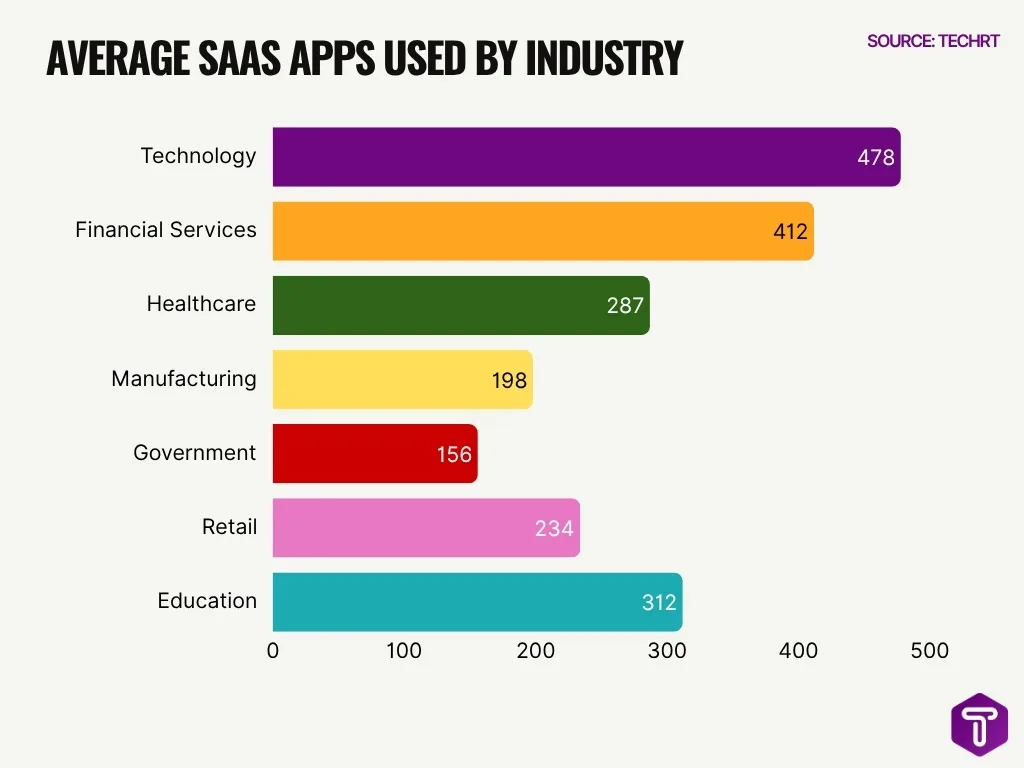
- Technology leads significantly with an average of 478 SaaS apps, highlighting its heavy reliance on cloud-based tools and advanced digital ecosystems.
- Financial Services ranks second with 412 apps, showing strong adoption driven by compliance, analytics, and fintech integrations.
- The education sector shows robust usage at 312 apps, reflecting the growing need for e-learning platforms and collaboration tools.
- Healthcare uses an average of 287 apps, indicating increasing adoption for patient management, telehealth, and data systems.
- Retail records 234 apps, driven by eCommerce, CRM, and inventory management solutions.
- Manufacturing adopts 198 apps, suggesting a more moderate but growing shift toward digital transformation and automation tools.
- The government has the lowest adoption at 156 apps, likely due to regulatory constraints, legacy systems, and slower digital transformation cycles.
- Overall, there is a clear gap of 322 apps between the highest (Technology – 478) and lowest (Government – 156) adopters, emphasizing uneven SaaS penetration across industries.
SaaS Spending and Budget Allocation
- Organizations spend an average of $3,500 per employee annually on SaaS.
- SaaS accounts for nearly 70% of total software spending in enterprises.
- Companies increased SaaS budgets by 12–15% in 2025 compared to 2024.
- Around 30% of SaaS spend is wasted on unused or underutilized licenses.
- IT departments allocate ~40% of their budgets to cloud and SaaS solutions.
- Businesses with SaaS management platforms reduce costs by up to 25%.
- SaaS spend in SMBs grew by over 18% year-over-year.
- Finance teams report that license optimization saves $100K+ annually in large organizations.
- Multi-year SaaS contracts now represent over 45% of enterprise agreements.
SaaS Pricing and Revenue Model Statistics
- Subscription-based pricing accounts for over 90% of SaaS revenue models.
- Usage-based pricing adoption increased to 61% of SaaS companies in 2025.
- Freemium models are used by over 40% of SaaS providers.
- Companies using hybrid pricing models see 20–30% higher revenue growth.
- Annual billing plans increase customer lifetime value by up to 35%.
- Tiered pricing is implemented by ~70% of SaaS companies.
- Enterprise SaaS contracts often exceed $100,000 annually per client.
- Price increases across SaaS products averaged ~9% in 2025.
- Add-on and upsell revenue contributes 15–25% of total SaaS revenue.
Global Distribution of SaaS Companies by Country
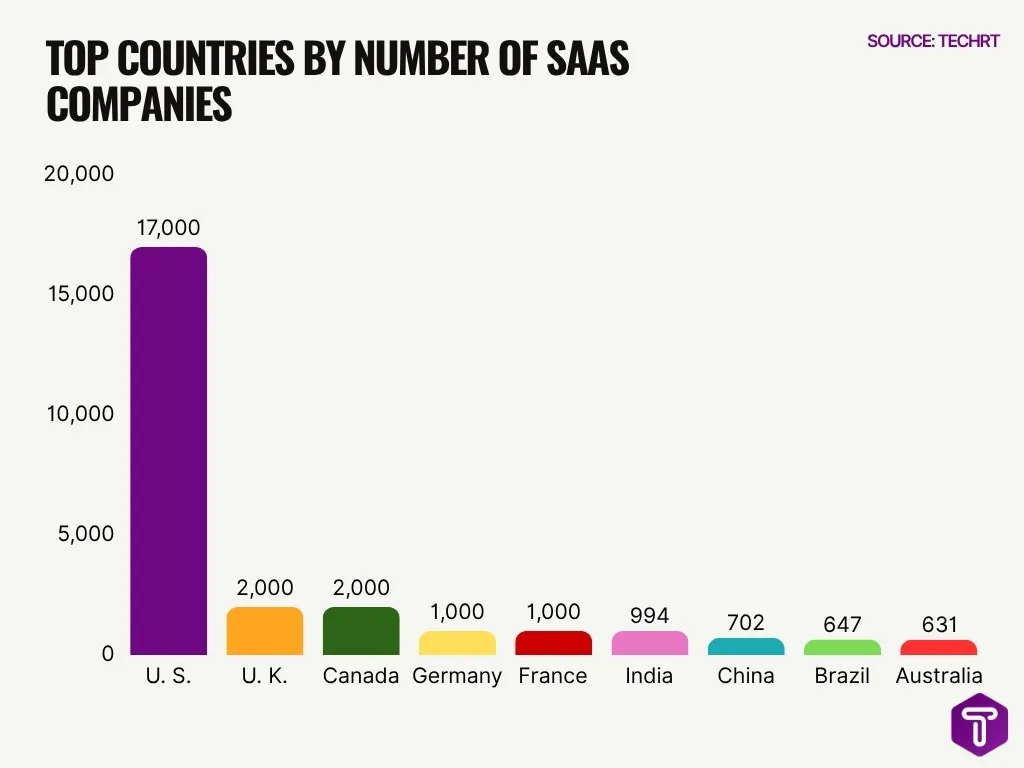
- The United States dominates the global SaaS market with a massive 17,000 companies, accounting for the largest share by a wide margin.
- The United Kingdom and Canada follow as distant leaders, each hosting around 2,000 SaaS companies, highlighting strong ecosystems outside the U.S.
- In Europe, Germany and France each have approximately 1,000 companies, reflecting steady SaaS adoption and growth across the region.
- India is emerging as a major SaaS hub with 994 companies, nearly matching leading European markets and signaling rapid expansion in the Asian SaaS landscape.
- China has around 702 companies, indicating a growing but comparatively smaller SaaS ecosystem relative to its market size.
- Among emerging markets, Brazil (647) and Australia (631) show a strong SaaS presence, demonstrating increasing adoption beyond traditional tech hubs.
- There is a significant gap between the U.S. and other countries, with the U.S. having over 8× more SaaS companies than any other nation listed.
- The data highlights a clear concentration of SaaS companies in North America and Europe, while the Asia-Pacific regions are rapidly catching up.
SaaS Churn and Retention Benchmarks
- Average SaaS churn rates range between 5% and 7% annually for enterprise companies.
- SMB SaaS churn rates are higher, averaging 3–7% monthly.
- A 1% reduction in churn can increase company valuation by up to 12%.
- Net revenue retention (NRR) for top SaaS companies exceeds 120%.
- Customer retention rates average 92% across mature SaaS businesses.
- Companies using customer success teams reduce churn by up to 15%.
- Poor onboarding contributes to over 20% of early churn cases.
- SaaS companies with annual contracts experience 30% lower churn rates.
- Increasing product usage frequency reduces churn risk by up to 50%.
SaaS Customer Acquisition and Conversion Metrics
- The average SaaS customer acquisition cost (CAC) ranges between $200 and $1,500, depending on the segment.
- CAC payback period averages 12–18 months for SaaS companies.
- Free trial conversion rates range from 15% to 25%.
- Freemium-to-paid conversion averages 2–5%.
- Companies investing in content marketing reduce CAC by up to 30%.
- Referral programs increase conversion rates by up to 4x.
- Email marketing delivers an ROI of $36 for every $1 spent in SaaS.
- SaaS landing pages convert at an average rate of 7–9%.
- Product-led growth (PLG) companies grow revenue 2–3x faster than traditional SaaS models.
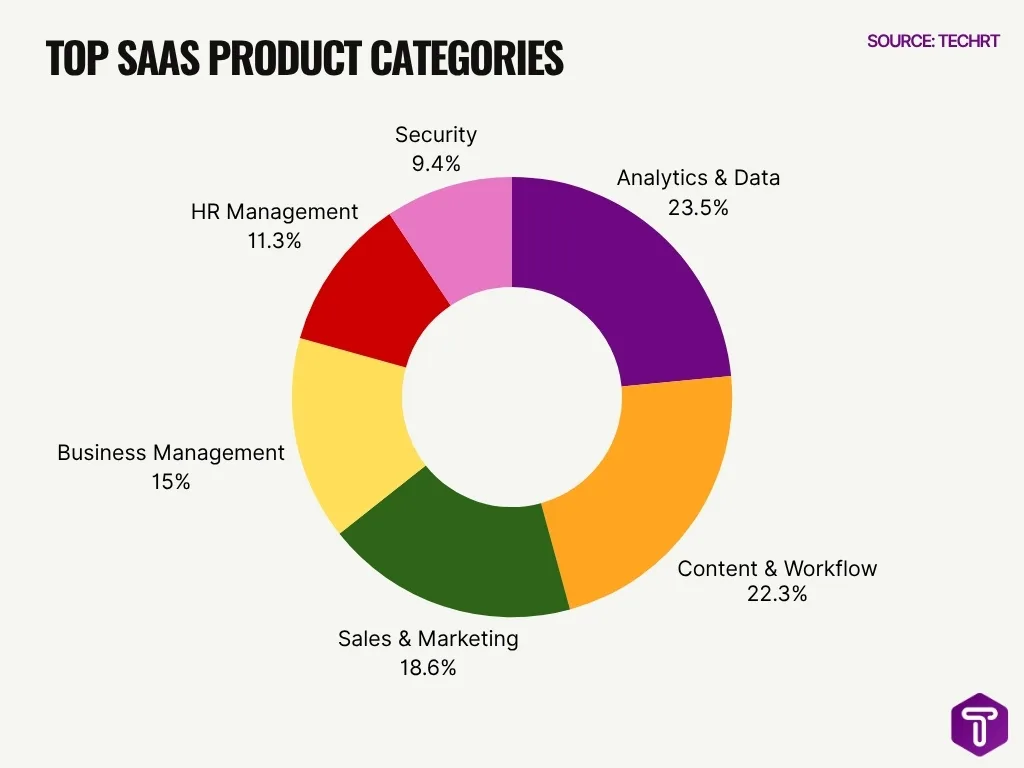
Top SaaS Product Categories Breakdown
- Analytics & Data dominates the SaaS landscape with the highest share at 23.5%, highlighting the growing demand for data-driven decision-making and AI-powered insights.
- Content & Workflow tools account for 22.3%, reflecting the strong need for automation, collaboration, and productivity platforms across organizations.
- Sales & Marketing solutions hold 18.6%, driven by increasing investments in customer acquisition, CRM, and digital marketing technologies.
- Business Management software contributes 15%, indicating steady adoption of tools for operations, finance, and enterprise planning.
- HR Management platforms represent 11.3%, showcasing rising focus on talent management, payroll, and remote workforce solutions.
- Security tools make up 9.4%, underscoring the critical importance of cybersecurity, compliance, and data protection in modern SaaS ecosystems.
- The top two categories alone (Analytics & Data + Content & Workflow) collectively account for 45.8%, signaling a strong shift toward data-centric and efficiency-driven SaaS solutions.
- The bottom three segments (Business Management, HR, Security) together contribute 35.7%, showing a balanced but comparatively smaller share in core operational and compliance tools.
SaaS Startup and VC Funding Statistics
- Global SaaS funding exceeded $120 billion in 2021 but stabilized around $70–80 billion annually in 2024–2025.
- Early-stage SaaS startups received over 40% of total VC funding in 2025.
- The median SaaS startup valuation dropped by ~30% from the 2021 peaks.
- AI SaaS startups account for over 35% of new funding rounds.
- Seed-stage SaaS funding rounds average $2–5 million globally.
- Series A SaaS rounds typically range between $10–20 million.
- U.S.-based SaaS startups attract over 50% of global SaaS funding.
- India’s SaaS ecosystem is expected to reach $50 billion in revenue by 2030.
- SaaS unicorns (valued over $1B) surpassed 1,000 companies globally.
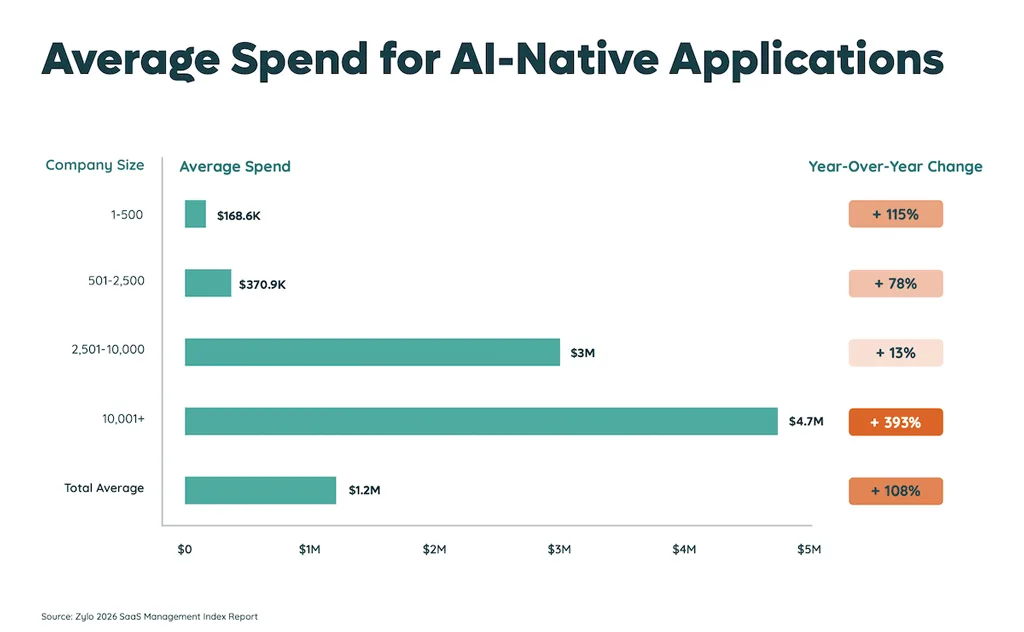
AI-Native SaaS Spend by Company Size
- Spending increases significantly with company size, highlighting a strong correlation between scale and AI investment.
- Small businesses (1–500 employees) spend an average of $168.6K, but still show a high growth rate of +115% YoY, indicating rapid early-stage adoption.
- Mid-sized companies (501–2,500 employees) spend around $370.9K, with a solid +78% YoY growth, reflecting steady scaling of AI initiatives.
- Upper mid-market firms (2,501–10,000 employees) see a sharp jump in spend to $3M, though growth slows to +13%, suggesting a more mature adoption phase.
- Large enterprises (10,001+ employees) dominate AI spending at $4.7M, with an explosive +393% YoY growth, signaling aggressive AI expansion at scale.
- The overall average spend across all companies is $1.2M, with a strong +108% YoY increase, underscoring widespread acceleration in AI-native SaaS adoption.
- Enterprise companies spend ~28x more than small businesses ($4.7M vs $168.6K), highlighting a massive investment gap.
- Despite lower budgets, smaller companies are scaling faster, as seen in their triple-digit growth rates, pointing to the increasing democratization of AI tools.
- The data suggests a shift from experimentation to large-scale deployment, especially among enterprises driving the highest growth.
AI and Emerging Technologies in SaaS
- Over 80% of SaaS companies will have integrated AI features into their products by 2025.
- Generative AI adoption in SaaS platforms crossed 50% of vendors in 2025, up from 30% in 2023.
- AI-driven SaaS solutions are expected to grow at a 38% CAGR through 2030.
- Around 65% of enterprises prioritize AI-enabled SaaS tools for automation and analytics.
- AI-powered customer support tools reduce response times by up to 70%.
- Predictive analytics features improve decision-making accuracy by over 25% in SaaS platforms.
- Nearly 45% of SaaS revenue growth in 2025 is linked to AI capabilities.
- Edge computing integration in SaaS is growing at ~20% annually, improving real-time processing.
- AI copilots and automation tools are used by over 60% of SaaS users globally.
Low-Code and No-Code SaaS Platform Statistics
- The low-code/no-code market is projected to reach $65 billion by 2027.
- Around 70% of new business applications will use low-code/no-code technologies by 2025.
- Low-code platforms reduce development time by up to 90%.
- Nearly 60% of organizations adopted low-code tools by 2025, compared to 44% in 2022.
- Citizen developers now account for over 40% of application development activity.
- Companies using no-code solutions cut IT costs by 20–30% annually.
- SaaS vendors offering low-code integrations see 2x faster product adoption rates.
- SMBs are 1.5x more likely to adopt no-code tools than large enterprises.
- Workflow automation via low-code tools improves operational efficiency by up to 35%.
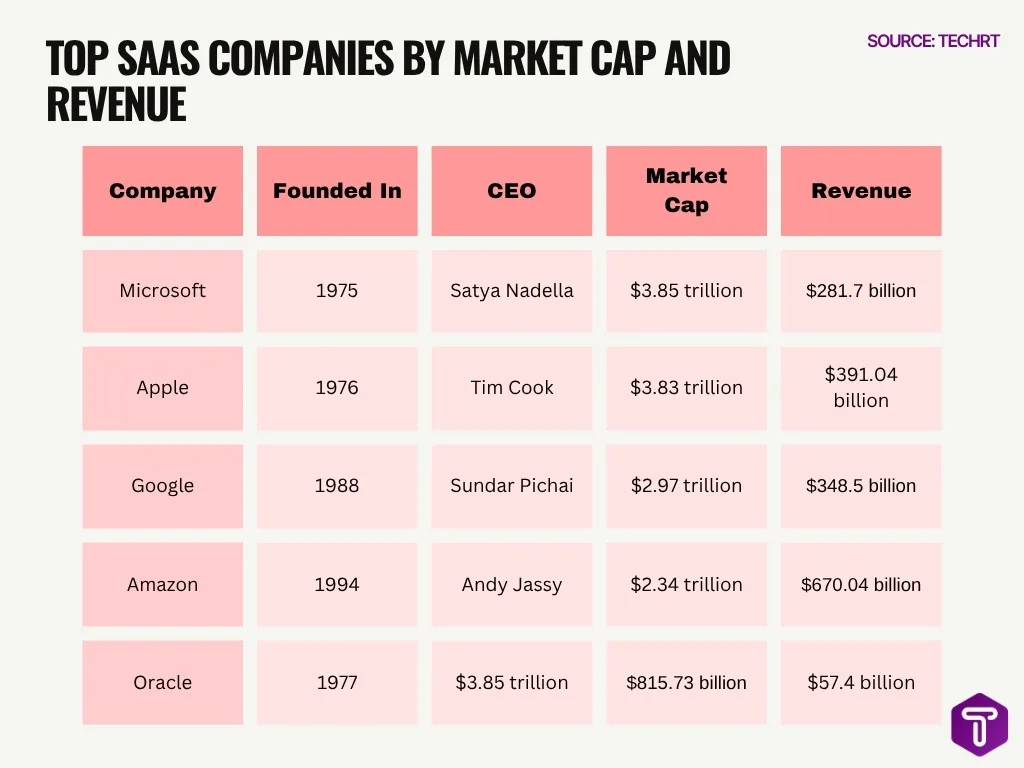
Top SaaS Companies: Key Market Insights
- The SaaS ecosystem is dominated by tech giants like Microsoft and Apple, both exceeding a $3.8 trillion market cap, highlighting their massive global influence.
- Amazon leads in revenue generation with $670.04 billion, significantly outperforming all other companies in the list.
- Despite being SaaS-heavy businesses, companies like Google and Microsoft generate over $300 billion in revenue combined, showcasing strong cloud and software monetization.
- Apple stands out with $391.04 billion in revenue, driven by its ecosystem, subscriptions, and services layer beyond hardware.
- Oracle, while smaller in comparison, still holds a substantial $815.73 billion market cap, reinforcing its position as a major enterprise SaaS and cloud provider.
- Leadership across these companies is helmed by influential CEOs like Satya Nadella and Sundar Pichai, who have driven aggressive cloud and AI transformation strategies.
- The founding timeline spans from 1975 to 1994, indicating that legacy tech companies have successfully evolved into modern SaaS and cloud-first organizations.
- There is a clear disparity between market cap and revenue, with companies like Microsoft achieving a higher valuation relative to revenue due to strong recurring SaaS revenue models and margins.
- The combined market capitalization of these five companies exceeds $13 trillion, underscoring the massive scale and dominance of SaaS-driven tech giants in the global economy.
- Overall, the data highlights a strong trend: SaaS, cloud computing, and subscription-based models are key drivers behind the world’s most valuable companies.
SaaS Security and Compliance Statistics
- 83% of enterprise workloads are expected to be in the cloud by 2026, increasing SaaS security demand.
- Around 55% of organizations experienced a SaaS-related security incident in 2025.
- Misconfigurations account for over 30% of SaaS data breaches.
- Companies using SaaS security posture management (SSPM) tools reduce risks by up to 40%.
- Multi-factor authentication (MFA) adoption in SaaS platforms reached 78% of organizations.
- Compliance costs for SaaS companies increased by ~15% year-over-year due to stricter regulations.
- Nearly 60% of SaaS data is classified as sensitive or confidential.
- Zero-trust security models are implemented by over 50% of enterprises using SaaS.
- Security spending on SaaS tools is expected to exceed $25 billion globally by 2027.
Future of the SaaS Industry and Market Projections
- The SaaS market is projected to surpass $1 trillion by 2032.
- SaaS is expected to represent over 85% of all business software by 2030.
- AI-native SaaS platforms will dominate over 60% of new product launches by 2028.
- Vertical SaaS is forecast to grow faster than horizontal SaaS by 3–5% annually.
- SaaS-enabled marketplaces are expected to generate $500+ billion in revenue by 2030.
- Global SaaS employment is projected to exceed 10 million jobs by 2030.
- API-first SaaS architectures are adopted by over 70% of new SaaS startups.
- Sustainability-focused SaaS solutions are growing at ~20% CAGR, driven by ESG initiatives.
- Consolidation in SaaS markets is expected to increase, with M&A activity rising steadily through 2030.
Frequently Asked Questions (FAQs)
What is the global SaaS market size in 2026?
What CAGR is the SaaS market expected to grow at through 2034?
How large was the SaaS market in 2025 compared to 2026?
What is the projected SaaS market size by 2034?
What CAGR is the SaaS market expected to grow at between 2026 and 2031?
Conclusion
SaaS continues to evolve from a convenient software delivery model into the backbone of modern business infrastructure. From AI-powered automation to low-code development and global cloud expansion, the industry shows consistent growth across every major metric. At the same time, rising security concerns and pricing innovation signal a more mature, competitive landscape.
For businesses, these statistics highlight a clear direction: invest in scalable SaaS tools, optimize usage, and stay aligned with emerging technologies. As the market moves toward a trillion-dollar valuation, companies that adapt early will capture the greatest value in the years ahead.

Leave a comment
Have something to say about this article? Add your comment and start the discussion.