




eLearning continues to reshape how people learn, train, and upskill across industries. From corporate training programs to university degrees, digital platforms now deliver scalable and flexible education at speed. Companies use eLearning to onboard employees faster, reduce training costs, and maintain consistent learning experiences across global teams. At the same time, universities and schools expand access to education by reaching remote learners who may not have access to traditional classrooms.
This shift is not just about convenience; it is about measurable impact. Businesses report higher productivity and faster skill development, while students benefit from improved retention and personalized learning paths. As digital adoption accelerates and technologies like AI, mobile learning, and gamification evolve, eLearning continues to redefine how knowledge is delivered and consumed. Let’s explore the latest eLearning statistics to understand how this fast-moving industry is evolving.
Editor’s Choice
- The global eLearning market is projected to reach $320.96 billion by 2026.
- The industry has grown by 900% since 2000, driven by internet access and mobile adoption.
- The eLearning market size is expected to exceed $406 billion in 2026.
- Students retain 25% to 60% more information through online learning.
- Around 73% of U.S. students want to continue online learning post-pandemic.
- AI integration has increased student engagement by up to 80% in eLearning environments.
- Over 85% of teachers now use digital tools to support learning.
Recent Developments
- The eLearning market grew from $352.59 billion in 2025 to $406.13 billion in 2026.
- AI-powered personalization can boost engagement by up to 60%.
- Over 80% of enterprises are expected to adopt AI-enabled eLearning by 2025.
- AI-driven analytics improve course completion rates by 25% to 40%.
- The AI-in-education market is projected to reach $32.27 billion by 2030.
- Around 67% of students already use AI tools for learning.
- Approximately 60% of teachers integrate AI into teaching practices.
- Gamification adoption in eLearning platforms has reached 48%.
- Video-based learning accounts for 74% of digital course content.
Global eLearning Market Overview
- The global eLearning market is projected to reach between $336 billion and $400 billion by 2026.
- The market could surpass $375 billion by 2026.
- Online learning revenue is expected to reach $220.8 billion in 2026.
- The education technology market is forecast to hit $213.20 billion in 2026.
- North America holds 36.1% of the global EdTech revenue share.
- The U.S. alone contributes nearly 50% of global online education revenue.
- Europe accounts for roughly 30% of the global eLearning market.
- Asia-Pacific contributes about 28% of global eLearning usage.
- Over 525 million users engage with eLearning platforms in North America alone.
Market Size and Growth Statistics
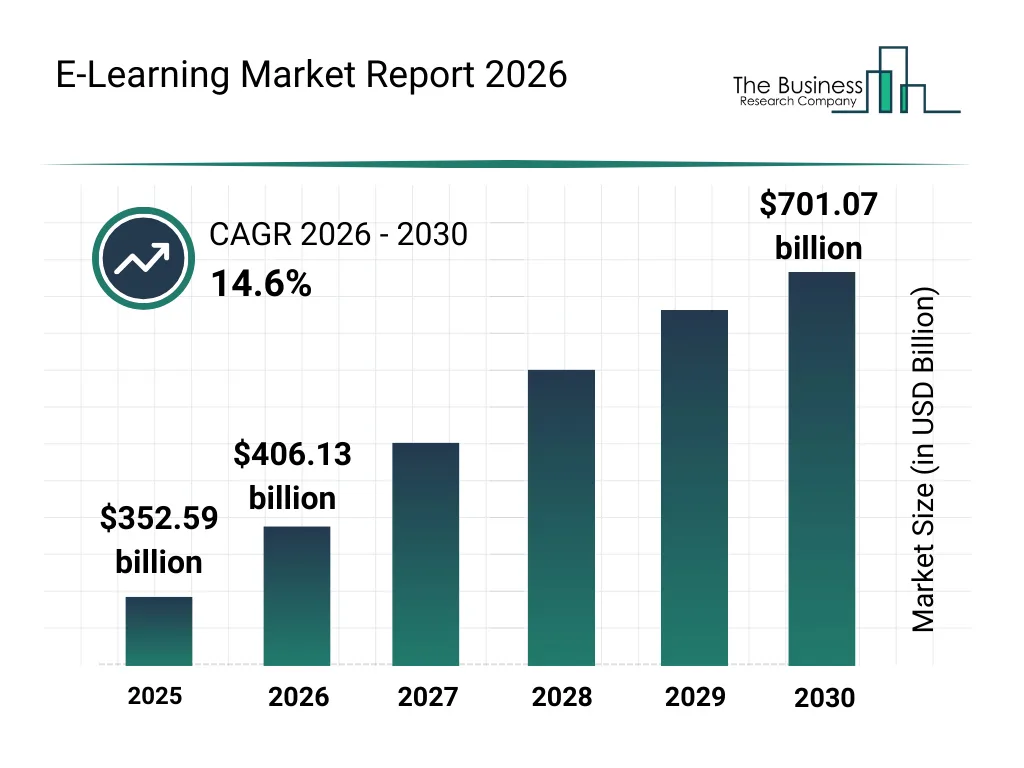
- The global e-learning market is projected to grow from $352.59 billion in 2025 to $701.07 billion by 2030, nearly doubling in size within five years.
- A strong compound annual growth rate (CAGR) of 14.6% (2026–2030) highlights the rapid expansion and sustained demand for digital learning solutions.
- The market surpasses the $400 billion mark in 2026, reaching $406.13 billion, signaling accelerated adoption across corporate and academic sectors.
- Between 2025 and 2030, the industry is expected to add over $348 billion in new market value, indicating massive investment and growth opportunities.
- The consistent year-over-year upward trend reflects increasing reliance on online education, remote training, and digital skill development globally.
- Growth momentum suggests strong contributions from emerging technologies such as AI-driven learning, mobile learning, and immersive platforms.
- The near 2x market expansion within a short timeframe positions e-learning as one of the fastest-growing segments in the global education and technology industry.
Regional eLearning Revenue and Market Share
- The U.S. eLearning market is expected to generate $99.84 billion in 2026.
- The U.S. accounts for approximately 32% of the global eLearning market share.
- China’s eLearning market is projected to reach $45.35 billion in 2026.
- India’s eLearning market is expected to hit $7.57 billion in 2026.
- Europe contributes around 25% of global eLearning usage.
- Asia-Pacific holds 28% of global usage share.
- The Middle East and Africa region accounts for 12% of global eLearning usage.
- The U.S. online learning penetration rate is projected at 19.5% in 2026.
- Revenue per user in the U.S. eLearning market is estimated at $1,490.
eLearning Market by Segment
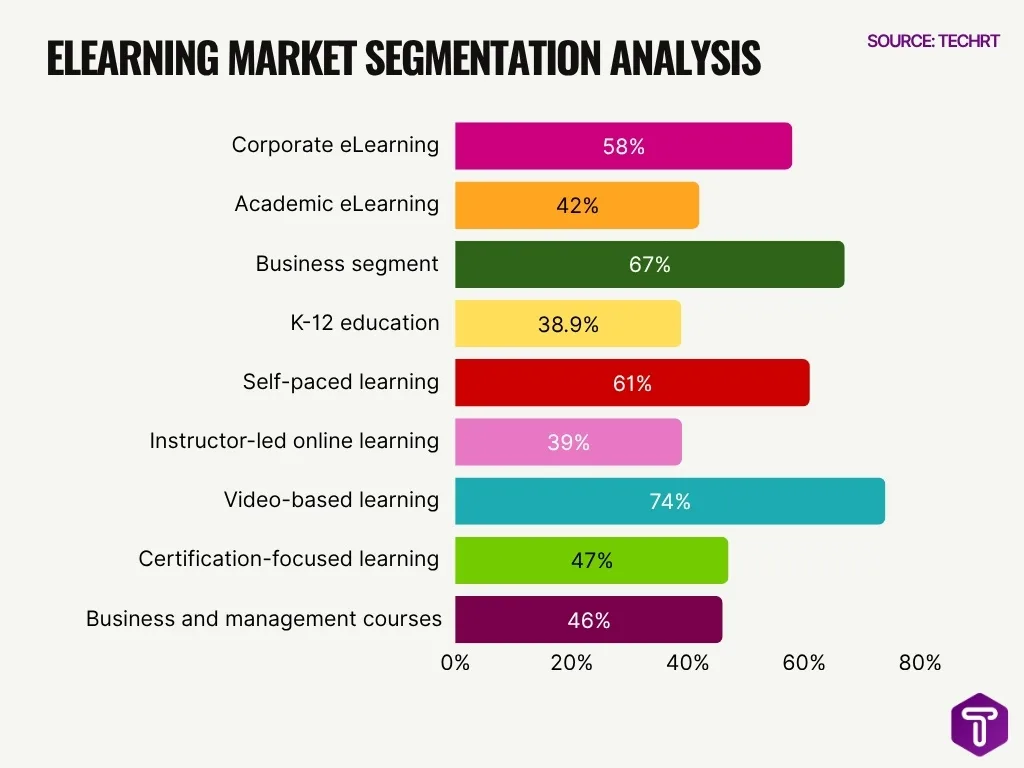
- Corporate eLearning accounts for 58% of total market usage.
- Academic eLearning contributes 42% of overall usage.
- The business segment holds 67% of the EdTech market share.
- K-12 education leads with 38.9% market share in EdTech.
- Self-paced learning represents 61% of user preferences.
- Instructor-led online learning accounts for 39% of the market.
- Video-based learning dominates with 74% content share.
- Certification-focused learning is used by 47% of academic providers.
- Business and management courses attract 46% of online learners.
Corporate eLearning Statistics
- 90% of corporations now use eLearning as a primary training method.
- Companies using eLearning report a 42% increase in employee productivity.
- eLearning reduces training time by 40% to 60% compared to traditional methods.
- Organizations save an average of $1,200 per employee annually through digital training.
- About 77% of U.S. companies rely on online learning to train employees.
- 72% of organizations say eLearning improves employee engagement.
- Companies that invest in eLearning see 24% higher profit margins.
- Around 68% of employees prefer learning at work via digital platforms.
- Microlearning in corporate settings boosts retention by 17%.
Academic eLearning Statistics
- Over 220 million learners are enrolled in online courses globally.
- Around 63% of U.S. students have taken at least one online course.
- Universities offering online programs have increased by over 70% since 2020.
- About 56% of undergraduate students in the U.S. took online classes in 2024.
- Online degree enrollment grew by ~9% year-over-year in 2025.
- Nearly 80% of academic institutions use LMS platforms for course delivery.
- Around 49% of students believe online learning is better than traditional classroom learning.
- Universities report a 20% cost reduction when offering online programs.
- Hybrid learning adoption has reached over 60% of institutions globally.
AI in eLearning: Key Benefits and Concerns Breakdown
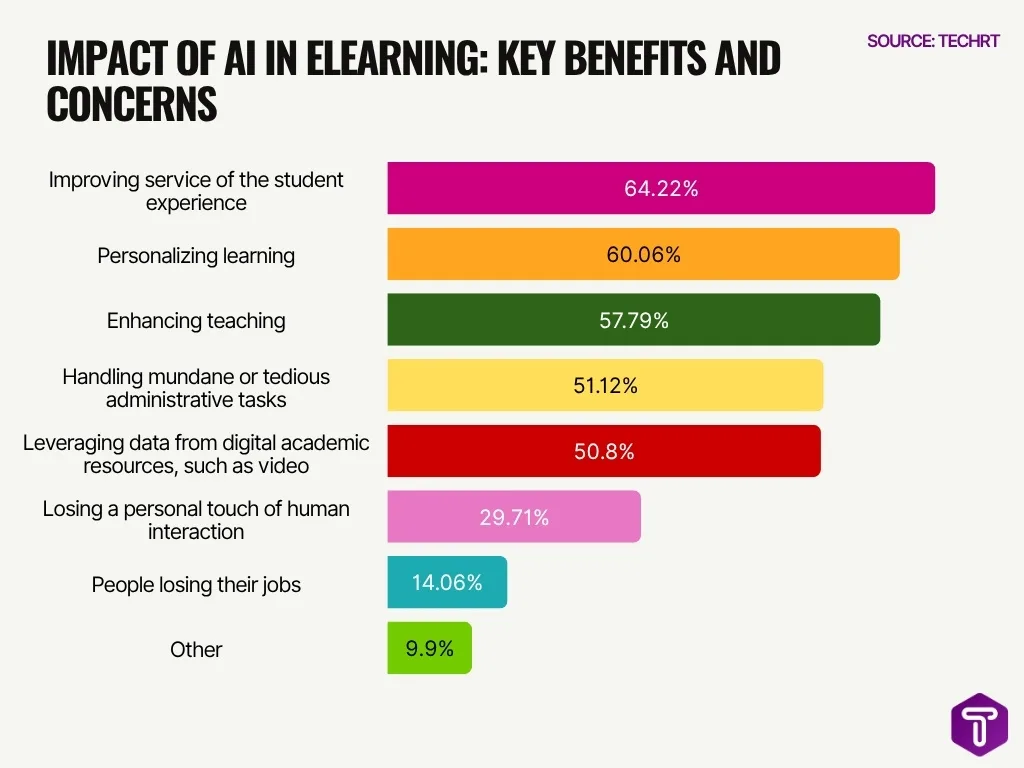
- The leading benefit of AI in eLearning is improving student experience, with 64.22% of respondents highlighting enhanced engagement and support.
- Personalizing learning ranks second at 60.06%, showing AI’s strong role in delivering customized learning paths and adaptive content.
- About 57.79% believe AI is enhancing teaching, enabling educators to optimize instruction and improve outcomes.
- Over half (51.12%) say AI helps in handling mundane or administrative tasks, significantly reducing operational workload.
- Nearly 50.8% emphasize AI’s ability to leverage digital academic resources (e.g., video-based learning), improving access to rich and interactive content.
- On the downside, 29.71% of respondents are concerned about losing the human touch in education, highlighting a key limitation of AI-driven learning environments.
- 14.06% express concerns about job displacement, indicating moderate fear of AI replacing certain roles in education.
- A smaller share (9.9%) falls under other concerns, suggesting most issues are concentrated around human interaction and employment impact.
- Overall, the data indicates that AI is largely perceived as a transformative force in eLearning, with strong benefits in personalization, efficiency, and content accessibility, outweighing its challenges.
K-12 Education Statistics
- Over 70% of U.S. K-12 schools use digital learning tools daily.
- The global K-12 eLearning market is projected to reach $150 billion by 2026.
- Around 60% of K-12 students engage in online or hybrid learning formats.
- Schools using eLearning report a 30% improvement in student engagement.
- 1 in 3 U.S. students uses a school-issued device for learning.
- Teachers using digital tools increased to 85% in 2025.
- Digital curriculum adoption has grown by over 50% since 2020.
- Around 45% of K-12 teachers use gamified learning platforms.
- Rural schools adopting eLearning increased by 28% in the last two years.
Microlearning Statistics
- Microlearning improves retention rates by up to 80%.
- Employees complete microlearning courses 50% faster than traditional modules.
- Around 58% of employees prefer short-form learning modules.
- Microlearning reduces development costs by up to 50%.
- Organizations using microlearning see 17% higher engagement rates.
- Mobile-based microlearning usage increased by over 40% in 2025.
- Short video content accounts for over 60% of microlearning formats.
- Microlearning is used by over 70% of corporate training programs.
- Learners are 3x more likely to complete microlearning courses.
Key Benefits of Microlearning vs Traditional Learning
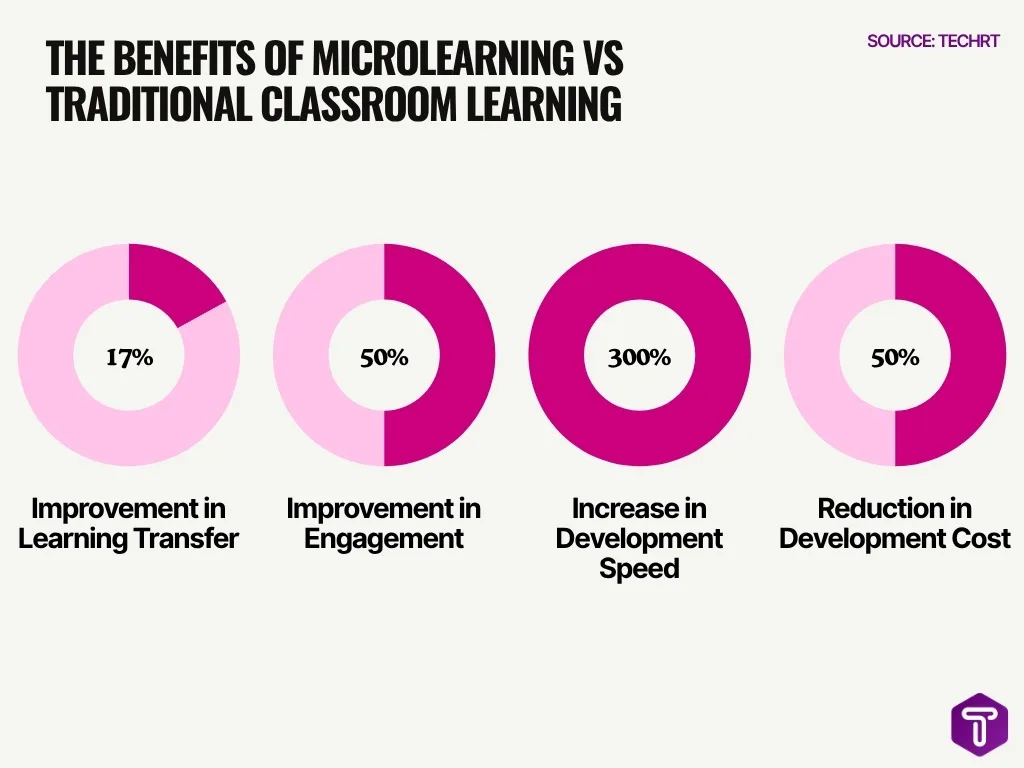
- Microlearning improves learning transfer by 17%, helping learners retain and apply knowledge more effectively.
- Engagement levels increase by 50%, indicating significantly higher learner interest and participation.
- Development speed sees a massive boost of 300%, enabling faster content creation and deployment.
- Organizations can reduce training expenses by 50%, making microlearning a highly cost-efficient solution.
- The combination of higher engagement and faster delivery makes microlearning ideal for modern, fast-paced learning environments.
- Overall, microlearning delivers better performance outcomes at lower costs, outperforming traditional classroom methods.
Learning Management Systems (LMS) Statistics
- The LMS market is expected to reach $28.1 billion by 2026.
- Over 83% of organizations use LMS platforms for training.
- Moodle remains one of the most widely used LMS platforms globally, with over 300 million users.
- LMS adoption in higher education exceeds 90% of institutions.
- Companies using LMS report a 34% faster onboarding process.
- LMS-driven training increases retention rates by 25% to 60%.
- Mobile LMS usage has grown by over 45% since 2022.
- Around 70% of LMS users prefer cloud-based solutions.
- LMS integration with HR systems improved efficiency by 30% in enterprises.
Mobile Learning Statistics
- Mobile learning accounts for over 60% of eLearning consumption.
- The mobile learning market is projected to reach $80 billion by 2027.
- Around 67% of learners access courses via smartphones.
- Mobile learning improves completion rates by 45% compared to desktop-only learning.
- 72% of organizations now support mobile-first learning strategies.
- Learners spend 40% more time on mobile-based courses.
- Push notifications increase course engagement by up to 50%.
- Mobile microlearning adoption grew by over 35% in 2025.
- Tablets account for 12% of mobile learning usage, while smartphones dominate.
Gamification in eLearning
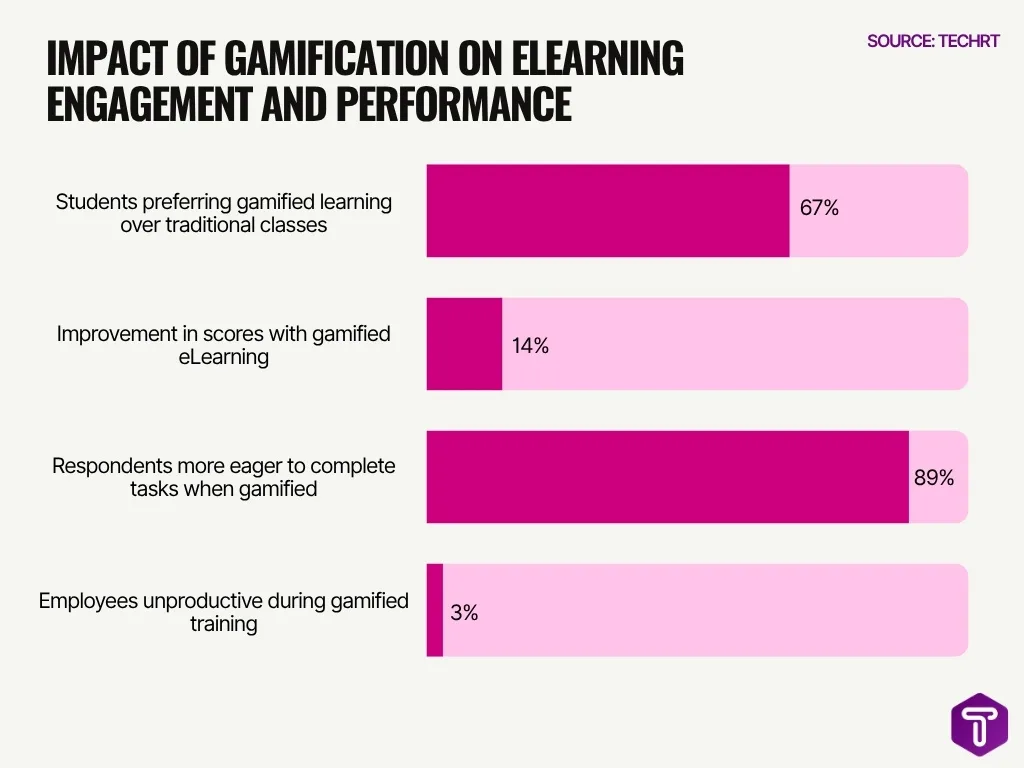
- 67% of students prefer gamified learning experiences over traditional classroom methods, highlighting a strong shift toward interactive education.
- Gamification leads to a 14% improvement in scores, indicating measurable gains in learning performance and retention.
- A significant 89% of respondents report being more eager to complete tasks when gamification elements are introduced, showcasing its impact on motivation and engagement.
- Only 3% of employees are unproductive during gamified training, suggesting that gamification maintains high efficiency and focus levels in workplace learning.
- Overall, the data demonstrates that gamification not only enhances engagement and participation but also drives better academic and training outcomes with minimal productivity loss.
Adaptive Learning Statistics
- The adaptive learning market is expected to reach $9.11 billion by 2027.
- Adaptive learning improves student performance by up to 30%.
- Around 44% of institutions use adaptive learning technologies.
- Personalized learning paths increase engagement by over 50%.
- Adaptive systems reduce course completion time by 20% to 30%.
- AI-driven adaptive platforms improve test scores by 15% to 25%.
- Around 60% of educators believe adaptive learning improves outcomes.
- Students using adaptive tools show higher retention rates by 25%.
- Adoption of adaptive learning grew by over 20% between 2023 and 2025.
Higher Education and Online Learning
- The U.S. higher education online market is expected to exceed $75 billion by 2026.
- Around 7.5 million U.S. students are enrolled in distance education courses.
- Nearly 35% of all college students in the U.S. study fully online.
- Graduate-level online enrollment has increased by over 10% annually.
- About 82% of institutions plan to expand online degree programs.
- Online MBA programs grew by 25% in enrollment between 2023 and 2025.
- Roughly 58% of students say flexibility is the top reason for choosing online education.
- Completion rates for online courses in higher education range between 50% and 70%.
- International student participation in online programs increased by 15% in 2025.
Benefits of eLearning
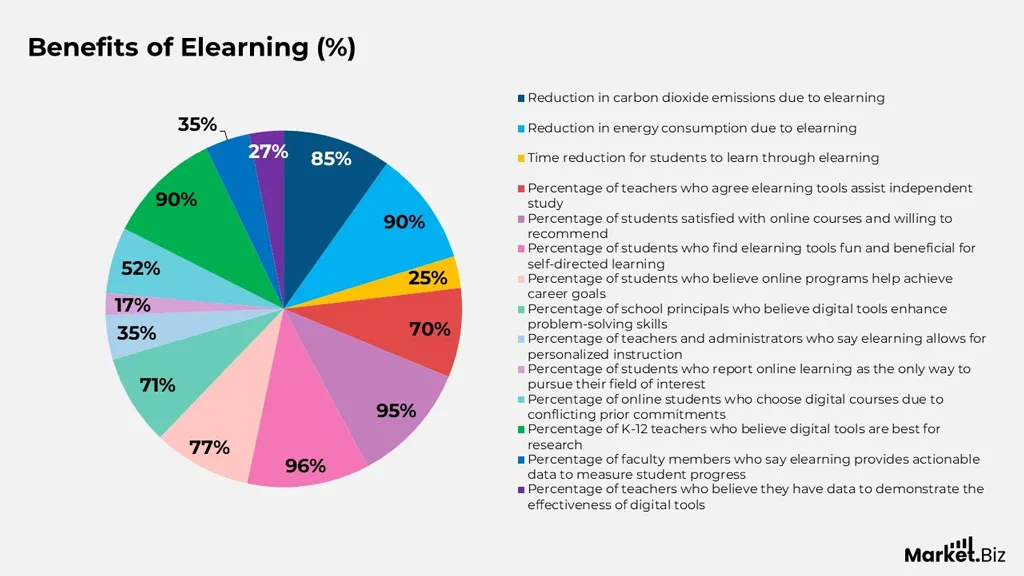
- eLearning delivers strong environmental benefits, with 90% reporting reduced energy consumption and 85% noting lower carbon dioxide emissions, highlighting its sustainability advantage.
- Student satisfaction is exceptionally high, as 96% of learners find eLearning fun and beneficial, while 95% are satisfied and willing to recommend online courses.
- Career impact is significant, with 77% of students believing online programs help them achieve career goals, reinforcing the value of digital education.
- Flexibility is a major driver, as 52% of students choose eLearning due to conflicting commitments, making it ideal for balancing work, study, and personal life.
- Educators see strong learning outcomes, with 71% of school principals stating digital tools improve problem-solving skills and 70% of teachers supporting independent study through eLearning tools.
- Research and knowledge access are enhanced, with 90% of K-12 teachers believing digital tools are best for research, emphasizing the role of technology in modern education.
- Personalization remains a moderate strength, as only 35% of teachers and administrators say eLearning enables personalized instruction, indicating room for improvement.
- Data-driven learning is emerging but limited, with 35% of faculty citing actionable student progress data and just 27% of teachers confident in measuring digital tool effectiveness.
- Time efficiency is still underutilized, with only 25% reporting reduced learning time, suggesting potential for optimization in course delivery.
- Niche dependency on eLearning exists, as 17% of students rely on online learning as their only option, reflecting its importance in accessibility and inclusion.
Knowledge Retention and Course Completion
- Microlearning improves retention rates by up to 80%.
- Average online course completion rates range from 50% to 70%.
- Gamification increases course completion rates by up to 50%.
- AI-driven personalization improves completion rates by 35%.
- Short-form video learning increases completion rates by over 70%.
- Mobile learning improves completion rates by 45%.
- Around 3 out of 5 learners complete courses when interactive content is used.
- Learners are 3x more likely to complete microlearning modules.
- Push notifications increase course completion by 20% to 30%.
Future of eLearning
- The global eLearning market is projected to exceed $700 billion by 2030.
- Over 90% of organizations are expected to adopt digital learning strategies by 2027.
- AI-driven learning platforms will dominate over 60% of eLearning solutions by 2030.
- Virtual Reality in education is projected to grow at a CAGR of ~25% through 2030.
- Around 75% of educators expect hybrid learning to become the standard model.
- Blockchain adoption in education is expected to grow by over 50% annually.
- Mobile-first learning will account for over 70% of total usage by 2028.
- Lifelong learning participation is projected to grow by over 15% annually.
- Corporate reskilling initiatives will drive over 60% of eLearning demand by 2030.
Frequently Asked Questions (FAQs)
What is the projected global eLearning market size in 2026?
What percentage of businesses are expected to adopt eLearning?
How much faster do learners complete courses with eLearning?
What percentage of information do students retain through eLearning?
What share of global eLearning revenue comes from the United States?
Conclusion
eLearning has moved from a supplementary tool to a core pillar of modern education and workforce development. Organizations now rely on digital platforms to train employees at scale, while academic institutions expand access through flexible online programs. At the same time, technologies like AI, gamification, and adaptive learning continue to improve engagement and outcomes.
As the market grows toward the $700+ billion mark, its influence will only deepen across industries. Whether you’re a business leader, educator, or learner, understanding these trends helps you stay ahead in a rapidly evolving learning ecosystem.

Leave a comment
Have something to say about this article? Add your comment and start the discussion.