



AI agents are moving from experimental tools to operational systems that execute tasks, make decisions, and automate workflows at scale. Organizations now deploy them in customer support to resolve tickets instantly, in finance to reconcile transactions, and in IT to manage infrastructure with minimal human input. As these systems evolve into autonomous “digital coworkers,” they reshape how businesses operate, reduce costs, and accelerate decision-making.
The rapid rise in adoption, investment, and real-world use cases highlights a fundamental shift in enterprise technology, making AI agents one of the most impactful innovations of this decade. Let’s explore the latest statistics shaping this transformation.
Editor’s Choice
- The global AI agents market reached $7.8 billion in 2025 and is projected to exceed $52.6 billion by 2030.
- AI agent market value is expected to hit $10.8 billion in 2026, up from $7.5 billion in 2025.
- The industry is growing at a CAGR of 46%+ through 2030, one of the fastest in the AI segments.
- By 2026, 40% of enterprise applications will include AI agents, up from less than 5% in 2025.
- Around 62% of organizations are already experimenting with AI agents.
- AI agents could generate $2.6 trillion to $4.4 trillion annually in economic value.
- 50% of enterprises using generative AI are expected to deploy autonomous agents by 2027.
Recent Developments
- In 2026, enterprise AI is shifting from pilots to fully embedded “digital coworkers” across workflows.
- Nearly half of enterprise applications are expected to integrate AI agents in active use cases by 2026.
- Anthropic’s Claude platform surpassed $30 billion in annualized revenue, driven by agent-based deployments.
- EY plans to support 100% of audit processes with AI agents by 2028, starting with 2026 rollouts.
- Gartner estimates that over 40% of AI agent projects may fail by 2027 due to cost and ROI issues.
- AI agents are increasingly used for multi-step workflows like onboarding and reconciliation, replacing fragmented tools.
- Voice-driven and real-time agents are emerging as primary interfaces for enterprise automation.
- Industry focus is shifting toward secure, sandboxed agent environments to manage risk.
Key AI Agent Statistics Overview
- Around 88% of companies use AI in at least one function, but only 6% achieve high performance.
- Enterprise AI agent adoption is estimated at ~37% in 2026, with scaling still in progress.
- Less than 5% of enterprise apps used AI agents in 2025, highlighting rapid growth.
- AI agents are projected to handle 15% of daily business decisions by 2028.
- Over 70% of early agentic AI use cases come from BFSI, retail, and manufacturing sectors.
- IT accounts for more than 50% of AI agent use cases, especially in DevOps.
- Software development represents 67% of AI agent tools, making it the dominant domain.
- AI agents are used for productivity and research tasks in 57% of interactions.
Global AI Agent Market Size Statistics
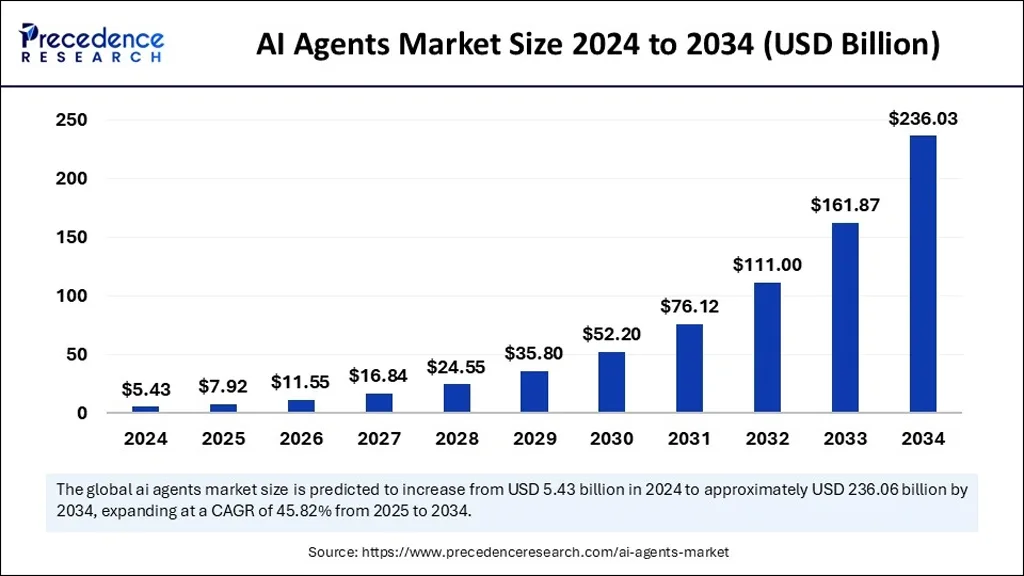
- The global AI agents market is projected to grow from $5.43 billion in 2024 to $236.03 billion by 2034, indicating an explosive expansion.
- The market is expected to register a remarkable CAGR of 45.82% (2025–2034), highlighting one of the fastest growth rates in the AI ecosystem.
- Early-stage growth remains steady, increasing from $5.43B (2024) to $16.84B (2027), showing gradual adoption across industries.
- The market enters a high-growth phase after 2028, jumping from $24.55B (2028) to $52.20B (2030), more than 2x growth in just two years.
- By 2031, the market crosses the $75B milestone, reaching $76.12 billion, signaling mainstream enterprise adoption.
- Rapid acceleration continues as the market surpasses $100B in 2032, hitting $111 billion, driven by AI automation and enterprise use cases.
- Between 2032 and 2034, the market nearly doubles from $111B to $236.03B, showcasing the exponential scaling of AI agent deployment.
- Over the full period, the market expands by more than 43x, reflecting massive investment, innovation, and demand for autonomous AI systems.
- The steep growth trajectory suggests AI agents will become a core component of business operations, especially in customer service, sales, and workflow automation.
- The data indicates a clear shift from experimental adoption (2024–2027) to hyper-scale commercialization (2030 onward) in the AI agents market.
AI Agent Market Growth and CAGR Projections
- The AI agent market is growing at a 46.3% CAGR from 2025 to 2030.
- Another estimate shows a 49.6% CAGR from 2026 to 2033, reflecting sustained acceleration.
- Industry forecasts also indicate a 40.5% CAGR through 2034.
- The AI agent platform market alone is expanding at 41.1% CAGR between 2024 and 2029.
- Some projections estimate 44.8% CAGR through 2030 for broader agent ecosystems.
- The market is expected to grow nearly 10x between 2025 and 2030.
- Healthcare AI agents are growing faster at ~48% CAGR, outpacing other sectors.
- AI agents represent one of the fastest-growing subsegments in enterprise AI, surpassing traditional chatbots.
AI Agent Revenue and Investment Statistics
- 88% of executives plan to increase AI budgets due to agentic AI adoption.
- Enterprises are prioritizing AI agents as core infrastructure investments, not experimental tools.
- AI agents are expected to generate multi-trillion-dollar annual value globally.
- The U.S. AI agents market alone is projected to grow from $1.6 billion in 2024 to $13.4 billion by 2030.
- Enterprise spending is shifting toward agent platforms and orchestration tools, not just models.
- Over 50% of enterprises using GenAI will invest in autonomous agents by 2027.
- AI agent infrastructure investments are driven by automation ROI and cost reduction goals.
- Companies are allocating budgets toward security, governance, and monitoring of agents, reflecting risk concerns.
AI Agents Market Share by Region
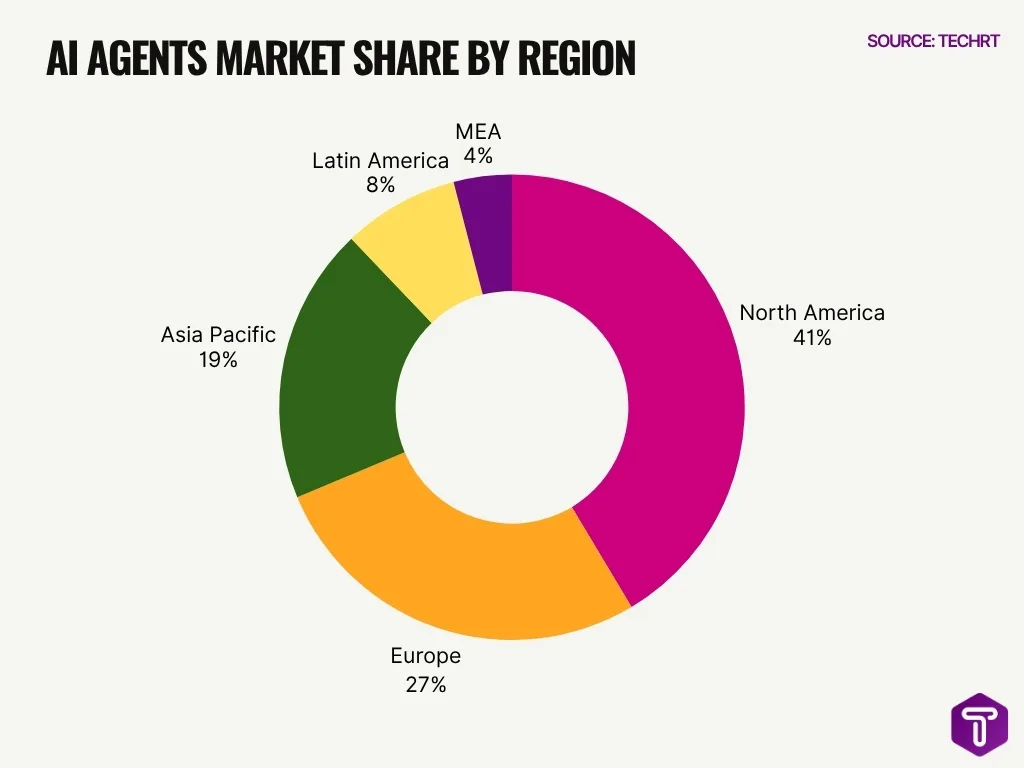
- North America dominates the AI agents market with a leading share of 41%, indicating strong adoption driven by advanced tech infrastructure and early AI integration.
- Europe holds the second-largest position at 27%, showcasing steady growth fueled by enterprise AI adoption and regulatory advancements.
- Asia Pacific captures 19% of the market, reflecting rapid expansion due to increasing investments in AI across countries like China, India, and Japan.
- Latin America accounts for 8%, highlighting emerging opportunities as digital transformation accelerates in developing economies.
- The Middle East & Africa (MEA) contribute 4%, representing a smaller but gradually growing market with rising interest in AI-driven solutions.
- The top two regions, North America (41%) and Europe (27%), together control a dominant 68% share, emphasizing their global leadership in AI agent adoption.
- In contrast, the combined share of Asia Pacific, Latin America, and MEA totals 31%, indicating significant untapped growth potential in these regions.
AI Agent Adoption by Industry and Sector
- BFSI leads adoption, accounting for over 25% of AI agent deployments globally.
- Retail and eCommerce contribute around 20% of AI agent use cases, especially in personalization.
- Manufacturing represents 15% of deployments, focused on predictive maintenance and automation.
- Healthcare adoption is growing rapidly, with AI agent usage increasing by 40% year over year.
- IT and software development account for over 50% of agent-based tools, especially in coding assistants.
- Logistics and supply chain use AI agents in inventory optimization and route planning, with adoption near 30%.
- Telecommunications companies use agents for network monitoring and automation, reducing downtime by up to 25%.
- Energy and utilities use AI agents to optimize grid operations, improving efficiency by 10–15%.
Enterprise AI Agent Adoption Statistics
- Around 62% of organizations actively use or experiment with AI agents in 2026, up from ~50% in 2024.
- Nearly 40% of enterprise applications are expected to embed AI agents by 2026, compared to under 5% in 2025.
- About 55% of large enterprises report deploying agent-based automation in at least one core workflow.
- Enterprises using AI agents report 20% to 30% reduction in operational costs.
- Roughly 48% of IT leaders prioritize AI agents for workflow automation over traditional RPA.
- Around 35% of enterprises have scaled AI agents beyond the pilot stage, reflecting growing maturity.
- Over 70% of AI adopters say agents improve decision-making speed across departments.
- Enterprises integrating AI agents into DevOps pipelines report up to 60% faster deployment cycles.
AI Agent Deployment Trends by Organization Size
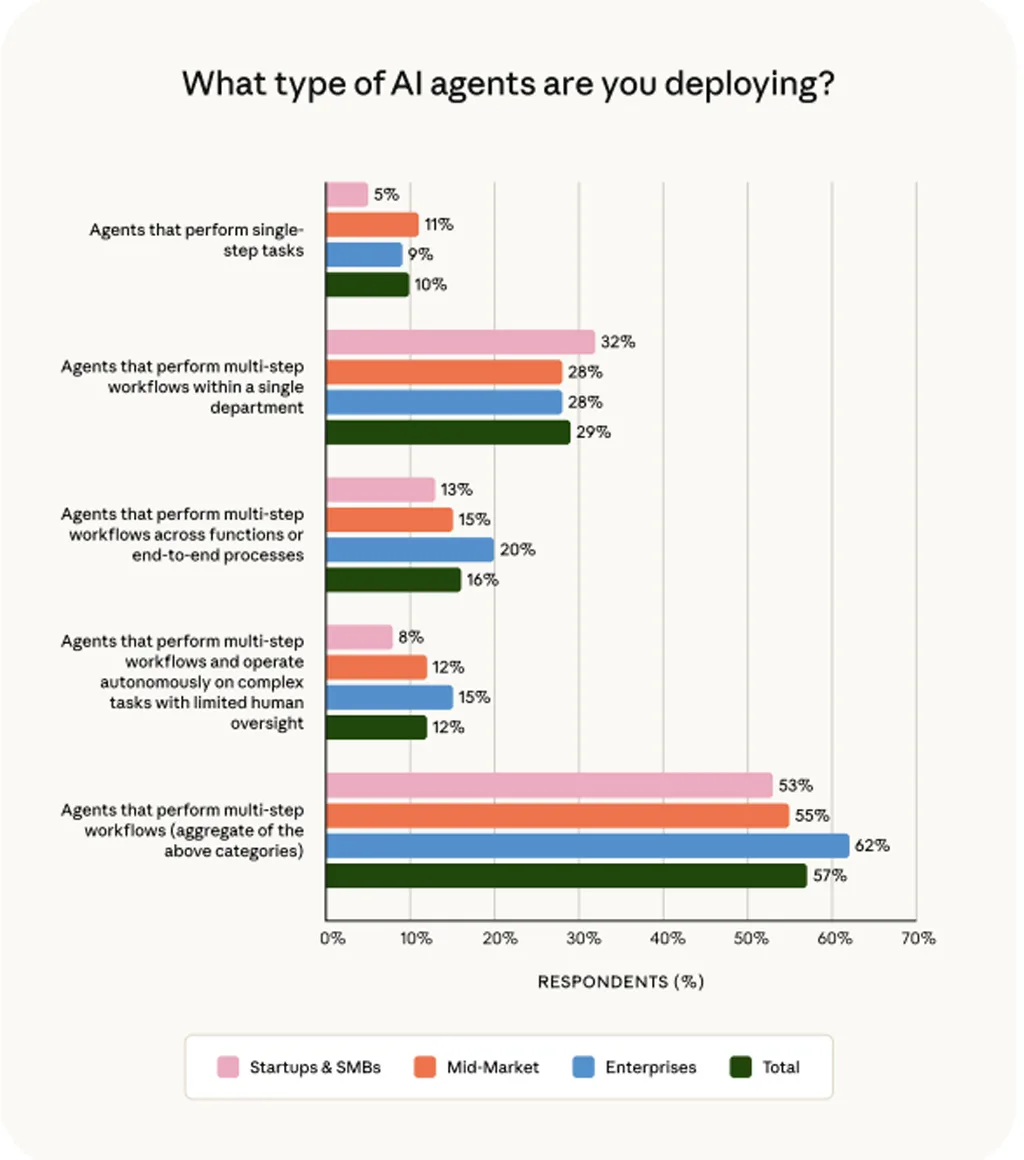
- Multi-step AI agents dominate adoption, with 57% of total respondents deploying them, highlighting a clear shift toward complex automation over simple tasks.
- Enterprises lead in advanced AI adoption, with 62% deploying multi-step agents, compared to 55% in mid-market and 53% in startups & SMBs, indicating greater maturity and resources in larger organizations.
- Department-level multi-step workflows are the most common use case, with 29% overall adoption, including 32% in startups, showing early-stage companies focus on internal efficiency within teams.
- Cross-functional and end-to-end automation is gaining traction, especially among enterprises (20%), compared to 15% in mid-market and 13% in SMBs, reflecting scaling AI across business processes.
- Autonomous AI agents (with limited human oversight) remain emerging, with only 12% overall adoption, though enterprises are ahead at 15%, signaling a gradual move toward full automation.
- Single-step AI agents are declining in relevance, used by just 10% overall, with only 5% in startups, indicating a strong transition toward multi-step intelligent systems.
- Startups & SMBs show a unique pattern, with higher reliance on department-level workflows (32%) but lower adoption of fully autonomous agents (8%), suggesting incremental AI maturity.
- Mid-market companies maintain balanced adoption, with 28% using department-level agents and 15% deploying cross-functional workflows, reflecting a transition phase toward enterprise-level AI sophistication.
- Overall, the data signals a clear evolution from task automation to workflow orchestration, with organizations increasingly investing in multi-step, scalable, and intelligent AI agent systems.
Customer Service and Contact Center AI Agent Statistics
- AI agents handle up to 80% of routine customer queries without human intervention.
- Businesses report 30% reduction in customer service costs after deploying AI agents.
- AI-powered chatbots and agents improve customer satisfaction scores by 20%.
- Contact centers using AI agents see average handling time reduced by 40%.
- Around 75% of customers expect AI-powered support for faster responses.
- AI agents enable 24/7 support coverage, improving response rates by over 50%.
- Voice-based AI agents are growing, with over 35% of contact centers adopting them in 2026.
- Companies using AI agents report up to 25% increase in first-contact resolution rates.
Sales and Marketing AI Agent Statistics
- AI agents contribute to 20% increase in sales productivity through automation.
- Marketing teams using AI agents see up to 30% higher campaign engagement rates.
- AI-driven personalization improves conversion rates by 10–15%.
- Around 63% of marketers use AI agents for content creation and optimization.
- AI agents reduce customer acquisition costs by 15–20%.
- Sales teams using AI agents report shorter deal cycles by 25%.
- AI-powered lead scoring increases qualified leads by 30%.
- Email marketing campaigns driven by AI agents achieve higher open rates by 18%.
AI Agent Adoption Trends by Use Case
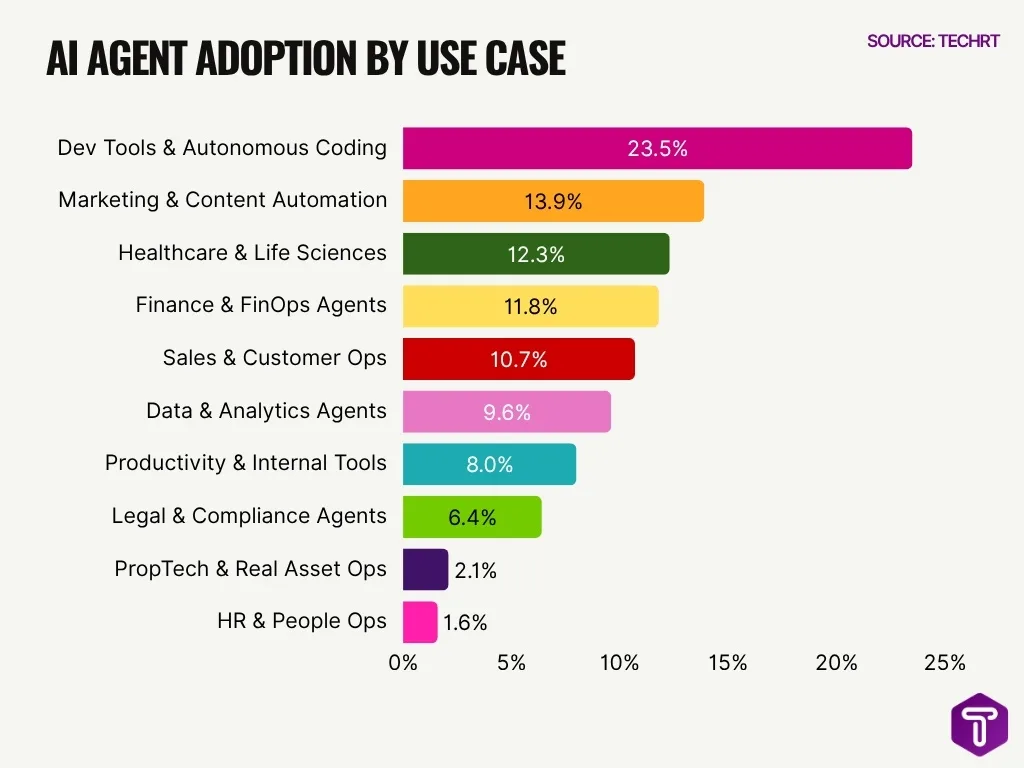
- Dev Tools & Autonomous Coding leads adoption at 23.5%, making it the most dominant use case due to strong ROI and automation potential in software development.
- Marketing & Content Automation ranks second with 13.9%, highlighting rapid adoption in content creation, campaign optimization, and personalization workflows.
- Healthcare & Life Sciences accounts for 12.3%, showing growing reliance on AI agents for diagnostics, research, and patient data management.
- Finance & FinOps Agents hold 11.8%, driven by demand for automation in cost optimization, fraud detection, and financial analysis.
- Sales & Customer Operations contribute 10.7%, reflecting increased use of AI in customer support, CRM automation, and lead management.
- Data & Analytics Agents capture 9.6%, emphasizing the role of AI in data processing, insights generation, and business intelligence.
- Productivity & Internal Tools stand at 8.0%, indicating steady adoption for workflow automation and operational efficiency improvements.
- Legal & Compliance Agents represent 6.4%, showing emerging adoption as organizations explore AI for contract analysis and regulatory compliance.
- PropTech & Real Asset Operations remain low at 2.1%, suggesting early-stage experimentation in real estate and asset management use cases.
- HR & People Operations is the least adopted at 1.6%, indicating limited but gradually increasing use of AI agents in recruitment and workforce management.
- Overall, over 60% of AI agent adoption is concentrated in the top 5 use cases, highlighting a strong skew toward high-ROI, structured, and automation-friendly domains.
Healthcare and Life Sciences AI Agent Statistics
- AI agents are projected to save the healthcare industry $150 billion annually by 2026.
- Around 50% of healthcare organizations use AI agents for administrative automation.
- AI agents reduce clinical documentation time by 40%, improving physician productivity.
- Hospitals using AI agents report 30% faster patient triage processes.
- AI-driven diagnostic agents achieve accuracy rates above 85% in specific conditions.
- Drug discovery processes using AI agents are up to 50% faster.
- Remote patient monitoring powered by AI agents reduces hospital readmissions by 20%.
- AI agents in medical imaging improve detection rates by 15–20% compared to traditional methods.
Banking, Finance, and Insurance AI Agent Statistics
- BFSI accounts for over 25% of total AI agent deployments, making it the leading sector.
- AI agents help reduce fraud losses by up to 30% through real-time anomaly detection.
- Banks using AI agents report 20%–25% cost savings in operations.
- AI-driven chat agents handle up to 70% of banking customer queries, reducing call center load.
- Insurance companies using AI agents improve claims processing speed by 40%.
- AI agents in credit scoring improve risk prediction accuracy by 10%–15%.
- Financial institutions report up to 50% faster compliance checks using AI agents.
- Algorithmic trading powered by AI agents contributes to over 60% of trading volume in US markets.
Consumer Usage and Attitudes Toward AI Agents
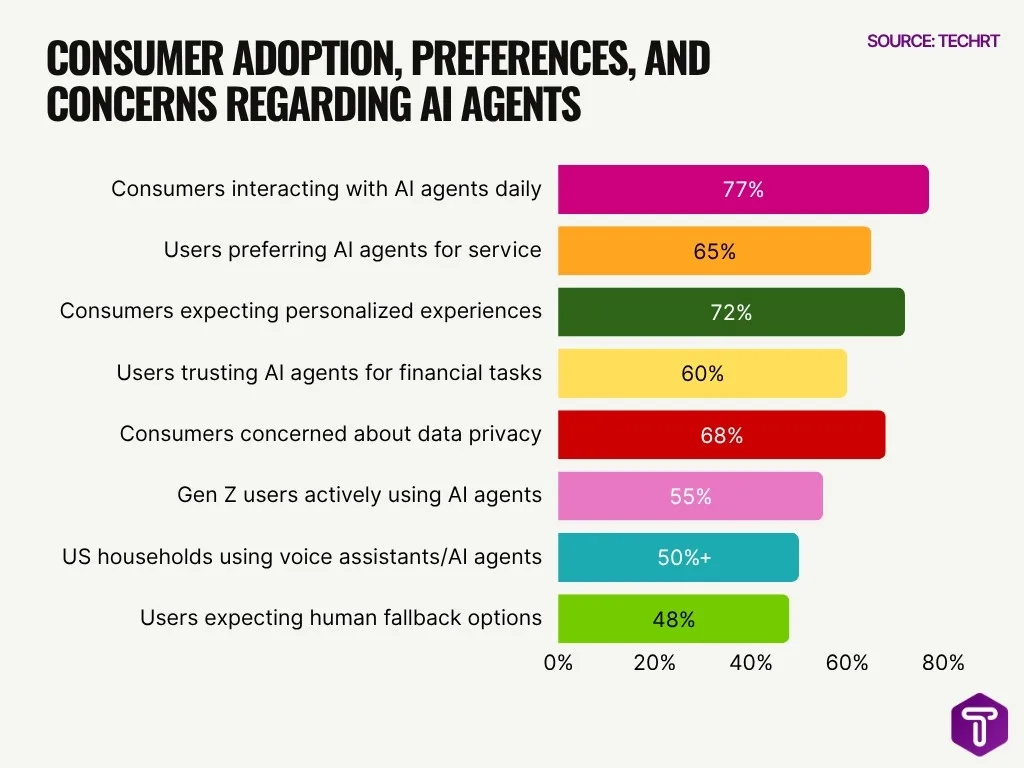
- Around 77% of consumers interact with AI agents daily, often without realizing it.
- Nearly 65% of users prefer AI agents for quick customer service interactions.
- About 72% of consumers expect personalized experiences, often delivered via AI agents.
- Roughly 60% of users trust AI agents for simple financial or transactional tasks.
- However, 68% of consumers remain concerned about data privacy in AI interactions.
- Around 55% of Gen Z users actively use AI agents for productivity tasks.
- Voice assistants and AI agents are used by over 50% of US households.
- About 48% of users expect human fallback options, showing the need for hybrid systems.
Productivity and Efficiency Gains from AI Agents
- AI agents can boost employee productivity by 30%–45% across knowledge work.
- Developers using AI agents complete tasks up to 55% faster.
- Businesses report 20%–30% reduction in operational costs with AI agent automation.
- AI agents reduce manual data entry tasks by up to 80%, freeing workforce capacity.
- Organizations using AI agents see up to 35% improvement in process efficiency.
- AI-driven workflows reduce error rates by up to 25% in enterprise processes.
- Companies report faster decision-making cycles by 50% with AI agents.
- Knowledge workers save 1.5 to 2 hours daily using AI-powered assistants.
AI Agent Technology and Architecture Statistics
- Over 65% of AI agent systems rely on large language models (LLMs) as their core engine.
- Multi-agent systems are gaining traction, with 30% of enterprises experimenting with collaborative agents.
- Around 70% of AI agents use API integrations to connect with enterprise tools.
- Retrieval-augmented generation (RAG) is used in over 60% of enterprise AI agent deployments.
- Cloud-based deployment dominates, with over 75% of AI agents hosted on cloud platforms.
- Edge AI agents are emerging, with 20% adoption in IoT-driven environments.
- Open-source frameworks power over 40% of AI agent development projects.
- AI orchestration platforms are growing rapidly, with enterprise adoption rising by 35% year over year.
AI Agents Pricing Models: Key Preference Insights
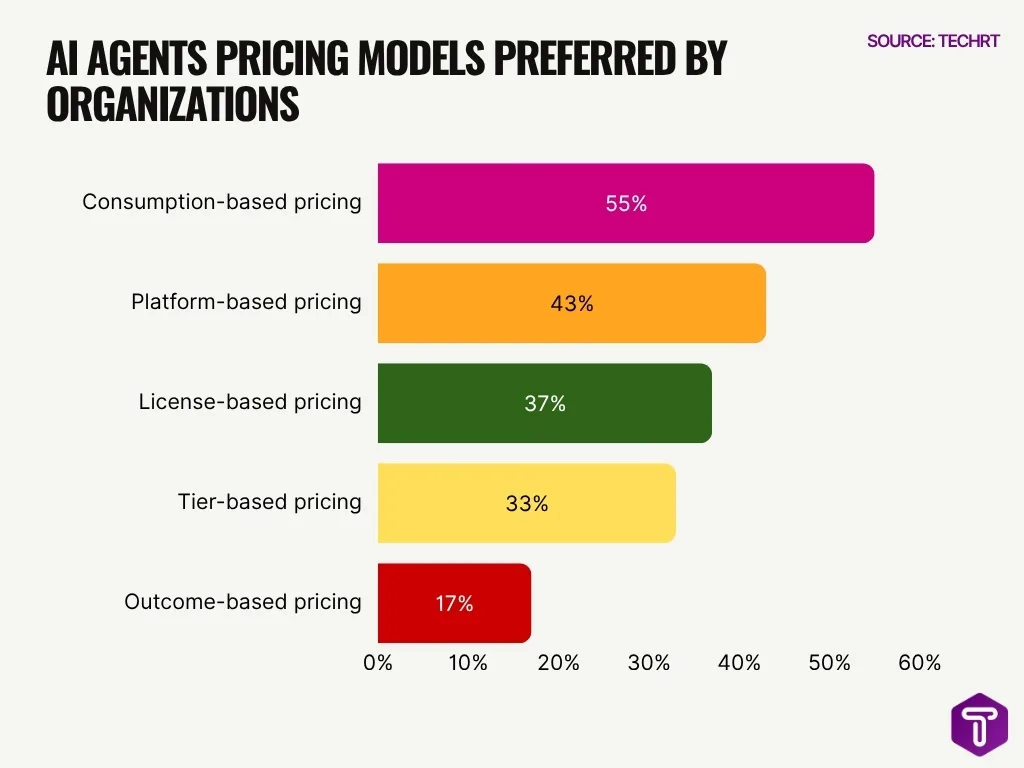
- Consumption-based pricing leads the market, with 55% of organizations preferring this model, highlighting a strong shift toward pay-as-you-use flexibility.
- Platform-based pricing ranks second, adopted by 43% of businesses, indicating growing demand for integrated AI ecosystems and bundled services.
- License-based pricing is still relevant, with 37% preference, showing that many enterprises continue to favor fixed-cost, predictable pricing structures.
- Tier-based pricing is chosen by 33%, reflecting the need for scalable plans tailored to different usage levels and organizational sizes.
- Outcome-based pricing is the least preferred, at just 17%, suggesting that performance-linked pricing models are still emerging and less widely trusted.
- Overall, the data indicate a clear trend toward flexible and usage-driven pricing models, while traditional and performance-based approaches lag behind in adoption.
AI Agent Security, Risk, and Governance Statistics
- Around 68% of organizations cite security risks as a major barrier to AI agent adoption.
- Over 40% of AI agent projects may be abandoned due to governance and ROI concerns.
- Nearly 60% of enterprises lack formal AI governance frameworks.
- AI agents increase the attack surface, with 30% rise in AI-related cyber risks reported.
- Around 55% of organizations invest in AI monitoring tools to track agent behavior.
- Regulatory compliance remains a challenge, with 45% of firms struggling to meet AI regulations.
- Bias and fairness issues affect over 35% of AI systems, including agents.
- Secure AI environments and sandboxing are being adopted by 50% of enterprises deploying agents.
Future Outlook and Predictions for AI Agents
- By 2028, 15% of daily work decisions will be made autonomously by AI agents.
- AI agents could contribute $4 trillion annually to the global economy.
- Around 50% of enterprises using GenAI will deploy autonomous agents by 2027.
- Multi-agent ecosystems will become standard, with over 35% adoption by 2030.
- AI agents will replace 20% of repetitive knowledge work tasks by 2030.
- The number of AI agents in enterprise systems is expected to grow 10x between 2025 and 2030.
- Autonomous agents will increasingly act as digital employees, managing workflows end-to-end.
- Human-AI collaboration models will dominate, with hybrid teams becoming the norm by 2028.
Frequently Asked Questions (FAQs)
What is the projected size of the AI agents market in 2026?
What is the expected CAGR of the AI agents market through 2033?
How large could the AI agents market become by 2030?
What share of enterprise applications will include AI agents by 2026?
What is the highest growth segment within AI agents?
Conclusion
AI agents have quickly evolved from experimental tools into core systems that drive automation, decision-making, and productivity gains across industries. From banking and healthcare to marketing and IT operations, the data shows consistent improvements in efficiency, cost reduction, and customer experience.
At the same time, challenges around security, governance, and trust remain critical as adoption scales. Businesses that invest in robust frameworks while aligning AI agents with real operational goals will capture the most value. As we move deeper and beyond, AI agents will not just support work, they will actively shape how work gets done.

Leave a comment
Have something to say about this article? Add your comment and start the discussion.