



Vibe coding, where developers and non-developers create software using natural language prompts and AI copilots, has moved from experimentation to mainstream workflows. It now powers everything from rapid MVP development in startups to internal automation tools in Fortune 500 companies. For example, product teams build prototypes in hours instead of weeks, while solo founders launch revenue-generating apps without traditional engineering teams. As adoption accelerates, the data behind this shift reveals both opportunity and complexity. Let’s explore the full picture.
Editor’s Choice
- 92% of US developers use AI coding tools daily, signaling near-universal adoption in advanced markets.
- Around 41% of global code is now AI-generated, reshaping how software is built.
- 84% of developers use or plan to use AI tools in 2025, up from 76% in 2024.
- Developers report that 42% of their committed code is AI-assisted, with expectations of 65% by 2027.
- 87% of Fortune 500 companies use vibe coding platforms, showing enterprise-level adoption.
- Only 33% of developers trust AI-generated code accuracy, highlighting a major trust gap.
- 72% of developers using AI tools rely on them daily, making them core workflow tools.
Recent Developments
- “Vibe coding” was named a Word of the Year in 2025, reflecting its cultural and industry impact.
- A 2026 survey found 46.9% of engineers feel they are keeping up with AI coding trends, while 16% feel behind.
- Only 17.5% of developers avoid AI tools entirely, mainly due to usability concerns.
- AI coding tools now contribute to over 256 billion lines of generated code annually.
- Startups like Replit are scaling rapidly, projecting $1 billion in revenue by 2026, driven by AI coding demand.
- New pricing models are emerging, with startups raising funding, for example, $2.2M seed rounds, to rethink AI coding costs.
- AI agents can now write, test, and deploy code autonomously, increasing speed but also cognitive strain.
- Non-technical users can build apps in under 4 hours using AI tools, drastically lowering entry barriers.
Vibe Coding Adoption and Impact
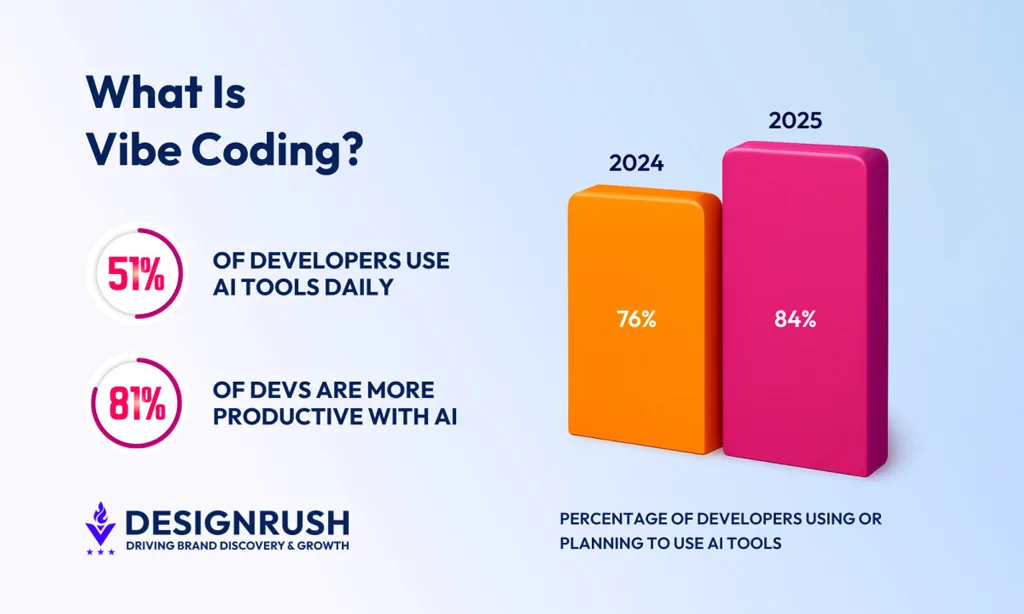
- Over half of developers (51%) are already using AI tools daily, signaling a strong shift toward AI-assisted coding workflows.
- A significant 81% of developers report higher productivity when using AI, highlighting its role as a performance multiplier in development tasks.
- Adoption is accelerating rapidly, with 76% of developers in 2024 either using or planning to use AI tools.
- This figure is projected to rise to 84% in 2025, indicating a fast-growing mainstream adoption trend.
- The 8 percentage point increase from 2024 to 2025 reflects strong momentum and increasing trust in AI-powered development tools.
- The combination of high daily usage (51%) and productivity gains (81%) suggests that AI is not just experimental but becoming a core part of modern coding practices.
- Overall, the data points to a clear transition toward “Vibe Coding”, where developers rely on AI to enhance efficiency, speed, and output quality.
Market Growth and Economic Impact of Vibe Coding
- AI coding contributes to a market where 41% of code is AI-generated, signaling a massive economic shift.
- This share is expected to exceed 50% by late 2026 in high-adoption companies.
- Replit grew from $2.8M to $150M annualized revenue in one year due to AI coding demand.
- The company now serves 40 million users with 150,000 paying customers, highlighting monetization potential.
- AI-driven development enables startups to reduce engineering costs by up to 70% in early stages.
- AI coding tools enable rapid MVP creation in days instead of weeks, accelerating time-to-market.
- Enterprise margins for AI coding platforms can reach 80% in high-value contracts, showing strong profitability.
- Over 256 billion lines of AI-generated code in 2024 reflect massive compute-driven economic activity.
- Around 25% of startups operate with 95%+ of their codebases generated by AI, redefining engineering economics.
Workplace and Company Adoption of Vibe Coding
- 87% of Fortune 500 companies use vibe coding platforms, indicating enterprise trust.
- 76% of developers using AI tools report unclear productivity metrics within organizations.
- 51% of developers rely on AI daily, embedding it deeply in workplace routines.
- AI tools are now used across prototyping, production, and internal systems, not just experimentation.
- Only 9% of teams deploy vibe coding for business-critical apps, showing caution in high-risk use cases.
- Meanwhile, 67.6% of teams use vibe coding for less than 25% of production apps, keeping it limited.
- 32.5% of developers feel confident using vibe coding in mission-critical systems, indicating a confidence gap.
- Companies adopting structured AI workflows report 300% better maintainability and 85% fewer vulnerabilities.
- AI coding adoption is now considered a core developer skill in modern organizations, not optional.
Global Vibe Coding Adoption by Region
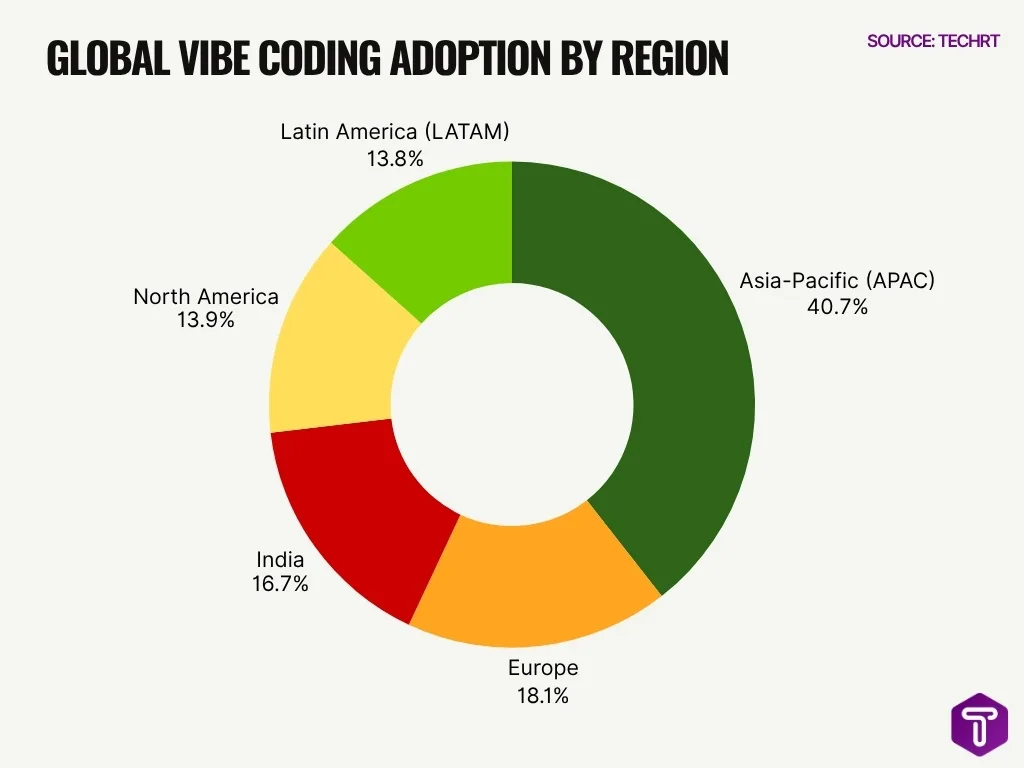
- Asia-Pacific (APAC) dominates globally with a massive 40.7% adoption, accounting for the largest share of usage by a wide margin.
- Europe ranks second with 18.1%, showing strong but significantly lower adoption compared to APAC.
- India emerges as a fast-growing market, contributing 16.7%, closely trailing Europe and outperforming major regions like North America.
- North America records 13.9% adoption, indicating moderate uptake despite being a mature tech market.
- Latin America (LATAM) shows similar trends with 13.8%, nearly identical to North America, highlighting balanced but lower adoption levels.
- The gap between APAC and other regions is substantial, with APAC having more than double the adoption of Europe.
- The top 3 regions (APAC, Europe, India) together account for 75.5% of global usage, indicating regional concentration of adoption.
- The bottom 2 regions (North America and LATAM) combined contribute only 27.7%, reflecting slower penetration in these markets.
- Overall, the data highlights a clear shift toward Asia-led adoption, with emerging markets playing a critical role in growth trends.
Developer Behavior and Preferences in Using Vibe Coding
- 78% of developers prefer AI tools for boilerplate code generation, saving time on repetitive tasks.
- Around 65% of developers use AI to debug and fix errors, rather than writing code from scratch.
- 52% of developers rely on AI for documentation generation, improving clarity and onboarding speed.
- Nearly 48% of developers say AI tools improve coding enjoyment, making workflows more engaging.
- 61% of developers cross-check AI outputs manually, indicating partial trust.
- Junior developers are 2x more likely to rely heavily on AI tools compared to senior engineers.
- 70% of developers use AI tools for learning new languages or frameworks, highlighting educational value.
- Around 44% prefer prompt-based coding over traditional coding for prototyping, especially in startups.
- Developers spend 30% less time searching documentation when using AI copilots.
AI Integration in Vibe Coding
- 84% of developers use AI coding tools in their workflow, up from 76% in 2024.
- AI tools now integrate with major IDEs like VS Code and JetBrains, covering over 90% of developer environments.
- 55% of companies have integrated AI into CI/CD pipelines, automating testing and deployment.
- AI-generated code suggestions are accepted 30% to 40% of the time, depending on task complexity.
- 60% of organizations use AI for automated code reviews, reducing human effort.
- AI tools reduce coding time for simple tasks by up to 55%, improving iteration speed.
- Around 47% of teams use AI for test case generation, improving coverage.
- AI integration has reduced onboarding time for new developers by up to 35%.
- 72% of developers say AI improves collaboration across teams, especially in distributed environments.
Impact of Vibe Coding on Development Efficiency
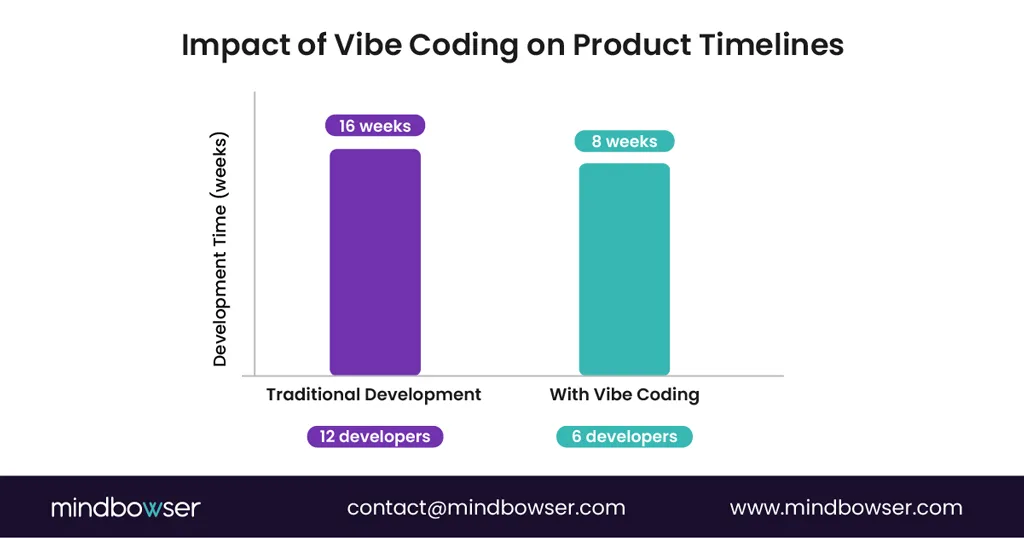
- Development time is reduced by 50%, dropping from 16 weeks in traditional development to just 8 weeks with vibe coding.
- Teams using vibe coding require 50% fewer developers, decreasing from 12 developers to 6 developers.
- This indicates a significant increase in productivity per developer, effectively doubling output efficiency.
- Vibe coding enables faster time-to-market, allowing companies to ship products 2x quicker than traditional methods.
- Reduced team size and timeline suggest lower operational and labor costs, improving overall ROI.
- The data highlights a clear efficiency advantage, where smaller teams can deliver projects in half the time without scaling resources.
- This trend reflects a broader shift toward AI-assisted or automation-driven development models that optimize both speed and resource utilization.
Vibe Coding Use Cases
- 78% of startups use vibe coding for MVP development, reducing early-stage costs.
- AI tools enable non-technical founders to build apps without engineers, expanding entrepreneurship.
- 65% of companies use AI coding tools for internal automation tools, such as dashboards and scripts.
- Around 52% of developers use AI for API integration tasks, simplifying backend development.
- AI-generated code supports rapid prototyping in under 24 hours for many use cases.
- 44% of enterprises use vibe coding for customer-facing applications, though often with human review.
- AI coding tools are used in game development, fintech, and healthcare applications, showing cross-industry reach.
- 58% of developers use AI for data processing and automation scripts, especially in analytics workflows.
- Educational use is rising, with over 60% of students using AI tools to learn coding.
Code Quality and Defects
- AI-generated code can introduce up to 40% more bugs in complex scenarios, requiring careful review.
- However, for simple tasks, AI reduces errors by up to 30%, improving baseline quality.
- 61% of developers report needing to fix AI-generated code regularly, highlighting reliability gaps.
- AI-assisted testing reduces defect rates by 20% in controlled environments.
- 35% of developers say AI introduces security vulnerabilities, especially in generated dependencies.
- Code review time increases by 15% when AI-generated code is used, due to verification needs.
- 48% of developers trust AI for simple scripts but not for complex systems, indicating partial adoption.
- AI tools sometimes hallucinate APIs or functions in over 20% of cases, leading to runtime errors.
- Structured workflows can reduce AI-related defects by up to 50%, improving reliability.
Tool Popularity and Usage Insights in Vibe Coding
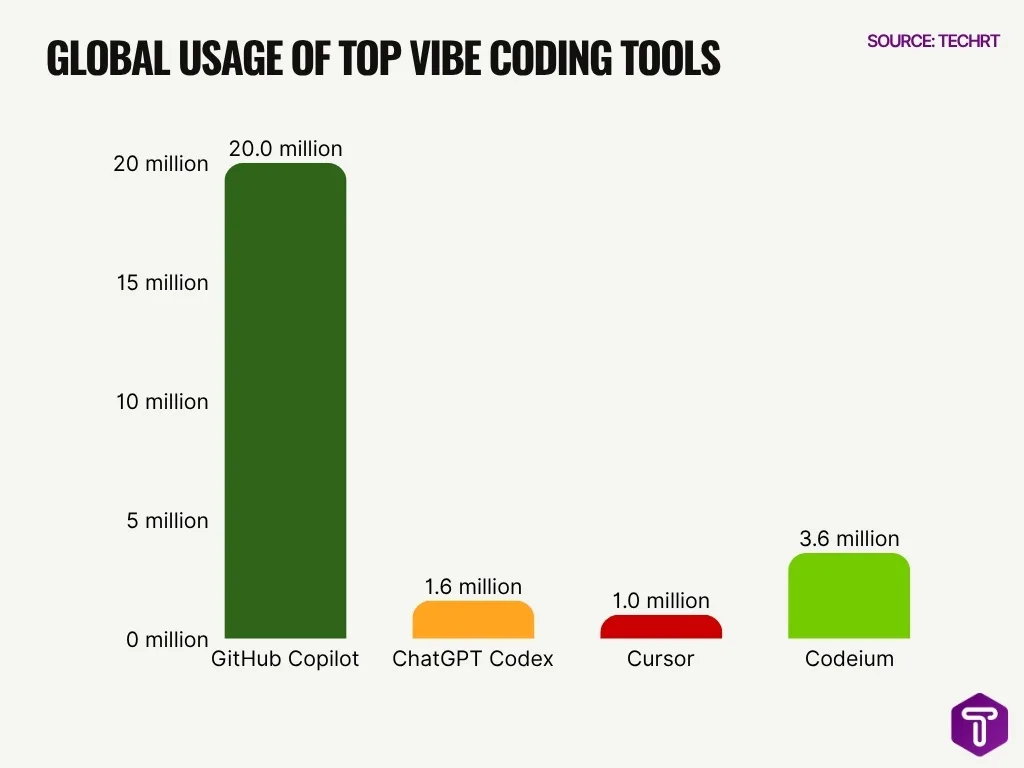
- GitHub Copilot has 4.7 million paid subscribers as of January 2026, with total users reaching 20 million by July 2025, cementing its position as the leading AI coding assistant.
- ChatGPT surpassed 900 million weekly active users as of February 2026, with 1.6 million weekly Codex users specifically for coding purposes.
- Cursor has over 1 million daily active users and is used by over half of the Fortune 500 companies, achieving $1 billion in annualized revenue by November 2025.
- Codeium serves over 3.6 million developers globally in 2026, representing 80%+ user growth in two years since early 2023, with adoption across 7,000+ companies.
- 84% of developers are using or planning to use AI tools in their development process, with 51% of professional developers using AI tools daily, according to Stack Overflow’s 2025 survey.
- 51% of professional developers use AI coding tools daily, demonstrating widespread integration into mainstream development workflows across organizations.
- 92% of developers now use AI tools, with productivity improvements averaging 25% boost and development speeds reportedly 27% faster task completion rates with AI assistance.
- GitHub Copilot leads in positive developer sentiment at 34.7% among AI coding assistants, according to the State of Web Dev AI 2025 survey of 4,181 developers.
- Tabnine has been recognized as a Visionary in the 2025 Gartner Magic Quadrant for AI Code Assistants, with enterprise adoption focused on secure and compliant AI-powered development.
Review and Maintenance
- 68% of developers say reviewing AI-generated code takes more time than expected, due to validation needs.
- AI-generated code requires 15% to 25% more review cycles compared to human-written code.
- 59% of teams have introduced additional QA layers specifically for AI-generated code.
- Code maintenance costs increase by up to 20% when AI-generated code lacks documentation.
- 47% of developers report difficulty understanding AI-generated logic, especially in large codebases.
- AI-assisted refactoring reduces legacy code maintenance time by 30%, improving long-term scalability.
- 62% of teams now enforce stricter code review guidelines for AI-generated contributions.
- Continuous monitoring tools reduce maintenance overhead by up to 35%, especially in AI-heavy environments.
- 41% of developers say AI helps maintain code consistency, particularly in style and formatting.
Vibe Coding Trust Gap: Security, Hallucinations, and Skepticism
- Only 33% of developers fully trust AI-generated code, reflecting ongoing skepticism.
- 35% of developers report security vulnerabilities in AI-generated code snippets.
- AI tools hallucinate incorrect or non-existent functions in over 20% of cases, especially in complex tasks.
- 48% of developers say they trust AI only for simple tasks, not production systems.
- Around 57% of organizations cite security as the top concern when adopting AI coding tools.
- 29% of developers avoid AI tools due to data privacy concerns, especially in regulated industries.
- AI-generated dependencies may include outdated libraries in up to 18% of cases, increasing risk.
- 66% of teams require human approval before deploying AI-generated code, reinforcing governance.
- Trust in AI tools improves by 25% when explainability features are included, showing the importance of transparency.
Big Tech Companies Are Vibe Coding
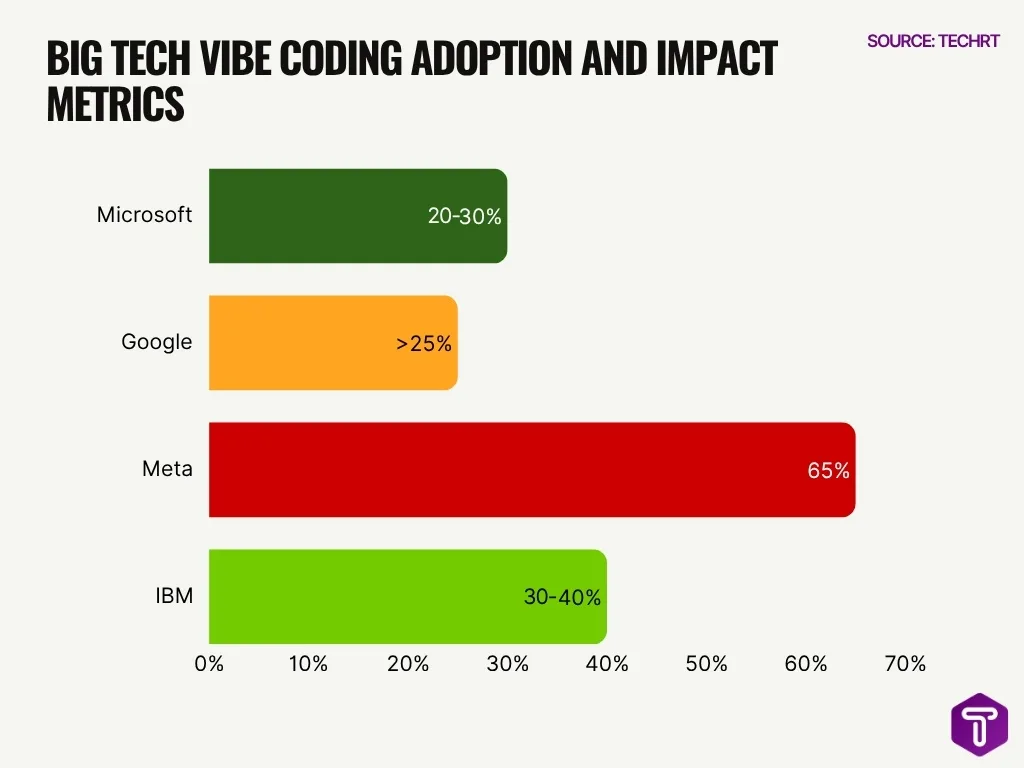
- Microsoft CEO Satya Nadella stated that 20–30% of code in the company’s repositories is written by AI.
- Google’s CEO revealed that over 25% of new code is generated by AI and reviewed by engineers.
- Meta targets 65% of engineers writing more than 75% of their code using AI tools by mid-2026.
- Amazon’s Amazon Q Developer saved 4,500 years of development work and $260 million annually through AI code transformation.
- NVIDIA enabled over 30,000 engineers to commit 3x more code using AI tools like Cursor while keeping bug rates flat.
- IBM reports 30–40% productivity gains from AI-assisted development in areas like code documentation and test cases.
- GitHub Copilot has 20 million total users and 4.7 million paid subscribers as of early 2026.
- Big Tech companies plan to invest $650 billion in AI infrastructure in 2026, mostly for coding advancements.
- 51% of professional developers use AI coding tools daily, saving an average of 3.6 hours per week.
Negatives and Failure Modes
- AI-generated code fails to meet requirements in up to 23% of complex tasks, requiring rework.
- 40% of developers report incorrect outputs when prompts are ambiguous or poorly structured.
- AI tools may introduce hidden bugs that appear only in production in 18% of cases.
- 26% of developers say AI suggestions degrade code readability, especially in large projects.
- Prompt misinterpretation leads to incorrect logic in over 30% of cases, particularly in edge scenarios.
- 19% of teams report project delays due to AI-generated code issues, offsetting productivity gains.
- AI-generated code sometimes duplicates existing logic, increasing redundancy by 15%.
- 34% of developers say AI tools struggle with domain-specific requirements, limiting their usefulness in specialized fields.
- Failure rates decrease by up to 35% when prompts are structured clearly, emphasizing prompt engineering importance.
The Cognitive Offloading Model
- 61% of developers rely on AI tools to reduce cognitive load, especially for repetitive tasks.
- Cognitive offloading improves task speed by up to 35%, enabling faster execution.
- However, 44% of developers report reduced deep understanding of code when overusing AI.
- AI-assisted workflows reduce mental fatigue by up to 30%, improving developer well-being.
- 52% of developers say AI helps them focus on architecture and design, not syntax.
- Over-reliance on AI reduces long-term skill retention in around 28% of developers.
- Cognitive offloading is most effective in low-complexity tasks, with diminishing returns in complex systems.
- 47% of developers use AI as a “thinking partner”, not just a coding assistant.
- Teams adopting balanced AI usage report 20% higher satisfaction scores, combining efficiency with skill growth.
Risks and Challenges in Using Vibe Coding
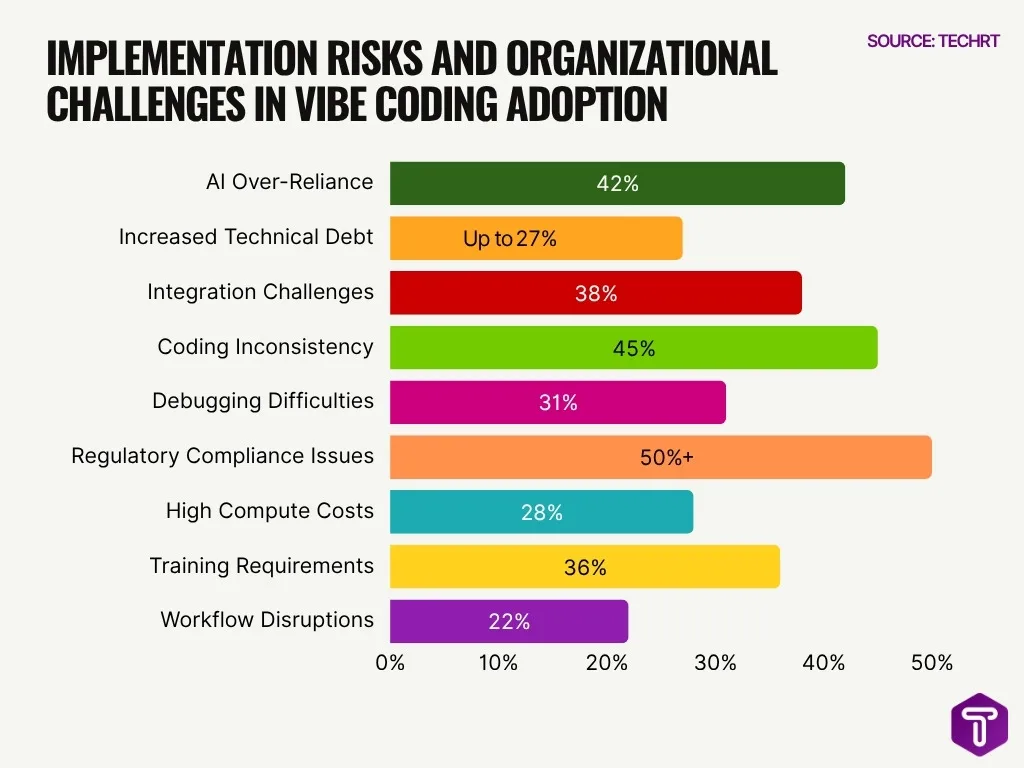
- 42% of developers report over-reliance on AI tools, reducing independent problem-solving skills.
- AI-generated code increases technical debt by up to 27% in poorly managed projects.
- 38% of teams struggle with integrating AI-generated code into existing systems, causing compatibility issues.
- Lack of standardization leads to inconsistent coding practices in 45% of AI-assisted projects.
- 31% of developers face challenges in debugging AI-generated code, especially when logic is unclear.
- Regulatory concerns affect over 50% of enterprises, particularly in the finance and healthcare sectors.
- 28% of organizations cite high compute costs as a barrier to scaling AI coding tools.
- Skill gaps persist, with 36% of developers needing additional training to effectively use AI tools.
- 22% of teams report workflow disruptions when introducing AI coding tools without clear processes.
Future Projections and Forecasts
- AI is expected to generate over 60% of code globally by 2027, up from ~41% today.
- The AI coding tools market is projected to exceed $50 billion by 2030, driven by enterprise demand.
- 90% of developers will use AI tools regularly by 2026, nearing full adoption.
- Low-code and vibe coding platforms will power over 65% of app development by 2027.
- AI-assisted development could reduce software development costs by up to 40% globally.
- 75% of enterprises plan to expand AI coding adoption, especially in automation and DevOps.
- AI agents capable of autonomous development will handle 20% of coding tasks by 2028.
- 50% of junior developer roles may shift toward AI supervision roles, reflecting changing skill demands.
- Developer productivity gains from AI could add $1.5 trillion annually to the global economy.
Frequently Asked Questions (FAQs)
What percentage of developers use AI coding tools today?
How much of global code is now generated by AI?
How many developers use GitHub Copilot worldwide?
How much productivity improvement do developers gain from vibe coding?
What percentage of companies have adopted vibe coding tools?
Conclusion
Vibe coding has evolved from a niche experiment into a foundational layer of modern software development. The data shows clear gains in speed, accessibility, and cost efficiency, especially in startup environments and enterprise automation. At the same time, trust gaps, security concerns, and maintenance challenges continue to shape how organizations deploy these tools at scale.
Looking ahead, the balance between human expertise and AI assistance will define success. Teams that invest in governance, prompt engineering, and developer education will extract the most value while minimizing risks. As adoption approaches ubiquity, vibe coding will not replace developers, but it will fundamentally reshape how they build, think, and collaborate.

Leave a comment
Have something to say about this article? Add your comment and start the discussion.