



Vibe marketing has quickly reshaped how brands connect with audiences, shifting the focus from product features to emotional storytelling, cultural alignment, and real-time relevance. Instead of pushing polished, one-way campaigns, companies now build immersive brand experiences that reflect how people feel, behave, and engage online. This approach plays a critical role in industries like ecommerce, where TikTok-driven trends can influence purchasing decisions overnight, and in SaaS, where community-led narratives help drive user adoption and retention.
At the same time, advancements in AI and automation have made vibe marketing more scalable than ever. Marketing teams can now analyze cultural signals, generate content, and launch campaigns within hours rather than weeks. As a result, brands of all sizes can compete by staying relevant, authentic, and emotionally connected to their audiences. In the sections ahead, we break down the latest statistics shaping vibe marketing and what they mean for modern marketers.
Editor’s Choice
- Search interest in vibe marketing surged by 686% year-over-year, reflecting explosive demand for this strategy.
- Nearly 47% of Fortune 500 companies adopted vibe marketing elements by late 2024.
- Brands report up to 70–80% reduction in content production costs using AI-driven workflows.
- Vibe-led campaigns achieved 340% higher engagement rates compared to traditional campaigns.
- Companies using vibe strategies saw 127% growth in brand awareness.
- Conversion improvements reached 250% in trial-to-paid scenarios for vibe-aligned campaigns.
- AI is expected to automate 30% of marketing tasks by 2030, accelerating vibe marketing adoption.
Recent Developments
- Vibe marketing emerged as a mainstream concept around 2025, driven by AI-assisted content creation.
- Brands now launch campaigns in hours instead of weeks, thanks to automation tools.
- AI-powered platforms enable small teams to match the output of large marketing departments.
- Emotion-first marketing replaces traditional feature-based messaging across industries.
- Content strategies increasingly rely on user-generated content, memes, and community storytelling.
- AI tools now support real-time cultural trend analysis and sentiment tracking.
- Marketers prioritize authentic, unpolished content over highly produced ads, especially on social platforms.
- The marketing tech industry supporting these trends is projected to reach $1.7 trillion by 2032.
- AI-driven personalization enables hyper-targeted emotional messaging at scale.
Key Insights: Why Vibe Marketing Will Dominate in 2026
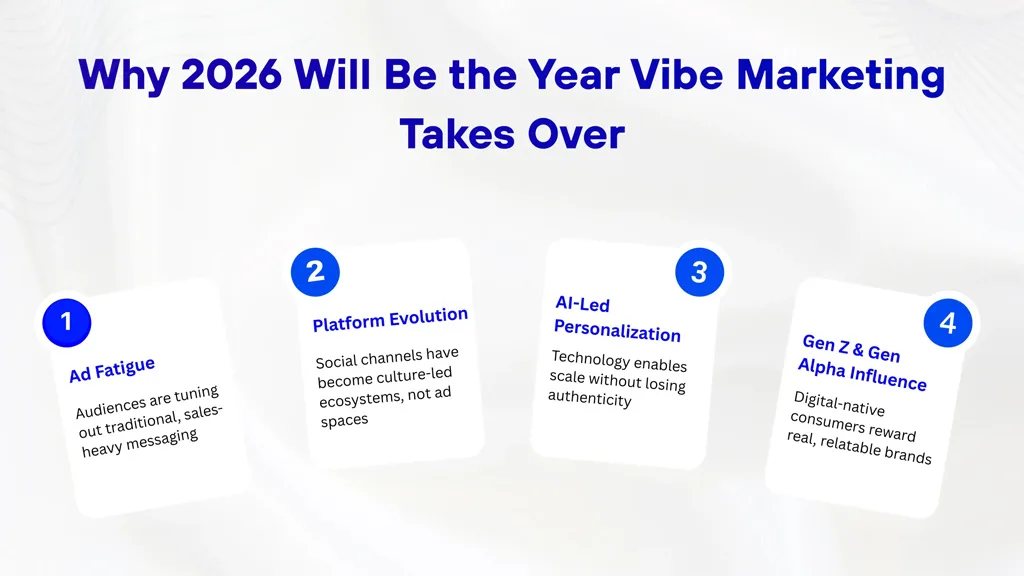
- Ad fatigue is rising rapidly, with audiences actively tuning out traditional, sales-heavy messaging, signaling a major shift away from push marketing strategies.
- Social platforms are evolving into culture-driven ecosystems, where brands must participate in conversations rather than rely on interruptive advertising.
- AI-led personalization is redefining scale, allowing brands to deliver highly tailored experiences while maintaining authenticity at scale.
- The influence of Gen Z and Gen Alpha is accelerating, as these digital-native consumers prioritize real, relatable, and emotionally resonant brands.
- Brands that fail to adapt to this shift risk losing engagement, as consumer expectations are moving toward authenticity over promotion.
- Vibe marketing bridges the gap between data-driven targeting and human-centric storytelling, making campaigns more engaging and culturally relevant.
- The convergence of technology, culture, and consumer behavior is creating a new marketing paradigm where connection > conversion-first messaging.
- Companies leveraging vibe marketing strategies are more likely to see higher engagement, stronger brand affinity, and improved long-term loyalty.
- In 2026, marketing success will depend less on ad spend and more on a brand’s ability to align with audience sentiment, identity, and culture.
- Overall, vibe marketing represents a shift from “selling to audiences” → “resonating with communities”, marking a fundamental transformation in digital marketing strategy.
Vibe Marketing Adoption and Market Growth
- Nearly half of large enterprises have already adopted vibe marketing approaches.
- Startups are offering up to $1 million salaries for vibe marketing roles, signaling high demand.
- AI-enabled marketing allows teams to operate with significantly fewer resources.
- The global marketing technology market is projected to grow from $575 billion to $1.7 trillion by 2032.
- Brands adopting vibe marketing report faster campaign iteration cycles, often within hours.
- Small teams can now execute campaigns at enterprise scale using automation tools.
- Emotional and cultural alignment is becoming a core competitive differentiator in marketing.
- AI-driven content systems enable continuous optimization and rapid testing cycles.
- By 2026, vibe marketing is shifting from an experimental tactic to a baseline requirement for brand relevance.
Search Interest and Vibe Marketing Popularity Trends
- Global search volume for “vibe marketing” surged 686% in one year.
- Nearly 47% of Fortune 500 companies now adopt vibe marketing approaches.
- One vibe marketer with AI can perform the work of 10+ specialists, shrinking teams from 10-20 to 2-3 people.
- Vibe marketing enables 50-100+ content pieces per month and 20+ A/B test variants simultaneously, versus traditional 5-10 pieces.
- 78% of Gen Z shoppers follow brands that “get their vibe“.
- 68% of Gen Z show higher loyalty to brands reflecting their lifestyle or identity.
- Brands using UGC-driven campaigns achieve 29% higher engagement than polished ads.
- TikTok boasts 7.4% average video engagement rate, outpacing Instagram Reels at 4.3% for trend-driven content.
- Emotionally connected customers prove 52% more valuable, with emotional ads boosting sales by 23%.
- 86% of consumers say authenticity strongly influences brand support in marketing trends.
Gen Z and Millennial Attitudes Toward Vibe-First Brands
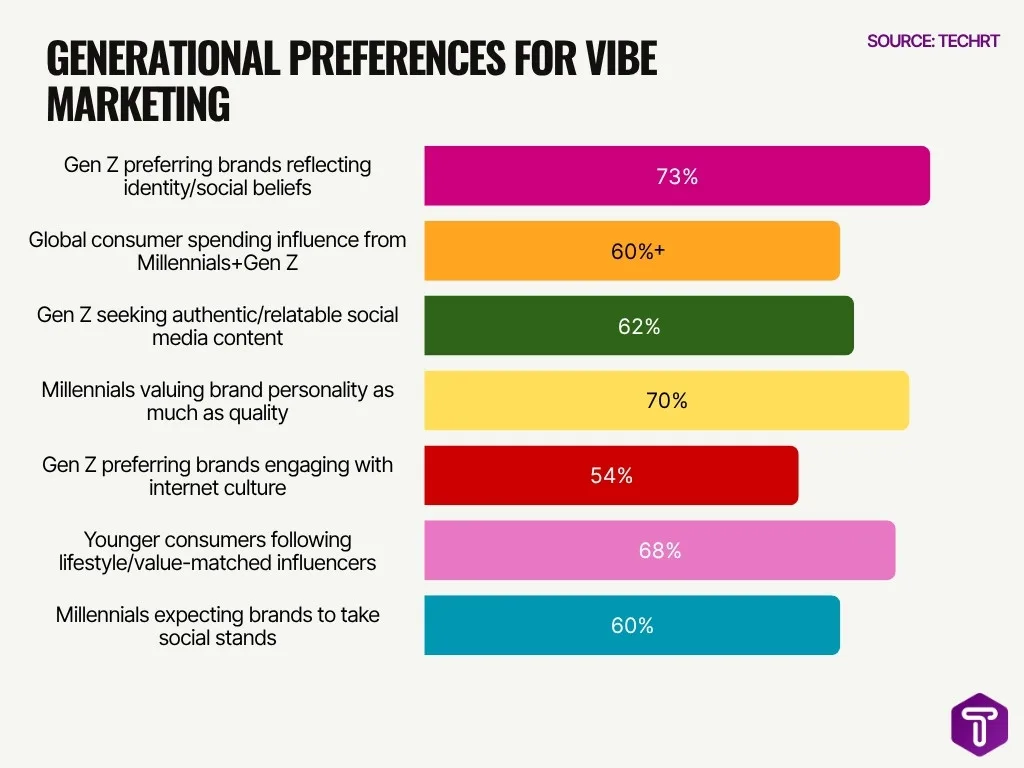
- 73% of Gen Z consumers prefer brands that reflect their personal identity and social beliefs.
- Millennials and Gen Z account for over 60% of global consumer spending influence.
- 62% of Gen Z actively seek brands that create relatable, authentic content on social media.
- About 70% of Millennials say brand personality matters as much as product quality.
- 54% of Gen Z prefer brands that engage with internet culture, memes, and trends.
- Nearly 68% of younger consumers follow influencers who match their lifestyle and values.
- Gen Z is 2.5x more likely to engage with short-form video content compared to older generations.
- 60% of Millennials expect brands to take a stand on social issues.
- Brands targeting Gen Z see higher engagement when using humor, authenticity, and community storytelling.
Consumer Behavior and Vibe-Driven Purchase Decisions
- 71% of consumers prefer brands that align with their values and identity, a core driver of vibe marketing success.
- Around 76% of buyers say emotional connection influences their purchase decisions, especially among younger audiences.
- Personalized, vibe-driven experiences can boost purchase likelihood by up to 80%.
- Nearly 64% of consumers say shared values are the primary reason they trust a brand.
- Brands that create emotional resonance see 3x higher customer lifetime value compared to product-focused competitors.
- About 58% of consumers are more likely to buy from brands that feel culturally relevant.
- 65% of Gen Z consumers say they purchase based on how a brand makes them feel, not just price or features.
- User-generated content influences 79% of purchase decisions, reinforcing the role of community-driven vibes.
- Brands with strong emotional narratives experience 20–40% higher conversion rates.
Emotional Resonance and Brand Affinity Metrics
- Emotional campaigns outperform rational ones with 31% higher effectiveness.
- Brands that rank high in emotional connection see 306% higher lifetime value.
- Customers emotionally connected to a brand are 52% more valuable than satisfied customers.
- Ads that evoke strong emotions generate 2x more recall than neutral campaigns.
- Around 70% of brand decisions are based on emotional factors, not rational ones.
- Brands with consistent emotional storytelling achieve 23% higher revenue growth.
- Emotional engagement increases customer retention rates by up to 44%.
- Companies that prioritize emotional branding see significant improvements in brand loyalty and advocacy metrics.
- Strong emotional branding reduces price sensitivity, allowing brands to maintain premium pricing power.
Impact of Vibe Marketing on Engagement and Conversion Rates
- Vibe-driven campaigns deliver up to 340% higher engagement rates than traditional campaigns.
- Brands using emotionally aligned messaging see 2x higher click-through rates (CTR).
- Conversion rates improve by 20–40% when campaigns align with user intent and emotions.
- Video-based vibe campaigns achieve 49% faster revenue growth.
- Interactive and community-driven campaigns increase engagement by up to 50%.
- Social media posts with emotional storytelling see higher share rates and organic reach.
- Brands leveraging UGC report 29% higher web conversions.
- Email campaigns using emotional tone and personalization deliver 6x higher transaction rates.
- Content aligned with cultural trends generates significantly higher engagement within the first 24 hours of posting.
Revenue Growth and ROI from Vibe-Led Campaigns
- Companies implementing vibe marketing report up to 60% faster revenue growth.
- Emotionally connected customers contribute 2–3x higher revenue compared to average customers.
- Brands investing in personalization see 5–8x ROI on marketing spend.
- Vibe-led campaigns improve marketing ROI by 20–30% across digital channels.
- Companies using AI-driven marketing strategies report 30% higher marketing efficiency.
- Customer-centric brands achieve 60% higher profitability than competitors.
- Emotion-driven branding increases upsell and cross-sell opportunities by 15–25%.
- Companies focusing on brand affinity report higher retention and repeat purchase rates, boosting long-term ROI.
- Data-driven emotional marketing helps reduce customer acquisition costs by up to 30%.
AI and Automation Tools Used in Vibe Marketing
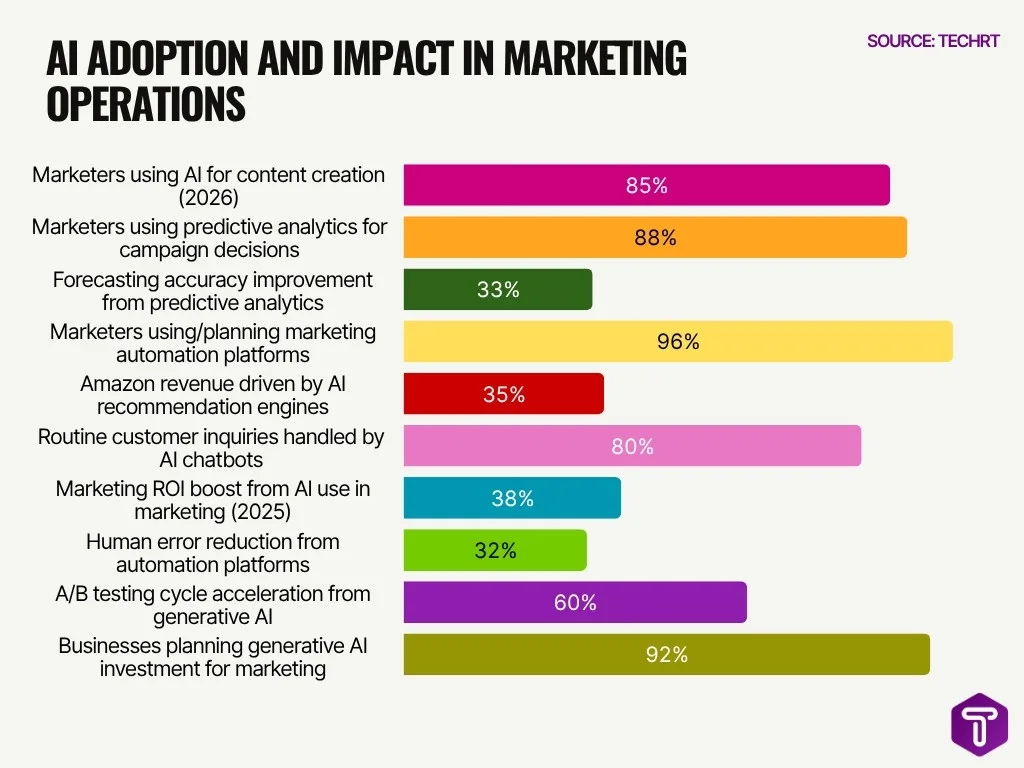
- Over 85% of marketers now use AI tools for content creation in 2026, up from 61% in 2023.
- 88% of marketers use predictive analytics to inform campaign decisions, improving forecasting accuracy by 33%.
- 96% of marketers have used or plan to use marketing automation platforms within the next year.
- AI-powered recommendation engines drive 35% of Amazon’s total revenue through advanced personalization.
- AI chatbots handle up to 80% of routine customer inquiries, reducing response times significantly.
- Companies using AI in marketing saw an average 38% boost in marketing ROI in 2025.
- Automation platforms reduce human error by 32%, enhancing campaign accuracy and productivity.
- Generative AI enables 60% faster A/B testing cycles for creative variations in campaigns.
- 92% of businesses plan to invest in generative AI for marketing personalization and efficiency.
Cost and Time Savings from AI-Powered Vibe Marketing
- AI-powered tools reduce content production costs by 70–80%.
- Campaign creation time has dropped from weeks to a few hours or days.
- Marketers using AI report up to 40% increase in productivity.
- Automation reduces manual workload by 30–50% across marketing operations.
- AI-driven tools enable real-time campaign optimization, improving efficiency and outcomes.
- Small marketing teams can now achieve enterprise-level output without large budgets.
- AI-powered personalization reduces wasted ad spend by up to 25%.
- Automated workflows improve campaign turnaround speed by up to 60%.
- Companies using AI-driven marketing report faster experimentation cycles and improved decision-making accuracy.
Content Production and Creative Workflow Statistics
- AI-assisted content creation reduces production time by up to 70%.
- Marketers publish 3x more content when using automation tools.
- Around 72% of marketers say content creation is their most time-consuming task, driving AI adoption.
- Companies using AI content tools report 50% faster campaign turnaround times.
- Content teams using automation see higher consistency and output quality across channels.
- AI tools enable real-time content personalization, improving engagement.
- Nearly 60% of marketers reuse and repurpose content across multiple formats for efficiency.
- Workflow automation reduces bottlenecks and improves collaboration across teams.
- Content strategies aligned with trends generate higher reach and faster engagement cycles.
Content Types That Influence Purchasing Decisions
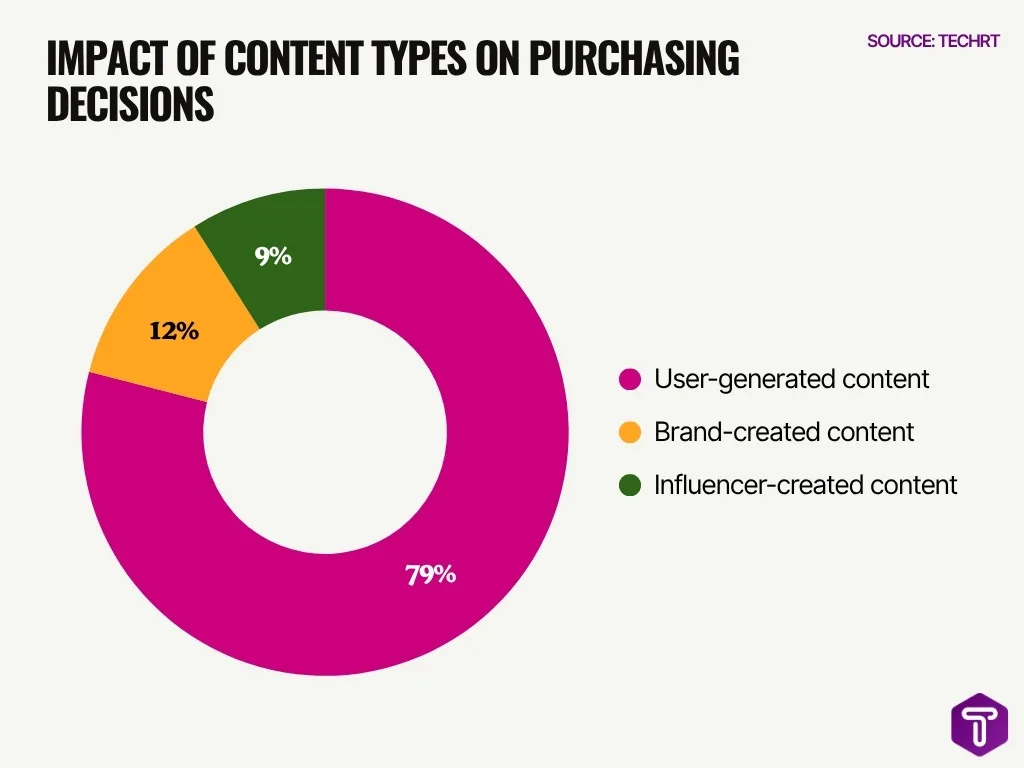
- User-generated content dominates purchasing influence, accounting for a massive 79%, highlighting strong consumer trust in peer reviews and real experiences.
- Brand-created content contributes only 12%, indicating that traditional marketing messages are significantly less persuasive compared to organic content.
- Influencer-created content holds a smaller share at 9%, suggesting that while influencers impact decisions, their effect is limited compared to everyday users.
- The data clearly shows a shift toward authenticity, where buyers prefer real user opinions over polished brand messaging.
- Trust and relatability are key drivers, making user-generated content nearly 6.5x more influential than brand-created content.
- Businesses focusing on UGC strategies (reviews, testimonials, community content) are more likely to drive conversions.
- The relatively low influence of influencer content suggests a potential decline in over-commercialized promotions.
- Overall, the trend emphasizes that social proof and community-driven content play a critical role in modern purchasing decisions.
Short-Form Video and TikTok Vibe Marketing Performance
- Short-form video delivers 2.5x higher engagement than long-form content.
- TikTok users spend an average of 95 minutes per day on the platform.
- 90% of marketers say short-form video provides the highest ROI among content formats.
- TikTok ads achieve up to 1.7x higher engagement rates than other social platforms.
- Around 67% of users say TikTok inspires purchases, highlighting its influence.
- Short-form video content increases brand recall by up to 80%.
- Brands using TikTok trends see faster virality and audience growth.
- Video-first campaigns drive higher click-through and conversion rates.
- Mobile-first audiences prefer quick, engaging content formats aligned with vibe marketing.
Community, Loyalty, and Tribe-Building Metrics
- Brands with strong communities see 2x higher customer retention rates.
- Community-driven brands grow revenue faster than competitors by up to 25%.
- Around 77% of consumers are more loyal to brands that foster community engagement.
- Loyalty program members generate 12–18% more incremental revenue growth annually.
- Engaged communities contribute to higher referral rates and organic growth.
- Brands investing in community platforms see improved customer feedback loops and innovation.
- Emotional brand communities increase advocacy and word-of-mouth marketing effectiveness.
- Online communities help reduce churn rates by up to 30%.
- Tribe-based branding fosters long-term relationships beyond transactional interactions.
Benefits of Vibe Marketing
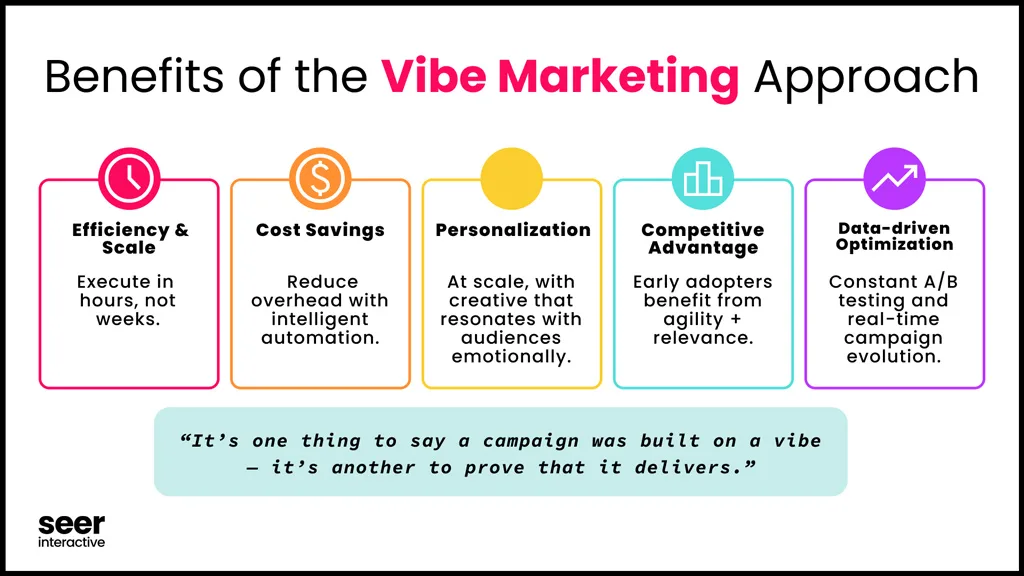
- Faster execution cycles: Campaigns can be launched in hours instead of weeks, significantly improving speed-to-market and responsiveness.
- Operational efficiency at scale: Brands can handle high-volume content production without increasing team size, enabling better scalability.
- Reduced marketing costs: Leveraging automation helps cut overhead expenses, leading to more cost-efficient campaign management.
- Higher personalization impact: Vibe marketing enables emotion-driven creative at scale, improving audience connection and engagement.
- Stronger brand resonance: Campaigns built around a “vibe” create deeper emotional alignment, boosting brand affinity and recall.
- Early-mover competitive edge: Brands adopting this approach gain greater agility and relevance, outperforming slower competitors.
- Continuous performance improvement: Ongoing A/B testing ensures campaigns evolve based on real-time data insights.
- Improved conversion potential: Data-driven optimization helps increase conversion rates through iterative refinement.
- Real-time campaign adaptability: Marketers can adjust messaging instantly using live performance data, reducing wasted spend.
- Enhanced ROI through optimization: Combining automation + testing leads to better marketing ROI and efficiency gains.
Industry-Wise Vibe Marketing Benchmarks (Ecommerce, SaaS, Fintech, etc.)
- Ecommerce brands using emotional storytelling see up to 30% higher conversion rates.
- SaaS companies leveraging community-driven marketing achieve 92% retention rates and 3x more upsells.
- Fintech brands using trust-based messaging reduce customer acquisition costs by up to 40%.
- DTC brands using vibe marketing build 306% higher lifetime value through emotional loyalty.
- Healthcare marketing campaigns with emotional storytelling report improved patient satisfaction and adherence rates.
- Gaming brands relying on influencer engagement deliver $5.78 ROI per dollar spent.
- Retail brands using personalization see conversion rates up 288% from recommendations.
- B2B SaaS companies using brand storytelling boost MQL-to-SQL conversion to 32-40%.
- Fintech startups leveraging UGC achieve 2x higher user retention and 4x referral growth.
B2B vs B2C Vibe Marketing Performance Stats
- B2C brands achieve 28% higher engagement rates with UGC compared to branded content, outperforming B2B efforts.
- B2C surveys yield response rates of 20-35%, significantly higher than B2B due to simpler consumer engagement.
- B2B buyers are nearly 50% more likely to purchase when emotionally connected to a brand.
- Emotional factors drive 66% of B2B buying decisions, surpassing logical considerations.
- Personalized messaging boosts B2B conversion rates by up to 80% and CTAs by 202%.
- UGC posts generate 6.9x more engagement for B2C brands, enhancing retention and loyalty.
- B2B sales cycles average 4+ months for 74.6% of deals, far longer than B2C transactions.
- B2B influencer marketing delivers 520% average ROI, rivaling B2C viral trends.
- Storytelling emotionally connects B2C buyers at higher rates through viral social trends.
Frequently Asked Questions (FAQs)
How fast is Vibe Marketing growing in search demand?
What percentage of Fortune 500 companies use vibe marketing?
How much cost reduction can brands achieve with vibe marketing?
How much faster can revenue grow with vibe marketing strategies?
How much of marketing work will AI automate in the near future?
Conclusion
Vibe marketing has moved beyond experimentation and now stands as a core strategy for brands aiming to stay relevant in a fast-moving digital landscape. By combining emotional storytelling, cultural awareness, and AI-powered execution, companies can create campaigns that resonate deeply with their audiences while delivering measurable business outcomes. The data clearly shows improvements in engagement, conversion rates, and customer loyalty when brands prioritize connection over traditional promotion.
Moreover, the rise of automation and generative AI has lowered the barrier to entry, allowing even small teams to produce high-impact campaigns at scale. As consumer expectations continue to evolve, especially among Gen Z and Millennials, brands that invest in authenticity, community, and emotional resonance will gain a lasting advantage. Looking ahead, vibe marketing will not just influence how brands communicate, it will define how they build relationships, drive growth, and compete in the digital economy.

Leave a comment
Have something to say about this article? Add your comment and start the discussion.