


Slack has become a central hub for modern workplace communication, especially in remote and hybrid environments where teams rely on real-time collaboration. Companies use it to replace internal emails, streamline project discussions, and integrate essential tools like CRM platforms, cloud storage, and automation apps into a single workspace. As a result, Slack reduces communication silos and helps teams move faster with fewer interruptions.
From startups coordinating product launches to enterprise teams managing global operations across time zones, Slack plays a direct role in improving productivity, transparency, and decision-making. Its growing ecosystem of integrations and AI-powered features further positions it as more than just a messaging app; it acts as a unified work operating system. Let’s explore the latest statistics shaping Slack’s growth, usage, and impact.
Editor’s Choice
- Slack reached over 42 million daily active users in 2023, reflecting strong adoption across global teams.
- The platform now supports 200,000+ paying organizations worldwide as of 2025.
- Slack operates in 150+ countries, highlighting its global footprint.
- Salesforce acquired Slack for $27.7 billion, making it one of the largest SaaS acquisitions.
- Slack contributed around $2.3 billion in revenue under Salesforce in 2025, showing steady growth.
- The platform integrates with 2,400+ apps and services, enabling workflow automation.
- Slack users experience up to 47% higher productivity compared to traditional communication tools.
Recent Developments
- Daily AI usage among Slack users increased by 233% within six months in 2025, signaling rapid adoption of AI features.
- Workers using AI in Slack report 64% higher productivity levels, reinforcing its role in workflow optimization.
- Slack introduced AI-powered features like summarization and workflow automation in the 2025 updates.
- Slack Connect usage grew by 35% year-over-year, enabling cross-company collaboration.
- Over 100 million inter-company messages are exchanged weekly via Slack Connect.
- Salesforce expanded Slack access to its ecosystem, increasing enterprise adoption.
- Slack is positioning itself as an AI-powered work operating system, not just a messaging tool.
- Enterprise AI tools introduced in Slack now include automation, translation, and meeting summaries.
Slack User Base and Growth
- Slack’s daily active users are projected to reach 47 million+ by 2025, up from 32 million in 2023.
- The platform surpassed 42 million daily active users globally in early 2025.
- Slack is used by over 1 million organizations worldwide, including startups and enterprises.
- User growth increased by 12% year-over-year in 2025, reflecting continued demand.
- Slack adoption accelerated due to hybrid work trends across North America and Europe.
- The platform saw strong growth in emerging markets like India, with 20% user increase in users in 2023.
- Slack maintains high retention rates, outperforming competitors by 15%.
- More than 77% of Fortune 100 companies use Slack, indicating strong enterprise penetration.
Slack Daily Active Users Growth Trends
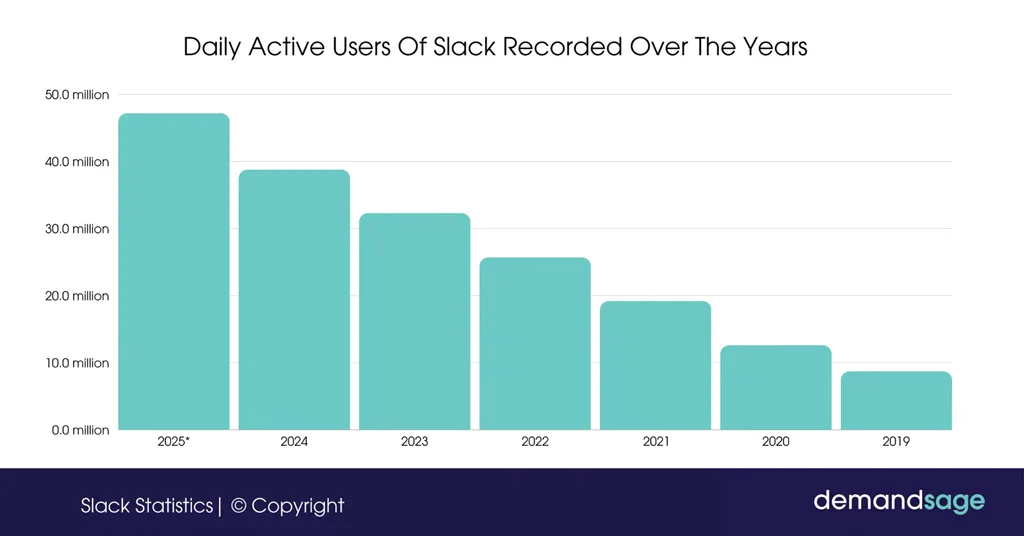
- Slack’s daily active users grew from 8.7 million in 2019 to 47.2 million in 2025, marking a 5.4x increase in just six years.
- The platform saw its largest surge between 2019 and 2021, jumping from 8.7M to 19.2M users, driven by rapid adoption during the remote work boom.
- In 2020 alone, Slack users increased by ~45%, rising from 8.7M to 12.6M, reflecting a major shift toward digital workplace communication.
- Growth remained strong through 2022, reaching 25.7 million users, showing continued enterprise and SMB adoption post-pandemic.
- Slack crossed the 30 million milestone in 2023 with 32.3 million users, highlighting sustained engagement and platform reliance.
- By 2024, daily active users climbed to 38.8 million, indicating a ~20% year-over-year increase.
- The latest figure for 2025 (47.2 million users) represents the highest recorded usage, with an 8.4 million increase in a single year.
- Overall, Slack has maintained a consistent upward growth trajectory, with no year showing a decline in user activity.
- The data reflects Slack’s strong positioning as a leading workplace communication platform, with accelerating adoption in enterprise collaboration ecosystems.
Paid Subscribers and Customers
- Slack has 200,000+ paid customers globally, including SMBs and enterprises.
- Paid organizations account for a major share of Slack’s revenue model.
- Approximately 92% of Slack’s revenue comes from subscriptions, indicating strong recurring revenue.
- Slack’s enterprise plans are widely adopted by Fortune 100 companies, with 77% usage.
- Over 215,000 organizations use Slack in some capacity as of 2025.
- A significant portion of users still rely on free plans, especially startups and small teams.
- Slack’s conversion rate from free to paid users continues to rise due to enterprise features.
- About 40% of paying customers switched from competing tools, indicating a strong competitive pull.
Global Reach and Adoption
- Slack has active users in 150+ countries worldwide, showing global penetration.
- Around 40% of Slack’s user base is outside North America, highlighting international growth.
- Europe contributes approximately 30% of Slack’s international revenue.
- Slack’s adoption in Japan grew by 25% in recent years, reflecting Asia-Pacific expansion.
- Australia reports 45% penetration among small businesses, one of the highest globally.
- The Middle East and Africa account for 8% of Slack’s total users, indicating emerging market growth.
- Slack holds strong adoption in North America, which remains its largest market.
- The platform continues to expand through localized infrastructure and enterprise partnerships.
Slack User Demographics: Gender and Age Insights
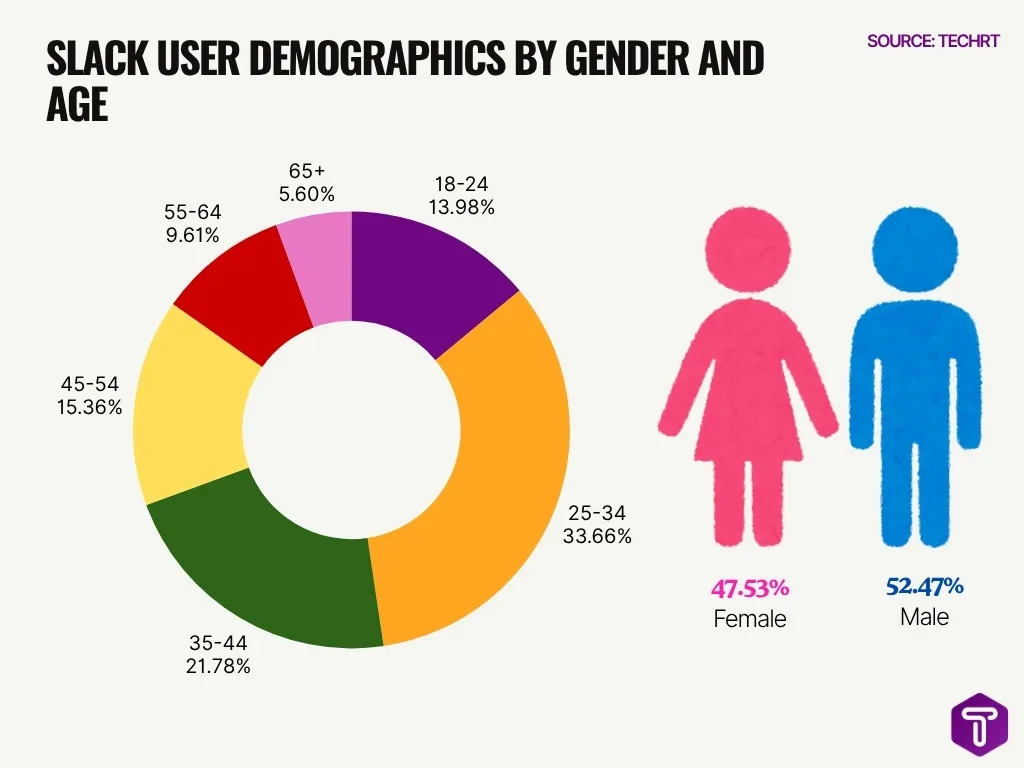
- Male users dominate slightly, accounting for 52.47% of Slack’s website traffic, compared to 47.53% female users, indicating a fairly balanced gender split.
- The gender gap is minimal (just ~5%), suggesting Slack has broad appeal across both male and female audiences.
- The largest age group is 25–34 years, contributing a significant 33.66% of total users, highlighting Slack’s strong adoption among young professionals.
- Users aged 35–44 make up 21.78%, reinforcing Slack’s popularity among mid-career professionals.
- The 18–24 segment accounts for 13.98%, showing early-career and student adoption, though smaller compared to core working-age users.
- The 45–54 age group represents 15.36%, indicating steady usage among experienced professionals and managers.
- Older users aged 55–64 contribute 9.61%, while 65+ users account for just 5.60%, showing declining adoption with age.
- Overall, over 55% of users fall between 25–44 years, confirming Slack’s dominance among the prime working-age population.
- The data clearly indicates that Slack is primarily used by working professionals, especially those in tech-savvy and collaborative work environments.
Messages and Activity Volume
- Slack users send over 5 billion messages per week across channels and direct messages.
- More than 1 billion messages are exchanged daily, reflecting constant workplace communication.
- Slack Connect facilitates 100+ million cross-company messages weekly, boosting collaboration.
- The average Slack user sends around 200 messages per week, depending on role and team size.
- Enterprise teams generate 3x more messages than small teams, due to complex workflows.
- Slack channels see peak activity between 10 AM and 2 PM local time, aligning with core work hours.
- Over 90% of messages are read within minutes, highlighting real-time communication efficiency.
- Slack users create millions of channels globally, enabling topic-based collaboration.
Time Spent on Slack
- Active Slack users spend an average of 90 minutes per day actively using the platform.
- Users typically keep Slack open for 9+ hours during the workday, even when idle.
- Around 60% of users check Slack every 30 minutes, indicating frequent engagement.
- Remote workers spend 15 to 20% more time on Slack compared to office-based employees.
- Slack usage peaks mid-week, with Wednesday being the most active day.
- Employees receive an average of 80+ notifications daily, impacting attention patterns.
- Teams using Slack report 32% faster response times compared to email-based communication.
- Heavy users spend over 2 hours daily actively engaging on Slack.
Usage by Industry
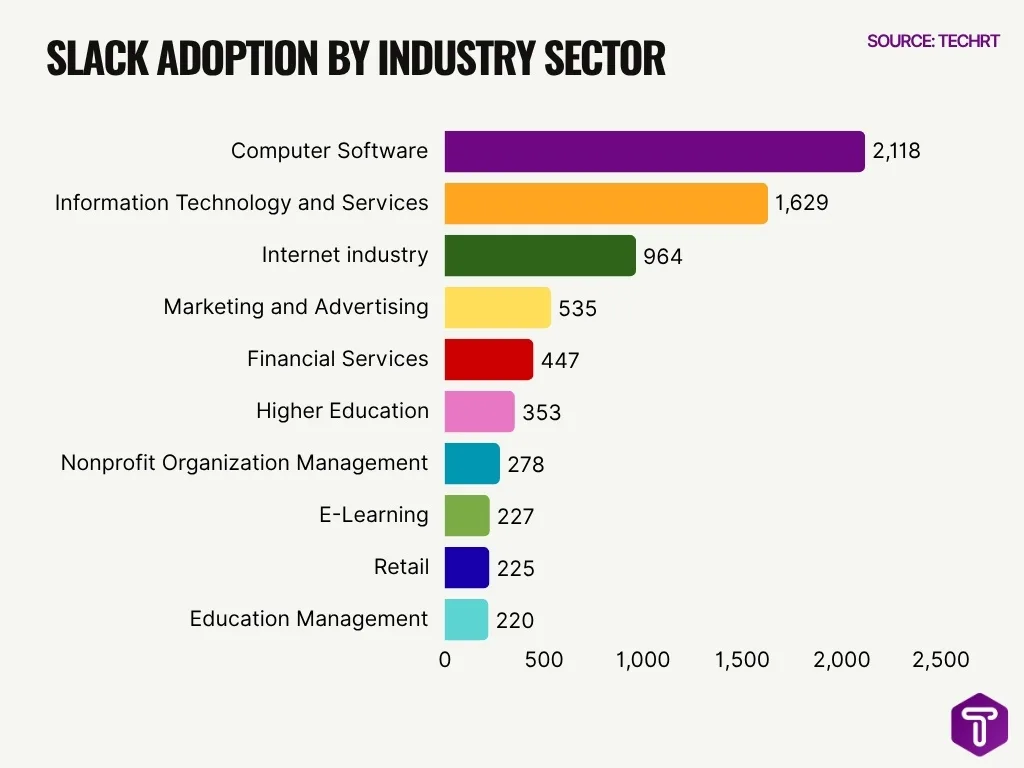
- Computer Software leads with 2,118 companies actively using Slack, making it the most dominant industry segment globally.
- Information Technology and Services follows closely with 1,629 companies, representing the second-largest sector of Slack adoption.
- Marketing and Advertising firms comprise 535 companies using Slack, showing strong growth in creative and campaign-focused industries.
- The Financial Services sector includes 447 companies using Slack, with adoption growth of approximately 22% year-over-year in non-tech sectors.
- Higher Education accounts for 353 institutions leveraging Slack for faculty-student collaboration and remote learning coordination.
- Nonprofit Organization Management demonstrates usage from 278 organizations, proving Slack’s value in mission-driven work environments.
- E-Learning platforms have 227 users actively using Slack for remote education and training delivery.
- The retail industry shows 225 companies using Slack to manage distributed teams and operational workflows.
- Education Management records 220 companies relying on Slack for administrative collaboration and institutional coordination.
- The Internet industry ranks among the top three with 964 companies using Slack, reflecting the platform’s dominance in digital-first businesses.
Revenue and Financial Performance
- Slack generated approximately $2.3 billion in revenue under Salesforce in 2025.
- Revenue grew by 15% year-over-year, showing steady enterprise demand.
- Slack contributes significantly to Salesforce’s overall SaaS revenue portfolio.
- Subscription revenue accounts for over 90% of Slack’s total income, ensuring recurring cash flow.
- Slack’s enterprise segment drives the majority of revenue growth.
- Average revenue per user increased by 10% in 2025, reflecting premium feature adoption.
- Slack’s operating margins improved after integration with Salesforce infrastructure.
- The platform continues to invest heavily in AI and automation features, impacting cost structures.
Revenue Growth Trends
- Slack revenue grew from $630 million in 2019 to over $2 billion by 2025, showing strong long-term growth.
- Year-over-year growth averaged 20 to 30% during 2020 to 2023, driven by remote work demand.
- Growth stabilized to 10 to 15% annually post-2023, indicating market maturity.
- Enterprise customers contributed over 60% of total revenue growth, highlighting the B2B focus.
- Slack’s revenue growth aligns closely with Salesforce ecosystem expansion, especially CRM integrations.
- The introduction of AI features is expected to boost revenue growth by an additional 5 to 8% annually.
- Slack’s international revenue share increased by 25% over the last three years, reflecting global expansion.
- The platform continues to see higher monetization per enterprise customer compared to SMBs.
Social Media Traffic Insights by Platform Share
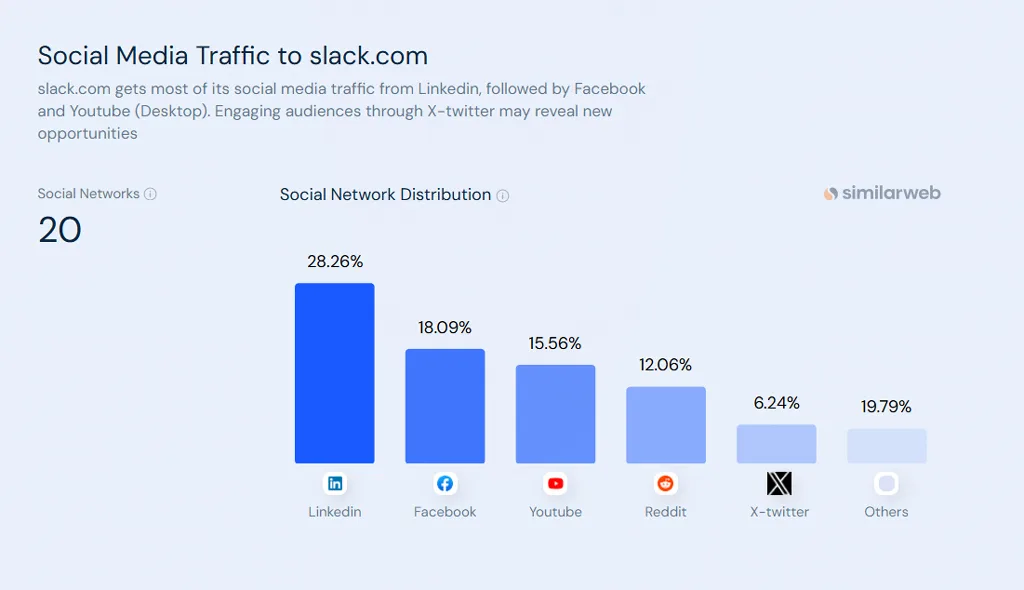
- LinkedIn dominates social traffic to Slack with the highest share at 28.26%, making it the top-performing platform by a significant margin.
- Facebook ranks second, contributing 18.09% of total traffic, highlighting its continued relevance in B2B and professional engagement.
- YouTube accounts for 15.56%, indicating a strong impact from video content and tutorials in driving users to Slack.
- Reddit contributes 12.06%, showing that community-driven discussions and forums play a meaningful role in traffic generation.
- X (Twitter) has a relatively low share of 6.24%, suggesting untapped potential for audience engagement and growth.
- The “Others” category holds 19.79%, representing a diverse mix of smaller platforms collectively driving a substantial portion of traffic.
- Overall, traffic is distributed across 20 social networks, reflecting a broad multi-channel acquisition strategy.
Mobile Usage Statistics
- Around 65% of Slack users access the platform via mobile devices at least once daily.
- Slack’s mobile app accounts for over 40% of total user sessions globally.
- Mobile usage increased by 25% between 2023 and 2025, driven by hybrid work trends.
- iOS users make up approximately 55% of mobile Slack users, with Android covering the rest.
- Push notifications drive 70% of mobile engagement, prompting users to respond quickly.
- Mobile Slack users check messages 5 to 7 times per hour during work hours.
- Teams with high mobile adoption report 20% faster decision-making cycles, due to real-time updates.
- Slack mobile downloads exceeded 100 million globally, reflecting widespread adoption.
Valuation and Acquisitions
- Salesforce acquired Slack for $27.7 billion in 2021, one of the largest SaaS deals.
- Slack’s valuation increased significantly from $7 billion in 2018 to $27.7 billion at the acquisition.
- The acquisition aimed to strengthen Salesforce’s position against competitors like Microsoft Teams.
- Slack became a core component of Salesforce’s Customer 360 platform strategy.
- Post-acquisition, Slack integration drove cross-selling opportunities across Salesforce products.
- Slack’s valuation reflects strong growth in the enterprise collaboration software market.
- Analysts estimate Slack’s standalone valuation could exceed $35 billion by 2026 if growth continues.
- The deal positioned Slack as a key player in the future of digital workplace ecosystems.
Usage by Company Size
- Nearly 80% of Fortune 100 companies use Slack, demonstrating strong enterprise adoption.
- Companies with 20-49 employees represent the largest user segment at 123,981 organizations using Slack.
- Small companies (0-9 employees) account for 102,248 Slack users, forming a key part of the customer base.
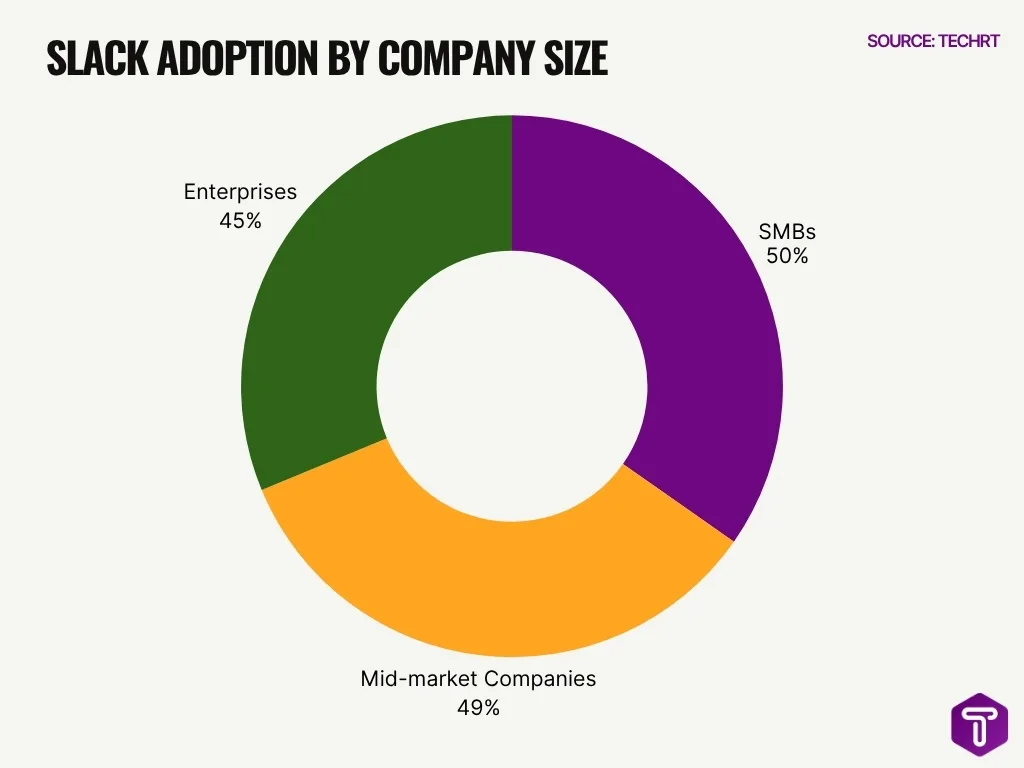
- SMBs show 50% adoption rate among communication vendors, the highest alongside micro-SMBs at 51%.
- Mid-market companies have a 49% adoption rate for Slack, consistently leading in full-time employee segments.
- Enterprises adopt Slack at 45%, with the segment contributing over $1.1 billion or nearly half of total revenue.
- Slack Enterprise Grid is used by 55-64% large enterprises (>1000 employees) for multi-team collaboration.
- Approximately 60% of startups use Slack, far outpacing Microsoft Teams at 12%.
- 45% of Slack customers are small (<50 employees), 38% medium-sized, and 17% large.
Market Share and Competitors
- Microsoft Teams commands a dominant 37-44% market share in team collaboration software as of 2025, far surpassing Slack.
- Slack maintains an 18-18.6% global market share in the team collaboration segment in 2025.
- Microsoft Teams boasts over 320 million monthly active users worldwide in 2025-2026.
- Slack projects 79 million monthly active users by the end of 2025.
- Zoom holds a 10% share in team collaboration tools and leads video conferencing with 55.91% market dominance.
- Slack dominates tech startups and firms under 500 employees with a 52% market share.
- Slack‘s overall market share has surged by over 40% since 2020 amid fierce competition.
- Around 40% of Microsoft Teams users also adopt Zoom, highlighting multi-tool usage trends.
- In 2021, 79% of global workers used digital collaboration tools, up from 55% in 2019.
Pricing Plans Overview
- Slack offers a free plan with limited message history (90 days) and basic integrations.
- The Pro plan starts at $7.25 per user per month, billed annually, targeting small teams.
- Business+ pricing begins at $12.50 per user per month, offering advanced security and compliance features.
- Enterprise Grid pricing is custom-based, designed for large organizations with thousands of users.
- Over 60% of paid customers opt for Pro plans, especially SMBs.
- Slack’s pricing tiers include features like unlimited message history, workflow automation, and analytics.
- The introduction of AI add-ons in 2025 increased average subscription costs by 8 to 12%.
- Slack offers discounted pricing for nonprofits and educational institutions, expanding accessibility.
Productivity Gains from Using Slack
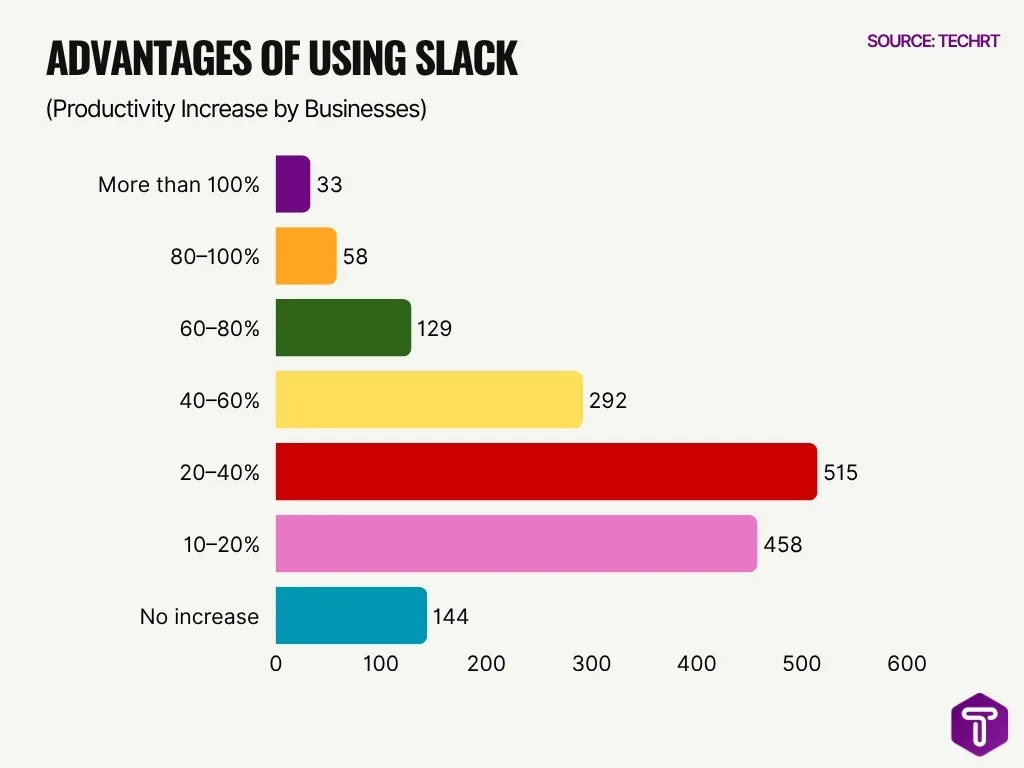
- A significant number of businesses (515 companies) reported a 20–40% increase in productivity, making it the most common improvement range.
- Another large segment (458 businesses) experienced a 10–20% productivity boost, indicating that even modest gains are widely achievable.
- Mid-to-high productivity improvements are also notable, with 292 companies seeing a 40–60% increase, showcasing Slack’s strong impact on workflow efficiency.
- Higher-tier gains include 129 businesses reporting 60–80% growth, and 58 businesses achieving 80–100% improvement, reflecting substantial operational transformation.
- A smaller but impactful group (33 businesses) reported over 100% productivity increase, demonstrating Slack’s potential for dramatic performance enhancement.
- Only 144 businesses reported no increase, meaning the vast majority (over 85%) experienced measurable productivity gains.
- Overall, the data highlights that Slack consistently improves workplace productivity, with most businesses achieving at least a 10–40% increase.
Integrations and App Ecosystem
- Slack integrates with over 2,600 third-party apps in its Marketplace, including CRM, project management, and cloud storage tools like Google Drive, Salesforce, and Trello.
- More than 750,000 custom bots and integrations are actively deployed across Slack workspaces worldwide.
- Over 550,000 custom integrations are used daily by organizations building tailored solutions via Slack APIs.
- Productivity apps lead Slack‘s ecosystem with approximately 1,300 available, followed by 850 communication tools and 700 HR & team culture apps.
- Users interact with at least 3 integrations daily on average, with power users utilizing up to 10 for enhanced workflows.
- 40% of paid Slack teams use Workflow Builder weekly, which saw 34% usage growth in 2025 for no-code automations.
- 95% of surveyed Slack app users state that integrations make their tools more valuable, driving daily reliance.
- Bots handle 18% of internal requests, like PTO checks and help desk tickets, through popular integrations.
- 80% of Workflow Builder users are non-technical, enabling millions of teams to automate processes globally.
- Calendars, task managers, and CRM tools rank as the top three integration categories by daily usage across Slack‘s ecosystem.
Frequently Asked Questions (FAQs)
How many daily active users does Slack have in 2025?
What is Slack’s estimated monthly active user count?
How much revenue does Slack generate annually?
What is Slack’s market share in collaboration software?
How many organizations and paying customers use Slack?
Conclusion
Slack continues to evolve from a messaging platform into a comprehensive work operating system. Its steady user growth, expanding enterprise footprint, and deep integration with tools like Salesforce highlight its role in modern digital workplaces. At the same time, rising competition from platforms like Microsoft Teams keeps innovation at the forefront, especially with AI-driven features and automation.
As organizations prioritize speed, flexibility, and real-time collaboration, Slack’s data shows a clear shift toward integrated communication ecosystems. Whether used by startups managing rapid growth or enterprises coordinating global teams, Slack remains a key driver of workplace productivity. Exploring these statistics offers a clearer view of where team collaboration is heading next.

Leave a comment
Have something to say about this article? Add your comment and start the discussion.