




Content marketing continues to shape how brands attract, educate, and convert audiences. From SaaS companies using blogs and SEO-driven landing pages to generate qualified leads, to e-commerce brands leveraging short-form video and influencer collaborations to drive conversions, its impact spans every major industry. Today, content does more than inform; it fuels discovery, builds trust, and supports long-term customer relationships across multiple touchpoints.
At the same time, the landscape is evolving rapidly. AI tools now accelerate content production, search engines are shifting toward zero-click experiences, and consumers increasingly discover brands through social platforms instead of traditional channels. This shift forces marketers to rethink how they create, distribute, and measure content. Data-backed strategies now determine success, while guesswork leads to wasted effort and budget.
As competition intensifies and content volume grows, understanding current benchmarks becomes critical. The statistics in this report highlight what works, where budgets are flowing, and how user behavior is changing. Let’s explore the latest content marketing statistics and uncover the trends shaping the future of digital growth.
Editor’s Choice
- The global content marketing industry is projected to reach $107 billion by 2026.
- The broader content marketing market size hit $524.73 billion in 2025, with strong growth expected through 2030.
- Around 90% of organizations use content marketing as part of their strategy.
- 87% of marketers report increased brand awareness through content marketing.
- A net 61% of marketers plan to increase investment in creator content in 2026.
- 54% of marketers actively measure content marketing ROI within their organizations.
- Content marketing ranks among the top 3 tactics for customer retention globally.
Recent Developments
- By 2026, AI-powered workflows will be central to content production, integrating creation, optimization, and distribution.
- Zero-click search experiences are rising, reducing organic website traffic despite growing search volumes.
- Google processes over 5 trillion searches annually, yet fewer clicks reach websites due to AI summaries.
- 41% of Gen Z users now search directly on social platforms instead of traditional search engines.
- Only 32% of younger users rely on traditional search engines, signaling a shift in discovery channels.
- 80% of creators use AI tools to streamline content production and editing.
- Nearly 246 million global video creators existed in 2025, reflecting massive content supply growth.
- Around 90% of online content could become AI-generated by 2026, reshaping content quality and trust.
Content Marketing Revenue Growth Trends
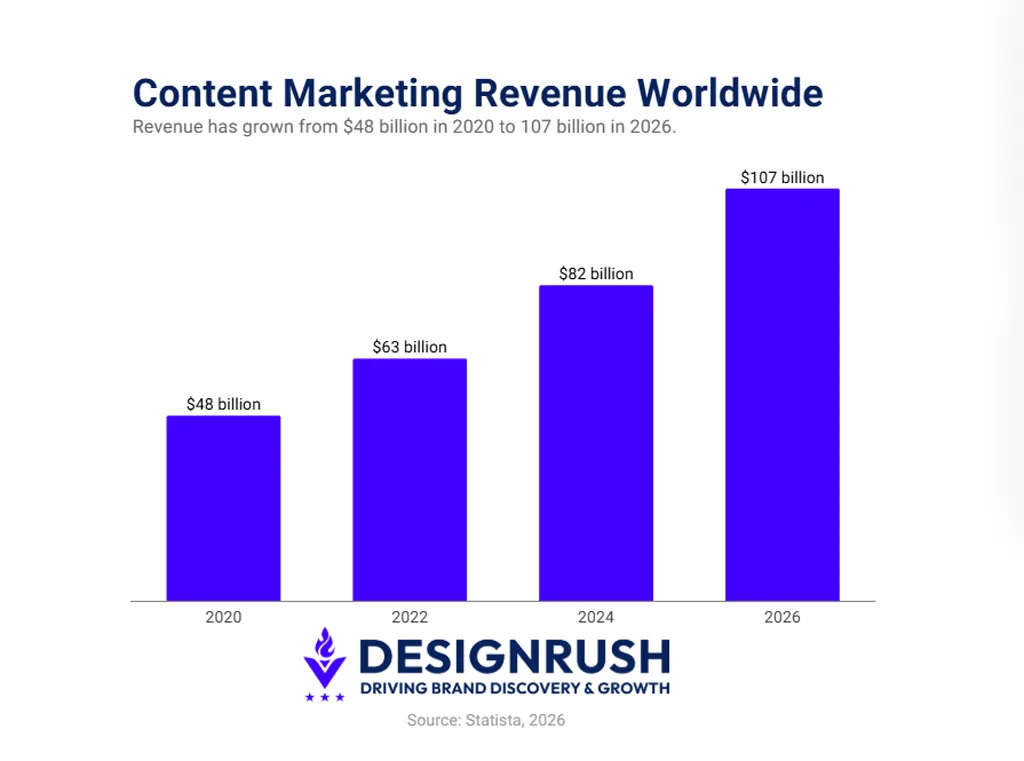
- The global content marketing industry has shown consistent and strong growth, increasing from $48 billion in 2020 to a projected $107 billion by 2026.
- This represents an overall growth of more than 2.2× in just six years, highlighting the rapid expansion of the industry.
- Between 2020 and 2022, revenue rose from $48 billion to $63 billion, marking an increase of $15 billion in just two years.
- From 2022 to 2024, the market continued accelerating, reaching $82 billion, an additional $19 billion growth.
- The largest jump is projected between 2024 and 2026, with revenue expected to grow by $25 billion, reaching $107 billion.
- The data indicate a steady upward trajectory, with no periods of decline, emphasizing the increasing adoption of content-driven strategies by businesses.
- The accelerating growth trend suggests that content marketing is becoming a core pillar of digital marketing budgets worldwide.
- By 2026, crossing the $100 billion milestone signals a mature yet rapidly evolving market with strong future potential.
- The growth pattern reflects rising investments in SEO, video content, social media, and AI-driven content strategies.
- Overall, the industry demonstrates high scalability and sustained demand, making it one of the fastest-growing segments in digital marketing.
General Content Marketing Statistics
- 70% of businesses report satisfaction with content marketing ROI.
- 74% of marketers generate leads through content marketing.
- 49% of businesses attribute revenue growth directly to content marketing.
- 80% of small business owners create content themselves, showing widespread adoption.
- 63% of businesses use paid channels to amplify content distribution.
- 55% of businesses allocate 11%–50% of their marketing budget to content marketing.
- Visual content is 43% more persuasive than text-only content, highlighting its importance.
- 29% of marketers spend 10–15 hours weekly creating content, reflecting operational effort.
- 54% of businesses planned to increase content budgets in 2024–2025, indicating sustained growth.
SEO and Organic Search Statistics
- 68% of all online experiences begin with a search engine, reinforcing SEO’s role in content discovery.
- Organic search drives 53% of all website traffic, outperforming paid and social channels.
- Google accounts for over 91% of the global search market share, dominating content visibility.
- The top result on Google gets 27.6% of all clicks, showing the importance of ranking position.
- 75% of users never scroll past the first page of search results.
- SEO leads have a 14.6% close rate, compared to 1.7% for outbound methods.
- Long-form content (3,000+ words) earns 3.5x more backlinks than shorter articles.
- Featured snippets capture 8% of clicks, even above position one results.
- 55% of marketers say improving SEO is their top inbound priority.
B2B Content Marketing Investment Trends
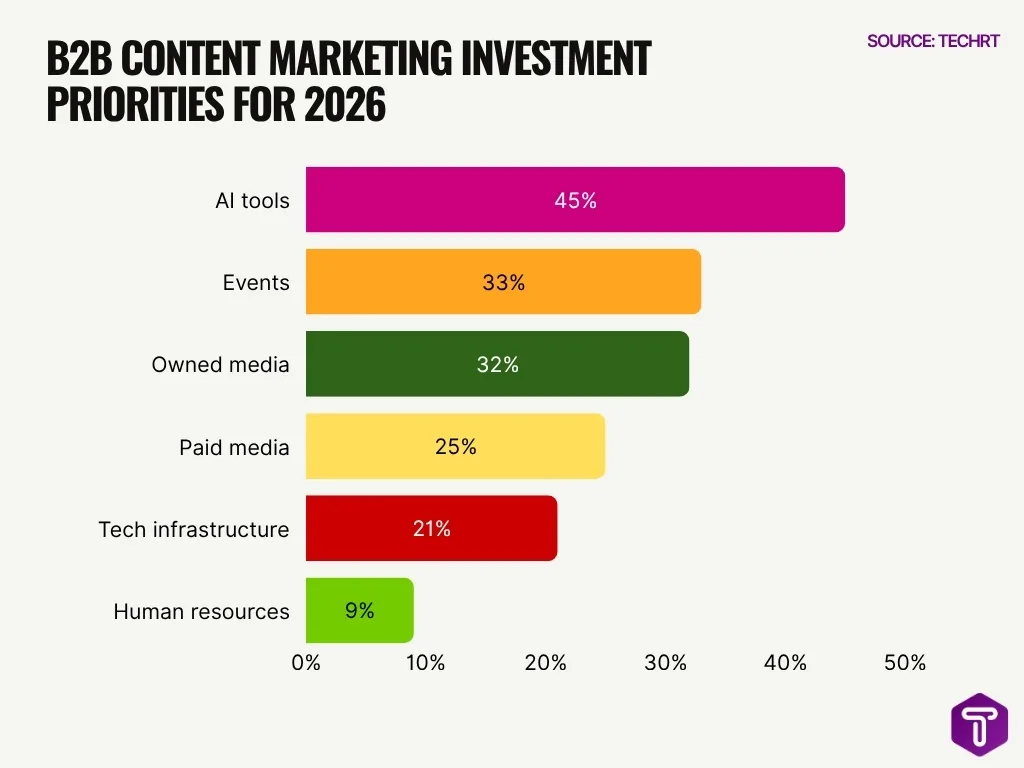
- AI tools dominate investment priorities, with 45% of B2B marketers planning to increase spending, making it the #1 focus area for 2026.
- Events remain a strong channel, with 33% of marketers boosting budgets, highlighting the continued importance of in-person and virtual engagement.
- Owned media investments are nearly equal to events at 32%, showing brands are prioritizing content assets, blogs, websites, and email marketing.
- Paid media sees moderate growth, with 25% of marketers planning increased investment, indicating a balanced but cautious approach to advertising spend.
- Tech infrastructure is gaining traction, with 21% focusing on martech stacks, analytics, and CRM systems to support data-driven strategies.
- Human resources rank lowest, with only 9% planning increases, suggesting a shift toward automation and AI over workforce expansion.
- The data clearly signals a strategic pivot toward AI-driven content marketing, with businesses optimizing efficiency, personalization, and scalability rather than traditional resource-heavy methods.
B2C Content Marketing Statistics
- 87% of consumers say video content influences purchasing decisions.
- User-generated content and creator-led campaigns drive higher engagement across B2C brands.
- U.S. creator ad spending reached $37 billion in 2025, growing 26% year over year.
- 92% of brands invested more in creators in 2024, a trend continuing into 2026.
- Consumers spend an average of 6 hours daily on digital media, creating high content exposure opportunities.
- Social video platforms are now a primary entertainment and content discovery channel.
- Nearly 58% of consumers want brands to interact directly with them on social platforms.
- Around 57% of users prefer serialized content formats, such as episodic posts or series.
Blogging Statistics
- Companies with blogs generate 67% more leads than those without.
- Businesses that blog receive 55% more website visitors.
- 77% of internet users regularly read blogs, showing continued relevance.
- Blog posts with images get 94% more views than text-only posts.
- Updating old blog content can increase traffic by over 100%.
- The average blog post length is now 1,400–1,500 words, reflecting depth requirements.
- 60% of marketers say blogging is their top inbound priority.
- Bloggers who publish weekly are 2.5x more likely to report strong results.
- 43% of bloggers use AI tools to assist content creation.
How AI is Transforming Content Marketing
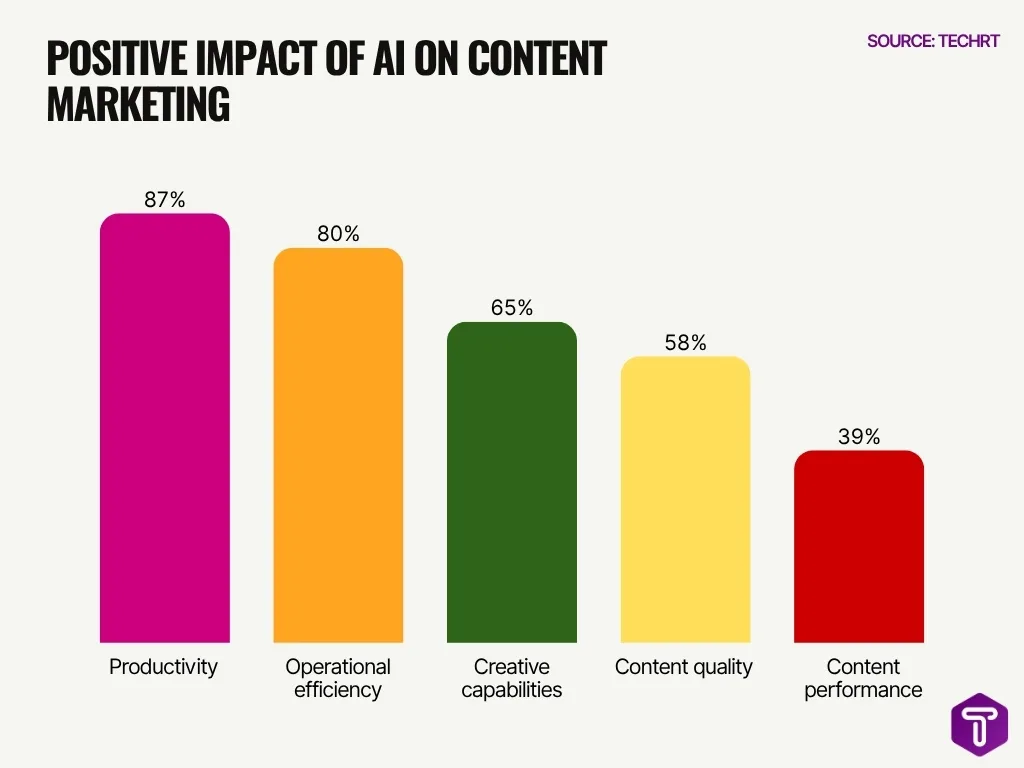
- AI significantly boosts productivity, with 87% of marketers reporting improved output and faster content creation workflows.
- Around 80% of marketers experience enhanced operational efficiency, indicating streamlined processes and reduced manual effort.
- Creative capabilities improve for 65% of users, showing that AI is not just automating tasks but also enhancing ideation and content innovation.
- 58% report better content quality, suggesting AI helps in refining messaging, accuracy, and overall content standards.
- Despite these gains, only 39% see improvement in content performance, highlighting a gap between content creation and actual results like engagement or conversions.
- The data indicates that while AI excels in efficiency and production, optimizing performance outcomes remains a key challenge for marketers.
- Overall, AI is reshaping content marketing by driving speed, scalability, and creativity, but strategic implementation is still crucial for maximizing ROI.
Video Marketing Statistics
- 91% of businesses use video as a marketing tool in 2025.
- 96% of consumers watch explainer videos to learn about products.
- Video content increases conversion rates by up to 80% on landing pages.
- 89% of marketers report positive ROI from video marketing.
- Short-form videos deliver the highest ROI among all content formats.
- Users retain 95% of a message when watched in video, compared to 10% when reading text.
- 72% of customers prefer video over text for learning about products.
- Mobile users account for over 75% of video consumption, emphasizing mobile-first strategies.
- YouTube remains the second-largest search engine globally, supporting video SEO.
Social Media Statistics
- There are over 5.17 billion social media users worldwide in 2025, representing a massive reach.
- The average user spends 2 hours and 23 minutes daily on social media.
- 90% of marketers say social media increases brand exposure.
- 78% of consumers discover new products via social platforms.
- Short-form video is the most engaging content type on social media.
- 71% of consumers who have a positive social experience with a brand recommend it.
- Social media ad spend surpassed $268 billion globally in 2025.
- 64% of Gen Z prefer social media for product discovery over traditional channels.
- Influencer marketing delivers up to 11x higher ROI than traditional ads.
Content Marketing Spending Trends
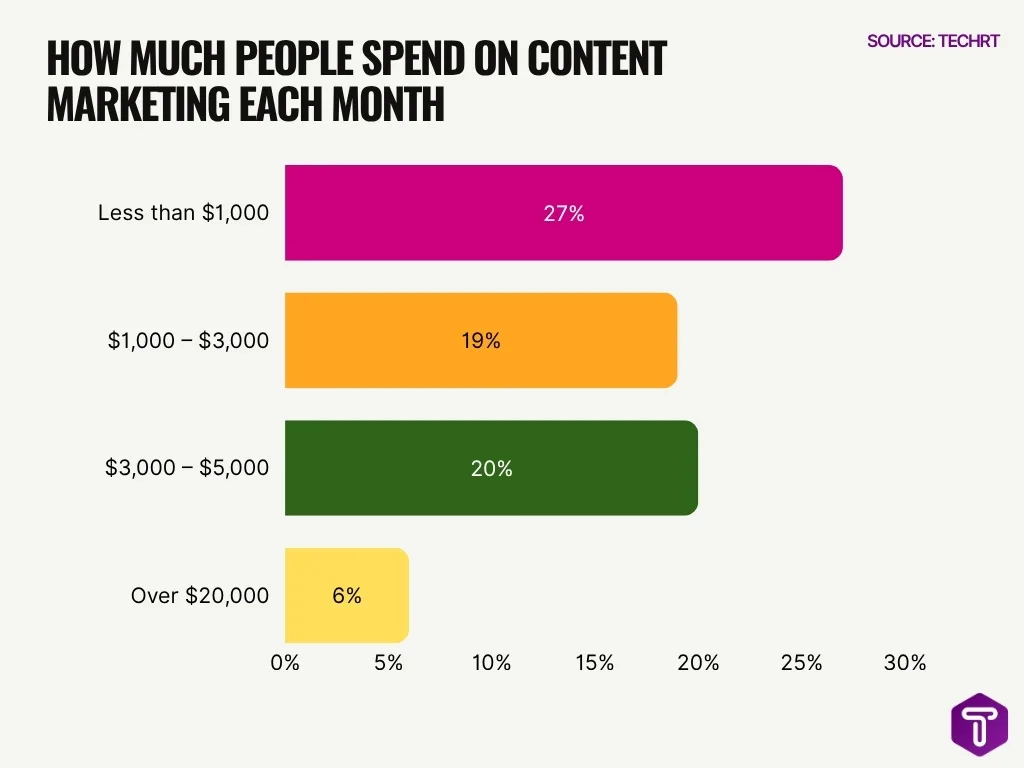
- 27% of businesses spend less than $1,000, indicating a strong presence of small businesses or startups with limited budgets.
- Around 19% allocate between $1,000 – $3,000, showing a moderate investment level focused on basic content strategies.
- 20% of marketers spend $3,000 – $5,000, highlighting a growing commitment to structured and consistent content marketing efforts.
- Only 6% spend over $20,000, suggesting that high-budget, enterprise-level content marketing is still a niche segment.
- The data reveals a skew toward lower spending brackets, with the majority investing under $5,000, reflecting cautious or early-stage adoption.
- There is a significant gap between mid-range and high-end spending, indicating that scaling content marketing budgets remains a challenge for many businesses.
- Overall, the trend suggests that while content marketing adoption is widespread, large-scale investment is limited to a small percentage of organizations.
Email Marketing Statistics
- Email marketing delivers an average ROI of $36 for every $1 spent.
- There are over 4.6 billion email users globally in 2025, expected to grow further.
- 81% of SMBs rely on email as their primary acquisition channel.
- Personalized emails generate 6x higher transaction rates.
- Email open rates average 20%–25% across industries.
- 64% of small businesses use email marketing to reach customers.
- Mobile devices account for over 60% of email opens, reinforcing responsive design.
- Automated email campaigns generate 320% more revenue than non-automated emails.
- 47% of email recipients open emails based on the subject line alone.
Podcast and Audio Content Statistics
- There are over 464 million podcast listeners worldwide, with steady growth.
- The global podcast market is projected to reach $47 billion by 2027.
- 42% of Americans listen to podcasts monthly, indicating strong adoption.
- Podcast listeners spend an average of 7 hours per week listening.
- 55% of podcast listeners have purchased a product after hearing about it.
- The U.S. podcast ad market exceeded $2.3 billion in 2025.
- 74% of listeners tune in to learn new things, making podcasts educational content hubs.
- Branded podcasts increase brand recall by up to 89%.
- Podcast audiences are highly loyal, with many listeners consuming entire episodes regularly.
Content Type Performance Statistics
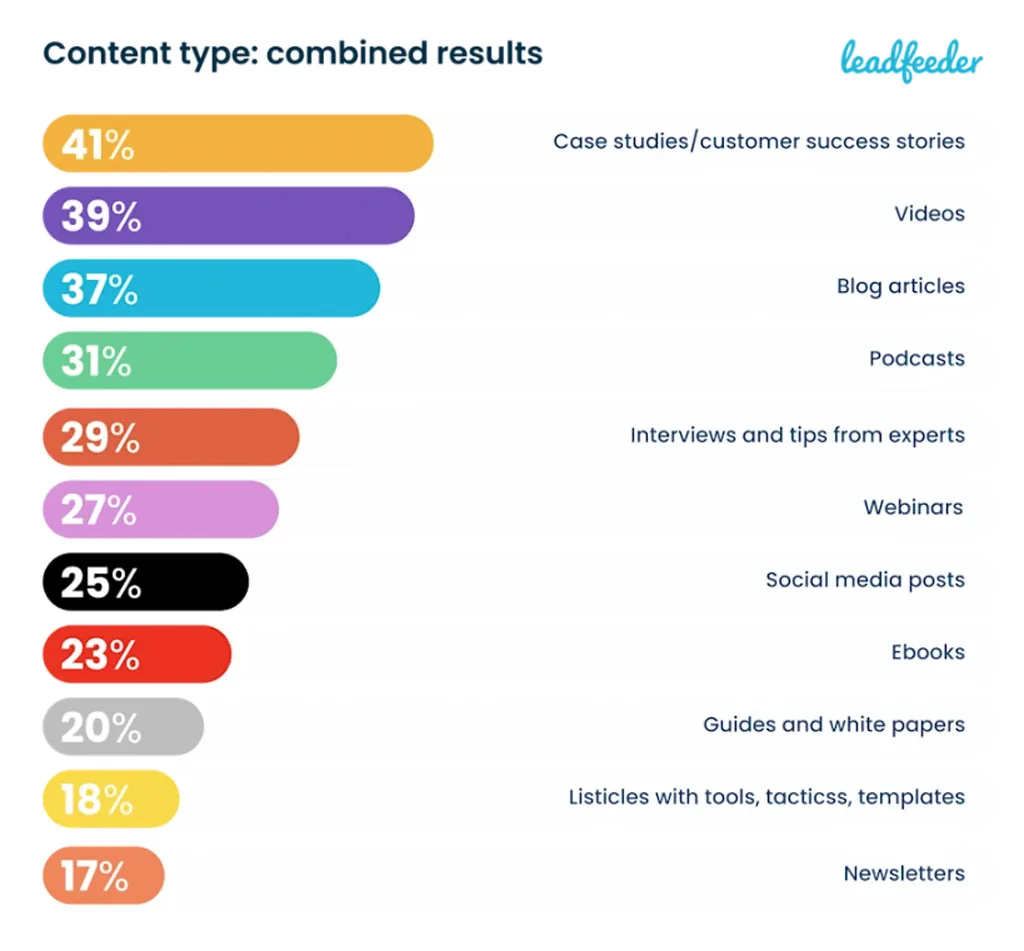
- Case studies/customer success stories lead at 41%, making them the most effective content type, highlighting the strong impact of real-world proof and results.
- Videos rank second at 39%, showing that visual and interactive content continues to dominate user engagement and consumption.
- Blog articles account for 37%, proving that written long-form content still holds strong SEO and informational value.
- Podcasts reach 31%, indicating a growing preference for on-the-go and audio-based content consumption.
- Interviews and expert tips stand at 29%, emphasizing the importance of authority-driven and insight-rich content.
- Webinars generate 27%, showcasing their effectiveness in educational and lead-generation strategies.
- Social media posts contribute 25%, reflecting their role in content distribution and audience engagement, though not as dominant as core formats.
- Ebooks hold 23%, suggesting they remain valuable for in-depth content and lead magnets, but with slightly lower engagement.
- Guides and white papers achieve 20%, indicating moderate performance in detailed, research-heavy content formats.
- Listicles with tools, tactics, and templates score 18%, showing that actionable and structured content still attracts attention but is less impactful than top formats.
- Newsletters come in at 17%, making them the least effective among listed formats, though still relevant for retention and nurturing audiences.
Conversion and ROI Statistics
- Content marketing generates 3x more leads than traditional marketing while costing 62% less.
- Businesses with strong content strategies achieve conversion rates up to 6x higher.
- 70% of marketers report positive ROI from content marketing efforts.
- Landing pages with video can increase conversions by up to 80%.
- Companies that blog consistently see 13x higher ROI than those that don’t.
- Personalized content improves conversion rates by 20% or more.
- Content marketing costs 62% less than outbound marketing while delivering better results.
- 47% of buyers view 3–5 pieces of content before engaging with a sales rep.
- Companies with documented strategies are 313% more likely to report success.
Consumer Behavior and Trust Statistics
- 81% of consumers need to trust a brand before purchasing.
- 70% of consumers prefer learning about products via content rather than ads.
- User-generated content is considered 2.4x more authentic than brand-created content.
- 46% of consumers trust online reviews as much as personal recommendations.
- 88% of consumers say authenticity is a key factor when choosing brands.
- 60% of consumers feel more positive about a brand after reading custom content.
- Younger audiences (Gen Z) are 2x more likely to trust influencers over brands.
- 65% of consumers say consistent messaging builds trust across channels.
- Consumers exposed to brand storytelling are 22x more likely to remember the message.
Top Content Marketing Challenges
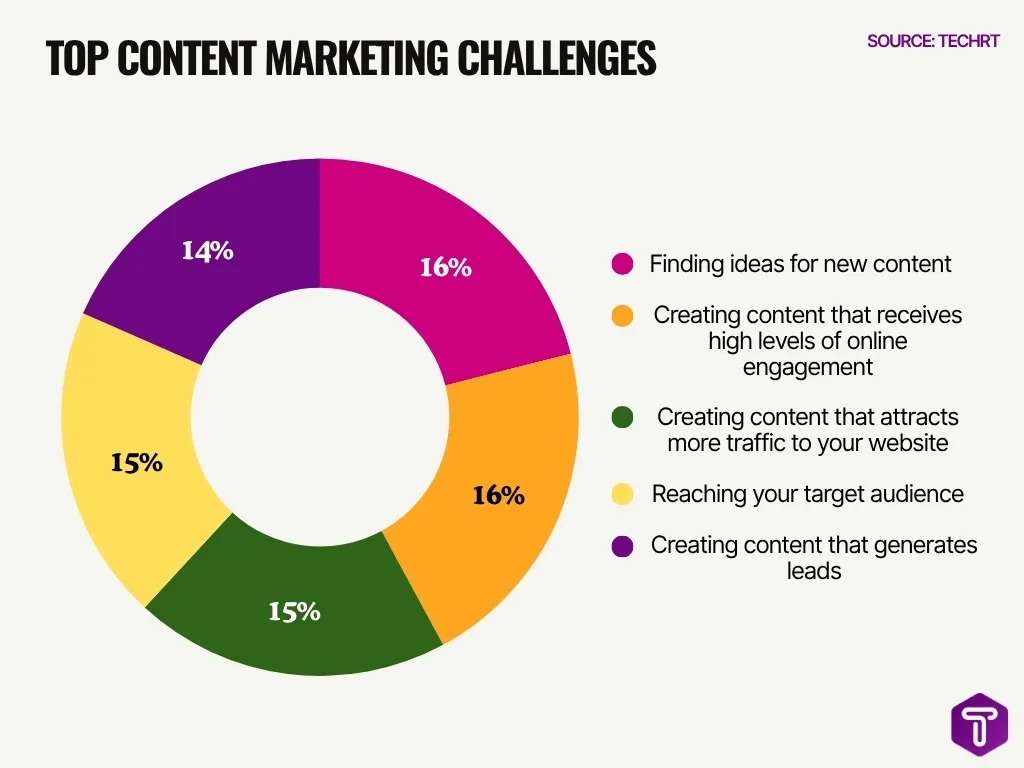
- Idea generation remains the biggest hurdle, with 16% of marketers struggling to consistently come up with new content ideas.
- Engagement is equally challenging, as 16% report difficulty in creating content that drives high online interaction and engagement.
- Traffic generation is a major concern, with 15% of marketers finding it hard to create content that attracts visitors to their websites.
- Audience targeting continues to be complex, with 15% facing challenges in effectively reaching their target audience.
- Lead generation is still a key pain point, with 14% struggling to create content that converts into leads.
- The data highlights that top challenges are closely clustered (14%–16%), indicating that marketers face multiple equally critical obstacles, rather than one dominant issue.
- Overall, the insights suggest that content strategy, distribution, and performance optimization need equal focus to overcome these challenges effectively.
Content Performance Metrics
- Page views and engagement rates remain the top KPIs for 70% of marketers.
- Average blog engagement time is 52 seconds to 2 minutes, depending on content depth.
- Conversion rate is tracked by over 65% of content teams as a primary success metric.
- Bounce rates above 70% often indicate poor content relevance or UX issues.
- Organic traffic growth is the top performance indicator for SEO-driven content.
- Click-through rates (CTR) average 2%–5% across industries.
- Heatmaps and behavioral analytics are used by over 40% of marketers to improve UX.
- Content refresh strategies can increase traffic by over 100%.
- Time on page strongly correlates with higher conversion rates, especially for long-form content.
Content Strategy and Documentation Statistics
- Only 40% of marketers have a documented content strategy, leaving room for improvement.
- Those with documented strategies are 3x more likely to succeed.
- 62% of the most successful marketers follow a documented strategy.
- Content calendars improve publishing consistency by up to 60%.
- 65% of marketers conduct regular content audits to improve performance.
- Teams with clear workflows report 30% higher productivity.
- 72% of marketers say strategy alignment improves ROI.
- Content governance frameworks help reduce errors by over 25%.
- 44% of marketers lack scalable content processes, limiting growth.
Frequently Asked Questions (FAQs)
What percentage of marketers use content marketing today?
How much ROI does content marketing generate compared to traditional marketing?
What is the projected size of the content marketing industry by 2026?
What percentage of marketers report positive ROI from content marketing?
How widely is AI used in content marketing in 2026?
Conclusion
Content marketing reflects a mature yet rapidly evolving discipline shaped by AI, multi-channel distribution, and shifting consumer behavior. Data shows that brands investing in SEO, video, personalization, and AI-driven workflows consistently outperform competitors in reach and ROI. At the same time, challenges like content saturation, measurement gaps, and resource constraints highlight the need for smarter strategies, not just more content.
Ultimately, success now depends on quality, consistency, and distribution precision. Marketers who combine data-backed insights with audience-first storytelling will continue to lead in an increasingly competitive digital landscape.

Leave a comment
Have something to say about this article? Add your comment and start the discussion.