


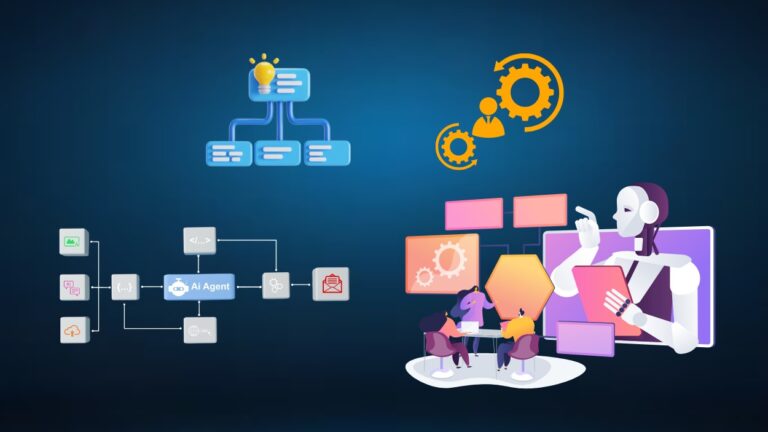

Agentic workflows are reshaping how businesses operate by enabling AI systems to plan, execute, and optimize multi-step processes with minimal human intervention. Unlike traditional automation, these systems can make contextual decisions, coordinate across tools, and continuously improve outcomes based on feedback. As a result, organizations are shifting from isolated task automation to fully autonomous process orchestration.
In real-world scenarios, companies now use agentic workflows to automate customer support pipelines, where AI agents handle queries, escalate issues, and learn from interactions in real time. Similarly, in software development, AI-driven agents accelerate coding, testing, and deployment cycles, reducing time-to-market while improving consistency. Industries such as finance, healthcare, and logistics are also embedding these workflows to streamline operations and enhance decision-making.
As enterprises prioritize efficiency, scalability, and intelligent automation, agentic workflows are becoming a foundational layer of modern digital infrastructure. The following statistics highlight how rapidly this technology is evolving and where it is delivering measurable impact.
Editor’s Choice
- 79% of organizations report some level of agentic AI adoption in 2025, showing rapid enterprise uptake.
- Around 40% of enterprise applications are expected to include AI agents by 2026.
- 66% of companies using AI agents report measurable productivity gains.
- Global agentic AI market projected to reach $199 billion by 2034.
- 88% of enterprises now use AI in at least one business function, up from 78% last year.
- Only 11% of companies have agentic AI in full production despite high investment intent.
- AI-driven workflows can complete tasks up to 6x faster in real-world enterprise cases.
Recent Developments
- AI now generates 75% of new code at Google, highlighting agent-driven workflows in engineering.
- Enterprise platforms report 50%+ reduction in manual effort using agentic AI systems.
- AI-driven workflow platforms can accelerate enterprise modernization by 3x.
- Over 100 new AI unicorns emerged in 2025, most leveraging agentic systems.
- Global AI funding reached $73.1 billion in a single quarter, fueling workflow automation innovation.
- Around 40% of enterprise apps will embed AI agents by late 2026.
- Security risks are rising, with 63% of some agent deployments vulnerable to exploits.
- More than 28,000 exposed agentic systems highlight governance gaps.
- Agentic AI is now considered the top investment theme in enterprise software.
What Are Agentic Workflows?
- Agentic workflows refer to AI systems that can plan, execute, and optimize tasks autonomously.
- These workflows rely on goal-driven AI agents rather than rule-based automation.
- AI agents can manage multi-step processes across tools like CRMs and ERPs.
- Around 15% of enterprise decisions are expected to be made autonomously by agents.
- Agentic systems differ from traditional AI by enabling end-to-end workflow execution.
- AI agents can coordinate with other agents, forming multi-agent orchestration systems.
- 57% of agent usage focuses on productivity and workflow tasks.
- Agentic workflows handle both personal (55%) and professional (30%) use cases.
- They enable businesses to transition from task automation to process autonomy.
Key Agentic Workflow Adoption Statistics
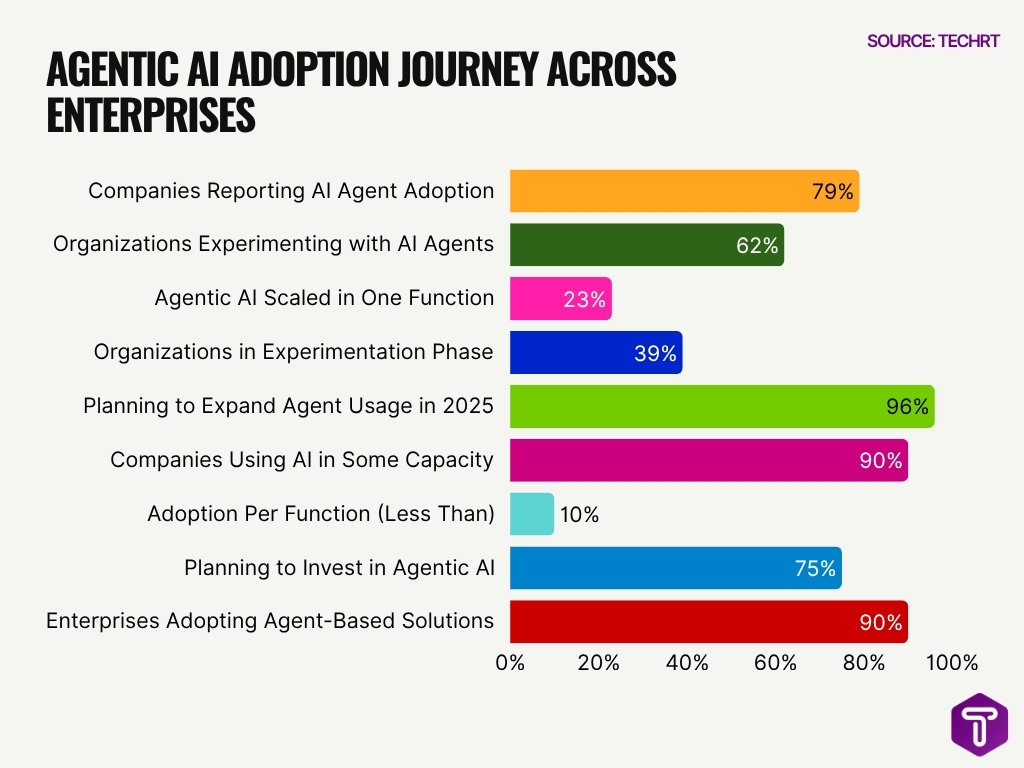
- 79% of companies report adopting AI agents in workflows.
- 62% of organizations are actively experimenting with AI agents.
- Only 23% of companies have scaled agentic AI in at least one function.
- Around 39% are still in the experimentation phase, highlighting early-stage adoption.
- 96% of organizations plan to expand agent usage in 2025.
- Nearly 90% of companies use AI in some capacity, enabling agentic transitions.
- Less than 10% adoption per function shows uneven deployment across departments.
- About 75% of companies plan to invest in agentic AI initiatives.
- Over 90% of enterprises are adopting agent-based solutions, though not fully scaled.
Market Size and Growth of Agentic AI Workflows
- The enterprise AI agent market reached $6.65 billion in 2025.
- It is projected to grow to $142.35 billion by 2035.
- The market is expanding at a 36.9% CAGR (2026–2035).
- The broader agentic AI market is expected to reach $199.05 billion by 2034.
- The AI market overall is valued at $391 billion globally.
- Global AI spending could hit $1.3 trillion by 2029.
- Around 33% of enterprise software will include agentic AI by 2028.
- Less than 1% of software had agentic AI in 2024, showing exponential growth.
- AI agent-driven automation is expected to influence 15% of business decisions by 2028.
Enterprise Use of AI Agents in Workflows
- 57% of companies use AI agents in customer service operations.
- 54% apply agents in sales and marketing workflows.
- 53% deploy agents in IT and cybersecurity tasks.
- Around 66% of enterprises report productivity gains from agent usage.
- 55% of organizations report faster decision-making with AI agents.
- Nearly 54% see improved customer experience due to automated workflows.
- 80% of companies prioritize efficiency as a core AI objective.
- Around 50% of high-performing firms are redesigning workflows around AI.
- Companies achieve up to 171% ROI from agentic AI deployments.
Industry-Wise Adoption of Agentic Workflows
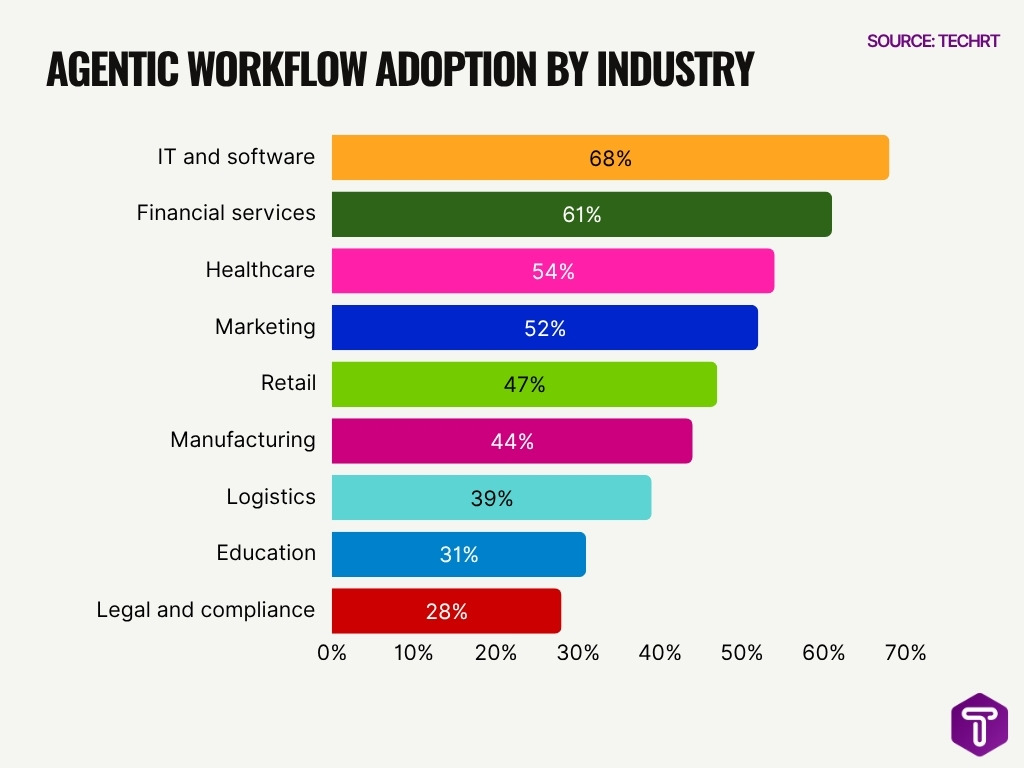
- The IT and software sector leads adoption, with over 68% of firms deploying agentic workflows in development and DevOps.
- In financial services, 61% of institutions use AI agents for fraud detection and risk workflows.
- Healthcare organizations report 54% adoption of AI-driven workflow automation for diagnostics and patient management.
- Retail companies use agentic workflows in 47% of supply chain operations, improving demand forecasting.
- Manufacturing firms report 44% adoption of AI agents in predictive maintenance workflows.
- Marketing teams use AI agents in 52% of campaign automation processes, including personalization.
- Logistics companies have seen 39% adoption in route optimization and delivery workflows.
- Legal and compliance sectors report 28% usage of AI agents for document review workflows.
- Educational institutions are experimenting with agentic systems in 31% of administrative workflows.
Agentic Workflow Impact on Productivity and Efficiency
- Companies using agentic workflows report up to 66% productivity improvement.
- AI agents reduce manual workload by 40% to 60% across enterprise functions.
- Knowledge workers save 1.5 to 2.5 hours daily using AI-powered workflows.
- 70% of organizations report faster task completion with AI agents.
- AI-driven automation improves operational efficiency by 30% on average.
- 63% of executives say AI agents significantly enhance decision-making speed.
- Workflow automation reduces process bottlenecks by up to 50%.
- AI-assisted coding improves developer productivity by 55%.
- Organizations deploying AI workflows report 35% faster project completion times.
Effects of Agentic Workflows on Cost Reduction and ROI
- Companies report cost savings of 20% to 30% after implementing agentic workflows.
- AI-driven automation reduces operational costs by up to 25% in customer service.
- Organizations achieve an average ROI of 171% from AI workflow investments.
- 44% of companies report reduced labor costs due to workflow automation.
- AI agents reduce IT maintenance costs by 30% through predictive automation.
- Finance departments report 25% reduction in processing costs using AI workflows.
- Marketing teams reduce campaign costs by up to 32% through automation.
- Supply chain operations see 15% to 20% cost savings with AI optimization.
- Businesses report faster payback periods, often within 12 to 18 months of implementation.
Regional Adoption Trends for Agentic AI
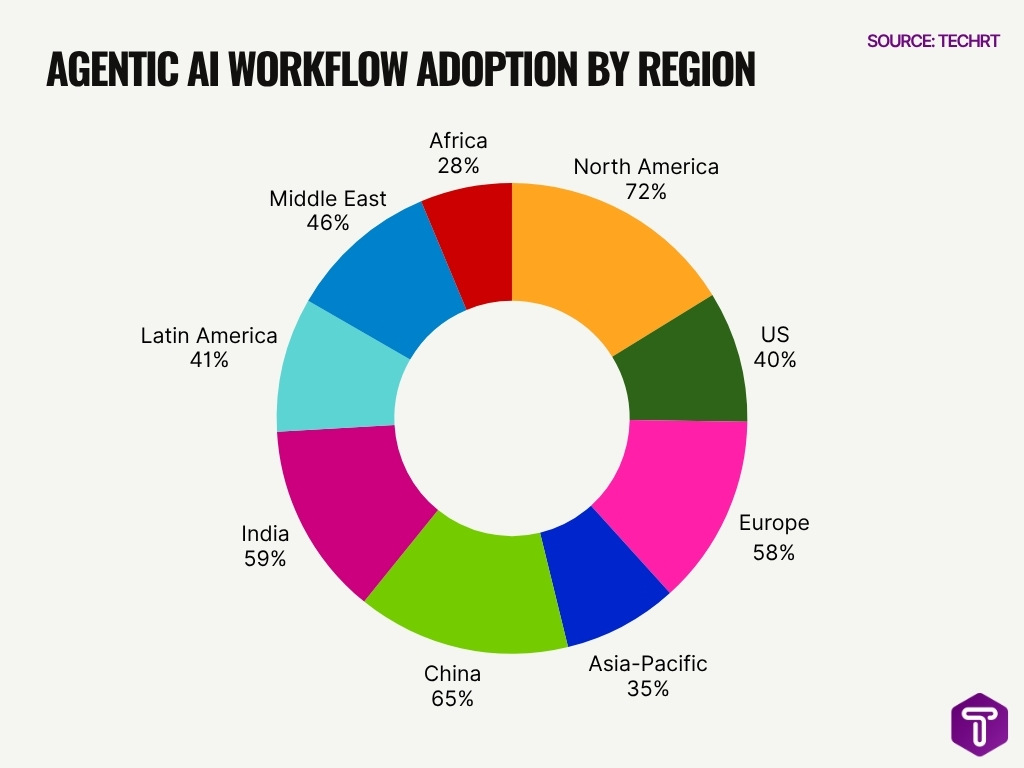
- North America leads globally, with over 72% enterprise adoption of AI workflows.
- The US alone accounts for 40% of global AI investment, accelerating agentic workflow deployment.
- Europe shows 58% adoption, with strong growth in regulated industries like banking.
- Asia-Pacific is the fastest-growing region, with annual growth exceeding 35% in AI workflow adoption.
- China leads Asia with 65% enterprise AI integration, including agentic workflows.
- India reports 59% adoption of AI-driven workflows, particularly in IT services and outsourcing.
- Latin America shows emerging adoption at 41%, driven by fintech and e-commerce.
- Middle East adoption stands at 46%, with strong government-led AI initiatives.
- Africa reports 28% adoption, with growth focused on telecom and banking sectors.
Impact of Agentic AI on Workflow Speed and Cycle Times
- AI agents reduce workflow cycle times by up to 50% in enterprise environments.
- Software development cycles are shortened by 30% to 45% using AI agents.
- Customer service resolution times drop by 40% with AI-driven workflows.
- AI-powered workflows enable real-time decision-making in over 60% of cases.
- Organizations report 35% faster onboarding processes using AI agents.
- Supply chain cycle times improve by 20% to 30% with AI automation.
- Financial reporting cycles are shortened by up to 40%.
- AI agents can execute workflows 24/7, eliminating delays caused by manual handoffs.
- Enterprises report 2x faster time-to-market for digital products using AI workflows.
Influence of Agentic AI on Employee Experience and Job Roles
- 60% of employees report improved job satisfaction with AI-assisted workflows.
- AI automation reduces repetitive tasks by up to 45%, allowing focus on strategic work.
- 68% of workers say AI helps them complete tasks faster.
- Organizations report 35% increase in employee productivity after AI adoption.
- 49% of employees expect AI to change their job roles significantly within 3 years.
- AI-assisted decision-making improves employee confidence by 27%.
- Companies investing in AI training see 20% higher workforce efficiency.
- Hybrid human-AI workflows are used by over 50% of enterprises.
- Employees using AI tools report 30% reduction in burnout levels.
Impact of AI on Workforce Roles
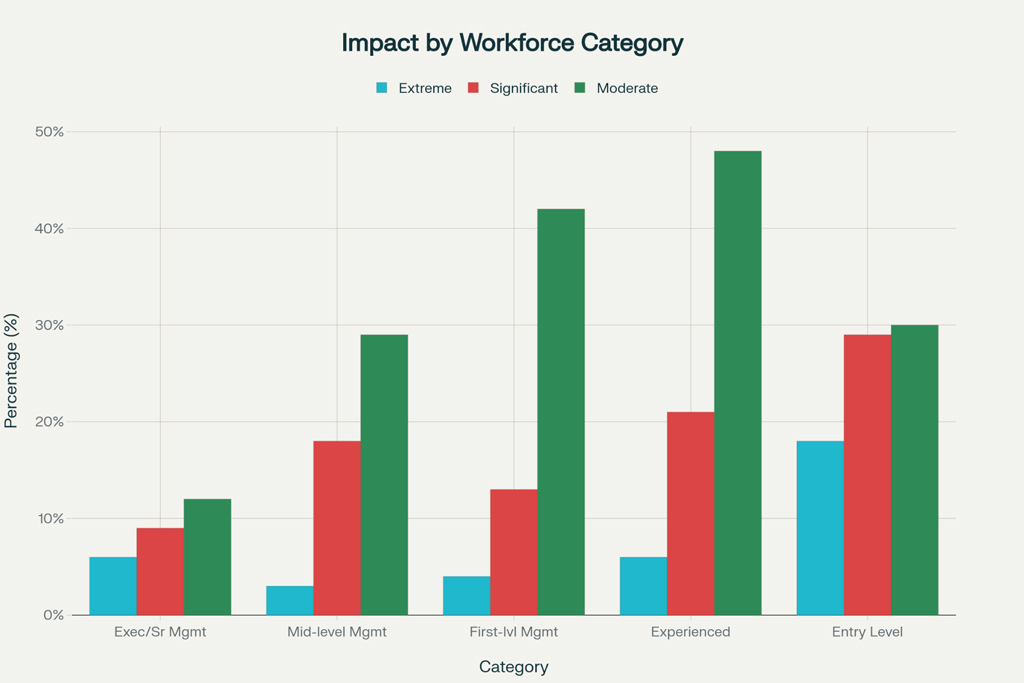
- Entry-level roles face the highest extreme disruption, with 18% reporting extreme impact, significantly higher than any other workforce category.
- Experienced professionals show the highest moderate impact, with 48%, indicating AI is more likely to augment rather than replace mid-to-senior roles.
- First-level management is heavily affected at a moderate level, with 42%, suggesting automation of supervisory and operational tasks.
- Mid-level management sees notable transformation, with 29% moderate impact and 18% significant impact, highlighting increasing AI integration in decision-making roles.
- Executive and senior management are least affected overall, with only 6% extreme impact, reflecting the continued need for strategic leadership and human judgment.
- Significant impact is most prominent in entry-level roles, reaching 29%, indicating strong exposure to automation and task replacement.
- Experienced workforce also faces considerable change, with 21% significant impact, showing AI’s growing role in skilled job functions.
- Across all categories, moderate impact dominates, especially in:
- Experienced roles (48%)
- First-level management (42%)
- This suggests AI is primarily augmenting roles rather than fully replacing them.
- Lower-level roles (entry + first-level) collectively experience higher extreme + significant impact, confirming that routine and repetitive tasks are most vulnerable.
- The data highlights a clear trend: as seniority increases, extreme disruption decreases, but moderate AI integration increases, indicating a shift toward human-AI collaboration rather than displacement.
Agentic Workflow Orchestration and Tool Integration Stats
- 72% of enterprises report integrating AI agents with existing tools like CRM, ERP, and analytics platforms.
- Around 65% of organizations use multi-agent orchestration frameworks to manage workflows.
- 58% of companies rely on API-based integrations to connect AI agents with enterprise systems.
- AI orchestration platforms reduce integration complexity by 30% on average.
- 41% of enterprises use low-code/no-code platforms to deploy agentic workflows.
- Workflow orchestration tools improve cross-system communication efficiency by 45%.
- 53% of IT leaders prioritize integration capabilities when selecting AI workflow tools.
- Organizations using integrated AI ecosystems report 2x higher automation success rates.
- Over 60% of enterprises plan to expand AI tool integration strategies by 2026.
Human-in-the-Loop and Oversight in Agentic Workflows
- 78% of organizations maintain human oversight in AI-driven workflows.
- Around 64% of enterprises use human-in-the-loop systems for critical decision workflows.
- 52% of companies require manual validation for high-risk AI outputs.
- Organizations with human oversight report 35% fewer AI-related errors.
- 69% of executives cite trust and transparency as key reasons for maintaining human control.
- AI governance frameworks are implemented in 55% of enterprises to monitor agent behavior.
- 47% of companies use audit trails to track AI decisions in workflows.
- Hybrid human-AI workflows improve accuracy by up to 40% compared to fully automated systems.
- Regulatory requirements drive oversight adoption in over 60% of large enterprises.
Agentic Workflows and Error Reduction in Processes
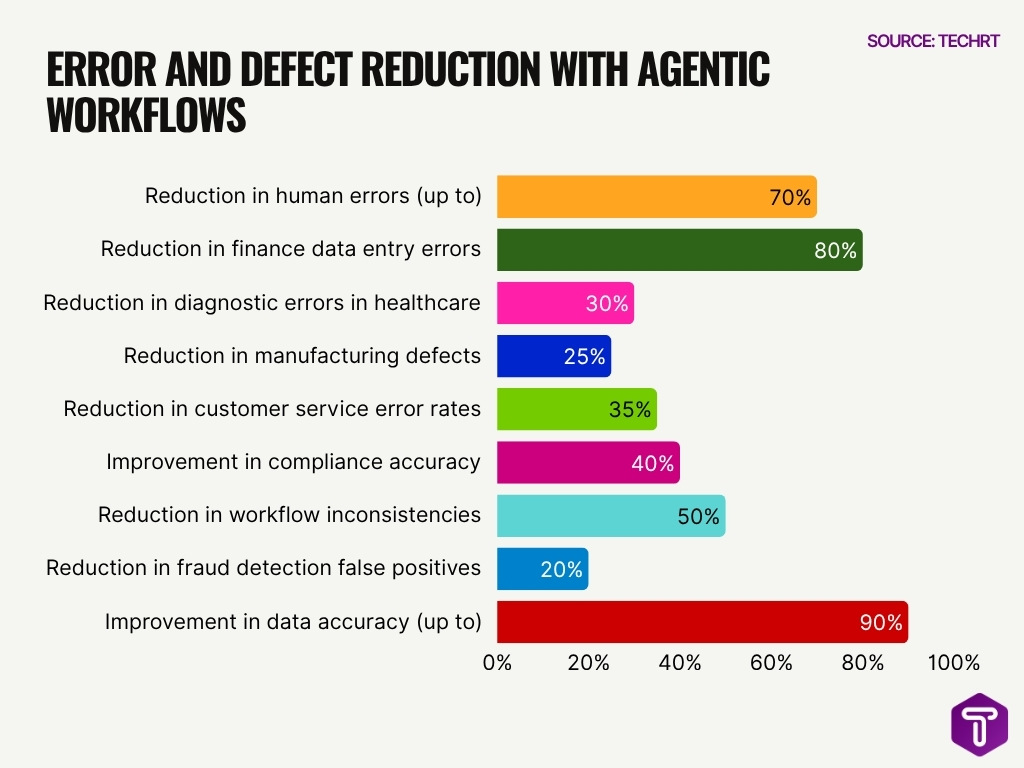
- AI-driven workflows reduce human errors by up to 70% in repetitive tasks.
- Finance departments report 80% fewer data entry errors with automation.
- Healthcare systems using AI workflows reduce diagnostic errors by 30%.
- AI-powered quality control reduces manufacturing defects by 25%.
- Customer service error rates drop by 35% with AI automation.
- AI agents improve compliance accuracy by 40% in regulated industries.
- Organizations report 50% reduction in workflow inconsistencies.
- AI-based fraud detection reduces false positives by 20%.
- Automated workflows improve data accuracy by up to 90% in enterprise systems.
Agentic Workflow Implementation and Scaling Challenges
- Only 11% of AI agent projects reach full production scale.
- 62% of organizations cite data quality issues as a major barrier to scaling AI workflows.
- Integration complexity affects 48% of enterprises, slowing deployment.
- 45% of companies struggle with a lack of skilled AI talent.
- Around 39% of organizations face challenges in aligning AI with business processes.
- 33% of enterprises report high implementation costs as a key barrier.
- Security concerns impact 42% of AI adoption decisions.
- 50% of companies report difficulty in scaling pilot projects to enterprise-wide workflows.
- Organizational resistance to change affects 37% of AI initiatives.
Data, Security, and Compliance Statistics for Agentic Workflows
- 63% of AI systems show vulnerabilities to security risks in early deployments.
- Over 28,000 exposed AI agent systems highlight security gaps.
- 58% of enterprises prioritize AI security investments in 2026 budgets.
- 49% of organizations report compliance challenges with AI regulations.
- AI-related data breaches increased by 27% year-over-year.
- 61% of companies implement data governance frameworks for AI workflows.
- Around 46% of enterprises use encryption and secure APIs for AI integrations.
- Regulatory compliance costs for AI projects increased by 18% in 2025.
- 70% of organizations consider ethical AI a top priority in workflow automation.
Barriers to AI Adoption in Global Business
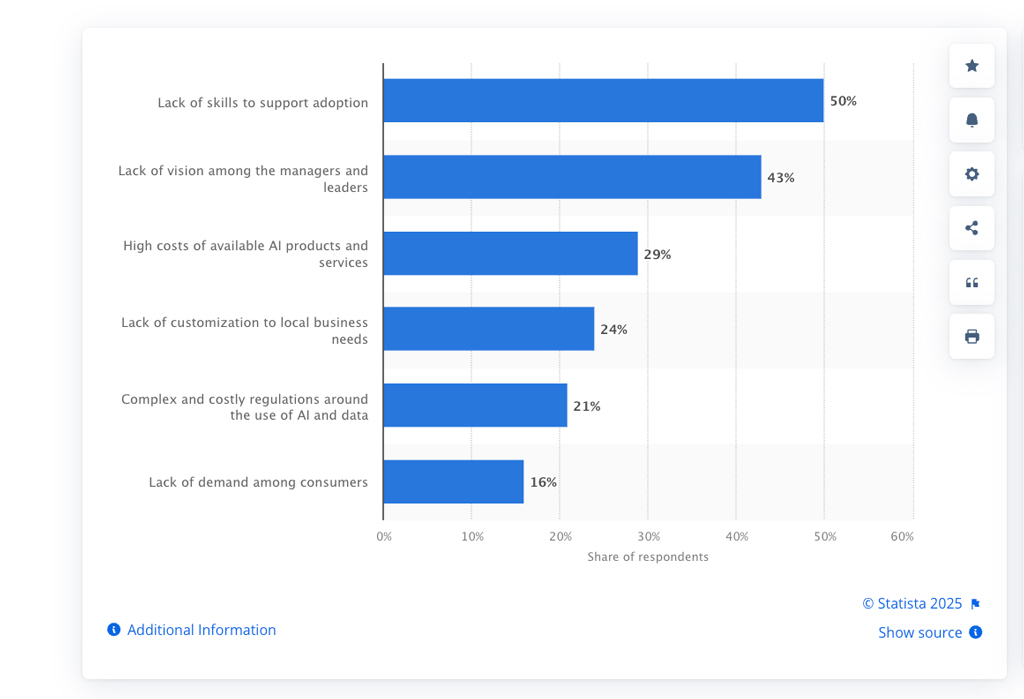
- Skill shortage is the biggest barrier, with 50% of respondents citing a lack of skills to support AI adoption.
- A significant 43% highlight a lack of vision among managers and leaders, indicating strategic misalignment at the top level.
- High costs of AI products and services remain a major concern, affecting 29% of businesses.
- 24% of respondents report a lack of customization to local business needs, suggesting AI solutions are often not tailored enough.
- Regulatory challenges are also notable, with 21% pointing to complex and costly AI/data regulations as a barrier.
- Only 16% cite lack of consumer demand, making it the least significant obstacle among those listed.
- Overall, the data shows that internal organizational challenges (skills and leadership vision) outweigh external factors (costs, regulations, demand) in slowing AI adoption.
Future Outlook and Forecasts for Agentic Workflows
- By 2028, 33% of enterprise software will include agentic AI capabilities.
- AI agents are expected to make 15% of enterprise decisions autonomously by 2028.
- Global AI spending is projected to exceed $1.3 trillion by 2029.
- 90% of enterprises plan to increase AI investments over the next 3 years.
- Multi-agent systems will become standard in over 50% of large enterprises by 2030.
- AI-driven workflows could contribute $15.7 trillion to the global economy by 2030.
- 80% of routine business processes are expected to be automated by AI by 2030.
- Agentic AI will reduce human intervention in workflows by up to 60%.
- 75% of organizations will adopt AI-driven workflow orchestration tools by 2027.
Frequently Asked Questions (FAQs)
What percentage of organizations have adopted agentic AI workflows?
What is the projected market size of agentic AI workflows?
What CAGR is expected for agentic AI and workflow platforms?
How many enterprise applications will include AI agents by 2026?
What share of AI agent projects successfully scale to production?
Conclusion
Agentic workflows are moving from experimentation to enterprise-scale deployment, reshaping how organizations design, execute, and optimize processes. The data shows consistent gains in productivity, cost efficiency, and speed, while also highlighting challenges in security, governance, and scaling. As AI agents evolve into multi-system orchestrators, businesses that invest early in integration, oversight, and workforce alignment will gain a measurable advantage. The next few years will define how deeply agentic workflows become embedded in everyday operations, and the numbers already point to a future driven by autonomous, intelligent systems.

Leave a comment
Have something to say about this article? Add your comment and start the discussion.