




Humanoid robotics is steadily moving from controlled lab environments into real-world operations, where it is beginning to reshape how businesses and institutions function. Companies in manufacturing now deploy humanoid robots to handle repetitive assembly tasks, reduce downtime, and improve operational efficiency. At the same time, healthcare providers are testing these robots in elder care settings, where they assist with mobility, monitoring, and routine support for aging populations. This dual impact across industrial and social sectors highlights how humanoid robotics is evolving into a practical solution for labor shortages and productivity challenges.
As investment accelerates and technology matures, the numbers behind this transformation reveal just how quickly the market is expanding, and the following statistics offer a clear view into that growth trajectory.
Editor’s Choice
- The global humanoid robot market is expected to grow from $5.44 billion in 2025 to $8.32 billion in 2026, reflecting rapid expansion.
- Market projections suggest a surge to $39 billion by 2030, driven by AI and automation demand.
- Global shipments exceeded 18,000 humanoid robots in 2025, marking a breakout year.
- The industry recorded a 508% year-over-year growth in shipments in 2025, signaling early mass adoption.
- China accounted for over 80% of global humanoid robot installations in 2025, dominating production.
- The U.S. humanoid robotics market alone is projected to reach $73.03 billion by 2035.
- Annual humanoid robot shipments could reach 2.6 million units by 2035, reflecting exponential scaling.
- The market could expand to over $165 billion globally by 2034, depending on adoption rates.
Recent Developments
- In 2025, humanoid robotics transitioned from lab testing to early commercial deployments in manufacturing and logistics.
- More than 85% of deployments in 2025 focused on education, entertainment, and pilot use cases, showing early-stage adoption.
- Leading Chinese firms shipped over 10,000 combined units in 2025, far ahead of global competitors.
- A single company, AgiBot, shipped over 5,100 humanoid robots in 2025, capturing major market share.
- Nearly 40% of humanoid robots in advanced trials now operate autonomously, highlighting rapid AI progress.
- Production costs for humanoid robots have dropped to around $100,000 per unit, down significantly from earlier prototypes.
- Venture funding surged, with startups like Figure raising over $1 billion in a single round in 2025.
- Global investment in AI-driven robotics contributed to a 75.6% increase in U.S. startup funding in early 2025.
- Governments and enterprises are increasingly testing humanoids for labor shortages and hazardous work environments.
Global Overview of Humanoid Robotics Adoption
- Global humanoid robot installations reached approximately 16,000 units in 2025, reflecting early adoption.
- Around 90% of global shipments in 2025 came from Chinese manufacturers, indicating regional concentration.
- The U.S. contributed only about 5% of global humanoid robot installations, highlighting a lag in commercialization.
- Early adoption remains concentrated in research, education, and demonstration environments.
- Industrial pilots in logistics and manufacturing began scaling in late 2025 and early 2026.
- Humanoid robots are increasingly used in customer interaction roles like retail guides and reception assistants.
- Adoption is driven by labor shortages and demand for flexible automation, especially in developed economies.
- Asia-Pacific leads adoption growth, while North America focuses on high-value industrial applications.
- Global adoption remains in early stages, with limited large-scale enterprise deployment as of 2026.
Humanoid Robot Market Size Forecast
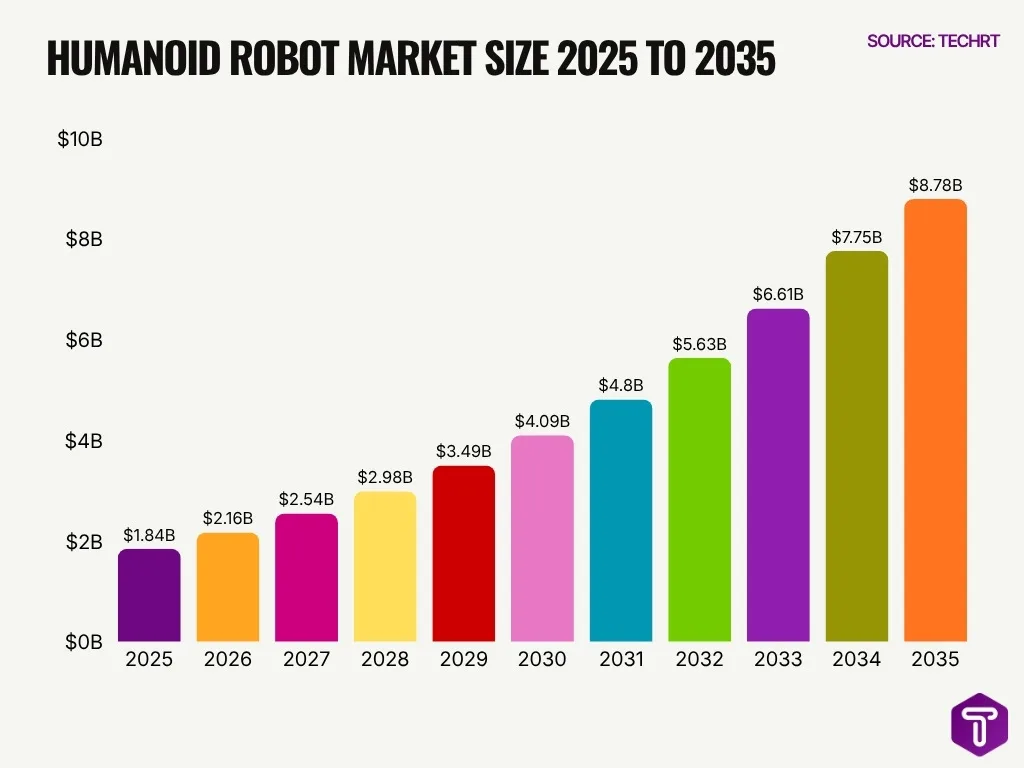
- The global humanoid robot market is projected to grow from $1.84 billion in 2025 to $8.78 billion by 2035, reflecting a strong long-term expansion.
- The market is expected to witness an overall increase of $6.94 billion over the 10-year period, highlighting accelerating adoption across industries.
- Between 2025 and 2030, the market rises from $1.84 billion to $4.09 billion, indicating steady early-stage growth driven by technological advancements.
- From 2030 onward, growth accelerates significantly, with the market nearly doubling from $4.09 billion in 2030 to $8.78 billion by 2035.
- The market surpasses the $5 billion mark by 2032, reaching approximately $5.63 billion, signaling mainstream adoption.
- By 2033, the industry size climbs to $6.61 billion, showing strong mid-decade momentum.
- The largest annual increments occur in the later years, especially between 2033 and 2035, where the market grows by over $2.17 billion in just two years.
- The consistent year-over-year increase indicates a stable CAGR trend, supported by rising demand in manufacturing, healthcare, logistics, and service sectors.
- The market crosses the $7 billion threshold in 2034, reaching $7.75 billion, marking a key milestone before approaching the decade peak.
- Overall, the data reflects a compounding growth pattern, with stronger gains in the second half of the forecast period due to scaling production and broader commercial deployment.
Humanoid Robotics Market Growth and CAGR Forecasts
- The humanoid robot market is growing at a CAGR of 52.9% between 2025 and 2026, one of the fastest in tech.
- Long-term forecasts show a 47.1% CAGR through 2030, driven by AI advancements.
- Another projection estimates a 39.2% CAGR from 2025 to 2030, indicating sustained expansion.
- Some aggressive forecasts predict 49.0% CAGR between 2026 and 2033.
- High-growth scenarios suggest a 50.60% CAGR through 2034, reflecting exponential scaling potential.
- Conservative models estimate 16.91% CAGR from 2026 to 2035, highlighting uncertainty in projections.
- Another study forecasts 42.8% CAGR between 2025 and 2030, driven by industrial demand.
- Some niche forecasts suggest 59.8% CAGR through 2030, indicating rapid commercialization phases.
- The U.S. market alone may grow at over 50% CAGR through 2035, fueled by automation needs.
Humanoid Robot Unit Shipments and Installed Base
- Global humanoid robot shipments reached approximately 18,000 units in 2025, a record high.
- Earlier estimates show shipments at 14,500–14,000 units in 2025, depending on data sources.
- The market saw a 508% increase in shipments year-over-year in 2025, indicating rapid scaling.
- Chinese companies produced nearly 90% of global shipments in 2025, dominating supply chains.
- AgiBot alone accounted for 39% of global shipments in 2025, showing market concentration.
- Combined shipments from top Chinese vendors exceeded 10,000 units in 2025.
- U.S.-based companies shipped only around 150 units each in 2025, highlighting early-stage production.
- Installed base remains relatively small, with most robots used in pilot or non-industrial settings.
- Annual shipments are projected to grow exponentially, potentially reaching millions of units by 2035.
Long-Term Humanoid Robot Population Forecasts
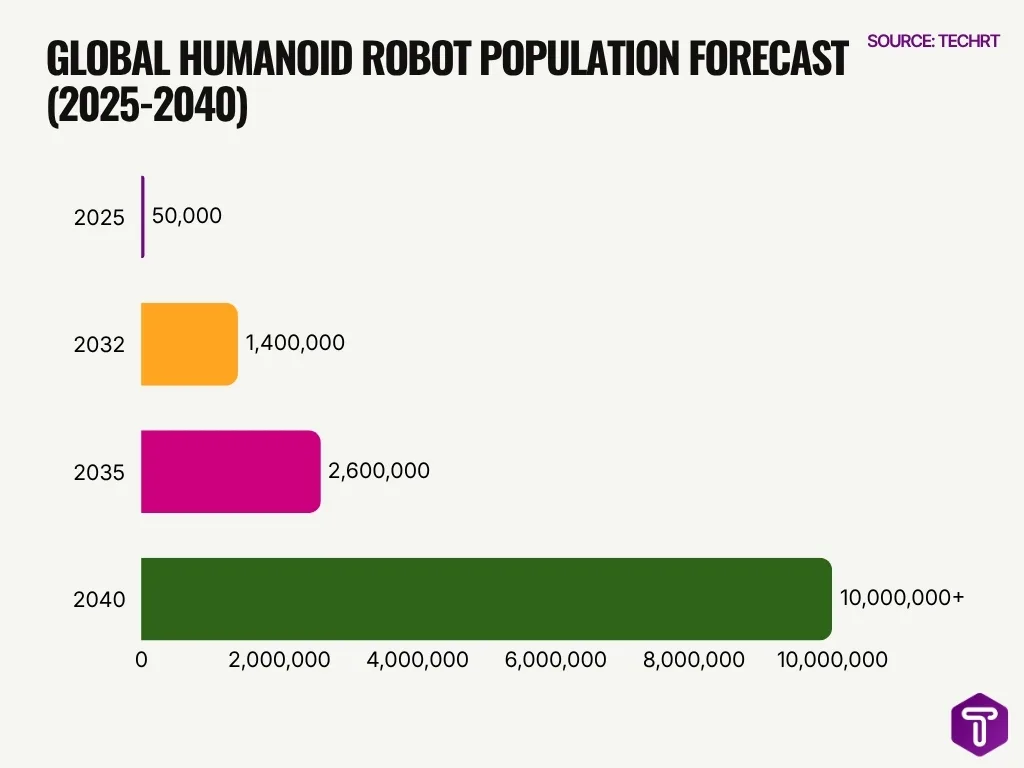
- Global humanoid robot population could exceed 2.6 million units by 2035, reflecting exponential scaling.
- Conservative estimates project around 1.4 million active humanoid robots by 2032 across industries.
- High-growth scenarios suggest a global installed base of over 10 million units by 2040.
- China alone aims to deploy hundreds of thousands of humanoid robots by 2030 as part of its national robotics strategy.
- The U.S. market could account for 15–20% of the global humanoid robot population by 2035, driven by enterprise adoption.
- Industrial applications are expected to represent over 60% of the total humanoid robot population by 2035.
- Service robots, including elder care and hospitality, may account for 30% of the installed base by 2035.
- Early-stage adoption remains low, with fewer than 50,000 humanoid robots globally in active use in 2025.
- The global humanoid robot population is projected to grow at over 40% annually through 2035, depending on adoption rates.
Humanoid Robotics Market by Component (Hardware vs Software)
- Hardware accounts for over 65% of total humanoid robot costs in 2025, driven by actuators and sensors.
- Software, including AI and control systems, represents approximately 35% of market value.
- AI-driven software is the fastest-growing segment, with over 50% CAGR through 2030.
- Sensor components, including LiDAR and vision systems, contribute 20–25% of hardware costs.
- Actuators and motors make up 30–40% of total hardware expenses, reflecting mechanical complexity.
- Cloud-based robotics software adoption increased by over 60% in 2025, enabling remote updates and learning.
- Edge computing integration in humanoid robots grew by over 45% year-over-year in 2025.
- Software-as-a-Service models for robotics are emerging, expected to capture 15% of revenue by 2030.
- Hardware costs are expected to decline by 20–30% over the next five years, improving accessibility.
Humanoid Robotics Market by Motion Type (Biped vs Wheeled)
- Biped humanoid robots dominate with over 70% market share in 2025, due to human-like mobility.
- Wheeled humanoid robots account for around 30% of deployments, mainly in logistics and indoor environments.
- Biped robots are preferred in complex environments, including stairs and uneven terrain applications.
- Wheeled robots offer up to 40% lower energy consumption, making them cost-efficient for certain tasks.
- Biped robot development costs remain 20–50% higher than wheeled alternatives due to mechanical complexity.
- Hybrid motion systems are emerging, combining wheels and legs for greater flexibility in operations.
- Biped robots are expected to grow at over 45% CAGR through 2030, driven by industrial use cases.
- Wheeled humanoids dominate in retail and service sectors, where mobility requirements are simpler.
- Research investments in dynamic locomotion increased by over 35% in 2025, improving biped stability.
Humanoid Robotics Market by Industry Vertical
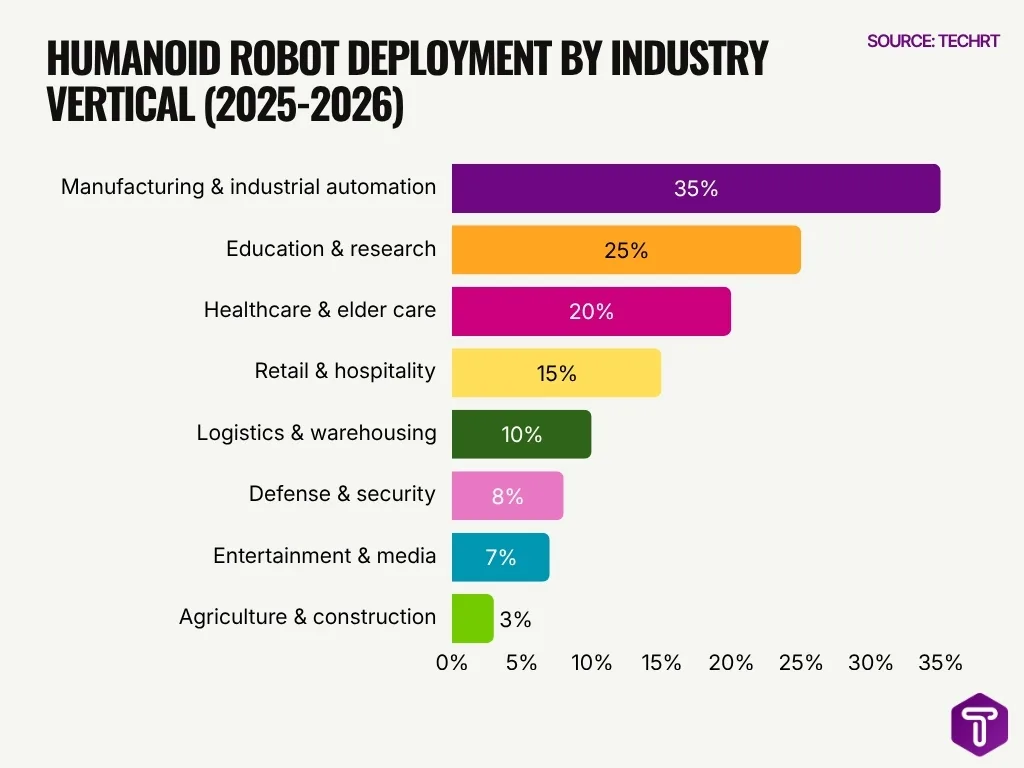
- Manufacturing and industrial automation account for over 35% of humanoid robot deployments in 2025.
- Healthcare and elder care applications represent around 20% of market demand, driven by aging populations.
- Retail and hospitality sectors contribute approximately 15% of humanoid robot usage, mainly for customer interaction roles.
- Education and research institutions still hold over 25% of deployments, reflecting early-stage adoption.
- Logistics and warehousing adoption is growing rapidly, with over 10% share in 2026 pilot programs.
- Defense and security applications account for 5–8% of humanoid robot usage globally.
- Entertainment and media applications, including theme parks and exhibitions, represent about 7% of deployments.
- Industrial inspection and maintenance roles are expected to grow at over 45% CAGR through 2030.
- Emerging use cases in agriculture and construction remain niche, with less than 3% market share in 2026.
Humanoid Robots in Healthcare and Elder Care
- Healthcare applications represent around 20% of humanoid robot demand globally in 2025.
- The global elder care robot market is projected to reach over $13 billion by 2030, including humanoid systems.
- Japan has deployed thousands of robots in elder care, addressing a population where over 29% are aged 65+.
- Humanoid robots assist with patient monitoring, mobility support, and medication reminders.
- Studies show robots can reduce caregiver workload by up to 20–30% in assisted living facilities.
- Patient engagement robots improve mental well-being, with over 60% positive response rates in trials.
- Telepresence humanoid robots are increasingly used, growing by over 35% in hospital deployments in 2025.
- The U.S. healthcare robotics market is expected to grow at over 20% CAGR through 2030.
- Adoption remains limited but expanding, with pilot programs across major hospitals globally in 2026.
Humanoid Robots in Manufacturing and Industrial Automation
- Manufacturing accounts for over 35% of humanoid robot deployments globally in 2025.
- Humanoid robots can improve productivity by up to 30% in repetitive industrial tasks.
- Companies are using humanoids for assembly line work, material handling, and inspection tasks.
- Labor shortages in manufacturing have increased demand, with over 60% of firms exploring automation solutions in 2025.
- Early pilot programs show cost savings of 20–25% in operational expenses using humanoid robots.
- Industrial humanoid robots can operate 24/7, reducing downtime and increasing throughput.
- Safety improvements include reducing workplace injuries by up to 15% in automated environments.
- Automotive and electronics sectors lead adoption, accounting for over 50% of industrial humanoid robot usage.
- Industrial humanoid robots are expected to grow at over 40% CAGR through 2030, driven by automation demand.
Humanoid Robot Production Market Share (China, 2026)
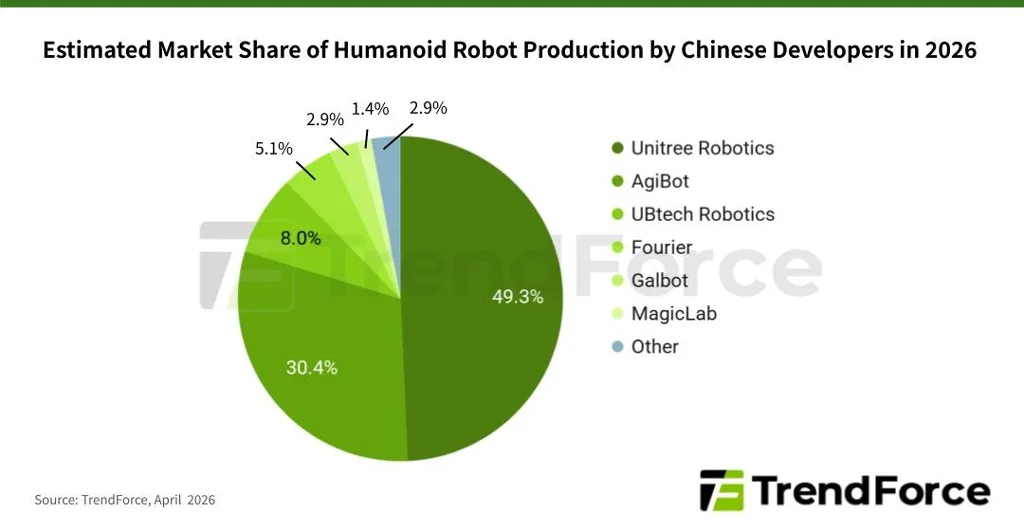
- Unitree Robotics dominates the market with a commanding 49.3% share, accounting for nearly half of total production.
- AgiBot holds the second position with 30.4%, showing a strong duopoly structure between the top two players.
- The top two companies together control 79.7% of the market, indicating high market concentration.
- UBtech Robotics contributes 8.0%, emerging as the largest mid-tier competitor but still far behind the leaders.
- Fourier captures 5.1%, positioning itself within the secondary competitive layer.
- Smaller players like Galbot (2.9%) and MagicLab (1.4%) hold limited but notable shares in the ecosystem.
- The “Other” category accounts for 2.9%, reflecting a fragmented long tail of smaller developers.
- There is a sharp drop-off after the top two firms, highlighting significant entry barriers and scale advantages in humanoid robotics production.
- The distribution suggests a winner-takes-most dynamic, typical in capital-intensive, high-tech manufacturing sectors.
- Overall, the market structure indicates early-stage consolidation, with leaders rapidly scaling production capacity.
Humanoid Robot Pricing and Cost Trends
- The average cost of a humanoid robot dropped to around $100,000 in 2025, down from over $250,000 a decade ago.
- Entry-level humanoid robots for education and research are now priced between $10,000 and $30,000, improving accessibility.
- Advanced industrial humanoids can still exceed $150,000 per unit, depending on capabilities and customization.
- Hardware accounts for the majority of costs, with actuators and sensors making up over 60% of total pricing.
- Battery and power systems contribute approximately 10–15% of total robot cost, especially for mobile units.
- Software licensing and AI subscriptions can add $5,000–$20,000 annually per robot in enterprise deployments.
- Mass production could reduce humanoid robot costs by 30–50% by 2030, driven by economies of scale.
- Chinese manufacturers have reduced production costs by over 20% in 2025 alone, intensifying global competition.
- Leasing models are emerging, with companies offering humanoid robots at $2,000–$5,000 per month, lowering upfront investment barriers.
Return on Investment and Productivity Gains from Humanoid Robots
- Companies report productivity gains of up to 30% in repetitive tasks after deploying humanoid robots.
- Labor cost savings range between 20% and 40% annually in industries with high automation adoption.
- Humanoid robots can operate continuously, increasing utilization rates to over 85% compared to human labor shifts.
- Payback periods for humanoid robot investments are estimated at 2 to 4 years in industrial settings.
- Warehouse operations report efficiency improvements of 25% in order fulfillment speeds.
- Error rates in manufacturing tasks can drop by up to 50% with robotic automation, improving quality control.
- Early adopters report a 15–20% reduction in workplace accidents, improving safety outcomes.
- Service-sector robots increase customer engagement metrics by over 20% in retail environments.
- Companies integrating humanoid robots with AI systems report 10–15% additional efficiency gains through optimization.
Regional Humanoid Robotics Market Share and Growth
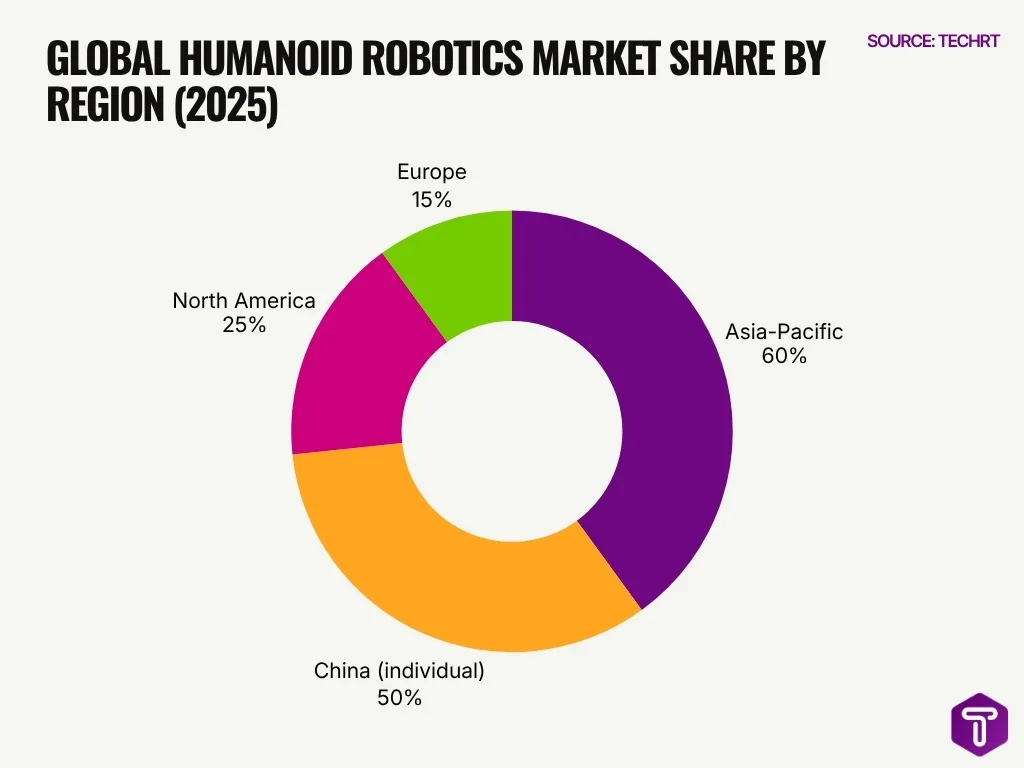
- Asia-Pacific leads the global market with over 60% market share in 2025, driven by China, Japan, and South Korea.
- China alone accounts for more than 50% of global humanoid robot production and deployment.
- North America holds approximately 20–25% market share, focusing on advanced AI integration.
- Europe contributes around 15% of the global market share, with a strong research and industrial automation focus.
- Japan remains a key innovator, investing heavily in elder care robotics due to demographic trends.
- South Korea increased humanoid robotics funding by over 30% in 2025, accelerating regional growth.
- The U.S. humanoid robotics market is expected to grow at over 50% CAGR through 2035.
- Emerging markets in the Middle East and Southeast Asia show early adoption growth of 20%+ annually.
- Government initiatives in the Asia-Pacific are driving large-scale pilot programs and subsidies for robotics adoption.
AI, Sensors, and Hardware Trends in Humanoid Robotics
- AI integration in humanoid robots increased by over 60% in 2025, enabling advanced autonomy.
- Vision systems using computer vision are now present in over 90% of humanoid robots, supporting navigation and interaction.
- Sensor fusion technologies improved accuracy by up to 40% in object detection tasks.
- Edge AI adoption grew by over 45% year-over-year, allowing real-time decision-making.
- Battery efficiency improved by 20% in 2025, extending operational time for mobile robots.
- Advanced actuators now deliver 30% higher torque efficiency, improving mobility and dexterity.
- Natural language processing integration enables robots to understand over 80% of common human commands.
- Cloud robotics platforms are used in over 50% of enterprise deployments, supporting updates and data sharing.
- Research in tactile sensors increased by over 35% in 2025, enhancing human-robot interaction.
Impact of Humanoid Robots on Employment and Workforce Skills
- Automation could impact up to 30% of global jobs by 2030, including roles suited for humanoid robots.
- However, robotics is expected to create over 12 million new jobs globally, particularly in tech and maintenance roles.
- Demand for robotics engineers grew by over 40% in 2025, reflecting industry expansion.
- Workforce reskilling programs increased by over 25% globally, focusing on automation-related skills.
- Manufacturing jobs requiring manual labor are expected to decline by 10–15% by 2030.
- Service roles are evolving, with over 20% of workers interacting with robots in daily tasks by 2026.
- Companies report productivity improvements of 15–20% when combining human and robotic teams.
- Training costs for robotics-related skills increased by over 30% in 2025, reflecting demand for talent.
- Governments are investing in workforce transition programs, with funding rising by over 20% in 2025.
Funding, Investment, and Startup Activity in Humanoid Robotics
- Global investment in humanoid robotics exceeded $5 billion in 2025, reflecting strong investor confidence.
- Robotics startup Figure raised over $1 billion in funding in 2025, reaching a multibillion-dollar valuation.
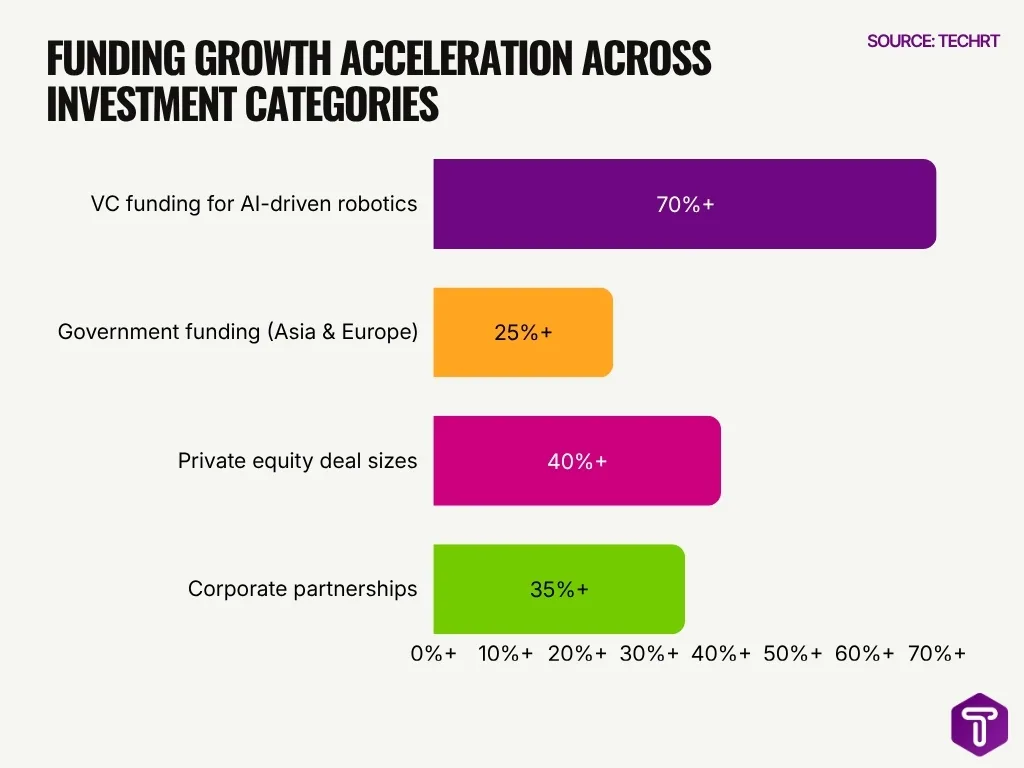
- Venture capital funding for AI-driven robotics grew by over 70% year-over-year in 2025.
- More than 150 new robotics startups were launched globally between 2024 and 2026, focusing on humanoid systems.
- Major tech companies are investing heavily, with combined spending exceeding $10 billion annually on robotics R&D.
- Government funding programs in Asia and Europe increased by over 25% in 2025, supporting innovation.
- Private equity firms are targeting robotics, with deal sizes increasing by over 40% compared to 2024.
- Corporate partnerships between robotics firms and manufacturers grew by over 35% in 2025, accelerating commercialization.
- Early-stage funding rounds for humanoid robotics startups now average $15–$25 million, up from $5–$10 million in 2022.
Future Opportunities and Challenges in Humanoid Robotics
- The humanoid robotics market could exceed $200 billion globally by 2035, depending on adoption rates.
- Labor shortages in developed economies could drive over 50% of demand for humanoid robots.
- Ethical concerns and regulation remain barriers, with over 60% of organizations citing compliance challenges.
- Battery limitations and energy efficiency remain key challenges, affecting operational scalability.
- Integration with existing systems remains complex, with over 45% of companies reporting deployment challenges.
- Public acceptance is improving, with over 55% of consumers open to interacting with service robots.
- Advances in AI could enable fully autonomous humanoid robots by the early 2030s, according to industry forecasts.
- Supply chain constraints, especially for semiconductors, impact production timelines by 10–20% delays.
- Opportunities in emerging markets are growing, with over 25% annual adoption growth expected in developing regions.
Frequently Asked Questions (FAQs)
What is the projected global humanoid robotics market size by 2030?
What is the expected CAGR of the humanoid robotics market?
How many humanoid robots are expected to be shipped annually by 2035?
What percentage of global humanoid robot production is dominated by China?
What share of the humanoid robot market does wheel-drive motion hold?
Conclusion
Humanoid robotics has moved beyond experimental prototypes and is now entering a phase of measurable commercial impact across multiple industries. The data shows strong momentum, from rising shipment volumes and falling costs to significant gains in productivity and efficiency. Businesses are increasingly integrating humanoid robots to address labor shortages, improve safety, and streamline operations, while sectors like healthcare are exploring their potential to enhance the quality of care. At the same time, rapid advancements in AI, sensors, and hardware continue to expand what these robots can achieve.
However, challenges such as cost optimization, regulatory frameworks, and workforce adaptation still require careful navigation. Looking ahead, the consistent growth trends and increasing investment suggest that humanoid robots will play a central role in the future of work and automation, shaping how industries operate over the next decade.

Leave a comment
Have something to say about this article? Add your comment and start the discussion.