




Edge AI is transforming how organizations process and act on data by shifting intelligence from centralized cloud systems directly to devices at the network edge. Instead of sending massive volumes of data to distant servers, businesses now analyze information locally, enabling faster decisions and reducing latency. This shift powers real-world applications such as autonomous vehicles that must respond instantly to road conditions, and smart factories that detect anomalies in equipment before costly failures occur.
At the same time, industries like healthcare, retail, and logistics increasingly rely on Edge AI to deliver real-time insights, improve operational efficiency, and enhance user experiences. With growing concerns around data privacy, bandwidth limitations, and response speed, companies are accelerating investments in edge-based intelligence. As adoption scales globally and new use cases emerge, Edge AI is becoming a core component of modern digital infrastructure. Let’s explore the latest statistics shaping this rapidly evolving space.
Editor’s Choice
- The global Edge AI market is projected to reach $37.5 billion in 2026, with strong growth momentum through the decade.
- Market size is expected to exceed $102.9 billion by 2030, reflecting a 28.7% CAGR.
- Another estimate places the 2025 market at $24.9 billion, growing to $118.7 billion by 2033.
- Global edge computing spending reached about $265 billion in 2025.
- IoT-connected devices are expected to hit 39 billion by 2030, fueling Edge AI demand.
- North America held roughly 40% market share in 2025.
- Edge AI market CAGR ranges between 20% and 28% across forecasts, indicating sustained high growth.
Recent Developments
- Edge AI adoption has surged due to real-time processing needs in IoT ecosystems.
- Companies are shifting AI workloads from cloud to edge devices like cameras and sensors for faster response times.
- The AI inference market, closely tied to edge deployments, will grow by $128.8 billion between 2024–2029.
- Edge AI platforms are expanding into industries like medical devices, logistics, and transportation.
- Hardware innovation is accelerating, with specialized chips enabling low-power, high-performance inference.
- Generative AI is emerging as the fastest-growing segment in edge AI software markets.
- Increasing privacy concerns drive organizations to process sensitive data locally instead of sending it to cloud servers.
- Edge AI is becoming critical in autonomous systems, smart cities, and industrial automation.
Global Edge AI Market Overview Statistics
- The Edge AI market reached approximately $26.9 billion in 2025.
- It is expected to grow to $33.4 billion in 2026, reflecting rapid year-over-year expansion.
- Long-term projections estimate the market at $128.5 billion by 2032.
- Another forecast places the 2035 valuation at $180.4 billion.
- The market recorded $20.9 billion in 2024, showing consistent upward momentum.
- CAGR across forecasts ranges from 21% to 27% globally.
- Edge AI forms a fast-growing segment within the $228–232 billion edge computing ecosystem (2024).
- Market fragmentation remains moderate, with strong competition across hardware, software, and platform providers.
Edge AI Market Size and Growth Rate Statistics
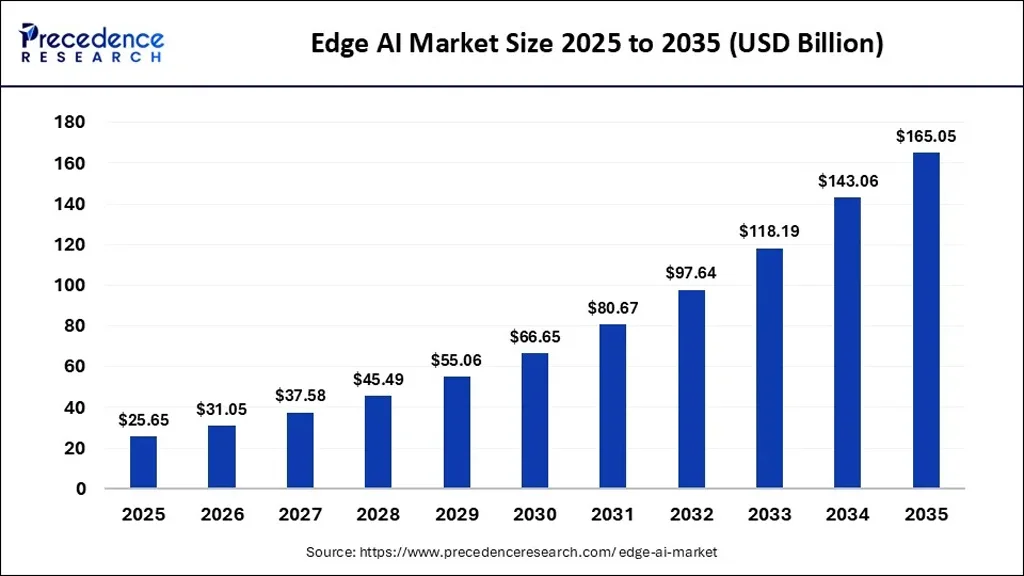
- The global Edge AI market is projected to grow from $25.65 billion in 2025 to $165.05 billion by 2035, reflecting massive long-term expansion.
- The market is expected to increase by over 6.4x within a decade, highlighting strong adoption across industries.
- From 2025 to 2030, the market rises from $25.65B to $66.65B, showing steady early-stage acceleration.
- By 2031, the market will surpass the $80 billion mark, indicating a shift toward mainstream adoption.
- The industry crosses $97.64 billion in 2032, nearing the $100B milestone.
- Between 2032 and 2035, the market grows rapidly from $97.64B to $165.05B, adding nearly $67 billion in just three years.
- The fastest growth phase occurs in the later years, especially from 2033 ($118.19B) to 2035 ($165.05B).
- Year-on-year increases consistently expand, with annual additions growing from about $5–6 billion early on to over $20 billion in later years.
- The data reflects a strong compound annual growth trajectory, driven by increasing demand for real-time processing, IoT integration, and low-latency AI solutions.
- Overall, the Edge AI market demonstrates a high-growth, high-investment opportunity, particularly beyond 2030.
Edge AI Adoption and Deployment Statistics
- The IT and telecom sectors hold over 20% revenue share in the edge AI market.
- Manufacturing leads with over 35% projected revenue share by 2030 in edge AI use cases.
- Global edge AI market grows from $29.08 billion in 2025 to $37.51 billion in 2026 at 29% CAGR.
- Edge AI market valued at $24.91 billion in 2025, reaching $118.69 billion by 2033 at 21.7% CAGR.
- Healthcare accounts for 43% of edge AI revenue, driven by real-time diagnostics.
- Edge AI hardware market hits $58.90 billion by 2030 from $26.14 billion in 2025 at 17.6% CAGR.
- Predictive maintenance in manufacturing reduces downtime by up to 40% using edge AI.
- Consumer electronics holds 81.3% volume share in the edge AI hardware market.
- North America dominates with a 36-40% share in the global edge AI market.
- The hardware segment leads edge AI with 51.8% revenue share in 2025.
Edge AI Hardware, Software, and Services Statistics
- Hardware dominates the Edge AI market, contributing over 55% of total revenue share in 2025.
- Edge AI software is expected to grow at a 27% CAGR through 2030, driven by AI frameworks and platforms.
- Services, including deployment and maintenance, account for nearly 20% of the market.
- AI chips and processors represent a key hardware segment, projected to exceed $50 billion by 2030.
- Edge AI software platforms are increasingly integrated with cloud ecosystems like google.com and aws.amazon.com.
- More than 70% of enterprises use hybrid edge-cloud architectures for scalability.
- Open-source frameworks such as TensorFlow Lite and ONNX are widely used in edge deployments.
- Spending on Edge AI services is growing steadily, with enterprises increasing budgets by 15–20% annually.
Edge AI by Region and Country Statistics
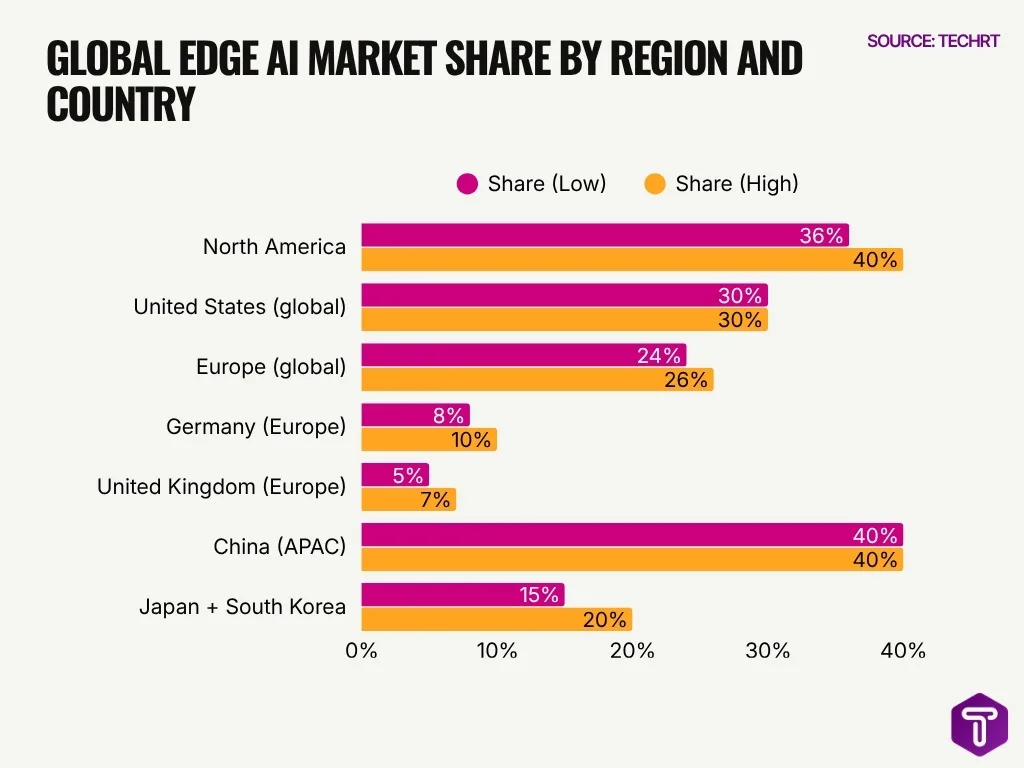
- North America holds about 40% share of the global Edge AI market in 2025.
- The United States represents over 30% of the global Edge AI market by 2025, led by strong enterprise AI adoption.
- Europe accounts for a roughly 24–26% share of the global Edge AI market in 2025, driven by industrial automation.
- Germany contributes about an 8–10% share of Europe’s Edge AI market, largely from manufacturing and Industry 4.0 deployments.
- The United Kingdom represents nearly a 5–7% share of Europe’s Edge AI market, with smart city and public‑sector AI projects scaling.
- Asia‑Pacific is projected to grow at a 30–35% CAGR in Edge AI from 2025 to 2030, outpacing other regions.
- China captures over 40% share of the Asia‑Pacific Edge AI market by 2025, backed by smart city and industrial AI investments exceeding $150 billion.
- India’s Edge AI market is expanding at around 20–25% annually, fueled by IoT and telecom deployments.
- Japan and South Korea together represent a roughly 15–20% share of APAC’s Edge AI revenue, driven by automotive and robotics AI.
Edge AI Device and Chipset Statistics
- The global AI chipset market for edge devices is expected to surpass $90 billion by 2030.
- Over 60% of AI workloads at the edge run on GPUs and specialized ASICs.
- Edge AI-enabled devices, including cameras and sensors, exceeded 1.5 billion units shipped in 2025.
- Smartphone AI chip integration reached over 80% of flagship devices in 2024–2025.
- AI accelerators improve processing speed by up to 10x compared to traditional CPUs.
- Edge devices now support sub-10 ms inference latency, critical for real-time applications.
- Demand for low-power chipsets is increasing, reducing energy consumption by 30–50%.
- Automotive AI chips are projected to grow at a 25% CAGR, driven by ADAS and autonomous driving.
Edge AI Performance, Latency, and Efficiency Statistics
- Edge AI reduces latency by up to 70% compared to cloud-based processing.
- Real-time processing enables response times under 10 milliseconds in mission-critical systems.
- Edge AI can lower bandwidth usage by 40–60%, improving efficiency.
- AI inference at the edge delivers up to 5x faster decision-making in industrial environments.
- Power-efficient AI models reduce device energy consumption by 20–40%.
- Edge deployments improve system uptime by 15–20% in manufacturing environments.
- Data processing speeds increase significantly with localized compute, reducing delays by up to 80%.
- Edge AI enables continuous operation even in low-connectivity environments, improving reliability metrics by 30%.
Edge AI Adoption by Industry
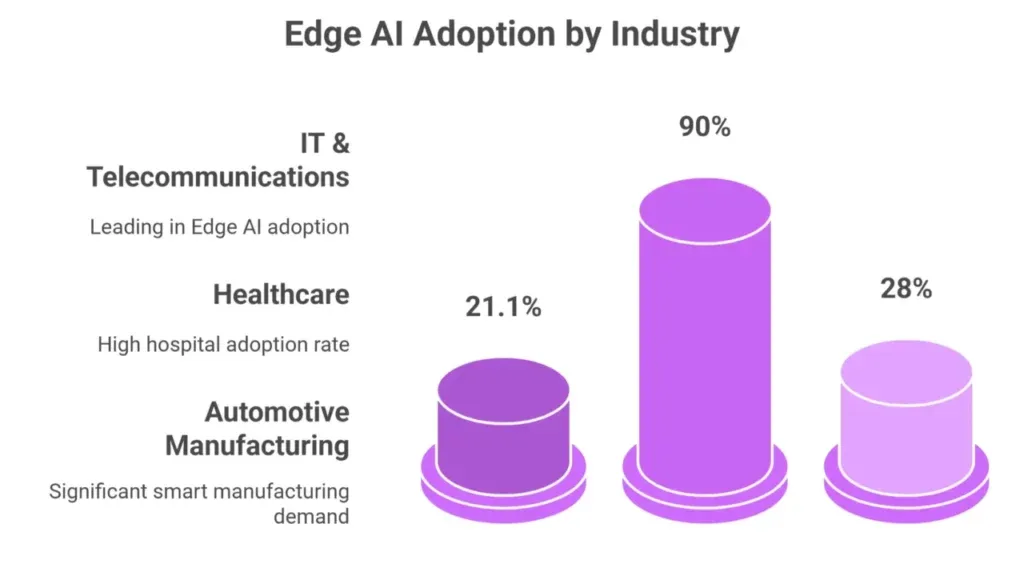
- IT & Telecommunications dominates with a massive 90% adoption rate, making it the clear leader in Edge AI implementation.
- The high adoption in IT & Telecom reflects strong demand for real-time data processing, low latency, and network optimization.
- Automotive Manufacturing shows a notable 28% adoption rate, driven by smart factories, automation, and predictive maintenance use cases.
- The sector is leveraging Edge AI to enhance operational efficiency and support Industry 4.0 initiatives.
- Healthcare records have a 21.1% adoption rate, indicating steady but more cautious integration compared to other industries.
- Adoption in healthcare is fueled by hospital systems, medical imaging, and patient monitoring solutions.
- The relatively lower adoption in healthcare suggests challenges like data privacy concerns and regulatory constraints.
- Overall, Edge AI adoption varies significantly, with a gap of nearly 69 percentage points between the highest (90%) and lowest (21.1%) sectors.
- The data highlights that industries requiring real-time decision-making and high data throughput are adopting Edge AI at a much faster pace.
Edge AI Data Processing and Bandwidth Reduction Statistics
- Edge AI reduces data sent to the cloud by up to 75%, minimizing network congestion.
- Organizations report 50% lower data transmission costs with edge processing.
- Video analytics workloads at the edge cut bandwidth consumption by 60–80%.
- IoT data processing at the edge improves efficiency, with over 90% of data processed locally in some deployments.
- Real-time filtering reduces unnecessary data storage by 40%.
- Edge AI enables faster anomaly detection, improving detection speed by up to 3x.
- Data privacy improves significantly as sensitive data remains on-device, reducing exposure risks.
- Enterprises adopting edge computing report 30–50% faster analytics workflows.
Edge AI and 5G Connectivity Statistics
- 5G adoption is expected to reach 1.9 billion subscriptions globally by 2025, supporting edge growth.
- 5G networks reduce latency to as low as 1 millisecond, enhancing edge AI performance.
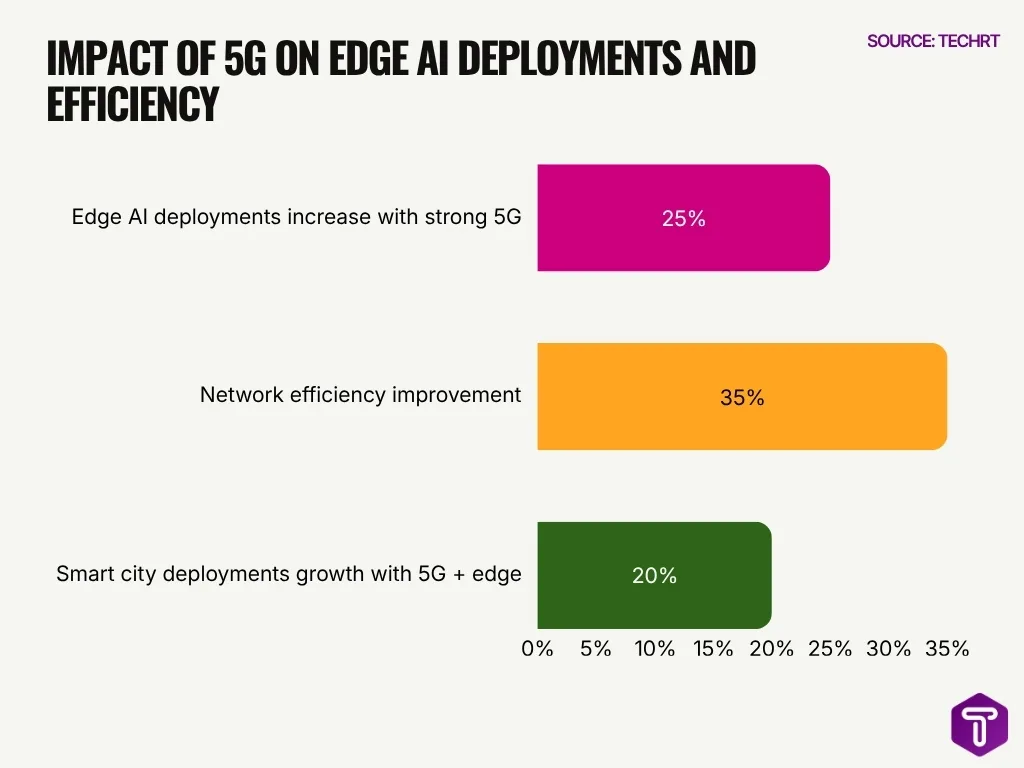
- Edge AI deployments increase by 25%+ in regions with strong 5G infrastructure.
- Telecom operators invest heavily in edge infrastructure, with spending exceeding $100 billion annually.
- 5G-enabled edge computing supports real-time applications like AR/VR and autonomous driving.
- Integration of 5G and Edge AI improves network efficiency by up to 35%.
- Industrial IoT applications rely on 5G edge solutions for ultra-reliable low-latency communication (URLLC).
- Smart city deployments combining 5G and Edge AI are growing at 20%+ annually.
Edge AI and IoT Device Proliferation Statistics
- The number of IoT devices is expected to reach 39 billion by 2030.
- Over 75% of enterprise-generated data will be created at the edge by 2026.
- Smart home devices account for a significant share, with over 1 billion devices deployed globally.
- Industrial IoT adoption continues to rise, with over 50% of manufacturers implementing edge solutions.
- Connected vehicles are expected to exceed 400 million units by 2030, driving edge adoption.
- Edge AI processes data from billions of sensors in real time, improving system responsiveness.
- Wearable devices using Edge AI are projected to grow at a 20% CAGR.
- Smart city IoT deployments are increasing, with hundreds of millions of connected devices installed globally.
Edge AI Investment and Funding Statistics
- Global AI investments surpassed $200 billion in 2024, with a growing share allocated to edge AI.
- Venture capital funding in edge AI startups grew by 35% year-over-year in 2025.
- Major tech companies increased spending on edge infrastructure by over $50 billion annually.
- Semiconductor firms are investing heavily, with AI chip R&D budgets rising by 20–30% annually.
- Government funding programs in AI exceeded $90 billion globally.
- Corporate adoption budgets for edge AI projects increased by 15–25% in 2025.
- Startup ecosystems in the US and China dominate, accounting for 70%+ of global funding deals.
- Edge AI mergers and acquisitions activity increased by 18% in 2024–2025.
Edge AI Revenue and Forecast Statistics by Year
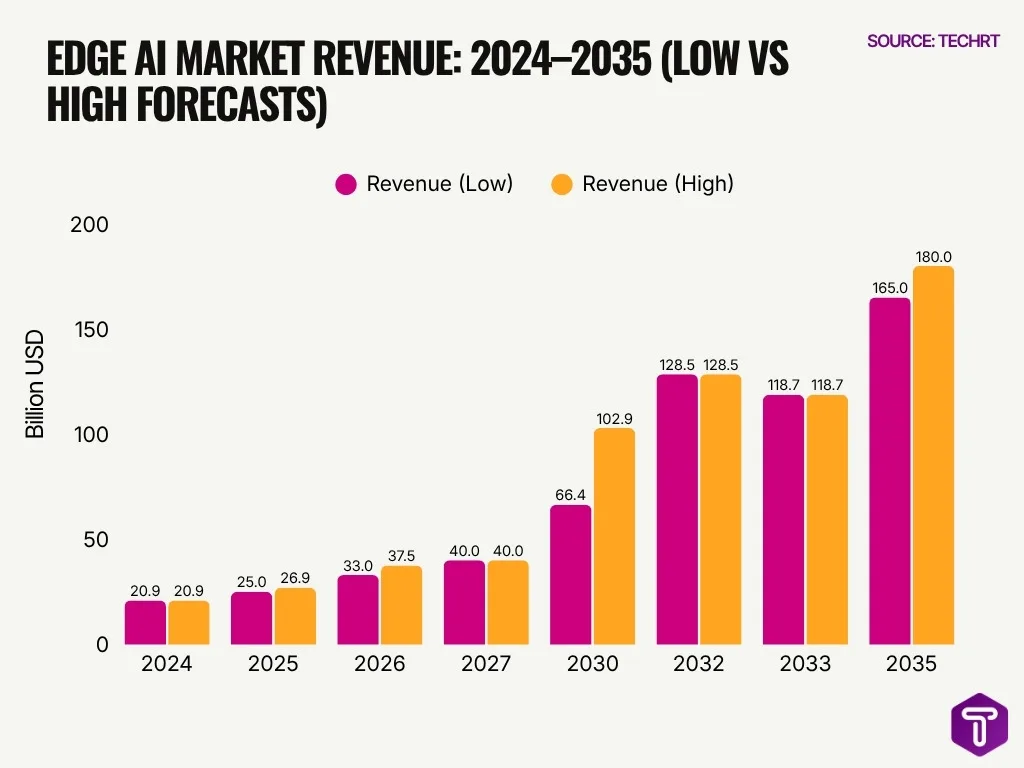
- The 2024 global market revenue stood at approximately $20.9 billion.
- 2025 revenue increased to around $25–26.9 billion, depending on methodology.
- 2026 estimates place revenue at $33–37.5 billion.
- By 2027, projections suggest the market will surpass $40 billion+.
- 2030 forecasts range from $66.4 billion to $102.9 billion.
- 2032 projections reach $128.5 billion globally.
- 2033 estimates place revenue at $118.7 billion.
- By 2035, the market could exceed $165–180 billion, depending on adoption rates.
Edge AI Security, Privacy, and Compliance Statistics
- 70% of organizations cite data privacy as a key driver for adopting edge computing.
- Edge AI reduces data exposure by keeping sensitive data processed locally, lowering breach risks.
- Cybersecurity spending related to edge environments is projected to reach $30+ billion by 2027.
- Over 60% of enterprises report improved compliance with regulations like GDPR when using edge processing.
- Edge AI deployments reduce cloud data transfer, minimizing attack surfaces by up to 40%.
- AI-based security systems at the edge improve threat detection speed by 2–3x.
- Device-level encryption adoption has increased by 25% in edge environments.
- Regulatory frameworks in the US and EU increasingly emphasize localized data processing requirements.
Edge AI Business Value and ROI Improvement Statistics
- Companies deploying edge AI report 20–30% operational cost savings.
- Real-time analytics improves decision-making speed by up to 5x.
- Predictive maintenance reduces equipment downtime by 30–50% in industrial settings.
- Retailers using Edge AI report 10–15% revenue growth through improved customer insights.
- Logistics firms achieve 20% efficiency gains in supply chain operations.
- Edge AI reduces cloud infrastructure costs by up to 40%.
- Healthcare providers improve patient outcomes with real-time diagnostics and monitoring systems.
- Smart city deployments reduce energy consumption by 15–25% through optimized resource usage.
Edge AI Challenges and Barrier Statistics
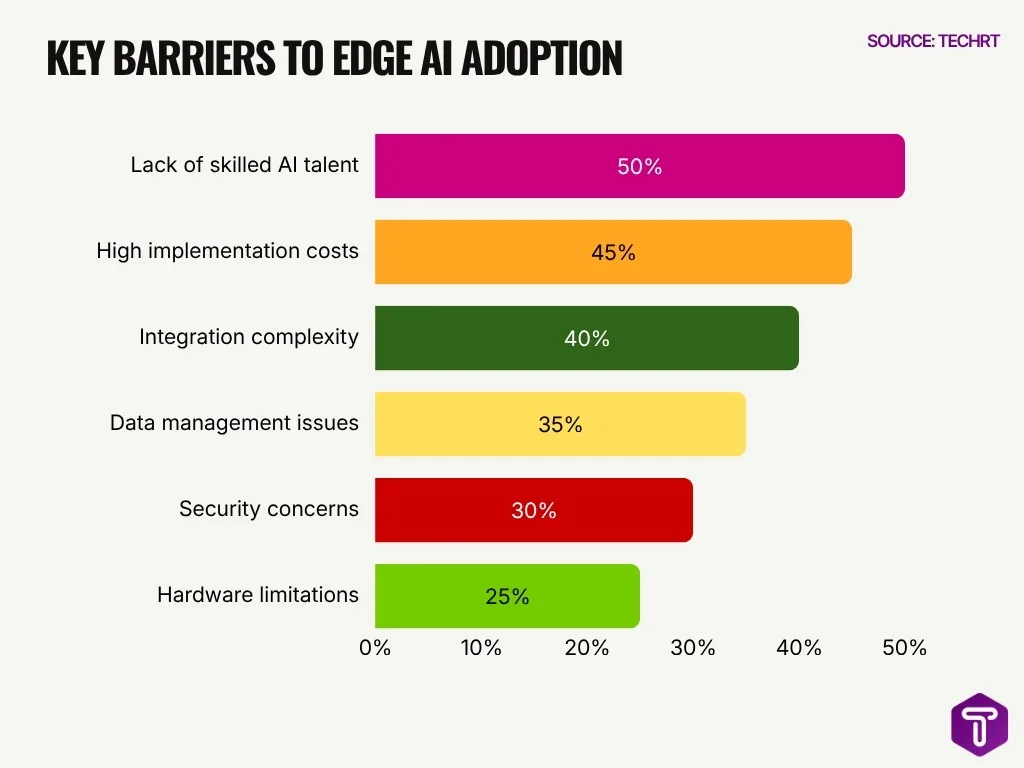
- 45% of organizations cite high implementation costs as a major barrier.
- Lack of skilled AI talent affects over 50% of enterprises globally.
- Integration complexity with existing systems remains a challenge for 40% of deployments.
- Data management issues impact 35% of edge AI projects.
- Security concerns still limit adoption for 30% of organizations.
- Hardware limitations, including processing power and battery life, affect 25% of edge deployments.
- Regulatory uncertainty slows adoption in certain regions.
- Scalability challenges arise when managing large networks of edge devices.
Edge AI Future Trends and Forecast Highlights Statistics
- By 2030, 75% of enterprise data will be processed at the edge, up from less than 20% in 2020.
- Edge AI market value is expected to surpass $100 billion by 2030.
- AI-enabled edge devices will exceed 10 billion units globally by 2030.
- Generative AI at the edge is expected to grow at 30%+ CAGR, driven by on-device inference.
- Autonomous systems powered by edge AI will expand across industries, including transportation and robotics.
- Energy-efficient AI models will reduce power consumption by up to 50% in next-gen devices.
- Edge AI will play a central role in Industry 4.0 and smart manufacturing ecosystems.
- Hybrid edge-cloud architectures will dominate, with over 80% of enterprises adopting them by 2030.
Frequently Asked Questions (FAQs)
What is the global Edge AI market size in 2026?
What is the expected CAGR of the Edge AI market?
How large will the Edge AI market be by 2033?
What share does hardware hold in the Edge AI market?
Which region dominates the Edge AI market?
Conclusion
Edge AI continues to move from experimentation to large-scale deployment across industries. The data shows consistent double-digit growth, expanding use cases, and increasing investment from both enterprises and governments. From reducing latency in autonomous vehicles to enabling real-time diagnostics in healthcare, Edge AI delivers measurable performance and cost benefits.
At the same time, challenges around talent, scalability, and infrastructure remain. However, ongoing advancements in AI chips, 5G connectivity, and hybrid architectures are steadily addressing these gaps. As organizations prioritize faster insights and stronger data privacy, Edge AI will remain a key pillar of digital transformation strategies in the years ahead.

Leave a comment
Have something to say about this article? Add your comment and start the discussion.