




Generative UI is transforming how digital products are designed, built, and experienced. Instead of relying on fixed layouts, modern interfaces now adapt in real time based on user behavior, preferences, and context. For example, e-commerce platforms dynamically adjust product displays to match shopper intent, while enterprise dashboards reorganize data views based on user roles and goals. This shift not only improves usability but also accelerates product development by reducing manual design and coding work.
At the same time, generative UI plays a growing role in personalization and automation across industries. Product teams use AI-driven interfaces to test multiple design variations instantly, while marketing teams rely on adaptive UI elements to improve engagement and conversions. As businesses push toward faster release cycles and more tailored experiences, generative UI sits at the center of this evolution. The statistics in this article highlight how rapidly this space is growing and where it is headed next.
Editor’s Choice
- 88% of organizations now use AI in at least one business function, reflecting widespread adoption that directly fuels Generative UI growth.
- Global generative AI market size reached $37.89 billion in 2025 and is projected to exceed $55.51 billion in 2026.
- Over 80% of enterprises will deploy generative AI APIs or applications by 2026, accelerating UI automation.
- Around 65% of design teams already use AI tools to accelerate interface creation and testing.
- Generative AI adoption reached 16.3% of the global population in 2025, highlighting growing user exposure to AI-driven interfaces.
- 86% of creators now use generative AI in their workflows, signaling deep integration into design ecosystems.
- Daily generative AI users range between 115 million and 180 million globally, driving demand for dynamic UI systems.
Recent Developments
- Runtime generative UI systems now adapt interfaces in real time using behavioral data and context-aware models.
- More than 75% of organizations actively use or explore AI, accelerating experimentation with dynamic UI layers.
- AI investment reached $33.9 billion in 2024, with continued growth in 2025 supporting UI innovation.
- Generative AI startups captured 48% of global VC funding in 2025, indicating strong backing for UI-related tools.
- Around 1 in 6 people globally now use AI tools, increasing expectations for adaptive interfaces.
- Generative UI frameworks are gaining traction, with some tools adopted by 10%+ of Fortune 500 companies.
- AI-driven design tools can now generate layouts, prototypes, and interactions automatically, reducing manual effort.
- Over 70% of developers report reduced time for routine coding tasks using generative AI, influencing UI development speed.
- Generative UI is increasingly tied to hyper-personalization trends, driven by real-time analytics and ML pipelines.
Key Generative UI Overview Statistics
- Generative UI shifts interfaces from static layouts to real-time adaptive systems based on user behavior.
- The AI software market reached $174.1 billion in 2025, up from $122 billion in 2024, supporting UI innovation.
- AI industry growth is projected at 37.3% CAGR through 2030, driven by generative technologies.
- Around 57% of users interact with generative AI tools monthly, indicating regular exposure to adaptive interfaces.
- Nearly 40% of users engage with generative AI weekly, reinforcing continuous UI interaction patterns.
- Generative AI tools are deeply embedded in software engineering workflows, improving design and testing phases.
- 18% of U.S. firms had adopted AI by the end of 2025, with rapid growth expected.
- Generative UI enables automated interface generation, reducing reliance on manual UI coding.
- Over 2 billion people globally have used AI tools, expanding the audience for generative interfaces.
Generative AI in Content Creation Market Growth Insights
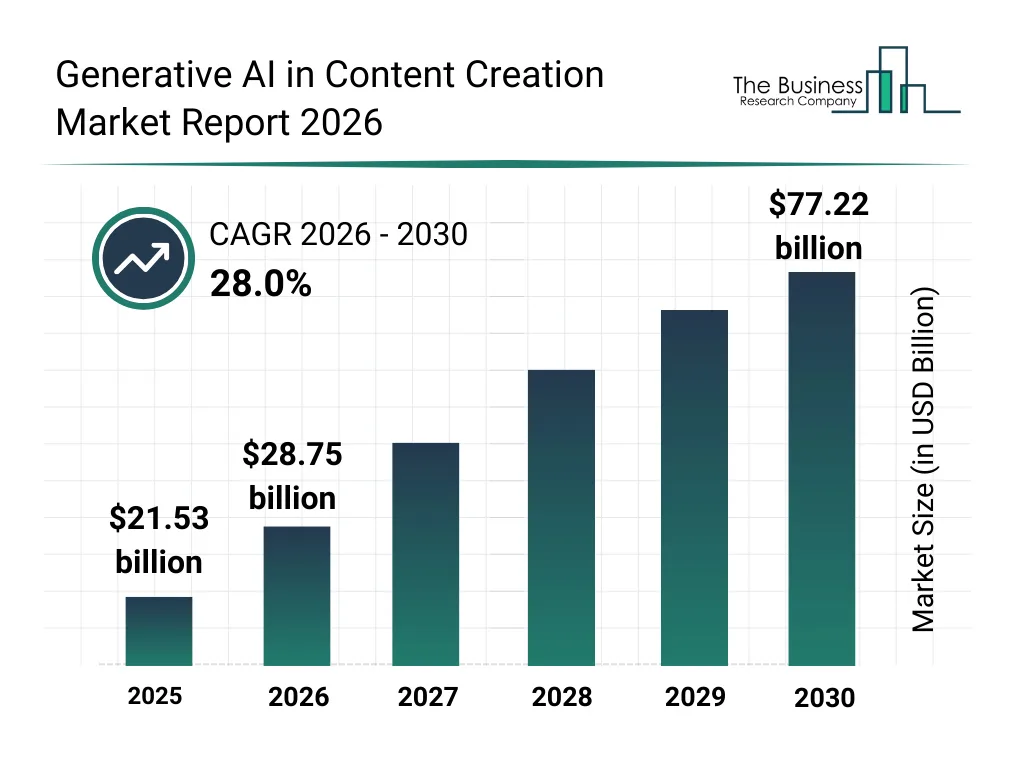
- The global generative AI content creation market is projected to grow from $21.53 billion in 2025 to $77.22 billion by 2030, showing massive expansion potential.
- The market is expected to register a strong CAGR of 28.0% between 2026 and 2030, highlighting rapid adoption across industries.
- In 2026, the market size is estimated at $28.75 billion, marking a significant year-over-year increase.
- By 2027, the market is projected to reach approximately $36.80 billion, driven by increased enterprise usage.
- The market is expected to climb further to around $47.10 billion in 2028, fueled by advancements in AI tools and platforms.
- In 2029, the market is anticipated to hit nearly $60.20 billion, reflecting widespread integration in content workflows.
- The industry is set to nearly triple in size within five years, growing by over $55 billion from 2025 to 2030.
- The consistent upward trajectory indicates accelerating demand for AI-powered content creation solutions across media, marketing, and enterprise sectors.
Generative UI Tools and Platforms Market Value
- The generative AI tools market continues to expand as part of the broader $174.1 billion AI software ecosystem in 2025.
- Over 100,000 developers actively use emerging generative UI frameworks globally.
- Some frameworks have achieved 22,000+ GitHub stars, indicating strong developer adoption.
- Enterprise adoption of generative UI platforms exceeds 10% of Fortune 500 companies.
- Over 300 teams use adaptive AI interface APIs for real-time UI generation.
- Generative AI tools save around 4 hours per week for marketers and designers.
- 86% of creators rely on generative tools, driving demand for UI-centric platforms.
- Private investment in generative AI reached $33.9 billion, supporting tool ecosystem growth.
- Generative AI startups saw 75% year-over-year funding growth, boosting platform innovation.
Generative UI Adoption Rates Among Organizations
- 88% of organizations use AI in at least one function as of 2025.
- Around 71% of organizations regularly use generative AI specifically.
- More than 75% of companies are using or exploring AI technologies.
- About 77% of companies are actively engaged with AI at some level.
- Nearly 80% of decision-makers have experimented with generative AI tools.
- Around 45% of companies are in testing or implementation phases for generative AI.
- 10% of organizations have fully integrated generative AI into operations.
- By 2026, 80%+ of enterprises are expected to deploy generative AI solutions.
- AI adoption among U.S. firms reached 18% in 2025, with rapid growth trends.
Generative UI Adoption in UX and Product Teams
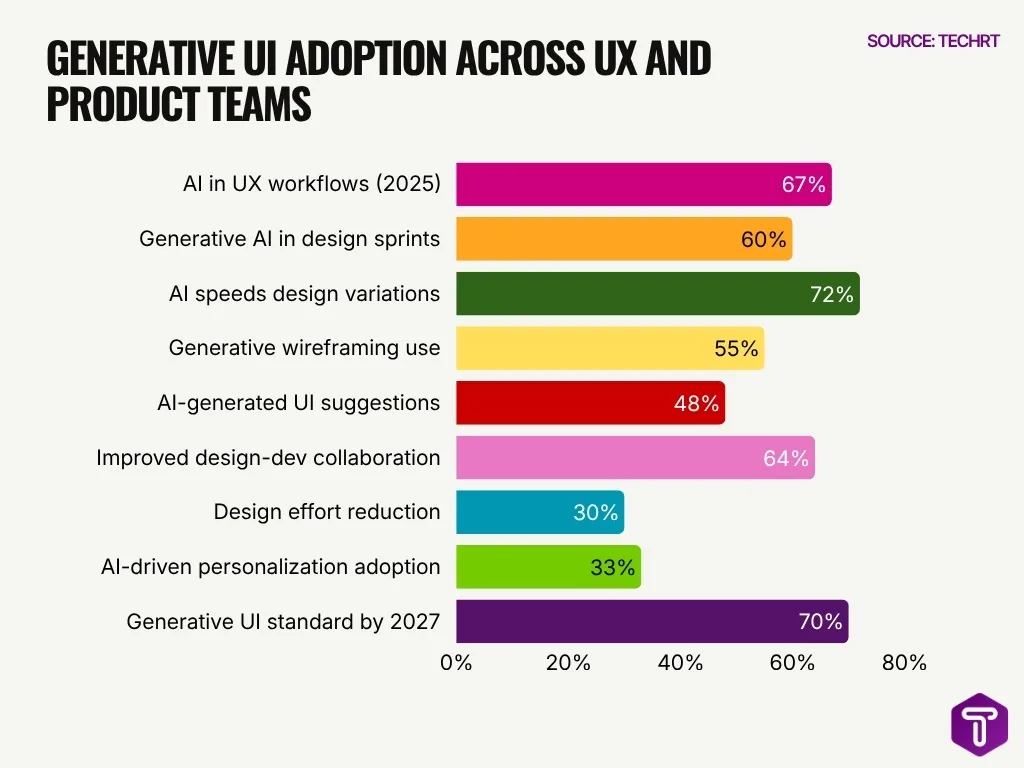
- Around 67% of UX designers reported using AI tools in their workflow in 2025, up from 52% in 2024.
- Nearly 60% of product teams now integrate generative AI into design sprints and prototyping cycles.
- About 72% of UX professionals say AI helps them generate design variations faster.
- 55% of designers use generative tools for wireframing and layout generation.
- Close to 48% of product managers rely on AI-generated UI suggestions during roadmap planning.
- Around 64% of teams report improved collaboration between designers and developers due to AI-assisted UI generation.
- Generative UI tools reduce manual design effort by up to 30% in early-stage ideation.
- Approximately 1 in 3 UX teams have adopted AI-driven personalization features directly into interface design.
- 70% of UX leaders expect generative UI to become a standard workflow component by 2027.
Generative UI Impact on Design Workflow Speed
- Designers report up to 50% faster UI iteration cycles using generative tools.
- AI-assisted design reduces initial concept creation time by 35% on average.
- Around 68% of teams say generative UI tools accelerate brainstorming sessions.
- Prototyping speed improves by 45% when using AI-generated layouts.
- Designers complete repetitive UI tasks up to 60% faster with automation.
- Nearly 70% of developers report faster front-end coding with AI support.
- Teams using AI tools cut feedback cycles by 30%, improving iteration efficiency.
- Around 52% of companies reduced time-to-market for digital products using generative UI.
- Design teams handle 2x more projects annually after adopting AI-powered UI tools.
Generative UI Impact on Development Time and Costs
- Generative AI reduces software development time by 30% to 50% across teams.
- Organizations report 20% to 25% cost savings in UI development using AI tools.
- Around 65% of developers say AI reduces debugging and testing time.
- AI-assisted coding tools improve productivity by up to 55%.
- Companies using generative UI report shorter release cycles by 40%.
- Development teams reduce manual coding effort by 35% on average.
- Around 50% of IT leaders say AI lowers operational costs significantly.
- Generative UI tools reduce reliance on external design resources by up to 25%.
- Small businesses adopting AI report 15% to 20% budget efficiency gains.
Generative UI Adoption by Industry and Sector
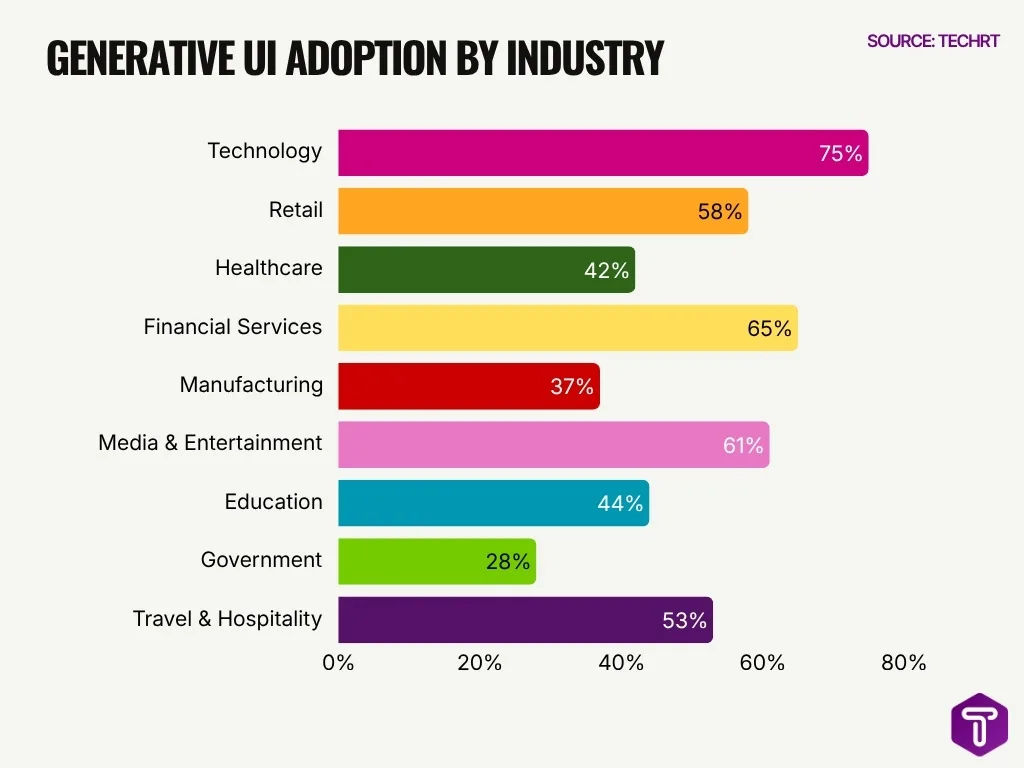
- The technology sector leads adoption, with over 75% of firms experimenting with generative UI.
- In retail, 58% of companies use AI-driven UI personalization to enhance shopping experiences.
- Healthcare adoption stands at 42%, mainly for patient-facing dashboards and portals.
- Financial services report 65% adoption of AI-driven UI for customer interactions.
- Manufacturing firms show 37% adoption, focusing on operational dashboards.
- Media and entertainment companies report 61% usage of generative UI for content personalization.
- Education sector adoption reached 44%, especially in adaptive learning platforms.
- Government agencies show 28% adoption, primarily in public service portals.
- Travel and hospitality industries use generative UI in 53% of customer interfaces, improving booking flows.
Generative UI Impact on Prototyping and Testing Cycles
- AI-powered tools reduce prototyping time by up to 70%.
- Around 62% of designers use AI for rapid prototype generation.
- Testing cycles are shortened by 30% to 40% with AI automation.
- Generative UI enables real-time A/B testing, improving iteration speed by 2x.
- 58% of teams report better usability testing outcomes using AI-generated variants.
- Automated UI testing tools reduce manual QA effort by 50%.
- Around 45% of companies use AI to simulate user interactions during testing.
- Prototyping tools powered by AI increase design accuracy by 28%.
- Teams deploying AI-driven testing reduce post-launch bugs by up to 35%.
Generative UI Effects on User Engagement and Retention Metrics
- AI-driven UI increases session duration by 20% to 40% on average.
- Personalized interfaces boost user retention rates by up to 30%.
- Around 68% of users engage more with platforms offering adaptive UI experiences.
- Dynamic UI elements improve click-through rates by 25%.
- Businesses report 15% higher repeat visits after implementing AI-driven UI.
- Real-time personalization increases in-app interactions by 35%.
- Around 50% of companies see improved customer loyalty with AI-powered UX.
- Adaptive UI reduces churn rates by 10% to 15%.
- AI-driven interfaces improve onboarding completion rates by 20%.
Inputs Powering a Generative UI Engine
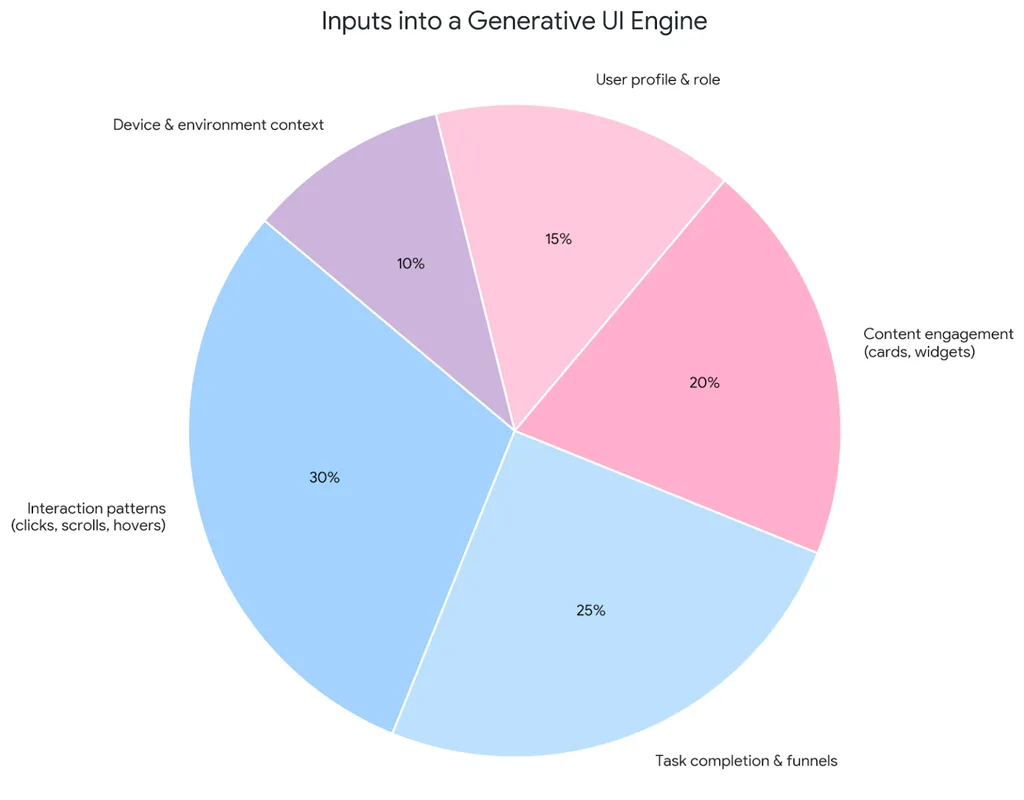
- Interaction patterns dominate with 30%, making them the most influential input, highlighting the critical role of user behavior signals like clicks, scrolls, and hovers.
- Task completion & funnels contribute 25%, showing that user intent and journey progression are central to how generative UI adapts experiences.
- Content engagement accounts for 20%, indicating that interaction with UI elements such as cards and widgets significantly shapes dynamic interface generation.
- User profile & role make up 15%, emphasizing the importance of personalization factors like user identity, preferences, and access levels.
- Device & environment context represent 10%, reflecting a smaller but still relevant role of technical and situational factors such as device type, screen size, and location.
- The top two factors, interaction patterns (30%) and task funnels (25%), together contribute a substantial 55%, underscoring that real-time behavior and intent outweigh static user data.
- Lower-weighted inputs like device context (10%) suggest that while optimization matters, behavioral and engagement data drive most UI decisions.
- Overall, the data shows a strong bias toward behavior-driven and intent-aware systems, which are essential for building adaptive and responsive generative interfaces.
Generative UI Effects on Conversion Rates and Revenue Metrics
- Companies using AI-driven personalization report conversion rate increases of 10% to 30%.
- Generative UI-driven product recommendations contribute up to 35% of total e-commerce revenue.
- Businesses adopting AI interfaces see average revenue growth of 15% compared to non-adopters.
- Dynamic UI personalization increases average order value by up to 20%.
- AI-powered UX improvements lead to 25% higher lead conversion rates in SaaS platforms.
- Around 63% of companies report measurable revenue gains from AI-driven UI enhancements.
- Real-time UI adaptation improves cart completion rates by 18% to 25%.
- Personalized landing pages driven by generative UI deliver up to 2x higher conversion rates.
- Businesses using AI-based UI report reduced customer acquisition costs by 10% to 20%.
Personalization and User Experience Outcomes with Generative UI
- 80% of consumers prefer personalized digital experiences powered by AI.
- Companies using AI personalization see 20% higher customer satisfaction scores.
- Around 65% of users expect adaptive interfaces tailored to their behavior.
- Generative UI increases user engagement by up to 35% through dynamic content delivery.
- Personalized UI experiences improve retention rates by 25% on average.
- Nearly 70% of businesses report improved UX metrics after adopting AI-driven personalization.
- Adaptive interfaces reduce bounce rates by 15% to 20%.
- AI-powered recommendations influence over 30% of user interactions in digital products.
- Around 55% of companies use generative UI for real-time personalization.
Productivity Gains for Designers and Developers Using Generative UI
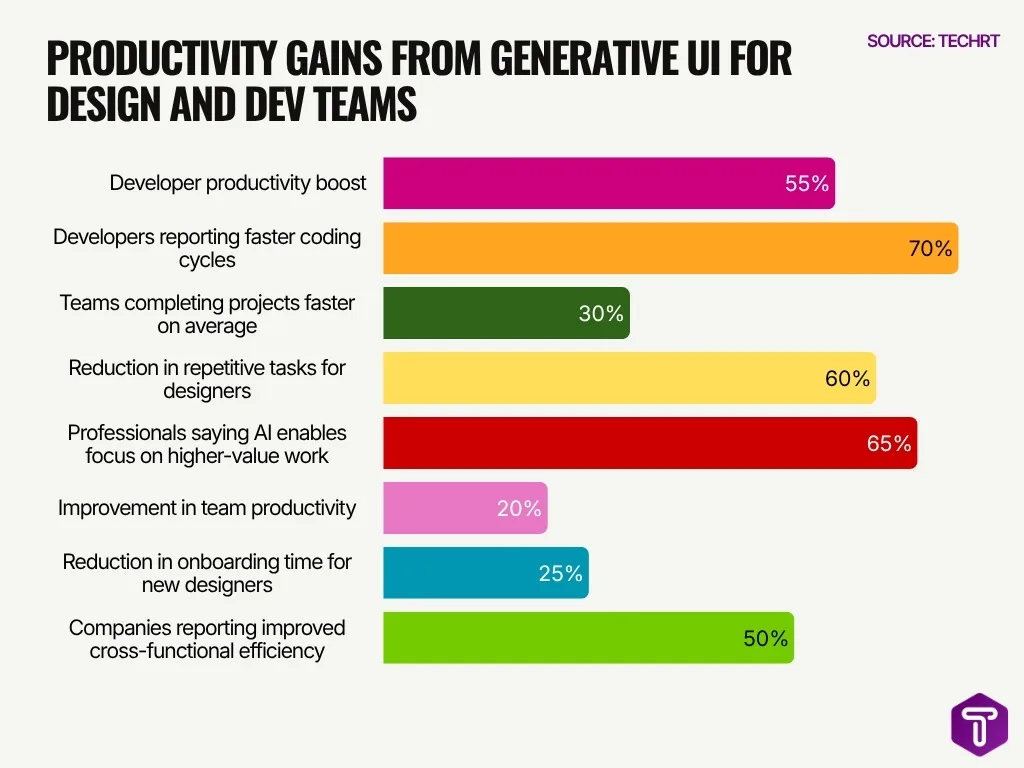
- Generative AI boosts developer productivity by up to 55%, especially in UI-related tasks.
- Designers save an average of 4 to 6 hours per week using AI-assisted tools.
- Around 70% of developers report faster coding cycles with AI support.
- Teams using generative UI tools complete projects 30% faster on average.
- AI-assisted design tools reduce repetitive tasks by 60%, improving efficiency.
- Approximately 65% of professionals say AI allows them to focus on higher-value creative work.
- Organizations report 20% improvement in team productivity after adopting AI-driven UI tools.
- Generative UI tools reduce onboarding time for new designers by up to 25%.
- Around 50% of companies report improved cross-functional efficiency between design and engineering teams.
Generative UI Integration with Generative AI and Large Language Models
- Over 80% of enterprises are expected to integrate generative AI APIs, including UI systems, by 2026.
- Large language models power over 60% of generative UI applications, enabling conversational interfaces.
- Around 72% of AI-driven applications now rely on LLMs for user interaction layers.
- Generative UI combined with LLMs improves user task completion rates by up to 40%.
- AI copilots integrated into UI workflows are used by over 50% of developers.
- Conversational UI adoption increased by 35% year-over-year due to LLM advancements.
- Around 45% of enterprises deploy chat-based UI powered by generative AI.
- LLM-powered UI reduces user friction by 30% in complex workflows.
- Generative UI platforms integrated with AI models improve accessibility and usability metrics by 25%.
Security, Privacy, and Compliance Statistics for Generative UI
- 61% of organizations worry about data security risks in AI-powered systems.
- Around 55% of companies have implemented AI governance frameworks to manage risks.
- 48% of enterprises report increased cybersecurity investments due to AI adoption.
- Generative AI-related data breaches increased by 18% in 2025, highlighting security gaps.
- Around 70% of organizations prioritize compliance with data protection laws when deploying AI.
- 43% of companies conduct regular AI audits to ensure compliance.
- Nearly 50% of enterprises face challenges aligning AI systems with GDPR and similar regulations.
- AI-driven UI systems require enhanced monitoring, with 65% of firms investing in real-time security tools.
- Around 38% of organizations report concerns about intellectual property risks in generative AI outputs.
Challenges, Risks, and Barriers to Generative UI Implementation
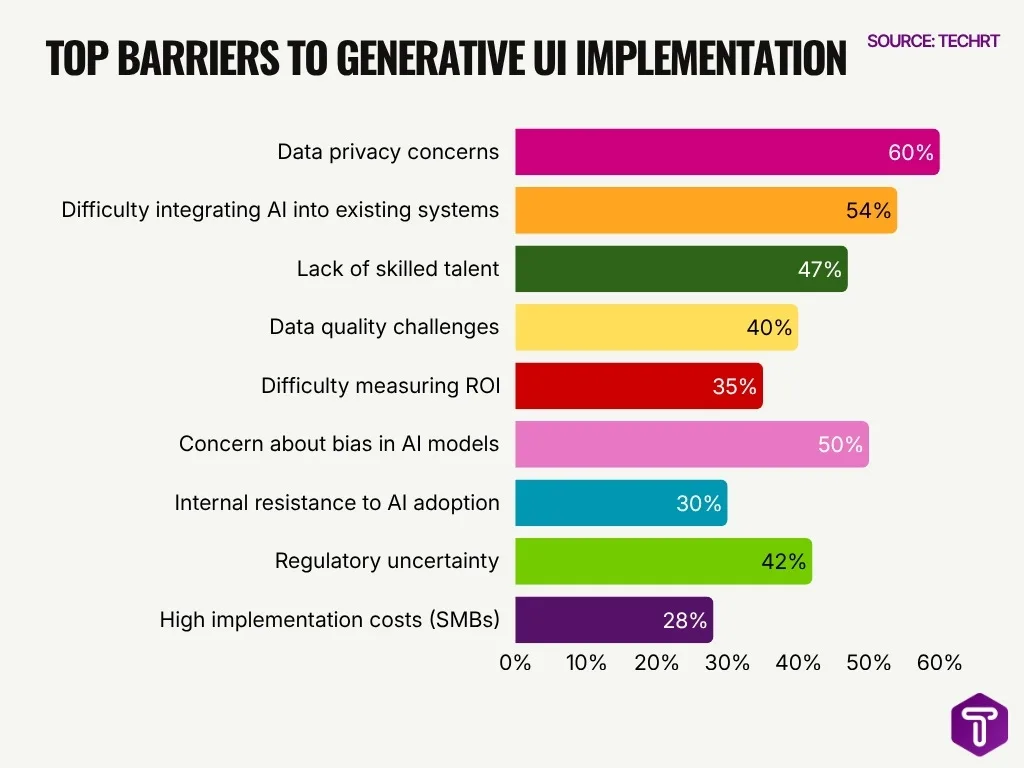
- 60% of organizations cite data privacy concerns as a major barrier to AI adoption.
- Around 54% of companies struggle with integrating AI into existing systems.
- 47% of executives report a lack of skilled talent as a key obstacle.
- Nearly 40% of businesses face challenges in ensuring data quality for AI systems.
- Around 35% of organizations report difficulty in measuring ROI from generative UI investments.
- Bias in AI models remains a concern for over 50% of companies.
- 30% of organizations experience resistance to AI adoption from internal teams.
- Regulatory uncertainty impacts 42% of enterprises implementing AI solutions.
- High implementation costs remain a barrier for 28% of small and mid-sized businesses.
Frequently Asked Questions (FAQs)
What percentage of SaaS platforms will have integrated generative UI features by 2025?
How much can generative UI improve user engagement rates?
What share of customer-facing applications use generative UI elements?
How much faster can teams design interfaces using generative UI tools?
What percentage of enterprises plan to adopt generative UI or AI-driven UX systems by 2026?
Conclusion
Generative UI is moving from experimentation to mainstream adoption, reshaping how digital products are built and experienced. The data shows clear gains in speed, efficiency, and personalization, while also highlighting measurable improvements in conversion rates and revenue. At the same time, organizations must address security, compliance, and implementation challenges to scale effectively. As AI models and UI systems continue to converge, businesses that invest early in adaptive interfaces will gain a strong competitive edge in delivering smarter, faster, and more engaging user experiences.

Leave a comment
Have something to say about this article? Add your comment and start the discussion.