




Physical AI blends artificial intelligence with machines that can sense, move, and act in the real world. Unlike traditional software-based AI, these systems interact directly with physical environments, making decisions in real time and executing tasks with precision. From warehouse robots optimizing fulfillment operations to surgical systems assisting doctors in complex procedures, physical AI is reshaping how industries operate and scale.
This technology is already driving measurable impact across sectors such as manufacturing, logistics, healthcare, and transportation. Companies use AI-powered robots to reduce operational costs, improve safety, and increase output, while healthcare providers rely on intelligent machines to enhance patient care and outcomes. At the same time, advancements in edge computing, robotics, and sensor technologies are accelerating adoption at a rapid pace.
As organizations seek efficiency and resilience, physical AI is emerging as a core driver of automation and innovation. The statistics in this report highlight how quickly this space is evolving, and why it is becoming central to the future of work and industry. Let’s explore the data behind this transformation and what it means for the years ahead.
Editor’s Choice
- The global physical AI market is projected to reach $15.24 billion by 2032, growing at a 47.2% CAGR from 2026.
- Another estimate values the broader physical AI ecosystem at $383 billion in 2026, with projections reaching $3.26 trillion by 2040.
- The market size stood at $81.64 billion in 2025 and may reach $960.38 billion by 2033.
- AI robotics markets are expected to grow from $6.11 billion in 2025 to $33.39 billion by 2030.
- Venture funding in robotics and physical AI hit $33 billion in 2025, marking a record year.
- Physical AI device shipments are expected to reach 145 million units by 2035.
- AI robotics markets are forecast to hit $200.19 billion by 2033, reflecting rapid enterprise adoption.
Recent Developments
- Venture investment in physical AI reached $26.7 billion by early 2026, signaling strong investor confidence.
- Robotics funding nearly doubled 2025 levels, even excluding large deals like Waymo’s $16 billion raise.
- A new wave of robotics models integrates vision, language, and motion control, enabling real-world adaptability.
- Over 10 million devices now run AI directly on physical hardware instead of relying on cloud processing.
- AI-powered offshore robots aim to replace vessels costing $100,000 per day, reducing operational expenses.
- Robotics-as-a-service models are gaining traction, offering subscription-based automation for enterprises.
- Tech firms are launching dedicated “physical AI” divisions to accelerate commercialization.
- New AI chips enable real-time decision-making on robots, with systems delivering 7.5x performance improvements.
- Warehouse automation is expected to dominate 50% of new facilities by 2030, driven by AI robotics.
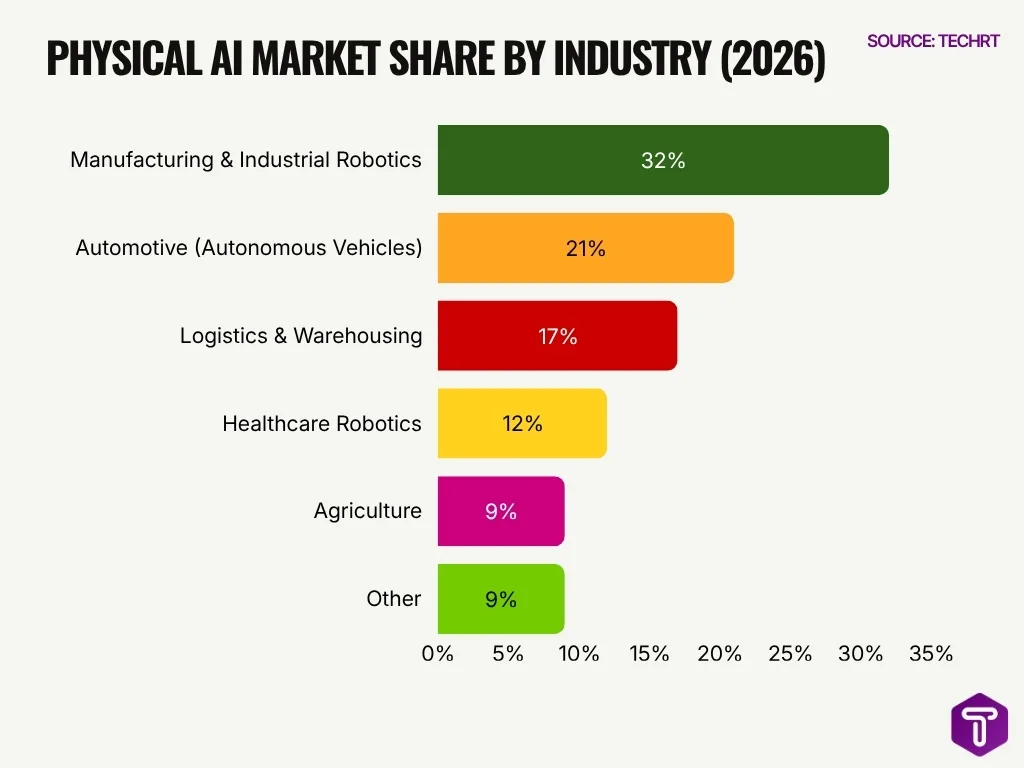
Physical AI Market Share by Industry
- Manufacturing & Industrial Robotics dominates the market with a leading 32% share, highlighting its central role in automation and smart factories.
- The Automotive (Autonomous Vehicles) segment holds a strong 21% share, driven by rapid advancements in self-driving technologies and AI-powered mobility systems.
- Logistics & Warehousing accounts for 17%, reflecting growing adoption of robotics for supply chain automation, order fulfillment, and inventory management.
- Healthcare Robotics contributes 12%, showcasing increasing use of AI in surgical robots, patient care, and medical automation.
- Agriculture captures 9%, indicating rising interest in precision farming, autonomous tractors, and AI-driven crop monitoring.
- The Other category also holds 9%, representing emerging applications of physical AI across retail, defense, and service robotics.
- Overall, the data highlights that the industrial and mobility sectors collectively dominate with over 50% share, emphasizing where physical AI investments are most concentrated.
- The distribution suggests a diversifying market, with significant growth potential in healthcare and agriculture as adoption accelerates.
Physical AI Market Size and Growth Projections
- The market is projected to grow from $1.50 billion in 2026 to $15.24 billion by 2032.
- Another forecast estimates growth from $5.13 billion in 2025 to $68.54 billion by 2034.
- CAGR estimates range between 31% and 47%, depending on segment definitions.
- Industrial automation alone is expected to reach $72.4 billion by 2034.
- AI robotics markets will expand at over 40% CAGR through 2030.
- The U.S. AI robot market is forecast to reach $38.9 billion by 2034.
- Global AI robotics revenue may exceed $101.63 billion by 2033.
- Robotics-as-a-service is growing at 30.8% CAGR between 2025 and 2030.
- Physical AI markets could expand 18x within a decade in some projections.
Embodied AI Market Size and Forecasts
- Embodied AI systems form a core segment of physical AI, enabling machines to interact with environments.
- The humanoid robotics market alone could reach $38 billion by 2035.
- Long-term projections suggest humanoid robots could evolve into a $5 trillion market by 2050.
- Embodied AI adoption is driven by advances in multimodal perception and reinforcement learning.
- Simulation-to-reality training pipelines are accelerating deployment in real-world settings.
- Industrial embodied AI systems reached $14.5 billion in 2025.
- Growth is fueled by labor shortages and the need for autonomous systems.
- AI-enabled robots are increasingly capable of adaptive and cognitive behaviors.
- Embodied AI systems are expanding beyond factories into homes and service industries.
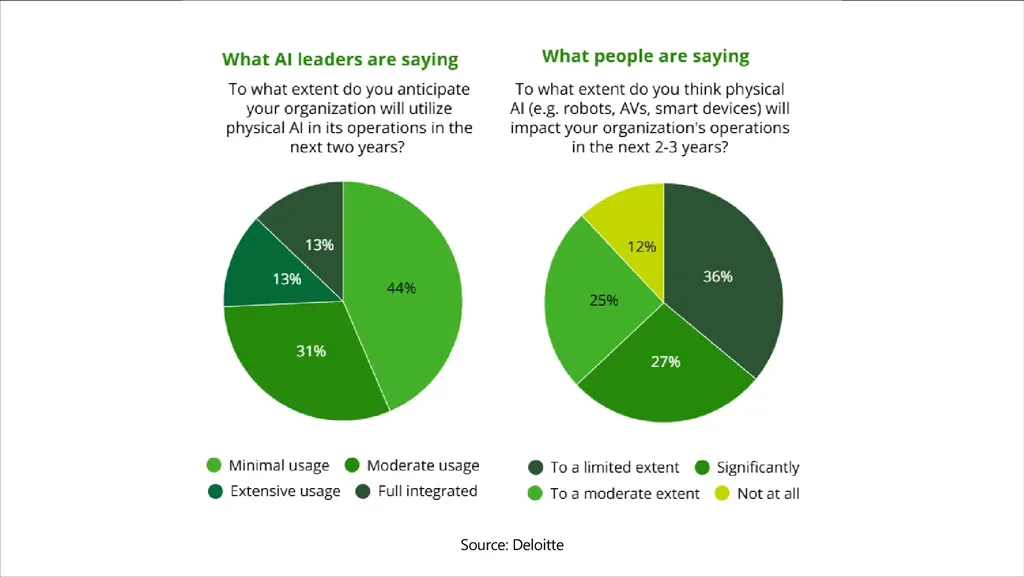
Physical AI Adoption and Expected Impact
- 44% of AI leaders expect only minimal usage of physical AI in the next 2 years, indicating a cautious early-stage adoption phase.
- A significant 31% anticipate moderate usage, suggesting gradual scaling rather than rapid deployment.
- Just 13% foresee extensive usage, highlighting that advanced implementation remains limited to a smaller segment.
- Only 13% expect full integration, showing that complete operational embedding of physical AI is still rare in the near term.
- On the impact side, 36% of respondents believe physical AI will affect operations to a limited extent, reflecting tempered expectations.
- Meanwhile, 27% expect a significant impact, signaling strong confidence among a notable portion of organizations.
- About 25% predict a moderate impact, reinforcing the trend of incremental transformation rather than disruption.
- A smaller 12% say “not at all,” indicating minimal skepticism but still some resistance to adoption.
- Overall, the data reveals a clear gap between adoption and perceived impact, where organizations expect measurable influence (52% moderate-to-significant impact) but are still progressing cautiously in actual deployment (only 26% extensive or fully integrated usage).
Industrial Robotics and Physical AI Deployment
- Global industrial robot installations reached 553,052 units in 2023, maintaining near-record levels into 2024.
- The operational stock of industrial robots surpassed 4.28 million units worldwide.
- The U.S. installed over 44,300 industrial robots in 2024, a 12% increase year over year.
- Automotive manufacturing accounts for over 25% of total robot deployments globally.
- Electronics manufacturing contributes nearly 23% of robot installations, driven by semiconductor demand.
- Collaborative robots (cobots) now represent 10%+ of total industrial robot sales, with strong growth in SMEs.
- AI-enabled robots reduce defect rates in production lines by up to 30%.
- Smart factories using physical AI report 20% to 25% efficiency gains in operations.
- China remains the largest robotics market, accounting for over 50% of global installations.
Service Robots and Humanoid Robots Growth
- Global service robot sales grew by 48% in 2023, with continued expansion in 2025.
- Over 158,000 professional service robots were sold globally in 2023.
- Cleaning robots account for nearly 50% of service robot deployments.
- The logistics robot segment is growing at a CAGR of over 35% through 2030.
- Humanoid robot shipments are expected to reach 1 million units annually by 2030.
- The humanoid robot market could generate $154 billion in annual revenue by 2035.
- Hospitality robots can reduce labor costs by up to 40% in hotels and restaurants.
- Delivery robots are projected to exceed a $3 billion market value by 2028.
- Healthcare service robots usage increased by over 30% post-2020, especially in eldercare.
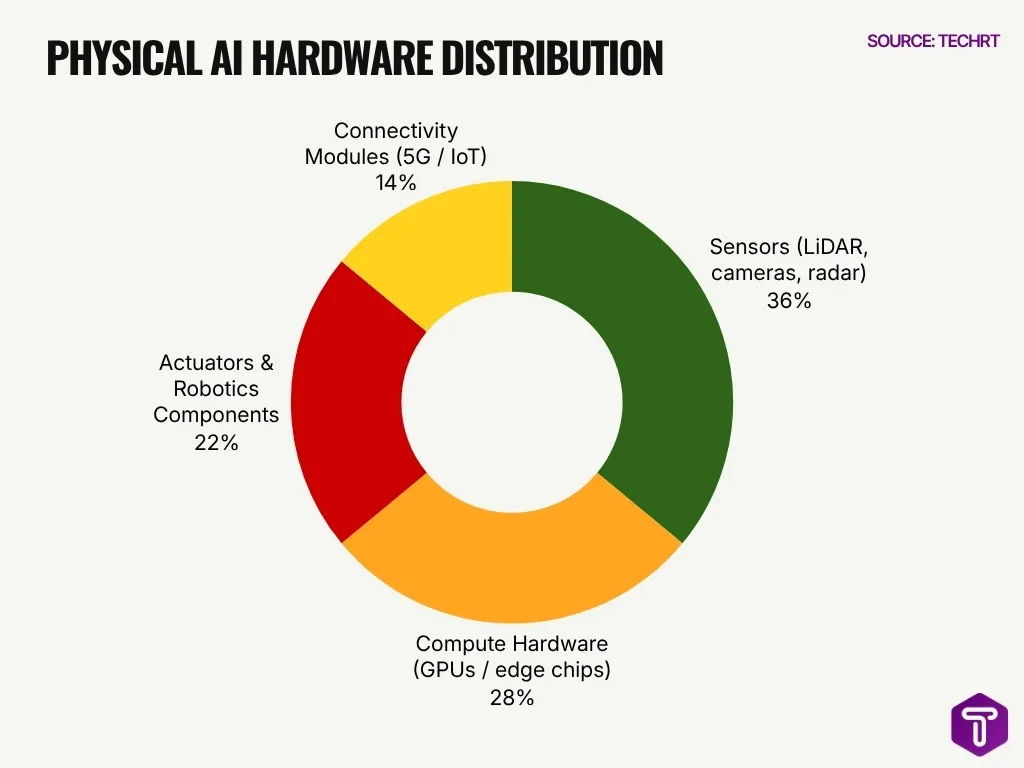
Physical AI Hardware Distribution
- Sensors dominate the market with 36% share, highlighting their critical role in enabling real-time perception and environmental awareness in physical AI systems.
- Compute hardware accounts for 28%, driven by rising demand for high-performance GPUs and edge AI chips to process complex data locally and reduce latency.
- Actuators & robotics components hold 22%, underscoring their importance in physical interaction, movement, and task execution in robotics and autonomous systems.
- Connectivity modules contribute 14%, reflecting the growing need for 5G and IoT integration to enable seamless communication between devices and cloud ecosystems.
- The distribution shows a clear prioritization of sensing and processing (64% combined), indicating that data acquisition and computation are the backbone of physical AI infrastructure.
- A lower share of connectivity suggests that while networking is essential, it remains a supporting layer compared to core hardware components.
- The balanced presence of actuators signals increasing investment in end-to-end automation, not just intelligence but also physical execution capabilities.
Physical AI Hardware, Software, and Services Breakdown
- Hardware accounts for over 60% of physical AI market revenue, including sensors and robotic systems.
- Software platforms, including AI models and control systems, represent around 25% of the market.
- Services, including integration and maintenance, contribute nearly 15% of total revenue.
- Edge AI chips are projected to grow at a CAGR of over 20% through 2030.
- Sensor markets for robotics are expected to reach $38 billion by 2032.
- Cloud-based robotics platforms are expanding rapidly, supporting real-time analytics.
- Software-defined robotics is enabling faster updates and adaptability in deployed systems.
- Integration services demand is rising as enterprises adopt hybrid AI infrastructures.
- AI middleware platforms are emerging to unify hardware and software ecosystems.
Physical AI Adoption by Region and Country
- Asia-Pacific dominates with 74% of global industrial robot installations in 2024.
- China installed 295,000 industrial robots in 2024, representing 54% of the worldwide total.
- South Korea boasts the highest robot density at 1,012 units per 10,000 manufacturing employees.
- Japan produces 45% of the world’s industrial robots.
- The U.S. installed 34,200 industrial robots in 2024, ranking second globally.
- Germany accounts for 32% of Europe’s total robot installations.
- India‘s industrial robotics market grows at a CAGR of 16.8% from 2025 to 2030.
- Europe saw 92,393 industrial robot installations in 2023, up 9% year-over-year.
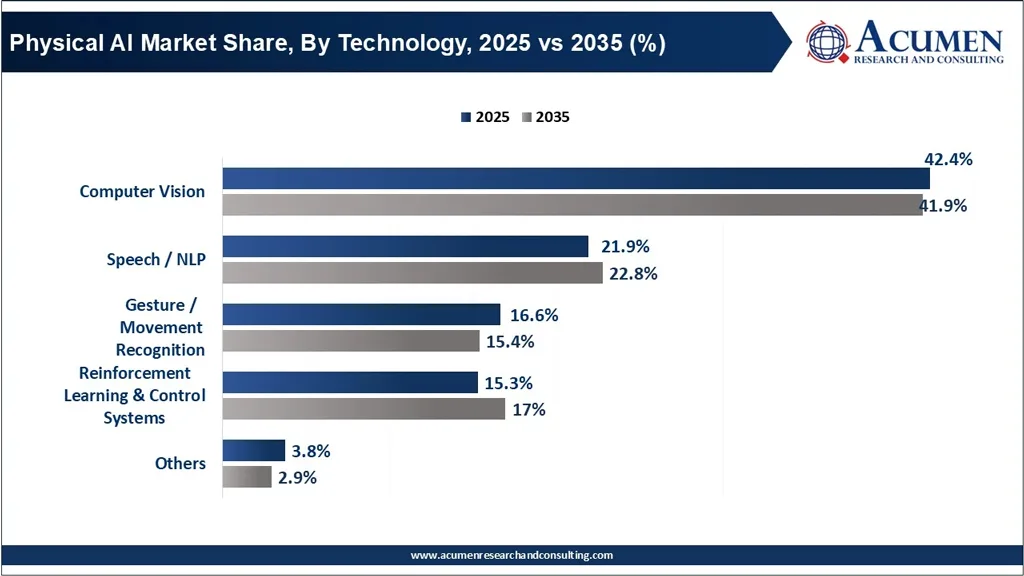
Physical AI Market Share by Technology (2025 vs 2035)
- Computer Vision dominates the market, holding the largest share at 42.4% in 2025, with a slight dip to 41.9% by 2035, indicating continued leadership but gradual diversification.
- Speech / NLP technologies are growing, increasing from 21.9% in 2025 to 22.8% in 2035, highlighting rising demand for human-machine interaction and conversational AI.
- Gesture / Movement Recognition shows a decline, dropping from 16.6% to 15.4%, suggesting slower growth compared to other AI modalities.
- Reinforcement Learning & Control Systems are gaining traction, rising from 15.3% in 2025 to 17.0% in 2035, reflecting increased adoption in autonomous systems and robotics control.
- The “Others” category shrinks from 3.8% to 2.9%, indicating market consolidation toward core, high-impact AI technologies.
- Overall, the market shows a shift toward intelligent control and communication capabilities, while vision-based AI remains foundational.
- The relatively stable shares across technologies suggest a maturing and balanced ecosystem, rather than disruptive shifts in dominance.
Investment and Funding in Physical AI and Robotics
- Global robotics and AI startup funding exceeded $33 billion in 2025.
- Venture capital investment in robotics grew by over 60% year over year in 2024.
- Autonomous vehicle companies accounted for nearly 40% of total robotics funding.
- The U.S. leads in robotics VC funding, capturing over 45% of global investments.
- China follows closely, supported by strong government-backed funds.
- AI hardware startups raised over $10 billion in 2025, driven by demand for edge computing chips.
- Robotics-as-a-service startups are attracting increasing capital due to subscription models.
- Corporate investments from major tech firms account for over 25% of total funding rounds.
- Defense-related robotics funding increased by 18% globally in 2024, reflecting geopolitical demand.
Cloud Versus On-Device Physical AI Adoption
- Over 60% of enterprises now use a hybrid approach combining cloud and edge AI.
- Edge AI deployments are growing at a CAGR of over 25% through 2030.
- On-device AI reduces latency by up to 70% compared to cloud-only systems.
- Cloud AI still dominates training workloads, handling over 80% of large-scale model training.
- Edge devices running AI exceeded 10 million units globally by 2025.
- Data privacy concerns drive over 45% of enterprises to adopt on-device AI solutions.
- Autonomous vehicles rely heavily on edge AI for real-time decision-making.
- Cloud robotics platforms enable centralized updates and coordination across fleets.
- Energy efficiency improves by 30% to 50% when processing is moved closer to the device.
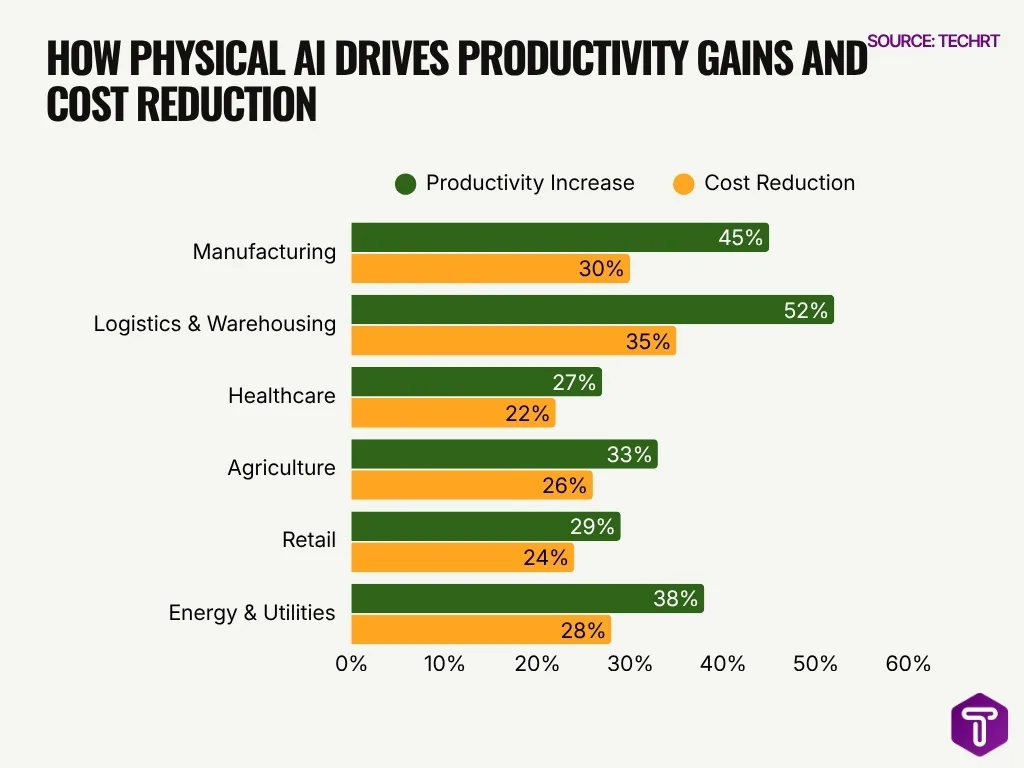
Physical AI Impact: Productivity Gains and Cost Reduction Across Industries
- Logistics & Warehousing leads with the highest efficiency gains, achieving a 52% productivity increase and 35% cost reduction, making it the top-performing sector.
- Manufacturing shows strong transformation, delivering a 45% productivity boost alongside 30% cost savings, driven by automation and robotics integration.
- The Energy & Utilities sector records solid gains, with 38% higher productivity and 28% reduced costs, highlighting the role of AI in optimizing infrastructure and operations.
- Agriculture benefits from precision technologies, achieving a 33% productivity increase and 26% cost reduction, improving yield and resource efficiency.
- Retail sector sees moderate improvements, with 29% productivity growth and 24% cost savings, largely due to automation in supply chains and customer operations.
- Healthcare shows comparatively lower but meaningful gains, with 27% productivity increase and 22% cost reduction, reflecting gradual adoption due to regulatory and operational complexities.
- Overall trend: Industries adopting Physical AI consistently achieve double-digit productivity improvements (27%–52%) and significant cost reductions (22%–35%), demonstrating strong ROI potential.
Physical AI Use Cases in Manufacturing and Logistics
- AI-powered robots can increase warehouse throughput by up to 3x.
- Autonomous mobile robots reduce labor costs in logistics by 20% to 40%.
- Smart factories achieve up to 50% reduction in machine downtime using predictive maintenance.
- Vision-based AI systems improve quality inspection accuracy to over 99%.
- Robotic fulfillment centers process millions of orders daily using AI automation.
- Digital twins in manufacturing reduce product development cycles by 30%.
- AI-driven route optimization cuts logistics fuel costs by 10% to 15%.
- Automated picking systems can handle over 1,000 items per hour per robot.
- Robotics adoption in warehouses is expected to reach 50% of operations by 2030.
Physical AI Use Cases in Healthcare and Eldercare
- The global surgical robotics market is projected to reach $18.4 billion by 2027, driven by AI-assisted procedures.
- Hospitals using robotic-assisted surgery report 21% fewer complications compared to traditional methods.
- AI-powered diagnostic robots can reduce diagnosis time by up to 30% in radiology workflows.
- Eldercare robots are expected to grow at a CAGR of over 25% through 2030, addressing aging populations.
- Japan deploys more than 5,000 care robots annually, supporting its aging society.
- Physical AI systems help reduce hospital labor costs by 15% to 20% through automation.
- Rehabilitation robots improve patient recovery rates by up to 40% in stroke therapy.
- AI-enabled monitoring systems reduce patient falls in hospitals by over 20%.
- Telepresence robots saw a 35% adoption increase post-2020, supporting remote care delivery.
Physical AI in Autonomous Vehicles and Drones
- AI in the self-driving cars market reached $5.5 billion in 2024, projected to hit $226 billion by 2034 at 45% CAGR.
- The global drone logistics market was valued at $1.9 billion in 2025, expected to reach $43.4 billion by 2034.
- Autonomous trucking will reduce freight costs per mile by 42%, saving the industry $85-125 billion annually.
- Delivery drones achieve up to 60% cost savings in the last mile compared to truck-only delivery in small regions.
- Level 4/5 autonomous vehicles are projected to comprise 15-20% of global sales by 2030.
- The AI drone technology market is forecasted to reach $84 billion by 2030 with 28.5% CAGR.
- Drone logistics market to grow by $29 billion from 2023 to 2028 at 27.77% CAGR.
- Physical AI revolutionizes autonomous vehicles by minimizing errors in high-stakes environments like trucking.
- Autonomous emergency braking reduces rear-end collisions by up to 50%, tackling 29% of U.S. crashes.
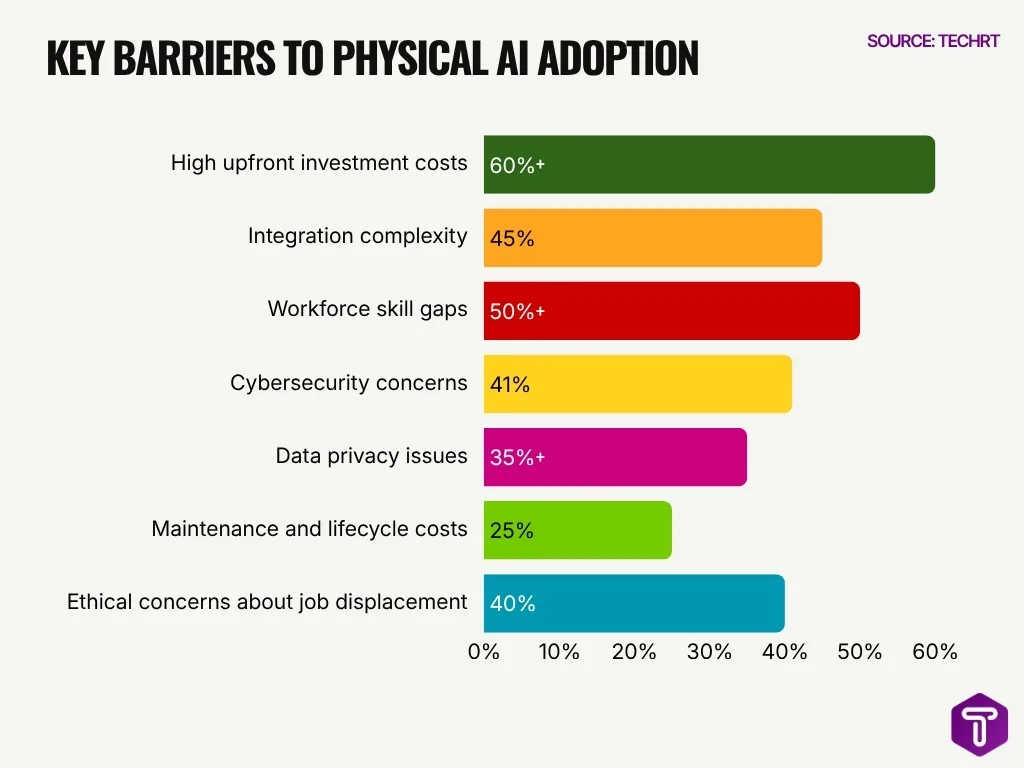
Physical AI Adoption Barriers and Challenges
- High initial investment costs remain a barrier for over 60% of small and mid-sized enterprises.
- Integration complexity affects 45% of organizations implementing robotics systems.
- Workforce skill gaps in AI and robotics impact over 50% of companies globally.
- Cybersecurity concerns influence 41% of enterprises adopting connected AI systems.
- Regulatory uncertainty slows adoption in sectors like healthcare and autonomous vehicles.
- Data privacy issues drive hesitation in over 35% of AI deployments.
- Maintenance and lifecycle costs can account for up to 25% of total system expenses.
- Ethical concerns around job displacement affect nearly 40% of the workforce sentiment.
- Interoperability issues between hardware and software platforms remain a key challenge.
Energy Efficiency and Operational Performance of Physical AI
- Edge AI systems reduce energy consumption by 30% to 50% compared to cloud-only processing.
- AI-driven energy optimization systems cut industrial energy use by up to 20%.
- Smart robotics can improve battery efficiency by 15% to 25% in mobile systems.
- Data centers supporting AI workloads account for 1% to 1.5% of global electricity use.
- Autonomous systems optimize route planning, reducing fuel consumption by 10% to 15%.
- AI-based process optimization improves equipment utilization rates by over 20%.
- Robotics systems reduce waste in manufacturing processes by up to 30%.
- AI-powered building automation reduces energy costs by 10% to 30%.
- Energy-efficient AI chips deliver up to 7x performance per watt improvements.
Frequently Asked Questions (FAQs)
What is the projected market size of physical AI by 2030?
What is the expected CAGR of the physical AI market?
How many industrial robots are currently deployed worldwide?
What percentage of new warehouses are expected to adopt physical AI automation?
How much funding is flowing into physical AI and robotics startups?
Conclusion
Physical AI is no longer a niche technology. It now drives measurable gains across industries, from faster warehouse operations to safer surgical procedures. The data shows consistent growth in adoption, investment, and performance outcomes, with productivity improvements often exceeding 20% and cost savings reaching double digits.
At the same time, barriers such as high upfront costs, talent shortages, and regulatory complexity continue to shape adoption timelines. However, advances in edge computing, robotics-as-a-service, and energy-efficient AI systems are steadily lowering these hurdles.
Looking ahead, physical AI will likely expand into everyday environments, including homes, hospitals, and cities. As organizations balance innovation with operational efficiency, the technology will play a central role in redefining how work gets done in the real world.

Leave a comment
Have something to say about this article? Add your comment and start the discussion.