



Quantum cryptography is rapidly transforming how organizations secure data as the world prepares for the impact of quantum computing. Traditional encryption methods, widely used in banking, healthcare, and government systems, face increasing risks from future quantum attacks. In response, industries are turning to quantum-safe solutions like quantum key distribution (QKD), which relies on the laws of physics rather than mathematical complexity to secure communications.
Real-world adoption is already underway. Financial institutions use quantum cryptography to protect high-value transactions and prevent data breaches, while governments invest heavily in quantum-secure networks to safeguard national security communications. Telecom providers are also integrating quantum encryption into next-generation infrastructure, including 5G and upcoming 6G networks. As cyber threats evolve and data privacy regulations tighten, quantum cryptography is becoming a strategic priority rather than an experimental technology.
This article explores the latest statistics, market trends, and regional insights shaping quantum cryptography, helping you understand where the industry stands today and where it is headed next.
Editor’s Choice
- The global quantum cryptography market reached $1.6 billion in 2025, with projections to hit $10.2 billion by 2031.
- The market was valued at $1.15 billion in 2024, showing rapid year-over-year expansion.
- Quantum cryptography is growing at a CAGR of over 35% between 2025 and 2031.
- The broader quantum communication market reached $1.36 billion in 2025, highlighting parallel growth.
- Governments accounted for about 57% of quantum communication spending in 2024, signaling strong public-sector demand.
- North America held over 36% market share in quantum communication in 2024.
- The quantum cryptography market is expected to exceed $4.6 billion by 2030, driven by cybersecurity concerns.
Recent Developments
- In 2025, satellite-based QKD projects expanded, enabling secure global communications via space infrastructure.
- European initiatives like EuroQCI accelerated cross-border quantum-secure networks in 2025.
- The adoption of 5G-integrated QKD solutions is increasing to secure telecom infrastructure.
- Governments worldwide increased funding for quantum cybersecurity due to the anticipated “Q-Day” threat scenario.
- Quantum-safe cryptography (PQC) markets are expanding alongside QKD, with 46% CAGR projected through 2030.
- Telecom providers are partnering with quantum startups to build secure fiber and satellite hybrid networks.
- Private-sector adoption is rising, especially in banking and healthcare data protection systems.
- Hardware innovations now support long-distance QKD transmission over fiber networks, improving scalability.
- Governments in the US and Europe increased investment in quantum-resistant encryption infrastructure in 2024 and 2025.
Quantum Cryptography Market Size Growth
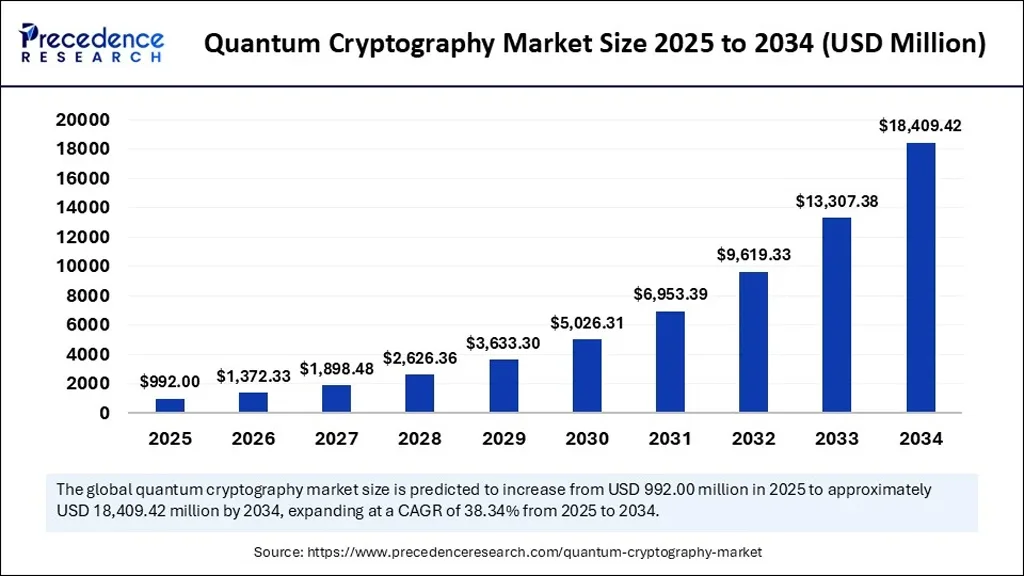
- The global quantum cryptography market is projected to grow from $992.00 million in 2025 to $18,409.42 million by 2034.
- The market is expected to expand at a strong CAGR of 38.34% between 2025 and 2034.
- In 2026, the market size is forecast to reach $1,372.33 million, showing early-stage acceleration in adoption.
- By 2030, the market is projected to cross $5,026.31 million, marking a major growth milestone.
- The market is expected to nearly double from $6,953.39 million in 2031 to $13,307.38 million in 2033.
- The sharp rise after 2030 suggests increasing demand for quantum-safe encryption, secure communications, and advanced cybersecurity infrastructure.
- Between 2025 and 2034, the market is projected to increase by approximately 18.6 times, highlighting rapid commercial expansion.
- The highest forecast value appears in 2034, when the market is expected to reach $18.41 billion.
Quantum Cryptography Market Growth Rate
- The market is growing at a 38.3% CAGR from 2024 to 2030.
- Some forecasts estimate a 35.7% CAGR from 2025 to 2031.
- Another report suggests a 36.8% CAGR through 2030, reflecting consistent acceleration.
- Historical growth (2019, 2024) averaged around 27.3% CAGR, indicating momentum.
- The QKD market alone is expanding at over 33.5% CAGR through 2030.
- Post-quantum cryptography shows even faster growth at 46.2% CAGR, complementing quantum cryptography.
- Space-based QKD is growing more slowly at ~16% CAGR, due to infrastructure constraints.
- Long-term projections show sustained growth of 22%, 25% annually through 2035 for quantum communication ecosystems.
Quantum Cryptography Market Forecast
- The market is projected to reach $4.6 billion by 2030 under moderate forecasts.
- Higher-growth scenarios estimate $7.59 billion by 2030.
- Some forecasts push the value to $10.2 billion by 2031, reflecting aggressive adoption.
- By 2032, the market could reach $7.9 billion, driven by enterprise adoption.
- Long-term projections estimate $3.73 billion to $15.6 billion by 2035, depending on adoption speed.
- The quantum communication ecosystem may reach $11, 15 billion by 2035.
- QKD alone could surpass $2.5 billion by 2030, reflecting its dominance.
- Emerging technologies like satellite QKD will expand the addressable market globally by 2030 and beyond.
Global Quantum Cryptography Market by Offering Type
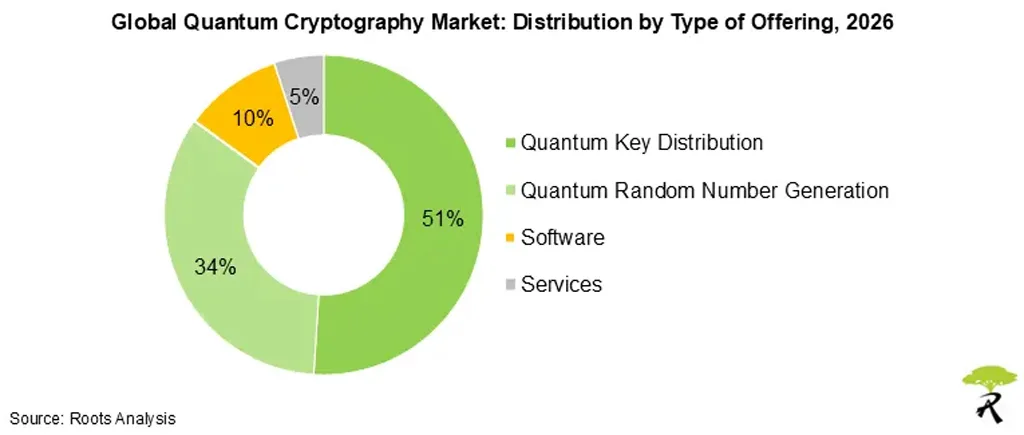
- Quantum Key Distribution (QKD) leads the global quantum cryptography market with a 51% share, making it the dominant offering type in 2026.
- Quantum Random Number Generation (QRNG) accounts for 34% of the market, showing strong demand for secure randomness in encryption systems.
- Together, QKD and QRNG represent 85% of the total market, highlighting that hardware-backed quantum security solutions dominate the sector.
- Software contributes 10% of the market, indicating a smaller but important role in managing, integrating, and supporting quantum cryptography deployments.
- Services hold the lowest share at 5%, suggesting that consulting, implementation, and maintenance services remain a relatively limited part of the market.
- The data shows that the market is heavily concentrated around core quantum security technologies, especially QKD, rather than service-led or software-only offerings.
Quantum Key Distribution Statistics
- The global QKD market reached $606 million in 2025, reflecting strong demand for secure communication systems.
- QKD adoption is expected to grow at a 33.5% CAGR through 2030, driven by rising cybersecurity risks.
- Over 70% of quantum cryptography deployments rely on QKD as the primary technology.
- China leads global QKD infrastructure with over 2,000 km of quantum-secured fiber networks already deployed.
- The US Department of Energy launched a quantum internet blueprint to expand QKD adoption across critical infrastructure.
- Satellite-based QKD networks achieved secure transmission over 1,200 km distances, marking a breakthrough in 2024 and 2025.
- Financial institutions account for nearly 28% of QKD use cases, focusing on transaction security.
- Telecom operators integrating QKD into fiber networks increased by over 40% between 2023 and 2025.
- Europe’s EuroQCI initiative aims to deploy pan-European QKD infrastructure by 2027, accelerating adoption.
Quantum Random Number Generator Statistics
- The quantum random number generator (QRNG) market reached $250 million in 2025, driven by demand for true randomness.
- QRNG adoption is growing at a 28% CAGR through 2030, particularly in cryptographic applications.
- Over 60% of hardware-based encryption systems now integrate QRNG for enhanced security.
- QRNG chips are being embedded into consumer devices like smartphones and IoT hardware, expanding use cases.
- Governments and defense sectors account for over 35% of QRNG demand globally.
- QRNG solutions can generate randomness at speeds exceeding 10 Gbps, improving encryption efficiency.
- In 2024, major cloud providers began integrating QRNG into secure key generation services.
- Asia Pacific leads QRNG adoption with over 38% market share, driven by semiconductor innovation.
- QRNG-based encryption reduces vulnerability to predictive attacks by nearly 100% compared to pseudo-random systems.
Quantum Cryptography by Application
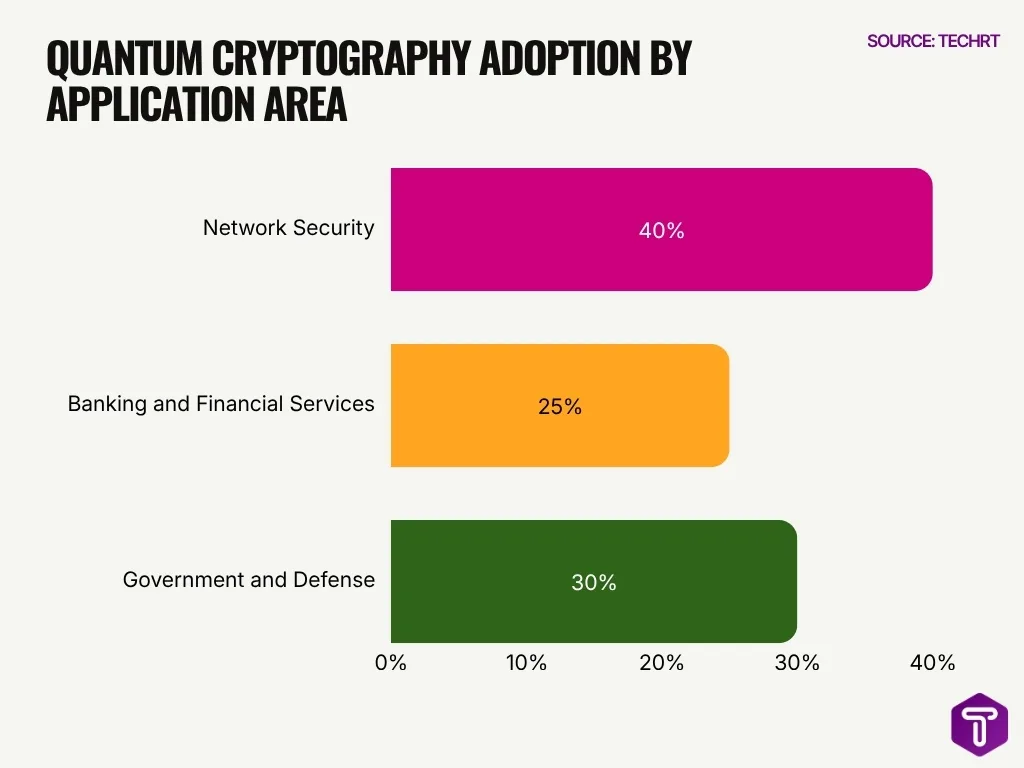
- Network security accounts for over 40% of quantum cryptography applications, leading to global adoption.
- Banking and financial services contribute over 25% of application demand, focusing on fraud prevention.
- Government and defense applications represent nearly 30% of total usage, driven by national security needs.
- Healthcare data protection adoption increased by 22% in 2025, due to stricter compliance requirements.
- Cloud security applications using quantum encryption grew by 27% year-over-year in 2024.
- Secure communication networks account for over 35% of QKD-based deployments.
- Critical infrastructure sectors, including energy and utilities, increased adoption by 19% in 2025.
- Quantum cryptography in IoT security is projected to grow at over 30% CAGR through 2030.
- Enterprise adoption for data center encryption rose by 24% in 2024, reflecting rising cyber threats.
Quantum Cryptography by Component
- Hardware accounts for nearly 89% of the total market share, dominating quantum cryptography deployments.
- Software solutions contribute around 11% of the market, mainly in encryption management platforms.
- Quantum-safe software adoption grew by over 32% in 2024, reflecting enterprise demand.
- Network infrastructure components, including fiber and satellite systems, represent over 45% of hardware investments.
- QRNG and QKD devices combined make up more than 60% of hardware revenues.
- Cloud-based quantum encryption services saw 25% growth in adoption in 2025, especially among enterprises.
- Integration costs for hardware components decreased by 18% between 2023 and 2025, improving accessibility.
- Startups developing quantum encryption chips increased funding by over 50% in 2024, signaling innovation growth.
- Hybrid systems combining classical and quantum encryption now represent 30% of enterprise deployments.
Quantum Cryptography by End User
- Government agencies represent over 35% of total market demand, making them the largest end-user segment.
- The BFSI sector accounts for approximately 28% of adoption, focusing on secure transactions.
- Telecom companies contribute over 20% of demand, driven by secure network requirements.
- Healthcare organizations increased spending on quantum encryption by 18% in 2025.
- Defense organizations globally invested over $1 billion in quantum cybersecurity projects in 2024.
- IT and cloud service providers saw 26% growth in quantum encryption adoption in 2025.
- The energy and utilities sectors increased adoption by 15% year-over-year, focusing on infrastructure protection.
- Enterprises with sensitive intellectual property increased adoption by over 20% in 2024.
- Small and medium businesses’ adoption remains low at under 10%, due to high implementation costs.
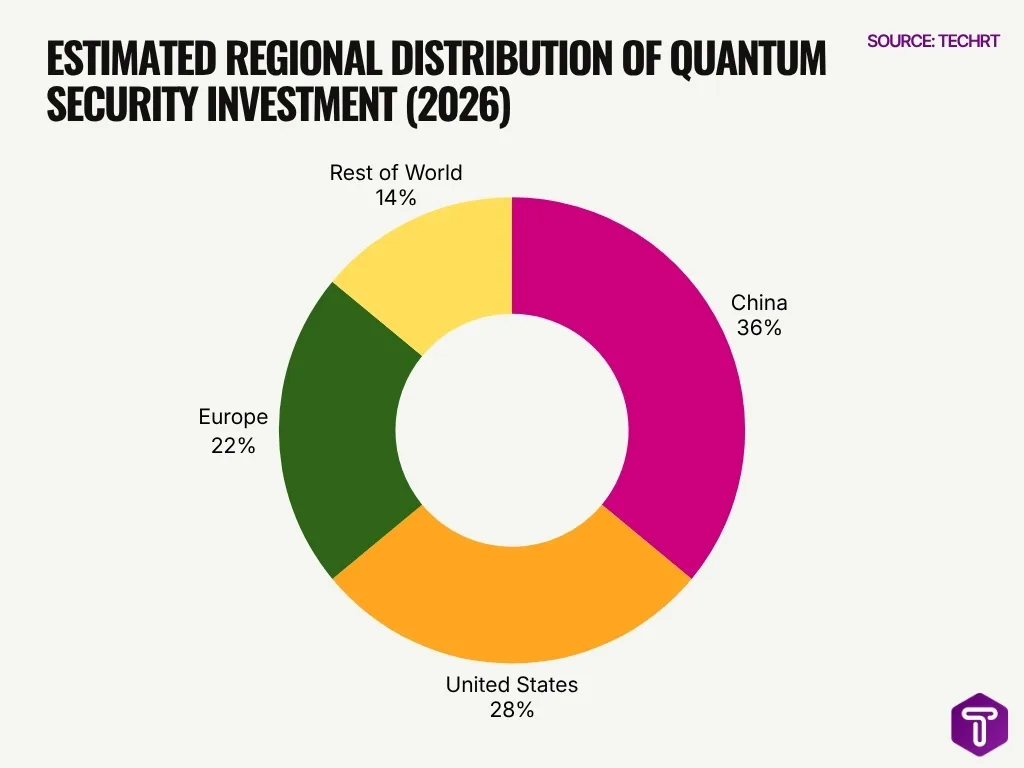
Estimated Regional Distribution of Quantum Security Investment
- China leads global quantum security investment with the highest share at 36%, showing its strong focus on quantum-safe infrastructure and cybersecurity innovation.
- The United States holds the second-largest share at 28%, reflecting continued investment in quantum security research, defense applications, and enterprise adoption.
- Europe accounts for 22% of total quantum security investment, supported by growing regional interest in data protection and post-quantum security readiness.
- The Rest of the World represents 14%, indicating that quantum security investment is still more concentrated in major technology-driven regions.
- Together, China, the United States, and Europe make up 86% of the estimated quantum security investment, showing that the market is heavily dominated by leading global economies.
- The gap between China (36%) and the United States (28%) is 8 percentage points, suggesting China has a notable lead in estimated investment share.
- The data highlights that quantum security investment in 2026 is expected to be regionally concentrated, with China emerging as the largest investor.
North America Quantum Cryptography Statistics
- North America generated over $260 million in revenue in 2024, leading global markets.
- The US accounts for more than 70% of the North American market share.
- Government funding for quantum technologies exceeded $3.7 billion cumulatively by 2025.
- The region hosts over 50% of global quantum startups, driving innovation.
- Telecom companies in the US increased QKD trials by over 45% between 2023 and 2025.
- Financial institutions in North America increased quantum encryption adoption by over 30% in 2024.
- The US National Quantum Initiative continues to fund long-term quantum communication infrastructure projects.
- Canada’s quantum sector is growing at over 25% annually, supported by public-private partnerships.
- Enterprise adoption in North America rose by 28% year-over-year in 2025, reflecting rising cybersecurity concerns.
Europe Quantum Cryptography Statistics
- Europe accounted for around 28% of the global quantum cryptography market in 2024, driven by public funding.
- The European Union committed over €1 billion to quantum technologies under its flagship initiatives.
- The EuroQCI project aims to deploy a secure quantum communication infrastructure across all EU member states by 2027.
- Germany, France, and the Netherlands lead regional adoption with over 60% of Europe’s quantum investments.
- The UK invested £2.5 billion in quantum technologies through 2033, including cryptography.
- Europe’s QKD deployments increased by over 35% between 2023 and 2025, reflecting telecom integration.
- Financial institutions in Europe increased quantum encryption spending by 22% in 2025.
- Cross-border quantum network trials in Europe expanded by over 40% in 2024, improving interoperability.
- The region’s quantum workforce grew by over 18% year-over-year, supporting innovation.
Asia Pacific Quantum Cryptography Statistics
- Asia Pacific is the fastest-growing region with a CAGR exceeding 40% through 2030.
- China leads the region, contributing over 60% of total quantum communication investments.
- China’s quantum network spans over 2,000 km, the largest in the world.
- Japan and South Korea increased investments by over 30% in 2024, focusing on telecom security.
- India’s quantum mission allocated $1 billion for quantum research, including cryptography.
- Asia Pacific holds over 38% share in QRNG adoption, driven by the semiconductor industries.
- Telecom operators in Asia increased QKD trials by over 50% between 2023 and 2025.
- The region saw 25% growth in enterprise quantum encryption adoption in 2025.
- Government-led projects account for over 55% of quantum cryptography spending in the Asia Pacific.
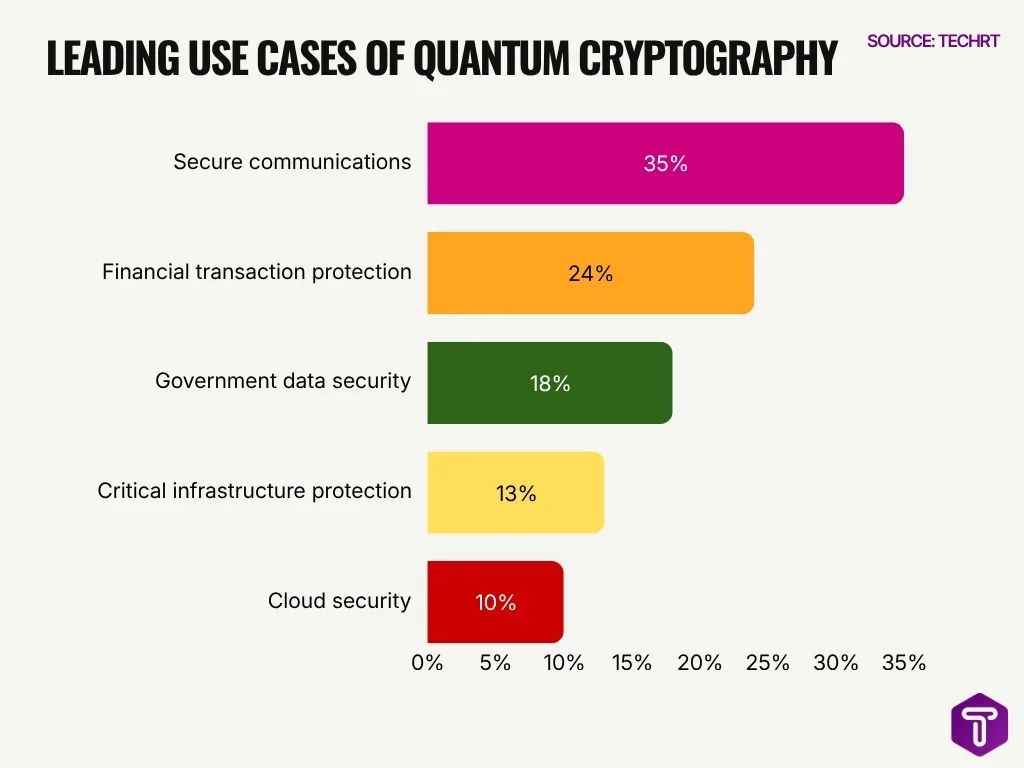
Quantum Cryptography Use Cases: Secure Communications Lead Adoption
- Secure communications is the leading use case for quantum cryptography, accounting for 35% of total adoption.
- Financial transaction protection ranks second with a 24% share, showing strong demand from banks, fintech firms, and payment networks.
- Government data security represents 18%, highlighting the growing use of quantum-safe technologies to protect sensitive national and public-sector data.
- Critical infrastructure protection holds a 13% share, reflecting its importance in securing energy grids, telecom networks, transport systems, and defense-related systems.
- Cloud security accounts for 10%, indicating rising interest in protecting cloud-based data and applications against future quantum-enabled cyber threats.
- Combined, secure communications and financial transaction protection make up 59% of total use cases, showing that communication privacy and financial security are the top priorities.
- The data suggests that quantum cryptography adoption is currently strongest in sectors where data confidentiality, transaction integrity, and long-term security are critical.
Quantum Cryptography Market Trends
- Rising cyber threats are driving over 30% annual growth in quantum-safe security adoption.
- Integration of QKD with 5G and 6G networks is accelerating telecom adoption.
- Hybrid encryption models combining classical and quantum methods now represent around 30% of deployments.
- Cloud providers are integrating quantum encryption, with over 25% adoption growth in 2025.
- Demand for quantum-safe solutions increased following growing concerns around “harvest now, decrypt later” attacks.
- Satellite-based QKD is emerging as a trend, enabling global secure communication networks.
- Financial services firms increased quantum security investments by over 28% in 2024.
- Governments are prioritizing post-quantum cryptography standards, with global regulatory frameworks evolving rapidly.
- Startups in quantum cybersecurity raised over $1.5 billion in funding in 2024, indicating strong investor interest.
Quantum Cryptography Market Opportunities
- The quantum cryptography market is projected to exceed $10 billion by 2031, creating major growth opportunities.
- Increasing digitization in banking creates opportunities, with over 70% of financial data requiring advanced encryption.
- The rollout of 6G networks will expand quantum encryption use cases, expected to grow at over 35% CAGR.
- Government funding programs globally exceeded $30 billion cumulatively for quantum technologies by 2025.
- Emerging markets in the Middle East are investing heavily, with double-digit growth rates expected through 2030.
- Integration with IoT security opens new markets, with over 75 billion connected devices projected by 2030.
- Cloud security services using quantum encryption are expected to grow by over 27% annually.
- Enterprise demand for data privacy solutions increased by over 25% in 2025, driving adoption.
- Partnerships between telecom and quantum startups increased by over 40% in 2024, accelerating commercialization.
Quantum Cryptography Market Challenges
- High implementation costs exceed $100,000 for enterprise QKD systems, with hardware like single qubits costing $10,000–$50,000 each.
- Global standards for quantum cryptography remain under development by NIST and ETSI, lacking full interoperability.
- QKD networks scale to just ~200–1,000 km without costly quantum repeaters, limiting broad deployment.
- Over 66% of quantum firms face talent shortages, with only 1 qualified candidate per 3 jobs available.
- Integration challenges with legacy systems affect most projects due to crypto-agility gaps and complexity.
- Hardware vulnerabilities in quantum devices enable side-channel attacks and info leaks, per recent studies.
- Regulatory uncertainty persists with 2030–2035 PQC migration deadlines and varying global frameworks.
- Infrastructure investments for QKD networks exceed $6.3 billion globally from 2025 to 2030 for operators.
- SME adoption lags with high costs being prohibitive, as hardware dominates 89.5% of the 2026 market spend.
Frequently Asked Questions (FAQs)
What is the global quantum cryptography market size in 2025?
What CAGR is expected for the quantum cryptography market through 2034?
How large will the quantum cryptography market be by 2030?
What is the projected size of the QKD (Quantum Key Distribution) market by 2030?
What share of the quantum cryptography market does North America hold?
Conclusion
Quantum cryptography is moving steadily from theoretical research into large-scale, real-world deployment. Industries that rely on secure data, such as finance, healthcare, defense, and telecommunications, are leading the adoption as they prepare for the long-term risks posed by quantum computing. The technology’s ability to provide tamper-proof, physics-based security positions it as a critical component of future cybersecurity strategies.
At the same time, the market continues to evolve. Strong investment from governments and private enterprises is accelerating innovation, while advancements in QKD, QRNG, and hybrid encryption models are improving scalability and practicality. However, challenges such as high implementation costs, limited infrastructure, and a shortage of skilled professionals still need to be addressed before widespread adoption becomes seamless.
Looking ahead, the growth of quantum computing, combined with increasing cyber threats, will continue to drive demand for quantum-safe encryption. Organizations that begin integrating these technologies today will gain a significant advantage in protecting sensitive data and maintaining trust in a rapidly changing digital landscape.

Leave a comment
Have something to say about this article? Add your comment and start the discussion.