




Startups continue to shape how industries evolve, from fintech platforms transforming traditional banking systems to AI-driven tools redefining enterprise workflows and productivity. In the US alone, startups play a critical role in driving innovation, attracting venture capital, and creating millions of new jobs each year. At the same time, global ecosystems are expanding rapidly, with emerging markets contributing a growing share of new ventures and investment opportunities.
Investors use startup data to identify high-growth sectors, while founders rely on it to benchmark performance, refine strategies, and secure funding. Policymakers also analyze these trends to support entrepreneurship and economic development. As capital flows shift and technologies like AI accelerate change, understanding the latest startup statistics becomes essential for making informed decisions. Let’s explore the key numbers shaping the startup landscape.
Editor’s Choice
- There are over 150 million startups globally, with more than 1.3 million in the United States alone.
- More than 1,500 unicorn startups exist worldwide as of 2025, reflecting rapid ecosystem expansion.
- Global unicorns are collectively valued at over $5 trillion, signaling massive private market value creation.
- Venture capital funding reached $91 billion in Q2 2025, showing recovery after a slowdown.
- The global startup failure rate stands at ~90%, highlighting high risk.
- The United States hosts over 800 unicorns, representing the largest share globally.
- In 2026, global VC funding surged to $300 billion in a single quarter, driven largely by AI investments.
Recent Developments
- AI-focused startups drove a record $300 billion in VC funding in Q1 2026, marking a historic high.
- Late-stage venture funds raised $23.6 billion in 2026, exceeding totals from previous years.
- In 2025, 191 new unicorns were created globally, up from 128 in 2024.
- Early-stage VC firms like Antler made 400+ investments in 2025, scaling toward 500 in 2026.
- AI startups dominate investor attention, with funding rounds often oversubscribed by 10x demand.
- Public markets are becoming a key funding source, with startups raising $5.3 billion via IPOs in FY25.
- Founder profiles are shifting, with unicorn founders averaging 13.8 years of experience in 2024, up from 8.2 years in 2010.
- Startup ecosystems now span 110+ countries and 1,400 cities, showing global diversification.
Startups by Country
- Israel boasts 740 tech startups per million people, ranking second globally.
- Singapore has 680 tech startups per 1M residents, third in startup density.
- Estonia leads with 1,020 tech startups per million people worldwide.
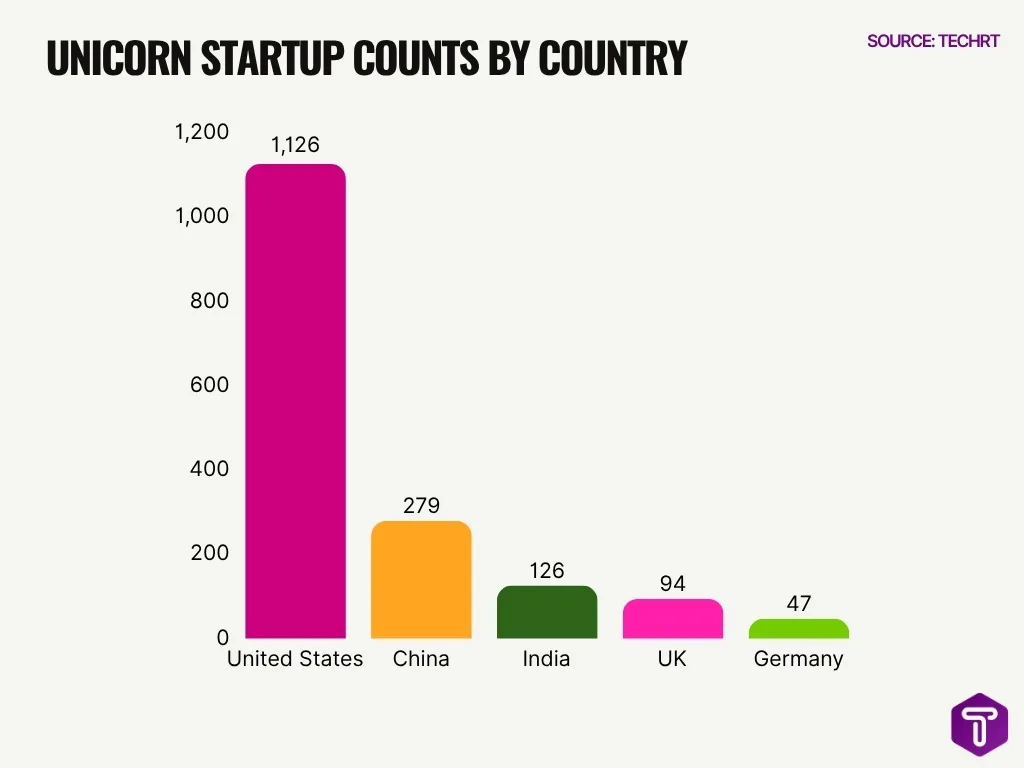
- The United States holds 1,126 unicorns, dominating the global count.
- China follows with 279 unicorns as of 2026, second in total unicorns.
- India ranks third with 126 unicorns, showing a strong emergence.
- North America captured 70% of global startup funding in H1 2025.
- US startups number over 118 million total active businesses.
- The UK secured 94 unicorns, fifth globally in unicorn startups.
- Germany recorded 47 unicorns, solidifying its European presence.
Global Number of Startups
- There are over 150 million startups worldwide, spanning all industries.
- The United States alone accounts for 1.31 million startups, the highest globally.
- Startup ecosystems operate across 1,400+ cities globally, reflecting widespread entrepreneurial activity.
- More than 110 countries actively support startup ecosystems, indicating global participation.
- The number of startups has grown significantly due to lower entry barriers from cloud computing and AI tools.
- Europe alone hosts tens of thousands of active startups, with strong growth in fintech and healthtech.
- India recorded 936+ startup funding deals in 2025, reflecting a high volume of new ventures.
- Global startup density continues to rise as remote work enables cross-border company formation.
New Startups Per Year
- Millions of new startups are launched annually, contributing to the 150M+ global total.
- In India alone, startups secured funding across 936 deals in 2025, indicating strong yearly creation.
- Early-stage investors are increasing deal volume, with firms targeting hundreds of investments per year.
- The number of new unicorns rose to 191 in 2025, showing increased scaling of startups.
- Startup formation continues to grow due to AI, SaaS, and fintech innovation cycles.
- Public market exits and IPOs encourage more founders to launch startups each year.
- Global accelerators and incubators now support thousands of startups annually, boosting creation rates.
- Startup creation is increasingly global, with emerging markets contributing a growing share of new ventures.
Highest Valued Startups
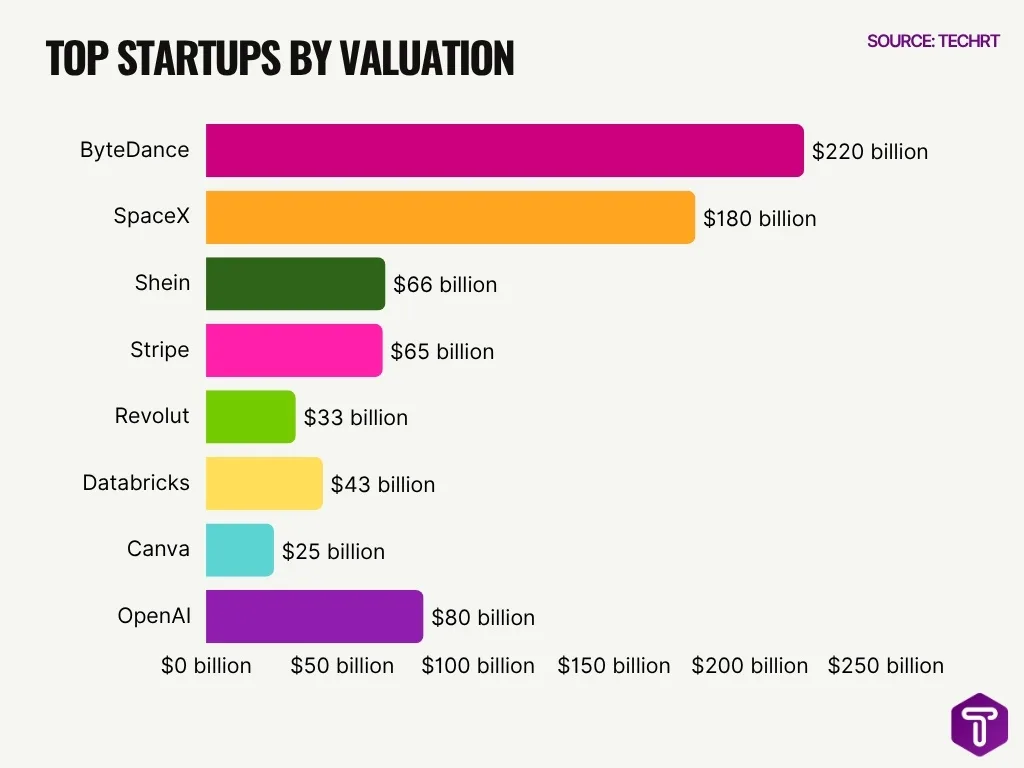
- ByteDance remains the world’s most valuable startup, with a valuation exceeding $220 billion.
- SpaceX is valued at around $180 billion, driven by satellite and launch services growth.
- OpenAI reached a valuation of $80+ billion in 2025, fueled by enterprise AI adoption.
- Stripe holds a valuation of approximately $65 billion, despite market fluctuations.
- Shein is valued near $66 billion, reflecting strong global consumer demand.
- Databricks surpassed a $43 billion valuation after recent funding rounds.
- Canva remains valued at $25+ billion, with millions of active users globally.
- Revolut reached a valuation of $33 billion, expanding across global markets.
- The top 10 startups collectively account for over $700 billion in valuation, showing concentration at the top.
Startup Ecosystem Value
- Global unicorn startups alone are valued at over $5 trillion, indicating a massive ecosystem worth.
- More than 1,200+ unicorns contribute significantly to the total startup valuation.
- Spain’s startup ecosystem reached €110 billion in value in 2025.
- The US startup ecosystem remains the most valuable, driven by high unicorn concentration and funding access.
- AI startups are rapidly increasing ecosystem value through large late-stage funding rounds.
- India’s ecosystem saw $11 billion+ in funding in 2025, boosting total valuation.
- Europe’s startup ecosystem continues to scale, with 100+ unicorns contributing billions in value.
- Global startup ecosystems now compete at scale, with top cities generating multi-billion-dollar exit values annually.
Unicorn Statistics
- There are 1,500+ unicorn startups globally as of 2025, a sharp rise from fewer than 500 in 2019.
- The United States accounts for over 50% of all unicorns, maintaining global dominance.
- China ranks second with 300+ unicorn startups, driven by fintech and AI sectors.
- India has produced 60+ unicorns, making it the third-largest ecosystem.
- In 2025 alone, 191 new unicorns were created globally, showing renewed investor confidence.
- The average time to become a unicorn has increased to 7–8 years, compared to 5–6 years a decade ago.
- AI startups represent a growing share, accounting for over 25% of new unicorns in 2025.
- Europe hosts 100+ unicorns, led by the UK, Germany, and France.
- More than 60% of unicorns operate in fintech, SaaS, or AI sectors, highlighting sector concentration.
Startup Failure Rates
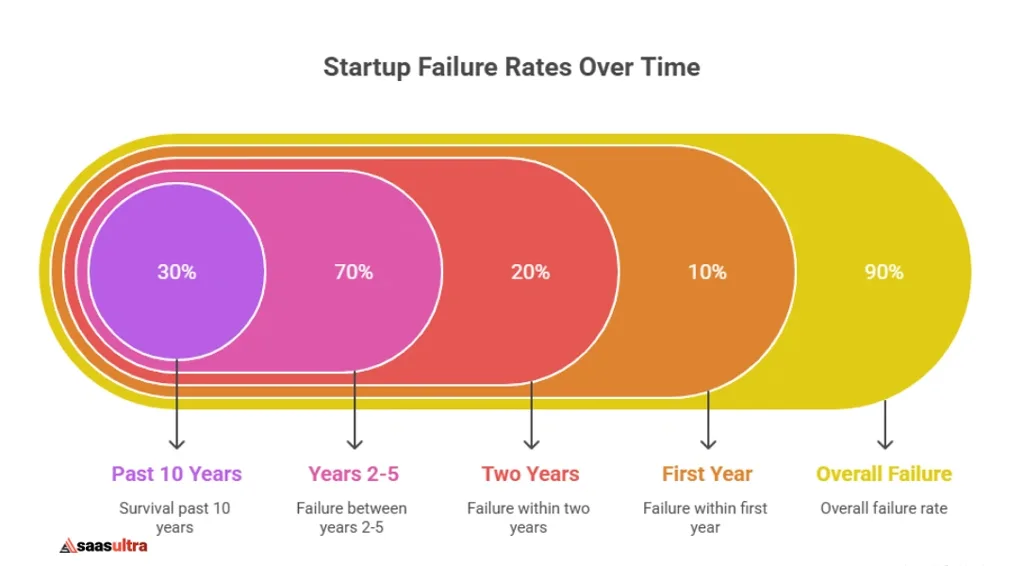
- 90% of startups fail overall, highlighting the extremely high-risk nature of new ventures.
- Only 30% of startups survive beyond 10 years, indicating long-term sustainability is rare.
- A significant 70% of startups fail between years 2–5, making this the most critical survival phase.
- Around 20% of startups shut down within the first 2 years, showing early-stage instability.
- Nearly 10% of startups fail within the first year, reflecting challenges in initial product-market fit and funding.
- The data suggests that while early failure is common, the highest risk window is scaling (years 2–5).
- Startups that survive beyond 5 years have a much higher chance of long-term success, compared to early-stage ventures.
- These trends emphasize the importance of strong business models, cash flow management, and market validation in the first few years.
Reasons Startups Fail
- The leading cause is a lack of market demand, cited in 42% of startup failures.
- Running out of cash contributes to 29% of failures, making funding management critical.
- Poor team structure is responsible for 23% of startup shutdowns.
- Strong competition accounts for 19% of failures, especially in saturated markets.
- Pricing and cost issues impact 18% of startups, affecting sustainability.
- Product-market mismatch leads to 17% of failures, despite strong technology.
- Lack of a clear business model contributes to 17% of startup failures.
- Regulatory and legal challenges affect 8% of startups, particularly in regulated sectors.
- Burnout and founder misalignment also contribute to qualitative failure factors.
Startup Success Rates
- Only 10% of startups succeed long term, reinforcing high-risk dynamics.
- Around 1% of startups become unicorns, highlighting the extreme rarity of success.
- Venture-backed startups have a higher success probability of 15–20%, compared to bootstrapped ones.
- Startups that pivot successfully increase survival chances by 30%.
- Companies with experienced founders show 2x higher success rates than first-time founders.
- Startups with strong early traction are 3.5x more likely to scale.
- SaaS startups report higher success rates due to recurring revenue models.
- Founders with prior industry experience improve success probability by 25–30%.
- Startups that secure Series A funding have a significantly higher survival rate, often above 70%.
Entrepreneur Funding Trends
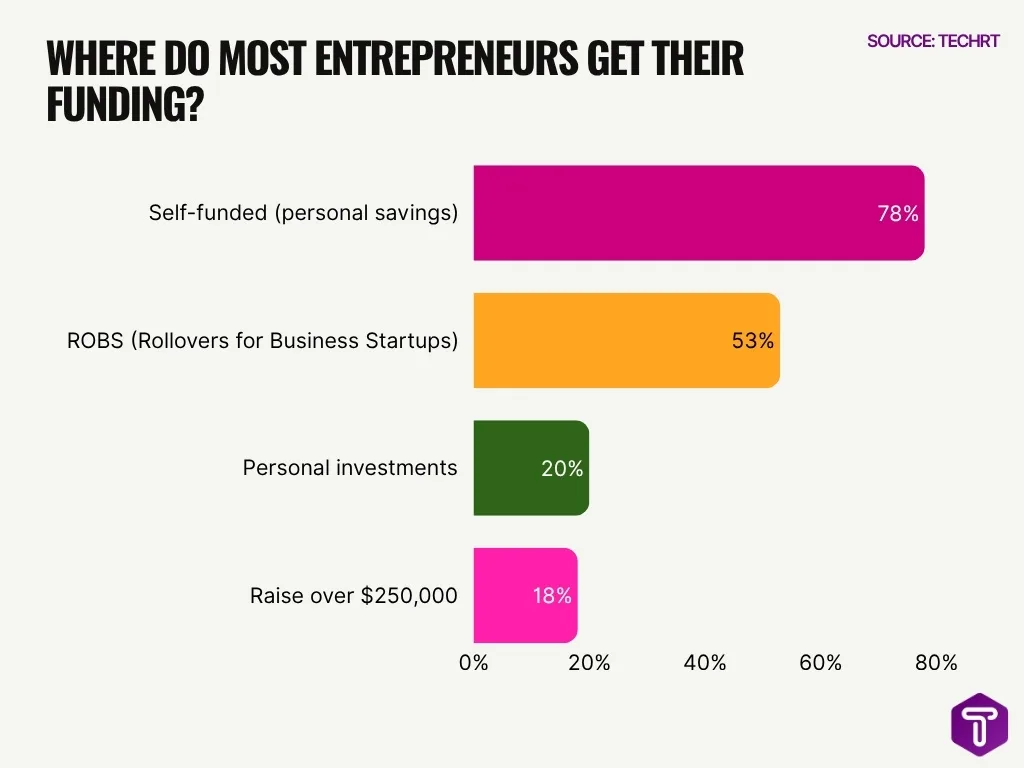
- Self-funding dominates startup financing, with a massive 78% of founders relying on personal savings, highlighting strong founder independence and limited early external access.
- A significant 53% of entrepreneurs use ROBS (Rollovers for Business Startups), indicating that many founders leverage retirement funds as a strategic funding source.
- Only 20% of founders rely on personal investments from others, showing that informal funding networks (friends/family) play a smaller but still relevant role.
- Just 18% of entrepreneurs raise over $250,000, emphasizing that large-scale funding is relatively rare in early-stage startups.
- The data clearly suggests that bootstrapping is the primary path, with most founders prioritizing control and ownership over external capital.
- There is a notable drop-off from self-funding (78%) to high-value fundraising (18%), highlighting the difficulty of securing substantial capital.
- Overall, early-stage entrepreneurship is heavily driven by personal financial risk, rather than institutional or venture-backed funding.
Average Funding Rounds
- The average seed funding round in the US reached $2.2 million in 2025.
- Series A rounds averaged $15–20 million globally.
- Late-stage rounds often exceed $100 million, especially in high-growth sectors.
- The median Series B funding round stood at $40 million in 2025.
- Startups require 2–3 funding rounds on average before profitability.
- Mega-rounds accounted for over 50% of total VC dollars.
- AI startups often secure larger-than-average early rounds.
- Funding timelines have extended to 18–24 months between rounds.
Bootstrapping Statistics
- Approximately 70% of startups begin as bootstrapped ventures.
- Around 38% of founders use personal cash as their primary funding source.
- About 30% reach break-even within 2 years.
- Founders retain full equity initially when bootstrapping.
- Nearly 50% of small businesses operate without external funding.
- Bootstrapped startups show higher early survival rates.
- SaaS companies are commonly bootstrapped due to lower costs.
- Emerging markets rely heavily on bootstrapped startup formation.
Venture Capital by Region
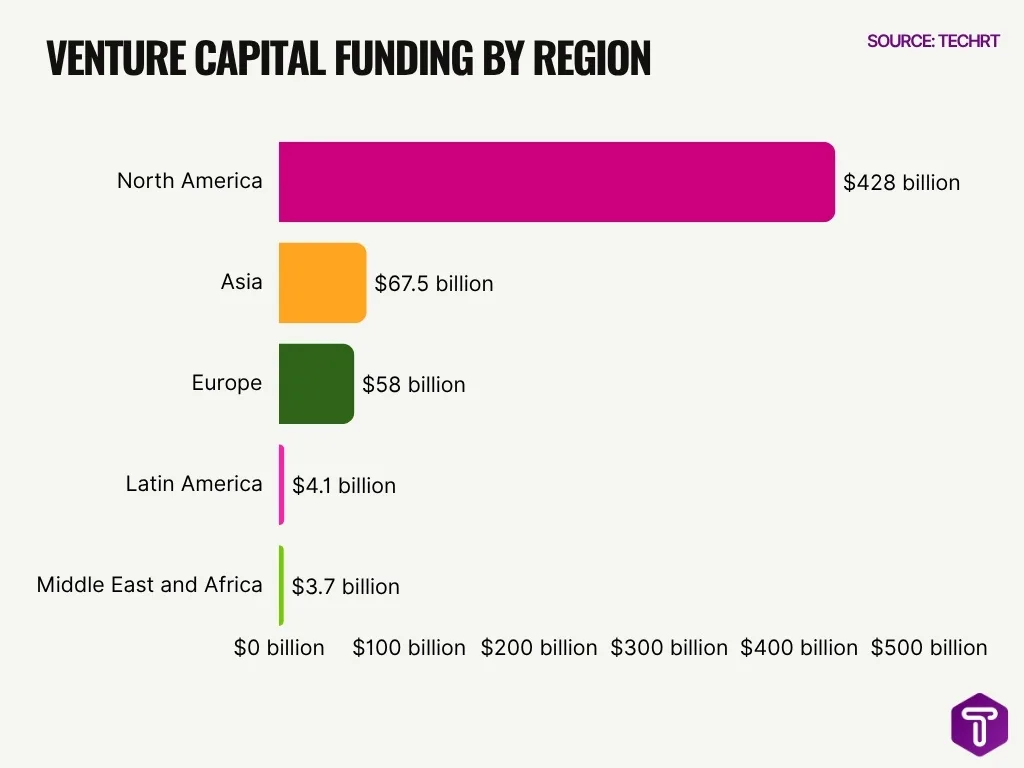
- North America captured 64% of global VC funding totaling around $428 billion in 2025.
- The United States alone secured $274 billion in VC investments, up from 56% global share in 2024.
- Asia received $67.5 billion in VC funding across Asia-based startups in 2025.
- Europe attracted $58 billion in venture funding, with the UK leading at $17 billion.
- India‘s VC investments reached $16 billion in 2025, driven by fintech and SaaS.
- Southeast Asia startups raised $5.37 billion in VC funding for the full year 2025.
- The Middle East and Africa VC market is valued at $3.69 billion in 2025, growing at 8.7% CAGR.
- Latin America saw VC funding rebound to $4.1 billion in 2025, up 14% year-over-year.
- Cross-border VC investments accounted for up to 75% of funds in regions like Germany.
Job Creation by Startups
- Startups create nearly 64% of new jobs in the US.
- New businesses generate 1.5 million jobs annually in the US.
- Scaleups contribute millions of jobs globally.
- Tech startups employ millions worldwide.
- Startups drive growth in major economic hubs.
- Remote startups expand global hiring opportunities.
- Early-stage startups employ 5–10 people.
- Hiring increases by up to 50% after funding rounds.
Gender in Startups
- Female founders receive only 2–3% of total venture capital funding globally.
- Startups with at least one female founder receive around 15% of VC funding.
- Women-led startups generate higher revenue per dollar invested.
- Only 15% of startup founders globally are women.
- Female participation is higher in specific sectors like healthtech.
- Women-owned businesses represent 42% of all businesses in the US.
- Diverse teams outperform by up to 25% in profitability.
- Gender diversity improves long-term performance outcomes.
Ages of Startup Founders
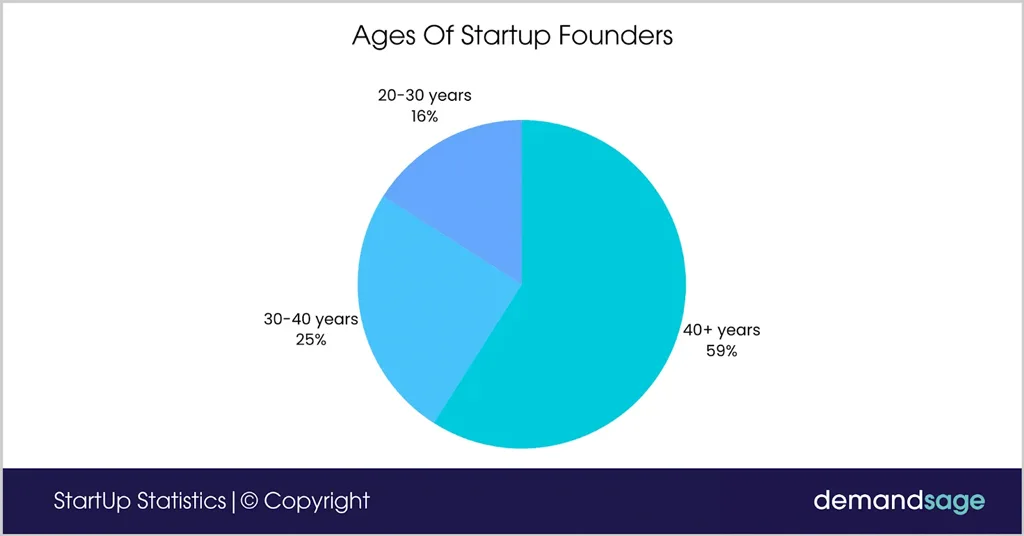
- The majority of startup founders are aged 40+ years, accounting for a dominant 59%, indicating that experience plays a crucial role in entrepreneurship.
- Founders in the 30–40 years age group make up 25%, representing a strong mid-career segment with growing industry expertise.
- Only 16% of founders fall within the 20–30 years bracket, showing that younger entrepreneurs are comparatively fewer.
- The data highlights a clear trend: older founders significantly outnumber younger ones, challenging the stereotype of startups being led primarily by young individuals.
- Combined, founders aged 30 and above represent 84% of all startup founders, emphasizing the importance of experience, skills, and professional networks.
- The relatively lower share of younger founders (16%) suggests potential barriers such as limited capital, experience, or access to resources.
- Overall, the distribution suggests that startup success is more common among seasoned professionals rather than early-career individuals.
Startup Costs
- Average startup costs hit $40,000 globally in 2025.
- Home-based businesses launch for under $3,100 on average.
- Tech startups need $125,000 median seed funding.
- 62% of startups fail due to cash flow issues.
- Founders allocate 28% of budgets to marketing.
- 80% of startups use cloud services to cut costs by 30%.
- 90% of failed startups mismanage burn rates.
- Lean startups boast 20% higher 5-year survival rates.
- Employee salaries consume 50-70% of early budgets.
- Product development costs average $100,000 for SaaS ventures.
Frequently Asked Questions (FAQs)
How many startups exist globally in 2026?
What percentage of startups fail globally?
How many unicorn startups are there worldwide?
How much venture capital funding did startups receive recently?
What share of global venture capital goes to AI startups?
Conclusion
Startup ecosystems reflect both opportunity and risk. While funding volumes and unicorn valuations continue to rise, especially in AI and fintech, failure rates remain high due to market misalignment and financial constraints. At the same time, trends like bootstrapping, diverse founder profiles, and global job creation show that innovation is no longer limited to a few regions or industries.
For founders, investors, and policymakers, these statistics highlight a clear takeaway: success depends not just on capital, but on timing, execution, and adaptability. As startup ecosystems evolve, staying informed with reliable data becomes a competitive advantage.

Leave a comment
Have something to say about this article? Add your comment and start the discussion.