




Sovereign cloud has evolved from a niche concept into a strategic priority for governments and enterprises that require full control over data, compliance, and infrastructure. Industries such as financial services rely on it to safeguard customer transactions within national borders, while public-sector agencies use it to manage sensitive systems tied to defense, healthcare, and citizen services. At the same time, global regulations and rising cybersecurity threats are pushing organizations to rethink how and where their data lives.
As a result, sovereign cloud is no longer optional; it is becoming a core part of modern cloud strategy. This article breaks down the latest statistics, trends, and market shifts shaping sovereign cloud.
Editor’s Choice
- The global sovereign cloud market reached $117.5 billion in 2025.
- It is expected to hit $143.2 billion in 2026, showing strong year-over-year growth.
- Market projections indicate a surge to over $648 billion by 2033.
- Another estimate places the 2026 market at $195.3 billion, highlighting rapid expansion across regions.
- Sovereign cloud IaaS spending will reach $80 billion in 2026, growing 35.6% year-over-year.
- North America holds approximately 44% of the global market share in 2026.
- Europe accounted for around 23% of the sovereign cloud market in 2025.
Recent Developments
- Microsoft expanded its sovereign cloud infrastructure to support thousands of servers in a single environment, enabling large-scale deployments.
- The European Commission awarded a €180 million sovereign cloud contract to regional providers to strengthen digital sovereignty.
- SAP introduced on-site sovereign cloud infrastructure, allowing organizations to host cloud services within their own facilities.
- Google Cloud expanded its sovereign solutions in India, targeting sectors such as banking and government.
- Enterprises increasingly adopt air-gapped cloud systems for sensitive workloads, particularly in defense and public services.
- Sovereign cloud is becoming central to AI deployment strategies, especially for regulated industries.
- Vendors now offer full-stack sovereign cloud solutions, including AI, infrastructure, and productivity tools.
- Governments increasingly partner with local cloud providers to reduce reliance on global hyperscalers.
- Demand for sovereign cloud surged after major outages and cybersecurity concerns in 2025, prompting resilience-focused strategies.
What is Sovereign Cloud?
- Sovereign cloud refers to cloud environments where data, infrastructure, and operations remain under a specific jurisdiction’s control, ensuring compliance with local laws.
- It ensures that sensitive data is stored and processed within national or regional boundaries, reducing exposure to foreign regulations.
- Sovereign cloud models often include data sovereignty, operational sovereignty, and technical sovereignty as core pillars.
- Around 55% of sovereign cloud demand in 2026 is driven specifically by data sovereignty requirements.
- Governments and regulated sectors such as healthcare and banking are the largest adopters due to strict compliance needs.
- Sovereign cloud environments often integrate air-gapped or isolated infrastructure for enhanced security.
- The concept goes beyond location, requiring legal, operational, and governance control over cloud systems.
- More than 40 countries accelerated data localization policies between 2022 and 2025, boosting sovereign cloud adoption.
- Enterprises increasingly treat sovereignty as a foundational cloud requirement rather than an optional feature.
Global Sovereign Cloud Market Size and Growth
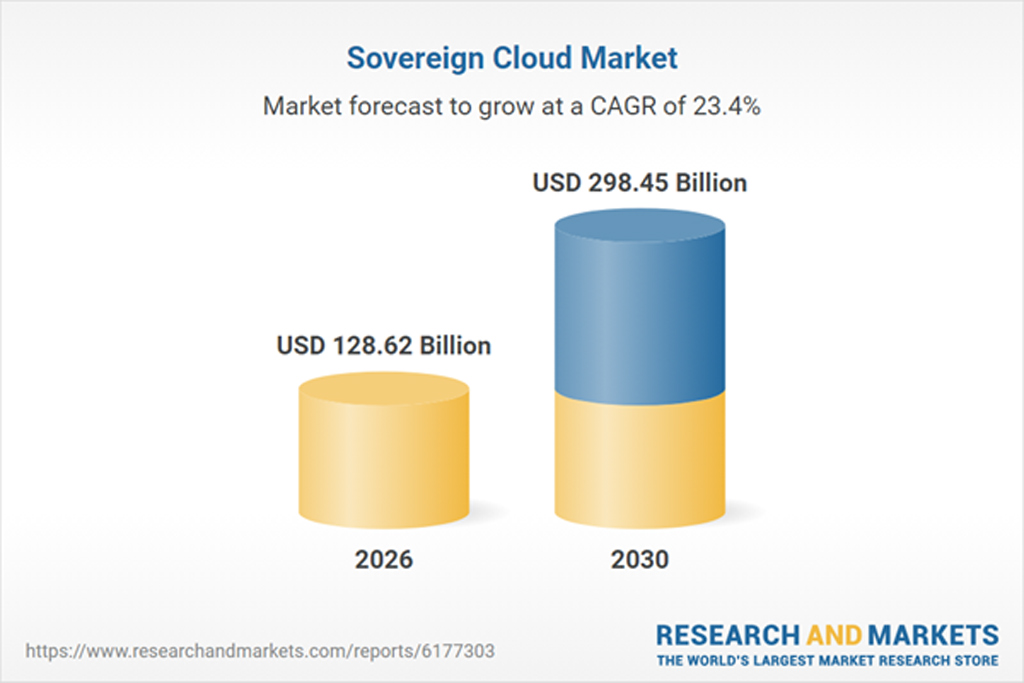
- The sovereign cloud market is projected to grow strongly from USD 128.62 billion in 2026 to USD 298.45 billion by 2030.
- This represents an increase of USD 169.83 billion over the forecast period.
- The market is expected to expand at a CAGR of 23.4%, showing rapid adoption of sovereign cloud solutions worldwide.
- Growth is being driven by rising demand for data sovereignty, cloud compliance, national data protection, and regulated cloud infrastructure.
- The forecast suggests that enterprises and governments are increasingly prioritizing local data control and jurisdiction-specific cloud services.
- By 2030, the sovereign cloud market is expected to be more than 2.3 times larger than its 2026 value.
Sovereign Cloud by Deployment Type
- Public sovereign cloud remains the dominant model, accounting for over 48% of deployments in 2025, as organizations seek scalable yet compliant solutions.
- Private sovereign cloud adoption grew to nearly 32% market share in 2026, driven by sectors requiring strict control over infrastructure.
- Hybrid sovereign cloud is the fastest-growing segment, expanding at a CAGR of over 28% through 2030.
- Around 62% of enterprises prefer hybrid sovereign cloud models to balance flexibility and compliance.
- Government agencies use private sovereign cloud in over 70% of sensitive workloads, especially in defense and intelligence.
- Public sovereign cloud adoption increased by 21% year-over-year in 2025, reflecting growing trust in regulated hyperscaler offerings.
- Edge-based sovereign cloud deployments rose by 18% in 2026, particularly for real-time data processing.
- Multi-cloud sovereign strategies are now used by 55% of large enterprises, ensuring redundancy and jurisdictional compliance.
- Small and mid-sized businesses increased hybrid deployments by 25% between 2024 and 2026, driven by cost efficiency.
Sovereign Cloud by Functionality (Data, Technical, Operational)
- Data sovereignty remains the top priority, with over 60% of organizations citing it as the primary driver for adoption.
- Technical sovereignty investments grew by 27% in 2025, focusing on encryption, identity control, and infrastructure independence.
- Operational sovereignty adoption increased by 22% year-over-year, as enterprises seek control over cloud governance.
- Around 68% of enterprises require local encryption key management to meet sovereignty standards.
- Nearly 50% of organizations deploy sovereign cloud for AI workloads, ensuring regulatory compliance in data processing.
- Data residency compliance drives over 45% of sovereign cloud procurement decisions globally.
- Sovereign cloud platforms offering full-stack control saw 30% higher adoption rates than partial solutions in 2025.
- Around 72% of IT leaders prioritize operational control in cloud contracts to avoid vendor lock-in.
- Enterprises implementing all three sovereignty layers report 35% fewer compliance violations.
Sovereign Cloud IaaS Spending by Region
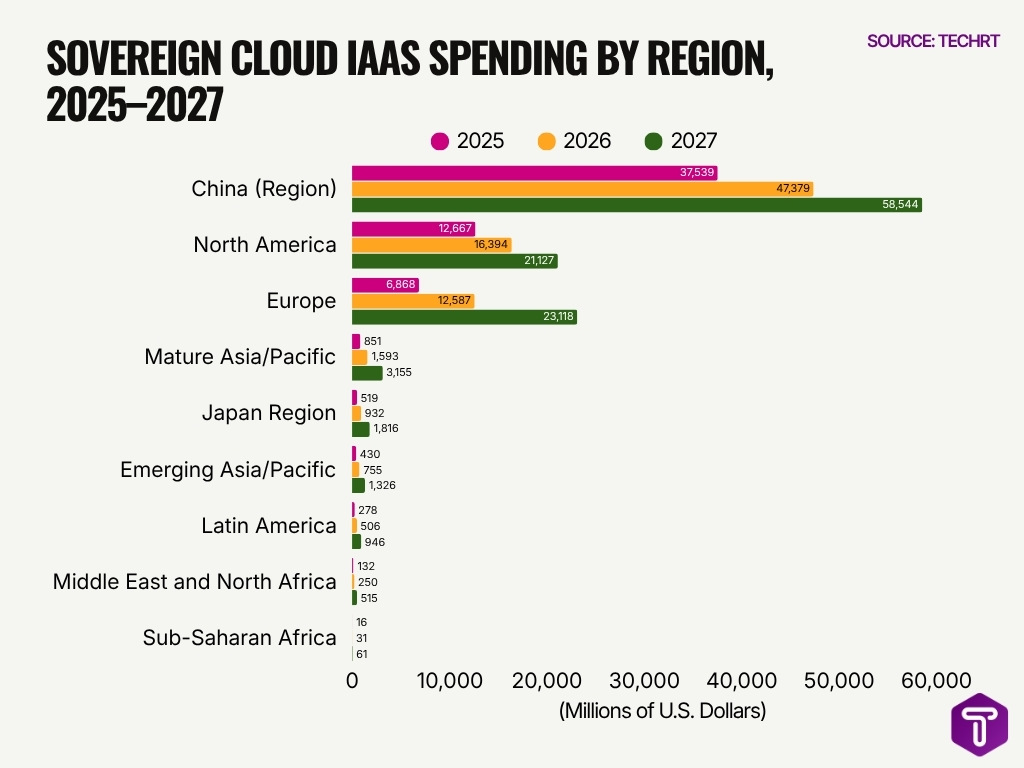
- Global sovereign cloud IaaS spending is heavily concentrated in China, which is projected to rise from $37.54 billion in 2025 to $58.54 billion in 2027.
- China (Region) remains the largest market throughout the period, adding more than $21.0 billion in spending between 2025 and 2027.
- North America is the second-largest market in 2025 and 2026, growing from $12.67 billion to $16.39 billion, before reaching $21.13 billion in 2027.
- Europe shows the strongest acceleration among major regions, increasing from $6.87 billion in 2025 to $23.12 billion in 2027.
- By 2027, Europe is projected to overtake North America, reaching $23.12 billion compared with North America’s $21.13 billion.
- Mature Asia/Pacific is expected to nearly quadruple, rising from $851 million in 2025 to $3.16 billion in 2027.
- The Japan Region also records strong growth, increasing from $519 million in 2025 to $1.82 billion in 2027.
- Emerging Asia/Pacific spending is projected to grow from $430 million to $1.33 billion between 2025 and 2027.
- Latin America is expected to more than triple, rising from $278 million in 2025 to $946 million in 2027.
- The Middle East and North Africa show rapid expansion from a smaller base, growing from $132 million to $515 million over the forecast period.
- Sub-Saharan Africa remains the smallest regional market, but spending is projected to increase from $16 million in 2025 to $61 million in 2027.
- Overall, the data points to strong global momentum for sovereign cloud IaaS, with every region showing year-on-year growth from 2025 to 2027.
Sovereign Cloud Adoption by Organization Size
- Large enterprises account for over 65% of sovereign cloud spending in 2026, due to complex compliance needs.
- Small and mid-sized enterprises (SMEs) adoption grew by 26% year-over-year, reflecting increasing regulatory awareness.
- Around 58% of large enterprises have already implemented sovereign cloud strategies.
- SMEs prefer hybrid models, with over 60% choosing hybrid sovereign cloud for cost and flexibility.
- Enterprise-level investments in sovereign cloud increased by 30% between 2024 and 2026.
- Startups in regulated industries saw a 20% rise in adoption, especially in fintech and healthtech.
- Mid-sized organizations report 25% lower compliance costs after adopting sovereign cloud.
- Around 47% of SMEs cite cost as the main barrier to adoption despite growing interest.
- Large enterprises achieve 40% faster compliance audits using sovereign cloud solutions.
Government and Public Sector Sovereign Cloud Spending
- Government spending on sovereign cloud reached $129 billion globally in 2025.
- Worldwide sovereign cloud IaaS spending forecast at $80 billion in 2026, up 35.6% from 2025.
- U.S. federal cloud spending hit $16.7 billion in FY 2024, projected to be $19.6 billion in FY 2026.
- Government cloud market valued at $41.56 billion in 2025, growing at 17.13% CAGR to 2030.
- The European Commission awarded a €180 million sovereign cloud tender in 2025 for EU institutions.
- Total federal cloud spending is expected to surpass $30 billion annually by 2028.
- Defense IT spending is expected to grow from $102.18 billion in 2025 at 5.1% CAGR through 2033.
- Cloud computing in the government sector is expected to grow by USD 38.76 billion at 16% CAGR from 2025 to 2030.
- Organizations to shift 20% of workloads from public clouds to sovereign providers by 2026.
Key Drivers of Sovereign Cloud Adoption
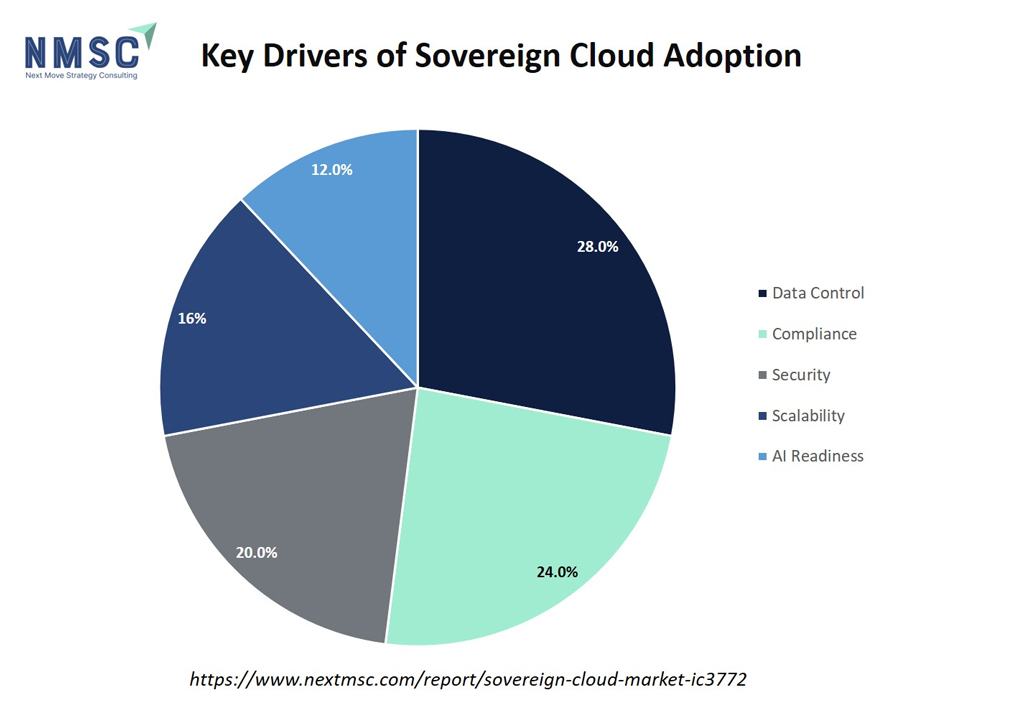
- Data Control is the leading driver of sovereign cloud adoption, accounting for 28.0% of the total share.
- Compliance ranks second at 24.0%, showing that regulatory and data residency requirements are a major reason organizations choose sovereign cloud solutions.
- Security represents 20.0% of adoption drivers, highlighting the importance of protecting sensitive workloads, government data, and enterprise information.
- Scalability contributes 16.0%, indicating that organizations also value sovereign cloud platforms for flexible infrastructure growth while maintaining local control.
- AI Readiness has a 12.0% share, suggesting that businesses are beginning to consider sovereign cloud as a foundation for secure and compliant AI deployment.
- Together, Data Control, Compliance, and Security account for 72.0% of the total adoption drivers, showing that trust, regulation, and protection are the strongest forces behind sovereign cloud demand.
Private Sector Sovereign Cloud Investment Trends
- Private sector investments in sovereign cloud grew by over 28% in 2026, reflecting rising compliance needs.
- Financial institutions increased spending by 32% year-over-year, leading private adoption.
- Technology companies invested over $50 billion globally in sovereign cloud infrastructure in 2025.
- Around 64% of enterprises plan to increase sovereign cloud budgets in 2026.
- Venture capital funding for sovereign cloud startups rose by 21% in 2025, signaling innovation growth.
- Enterprises allocate 35% of their cloud budgets to compliance and sovereignty features.
- Manufacturing companies increased investments by 18%, focusing on supply chain data control.
- Retail sector investments rose by 16%, ensuring regional data compliance.
- Around 42% of enterprises consider sovereignty a top-three cloud investment priority.
Key Regulatory Drivers of Sovereign Cloud
- Data protection regulations drive over 65% of sovereign cloud adoption decisions globally.
- The EU’s GDPR continues to influence global cloud compliance strategies, impacting companies beyond Europe.
- The U.S. CLOUD Act affects cross-border data access, pushing organizations toward sovereign cloud models.
- Over 70 countries now enforce data localization or sovereignty laws, up from fewer than 40 a decade ago.
- Financial regulations such as Basel III drive strict data governance requirements in banking cloud deployments.
- Healthcare regulations like HIPAA require strict control over patient data storage and access.
- National cybersecurity laws increased sovereign cloud demand by 25% between 2023 and 2026.
- Around 58% of enterprises cite regulatory pressure as the primary reason for adopting sovereign cloud.
- Cross-border data transfer restrictions influenced over 40% of enterprise cloud strategy changes in 2025.
Sovereign Cloud Adoption by Industry Verticals
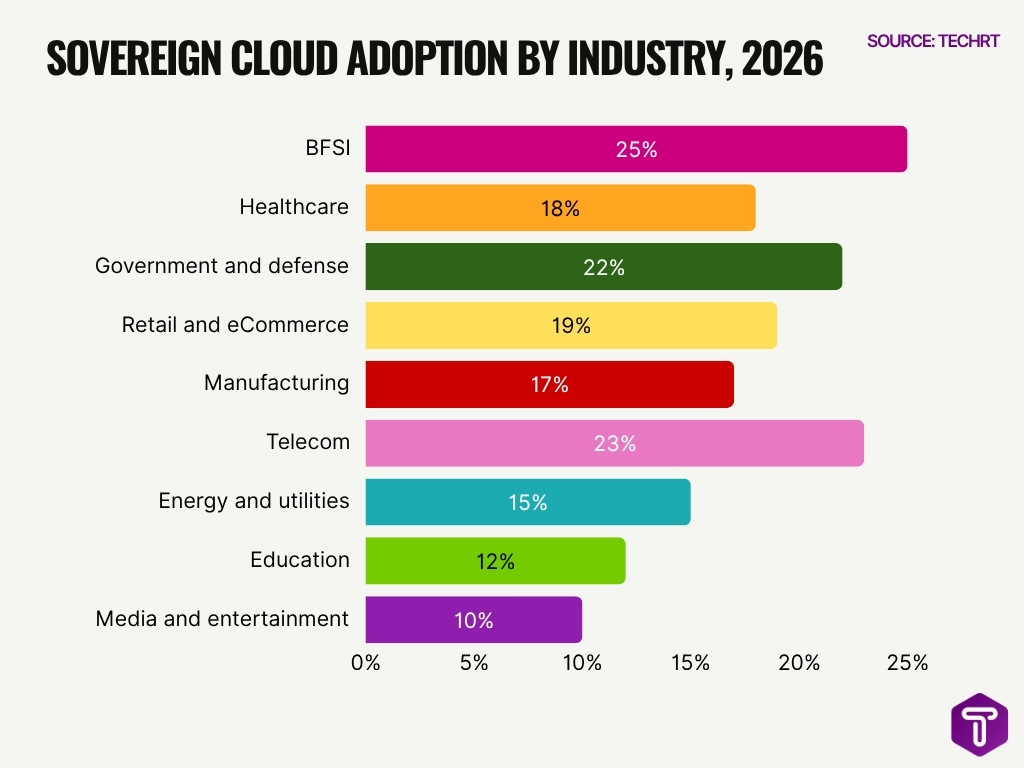
- The BFSI sector leads adoption, contributing over 25% of sovereign cloud usage globally in 2026.
- Healthcare accounts for 18% of adoption, driven by strict patient data protection laws.
- Government and defense sectors represent over 22% of total deployments, especially for national security systems.
- Retail and eCommerce adoption increased by 19% in 2025, focusing on customer data compliance.
- Manufacturing sector usage grew by 17% year-over-year, integrating sovereign cloud with Industry 4.0 systems.
- Telecom companies increased sovereign cloud investments by 23% in 2026, driven by 5G infrastructure needs.
- Energy and utilities adoption rose by 15%, focusing on critical infrastructure protection.
- Education sector adoption grew by 12% in 2025, particularly for research data governance.
- Media and entertainment companies increased adoption by 10%, mainly for localized content delivery compliance.
Data Localization and Sovereignty Regulations by Region
- The European Union enforces strict GDPR compliance, impacting over 450 million citizens’ data handling requirements.
- More than 70 countries globally have active data localization laws as of 2026, up from around 40 in 2015.
- The U.S. CLOUD Act allows cross-border data access, prompting over 38% of enterprises to adopt sovereign cloud alternatives.
- India’s Digital Personal Data Protection Act has accelerated sovereign cloud adoption by over 25% in regulated sectors since 2024.
- China mandates strict localization, with nearly 100% of critical data required to remain within national borders.
- Middle Eastern countries, including the UAE and Saudi Arabia, introduced localization frameworks covering over 60% of government data workloads.
- Latin America saw a 20% increase in data sovereignty regulations between 2023 and 2026, particularly in Brazil and Mexico.
- Cross-border data restrictions influenced over 45% of multinational companies to restructure cloud architecture in 2025.
- Africa is emerging in this space, with over 15 countries drafting or implementing localization laws by 2026.
Cybersecurity and Risk-Management Statistics in Sovereign Cloud
- The global average cost of a data breach reached $4.45 million in 2025, increasing pressure on secure cloud solutions.
- Organizations using sovereign cloud report up to 30% fewer data breach incidents compared to traditional cloud setups.
- Around 68% of enterprises cite cybersecurity as a primary driver for sovereign cloud adoption.
- Zero-trust security adoption increased by 27% in sovereign cloud environments in 2026.
- Over 55% of organizations deploy sovereign cloud for critical workloads, reducing risk exposure.
- Sovereign cloud environments improve compliance audit success rates by 35%, especially in regulated industries.
- AI-driven threat detection in sovereign cloud systems increased by 22% in 2025, enhancing proactive security measures.
- Nearly 60% of enterprises experienced at least one cloud-related security incident in 2025, accelerating sovereign adoption.
- Encryption key ownership is prioritized by over 70% of enterprises, ensuring control over sensitive data.
Top Sovereign Cloud Providers and Market Share
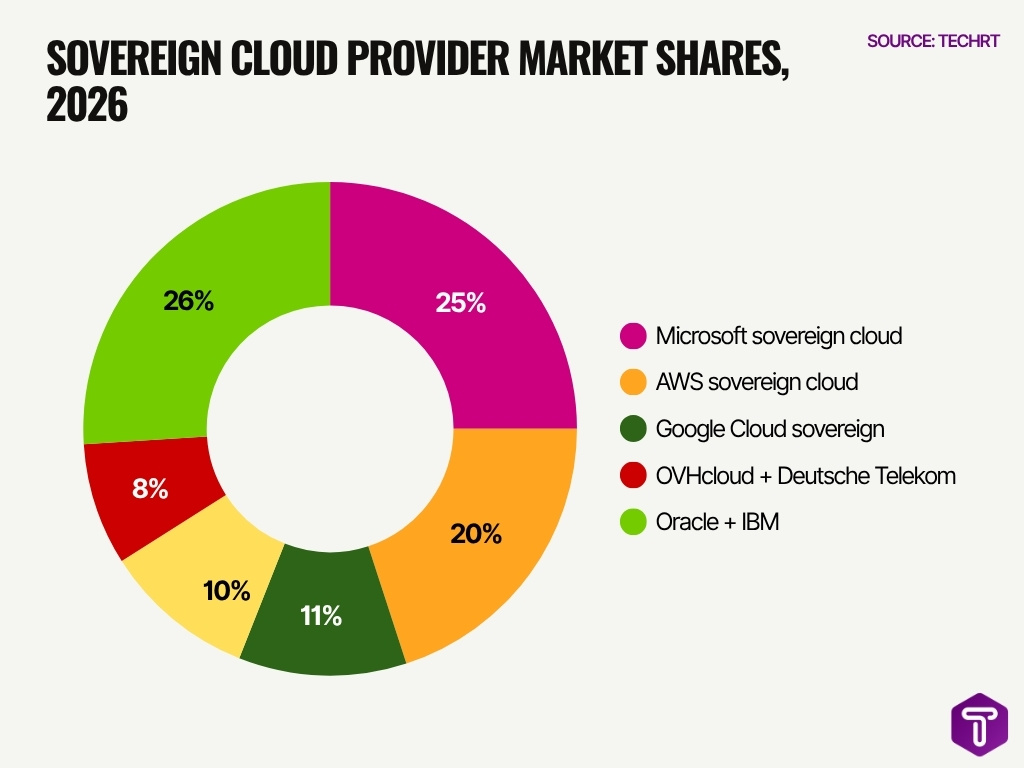
- Microsoft leads the sovereign cloud segment with over 25% global market share in 2026.
- Amazon Web Services (AWS) holds approximately 20% share, offering region-specific sovereign solutions.
- Google Cloud accounts for around 11% of the market, expanding rapidly in Europe and Asia.
- European providers like OVHcloud and Deutsche Telekom collectively hold over 10% share, driven by regional demand.
- Oracle and IBM together contribute around 8% of sovereign cloud deployments, focusing on enterprise workloads.
- Local providers in Asia-Pacific saw 18% growth in 2026, supported by government initiatives.
- Multi-vendor strategies are used by over 55% of enterprises, reducing dependency on a single provider.
- Sovereign cloud partnerships between global and local providers increased by 22% in 2025, enhancing compliance capabilities.
- Open-source sovereign cloud solutions grew by 15% adoption rate, particularly in Europe.
Sovereign Cloud vs Traditional Public Cloud Adoption
- Traditional public cloud still dominates, accounting for over 65% of global cloud workloads in 2025.
- Sovereign cloud adoption grew by over 30% year-over-year in 2026, outpacing traditional models.
- Around 48% of enterprises now use a mix of sovereign and public cloud environments.
- Sovereign cloud is preferred by over 70% of regulated industries, compared to less than 40% for public cloud.
- Public cloud remains more cost-effective, with up to 25% lower operational costs compared to sovereign cloud.
- Sovereign cloud deployments reduce compliance risks by over 40%, particularly in finance and healthcare.
- Hybrid approaches combining both models increased by 35% between 2024 and 2026.
- Enterprises using sovereign cloud report 20% faster regulatory approvals for new digital services.
- Around 52% of CIOs plan to shift more workloads to sovereign cloud by 2027.
Sovereign Cloud Projects and National Initiatives
- The European GAIA-X initiative aims to federate data across 27 EU member states into a single sovereign data infrastructure by 2027.
- Germany has invested more than €3 billion in sovereign cloud and digital‑sovereignty projects by 2026.
- France’s “Cloud de Confiance” program supports secure cloud services for over 200 government agencies and public bodies.
- India’s government cloud platform MeghRaj hosts more than 1,000 government applications and citizen‑facing services.
- The U.S. Department of Defense has committed $9 billion to cloud modernization contracts embedding sovereign‑cloud capabilities.
- Saudi Arabia has launched sovereign cloud zones as part of a $10 billion national digital infrastructure investment plan.
- Australia’s sovereign cloud strategy is designed to cover over 80% of federal data workloads by 2027.
- Japan’s government cloud initiative targets consolidation of over 60% of critical public systems into sovereign environments by 2027.
- Canada’s sovereign cloud adoption now spans over 75% of provincial and federal public‑sector IT systems.
- Global sovereign cloud IaaS spending is projected to rise from $59.3 billion in 2025 to $80.4 billion in 2026.
Barriers to Sovereign Cloud Implementation
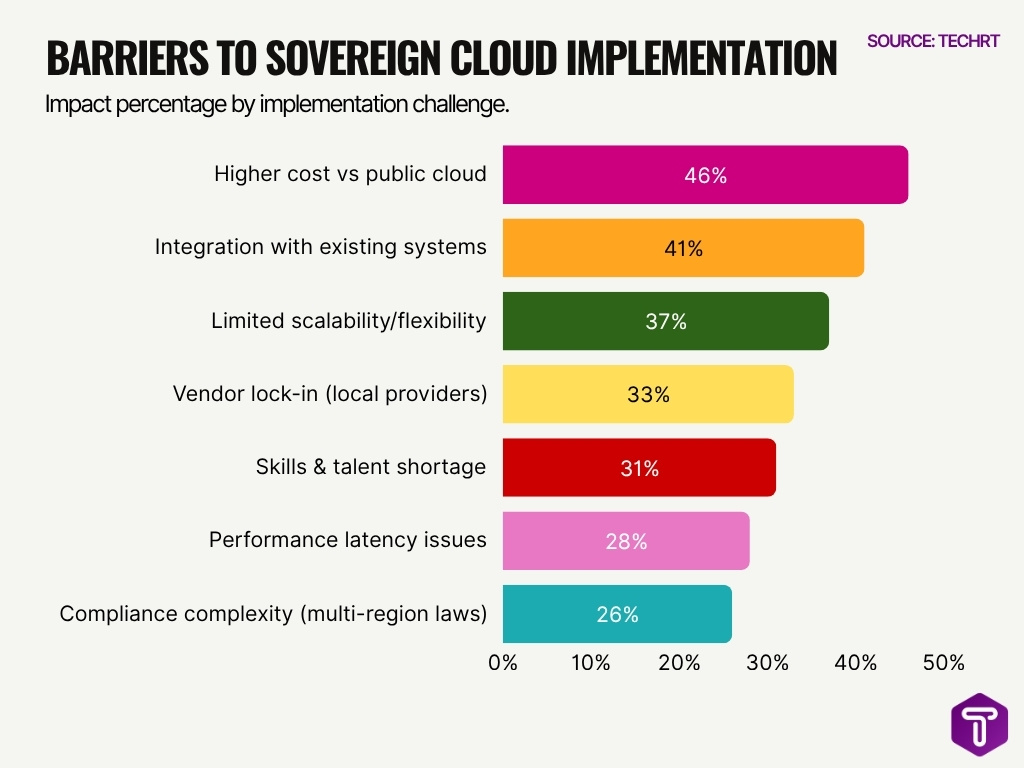
- Higher cost vs public cloud is the top barrier, cited by 46% of respondents. This suggests that cost competitiveness remains the biggest challenge for sovereign cloud adoption.
- Integration with existing systems ranks second at 41%, showing that many organizations struggle to connect sovereign cloud platforms with their current IT infrastructure.
- Limited scalability and flexibility affects 37% of respondents, indicating concerns that sovereign cloud environments may not offer the same agility as major public cloud providers.
- Vendor lock-in with local providers is a concern for 33%, highlighting the risk that organizations may become dependent on a limited set of sovereign cloud vendors.
- Skills and talent shortage is reported by 31%, suggesting that successful implementation requires specialized expertise that may not be widely available.
- Performance and latency issues impact 28% of respondents, reflecting concerns about whether sovereign cloud platforms can deliver the speed and reliability businesses expect.
- Compliance complexity across multi-region laws is cited by 26%, showing that regulatory alignment remains challenging even when organizations choose sovereign cloud solutions.
- Overall, the data shows that sovereign cloud adoption is shaped by a mix of financial, technical, operational, and regulatory barriers, with cost and integration standing out as the most significant concerns.
Future Forecasts and Long-Term Sovereign Cloud Trends
- The sovereign cloud market is projected to exceed $600 billion by 2033, driven by regulatory and security demands.
- AI integration in sovereign cloud is expected to grow at a CAGR of 35% through 2030.
- Over 75% of enterprises will adopt sovereign cloud strategies by 2030.
- Edge computing combined with sovereign cloud will account for over 40% of deployments by 2028.
- Quantum-safe encryption adoption in sovereign cloud is expected to rise by 20% annually, preparing for future cyber threats.
- Sovereign AI platforms will handle over 60% of regulated AI workloads by 2030.
- Green cloud initiatives will influence over 30% of sovereign cloud investments, focusing on sustainability.
- Emerging markets will contribute over 35% of new sovereign cloud deployments by 2030, led by Asia and Africa.
- Multi-cloud sovereignty strategies will dominate, with over 65% of enterprises adopting them by 2028.
Frequently Asked Questions (FAQs)
What is the projected size of the sovereign cloud market in 2026?
What CAGR is the sovereign cloud market expected to grow at through 2033?
How much will sovereign cloud IaaS spending total in 2026?
What market share did Europe hold in the sovereign cloud market in 2025?
What percentage of the sovereign cloud market is driven by data sovereignty needs?
Conclusion
Sovereign cloud is redefining how organizations approach data ownership, regulatory compliance, and digital resilience in a rapidly evolving landscape. As governments introduce stricter data protection laws and businesses face increasing cybersecurity risks, the demand for localized and controlled cloud environments continues to rise. Moreover, the integration of technologies like AI, edge computing, and zero-trust security is strengthening the long-term value of sovereign cloud solutions across industries.
While challenges such as cost and complexity remain, the overall trajectory points toward widespread adoption and deeper integration into enterprise IT strategies. In the years ahead, sovereign cloud will not just support compliance, it will shape how digital ecosystems operate on a global scale.

Leave a comment
Have something to say about this article? Add your comment and start the discussion.