




Telemedicine continues to reshape how patients access healthcare across the United States and worldwide. Hospitals, insurers, and digital health startups now rely on virtual care to reduce wait times, expand specialist access, and improve chronic disease management. Remote consultations also play a growing role in mental health care, rural healthcare delivery, and post-surgical monitoring. As healthcare systems invest heavily in digital infrastructure, telemedicine usage keeps accelerating across age groups and medical specialties. This article explores the latest telemedicine usage statistics, adoption trends, market growth, and patient behavior patterns shaping the industry.
Editor’s Choice
- The global telemedicine market is projected to reach $156.31 billion in 2026, up from $132.54 billion in 2025.
- North America accounted for more than 38% of global telemedicine revenue in 2025, maintaining its lead in digital healthcare adoption.
- Remote patient monitoring is forecast to grow at a 17.09% CAGR through 2031, making it one of the fastest-growing telehealth segments.
- Real-time video consultations represented 44.28% of telemedicine services in 2025 worldwide.
- The U.S. telehealth market is expected to grow from $65.35 billion in 2026 to $447.69 billion by 2035.
- Mobile and web-based telemedicine platforms generated over 74% of global revenue share in recent market assessments.
- Telepsychiatry is projected to record an 18.21% CAGR through 2031, reflecting rising demand for virtual mental healthcare.
- More than 1 in 6 people globally could benefit from accessible telehealth services designed for patients with disabilities.
- The global telemedicine market is expected to surpass $380 billion by 2030 under current growth projections.
Recent Developments
- In 2025, several U.S. states extended reimbursement parity laws that require insurers to reimburse telehealth visits at rates similar to in-person care.
- AI-assisted telemedicine platforms saw accelerated deployment in 2025 as healthcare systems integrated automated triage and clinical decision support tools.
- Major healthcare providers increased investments in 5G-enabled telehealth infrastructure to support real-time diagnostics and HD consultations.
- Telemedicine companies increasingly partnered with employers to provide virtual primary care services as part of employee wellness programs in 2025.
- The mental health and behavioral therapy segment emerged as the fastest-growing telehealth application category in 2025.
- Government-backed telehealth expansion programs accelerated in Asia-Pacific markets, especially in India and Southeast Asia.
- In 2025, cloud-based deployment models represented nearly 49% of India’s telemedicine market, reflecting increased hospital digitization.
- Healthcare providers increasingly adopted wearable device integrations for remote patient monitoring and chronic disease management.
- Teleconsultation remained the largest application segment globally, contributing roughly 44% market share in 2025.
Telehealth Adoption Across Medical Domains
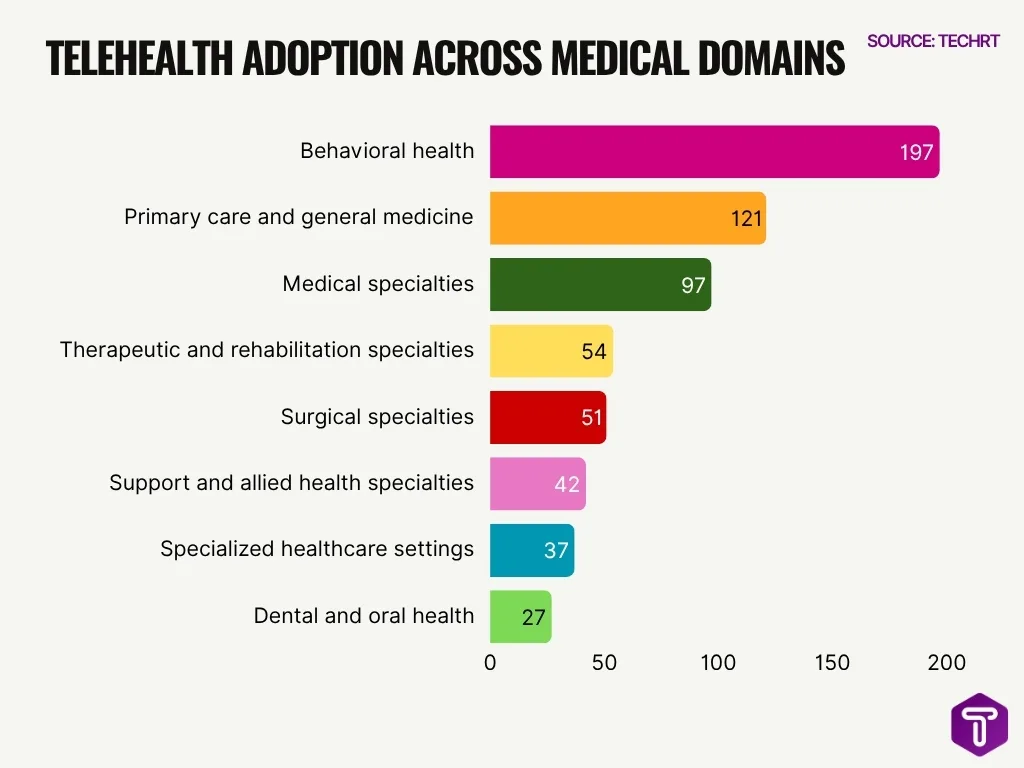
- Behavioral health leads telehealth adoption, with 197 respondents indicating that their program provides this service via telehealth.
- Primary care and general medicine rank second, with 121 respondents using telehealth for these services.
- Medical specialties also show strong telehealth use, with 97 respondents reporting availability through virtual care.
- Therapeutic and rehabilitation specialties recorded 54 respondents, showing moderate adoption of telehealth in rehabilitation-focused care.
- Surgical specialties had 51 respondents, suggesting that some pre-surgical, post-surgical, and consultation-based services are being delivered virtually.
- Support and allied health specialties were reported by 42 respondents, reflecting telehealth use in supporting clinical services.
- Specialized healthcare settings had 37 respondents, showing a smaller but present role for telehealth in niche healthcare environments.
- Dental and oral health had the lowest adoption among listed domains, with 27 respondents offering these services through telehealth.
- The data shows that telehealth is most widely adopted in domains that rely heavily on consultation, counseling, follow-up care, and routine assessments.
- Overall, behavioral health, primary care, and medical specialties are the top three domains driving telehealth adoption across medical services.
Telemedicine Market Growth
- The global telemedicine market is projected to grow at a 15.21% CAGR between 2026 and 2031.
- Market estimates suggest telemedicine revenue could exceed $317 billion globally by 2031.
- Another industry forecast projects the market to reach $380.33 billion by 2030.
- The telehealth market was valued at approximately $141.19 billion globally in 2024.
- Analysts forecast the industry will add nearly $159.4 billion in market value between 2025 and 2029.
- Asia-Pacific is expected to become the fastest-growing telemedicine region with projected growth rates approaching 19.59% CAGR through 2031.
- The U.S. telehealth market alone is projected to grow at a 23.84% CAGR through 2035.
- Services and support represented approximately 56.73% of market share in 2025, outperforming hardware growth.
- Telemedicine growth continues to benefit from rising chronic disease rates, aging populations, and physician shortages worldwide.
Telemedicine Usage Trends
- Over 60% of global telehealth visits in 2025 were delivered via mobile-based telehealth apps, marking the fastest‑growing delivery mode.
- Around 61% of telehealth delivery systems in 2025 ran on web and cloud‑based platforms.
- More than half of routine consultations in 2025 used asynchronous methods like secure messaging or chat.
- Roughly 30–40% of cardiac and diabetes programs in advanced markets embedded wearable devices and remote monitoring tools in 2025.
- Over 50% of large telemedicine platforms in 2025 integrated AI‑driven symptom checkers to triage patient inquiries.
- Video consultations accounted for about 70–80% of mental health and specialist visits in 2025.
- Rural healthcare systems increased telemedicine usage by roughly 35–50% year‑on‑year in 2025 to cut travel burdens.
- Approximately 65% of hospitals piloting or scaling telemedicine in 2025 adopted hybrid care models combining virtual and in‑person visits.
- Multilingual support was added to over 40% of major telemedicine platforms in 2025 to improve access for underserved populations.
- Around 45–55% of telehealth platforms in 2025 deployed automated scheduling systems to reduce appointment no‑shows and improve throughput.
Telemedicine Usage by Age Group
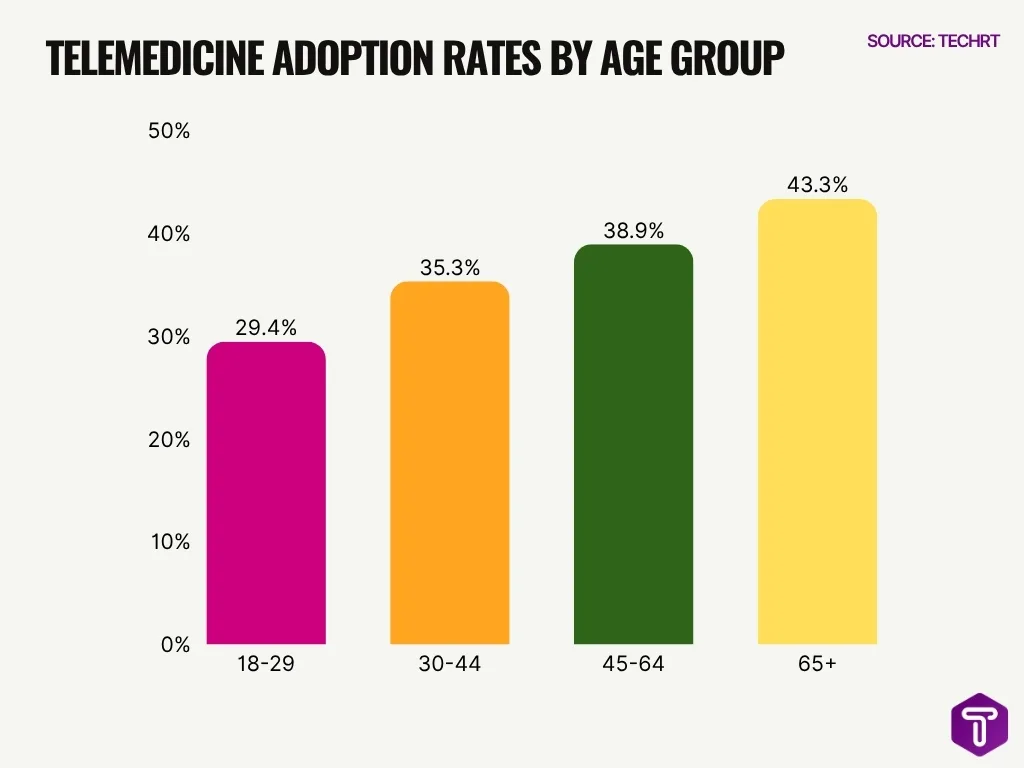
- Adults aged 18–29 used telemedicine at a rate of 29.4% in the past 12 months.
- Adults aged 30–44 used telemedicine at 35.3%, one of the highest shares.
- Adults aged 45–64 showed 38.9% telemedicine usage in recent surveys.
- Adults aged 65+ reached 43.3% telemedicine adoption, the highest rate.
- 74% of millennials prefer teleconsultations over in-person visits.
- 68% of millennials used virtual care in the past year, 10% above average.
- Young adults aged 18–24 comprise 55% of AI symptom checker users in telemedicine apps.
- Children aged 0–17 had 14.2% telemedicine usage in 2023, declining from 18.3% in 2021.
- 73% of rural residents, including older adults, rely on telemedicine amid provider shortages.
Telemedicine Usage by Demographics
- 43.3% of adults aged 65+ use virtual care, higher than 29.4% for ages 18-29.
- 68% of Millennials used virtual care in the past year, 10% above average.
- 73% of rural residents use telehealth services.
- Women are more likely to use telehealth than men (33.8% vs 26.3%).
- People with mobility disabilities (36.1%) and cognitive disabilities (33.4%) show higher telehealth use.
- 80% of consumers have used telemedicine at least once.
- 52% of patients with chronic diseases used telehealth vs 39.3% general population.
- Urban areas see 34.2% telemedicine use vs 19.6% in rural areas.
- 60% of Gen Z used virtual care, preferring text-based options.
Telemedicine Usage by Gender
- Women accounted for 62% of telehealth patients in 2020, while men made up 38%.
- Women used telemedicine at 42% rate vs men’s 31.7% among US adults in 2021.
- Females comprised 54.2% of telemedicine services adjusted for total healthcare use.
- Women made up nearly 60% of telehealth patients in the USA during 2020-21.
- 3.2% of female patients received telemedicine for mental health vs 2.5% males.
- 64% of Teladoc general medical visits were by women vs 36% men in Q1 2021.
- Male patients had 15% lower odds of adopting telehealth than females.
- 71.1% of primary care mental health patients seeking care were female.
- Women aged 25-44 were the most frequent telehealth users overall.
Top Physician Specialties Using Telehealth the Most
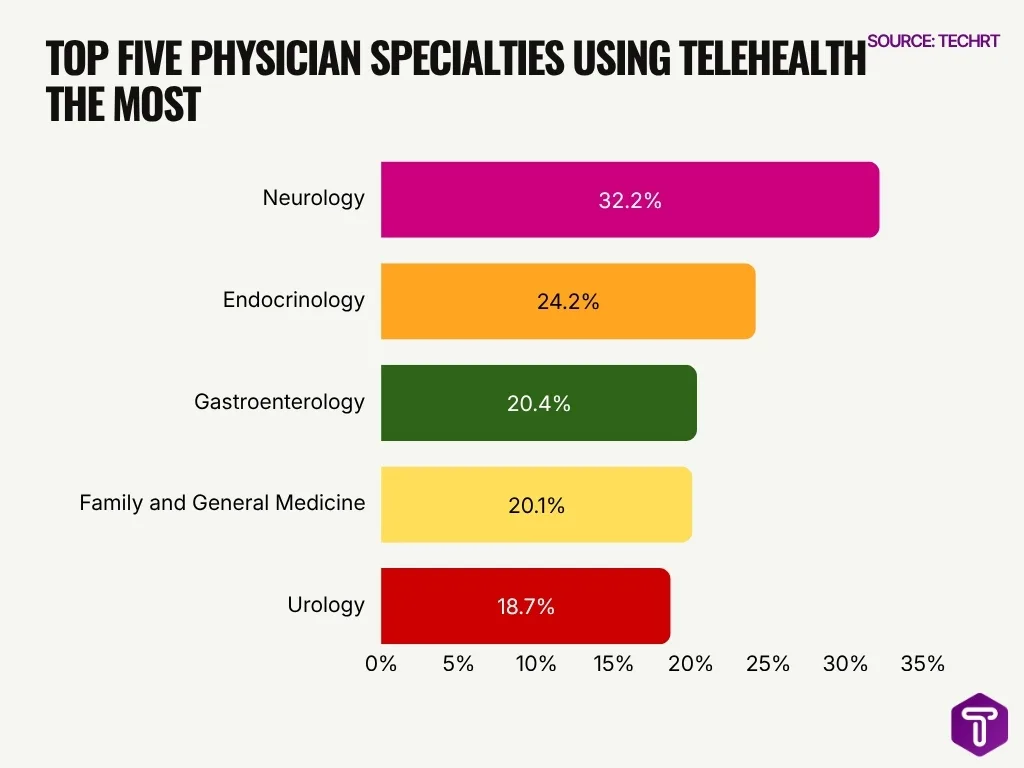
- Neurology recorded the highest telehealth usage among the listed specialties, with 32.2% of physicians using telehealth.
- Endocrinology ranked second, with 24.2% telehealth usage, showing strong adoption for ongoing care and chronic condition management.
- Gastroenterology followed with 20.4% telehealth usage, slightly ahead of family and general medicine.
- Family and general medicine reported 20.1% telehealth usage, highlighting telehealth’s role in primary care consultations.
- Urology had the lowest share among the top five specialties, but still showed notable adoption at 18.7%.
- The gap between neurology and endocrinology was 8 percentage points, making neurology the clear leader.
- The difference between gastroenterology and family and general medicine was only 0.3 percentage points, showing nearly equal telehealth adoption.
- All five specialties recorded telehealth usage above 18%, indicating that virtual care remains relevant across both specialty and primary care settings.
- The data suggests telehealth is especially useful in fields such as neurology and endocrinology, where follow-ups, test reviews, and chronic disease monitoring can often be handled remotely.
Telemedicine Usage Before and After COVID-19
- Telemedicine usage in the U.S. increased dramatically during the COVID-19 pandemic and remained well above pre-pandemic levels afterward.
- Before 2020, fewer than 15% of physicians regularly used telemedicine for patient consultations.
- During the pandemic, telehealth visits increased by more than 150% in several healthcare systems.
- Virtual care adoption remained stable after COVID-19 because patients became more comfortable with digital healthcare access.
- Healthcare organizations invested heavily in telemedicine infrastructure between 2020 and 2024.
- Insurers expanded reimbursement coverage for telehealth services during and after the pandemic period.
- Mental health telemedicine visits experienced some of the highest sustained growth rates after COVID-19 restrictions eased.
- Remote patient monitoring adoption accelerated because hospitals wanted to reduce unnecessary in-person visits.
- Many providers now operate hybrid healthcare models that combine virtual consultations with physical clinic visits.
Telemedicine Visit Frequency
- 62.6% of telemedicine appointments were completed, 64% higher odds than in-person visits.
- 52% of chronic disease patients used telehealth in the past 12 months.
- 67% of patients had at least one virtual visit annually, rising to 80% for chronic illness users.
- Mental health patients attend weekly teletherapy sessions at a standard frequency.
- Diabetes and hypertension patients receive biweekly remote monitoring consultations.
- 14.4% of pediatric video telemedicine visits led to in-person follow-ups.
- 73.4% completion rate for telemedicine appointments versus 64.2% in-person.
- 96% of large employers offered telemedicine coverage, boosting repeat usage in 2025.
- Older adults over 65 actively use telemedicine at 43% rate for medication management.
Telemedicine Market Share by Region
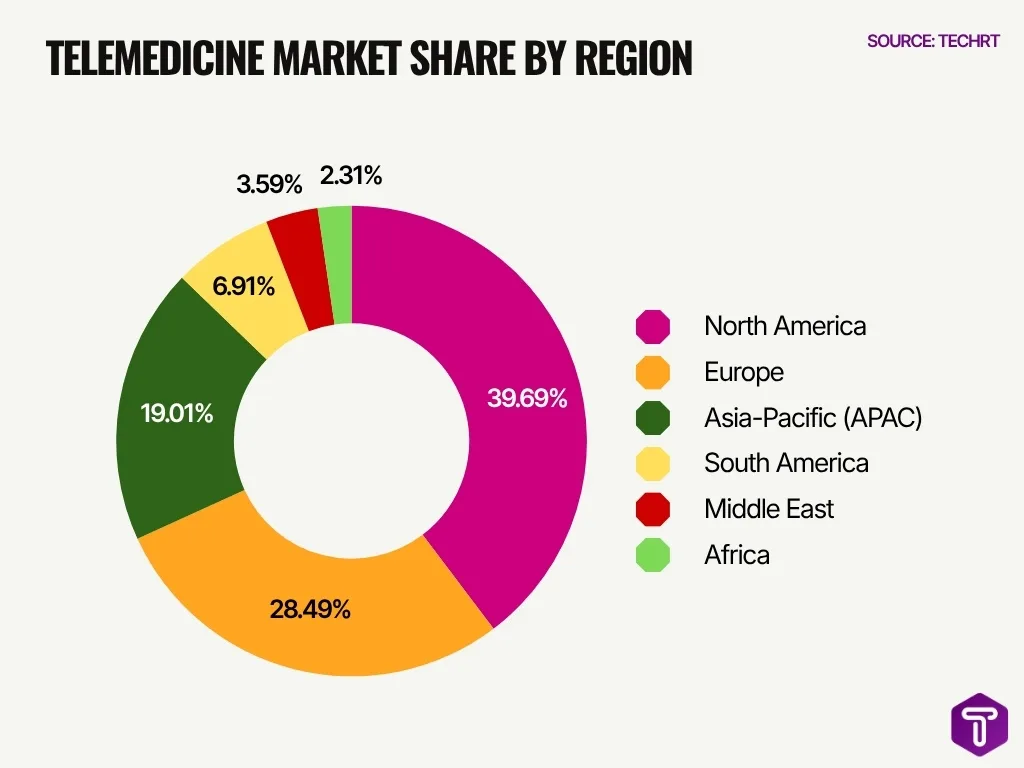
- North America leads the global telemedicine market with the highest share of 39.69%.
- Europe ranks second, holding 28.49% of the total telemedicine market.
- Together, North America and Europe account for 68.18% of the market, showing strong dominance by developed healthcare regions.
- Asia-Pacific (APAC) holds the third-largest share at 19.01%, driven by growing digital health adoption and expanding healthcare access.
- South America represents 6.91% of the telemedicine market, indicating steady but smaller adoption compared to major regions.
- The Middle East accounts for 3.59%, reflecting an emerging telemedicine market with room for future growth.
- Africa has the smallest market share at 2.31%, suggesting that telemedicine adoption is still in the early stages across the region.
- The top three regions, North America, Europe, and APAC, collectively make up 87.19% of the global telemedicine market.
- The data shows that telemedicine adoption is heavily concentrated in regions with stronger healthcare infrastructure, internet access, and digital health investment.
- Emerging markets such as South America, the Middle East, and Africa together account for 12.81%, highlighting future growth opportunities for telemedicine providers.
Telemedicine Usage by Device
- Smartphones drive over 80% of telemedicine consultations globally in 2025 assessments.
- Mobile devices account for 74% of telehealth platform access worldwide.
- Tablets see 32% higher adoption among adults over 65 for video calls.
- Desktops and laptops comprise 20-25% of specialist teleconsultations.
- Wearable users are 32% more likely to adopt telemedicine services.
- Rural health workers show 75% smartphone ownership for telehealth.
- mHealth apps hold 47% share of the telemedicine market via mobiles.
- 80% of consumers access telehealth primarily through smartphones.
- Urban mobile telehealth usage reaches 34% versus 20% rural.
Telemedicine Usage for Chronic Care
- Remote patient monitoring for chronic disease management is projected to grow at a 17.09% CAGR through 2031.
- Telehealth interventions for chronic disease care showed a 0.27 pooled effect size across 55 studies and 16,157 participants.
- In one chronic care study, 51.5% of patients had at least one telehealth visit.
- Telehealth users had a 57.1% rate of 2+ A1C utilization-based measures versus 51.1% for non-users.
- A telehealth medication-focused review found 10 of 23 studies reduced readmissions, including 7 heart failure studies.
- Telehealth programs in a rural chronic care study raised patient satisfaction to 4.6/5 versus 3.9/5 with usual care.
- A rural telehealth review found 15 studies reported better access, lower costs, and fewer missed appointments for chronic care patients.
- Telemedicine patients generated $9.18 million in cumulative savings and 1.87 million hours saved in one chronic care program.
- Patients with higher telemedicine use saw a 2.7% decrease in emergency department visits.
Respondents’ Willingness to Use Telemedicine Services
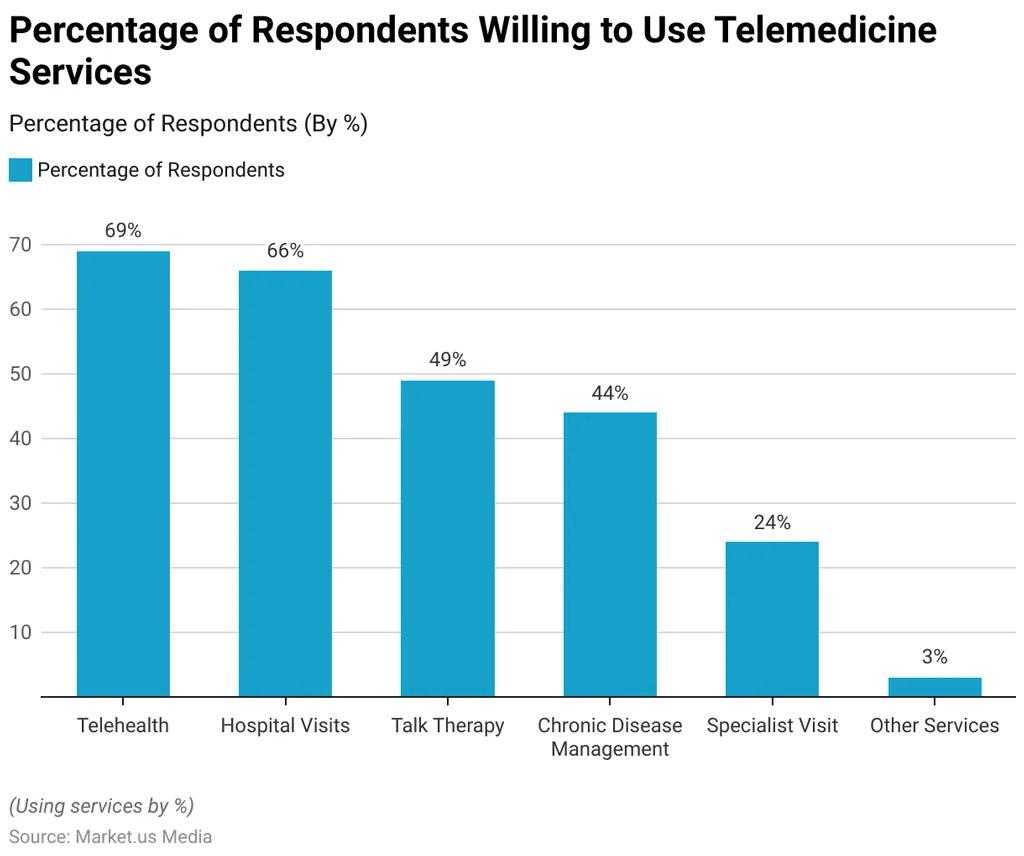
- Telehealth is the most preferred telemedicine service, with 69% of respondents willing to use it.
- Hospital visits also show strong digital adoption, with 66% of respondents open to using telemedicine for this purpose.
- Nearly half of respondents, 49%, are willing to use telemedicine for talk therapy, highlighting its growing role in mental healthcare.
- Chronic disease management has notable acceptance, with 44% of respondents willing to use telemedicine for ongoing care.
- Willingness drops for specialist visits, where only 24% of respondents prefer using telemedicine services.
- Other services recorded the lowest interest, with just 3% of respondents willing to use them through telemedicine.
- The data shows that telemedicine is most accepted for general healthcare access, while adoption is lower for more specialized or unclear service categories.
- Overall, the findings suggest strong consumer interest in telemedicine, especially for telehealth, hospital visits, therapy, and chronic care management.
Telemedicine Usage for Mental Health
- The global telepsychiatry market is projected to hit $41.8 billion by 2031, growing at a 20.3% CAGR.
- Telepsychiatry is also forecast to reach $64.5 billion by 2030 at a 18.4% CAGR, showing strong long-term momentum.
- Among adults 18–29, 66% say they would use telehealth for mental health services, compared with 36% of those 65+.
- In one survey, 49% of Americans said they would use telehealth for mental healthcare in 2020, rising to 59% in 2021.
- Rural residents accounted for 42% teletherapy use in one dataset, highlighting growing virtual care adoption outside cities.
- Urban residents showed 64% telehealth usage in the same dataset, suggesting especially strong demand for flexible virtual sessions.
- College research across nearly 65,000 students at 81 universities found 35.5% of undergraduates had used telemental health.
- In adolescent mental health treatment, 45.3% received some care via telehealth, showing mainstream use among younger patients.
- At least 16 of the 20 largest U.S. public school districts now offer online mental health counseling, with contracts totaling over $70 million.
Telemedicine Provider Adoption
- 82% of telemedicine platforms reached adoption across healthcare providers in 2025, up from 23% in 2020.
- 94% of organizations now use electronic health records, making EHR integration a near-universal foundation for telehealth workflows.
- Large health systems adopt AI-powered diagnostics at 73%, versus 28% in small practices, showing a major implementation gap.
- Telemedicine adoption rose by 37% over five years, driven by patient demand for flexible access and provider investment in virtual care.
- Remote patient monitoring climbed 39% over five years, reflecting stronger use of connected devices for chronic care.
- Telemedicine platforms deliver an average payback period of just 8 months, helping smaller clinics justify cloud-based deployment.
- 73% of organizations cite staff resistance as the top barrier to digital health adoption, including telemedicine rollouts.
- 40% higher implementation success is achieved when organizations pair telehealth deployment with strong change management and staff training.
- In primary care, telephone consultations were available in 90.4% of cases during the pandemic, showing how virtual access expanded quickly.
- Hospital leaders reported 82% patient preference for hybrid care and 83% provider endorsement, reinforcing provider-led telemedicine adoption.
Telehealth Adoption Barriers
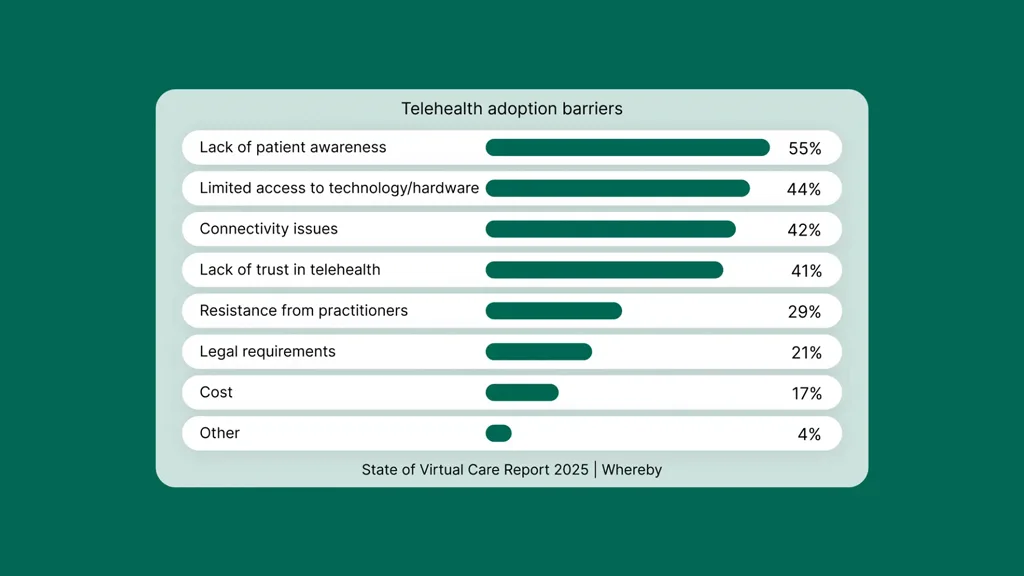
- Lack of patient awareness is the biggest barrier to telehealth adoption, affecting 55% of respondents.
- Limited access to technology or hardware ranks second, with 44% identifying it as a major challenge.
- Connectivity issues remain a significant obstacle, reported by 42% of respondents.
- Lack of trust in telehealth is nearly as common, affecting 41% of respondents.
- Resistance from practitioners creates another adoption barrier, cited by 29% of respondents.
- Legal requirements are a concern for 21%, showing that regulatory complexity still affects telehealth expansion.
- Cost is a barrier for 17% of respondents, making it less common than awareness, access, and trust-related issues.
- Only 4% selected Other, suggesting that most adoption barriers fall into clearly defined categories.
- The data shows that telehealth adoption is held back more by awareness, access, connectivity, and trust than by cost alone.
- Improving patient education, digital access, and provider confidence could help reduce the largest barriers to telehealth adoption.
Telemedicine Patient Satisfaction
- 55% of patients said they were more satisfied with telehealth/virtual care than with in-person visits.
- 85.1% of endocrinology patients were satisfied with telemedicine-related wait times.
- Telemedicine e-consults cut waiting time by 25.4 days on average across specialties.
- Mental health telehealth showed 81.5% overall satisfaction, with 80.0% saying they would use it again.
- Telemedicine lowered patient costs by $223 to 3,846 per event, with up to 94% savings in low-income settings.
- In one patient study, 84% said virtual visits were sufficiently private, and 92% were comfortable using the technology.
- Among neuromuscular patients, 26% preferred virtual visits while 50% preferred in-person care, showing a strong hybrid preference.
- Telemedicine referrals were linked to an adjusted odds ratio of 1.27 for MOUD retention and 0.67 for medically treated overdose.
- Digital health literacy interventions improved outcomes in 710 older adults, supporting better telehealth experiences for seniors.
Telemedicine Security and Privacy
- Healthcare cybersecurity budgets grew 12% in 2024, averaging $66 million, with nearly 19% of that spend going to information security initiatives.
- In 2025, more than 57 million patients had data exposed across 642 large healthcare breaches reported to HHS.
- Telehealth barrier research found 395 studies, with 55% citing lack of skills or ability and 49% citing lack of interest.
- The same review found 45% of studies reported a lack of access to technology, and 45% reported technology infrastructure limits.
- Concerns about data security and privacy were part of the 27% of studies that identified a lack of trust in telehealth systems.
- During COVID-related telehealth studies, the lack of access to technology rose to 56%, compared with 38% in non-COVID studies.
- U.S.-based telehealth studies reported a lack of access to technology at 51%, versus 38% in international studies.
- In a telemedicine adoption study, 71% of health professionals cited privacy risks related to data security, while 50% cited training-time risk.
- A telehealth privacy assessment found 54% of smartphone users connect to potentially insecure Wi-Fi networks, and 20% access sensitive data on them.
- Pew Research found 62% of Americans were extremely or very concerned about health app privacy when told HIPAA does not cover app data.
Frequently Asked Questions (FAQs)
What is the projected global telemedicine market size in 2026?
What CAGR is the telehealth market expected to grow at from 2026 to 2035?
What share of the global telemedicine market did North America hold in 2025?
How large could the global telemedicine market become by 2030?
What is the projected size of India’s telemedicine market by 2031?
Conclusion
Telemedicine has evolved from a convenience-driven healthcare option into a core part of modern medical delivery. Growth in remote patient monitoring, mental healthcare, and AI-powered virtual consultations continues to reshape patient expectations and provider operations. At the same time, hospitals, insurers, employers, and governments are investing heavily in digital healthcare infrastructure to support long-term telehealth adoption.
The latest statistics show that telemedicine usage remains strongest in mental health services, chronic disease management, and rural healthcare access. Mobile devices, cloud-based platforms, and wearable technologies continue driving broader accessibility and repeat patient engagement. Meanwhile, rising cybersecurity investments and reimbursement reforms indicate that the industry is preparing for sustained expansion beyond pandemic-era demand.
As healthcare systems face rising costs, physician shortages, and increasing chronic disease burdens, telemedicine will likely remain a critical solution for improving care accessibility and operational efficiency worldwide.

Leave a comment
Have something to say about this article? Add your comment and start the discussion.