



Satellite internet has shifted from a niche backup option to a mainstream connectivity solution for homes, businesses, airlines, shipping operators, and emergency response teams. Low Earth orbit (LEO) networks now deliver faster speeds and lower latency, making satellite broadband more practical for video streaming, remote work, precision agriculture, and industrial IoT deployments. At the same time, governments and telecom providers continue to expand coverage in underserved rural areas where fiber and cable networks remain limited. Explore the latest satellite internet adoption statistics, market trends, subscriber growth, and industry developments.
Editor’s Choice
- The global satellite internet market is projected to reach $16.81 billion in 2026, up from $14.26 billion in 2025.
- Analysts expect the market to grow to more than $33 billion by 2030, driven by LEO constellation expansion and rural broadband demand.
- Starlink reportedly expanded from 4.5 million to 9 million subscribers during 2025, making it the largest satellite internet provider globally.
- Satellite internet consumer broadband subscribers could increase from 6.2 million in 2025 to 15.6 million by 2030.
- The industry’s projected CAGR ranges between 13.9% and 23.3%, depending on the forecast model and region analyzed.
- Ka-band services accounted for roughly 31.25% of satellite internet revenue share in 2025 because of higher throughput efficiency.
- North America remained the leading satellite internet market in 2025, supported by strong consumer adoption and government-backed rural broadband programs.
- Global satellite IoT connections reached 7.5 million in 2024, highlighting growing enterprise demand for hybrid satellite connectivity.
- Average Starlink download speeds in many developed markets now exceed 200 Mbps, narrowing the gap with terrestrial broadband providers.
Recent Developments
- In April 2026, reports showed Starlink’s monthly active users and app downloads grew by more than 100% year over year for the fourth consecutive quarter.
- SpaceX’s satellite internet division reportedly generated $11.4 billion in revenue during 2025, reflecting a 50% annual increase.
- By early 2026, Starlink had deployed more than 8,000 satellites globally to improve coverage and latency.
- Industry forecasts estimate satellite internet market revenue could climb from $14.56 billion in 2025 to $33.44 billion by 2030.
- India’s satellite broadband sector gained momentum in 2025 as regulators advanced licensing frameworks for commercial LEO services.
- New satellite manufacturing technologies reduced launch and deployment costs, helping providers scale faster between 2024 and 2026.
- Satellite internet providers increasingly partnered with telecom carriers to support hybrid terrestrial-satellite connectivity models.
- Several airlines expanded in-flight satellite Wi-Fi coverage in 2025 as passenger demand for streaming-quality internet increased.
- Enterprise adoption accelerated in mining, oil and gas, and maritime operations due to improved low-latency satellite performance.
Satellite Internet Market Size
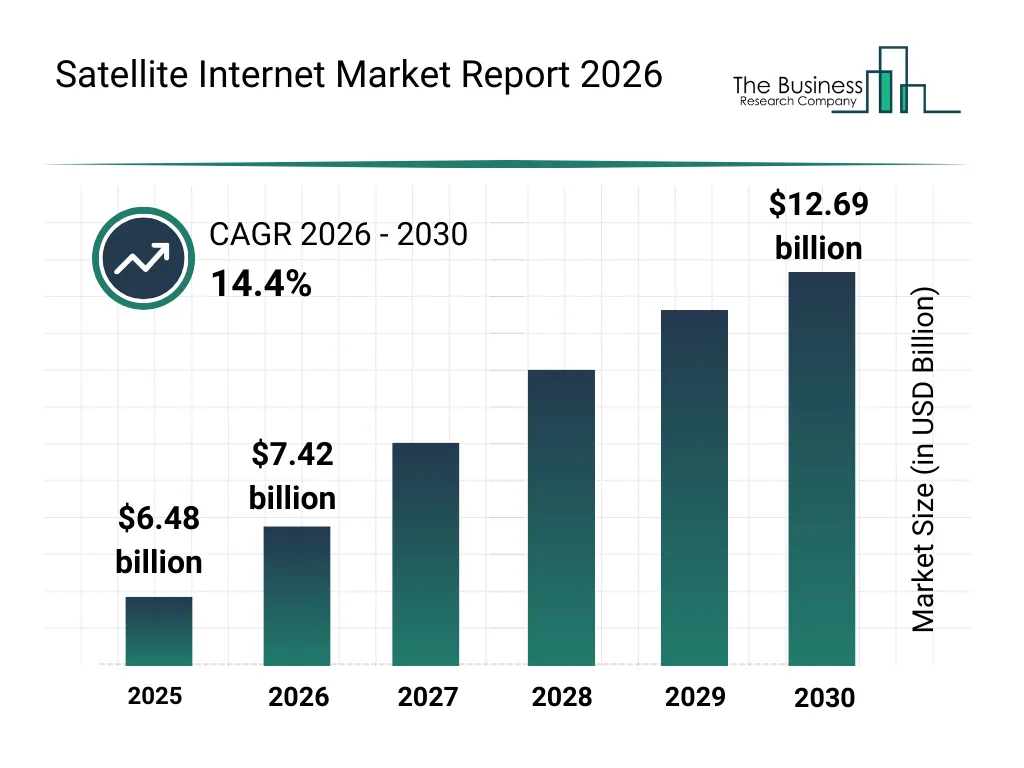
- The global satellite internet market is projected to grow from $6.48 billion in 2025 to $12.69 billion by 2030.
- The market is expected to nearly double in value over the forecast period.
- In 2026, the satellite internet market is estimated to reach $7.42 billion, up from $6.48 billion in 2025.
- The industry is forecast to grow at a strong 14.4% CAGR from 2026 to 2030.
- By 2027, the market size is expected to rise to around $8.49 billion.
- The market is projected to cross $9 billion by 2028, reaching approximately $9.71 billion.
- In 2029, the satellite internet market is expected to exceed $11 billion, reaching $11.11 billion.
- By 2030, the market is forecast to reach $12.69 billion, highlighting strong demand for satellite-based connectivity.
- The steady year-over-year increase shows growing adoption across rural broadband, enterprise connectivity, maritime, aviation, and remote operations.
- The data indicates that satellite internet will remain a fast-growing connectivity segment as demand rises for high-speed internet in underserved and hard-to-reach areas.
Satellite Internet Adoption Growth
- Global satellite broadband adoption accelerated sharply between 2024 and 2026 due to LEO network expansion.
- Starlink reportedly added roughly 20,000 new subscribers per day during peak periods in late 2025.
- Consumer broadband subscriber volumes are projected to grow by more than 150% between 2025 and 2030.
- In the US, satellite internet usage stood near 6% of internet households in 2024.
- Canada recorded approximately 7% satellite internet penetration in 2024, reflecting strong rural demand.
- Analysts expect LEO-based broadband services to drive faster adoption than legacy geostationary satellite systems.
- Falling user terminal prices helped improve accessibility for middle-income households in 2025 and 2026.
- Satellite IoT connectivity markets are forecast to grow at a 26% CAGR through 2030.
- Enterprise demand for backup internet connectivity expanded significantly after weather-related terrestrial outages increased in several regions.
- Remote work adoption continues to increase satellite internet demand in low-density suburban and rural areas.
Satellite Internet Subscriber Trends
- Starlink surpassed an estimated 9 million subscribers globally in 2025.
- Separate industry reports estimated that Starlink’s subscriber base exceeded 2.3 million users by 2026 in confirmed active markets.
- Consumer broadband satellite subscribers are forecast to rise from 6.2 million in 2025 to 15.6 million in 2030.
- Monthly active users for Starlink services more than doubled year over year in Q1 2026.
- Maritime and aviation connectivity subscribers represented one of the fastest-growing commercial customer segments in 2025.
- Hybrid satellite-cellular subscriptions increased among enterprise users seeking network redundancy.
- Satellite internet adoption grew rapidly among RV owners and mobile travelers across North America between 2024 and 2026.
- Industry reports indicate that lower equipment costs improved subscriber retention rates during 2025.
- Average household satellite internet spending in North America remained above $100 per month in 2024, reflecting premium service pricing.
- Subscriber growth increasingly shifted toward emerging markets where terrestrial broadband infrastructure remains underdeveloped.
Regional Share of Satellite Internet Adoption Worldwide
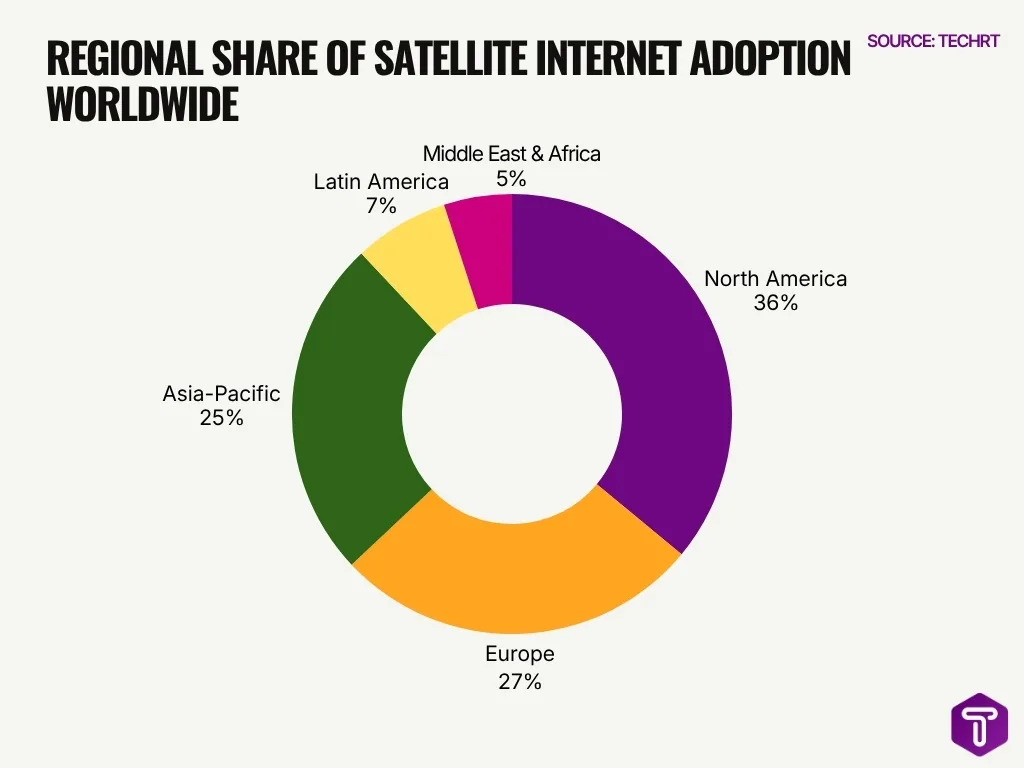
- North America dominates satellite internet adoption with 36% share, making it the leading regional market.
- Europe ranks second with 27% share, showing strong uptake across developed broadband markets.
- Asia-Pacific follows closely with 25% share, highlighting rising adoption across fast-growing digital economies.
- The top three regions, North America, Europe, and Asia-Pacific, together account for 88% of total satellite internet adoption.
- Latin America holds 7% share, showing moderate adoption driven by rural and remote connectivity needs.
- The Middle East & Africa accounts for 5% share, making it the smallest regional segment in the chart.
- Emerging regions, Latin America, and the Middle East & Africa, together represent 12% of satellite internet adoption.
- The gap between Europe at 27% and Asia-Pacific at 25% is only 2 percentage points, suggesting Asia-Pacific is nearly matching Europe’s adoption level.
- The data shows satellite internet adoption is currently concentrated in high-income and infrastructure-ready regions.
- Overall, the chart indicates strong global demand for satellite internet, especially in regions needing rural broadband, remote access, and backup connectivity.
Satellite Internet Adoption by Country
- In the United States, satellite internet reached about 6% household usage in 2024 with a market value of about $0.9 billion.
- In Canada, satellite internet was used by roughly 7% of households in 2024, generating around $645 million in market revenue.
- In Brazil, Starlink’s satellite broadband base grew 85% in 2025 to about 606,000 active accesses, within a fixed‑broadband market of 53.9 million lines.
- In India, the satellite broadband service market reached about $393.6 million in 2025, with 10+ operators seeking licenses under new LEO‑oriented regulations.
- In Indonesia, a 17,000‑island nation where about 33% of villages lack fiber and 57 million people remain offline, Starlink ranks as its 4th‑largest speed‑test sample market.
- In Nigeria, Starlink’s subscriber base climbed to about 65,564 users by Q3 2024, making it the country’s second‑largest ISP and a fast‑growing satellite broadband market.
- In Germany, around 3% of respondents reported using satellite internet at home, supporting a $806 million satellite internet market in 2024.
- In Australia, the Sky Muster satellites were engineered to serve up to 400,000 homes and businesses and had already connected over 100,000 customers in remote regions by 2020.
- In Ukraine, Starlink deployments expanded from about 5,000 terminals in early 2022 to as many as 200,000 by 2025, making it Europe’s largest Starlink user.
- In Japan, KDDI plans to extend Starlink‑backhauled remote base stations to around 1,200 sites, while SoftBank readies OneWeb links with speeds up to 195 Mbit/s.
Rural and Remote Area Adoption
- 58% of the global rural population accessed the internet in 2025, trailing behind the 85% urban adoption rate.
- Rural India accounts for 57% of the country’s active internet users, totaling approximately 548 million people.
- Satellite internet adoption reached 7% in Canada and 6% in the United States during 2024.
- Deploying and maintaining internet infrastructure in remote regions remains 10 to 20 times more expensive than in urban areas.
- The $42.45 billion federal broadband expansion program in the US aims to fund operational networks within a four-year timeline.
- Mobile penetration in rural India sits at 58.8%, significantly lower than the 125.3% rate seen in urban areas.
- Satellite terminal costs can reach up to ₹100,000 per unit for individual users in regions lacking subsidized connectivity.
Satellite Internet Usage Is Led by Residential Customers
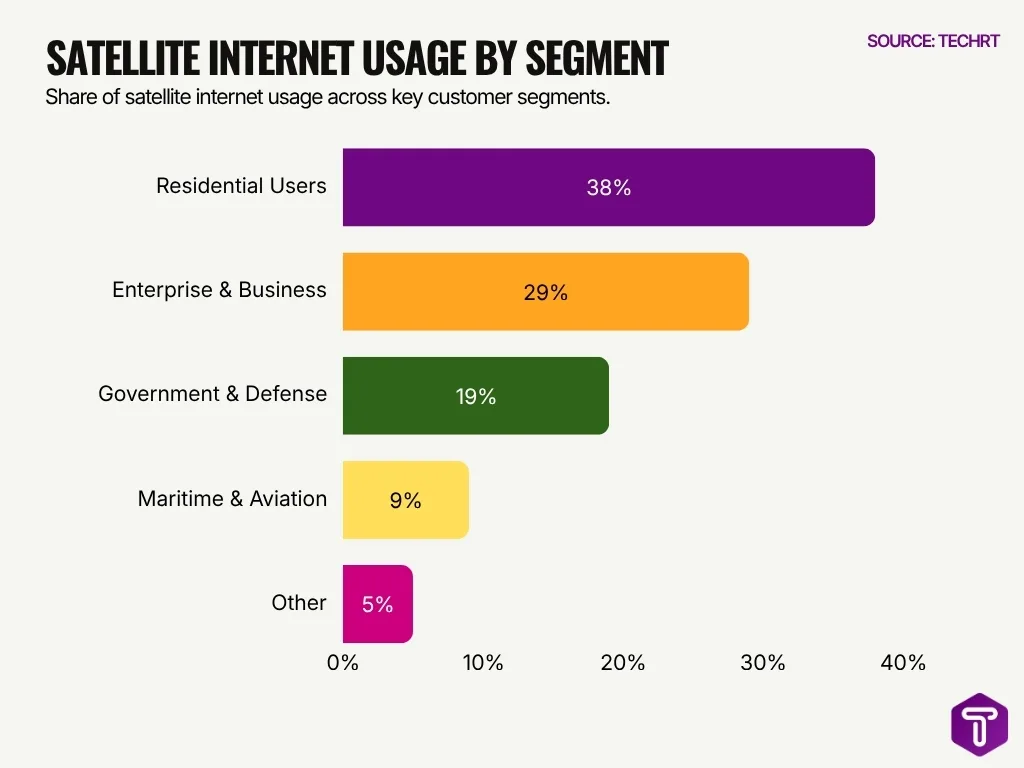
- Residential users represent the largest segment of satellite internet usage, accounting for 38% of the total share.
- Enterprise & business users hold the second-largest share at 29%, showing strong adoption among commercial organizations.
- Government & defense usage makes up 19%, highlighting satellite internet’s importance for secure and remote connectivity.
- Maritime & aviation accounts for 9% of usage, reflecting demand for connectivity across ships, aircraft, and offshore operations.
- The other category represents the smallest share at 5%, covering niche or less-defined satellite internet use cases.
- Combined, residential and enterprise users account for 67% of total satellite internet usage.
- Non-consumer segments, including government, defense, maritime, aviation, and other users, collectively make up 33% of the market.
- The data shows that satellite internet is no longer limited to specialized sectors, with residential users leading adoption across the market.
Enterprise Satellite Internet Adoption
- The enterprise satellite internet market reached $14.56 billion in 2025, growing at a CAGR of 18.1% to 2030.
- Satellite IoT connections hit 10 million globally in 2024, projected to reach 28 million by the end of the decade.
- The oil and gas satellite communication market is valued at $3.86 billion in 2025, with 10.8% CAGR forecast.
- The maritime satellite communication market stood at $8.16 billion in 2026, expanding at 13.58% CAGR.
- The LEO satellite market grew to $11.81 billion in 2025, achieving 11.9% CAGR through 2030.
- The Enterprise VSAT market is projected to grow from $5.6 billion in 2024 to $11.2 billion by 2030.
- Asia-Pacific airlines lead with 95% fleet in-flight WiFi adoption via satellite in 2026.
Satellite Internet Adoption by Industry
- The aviation sector accounted for about 47% of global in‑flight internet traffic in 2024, with satellite‑based connectivity remaining the dominant technology.
- Over 50% of major airlines increased satellite‑based in‑flight connectivity adoption by 2025 as LEO constellations cut latency and improved bandwidth.
- The maritime satellite broadband market reached an estimated $3.2 billion in 2025, driven largely by vessel tracking and crew‑connectivity demand.
- Nearly 60% of large‑scale agricultural operations in remote regions will use satellite internet for precision‑farming systems and IoT‑enabled machinery control by 2024.
- Global mining companies deployed satellite‑based autonomous‑vehicle systems across roughly 35% of large open‑pit and underground sites by 2025.
- The oil and gas satellite‑monitoring segment grew at a CAGR of about 12% between 2023 and 2025, led by offshore‑platform and pipeline deployments.
- Across defense and government users, satellite‑communication investments expanded by over $4.18 billion between 2024 and 2029, with higher‑bandwidth links for drones and remote bases.
- Logistics and transportation firms adopted satellite tracking across around 41% of global shipments, with the satellite‑tracking market valued at $6.8 billion in 2024.
- Satellite‑based telehealth and rural‑health connectivity programs reached an estimated 15% of underserved health facilities in emerging markets by 2025.
- Media and broadcast operators will rely on satellite internet for over 70% of live‑streaming events from remote or temporary locations by 2024.
Satellite Internet Adoption by Frequency Band
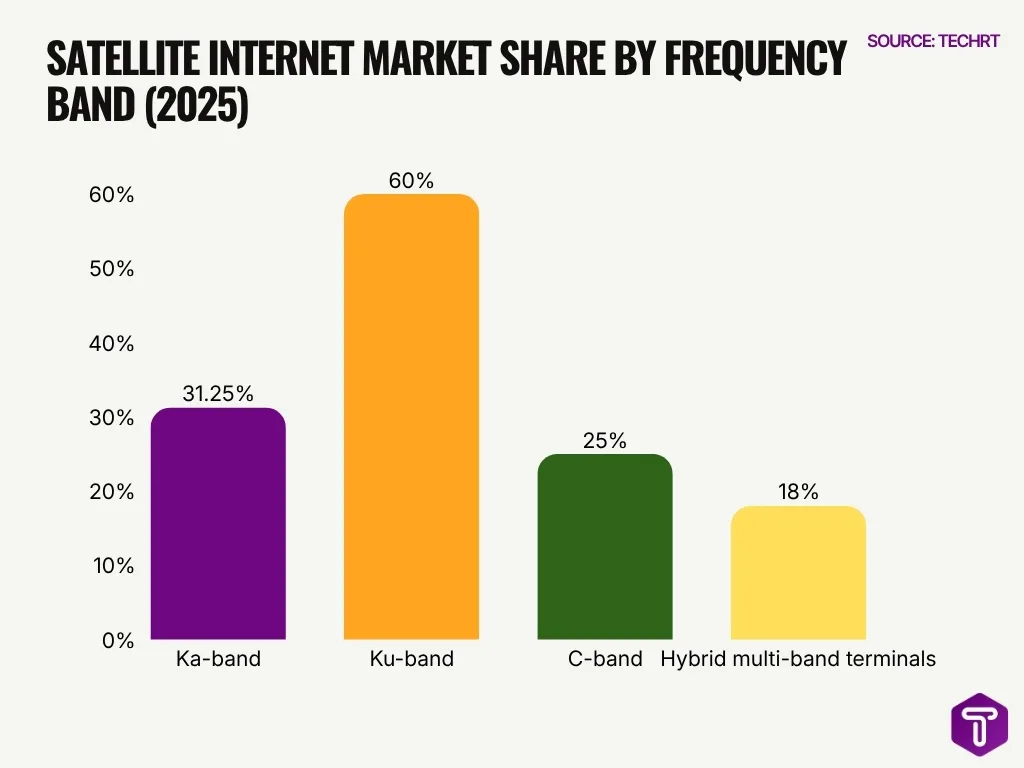
- Ka-band accounted for 31.25% of global satellite internet revenue in 2025.
- Ku-band serves over 60% of maritime and aviation satellite connectivity deployments worldwide.
- C-band supports approximately 25% of weather-resistant communication links in high-rainfall regions.
- Ka-band adoption grew 45% between 2024 and 2026 due to LEO network optimizations.
- Defense agencies allocate around $2.3 billion annually for X-band secure satellite communications.
- Hybrid multi-band terminals now represent 18% of enterprise satellite connectivity installations globally.
- Demand for high-frequency bands rose 38% in 2025, driven by streaming and cloud workloads.
- 5G non-terrestrial networks will integrate satellite spectrum in over 12 countries by early 2026.
- Analysts project Ka-band will maintain over 40% market dominance through 2030.
- Aviation providers installed Ka-band and Ku-band systems on more than 8,500 aircraft by 2025.
Satellite Internet Adoption by Orbit Type
- LEO‑based satellite internet services captured over 55% of new satellite broadband subscribers between 2024 and early 2026.
- Low Earth orbit constellations now account for roughly 70% of active communication satellites in orbit by early 2026.
- Starlink’s LEO fleet exceeded 8,000 operational satellites by early 2026, representing more than 40% of all active LEO broadband spacecraft.
- Latency on leading LEO networks averages under 40 milliseconds, making them suitable for real‑time applications.
- GEO satellites still cover over 80% of satellite‑based broadcast and maritime traffic despite slower growth.
- Multi‑orbit satellite architectures are projected to carry over 30% of global satellite internet traffic by 2030.
- MEO‑based services now support around 25% of aviation and maritime broadband links where latency and coverage must be balanced.
- LEO satellite broadband revenues are expected to reach approximately 15 billion dollars annually by 2026.
- LEO adoption in disaster‑response deployments grew at a CAGR above 25% between 2024 and 2026.
- Satellite internet subscribers are forecast to surpass 15 million globally by the end of 2026, with LEO services contributing over 60% of new sign‑ups.
Satellite Internet Adoption by Speed Tier
- Average satellite internet download speeds surpassed 100 Mbps in several major markets during 2025.
- Premium residential satellite plans increasingly offer speeds between 150 Mbps and 250 Mbps.
- Enterprise satellite internet packages frequently exceeded 500 Mbps for maritime and aviation customers.
- Legacy GEO satellite services generally delivered lower average speeds compared to modern LEO systems.
- Demand for high-speed satellite plans increased as remote work and cloud applications expanded globally.
- Rural households are increasingly upgrading from basic 25 Mbps plans to higher-speed streaming-capable packages.
- Low-latency gaming and 4K streaming accelerated the adoption of premium speed tiers in North America and Europe.
- Business users prioritized symmetrical upload and download speeds for cloud collaboration and remote operations.
- Speed-based pricing models became more common among satellite providers during 2025 and 2026.
- Analysts expect gigabit-capable satellite services to emerge commercially before 2030.
Global Satellite Internet Provider Market Share
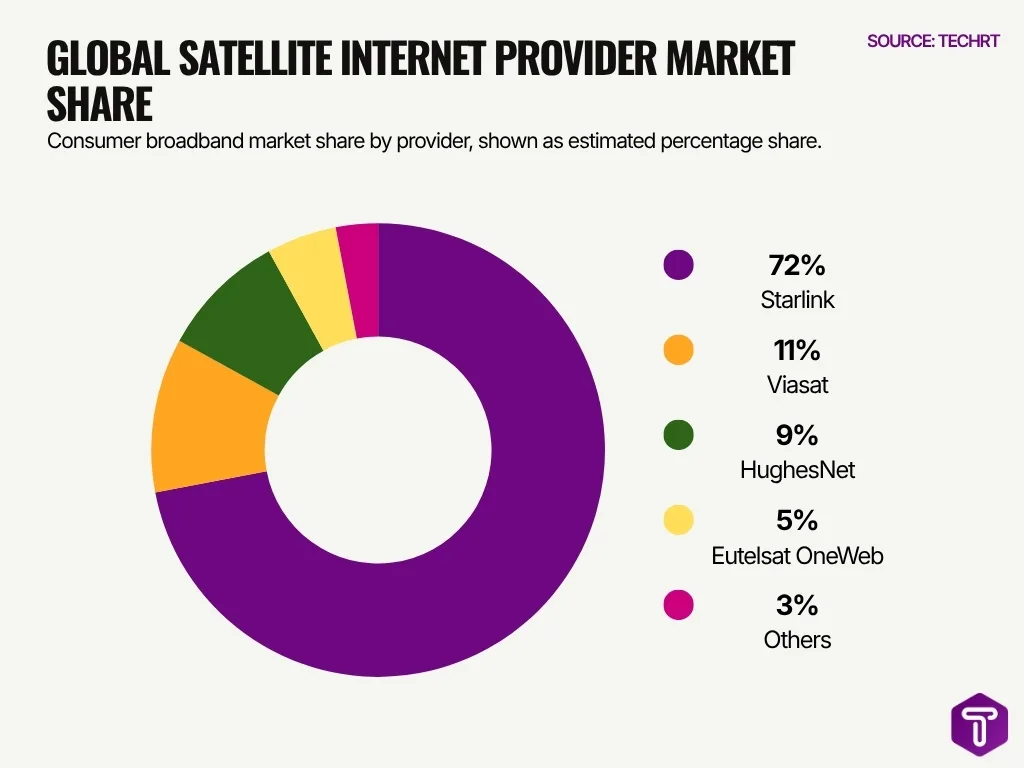
- Starlink dominates the global satellite internet consumer broadband market with an estimated 72% share.
- Viasat holds the second-largest position, but its share is much smaller at 11%.
- HughesNet follows closely behind Viasat with an estimated 9% market share.
- Eutelsat OneWeb accounts for 5% of the consumer broadband provider market.
- Other providers together represent only 3%, showing that the market is highly concentrated among a few major players.
- The gap between Starlink and Viasat is significant, with Starlink leading by 61 percentage points.
- Combined, Viasat, HughesNet, Eutelsat OneWeb, and other providers make up just 28% of the market.
- The data shows that Starlink’s LEO satellite network has become the strongest force in consumer satellite broadband adoption.
- Traditional satellite broadband players such as Viasat and HughesNet remain relevant, but their combined share is only 20%.
- The market structure highlights a clear leader-heavy competitive landscape, with Starlink far ahead of all other providers.
Satellite Internet Constellation Growth
- More than 10,000 active satellites orbited Earth by 2025, with broadband constellations driving most of the growth.
- Starlink alone accounted for roughly two‑thirds of all orbital launches devoted to broadband satellite deployment as of 2025.
- Industry forecasts project the global satellite internet constellations market to reach around $80 billion by 2033, up from $25 billion in 2025.
- Analysts estimate that the space industry is on track to launch about 58,000 satellites by 2030, with most belonging to broadband LEO constellations.
- Starlink already provides service across over 100 countries and territories, serving tens of millions of broadband subscribers worldwide.
- Amazon’s Project Kuiper plans to deploy more than 3,200 satellites, with half of them expected in orbit by mid‑2026.
- Reusable rocket flights reduced launch costs by roughly 50–70% compared with conventional expendable rockets between 2020 and 2025.
- Global satellite internet subscriber numbers are projected to swell from about 6.2 million in 2025 to 15.6 million by 2030.
- Current deorbit and mitigation guidelines require most LEO satellites to be removed within 25 years after mission end, with stricter rules emerging for large constellations.
- Modular production and mass‑manufacturing techniques have cut satellite build times from months to weeks for many new broadband‑focused operators.
Satellite Internet Use Cases
- Remote work drove residential satellite internet adoption, with 6.2 million consumer broadband subscribers rising to 15.6 million by 2030.
- Airlines used satellite broadband for passenger Wi-Fi, and the in-flight internet market is projected to reach $2.87 billion by 2034.
- Maritime operators relied on satellite connectivity, with the maritime satellite communication market valued at $8.16 billion in 2026.
- Emergency response teams used portable satellite systems, and the space-based disaster response market was worth about $1.5 billion in 2023.
- Rural schools benefited from satellite access, while India had about 1,002.85 million internet subscribers in April–June 2025.
- Precision agriculture uses satellite internet, with agriculture satellite data services forecast to grow at 22.98% CAGR.
- Defense organizations invested in satellite broadband, with the defense satellite communication market expected to reach $6.58 billion in 2026.
- Smart transportation uses satellite networks, with more than 10 million IoT devices projected to depend on satellite links by 2025.
Key Challenges Slowing Satellite Internet Adoption
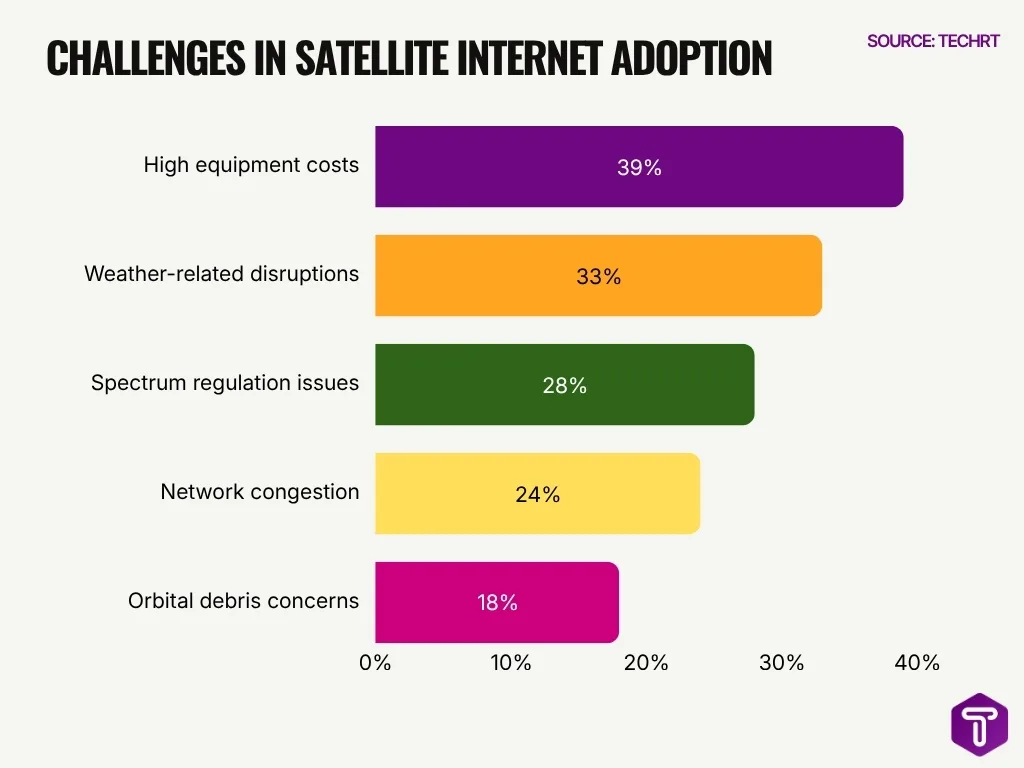
- High equipment costs are the biggest barrier, affecting 39% of adoption challenges, making affordability a major concern for many users.
- Weather-related disruptions account for 33%, showing that rain, storms, and extreme weather can still impact satellite internet reliability.
- Spectrum regulation issues represent 28%, highlighting the role of government policies, licensing, and frequency allocation in slowing deployment.
- Network congestion makes up 24%, suggesting that rising user demand can affect speed and service quality in high-usage areas.
- Orbital debris concerns account for 18%, reflecting growing safety and sustainability risks as more satellites are launched into orbit.
- The data shows that cost and service reliability are the two most significant adoption barriers, with high equipment costs at 39% and weather disruptions at 33%.
- Regulatory and technical issues, including spectrum rules, congestion, and orbital debris, together show that satellite internet adoption depends on both market affordability and infrastructure management.
Frequently Asked Questions (FAQs)
What is the projected size of the satellite internet market in 2030?
What CAGR is expected for the satellite internet market?
How many satellite internet subscribers are forecast to be by 2030?
How many satellites does Starlink operate in 2026?
What share of the satellite internet market does North America hold?
Conclusion
Satellite internet adoption accelerated sharply as low Earth orbit networks improved broadband speeds, reduced latency, and expanded service availability worldwide. Residential households, airlines, shipping companies, rural healthcare providers, and industrial operators increasingly adopted satellite connectivity to solve coverage gaps and improve operational resilience. At the same time, strong investment in satellite constellations, government broadband initiatives, and hybrid 5G integration continue pushing the market toward mainstream adoption.
However, the industry still faces challenges tied to affordability, orbital congestion, regulation, and infrastructure sustainability. Even so, current market forecasts suggest satellite internet will play a larger role in global connectivity throughout the next decade, especially in underserved and geographically remote regions.

Leave a comment
Have something to say about this article? Add your comment and start the discussion.