




Remote work has shifted from a temporary response to a long-term strategy that shapes how organizations operate, hire, and scale. Companies now use distributed teams to cut real estate costs, access global talent, and maintain business continuity, while employees benefit from flexible schedules and reduced commuting. This shift plays a critical role across industries, from tech firms building remote-first teams to enterprises redesigning hybrid workplace policies. As remote work continues to influence productivity, hiring, and employee well-being, understanding the latest data becomes essential. Let’s explore the key statistics defining remote work.
Editor’s Choice
- 22.8% of U.S. employees work remotely at least part-time, representing over 36 million workers.
- Around 52% of the global workforce now participates in remote work in some form in 2026.
- The U.S. is projected to reach 32.6 million remote workers, about 22% of the workforce.
- Remote workers are 13% more productive compared to in-office employees.
- Nearly 80% of remote-capable employees now work either hybrid or fully remote.
- 98% of remote workers want to continue working remotely for the rest of their careers.
- Remote employees save an average of 72 minutes per day on commuting globally.
Recent Developments
- Remote work adoption has stabilized at 17.9%–23.8% in the U.S. since 2022, indicating long-term normalization.
- Remote job postings increased by 3% in late 2025, signaling renewed hiring momentum.
- About 88% of U.S. employers now offer hybrid work options.
- Only 30% of companies plan to eliminate remote work by 2026.
- Remote work has expanded by over 30 percentage points in some industries since 2019.
- Over 40 million digital nomads exist globally, reflecting cross-border work growth.
- More than 50% of companies plan to increase international hiring, enabled by remote work.
- Remote work has become standard across 40+ countries, showing global adoption consistency.
Global Remote Work Statistics
- 27% of full-time employees globally work fully remote, while 52% follow hybrid models.
- Only 16% of companies worldwide operate as fully remote organizations.
- About 44% of companies globally still do not allow remote work at all.
- Remote work participation increased from 20% in 2020 to over 50% in 2026 globally.
- Remote work penetration varies widely by region, with developed economies leading adoption.
- The U.S. alone accounts for over 18 million digital nomads, a 147% increase since 2019.
- In India, 60–90 million workers are expected to work remotely by 2025.
- Remote work continues to expand global talent pools, enabling hiring across borders at scale.
Remote Work Adoption by Education Level in the U.S.
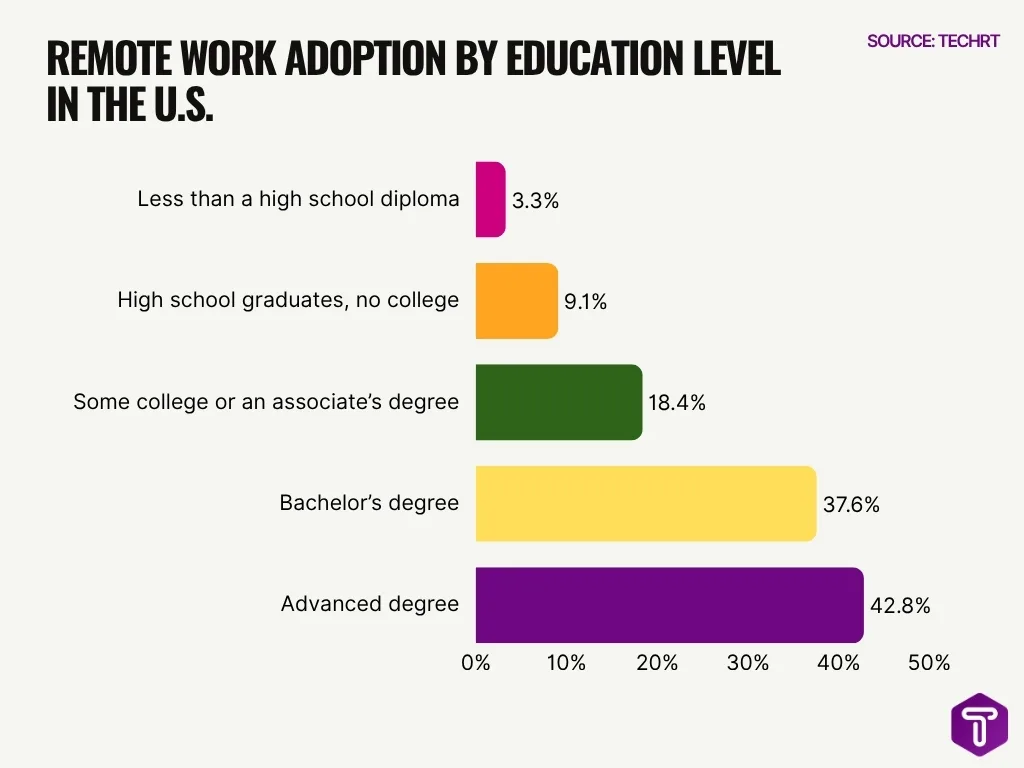
- Remote work adoption rises sharply with education level, highlighting a strong correlation between qualifications and access to flexible work opportunities.
- Employees with an advanced degree lead at 42.8%, making them the most likely group to work remotely.
- Those holding a bachelor’s degree follow closely at 37.6%, indicating that higher education significantly increases remote work participation.
- Workers with some college or an associate’s degree show a moderate adoption rate of 18.4%, reflecting limited but growing access.
- Among high school graduates with no college education, only 9.1% work remotely, showing a significant gap compared to degree holders.
- The lowest adoption is seen among individuals with less than a high school diploma at just 3.3%, highlighting a major digital and occupational divide.
- Overall, the data reveals a clear educational divide, where individuals with higher qualifications are 10x–13x more likely to work remotely compared to those with minimal education.
Number of Remote Workers
- Over 36 million Americans work remotely at least part-time.
- Around 34.3 million U.S. workers worked remotely in 2025.
- The U.S. is projected to maintain 32.6 million remote workers through 2025–2026.
- Globally, remote workers now represent over half of the workforce in some capacity.
- The number of digital nomads has reached 40+ million worldwide.
- Remote workforce growth in the U.S. reflects a 417% increase since pre-2020 levels.
- About 26% of remote-capable U.S. employees work fully remote.
- Remote workforce participation continues to expand globally as companies adopt distributed hiring models.
Hybrid vs Fully Remote
- Around 52% of remote-capable employees globally now work in hybrid setups, making it the dominant model.
- Only 27% of workers are fully remote worldwide, reflecting a preference for flexibility with structure.
- In the U.S., roughly 34% of remote workers operate in hybrid roles, while about 26% are fully remote.
- Nearly 74% of companies prefer hybrid work over fully remote models for long-term operations.
- Fully remote roles attract 2–3x more applicants compared to hybrid roles.
- About 68% of executives believe hybrid work improves collaboration compared to fully remote teams.
- Employees in hybrid roles report higher job satisfaction (up to 15%) compared to fully on-site workers.
- Over 60% of knowledge workers prefer hybrid arrangements over fully remote setups.
- Companies adopting hybrid work report reduced attrition by 20–25% compared to rigid office-only models.
Flexible Work Trends by Industry
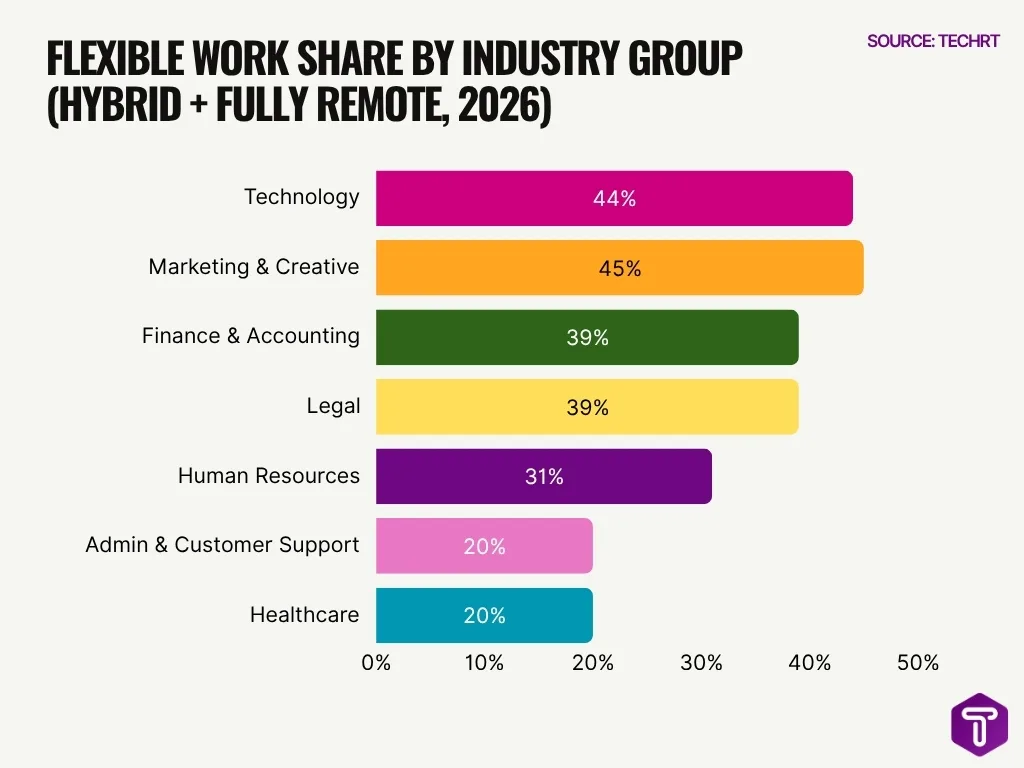
- Marketing & Creative leads all sectors with the highest flexible work adoption at 45%, indicating strong alignment with remote-friendly workflows.
- Technology follows closely with 44%, reinforcing its position as one of the most remote-enabled industries globally.
- Finance & Accounting and Legal sectors show identical adoption levels at 39%, highlighting a growing shift toward flexible work even in traditionally structured roles.
- Human Resources records a moderate 31%, suggesting partial adoption as HR functions balance operational and people-facing responsibilities.
- Admin & Customer Support roles have significantly lower flexibility at 20%, reflecting the need for real-time coordination and service availability.
- Healthcare ranks lowest alongside admin roles at 20%, due to the inherently on-site and hands-on nature of medical services.
- The gap between the highest (45%) and lowest (20%) sectors is 25 percentage points, showcasing a substantial disparity in remote work feasibility across industries.
- Overall, knowledge-based and digital-first industries dominate flexible work adoption, while service-oriented and physical roles lag behind.
Remote Work Trends
- Remote job postings still account for over 15% of all job listings in 2026, down from pandemic peaks but stable.
- Around 70% of employees say remote work options influence their decision to stay with an employer.
- The global remote work software market is projected to reach $58 billion by 2027.
- More than 80% of companies now use at least one remote collaboration tool daily.
- Async communication adoption has increased by over 30% since 2022.
- Companies report a 25% increase in cross-border hiring due to remote work flexibility.
- Remote-first companies grow 2x faster in hiring compared to traditional office-based firms.
- The demand for digital nomad visas has risen by over 40% globally since 2023.
- About 67% of managers now receive training on leading remote or hybrid teams.
Remote Work by Demographics
- Workers aged 25–34 are the most likely to work remotely, representing over 35% of remote employees.
- About 48% of college-educated workers have remote-capable jobs, compared to 9% without degrees.
- Men and women participate in remote work at similar rates, though women show a slightly higher preference (by 5–7%).
- Parents are 20% more likely to prefer remote work due to childcare flexibility.
- High-income workers are 3x more likely to work remotely than low-income workers.
- Urban workers show slightly lower remote participation compared to suburban workers due to industry distribution.
- Gen Z workers increasingly demand flexibility, with 75% preferring hybrid or remote roles.
- Workers with disabilities are 2x more likely to seek remote jobs for accessibility reasons.
- Minority groups report improved access to opportunities through remote work, with 30% citing expanded job access.
Remote Work Productivity
- Remote workers are 13% more productive than office-based employees in controlled studies.
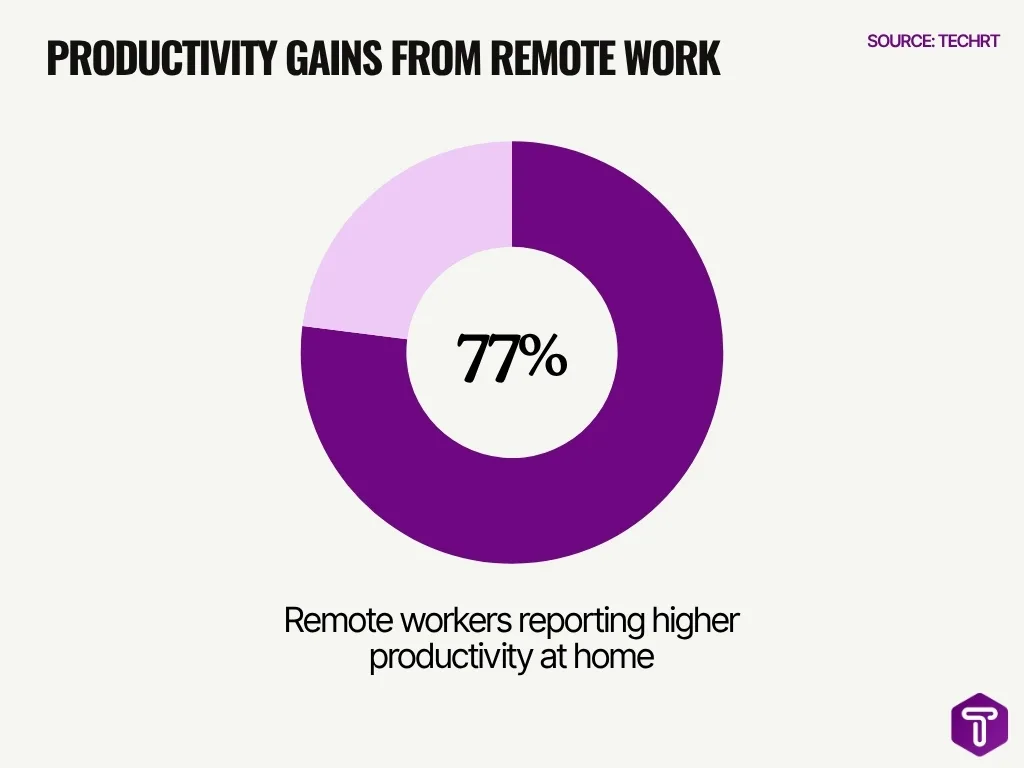
- About 77% of remote workers report higher productivity when working from home.
- Companies adopting remote work report a 20–25% increase in productivity overall.
- Employees working remotely take fewer breaks and sick days, boosting output by 5–10%.
- Remote employees work an average of 1.4 more days per month compared to office workers.
- Hybrid workers report balanced productivity gains, with fewer burnout symptoms.
- Around 65% of managers say remote work has had a positive impact on team productivity.
- Workers with flexible schedules are 29% more likely to report high performance levels.
- Remote work reduces workplace distractions, with 54% of employees citing fewer interruptions.
Employee Preferences
- 98% of employees want to work at least part-time for the rest of their careers.
- Around 65% prefer hybrid work, while only 15% prefer fully remote setups.
- About 57% of employees would consider quitting if remote flexibility is removed.
- Workers rank flexibility as the top job benefit, above salary, in some surveys.
- Nearly 76% of employees say flexible work improves job satisfaction.
- Employees save an average of $4,000 annually by working remotely.
- Over 80% of workers say remote work improves their overall happiness.
- Around 70% of employees want employers to continue offering remote work options.
- Remote work policies influence job application decisions for 60%+ of candidates.
Work-Life Balance Impact
- Remote workers report a 71% improvement in work-life balance compared to office-based roles.
- Employees save an average of 72 minutes daily by avoiding commutes, which they reinvest in personal time.
- About 84% of remote workers say flexible schedules help them better manage family responsibilities.
- Nearly 78% of workers report reduced stress levels when working remotely.
- Parents working remotely spend 30% more time with children compared to office workers.
- Remote employees are 20% more likely to exercise regularly due to flexible schedules.
- Around 67% of workers say remote work improves overall life satisfaction.
- Employees working from home report less burnout from commuting, a top stress factor pre-2020.
- Flexible work reduces time pressure, with 64% of employees reporting better time control.
High-Paying Remote Jobs with $100K+ Salaries
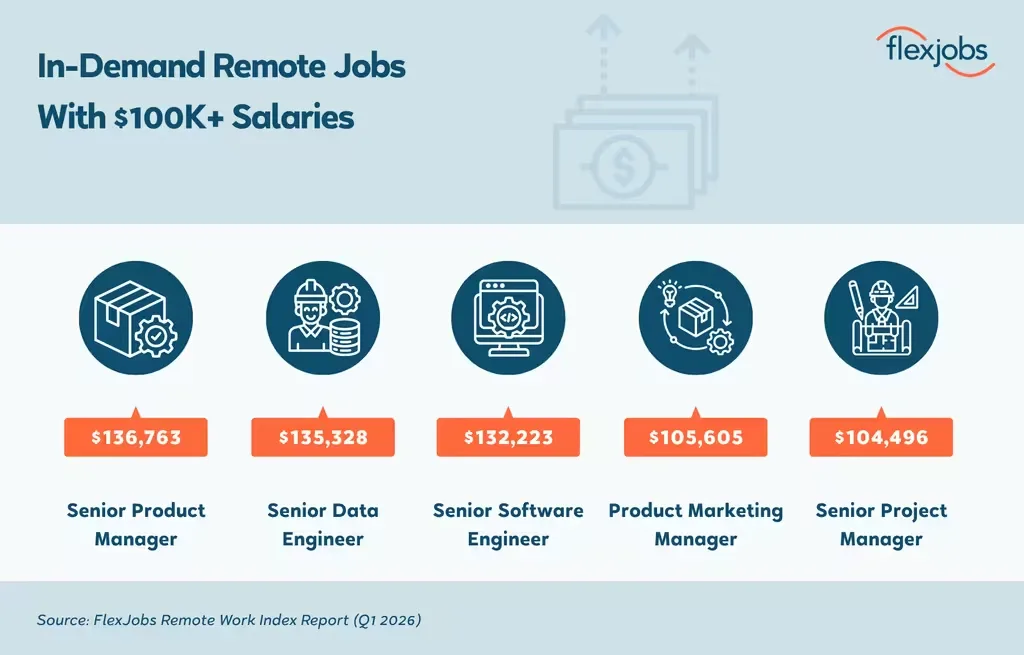
- Senior Product Manager tops the list with an average salary of $136,763, making it the highest-paying remote role among the top five.
- Senior Data Engineer follows closely at $135,328, highlighting the strong demand for data infrastructure and analytics expertise.
- Senior Software Engineer earns around $132,223, reinforcing that software development remains one of the most lucrative remote career paths.
- There is a noticeable salary gap, with Product Marketing Manager earning $105,605, indicating lower compensation compared to core technical roles.
- Senior Project Manager rounds out the list at $104,496, still comfortably above the $100K benchmark for high-paying remote jobs.
- The top three roles (Product Manager, Data Engineer, Software Engineer) all exceed $130K, showing that technical and product-focused roles dominate high-income remote opportunities.
- Overall, all listed roles offer salaries above $100,000, confirming a strong trend toward high-paying remote positions in specialized and senior-level roles.
- The salary difference between the highest and lowest roles is over $32,000, indicating significant earning variation depending on skill specialization and role type.
Cost Savings from Remote Work
- Remote employees save between $2,000 and $6,000 annually on commuting, meals, and work attire.
- Employers save an average of $11,000 per employee per year by allowing remote work.
- Companies can reduce office space costs by up to 30% with hybrid models.
- Businesses adopting remote work report lower utility and maintenance expenses by 20%.
- Remote work reduces absenteeism costs by up to 63%.
- Employees working remotely spend less on transportation (up to 70% savings).
- Organizations report real estate savings in the billions globally due to downsizing offices.
- Hybrid work reduces travel-related expenses by over 50% for many firms.
- Remote work enables hiring in lower-cost regions, reducing salary expenses by 10–30%.
Return-to-Office Mandates
- Around 60% of large U.S. companies have implemented some form of return-to-office policies.
- Nearly 30% of employees resist full-time office returns and prefer hybrid work.
- Companies enforcing strict RTO policies see higher attrition rates (up to 15%).
- About 68% of executives support hybrid over full in-office mandates.
- Only 12% of companies require a full-time office presence as of 2026.
- Employees facing RTO mandates are 2x more likely to seek new jobs.
- Around 55% of organizations have adjusted policies after employee pushback.
- Remote flexibility remains a top retention factor for over 70% of workers.
- Companies adopting flexible RTO strategies report higher employee engagement (by 20%).
How Workers Allocate Their Time Across Tasks
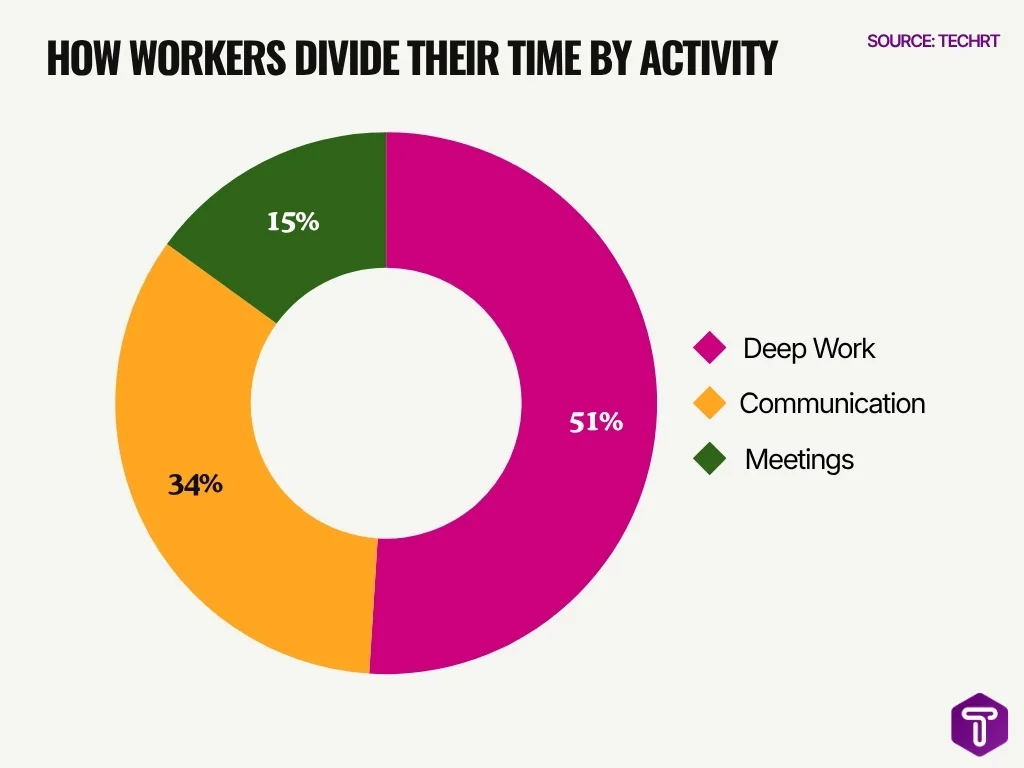
- Deep Work dominates productivity, accounting for 248,214 hours (51%), making it the largest share of total work time.
- Communication activities take up 163,013 hours (34%), highlighting the significant role of collaboration in modern workflows.
- Meetings consume 70,716 hours (15%), representing the smallest but still substantial portion of time allocation.
- More than half of all working hours (51%) are spent on focused, high-value tasks, indicating a strong emphasis on productivity-driven work.
- However, a combined 49% of time is spent on communication and meetings, showing that nearly half of work time is non-deep work.
- The ratio of deep work to meetings is over 3:1, emphasizing that focused work significantly outweighs meeting time.
- With a total of 481,943 hours tracked, the data reflects a balanced but collaboration-heavy work environment.
Remote Work Hiring Trends
- Remote job applications receive 2.5x more applicants than in-office roles.
- About 50% of companies now hire internationally due to remote work capabilities.
- Remote hiring reduces time-to-hire by up to 30%.
- Over 70% of HR leaders say remote work expands access to top talent.
- Companies offering remote roles see higher diversity in hiring pools (up to 35%).
- Startups hiring remotely grow teams 2x faster than traditional firms.
- Around 60% of job seekers prioritize remote-friendly employers.
- Remote roles account for over 15% of total job postings in 2026.
- Employers report lower hiring costs (by 20–40%) when recruiting remotely.
Technology and Tools Usage in Remote Work
- Over 80% of remote teams rely on collaboration tools like Slack and Zoom daily.
- The video conferencing market is expected to exceed $20 billion by 2027.
- Around 67% of companies use project management tools such as Asana or Trello.
- Cloud adoption among remote teams has increased by over 40% since 2021.
- Employees spend an average of 3–5 hours per week in virtual meetings.
- AI-powered productivity tools adoption has grown by over 25% in remote teams.
- Cybersecurity spending increased by over 15% due to remote work risks.
- About 72% of companies provide stipends for home office equipment.
- Remote teams report improved collaboration efficiency (by 20%) using digital tools.
Key Remote Work Challenges
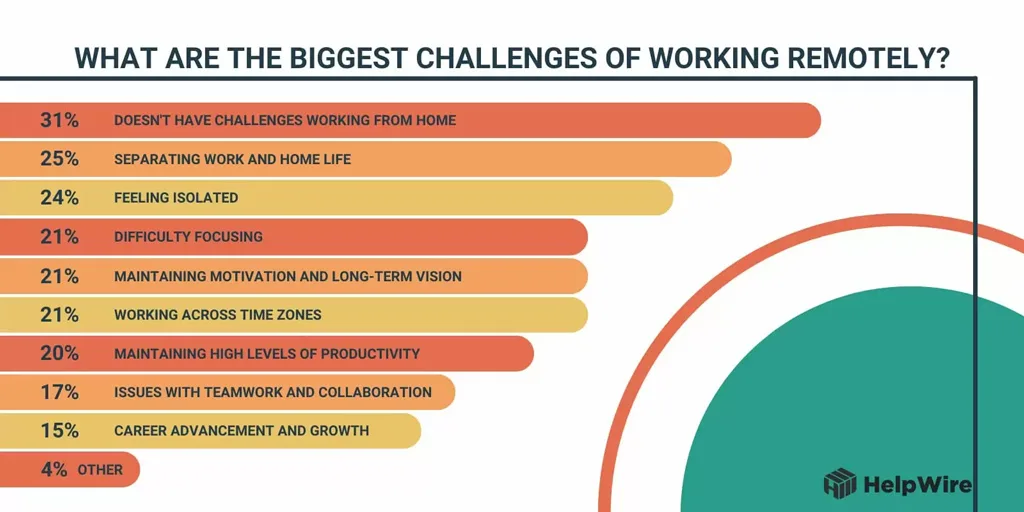
- A significant 31% of workers report no major challenges while working remotely, indicating that nearly one-third have successfully adapted to remote environments.
- The biggest struggle among remote employees is separating work and home life (25%), highlighting ongoing issues with work-life boundaries in remote setups.
- Close behind, 24% of workers feel isolated, emphasizing the social and psychological impact of remote work.
- Around 21% face difficulty focusing, showing that distractions at home continue to affect productivity and concentration.
- An equal 21% struggle with maintaining motivation and long-term vision, suggesting challenges in self-discipline and goal alignment without in-office structure.
- Another 21% report issues with working across time zones, reflecting coordination challenges in globally distributed teams.
- Approximately 20% find it difficult to maintain high productivity levels, reinforcing concerns around efficiency in remote settings.
- 17% experience issues with teamwork and collaboration, indicating gaps in communication and team synergy in virtual environments.
- Only 15% cite career advancement and growth as a challenge, suggesting that while present, it is a less immediate concern compared to daily workflow issues.
- A small 4% fall under “other” challenges, showing that most remote work issues are concentrated within a few key categories.
Mental Health and Burnout
- About 45% of remote workers report experiencing burnout despite flexibility.
- Isolation remains a concern, with 23% citing loneliness as the biggest challenge of remote work.
- Employees working remotely are 32% less likely to experience workplace-related stress than office workers.
- Around 41% of employees struggle with boundaries between work and personal life.
- Companies offering mental health support see a 25% reduction in burnout rates.
- Remote workers who lack structured schedules are 2x more likely to report anxiety.
- About 70% of employees say flexible work improves mental well-being overall.
- Workers with regular virtual check-ins report 20% lower burnout levels.
- Remote work has increased demand for mental health apps by over 35% since 2022.
Frequently Asked Questions (FAQs)
What percentage of U.S. employees work remotely in 2026?
How many Americans are expected to work remotely?
What share of jobs can be done remotely in the U.S.?
What percentage of employees with remote-capable jobs work hybrid or fully remote?
What percentage of paid workdays are now done from home?
Conclusion
Remote work has moved beyond a temporary shift and now anchors how companies hire, operate, and scale. The data shows a clear preference for hybrid models, steady productivity gains, and strong employee demand for flexibility. At the same time, organizations continue to refine policies to address burnout, communication gaps, and return-to-office pressures.
Looking ahead, remote work will likely evolve into more structured hybrid ecosystems supported by advanced collaboration tools and global hiring strategies. Companies that balance flexibility with clear systems will attract stronger talent and maintain long-term performance. For professionals and businesses alike, understanding these trends is essential to staying competitive in a rapidly changing work environment.

Leave a comment
Have something to say about this article? Add your comment and start the discussion.