




APIs now power nearly every digital experience consumers use each day, from mobile banking and food delivery apps to AI chatbots and connected healthcare systems. Businesses rely on APIs to connect software platforms, automate workflows, and deliver real-time data across cloud environments. At the same time, AI companies increasingly depend on APIs to distribute models and services at scale, making APIs a core layer of modern software infrastructure.
The API economy has expanded rapidly and continues to grow as enterprises invest in AI integrations, cloud-native development, and API-first software strategies. This article explores the latest API usage and growth statistics, including market size, adoption trends, API traffic volumes, and enterprise implementation patterns shaping the global technology landscape.
Editor’s Choice
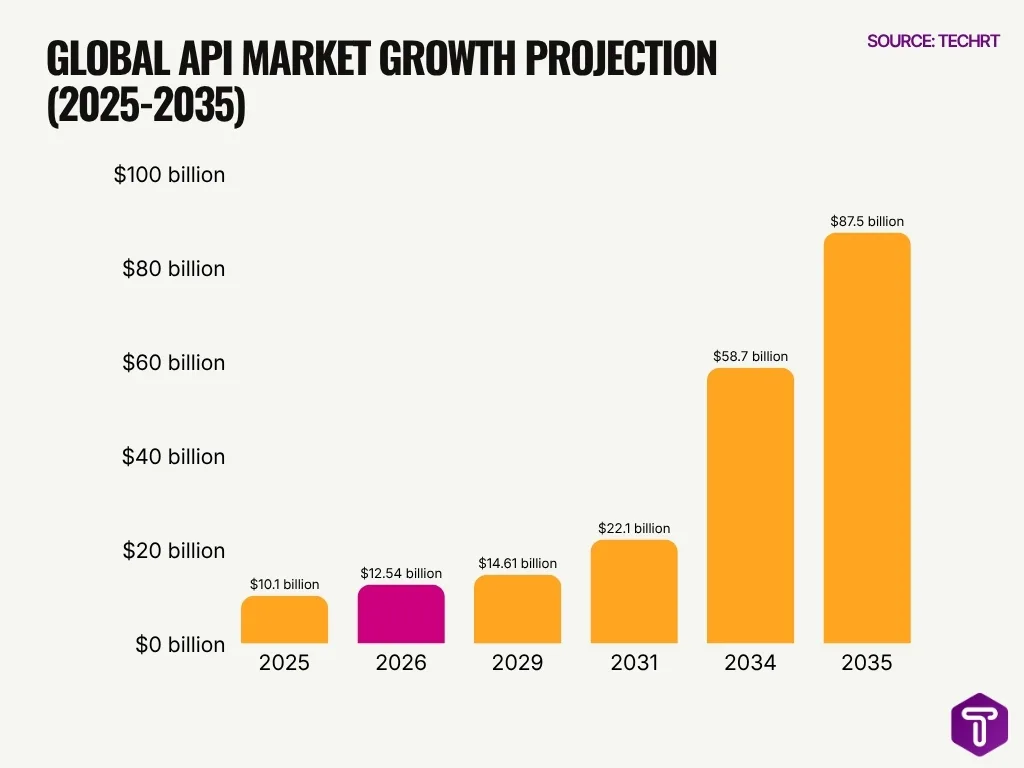
- The global API market was valued at $10.1 billion in 2025 and could reach $87.5 billion by 2035, growing at a 24.1% CAGR.
- Around 82% of organizations now follow some level of an API-first strategy, while 25% identify as fully API-first in 2025.
- API-first adoption increased by 12% year over year between 2024 and 2025 as enterprises accelerated AI and automation projects.
- Fastly reported processing approximately 1.8 trillion requests per day across its edge network infrastructure in 2025.
- North America accounted for roughly 42.1% of the API management market share in 2024, maintaining leadership in enterprise API adoption.
- Nearly 89% of developers expect API usage to continue increasing as organizations expand cloud and AI workloads.
- Businesses using AI-related APIs and integrations increased sharply in 2025, with enterprise spending on OpenAI products reaching record levels among US companies.
Recent Developments
- Enterprise AI adoption pushed API demand higher in 2025, with companies increasingly treating API strategies as part of their broader AI infrastructure planning.
- Postman reported that 93% of API teams still experience collaboration bottlenecks despite rising API maturity levels.
- Organizations managing APIs now commonly operate 50 or more APIs across internal, partner, and public environments.
- Businesses integrating SaaS tools estimate that 85% of enterprise applications will be SaaS-based by 2025, increasing API dependency across workflows.
- API management vendors expanded security investments in 2025 as API attacks and bot-driven traffic continued to rise globally.
- Cloudflare observed major growth in AI-related crawler and automated API traffic during 2025 across global web infrastructure.
- Usage-based API pricing models gained momentum in late 2025 as platforms shifted away from fixed-rate developer pricing structures.
- AI-enabled APIs for text generation, predictive analytics, and computer vision saw accelerated enterprise integration throughout 2025.
- Open-source API platforms experienced stronger enterprise adoption as businesses focused on flexible integration architectures and lower infrastructure costs.
Global API Market Size and Value
- The API market reached approximately $10.1 billion in 2025, reflecting strong enterprise demand for digital integration infrastructure.
- Analysts project the global API industry could surpass $87 billion by 2035 if current enterprise adoption trends continue.
- The API management market alone was valued at $8.86 billion in 2025.
- API management revenue may increase to $22.1 billion by 2031, supported by multi-cloud and AI workloads.
- Another market forecast estimates the API management sector could grow from $7.1 billion in 2025 to $58.7 billion by 2034.
- Technavio forecasted that the API management market could expand by $3.75 billion between 2024 and 2029.
- API security remains one of the fastest-growing API segments due to increased exposure of public-facing endpoints.
- Data integration markets tied closely to APIs are expected to reach $15.24 billion in 2026.
- Specialized API categories such as number verification APIs generated approximately $3.8 billion in market value during 2025.
API Adoption Rates Among Businesses
- Around 83% of businesses use APIs to maximize returns from digital assets and connected services in 2026.
- Enterprise API adoption rose from roughly 68% in 2022 to more than 84% in 2023, with further increases through 2025.
- Large enterprises are estimated to have surpassed 90% API adoption by 2025 as APIs have become central to cloud operations.
- Approximately 71% of digital businesses now consume third-party APIs as part of everyday operations.
- Organizations increasingly depend on APIs to connect SaaS ecosystems, automation tools, and AI services across departments.
- API adoption in healthcare and banking accelerated faster than in many other sectors due to digital compliance requirements and customer demand.
- Businesses using API analytics tools reported up to 20% higher API adoption rates internally.
- Companies implementing API-led architectures achieved stronger operational efficiency and faster software integration timelines.
- Organizations increasingly prioritize APIs as revenue-driving digital products rather than backend development components.
API-First Development Statistics
- Around 82% of organizations adopted an API-first approach in 2025, compared with lower adoption rates in earlier years.
- Fully API-first organizations represented 25% of surveyed enterprises in 2025.
- API-first adoption rose from 66% in 2023 to 82% in 2025, highlighting rapid modernization efforts.
- Enterprises using API-first models reported significantly faster deployment cycles and improved developer collaboration.
- Companies embracing API-first development achieved approximately 43% faster time-to-market for new product features.
- API-first organizations also reported roughly 38% lower development costs over three years.
- Modern applications now commonly rely on 26 to 50 APIs to deliver features and integrations.
- AI-driven software development has increased interest in API-first design because AI agents often depend on structured API access.
- Research published in 2025 demonstrated that multi-agent AI systems can automate parts of API-first microservice development workflows.
API Usage Volume and Request Counts
- Fastly’s infrastructure processed approximately 1.8 trillion requests daily in 2025 across applications and APIs.
- Fastly’s security systems also analyzed 6.5 trillion monthly requests tied to APIs, bot traffic, and application security.
- Cloudflare reported rising API traffic volumes throughout 2025 as AI crawlers and automated systems expanded rapidly.
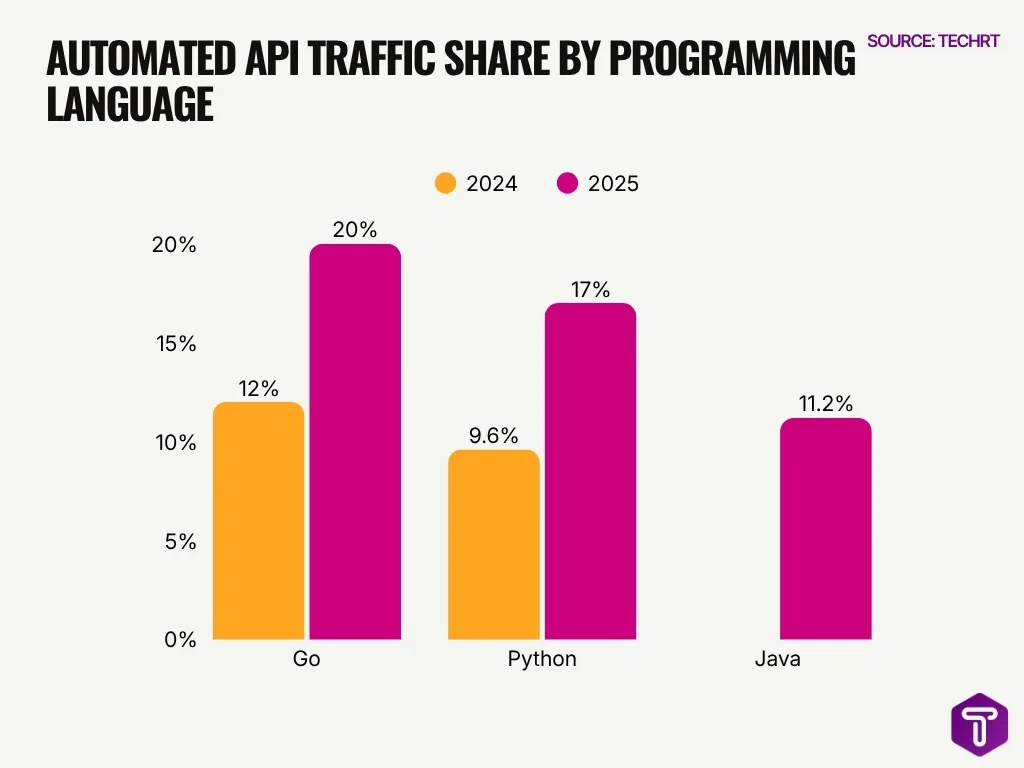
- Automated API traffic increasingly shifted toward Go and Python-based clients during 2025.
- Go-based automated API requests accounted for 20% of observed API traffic in 2025, up from 12% in 2024.
- Python’s share of automated API request traffic climbed from 9.6% in 2024 to 17% in 2025.
- Java-based API traffic also increased during 2025, reaching 11.2% share of observed automated traffic.
- AI crawlers generated millions of automated requests to cloud-hosted websites and APIs in 2025.
- Security providers observed API traffic spikes linked to DDoS attacks generating more than 27 billion requests per second during major cyber events in 2025.
Growth Rate and CAGR Forecasts
- The global API management market is projected to grow at a compound annual growth rate (CAGR) of 25% between 2025 and 2030.
- API security markets are forecast to expand at approximately 32.7% CAGR through 2030 as enterprises strengthen protection for public-facing APIs.
- Research estimates the broader API economy could exceed $500 billion in indirect business value by 2030 through digital services and platform ecosystems.
- The API gateway market is expected to grow from $3.4 billion in 2024 to nearly $9 billion by 2030.
- Cloud-native API infrastructure spending increased by 18% year over year in 2025 due to rising AI workloads.
- Gartner projected that over 95% of new digital workloads will deploy on cloud-native platforms by 2025, accelerating API growth.
- AI-related API traffic volumes are forecast to increase by more than 150% between 2025 and 2027.
- API observability and monitoring markets are expected to maintain a 20%+ CAGR through the end of the decade.
- Analysts expect fintech API usage to continue growing rapidly as open banking regulations expand globally.
API Monetization and Revenue Generation
- Around 60% of enterprises now generate direct or indirect revenue from APIs, up slightly from prior years.
- Global API monetization platform revenue is projected to grow from about $732 million in 2025 to $2.9 billion by 2035, at a roughly 11.9% CAGR.
- Roughly 43% of companies derive more than 25% of their total revenue from APIs, highlighting deep integration into core business models.
- Over 65% of API‑using organizations now report that they generate revenue from their APIs, with many charging partners or customers.
- AI‑powered APIs are expected to be used in at least one function of 70% of new applications by 2025, boosting monetizable AI‑API usage.
- The global API marketplace segment generated around $18 billion in revenue in 2024 and is forecast to reach nearly $50 billion by 2030.
- Enterprises using API‑led strategies report being able to launch new digital products up to 40% faster than traditional development teams.
- Usage‑based API pricing now accounts for a major share of new API monetization models, especially among AI and cloud‑native providers.
- API‑driven ecosystems are projected to contribute to a global economic impact exceeding $14 trillion by 2027, underscoring scalability.
- About half of digital businesses consume third‑party APIs, with over 50% of companies spending significant time troubleshooting partner APIs each week.
Popular Third-Party API Categories
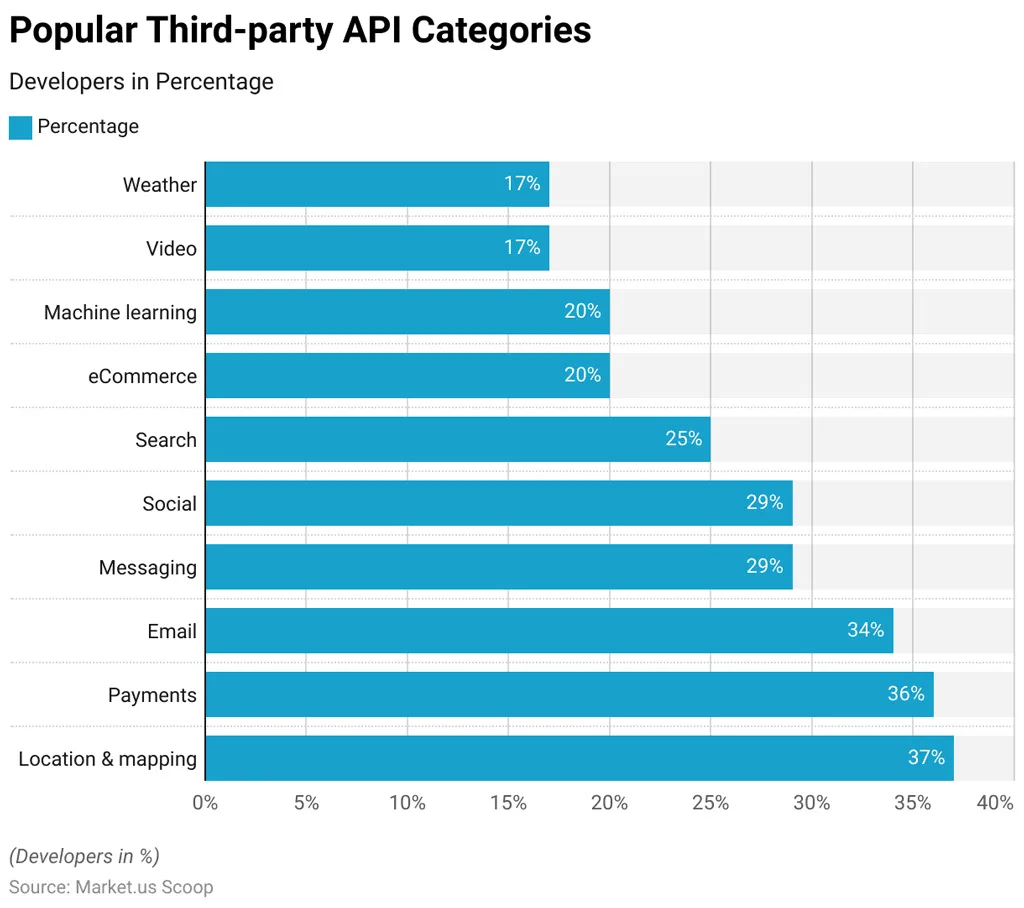
- Location & Mapping APIs are the most popular third-party API category, used by 37% of developers, showing strong demand for maps, geolocation, delivery tracking, and navigation features.
- Payments APIs rank second with 36% developer usage, highlighting how payment processing remains one of the most essential API integrations for digital businesses.
- Email APIs are used by 34% of developers, making them a major category for transactional emails, marketing automation, account verification, and notification workflows.
- Messaging APIs and Social APIs both stand at 29%, indicating strong adoption of communication, chat, social sharing, and user engagement features.
- Search APIs are used by 25% of developers, showing that one in four developers relies on third-party search tools to improve content discovery and user experience.
- eCommerce APIs and Machine Learning APIs each account for 20% of developer usage, reflecting growing demand for online shopping infrastructure and AI-powered application features.
- Video APIs and Weather APIs are the least used among the listed categories, each at 17%, but they still serve important use cases in media platforms, forecasting apps, travel, logistics, and event planning.
- The data suggests that developers prioritize APIs that support core business functions, especially location services, payments, email, messaging, and social integrations.
- The top three categories, Location & Mapping (37%), Payments (36%), and Email (34%), show that practical, revenue-supporting, and communication-focused APIs dominate third-party API adoption.
AI API Usage and Integration Statistics
- The global AI API market is projected to grow from $44.41 billion in 2025 to $179.14 billion by 2030.
- Global AI-related API calls surged by 73% in 2025 as the AI market reached $250 billion.
- Approximately 78% of companies globally now use AI tools in their daily operations as of 2025.
- About 47% of enterprises adopted generative AI APIs in 2024 for content creation and design automation.
- Machine learning and foundation models captured 49.77% of enterprise adoption in 2025.
- Customer-facing applications like chatbots and recommendation engines accounted for 38.91% of AI spending in 2025.
- Automated API generation can cut development time by 85% for organizations scaling AI-driven projects.
- Large enterprises held 71.43% of the AI market revenue in 2025 due to their capacity to scale in-house data science.
- Healthcare organizations use diagnostic imaging APIs for patient data management, currently representing 28% of application usage.
- Integration of edge computing APIs saw 42% growth, enabling a 37% reduction in latency for IoT applications.
API Security Incidents and Breach Statistics
- Around 57% of organizations experienced at least one API-related security incident in the past 2 years.
- API attacks surged by over 400% in 2025, driven by automated bots and AI-powered attack methods.
- Gartner projected that APIs would become the #1 attack vector for enterprise web applications by 2025.
- Over 90% of web applications now expose APIs, significantly increasing the attack surface.
- Nearly 35% of API breaches in 2025 were linked to broken object-level authorization (BOLA) vulnerabilities.
- API abuse and credential stuffing attacks rose by more than 150% YoY across banking, ecommerce, and healthcare.
- About 60% of organizations reported a lack of visibility into shadow or unmanaged APIs.
- Companies using dedicated API security solutions reduced breach detection time by up to 80%.
- API-related data breaches cost organizations an average of $4.5 million per incident, higher than traditional breaches.
Most Used AI Tools for API Development
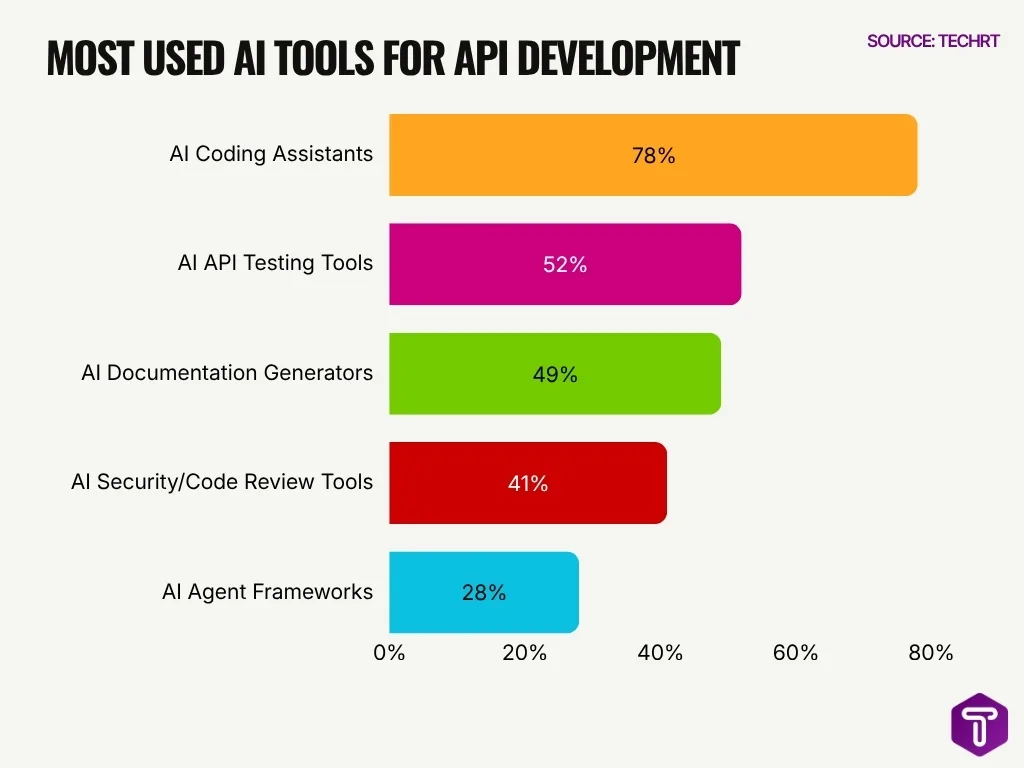
- AI Coding Assistants are the most widely used AI tools for API development, with 78% adoption among developers and teams.
- AI API Testing Tools rank second, used by 52% of respondents, showing strong demand for faster and automated API validation.
- AI Documentation Generators have a high adoption rate of 49%, highlighting the growing need to simplify API documentation workflows.
- AI Security/Code Review Tools are used by 41%, suggesting that AI is increasingly being applied to detect vulnerabilities and improve code quality.
- AI Agent Frameworks have the lowest adoption in this chart at 28%, indicating that agent-based API development is still emerging compared with coding and testing tools.
- The gap between AI Coding Assistants and AI Agent Frameworks is significant at 50 percentage points, showing that practical coding support is currently far more mainstream.
- Overall, the data shows that AI adoption in API development is strongest in coding, testing, and documentation, while more advanced AI workflow tools are still gaining traction.
Regional API Adoption and Market Share
- North America held about 42% of the API management market in 2025, keeping it the largest regional share.
- The United States remained the top enterprise API spender in 2025, supported by cloud and AI infrastructure investment.
- Asia-Pacific fintech is projected to reach $348.1 billion by 2031, reflecting its fastest-growth API demand.
- India’s digital payments volume is projected to rise from 206 billion in FY25 to 617 billion by FY30, boosting API usage.
- India’s API banking market is forecast to grow from $2.32 billion in FY2025 to $6.35 billion by FY2033 at a 13.41% CAGR.
- Europe’s API adoption accelerated as PSD2 required banks to share data through secure APIs and open standards.
- Latin America’s digital payments are now over 60% of consumer spending, with digital wallets at ~25% and A2A transfers at 19%.
- Africa had 621 million registered mobile money accounts across Sub-Saharan Africa in 2022, making APIs central to mobile payments.
- Africa now has 36 live instant payment systems across 31 countries, strengthening API-driven digital banking rails.
- Cross-border payment APIs are expanding as API-led platforms connect merchants, banks, and third-party providers for faster settlement.
Cloud API Deployment Statistics
- More than 94% of enterprises now use cloud services that depend heavily on APIs for application connectivity and automation.
- Gartner forecasted that over 95% of new digital workloads would deploy on cloud-native platforms by 2025, increasing API-driven infrastructure demand.
- Multi-cloud deployments continued rising in 2025, with enterprises using APIs to manage interoperability between providers.
- Kubernetes-based API deployments expanded rapidly as organizations modernized microservices infrastructure.
- Serverless computing adoption increased API traffic efficiency for cloud-native applications during 2025.
- Public cloud spending is projected to exceed $800 billion globally in 2026, supporting continued API infrastructure growth.
- Enterprises increasingly use API orchestration layers to connect SaaS, AI, and internal cloud systems.
- Edge computing deployments generated new API traffic patterns as businesses processed data closer to users.
- Cloud-native API gateways became standard in zero-trust security environments throughout 2025.
API Usage by Industry
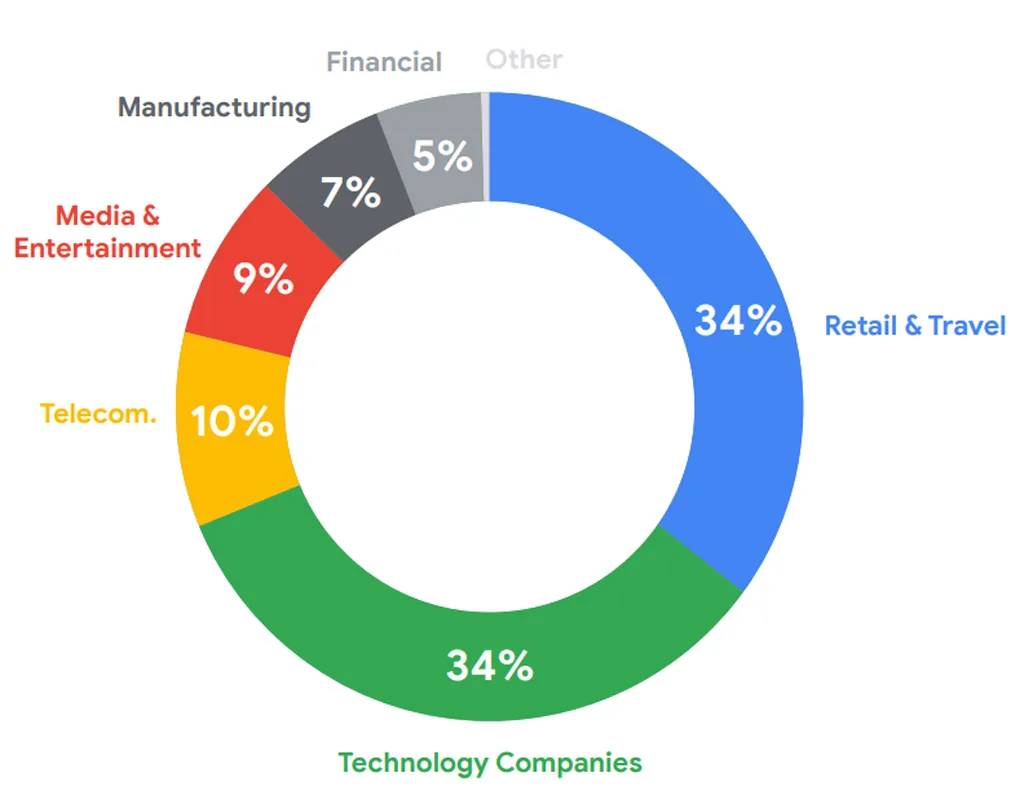
- Retail & Travel and Technology Companies lead API usage, with both industries accounting for 34% each.
- Together, Retail & Travel and Technology Companies represent 68% of total API usage, showing strong API dependence in customer-facing and digital-first sectors.
- Telecom ranks third with 10%, reflecting the sector’s reliance on APIs for connectivity, billing, data exchange, and service integrations.
- Media & Entertainment accounts for 9% of API usage, driven by streaming platforms, content delivery, personalization, and digital distribution.
- Manufacturing contributes 7%, indicating growing API adoption for automation, supply chain systems, IoT, and production workflows.
- Financial services hold a 5% share, likely supported by fintech integrations, payment APIs, open banking, and secure data exchange.
- Other industries make up only 1%, suggesting API usage is highly concentrated in a few major sectors.
- The data shows that API adoption is strongest in industries where real-time data, digital platforms, customer experience, and system integrations are central to business operations.
REST API vs GraphQL Adoption Rates
- REST is used in roughly 80%–90% of public APIs, making it the dominant API architecture in 2025.
- GraphQL is now used by around 30%–35% of organizations, up from under 10% before 2021.
- Surveys show over 50% of enterprises plan to run GraphQL in production by 2025.
- In tech and mobile‑first companies, 70%–78% of client‑facing APIs now use GraphQL.
- Roughly 45% of new API projects in developer‑heavy organizations consider GraphQL as the primary architecture.
- Enterprise adoption of GraphQL has surged by about 340% since 2023, reflecting rapid growth.
- Mobile and social media apps report up to 60–70% less bandwidth usage with GraphQL compared with equivalent REST endpoints.
- 89% of teams that adopt GraphQL say they would choose it again for similar projects.
- E‑commerce product‑catalog APIs use GraphQL in about 67% of cases, while REST still handles most payment and inventory flows.
- API management providers report that over 50% of new hybrid API gateways now support GraphQL natively alongside REST.
API Performance Metrics and Uptime Statistics
- Enterprise APIs averaged 99.46% uptime in 2025, down 0.20% year-over-year.
- Weekly API downtime rose to 55 minutes in Q1 2025 from 34 minutes prior.
- High-performing APIs target P95 response times under 200 ms for optimal performance.
- Enterprise downtime costs average $5,600 per minute for IT outages.
- Financial enterprises face $300,000 per hour in application downtime losses.
- CDN-backed APIs reduce global latency by 40-70% versus centralized setups.
- API traffic constitutes over 80% of all web traffic, driving rate-limiting needs.
- Automated API testing boosts security coverage by 200-400% through edge case detection.
- API observability solutions hold 72% market share for performance monitoring in 2025.
Most Popular API Types and Endpoints
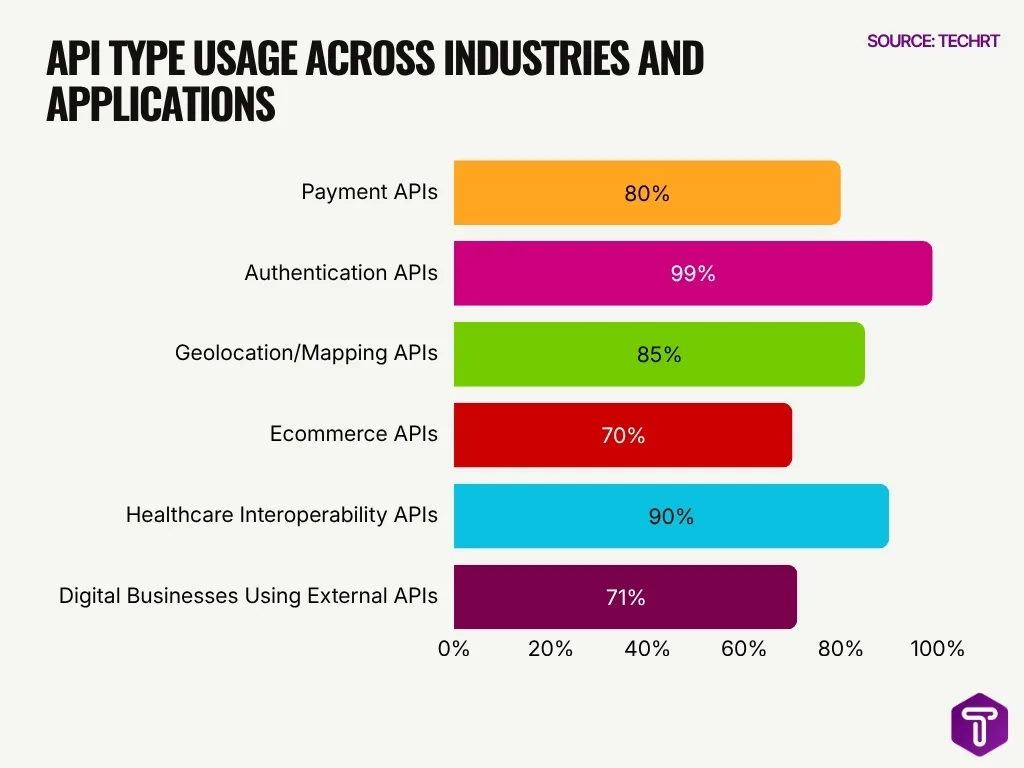
- Payment APIs powered over 80% of global ecommerce checkout flows in 2025.
- Authentication APIs protect roughly 99% of enterprise SaaS workloads via identity‑as‑a‑service stacks.
- Messaging and communication APIs deliver more than 130 billion messages per month across SMS, RCS, and WhatsApp.
- AI and machine learning APIs grew by over 300% in call volume from 2023 to 2025.
- Geolocation and mapping APIs support 85% of global logistics and ridesharing platforms for real‑time routing.
- Financial data APIs underpin 24 billion open‑banking API calls in the UK alone during 2025.
- Ecommerce APIs sync over 70% of enterprise inventory and pricing data across channels in real time.
- Healthcare interoperability APIs are used by 90% of major health systems via FHIR‑based endpoints.
- Video streaming and content delivery APIs handle over 1 billion concurrent streams during peak global events.
- 71% of digital businesses now consume at least one external API type per product line.
API Gateway and Management Platform Adoption
- Over 50% of organizations will use API management solutions for more than half of their APIs by 2025, up from less than 20% in 2021.
- 76% of enterprises prioritize API security above scalability and performance when adopting API gateways in 2025.
- 31% of organizations use multiple API gateways, with 20% running two and 11% running three or more.
- 79.55% of the API management market share in 2025 belonged to cloud deployments, driven by hyperscaler managed services.
- 54% of organizations use a service mesh and API management together to support microservices in Kubernetes environments.
- 76% of enterprises now operate in a multi-cloud environment, accelerating hybrid API management strategies.
- The API management market reached $8.86 billion in 2025 and is projected to reach $22.11 billion by 2031.
- 48% of CTOs are investing in low-code/no-code API management tools to speed up gateway deployment in 2025.
- 27.65% of the API management market revenue in 2025 came from financial services, the leading end-user segment.
Frequently Asked Questions (FAQs)
What is the projected global API market size in 2026?
What percentage of organizations use an API-first strategy in 2025?
How fast is the API management market expected to grow?
How much web traffic now comes from APIs?
How many APIs does the average enterprise manage in 2026?
Conclusion
APIs have evolved from backend integration tools into core business infrastructure powering AI systems, cloud platforms, fintech services, ecommerce operations, and enterprise automation. The data show that organizations increasingly rely on APIs to accelerate software delivery, improve customer experiences, and expand digital ecosystems across industries.
At the same time, rising API traffic volumes, AI-driven workloads, and growing security risks continue shaping how businesses manage performance, governance, and scalability. Companies investing in API-first development, cloud-native architectures, and advanced API security frameworks are better positioned to compete in a market where connectivity and automation drive long-term growth.

Leave a comment
Have something to say about this article? Add your comment and start the discussion.