




Female tech founders continue to shape the startup economy across artificial intelligence, fintech, healthtech, climate tech, and enterprise software. From building AI infrastructure platforms to scaling digital healthcare solutions, women-led startups now influence hiring trends, venture capital allocation, and innovation pipelines across the US and global markets.
At the same time, funding disparities, representation gaps, and access to leadership networks remain major challenges for women in technology entrepreneurship. Recent data also shows that mixed-gender founding teams often outperform industry averages in capital efficiency and revenue generation. Explore the latest statistics, investment trends, and market insights shaping female tech founders.
Editor’s Choice
- Female-founded startups in the US raised a record $73.6 billion in venture capital funding during 2025.
- Companies with at least one female founder captured 27.7% of total US VC deal value in 2025, the highest share recorded so far.
- Female-only founding teams globally received just 2.3% of total VC funding in 2024 despite ongoing diversity initiatives.
- Around 30% to 32% of startups worldwide now include at least one woman founder.
- Women account for roughly 15% to 18% of tech startup founders globally entering 2026.
- One in 10 women globally started a business in 2024, compared with one in eight men.
- Female-founded startups generated stronger capital efficiency, with some studies showing 35% higher returns compared with male-led startups.
- Mixed-gender founding teams secured 14.1% of global VC funding in 2024, far above all-female teams.
- In Europe, female-only founding teams captured approximately 2% of equity investments in 2025.
Recent Developments
- AI-focused female-founded startups received nearly two-thirds of the VC dollars invested into women-led startups in the US during 2025.
- More than $30 billion invested in female-founded AI startups during 2025 came from major rounds involving Anthropic and Scale AI.
- Female-founded startups in Europe raised approximately €9.5 billion in 2025 despite a slower VC market.
- The top five female-founded startups accounted for 79% of total capital raised by female-founded companies in one major 2025 funding analysis.
- Women-led startups in India raised more than $1 billion in 2025, while acquisitions involving women-led firms increased by 175%.
- Female-founded companies represented roughly 25% of US startup exits in 2025 as exit activity recovered.
- Women remained underrepresented in venture capital leadership, with women accounting for only 17% of decision-makers at major VC firms in 2024.
- Female founders in healthtech and femtech continued facing investment bias, with women-led femtech startups raising 23% less capital compared with male-led competitors.
- Women-led startups in India represented just 7.5% of the startup ecosystem despite growing entrepreneurial participation.
- Female founders increasingly entered deep-tech sectors, including quantum computing, climate technology, and biotech, in 2025.
Global Overview of Female Tech Founders
- Women now represent nearly one-third of entrepreneurs globally across startup ecosystems.
- Female startup activity rates increased from 6.1% in 2001-2005 to 10.4% in 2021-2023 worldwide.
- Women accounted for one in three high-growth-oriented entrepreneurs globally by 2023.
- Around 18 countries reported women matching or exceeding men in innovation-focused startup activity during 2024.
- Startup participation among women increased significantly across emerging economies, including Jordan and Morocco, where rates reportedly doubled between 2023 and 2024.
- Female-founded startups remain heavily concentrated in fintech, SaaS, healthtech, and e-commerce sectors entering 2026.
- High-income countries continue showing the largest gender gaps in entrepreneurship participation.
- Research published in 2025 found that institutional systems, not only direct discrimination, continue to affect women’s innovation outcomes in science and technology ecosystems.
- Female-founded startups increasingly rely on accelerator ecosystems and community-led funding models to scale operations globally.
Share of Startups With at Least One Female Founder
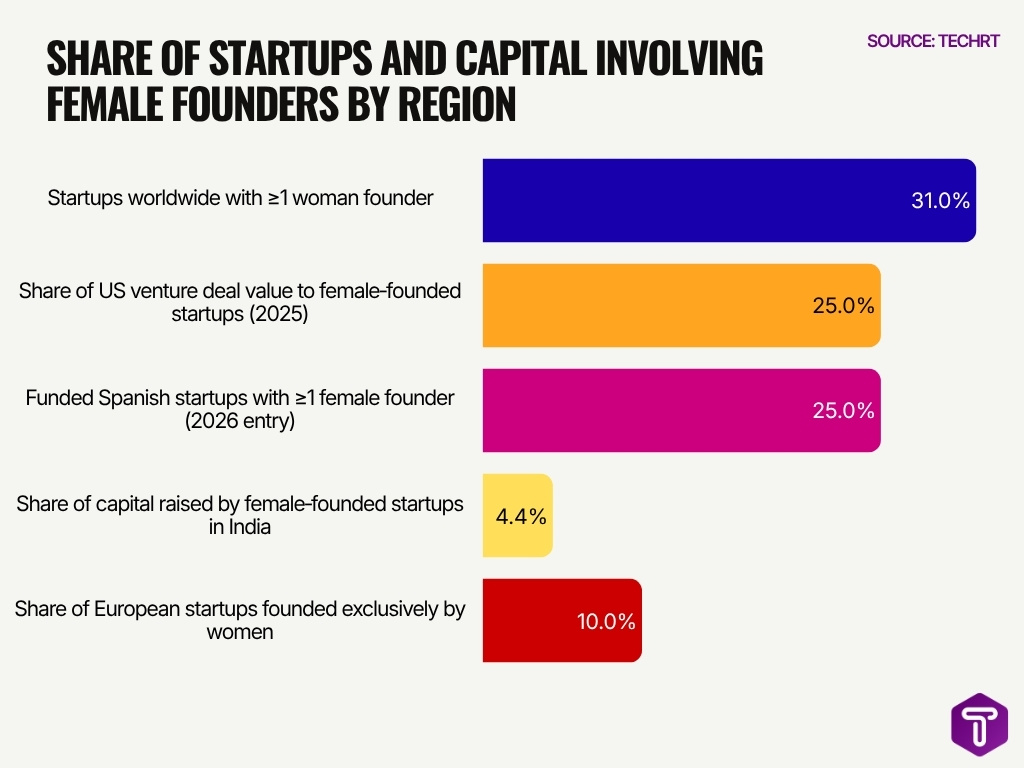
- Approximately 30% to 32% of startups worldwide include at least one woman founder in 2025.
- Female-founded startups accounted for more than 25% of total US venture deal value in 2025.
- In Spain, startups with at least one female founder represented roughly 25% of funded startups entering 2026.
- Female-founded startups in India raised nearly 4.4% of total startup capital in recent funding rounds.
- Women-led startups in Europe still account for less than 10% of startups founded exclusively by women.
- Mixed-gender founding teams consistently secured larger funding rounds than female-only teams during 2024 and 2025.
- The proportion of startups with female co-founders increased steadily in the AI and climate tech sectors during 2025.
- Research shows startups with at least one female founder often report stronger operational efficiency and revenue generation metrics.
- Women-founded startups remain significantly underrepresented in cybersecurity, infrastructure software, and semiconductor industries.
Percentage of Tech Startup Founders Who Are Female
- Women currently make up approximately 15% to 18% of tech startup founders globally.
- In the US, all-female founding teams captured only about 1% of total venture funding during 2024.
- Female founders in Europe received just 0.5% of total VC capital in some 2024 funding analyses.
- Women represented only 17% of senior investment decision-makers at major VC firms in 2024.
- Female entrepreneurs were 47% more likely than men to close businesses for family or caregiving reasons during 2024.
- Women entrepreneurs are about 25% less likely to use bank loans for startup financing than male entrepreneurs.
- Studies published in 2025 found female-founded startups face structural disadvantages tied to relocation, mentorship access, and networking limitations.
- Women-led startups generated approximately 78% more revenue per dollar invested compared with male-founded startups in several recent analyses.
- Female participation in startup ecosystems continues growing fastest in AI-enabled healthtech, education technology, and sustainability sectors.
Regional Distribution of Female Tech Founders
- North America is home to about 40% of all globally tracked female‑led tech startups in 2025.
- The United States alone accounts for roughly 55% of venture‑backed women‑led tech startups worldwide as of 2025.
- Europe recorded 1,307 female‑founded startups raising €7.5 billion in venture capital during 2025.
- Women‑led companies in Europe captured 12% of all European venture capital invested in startups in 2024.
- The United Kingdom, France, and Germany together absorbed 71% of Europe’s VC funding into female‑founded tech companies in 2024.
- In the Asia‑Pacific region, India hosts around 22% of all female‑founded tech startups in the region, led by fintech and SaaS verticals.
- Women comprise approximately 15% of tech startup founders globally, but that share rises to 15.7% in North America.
- Female‑led startups in Africa represent about 14% of all tech founders yet drive over 30% of new mobile‑payments and agritech ventures.
- Women‑founded startups in Latin America secured just under 9% of regional VC value in 2025, with Brazil and Mexico accounting for 68% of those deals.
- In MENA, women‑led tech ventures grew at a compound annual rate of 27% between 2023 and 2025, despite starting from a low base.
Educational Background of Female Tech Founders
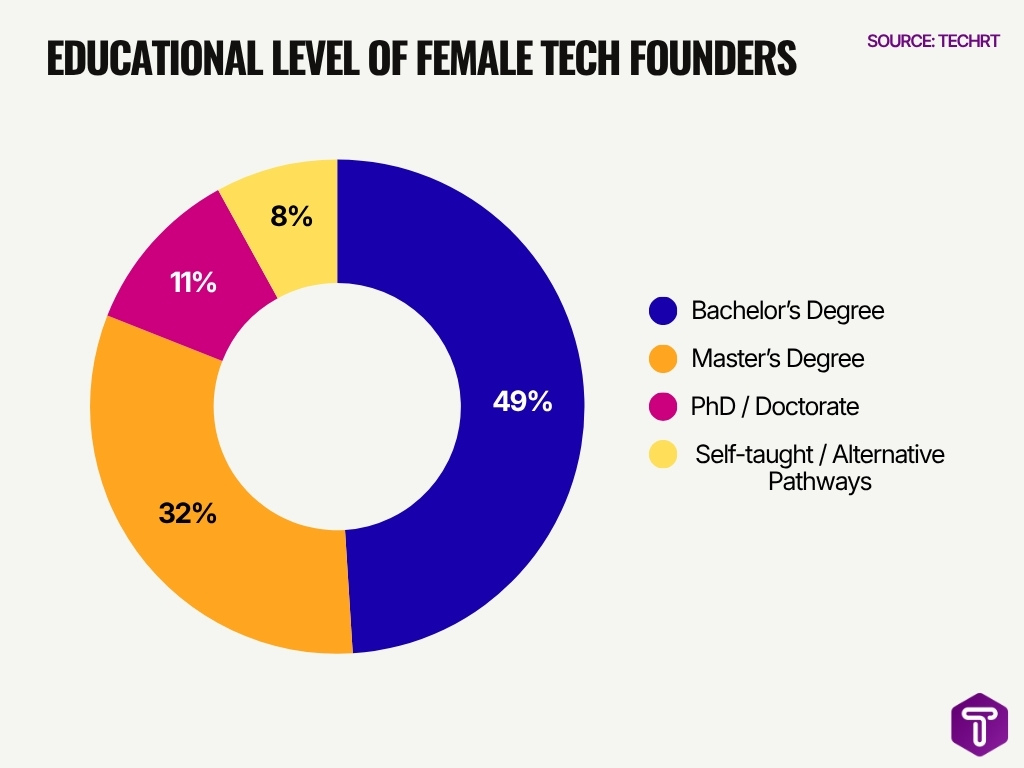
- Bachelor’s degrees are the most common education level, held by 49% of female tech founders.
- Master’s degree holders make up 32%, showing that advanced education is also common among women building tech startups.
- Together, women with bachelor’s or master’s degrees account for 81% of female tech founders.
- PhD or doctorate holders represent 11%, suggesting a smaller but important presence of highly specialized academic founders.
- Self-taught or alternative pathways account for 8%, highlighting that non-traditional routes can also lead women into tech entrepreneurship.
- The data shows that formal education remains a major pathway, but alternative learning routes are still contributing to founder diversity.
Growth Trends in Female-Founded Tech Startups
- Female-founded startups in the US raised a record $73.6 billion in venture capital funding during 2025.
- Startups with at least one female founder captured more than 25% of total US VC deal value in 2025.
- European female-founded startups experienced a 19% year-over-year increase in capital raised during 2025.
- The number of European female-founded companies nearing unicorn status increased by 50% year over year in 2025.
- Five European female-founded startups reached unicorn status during 2025, pushing the regional total to 29 female-founded unicorns.
- Research shows female-founded startups increasingly outperform broader startup markets in Series A conversion rates.
- Women-led scaleups in the UK expanded significantly, with tracked female-founded scaleups growing from 200 in 2019 to more than 1,300 in 2025.
- Female founders continued shifting toward sustainable and profitability-focused growth models instead of aggressive cash-burning strategies.
- AI-focused female-founded startups absorbed nearly two-thirds of the VC funding invested into women-led startups during 2025.
- Startup ecosystems increasingly launched female-focused accelerators and founder communities between 2024 and 2026.
Health Dominates Female-Founded Startups in Europe
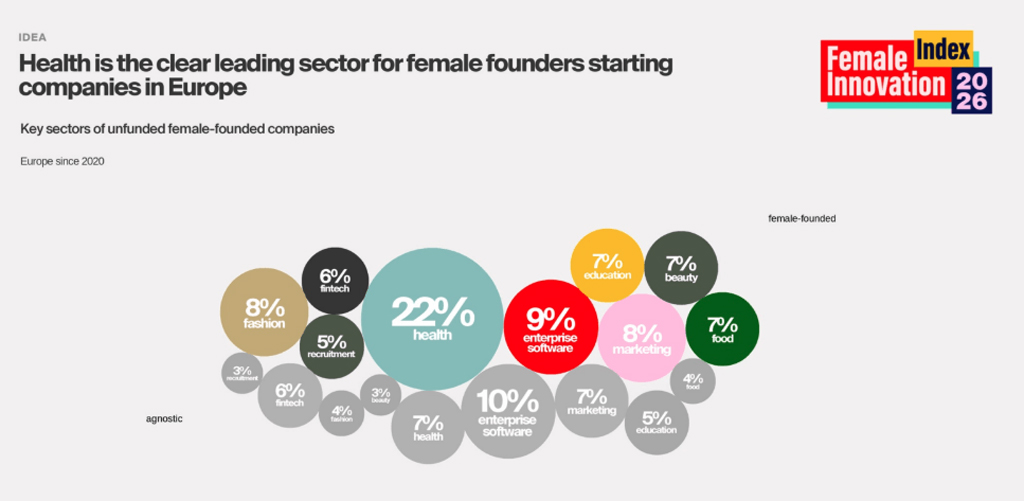
- Health is the leading sector for unfunded female-founded companies in Europe, accounting for the highest share at 22%.
- The health sector’s 22% share is more than double the next-largest category, showing a clear concentration of female founders in healthcare-related ventures.
- Enterprise software is also a strong category, appearing with shares of 10% and 9%, indicating growing female founder activity in B2B technology.
- Consumer-focused sectors such as marketing, fintech, education, beauty, and food each show notable representation, generally ranging between 7% and 8%.
- Fintech accounts for 8% and 6% in the chart, suggesting that finance-related startups remain an important area for female founders.
- Education represents 7% and 5%, highlighting continued interest in edtech and learning-focused businesses among female entrepreneurs.
- Beauty and food each reach 7% in the data, showing that lifestyle and consumer markets remain relevant startup categories.
- Smaller sectors such as recruitment, beauty, and food appear at 3% to 5%, suggesting more niche but still active areas of female-founded startup creation.
- Overall, the data shows that female founders in Europe are active across both impact-driven sectors like health and education, and commercial tech sectors like enterprise software and fintech.
Female Founders in Deep Tech, AI, and Emerging Technologies
- Less than 25% of deep-tech startups in Europe include a woman on the founding team.
- The percentage of women founders in deep-tech startups increased from roughly 7% in 2010 to 14% by 2022.
- Women-led deep-tech startups received approximately 11.4% of total deep-tech funding despite representing 17.4% of startups in the sector.
- Female founders in AI and deep tech increasingly focused on robotics, semiconductors, climate technology, and biotech innovation during 2025.
- AI represented 25% of all funding rounds raised by female-founded startups in Europe during 2025.
- Deep-tech startups led by women increasingly relied on public grants and government-backed innovation programs for early-stage funding.
- Women-led AI startups in India experienced steady funding traction across defense tech, spacetech, and semiconductor ecosystems during 2025.
- Research published in 2025 found AI-era startups attracted larger valuations but showed lower efficiency ratios during early scaling stages.
- Female founders remain significantly less likely to launch solo deep-tech startups compared with male entrepreneurs.
- Women-led emerging technology startups increasingly target sustainability, healthcare automation, and enterprise AI markets entering 2026.
Representation of Women of Color and Underrepresented Groups Among Tech Founders
- Black women founders received less than 0.1% of total VC funding in 2025 cycles.
- Women of color represent 34% of Black/Latino VC-funded startups but only 21% of capital raised.
- Female-only founding teams captured just 2.3% ($6.7B) of global VC in 2024-2025.
- Women founders are 2.2x more likely to bootstrap longer due to limited early capital access.
- VC firms with female partners are 2.3x more likely to fund underrepresented founders.
- Crowdfunding success for women founders exceeds that of men by 32% on rewards platforms.
- Black women-owned businesses hit 2.02 million in the US, 14% of all women-owned businesses in 2024.
- Female founders hold 6.4% of VC deals but receive only 2.3% of total capital.
Industry Sectors Where Female Tech Founders Are Most Active
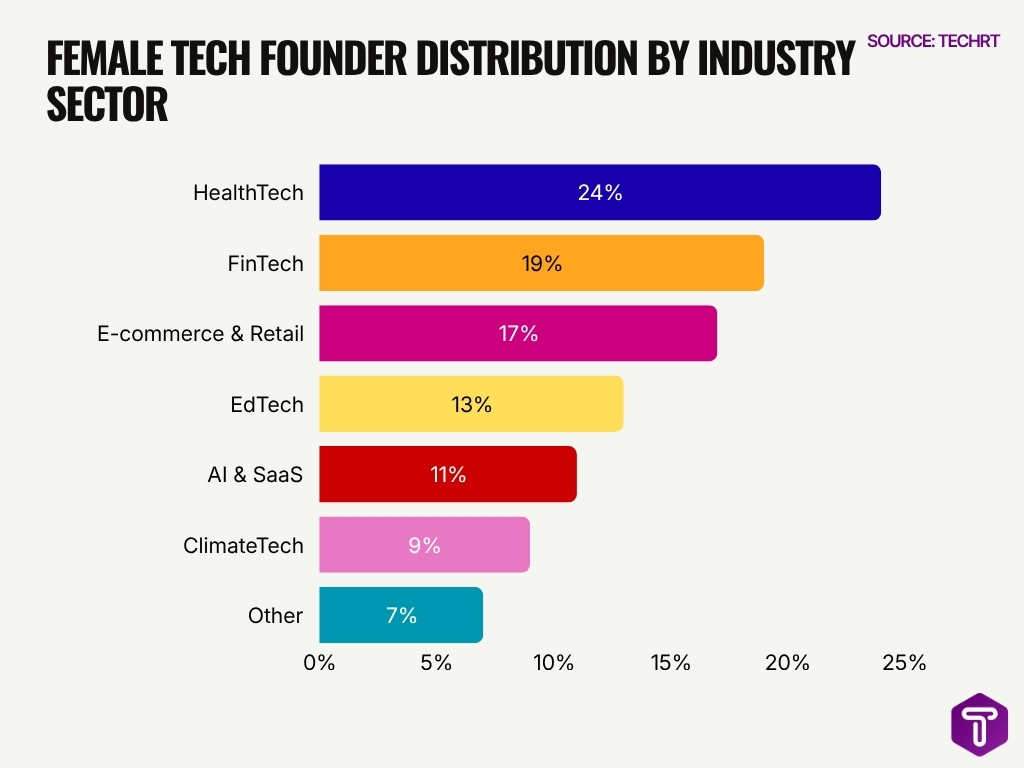
- HealthTech leads the industry distribution, accounting for the highest share of women-led startups at 24%.
- FinTech ranks second, representing 19% of women-led startups, showing strong female founder participation in financial innovation.
- E-commerce & Retail holds a notable share of 17%, indicating that consumer-focused digital businesses remain a major area for women entrepreneurs.
- EdTech accounts for 13% of women-led startups, reflecting continued involvement in education technology and online learning solutions.
- AI & SaaS make up 11%, showing that women-led startups are also gaining ground in advanced technology and software-based business models.
- ClimateTech represents 9%, suggesting growing participation of women founders in sustainability, clean energy, and climate-focused innovation.
- The “Other” category contributes 7%, covering women-led startups across smaller or emerging industry segments.
- Overall, the data shows that women-led startups are most concentrated in HealthTech, FinTech, and E-commerce & Retail, which together account for 60% of the total distribution.
Solo Female Founders vs Mixed-Gender Founding Teams
- Mixed-gender founding teams captured approximately 14.1% of global VC funding during 2024, while all-female teams secured only 2.3%.
- Female-only founding teams in the US received around 1% of total venture funding in 2024.
- Research shows mixed-gender startup teams often outperform homogeneous teams in innovation and revenue growth metrics.
- Female-led startups generated approximately 78% more revenue per dollar invested compared with male-founded startups in recent analyses.
- Solo female founders are less likely to raise Series A funding compared with mixed-gender founding teams.
- Mixed-gender founding teams continue receiving larger average check sizes from institutional investors across North America and Europe.
- Solo female founders increasingly rely on angel networks, crowdfunding, and revenue-based financing instead of traditional VC pathways.
- Investors increasingly favor mixed-gender executive teams in enterprise SaaS, fintech, and AI startups due to perceived market balance and operational diversity.
- Female solo founders continue showing strong growth in the creator economy, wellness technology, and digital healthcare startups entering 2026.
VC Funding Share for Female-Founded Tech Startups
- Female-founded startups in the US raised a record $73.6 billion in venture capital during 2025.
- Companies with at least one female founder captured 27.7% of total US VC deal value in 2025.
- Female-only founding teams globally secured only 2.3% of overall venture funding in 2024.
- Mixed-gender founding teams received more than six times the funding allocated to female-only teams during 2024.
- AI startups led by women absorbed nearly two-thirds of the funding invested into female-founded companies in the US during 2025.
- European female-founded startups raised approximately €9.5 billion during 2025 despite broader venture market slowdowns.
- Female founders in India received less than 5% of total startup funding despite growing startup participation.
- Female-founded companies accounted for nearly 25% of US startup exits during 2025.
- Women-led startups in climate tech and healthtech saw higher investor participation rates compared with traditional enterprise software sectors in 2025.
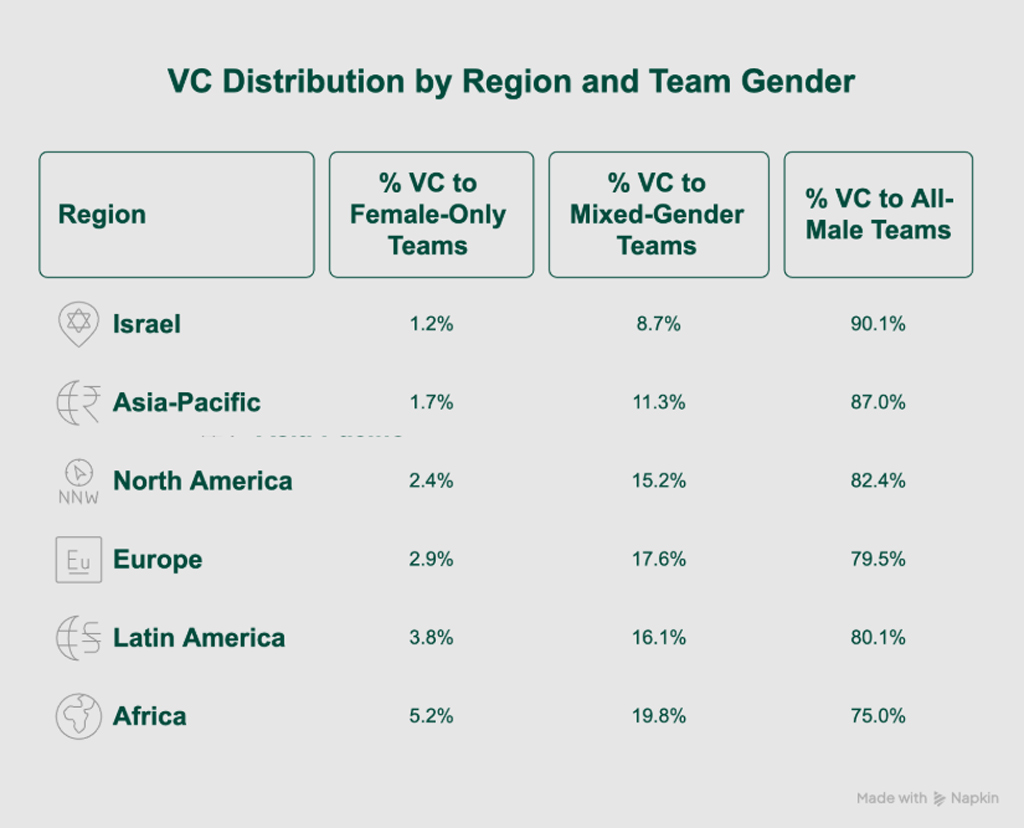
VC Funding Distribution by Region and Team Gender
- All-male teams dominate VC funding across every region, receiving the largest share of venture capital in all listed markets.
- Israel has the highest VC concentration among all-male teams, with 90.1% of funding going to all-male founder teams.
- Asia-Pacific also shows a major gender funding gap, where all-male teams receive 87.0% of VC funding, compared with only 1.7% for female-only teams.
- North America allocates just 2.4% of VC funding to female-only teams, while all-male teams receive 82.4%.
- Europe performs slightly better for female-only teams, with 2.9% of VC funding, but all-male teams still secure 79.5%.
- Latin America has one of the strongest female-only funding shares, at 3.8%, though all-male teams still receive 80.1%.
- Africa records the highest VC share for female-only teams, at 5.2%, making it the leading region in this dataset for female-only founder funding.
- Mixed-gender teams receive the highest VC share in Africa, at 19.8%, followed by Europe at 17.6% and Latin America at 16.1%.
- The data shows that mixed-gender teams consistently outperform female-only teams in VC funding share across all regions.
- Overall, the chart highlights a clear global funding imbalance, where female-only teams receive between just 1.2% and 5.2% of VC funding, depending on region.
Stage-Wise Funding Access for Female Tech Founders
- Female founders secure 50% of pre-seed deals but only 21% of Series A rounds, showing the steepest drop-off at Seed-to-A.
- Women-led startups receive just 3.2% of Seed capital versus 2.2% at Series B and 1.8% at Series C+, confirming smaller later-stage rounds.
- Female-only teams raise a median of $2.0M per round compared to $3.0M for male-led startups across Series B and C stages.
- Late-stage AI startups founded by women attracted $73.6 billion globally in 2025, with two-thirds of all female-founder VC dollars flowing into AI.
- 40% of female founders rely on accelerator-backed pathways for early-stage fundraising, versus 27% who secure direct angel investment.
- Women-led startups are 60% more likely to bootstrap operations longer before seeking institutional capital compared to male-led ventures.
- Female entrepreneurs receive only 5.2% of outstanding bank credit and are less likely to secure debt financing than male founders.
- Women-led fintech and climate tech startups achieved 50.4% of pre-Series B funding in 2025, outpacing women-led consumer startups at 3.4%.
- Investors concentrated over 40% of late-stage female-founder AI funding into just 2 companies (Anthropic and Scale AI) during 2025.
Female Representation Among Unicorn and High-Valuation Tech Startups
- Europe reached approximately 29 female-founded unicorns during 2025.
- Five female-founded startups achieved unicorn status in Europe during 2025 alone.
- Female-founded AI startups represented some of the fastest-growing unicorn candidates in the US during 2025.
- Women-led unicorns remain concentrated in fintech, healthtech, e-commerce, and enterprise AI sectors.
- Female-founded startups nearing unicorn status increased by 50% year over year in Europe during 2025.
- High-valuation female-founded startups increasingly attracted sovereign wealth funds and global institutional investors in 2026.
- Women-led startups remain significantly underrepresented among decacorn companies valued above $10 billion.
- Enterprise AI and biotech emerged as the fastest-growing categories for women-led unicorn creation during 2025.
- Female unicorn founders increasingly expanded internationally earlier in their growth cycle compared with pre-pandemic cohorts.
Access to Networks, Accelerators, and Mentorship for Female Founders
- Regions with >30% women in accelerators show 40% higher female founder funding rates.
- Organized female angel networks boost early-stage funding by 27% for women entrepreneurs.
- Female founders with strong mentorship access have 42% higher funding success rates.
- Ecosystems with public co-investment in women-led ventures see 35% higher follow-on private investment.
- UK women angel investors grew 60% since 2022, backing over 2,155 female-founded businesses.
- Female accelerator participants report stronger networking access as the top benefit, boosting investor readiness.
- Climate tech female founder representation rose from 15.2% to 21.7% since 2021 via accelerators.
- VC firms with female partners are 2.3x more likely to invest in female founders through networks.
- Female entrepreneurs in accelerators invest more capital and attract higher angel/VC funding.
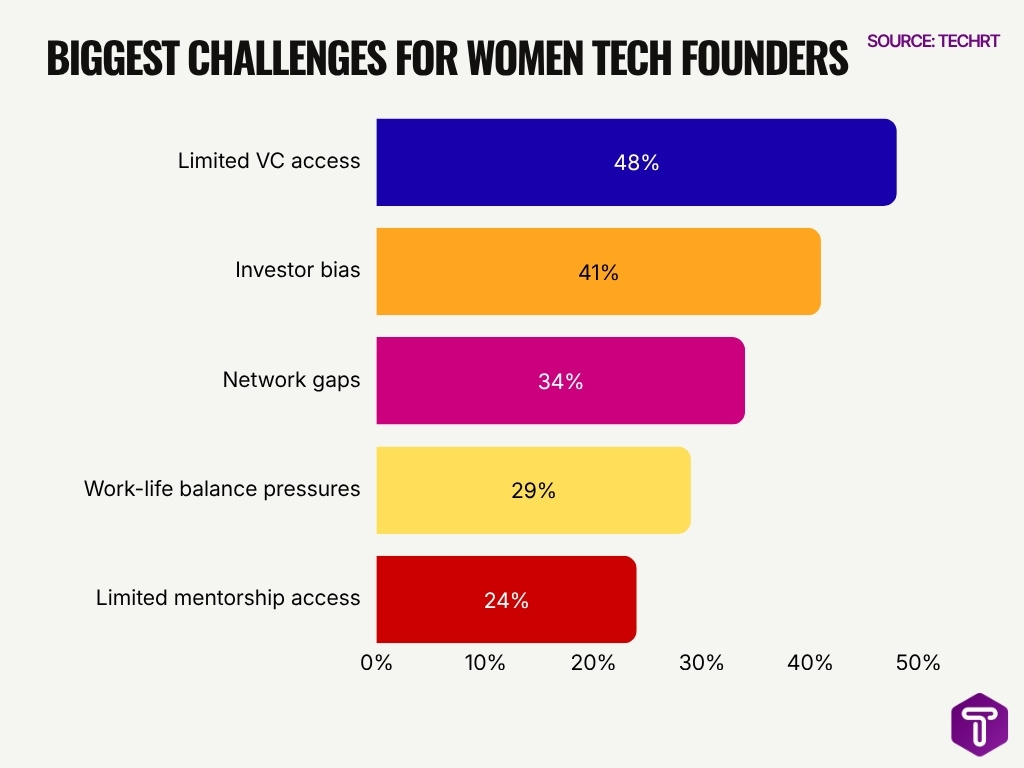
Key Challenges Facing Women Tech Founders
- Limited VC access is the biggest challenge for women tech founders, affecting 48% of respondents.
- Investor bias is another major barrier, reported by 41% of women tech founders.
- Network gaps impact 34% of founders, showing that access to strong professional and investor networks remains a key issue.
- Work-life balance pressures affect 29% of women tech founders, highlighting the personal and professional demands of building a startup.
- Limited mentorship access is reported by 24% of founders, suggesting that better guidance and founder support systems are still needed.
- Overall, the data shows that the top challenges are linked mainly to funding access, bias, networks, and mentorship, rather than product-building alone.
Government and Policy Initiatives Supporting Female Tech Founders
- In 2025, 1,307 European female-founded startups raised €7.5B, a 19% YoY increase.
- Women TechEU invests €12M in equity-free grants for 160 women-led deep tech companies.
- EIC Women Innovators prize awards up to €100,000 to top women founders in the EU.
- India projects women in semiconductors rising from 25% in 2025 to 35% by 2030.
- OECD finds women entrepreneurs 25% less likely to use bank loans than men.
- EIC Accelerator funded 30% female-led deep tech startups in 2025.
- Women TechEU provides €75,000 grants plus coaching to early-stage women deep tech founders.
- California mandates VC firms report diversity data on funded teams starting in 2026.
- Village Capital Women in Tech Accelerator distributed over $550K grants to 21 women-led startups.
- European Prize for Women Innovators offers €220,000 total prizes across the top categories.
Future Outlook for Female Tech Founder Participation
- 2.3% of global VC funding went to female-only founding teams in 2024, showing the current gap is still wide.
- Startups with at least one female founder raised a record $73.6 billion in the U.S. in 2025, nearly 2x the 2023 total.
- Female founders captured 27.7% of total U.S. deal value in 2025 when AI mega-rounds are included, a new high.
- Women-founded startups in Europe raised €5.76 billion across 1,305 deals in 2024, proving the pipeline is still active.
- In U.S. climate tech, only $135.8 million of the $33.5 billion invested through Q3 2024 went to female-founded startups.
- Female-led, privately held tech companies have shown 35% higher ROI in some research, reinforcing the efficiency case for backing women founders.
- Female-founded companies generated 78 cents per dollar invested versus 31 cents for male-founded companies in a widely cited study.
- In India, 73,151 startups with at least one woman director were recognized by October 2024, nearly half of all startups supported under Startup India.
- Global startup ecosystems still show that only 15% of tech startup founders are women, leaving major room for growth through 2030.
Frequently Asked Questions (FAQs)
How much VC funding did US female-founded startups raise in 2025?
What share of US VC deal value went to startups with at least one female founder in 2025?
What percentage of global tech startup founders are women?
What share of global VC funding went to all-female founding teams in 2024?
How much funding did female-founded startups raise in Europe in 2025?
Conclusion
Female tech founders continue gaining visibility across AI, fintech, healthtech, climate technology, and deep-tech industries heading. Funding totals and startup participation rates improved over the past two years, especially for mixed-gender teams and women-led AI companies. However, major funding disparities still exist between female-only and male-only founding teams, particularly in late-stage venture capital and deep-tech sectors.
At the same time, accelerator programs, policy initiatives, mentorship ecosystems, and institutional diversity efforts continue expanding support for women entrepreneurs globally. As more women enter STEM careers and launch scalable technology companies, female-led startups are expected to influence the next generation of innovation, sustainability, and enterprise growth worldwide.

Leave a comment
Have something to say about this article? Add your comment and start the discussion.