



Artificial intelligence now shapes how schools, colleges, and training providers deliver education at scale. From AI tutors that support personalized learning to automated grading systems that reduce teacher workloads, education systems across the US and globally continue to expand AI adoption. Universities also use AI analytics to identify at-risk students earlier, while K-12 schools increasingly integrate generative AI tools into classroom instruction and homework support.
At the same time, governments, educators, and technology providers continue to debate data privacy, ethical AI use, and academic integrity. As investment in AI-powered education platforms accelerates, institutions now focus on measurable learning outcomes instead of experimentation alone. Explore the latest AI in education statistics, market data, adoption trends, and usage insights shaping the future of learning.
Editor’s Choice
- The global AI in education market reached $8.3 billion in 2025, up from $5.88 billion in 2024.
- Analysts project the AI in the education industry to grow at a 31.2% CAGR between 2025 and 2030.
- The broader global education market will approach $10 trillion by 2030, with AI-powered learning platforms driving significant growth.
- North America accounted for 38% of the AI in education market share in 2025, making it the largest regional market worldwide.
- Around 68% of higher education institutions now use learning analytics dashboards to track engagement and student performance.
- Research findings show adaptive learning systems can improve student engagement by 18% to 25%.
- Studies also indicate AI-supported learning systems may reduce student dropout rates by 28% in digital learning environments.
- Approximately 47% of institutions in high-income countries had implemented AI-driven educational tools by 2023, compared with just 8% in low-income regions.
Recent Developments
- The OECD released its Digital Education Outlook 2026, focusing specifically on generative AI adoption in teaching and learning.
- UNESCO launched the Observatory on Artificial Intelligence in Education for Latin America and the Caribbean in 2026.
- Governments increasingly shifted from AI experimentation toward practical classroom implementation during 2025 and 2026.
- Global EdTech investment reached $2.6 billion in 2025, with investors prioritizing workforce training and AI-enabled learning tools.
- AI tutors emerged as one of the fastest-growing EdTech categories, with the market estimated at $3.55 billion in 2025.
- Cloud-based AI education platforms held 57% of the deployment share in 2025, highlighting the shift toward scalable digital infrastructure.
- AI-powered services in education are expected to grow at a 37.15% CAGR through the next decade.
- Asia-Pacific became the fastest-growing regional AI education market in 2025 due to rapid digital learning adoption.
- UNESCO continued promoting ethical AI policies through its AI and education guidance frameworks for governments and institutions.
Global Overview of AI in Education
- The global education market was valued at approximately $7.6 trillion in 2025.
- Governments currently contribute 60% to 70% of total global education spending.
- Education spending globally represents roughly 4% to 5% of global GDP.
- The EdTech market reached $227.47 billion in 2023 and continues expanding rapidly across schools and universities.
- Analysts expect the EdTech sector to grow at a 13.6% CAGR from 2024 to 2030.
- Digital education expenditure will account for 5.2% of the total global education market in 2025.
- North America represented 38% of the global EdTech market in 2026, while Asia-Pacific held 32%.
- Asia-Pacific EdTech markets currently grow at a 16.5% CAGR, making the region one of the strongest growth areas globally.
- India accounted for 91% of South Asia’s 2025 EdTech 100 cohort, highlighting the country’s dominance in education innovation.
- More than 220 million learners worldwide enrolled in MOOCs and online courses in 2023.
AI in Education Market Size Growth
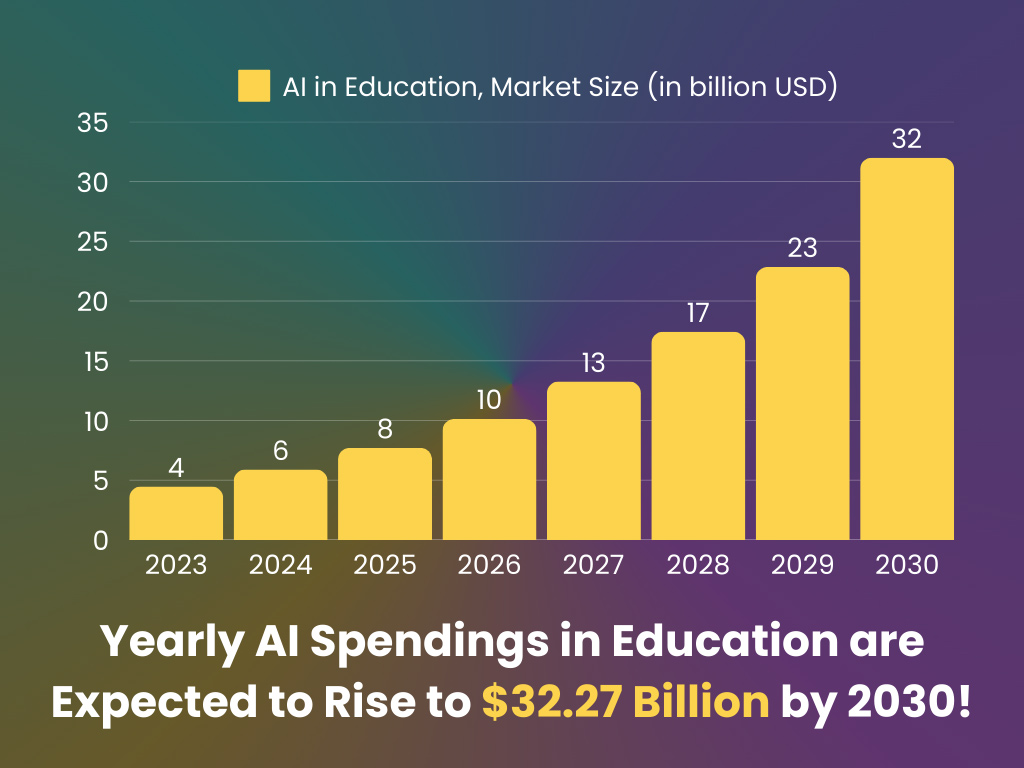
- The AI in education market is projected to grow steadily from $4 billion in 2023 to around $32 billion by 2030.
- Market spending is expected to increase by nearly 8x between 2023 and 2030, showing strong long-term adoption.
- The market rises from $6 billion in 2024 to $8 billion in 2025, reflecting early-stage growth momentum.
- By 2026, AI spending in education is expected to reach $10 billion, crossing a key double-digit milestone.
- Growth accelerates after 2027, when the market increases from $13 billion to $17 billion in 2028.
- The biggest jumps appear in the final years, with spending rising from $23 billion in 2029 to $32 billion in 2030.
- The data suggests that schools, colleges, and edtech platforms are likely to increase investment in AI tutoring, personalized learning, automated grading, and administrative tools.
- By 2030, yearly AI spending in education is expected to reach approximately $32.27 billion, highlighting AI’s growing role in the global education sector.
Adoption of AI Tools by Educators
- 95% of US teachers used digital tools in classrooms by 2022, building a foundation for AI adoption.
- 77% of educators explored generative AI in the 2024–2025 academic year, mainly for lesson planning.
- 64% of teachers say AI grading tools cut their administrative workload by at least 3 hours weekly.
- 68% of higher education institutions now use analytics platforms to track student engagement and performance.
- 59% of educators regularly use AI chatbots for classroom communication and tutoring support in 2025.
- Adaptive AI systems boost classroom engagement rates by 18% to 25% according to research studies.
- AI-assisted learning reduced student dropout rates by approximately 28% in multiple digital learning studies.
- 47% of institutions in high-income countries have adopted educator AI tools versus just 8% in low-income regions.
Adoption of AI Tools by Students
- More than 220 million learners globally participated in MOOCs and online learning ecosystems by 2023.
- Students increasingly use generative AI for tutoring, homework support, summarization, and exam preparation.
- AI tutoring tools became one of the fastest-growing EdTech categories in 2025, reaching a market size of $3.55 billion.
- Personalized learning systems can improve learner retention by approximately 25%.
- Gamified AI learning platforms improved student grades by an average of 14% in several educational studies.
- AI-powered adaptive systems reduced dropout rates by nearly 28% in digital learning environments.
- Around 60% of US K-12 schools use Google Classroom, giving students broad access to AI-enabled digital learning workflows.
- AI-supported educational dashboards increasingly help students track learning progress and assignment completion in real time.
- Students in AI-supported learning environments scored approximately 15% higher in some EdTech performance studies.
Student Sentiment on AI in Education
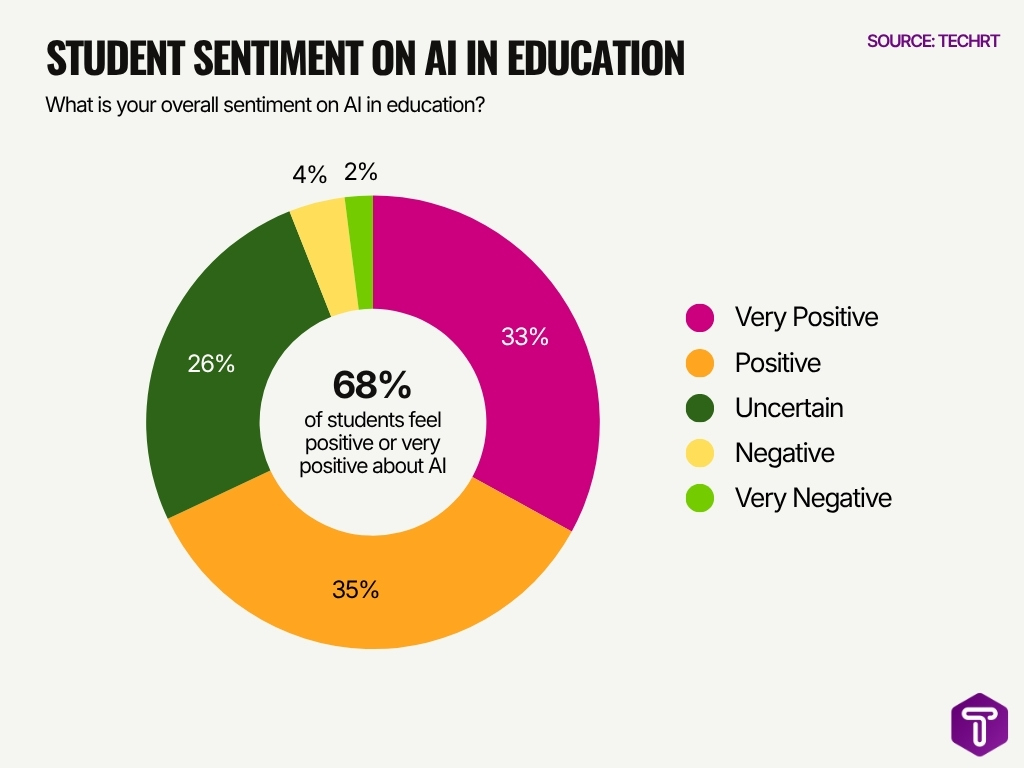
- 68% of students feel positive or very positive about AI in education, showing strong overall acceptance.
- The largest share of students reported a positive sentiment, at 35%.
- Another 33% of students said they feel very positive about AI in education.
- More than two-thirds of students appear optimistic about the role of AI in learning.
- 26% of students remain uncertain, suggesting that many learners are still forming opinions about AI’s impact.
- Only 4% of students expressed a negative view of AI in education.
- Just 2% of students said they feel very negative, making strong opposition relatively low.
- Combined negative sentiment stands at only 6%, compared with 68% positive sentiment.
- The data suggests that students are largely open to AI tools, but institutions may still need to address concerns among the 26% uncertain group.
- Overall, the findings indicate that AI is viewed more as an opportunity than a threat by most students.
Institutional Adoption of AI in Education
- Around 47% of educational institutions in high-income countries had implemented AI-driven learning systems by 2023.
- By comparison, only 8% of institutions in low-income economies reported meaningful AI adoption in education infrastructure.
- Nearly 68% of colleges and universities now use predictive analytics dashboards to monitor student engagement and retention trends.
- Cloud-based AI education deployments represented 57% of institutional AI implementations in 2025.
- Public universities in the US increasingly adopted AI governance frameworks during the 2024-2025 academic cycle to regulate generative AI use in classrooms.
- More than 70 countries had introduced national AI strategies affecting education policy by early 2026.
- AI-powered student support systems became a top institutional investment priority across higher education in 2025.
- Universities are increasingly integrating AI chatbots into admissions, financial aid, and student services to reduce administrative costs.
- Community colleges in the US expanded AI-powered career guidance systems to improve workforce readiness outcomes.
- Institutional spending on AI-enhanced cybersecurity and data governance tools increased sharply alongside AI classroom adoption in 2025.
AI Usage Across K-12 and Higher Education
- Around 60% of US K-12 schools use Google Classroom or comparable digital learning systems with embedded AI capabilities.
- K-12 schools increasingly adopted AI tutoring and adaptive reading systems during the 2024-2025 school year.
- AI-assisted tutoring improved math performance among elementary students by up to 15% in pilot programs.
- Higher education institutions led generative AI adoption due to stronger digital infrastructure and remote learning ecosystems.
- AI plagiarism detection and writing assistance tools became standard in many US universities during 2025.
- Around 74% of college students reported using AI tools for coursework support or study assistance in recent surveys.
- AI-driven accessibility tools improved classroom participation for students with disabilities across K-12 and university systems.
- Digital assessment systems with AI grading features expanded rapidly across secondary and postsecondary education in 2025.
- Rural school districts in the US increased AI-powered virtual tutoring adoption to address teacher shortages.
- Universities using AI retention systems reported measurable improvements in student persistence and course completion rates.
Most Popular AI Tools Among Students
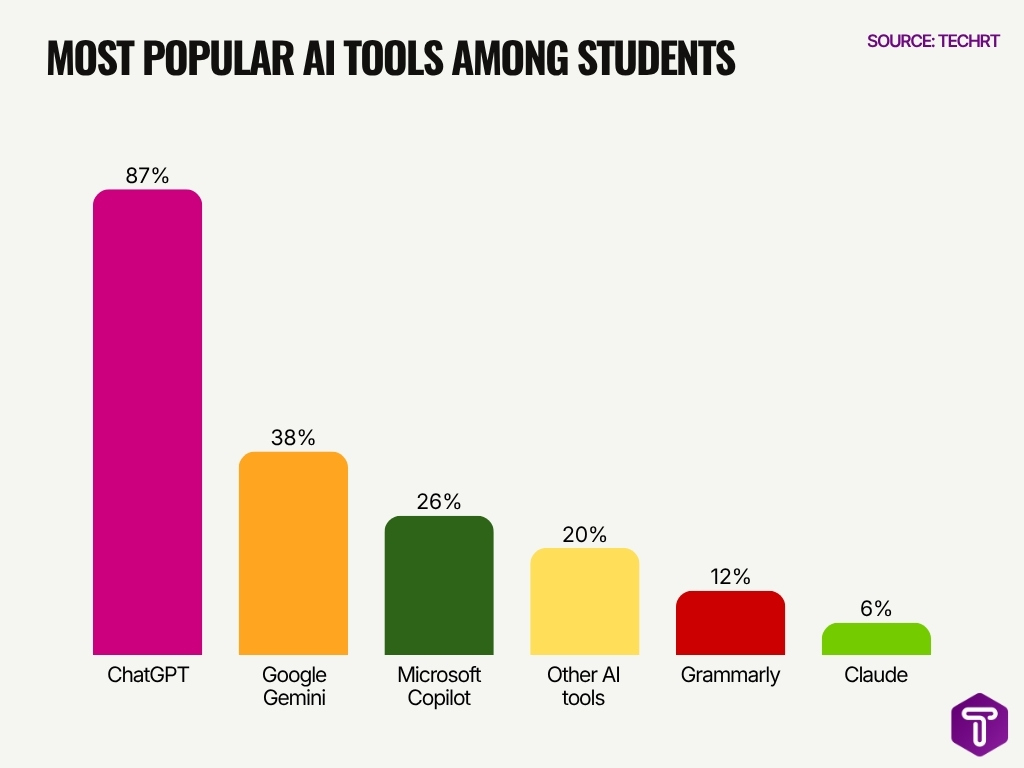
- ChatGPT dominates student AI tool usage, with 87% of students reporting that they use it.
- Google Gemini is the second-most used AI tool among students, with 38% adoption.
- Microsoft Copilot is used by 26% of students, showing growing interest in productivity-focused AI tools.
- Other AI tools account for 20% of student usage, suggesting that students are experimenting with a wide range of AI platforms beyond the major names.
- Grammarly is used by 12% of students, mainly reflecting demand for writing, grammar, and editing support.
- Claude has the lowest reported usage among the listed tools, at 6%.
- ChatGPT’s usage rate is more than 2 times higher than Google Gemini’s 38%, highlighting its strong lead in the student AI tools market.
- The data shows that students often use multiple AI tools, but ChatGPT remains the clear first choice for academic and productivity tasks.
Time Savings and Productivity Gains with AI
- Teachers using AI tools saved an average of 5.9 hours weekly on tasks.
- AI lesson planning reduced preparation time by ~30% in pilot programs.
- AI grading systems cut grading time by up to 70% for educators.
- AI-assisted grading reduced workload by 65% in higher education studies.
- Administrative tasks saw a 30-50% time reduction with AI attendance tools.
- AI chatbots handled 71% of repetitive student service tasks.
- AI scheduling boosted classroom utilization to nearly 90%.
- Content creation time dropped by up to 70% using generative AI tools.
- Adaptive learning systems improved efficiency by up to 30%.
Learning Outcomes and Academic Performance with AI
- Students using AI-supported learning systems scored approximately 15% higher in several controlled EdTech studies.
- Adaptive learning systems improved student engagement by 18% to 25% across multiple education pilots.
- AI-powered tutoring platforms reduced dropout rates by nearly 28% in online learning environments.
- Gamified AI learning applications improved student grades by an average of 14% in recent education studies.
- Personalized AI learning pathways increased learner retention rates by approximately 25%.
- AI-powered reading support systems improved literacy outcomes among younger learners in pilot programs across the US and Europe.
- Universities using predictive AI analytics reported stronger first-year retention outcomes compared with traditional advising models.
- AI-assisted STEM tutoring systems showed measurable improvements in problem-solving performance and assignment completion rates.
- Institutions increasingly measured AI success through student outcomes rather than software adoption rates alone during 2025.
- Research also indicates that AI-supported peer collaboration systems can improve participation rates in online classrooms.
Why Teachers Use AI in Education
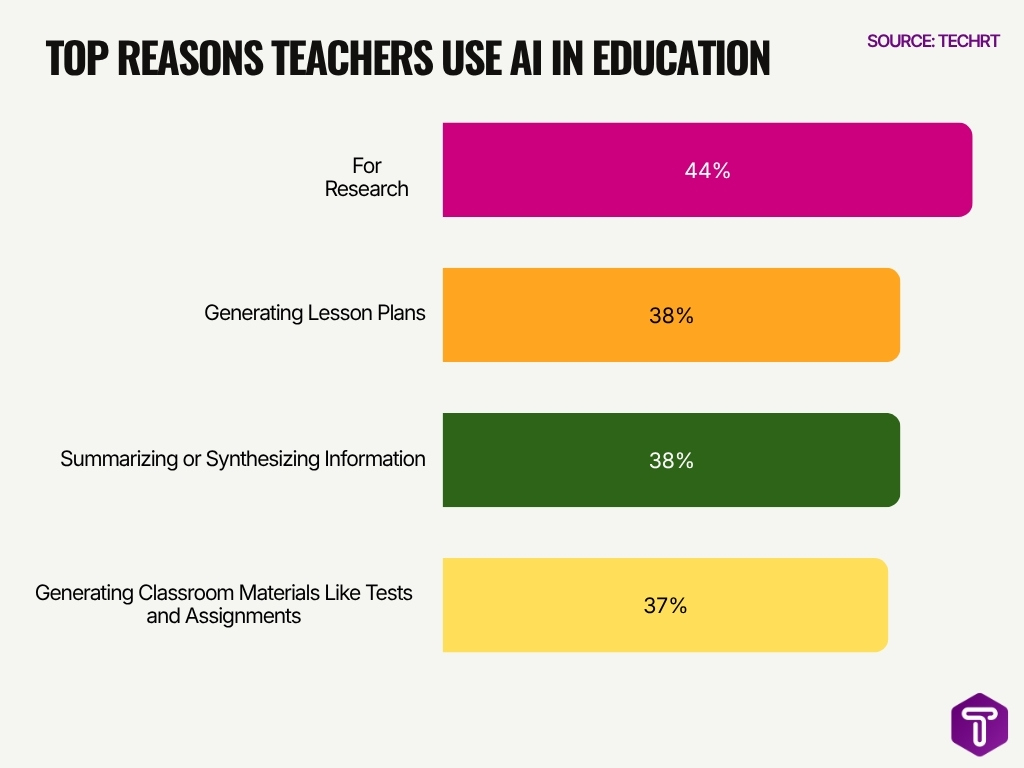
- Research is the top reason teachers use AI in education, with 44% of teachers using AI tools to support research-related tasks.
- Lesson planning is a major AI use case, as 38% of teachers use AI to generate lesson plans and classroom ideas.
- 38% of teachers also use AI for summarizing or synthesizing information, showing that educators rely on AI to simplify complex content.
- Classroom material creation is another important use, with 37% of teachers using AI to generate tests, assignments, and other teaching resources.
- The data shows that teachers are mainly using AI for time-saving tasks, especially research, planning, summarization, and content creation.
- The gap between the highest and lowest use cases is only 7 percentage points, suggesting that AI adoption among teachers is spread across several practical teaching activities.
- AI is becoming a useful support tool for educators, helping them improve productivity, reduce manual work, and prepare learning materials more efficiently.
Personalization and Adaptive Learning Outcomes
- AI-driven personalized learning improves student outcomes by 30% compared to traditional methods.
- Personalized learning systems boost student retention by 25% in EdTech implementations.
- Adaptive AI platforms enhance student engagement by 28.4% and quiz accuracy by 17.2%.
- AI-powered systems increase course completion rates by 10-20 percentage points.
- Students using adaptive AI complete coursework 22.9% faster in time-to-mastery.
- AI tutoring doubles learning gains while reducing session time to a median of 49 minutes.
- AI-enhanced learning improves engagement and retention by 20-30% per McKinsey and OECD studies.
- Adaptive assessments boost course pass rates by 27% to near 90%.
AI for Assessment, Grading, and Feedback
- Over 60% of educators worldwide now use AI tools for grading and assessment, up sharply from under 30% in 2022.
- AI-powered assessment systems can reduce manual grading time by up to 70% in large‑enrollment courses.
- Districts using AI grading software report over 40% faster feedback turnaround compared with traditional hand‑grading.
- Automated essay scoring engines now achieve agreement with human graders of around 85–90% in many large‑scale tests.
- Institutions using AI‑driven rubrics report 20–30% improvement in grading consistency across multiple instructors.
- In AI‑based feedback pilots, students received at least 10 times more feedback points per assignment than in non‑AI sections.
- Plagiarism detection platforms flag roughly 25–35% of submissions as needing manual review in higher‑education settings.
- Speech‑analysis tools in language courses cut pronunciation‑feedback delay from days to under 2 minutes per student.
- Mixed human‑AI grading setups reduced inter‑grader variance by about 30–40% in multi‑section university courses.
- AI assessment analytics can identify at‑risk students up to 2–3 weeks earlier than traditional manual monitoring.
AI for Tutoring and Homework Assistance
- The global AI tutoring market is projected to reach about $3.55 billion by 2025, driven by rapid adoption in schools and universities.
- AI-based tutoring pilots report 4–9 percentage point higher student proficiency gains compared with traditional instruction alone.
- Around 57% of college students now use AI tools at least weekly for homework, assignments, or studying support.
- Roughly 64% of students use AI to understand difficult coursework, and about 60% use it to check homework answers.
- The wider AI in education market is expected to hit roughly $7.8 billion in 2025, heavily supported by tutoring and homework tools.
- Global AI tutoring services are valued at about $1.4–3.7 billion in 2025, reflecting strong demand for automated homework help.
- Generative AI tutors have shown student success rates near 66%, versus about 56–61% for non-AI tutoring conditions.
- Over 50% of students frequently rely on AI to edit writing and summarize notes as part of their homework routine.
- Quality reviews find that about 76.4% of AI-generated tutoring responses are accepted with minimal edits by human supervisors.
- Analysts estimate that current AI tutors effectively support around 16% of overall learning tasks, especially drill and homework practice.
Teachers’ Attitudes Towards AI in Education
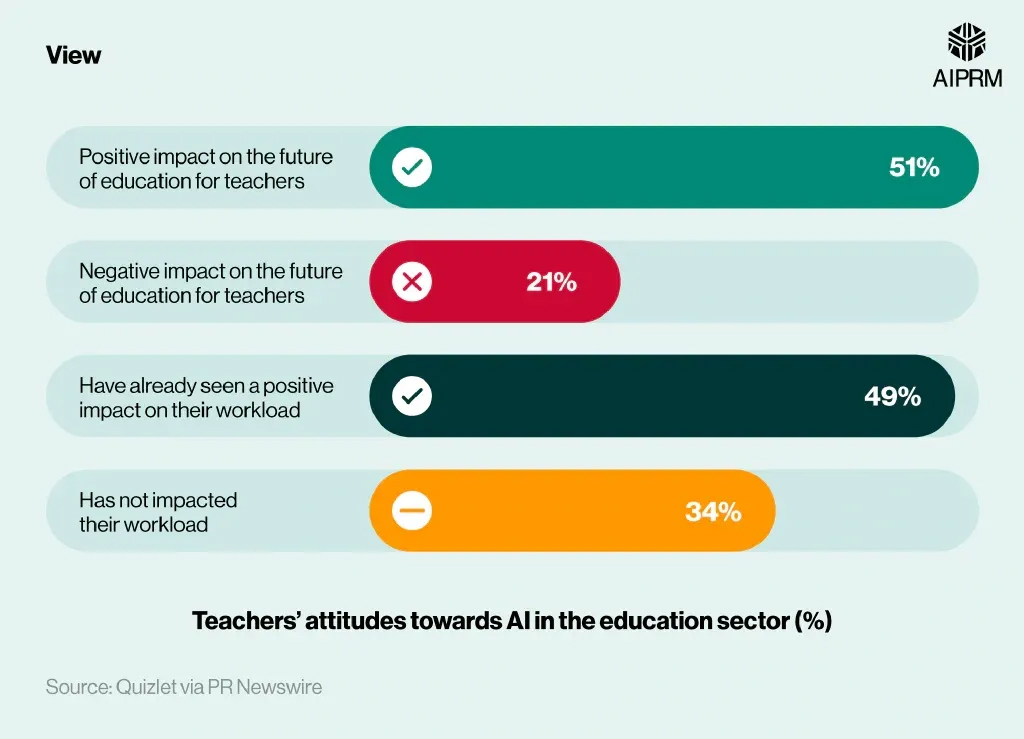
- 51% of teachers believe AI will have a positive impact on the future of education, showing that optimism around AI use in classrooms is stronger than concern.
- Only 21% of teachers think AI will have a negative impact on the future of education, suggesting that resistance exists but remains comparatively lower.
- Nearly 1 in 2 teachers have already seen AI create a positive impact on their workload, with 49% reporting benefits.
- 34% of teachers say AI has not impacted their workload, meaning a sizable share may still be in the early stages of adoption or experimentation.
- The data shows that teachers are more likely to associate AI with future benefits than negative outcomes, as positive sentiment is 30 percentage points higher than negative sentiment.
- AI’s workload impact is also becoming visible, with 49% reporting positive workload changes, compared with 34% seeing no change.
- Overall, the findings suggest that AI is increasingly viewed as a supportive classroom tool, especially for reducing workload and improving teaching efficiency.
Student Engagement and Motivation with AI
- AI-powered personalized learning increases student engagement by up to 60% and learning efficiency by 57%.
- Gamified AI applications boost skill assessments by 14% higher scores among learners.
- Adaptive AI systems achieve 88.3% course completion rates versus 76.5% in traditional online classes.
- AI-enhanced active learning generates 10x more engagement than passive methods in classrooms.
- AI tutoring platforms deliver 54% higher test scores compared to traditional environments.
- AI-powered feedback tools provide responses 10x faster, enhancing online coursework engagement.
- Personalized AI pathways yield 70% better course completion rates over standard approaches.
- AI collaboration tools increase team project completion and involvement by 40%.
- Gamified eLearning reaches 90% completion rates against 25% for non-gamified programs.
Data Privacy and Security Concerns in AI Use
- 56% of students express major data privacy concerns with AI tools in education.
- 84% cite cybersecurity risks as the top issue in AI adoption across organizations.
- 73% of educational AI systems exhibit bias, affecting grading and evaluations.
- 86% of school surveillance companies monitor students 24/7 using AI, raising consent issues.
- 61% of higher ed leaders identify data privacy as the primary barrier to AI use in institutions.
- AI cybersecurity investments in education reached $38.2 billion globally in 2026 amid rising threats.
- 67% of schools adopting AI without privacy frameworks face heightened breach risks.
- 96% of security leaders view AI-enabled attacks as a significant threat to educational data.
- AI grading achieves up to 70% time efficiency but sparks fairness debates over bias.
Parents’ Feelings About AI in Their Child’s Life
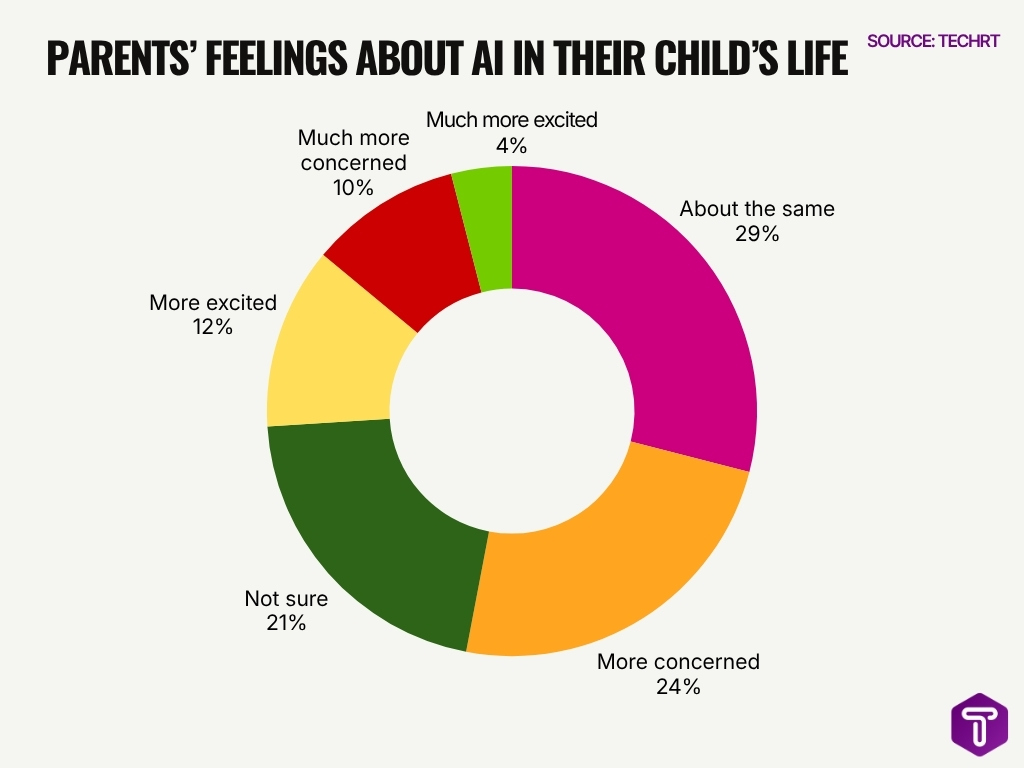
- The largest share of parents, 29%, said they feel about the same about AI in their child’s life.
- Concern is stronger than excitement, with 24% of parents saying they are more concerned and 10% saying they are much more concerned.
- Combined, 34% of parents expressed some level of concern about AI’s role in their child’s life.
- Only 12% of parents said they are more excited, while just 4% said they are much more excited.
- Overall, only 16% of parents showed a positive or excited view toward AI in their child’s life.
- A notable 21% of parents said they are not sure, showing that many families are still uncertain about AI’s impact on children.
- The data suggests that parents are more likely to feel cautious or uncertain than highly enthusiastic about AI in education and daily child development.
- The gap between concern and excitement is clear: 34% concerned compared with 16% excited.
Policies, Regulations, and Governance of AI in Education
- More than 70 countries have introduced national AI strategies with explicit implications for education governance by early 2026.
- Two‑thirds of higher education institutions worldwide have or are developing AI guidelines addressing ethics, data privacy, and fairness in education.
- Only about 6% of teachers report that their school’s AI policies are clear and consistently enforced, underlining governance gaps.
- Around 87% of schools already use AI tools, yet only roughly 12% have formal AI governance frameworks in place.
- Roughly 19% of universities already have a formal AI policy, while an additional 42% are actively developing AI‑use frameworks.
- In the United States, less than 20% of colleges and universities had issued institutional AI policies by the end of 2025.
- Over 90% of OECD countries entered the generative‑AI‑in‑education debate with pre‑existing national AI or digital‑education strategies.
- UNESCO estimates that no more than 50% of middle and high schools globally have any kind of dedicated AI policy.
- Nearly a third of national AI strategies explicitly reference fairness, transparency, and human oversight as core requirements for AI in education.
- Around 70% of institutions in Europe and North America already have or are developing AI‑use guidance, compared with about 45% in Latin America and the Caribbean.
Future Trends and Predictions for AI in Education
- The global AI in education market is projected to reach $32.27 billion by 2030, growing at a 31.2% CAGR from 2024.
- Long‑term forecasts suggest the sector could exceed $136 billion by 2035, driven by AI‑driven personalization and cloud‑based learning platforms.
- Analysts estimate the AI education market will grow at a 34.52–35.6% CAGR between 2026 and 2035, making it one of the fastest‑growing EdTech segments.
- The global corporate AI‑learning and upskilling market is expected to reach $97 billion by 2034, with AI‑powered workforce training capturing over 26% CAGR.
- AI‑tutoring and adaptive‑learning revenues are forecast to rise from $3.55 billion in 2025 to $6.45 billion by 2030, as virtual tutors penetrate mainstream K–12 and higher education.
- AI‑powered immersive simulations and virtual labs in STEM and medical education are projected to grow at over 30% CAGR through 2030, fueled by VR and AI integration.
- Institutions using predictive analytics for early‑intervention programs report up to 15–20% higher retention rates in programs that systematically flag at‑risk students.
- Governments in over 30 countries are drafting AI literacy frameworks by 2030, aiming to embed responsible AI competencies in primary and secondary curricula.
- Multilingual AI‑learning tools are expected to support 100+ languages by 2030, expanding global access to digital education for over 1.2 billion learners in low‑resource regions.
- Hybrid human‑AI teaching models are projected to power over 60% of digital classrooms by 2030, with AI‑assisted tutors augmenting in‑person instruction instead of replacing teachers.
Frequently Asked Questions (FAQs)
How big is the global AI in education market in 2025?
What is the projected CAGR of the AI in education market?
Which region leads the AI in education market?
How many college students use AI tools for schoolwork?
How much can AI improve student learning outcomes?
Conclusion
AI continues to reshape education across K-12 schools, universities, workforce programs, and online learning platforms. Institutions moved beyond experimentation and increasingly focused on measurable outcomes such as student retention, engagement, productivity gains, and personalized learning support. AI tutoring, adaptive learning systems, automated grading, and predictive analytics now play a growing role in modern education infrastructure.
At the same time, educators and policymakers remain focused on privacy, transparency, governance, and ethical AI use. Future growth will likely depend on balancing innovation with accountability while ensuring equitable access to AI-powered learning tools worldwide. As investment and adoption continue accelerating, AI will remain one of the most influential technologies shaping the future of education throughout the next decade.

Leave a comment
Have something to say about this article? Add your comment and start the discussion.