




Neobanks continue to reshape how consumers and businesses manage money. Mobile-first banking platforms now compete directly with traditional banks by offering low-fee accounts, faster onboarding, real-time payments, and AI-powered budgeting tools. Companies in e-commerce, gig work, and cross-border payments increasingly rely on digital-only banks to streamline transactions and improve customer experiences.
The rise of neobanking also reflects broader changes in financial behavior. Younger users prefer app-based banking over branch visits, while small businesses use neobanks for instant invoicing, expense tracking, and international transfers. As regulators expand open banking frameworks and fintech investment grows, neobank adoption keeps accelerating worldwide. Explore the latest data, trends, and market shifts shaping the neobanking industry.
Editor’s Choice
- The global neobanking market reached $382.8 billion in 2025 and is projected to exceed $552 billion in 2026.
- Europe accounted for 37.2% of global neobank revenue in 2025, making it the largest regional market.
- Asia-Pacific represented 21.3% of global neobanking revenue in 2025 and remains the fastest-growing region.
- Millennials and Gen Z make up roughly 78% of global neobank customers in 2026.
- The global neobanking industry is forecast to grow at a 45% CAGR through 2032.
- North America held 28.4% of the global neobank market in 2025, driven by rapid fintech adoption in the US and Canada.
- Business accounts generated about 67% of neobank revenue share in 2025, highlighting strong SME demand.
- The US neobanking market alone is expected to surpass $48.5 billion in 2026.
- Smartphone penetration in several emerging economies is expected to exceed 90% before 2040, creating long-term growth opportunities for mobile-first banking.
Recent Developments
- Several neobanks integrated generative AI assistants in 2025 and 2026 to improve customer support and budgeting insights.
- Digital banking platforms increasingly added embedded finance tools, including invoicing, lending, and payroll integrations for SMEs in 2026.
- Chime completed a public offering valued at approximately $864 million in 2025, signaling stronger investor confidence in digital banks.
- Nubank surpassed 110 million customers globally in 2025, reinforcing Latin America’s leadership in digital banking adoption.
- Greenwood expanded its user base by acquiring Kinly and adding around 300,000 customers in 2025.
- Open banking regulations across Europe and parts of Asia accelerated partnerships between neobanks and fintech infrastructure providers during 2025 and 2026.
- Mobile banking services represented nearly 47% of neobanking revenue share in 2025, showing continued reliance on app-driven transactions.
- Enterprise banking applications contributed over 51% of the global neobank market revenue in 2025.
- Several digital-only banks expanded cross-border payment products in 2026 to compete with traditional remittance providers.
- AI-driven fraud detection systems became a core investment area for neobanks as digital transaction volumes increased worldwide.
Global Neobank Adoption Overview
- Global neobank adoption accelerated after 2020 as consumers shifted toward mobile-first financial services.
- The worldwide neobanking market reached approximately $230.5 billion in 2025 based on multiple industry estimates.
- Market forecasts indicate the industry could surpass $5 trillion by 2035 if current adoption rates continue.
- Europe remains the leading market because of strong fintech ecosystems in the UK, Germany, and France.
- Neobanks gained traction among freelancers and remote workers due to lower international transaction fees and faster account approvals.
- Consumers increasingly use neobanks for budgeting, spending alerts, and real-time payment tracking rather than basic checking accounts alone.
- Smartphone penetration remains a major adoption driver, particularly in emerging economies with limited branch banking infrastructure.
- Open banking APIs helped digital-only banks integrate savings, investment, and lending products into single mobile apps in 2025 and 2026.
- Younger consumers continue to adopt neobanks at higher rates than older demographics because of app-first user experiences.
- Financial inclusion initiatives in Africa, Southeast Asia, and Latin America increasingly rely on neobank infrastructure to reach unbanked populations.
Neobanking Market Size
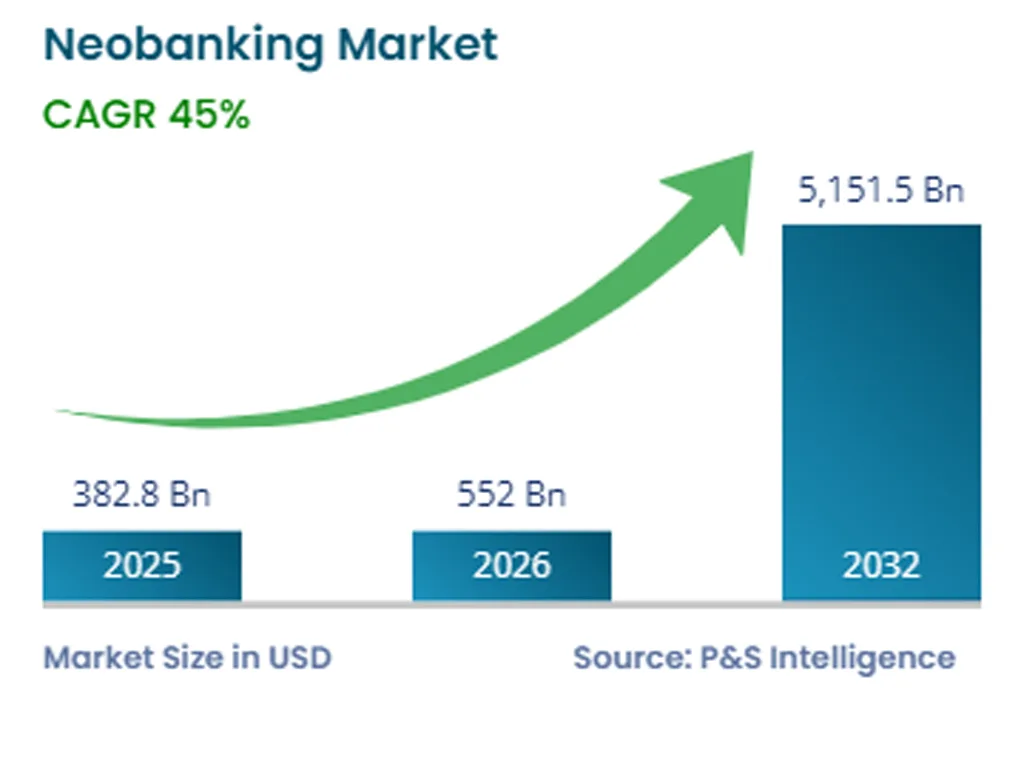
- The neobanking market is projected to grow rapidly, with a strong CAGR of 45%.
- The market size is estimated at USD 382.8 billion in 2025, showing a large existing base for digital-only banking services.
- By 2026, the neobanking market is expected to reach USD 552 billion, reflecting strong year-over-year growth.
- The market is forecast to expand dramatically to USD 5,151.5 billion by 2032.
- From 2025 to 2032, the market is expected to grow by nearly 13.5 times, highlighting massive adoption potential.
- The sharp upward trend suggests increasing consumer preference for mobile-first banking, low-fee financial services, and digital account management.
- The data indicates that neobanks are likely to become a major force in the global financial services industry by 2032.
- This growth is being driven by rising demand for cashless payments, fintech innovation, and convenient digital banking platforms.
Growth of Neobanking User Base Worldwide
- Global neobank customer counts expanded rapidly between 2023 and 2026 as digital banking adoption became mainstream.
- Nubank alone crossed 110 million customers in 2025, making it one of the world’s largest digital banks by user base.
- Revolut continued expanding internationally in 2025 with strong growth in Europe and Asia-Pacific markets.
- More than 95% smartphone penetration projected in several advanced economies supports long-term digital banking growth.
- Gen Z users increasingly prefer mobile banking apps over physical branches, with nearly 99% using a banking app monthly.
- Cross-border workers and digital nomads boosted the adoption of multi-currency neobank accounts in 2025 and 2026.
- Digital payroll integrations encouraged small businesses to onboard employees through neobank-linked payment systems.
- Latin America recorded one of the fastest increases in neobank users because of limited traditional banking access and high mobile usage.
- Asia-Pacific adoption surged due to rising smartphone ownership and digital payment infrastructure expansion.
- Digital-first banking brands increasingly target teenagers and students through prepaid debit products and budgeting tools.
Country-Wise Neobank Penetration and Leading Markets
- The UK neobank penetration reached about 50% of adults using at least one digital‑banking app by the end of 2024, up from 16% in 2018.
- Revolut reported over 45 million global customers in 2025, with Europe and Asia‑Pacific accounting for the majority of its active users.
- Brazil’s neobank market size hit approximately $6.1 billion in 2025, positioning it as Latin America’s largest digital‑banking ecosystem.
- Nubank alone amassed more than 60 million users in Brazil by Q1 2025, underpinning Brazil’s leadership in regional neobanking.
- The United States neobanking sector served nearly 150 million active accounts in 2025, roughly doubling its base from 86 million over 30 months.
- Around 28% of US consumers in 2025 considered a neobank their primary banking relationship, led by Millennials and Gen Z.
- India’s neobank‑linked users grew to over 150 million app‑based banking customers by 2025, driven largely by UPI‑enabled fintech platforms.
- South Korea recorded mobile‑banking engagement rates exceeding 90% of smartphone owners in 2025, creating a strong base for neobank growth.
- Mexico’s neobanking user base expanded by more than 35% year‑on‑year in 2025, making it one of Latin America’s fastest‑growing fintech markets.
- Singapore’s licensed digital banks served roughly 10 million unique users by 2025, consolidating the city‑state’s role as a regional digital‑banking hub.
Regional Neobank Adoption by Continent
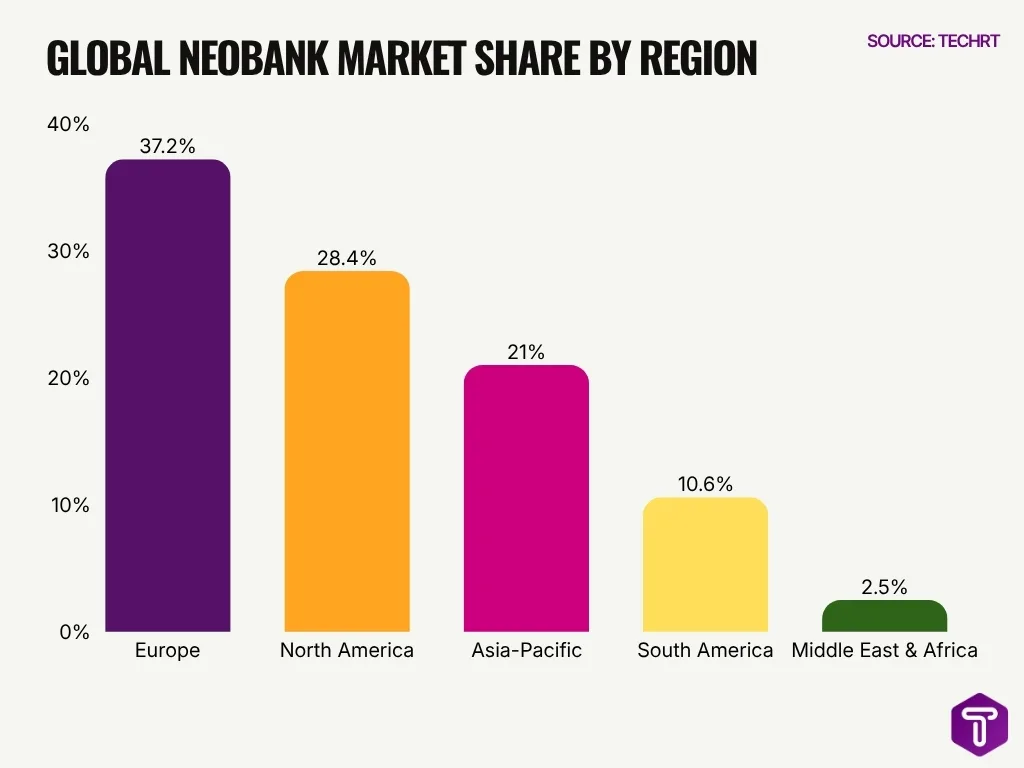
- Europe held the largest global neobank market share at 37.2% in 2025.
- North America captured approximately 28.4% of global market revenue in 2025.
- Asia-Pacific represented more than 21% of worldwide neobank revenue in 2025.
- South America accounted for roughly 10.6% of global neobank revenue in 2025.
- The Middle East and Africa generated about 2.5% of total market revenue in 2025, though adoption rates continue rising quickly.
- The UK remains one of Europe’s strongest neobank markets, supported by more than 1,600 fintech firms.
- India’s neobank ecosystem expanded rapidly because of increasing smartphone access and digital payment adoption.
- Brazil became a leading Latin American market due to Nubank’s rapid growth and increasing digital wallet adoption.
- African fintech startups increasingly use neobank infrastructure to deliver financial services to unbanked populations.
- Asia-Pacific is projected to become the fastest-growing regional market through 2032 due to expanding digital economies and mobile-first consumers.
Neobank Adoption in Emerging Markets
- More than 1.4 billion adults globally lacked access to traditional banking in 2025, fueling neobank growth.
- Africa’s fintech industry grew rapidly as mobile money and neobanks reached underserved populations.
- India processed over 130 billion UPI transactions in 2025, building a strong neobank infrastructure.
- Brazil saw accelerated digital banking adoption due to high inflation and demand for fee-free accounts.
- Southeast Asia experienced rapid neobank expansion due to rising smartphone penetration and internet access.
- Nigeria ranked among Africa’s top fintech investment destinations in 2025, boosting digital banking.
- Indonesia’s digital banking market grew as e-commerce and mobile wallets became mainstream.
- Latin America’s underbanked population drove strong app-based banking adoption in 2025–2026.
- Egypt expanded digital banking via government-backed financial inclusion programs.
- Pakistan’s fintech ecosystem recorded double-digit growth in digital wallet users in 2025.
Neobank Adoption in Developed Economies
- 89% of Americans used digital banking channels in 2025, driving demand for app-first financial services.
- Over 60% of European consumers now use multi-bank financial apps connected via open banking frameworks.
- Canada’s mobile banking penetration exceeded 80% among adults in 2025.
- 45% of Japanese users aged 18–34 adopted cashless payment programs through digital banking platforms in 2025.
- Scandinavian countries maintain over 90% rates of digital payment and mobile banking usage globally.
- Germany’s fintech adoption grew 18% year-over-year due to demand for low-cost digital financial products.
- France processed over 2 billion instant payments through retail banking channels in 2025.
- Australia’s Consumer Data Right framework boosted competition, with 35% of users switching to digital-first platforms in 2024–2025.
- 22% of US consumers now use neobanks for paycheck advances, savings automation, and budgeting tools.
- The UK attracted $4.2 billion in venture funding for digital banking startups, remaining Europe’s fintech leader.
Global Neobanking Brand Share
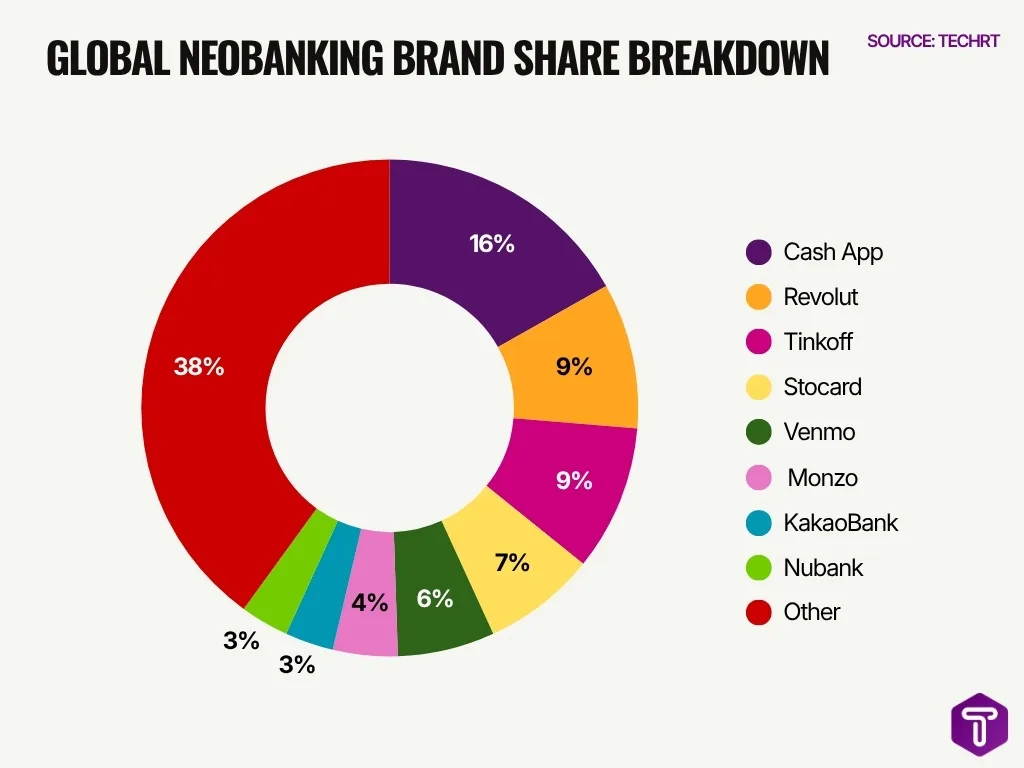
- Other neobanking brands hold the largest share at 38%, showing that the global neobank market is highly fragmented beyond the leading names.
- Cash App leads among individual neobank brands with 16% worldwide share, making it the top standalone brand in this dataset.
- Revolut and Tinkoff each account for 9%, placing them jointly behind Cash App among the major neobanking players.
- Stocard holds a 7% share, making it a mid-tier brand in the global neobanking landscape.
- Venmo captures 6% of worldwide neobanking brand share, reflecting its strong position in digital payments and peer-to-peer finance.
- Monzo accounts for 4%, while KakaoBank and Nubank each hold 3%, indicating smaller but still notable global brand presence.
- The top three named brands, Cash App, Revolut, and Tinkoff, together represent 34% of the worldwide neobanking brand share.
- The data suggests that while a few brands dominate visibility, no single neobank controls the market, with the largest individual share being only 16%.
- The high 38% “Other” category highlights room for regional neobanks, niche digital banks, and emerging fintech challengers to compete globally.
Neobank Customer Acquisition and New Account Share
- Neobanks reduced onboarding times to 5–10 minutes for new customers, compared to 2–5 days at traditional banks.
- Worldwide neobank users are expected to hit 350 million in 2026, up from 210 million in 2022.
- Almost 40% of new banking accounts are already going to neobanks, though they capture only 5% of banking revenues.
- Neobank customer acquisition costs via referral programs are $30–$80, a 60–80% reduction versus $150–$400 for paid digital ads.
- 10–18% of active neobank users participate in referral programs, with a 20–35% conversion rate on referred visitors.
- 92% of Gen Z prefer using mobile banking apps over visiting a physical branch, with 72% preferring to open accounts via app.
- Neobank accounts outside North America and Europe grew by 85 million in 2025, exceeding 250 million total in emerging markets.
- 65% of neobank services are basic savings accounts, while crypto-linked accounts rose 50% and teen banking gained 35%.
Primary Account Usage and Share of Wallet With Neobanks
- 31% of Americans were estimated to be neobank customers by 2025, showing digital-only banks were moving beyond a niche audience.
- 42% of ages 18–24 preferred online-only primary accounts, indicating strong primary-account potential among younger users.
- 79% of employees said they would switch to an employer offering early wage access, which helps explain why salary-linked neobank features improve engagement.
- Monthly transactions per active user reached 17.4x, while second-month retention hit 80%, showing how frequent-use features can lift loyalty.
- Neobank users averaged $1,200 in monthly transaction value, up from $950 a year earlier, suggesting a rising share of wallet.
- Small business accounts averaged about $16,200 in monthly processing, reinforcing neobanks’ growing role in SME operating activity.
- About 43% of surveyed users mainly used their neobank for e-commerce, with an average transaction size of nearly $180.
- 65% of neobank services were basic savings accounts, while crypto-linked accounts rose 50%, showing expanding product breadth and deeper wallet capture.
- Monzo’s subscription revenue rose to over £11 million across 360,000 customers, illustrating how premium plans can create recurring revenue.
- Premium tiers priced around Rs 199–999 per month were cited as a predictable recurring-revenue model, especially when paired with cashback, travel, and support perks.
User Demographics by Age Group
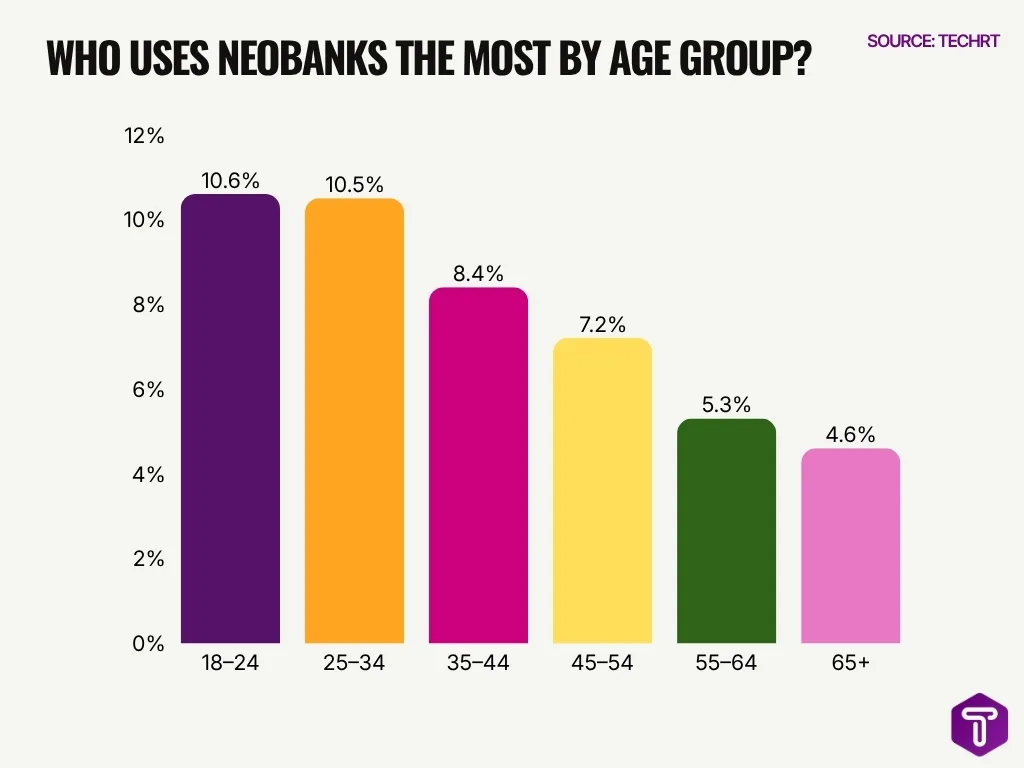
- Young adults aged 18–24 show the highest neobank usage, with 10.6% of the population using digital banking.
- The 25–34 age group follows very closely at 10.5%, showing that neobanks are especially popular among younger working-age consumers.
- Neobank adoption starts to decline after age 35, with usage dropping to 8.4% among people aged 35–44.
- The 45–54 age group records a lower usage rate of 7.2%, suggesting that middle-aged users are less likely to rely heavily on neobanks.
- Older consumers show the lowest adoption levels, with 55–64-year-olds at 5.3% and those aged 65+ at 4.6%.
- The data shows a clear age-based trend: younger generations are more likely to use neobanks, while adoption gradually decreases among older age groups.
- The gap between the highest and lowest age groups is 6 percentage points, from 10.6% among 18–24-year-olds to 4.6% among people aged 65+.
- This suggests that neobanks appeal most strongly to digital-first users, especially younger adults who are more comfortable with mobile banking, app-based finance, and cashless transactions.
Neobank Adoption Among Millennials and Gen Z
- More than 70% of Gen Z consumers reported using a mobile banking app weekly in 2025.
- Millennials accounted for 38% of global digital-only bank customers, remaining the largest group.
- 62% of Gen Z users preferred instant notifications and real-time spending insights over traditional statements.
- 74% of younger users discovered neobanks through social media marketing campaigns in 2025.
- Neobanks with buy now, pay later integrations saw 45% higher engagement with consumers under 30.
- 58% of Gen Z users showed interest in crypto-linked financial services versus 22% of Baby Boomers.
- Apps with gamified financial tools achieved 31% higher engagement rates among younger users.
- 69% of consumers under 35 viewed physical bank branches as unnecessary for daily financial management.
- Neobanks with Apple Pay and Google Pay integrations saw 52% stronger adoption among smartphone-first users.
- 81% of Gen Z considered financial literacy content in apps a key factor when choosing a neobank.
Neobank Adoption Among SMEs and Business Customers
- 67.62% of the neobanking market share came from business accounts in 2025, showing SMEs remain a core revenue driver.
- 67% of neobank revenue share in 2025 came from business customers, reflecting strong demand for digital business banking tools.
- More than 50% of SME loans in developed markets were delivered through fintech platforms in 2025.
- 18% of small-business users in Europe used open banking, compared with 13% of retail users, showing stronger SME adoption.
- The UK reached 12 million open banking users in December 2024, a 50% year-over-year increase that supported SME digital banking adoption in 2025.
- European SMEs generated 6.4 billion open banking API calls across France, Germany, Italy, and Spain in 2023, versus 14 billion in the UK.
- Global neobank users rose to about 350 million in 2025, up from 301.7 million in 2024, showing broad digital banking momentum.
- The neobank market was expected to reach $261.4 billion in 2025, reinforcing rapid expansion across business banking.
- 34.6% CAGR through 2026 was projected for North America, driven by startups and SMEs adopting advanced banking platforms.
- Digital payment transaction value was projected to hit $20.09 trillion in 2025, helping neobanks win SME and cross-border payment use cases.
BaaS Advantage in Neobanks
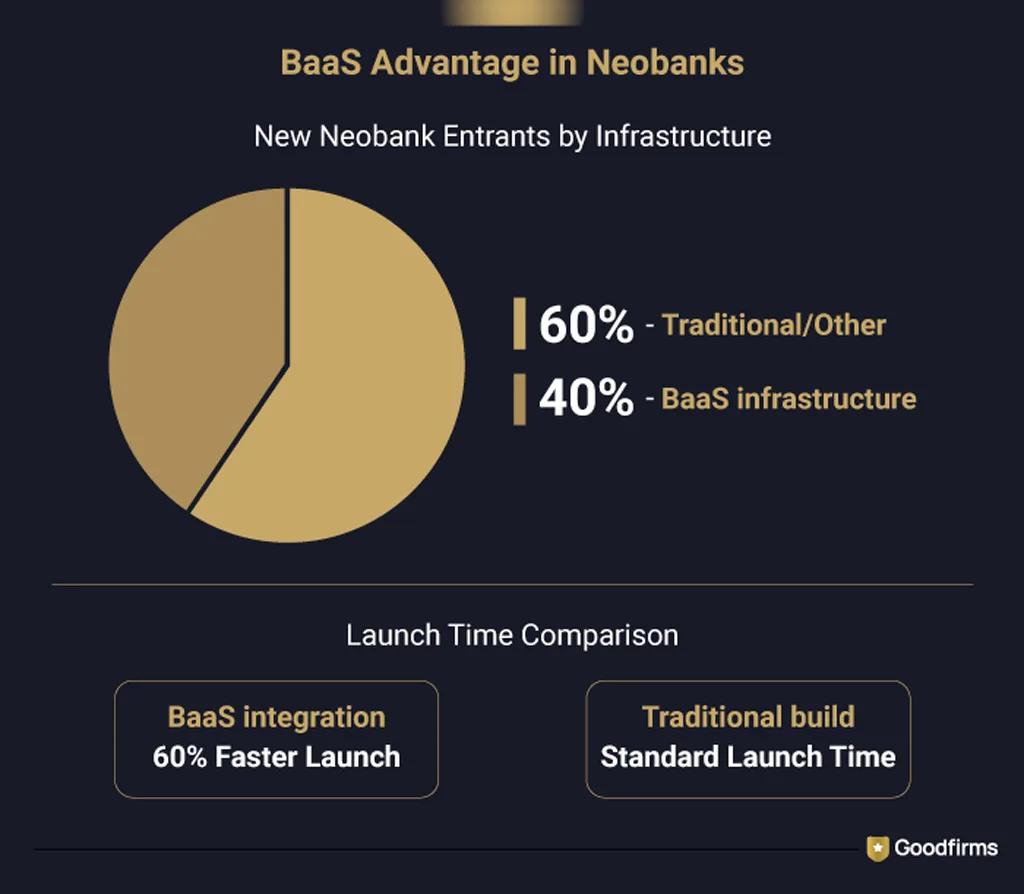
- Traditional/Other infrastructure accounts for the largest share of new neobank entrants at 60%.
- BaaS infrastructure supports 40% of new neobank entrants, showing strong adoption among digital banking startups.
- The data suggests that while traditional infrastructure still leads, BaaS is becoming a major alternative for launching neobanks.
- BaaS integration helps neobanks achieve a 60% faster launch compared to traditional build models.
- Traditional build models are linked with a standard launch time, which may require longer development, compliance, and infrastructure setup.
- The 40% share of BaaS-based entrants highlights how banking-as-a-service platforms are reducing entry barriers for fintech companies.
- Faster launch capability makes BaaS infrastructure especially attractive for startups looking to enter the market quickly.
- Overall, the chart shows that BaaS offers a clear competitive advantage through speed, flexibility, and faster go-to-market execution.
Digital-Only Bank Preference vs Traditional Banks
- 46% of Gen Z consumers preferred digital-only banking platforms over traditional banks in 2025.
- 83% of Gen Z preferred digital-first financial services, showing a strong lean toward app-based banking.
- 60% of Gen Z preferred to open an account directly from their phones, reinforcing mobile-first onboarding.
- 72% of Gen Z would rather open a bank account via app than visit a branch.
- 92% of Gen Z said they prefer mobile banking apps over visiting a physical branch.
- The share of U.S. bank account holders handling banking matters in person in a branch fell to 45% in Q4 2024, down 8 points from the first half of 2019.
- The number of U.S. digital-only bank account holders is projected to rise from 29.8 million in 2021 to 53.7 million by 2025.
- 68% of digital banking users said neobank apps offer better budgeting and financial management tools than traditional banks.
- Nearly 80% of neobank customers use their accounts for daily activities like bills, shopping, and transfers.
- Neobank users in the U.S. are expected to grow to 53.7 million by 2025, up from 29.8 million in 2021.
Drivers of Neobank Adoption
- 3.6 billion people used online banking globally in 2025, showing the scale of digital banking adoption.
- Smartphone penetration reached about 80% in many regions by October 2025, making mobile-first banking easier to access.
- Nearly 80% of adults worldwide had a financial account in 2025, up from 50% in 2011, which supports branchless banking growth.
- 10% of adults in developing economies used a mobile-money account to save in 2025, a 5-point rise from 2021.
- About 900 million adults without financial accounts still had a mobile phone, including 530 million with smartphones, widening the neobank opportunity.
- The global gig workforce exceeded 1.57 billion workers in 2025, fueling demand for instant payouts and flexible banking.
- Freelancers worldwide earn about $28 per hour on average, making low-fee transfer and payout options especially attractive.
- In the U.S., 44% of new checking accounts were opened with digital-first providers in 2024, reflecting stronger trust in app-based banking.
- 80% of consumers said they prefer online services over visiting a physical bank branch, supporting cashback and app-led neobank acquisition.
- The open banking-enabled neobank market was valued at $22.91 billion in 2025, showing how APIs and product integration are expanding adoption.
Key Challenges Facing Neobanks
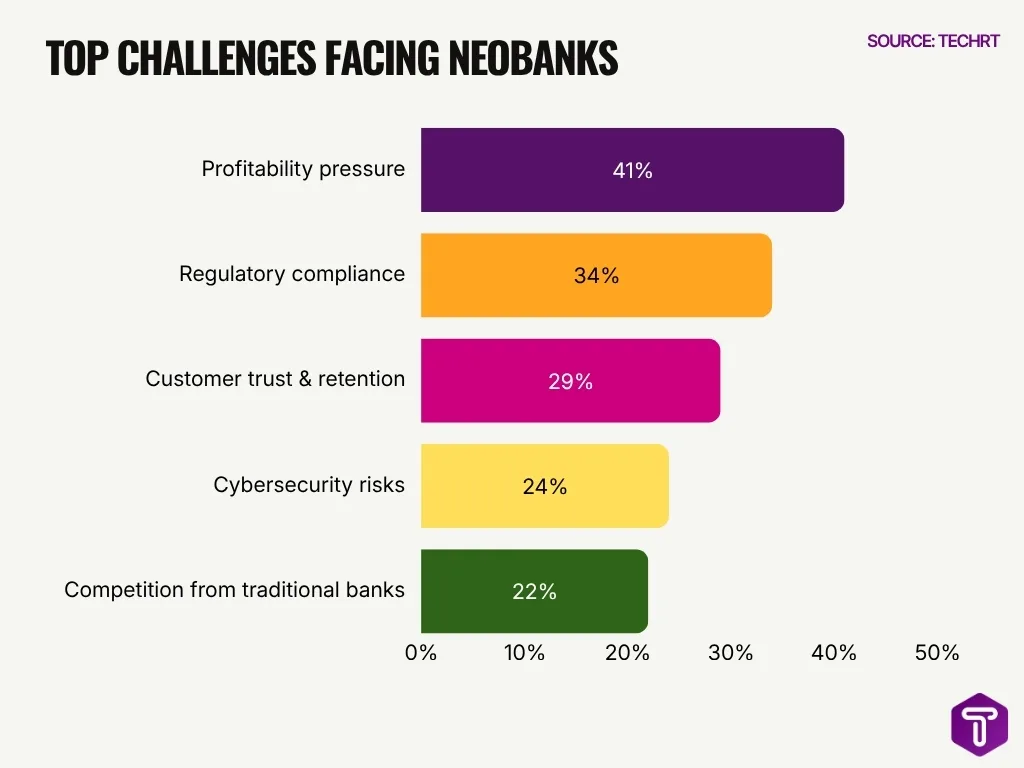
- Profitability pressure is the biggest challenge for neobanks, affecting 41% of the sector.
- Regulatory compliance ranks second, with 34% share, showing that digital banks face strong pressure to meet financial rules and licensing requirements.
- Customer trust & retention is a major concern at 29%, highlighting the need for neobanks to build credibility and keep users engaged.
- Cybersecurity risks account for 24%, making data protection, fraud prevention, and secure transactions critical priorities.
- Competition from traditional banks represents 22%, as established banks continue to improve digital banking services.
- The data shows that neobanks are not only competing on technology but also dealing with business sustainability, regulation, trust, and security.
- Overall, the top challenge, profitability pressure at 41%, is nearly double the impact of competition from traditional banks at 22%.
Mobile App Usage and Engagement Metrics for Neobanks
- 34% of consumers use a mobile banking app daily, and 42% prefer a mobile app to manage their finances overall.
- 95% of Millennials and 89% of Gen Z use digital banking at least weekly, showing especially high engagement among younger users.
- 71% of Gen Z use mobile apps for P2P payments weekly, compared with 53% of Millennials.
- Push notifications can drive up to 90% mobile view rates, and personalized push strategies can reach as high as 31% conversion rates.
- 85% of financial account holders opt in to push notifications, which supports stronger real-time alert engagement.
- Around 90% of neobanks are expected to use biometric security methods like fingerprint and facial recognition by 2025.
- AI-focused neobanks can achieve a 25% to 35% DAU-to-MAU ratio, while one major AI banking platform reports 98% of customer queries handled by chatbots.
- Neobanking app downloads hit 1.2 billion in one recent year, and average daily usage reached 25 minutes.
- NuBank has 93 million users, while Revolut serves over 30 million customers, and Chime has about 22 million users.
Security, Fraud, and Compliance Statistics in Neobanking
- Global cybercrime costs are projected to hit $10.5 trillion annually by 2025, putting heavier security pressure on digital banks.
- In 2025, financial institutions planned $21.1 billion in fraud detection and prevention spending, rising to $39.1 billion by 2030.
- Account takeover attacks reached an overall rate of 2.5% in Q2 2025, with fintech and finance attacks surging 122% year over year.
- In the UK alone, more than 78,000 account takeover cases were recorded in 2025, equal to 18% of all fraud-risk filings.
- Open banking-initiated payment fraud in H1 2025 accounted for just 0.013% of transactions by volume, compared with 0.045% across the wider payments market.
- Europe’s identity verification market is projected to grow from $3.53 billion in 2025 to $7.72 billion by 2030, reflecting stricter compliance needs.
- The biometric identity verification market is forecast to expand from $8.88 billion in 2025 to $17.81 billion by 2030.
- One biometric provider surpassed 1 million daily biometric verifications in 2025, showing how quickly high-assurance checks are scaling.
- AI-enabled fraud and identity attacks also intensified in 2025, with native virtual camera attacks rising 2,665% and face-swap attempts up 300%.
- Account takeover fraud, in which fraudsters stole more than $262 million in 2025, underscores the need for real-time monitoring and stronger authentication.
Frequently Asked Questions (FAQs)
What is the projected global neobanking market size in 2026?
What CAGR is the neobanking industry expected to grow at?
What share of global neobank revenue came from Europe in 2025?
How many customers did Nubank have by the end of 2025?
What percentage of neobank revenue came from business accounts in 2025?
Conclusion
Neobanks have evolved from niche fintech startups into major players in the global financial system. Digital-only banks continue attracting consumers and businesses with faster onboarding, lower fees, AI-driven insights, and mobile-first experiences. Adoption remains strongest among Millennials, Gen Z, freelancers, and SMEs, although older demographics increasingly use digital banking tools as well.
Regional growth patterns show strong momentum across Europe, Latin America, Asia-Pacific, and emerging economies, where mobile connectivity and financial inclusion initiatives continue expanding. At the same time, security, compliance, and profitability remain key challenges for the industry.
As open banking frameworks mature and embedded finance becomes more common, neobanks are likely to deepen their role in payments, lending, savings, and cross-border transactions. The next phase of growth will depend on customer trust, stronger cybersecurity systems, and the ability to deliver seamless financial experiences across global markets.

Leave a comment
Have something to say about this article? Add your comment and start the discussion.