




Quantum computing has moved beyond laboratory experiments and into commercial planning, national security programs, and enterprise software strategies. Financial firms now test quantum systems for portfolio optimization, while pharmaceutical companies use quantum simulations to accelerate drug discovery. At the same time, governments and cloud providers continue to invest billions into scalable quantum infrastructure.
The market entered a faster growth phase as hardware vendors improved qubit stability, startups secured record funding rounds, and enterprise pilots expanded across industries. This article explores the latest quantum computing market statistics, growth forecasts, regional trends, and investment activity shaping the industry.
Editor’s Choice
- The global quantum computing market is projected to grow from $3.52 billion in 2025 to $20.20 billion by 2030, reflecting a 41.8% CAGR.
- The market reached an estimated $1.88 billion in 2026, up from $1.44 billion in 2025.
- North America accounted for roughly 43.6% to 61% of the global quantum computing market share in 2025, maintaining leadership through enterprise adoption and government support.
- Quantum technology investments surpassed $55 billion globally through combined public and private funding initiatives.
- Quantum technology startup investment climbed to $12.6 billion in 2025, representing a 6.3x increase over 2024 levels.
- Over the last 12 months, quantum computing companies raised approximately $4.51 billion across 28 disclosed equity rounds.
- Hardware-focused companies captured nearly 88.5% of disclosed quantum funding capital in 2025 and 2026.
- The U.S. quantum computing market is forecast to exceed $8.5 billion by 2034, expanding at nearly 30% CAGR.
- Quantum computing revenues are expected to surpass $3 billion globally by 2028, signaling the shift from research-stage innovation to commercial deployment.
Recent Developments
- In 2026, the U.S. Department of Commerce announced $2 billion in grants for quantum technology companies under the CHIPS R&D initiative.
- IonQ agreed to acquire SkyWater Technology for approximately $1.8 billion to expand domestic quantum semiconductor manufacturing capabilities.
- PsiQuantum secured a record-breaking $1 billion funding round, one of the largest private investments in quantum computing history.
- QuEra Computing closed a funding round exceeding $230 million, backed by investors including Google Quantum AI and SoftBank Vision Fund.
- Quantum startup investment in 2025 reached $12.6 billion, with nearly 90% directed toward quantum computing firms instead of sensing or networking companies.
- Governments worldwide announced roughly $1.8 billion in additional quantum funding initiatives during 2024, supporting workforce expansion and research infrastructure.
- UK-based public investment programs committed more than £1 billion over four years to quantum technologies and procurement programs.
- Quandela identified hybrid quantum-classical systems, industrial pilot programs, quantum error correction, and cybersecurity applications as the defining commercial trends of 2026.
- The global quantum technology industry reached approximately $1.9 billion in 2025 and is projected to exceed $4 billion by 2028.
- Analysts estimate that quantum computing could contribute nearly $1 trillion in economic value by 2035 through optimization, simulation, and advanced AI workloads.
Global Quantum Computing Market Overview
- The quantum computing market continues to evolve from experimental systems into enterprise-grade computing infrastructure for optimization, cryptography, and AI applications.
- Quantum computing revenue exceeded $1.4 billion globally in 2025, according to several market research estimates.
- Cloud accessibility remains a major growth driver, with leading providers integrating quantum tools into enterprise cloud platforms.
- Hardware development attracts the largest share of investment capital because scalability and error correction remain industry bottlenecks.
- Neutral-atom, superconducting, trapped-ion, and photonic systems are now competing aggressively for commercial leadership.
- Financial services firms increasingly use quantum algorithms for portfolio optimization, fraud detection, and risk analysis pilots.
- Pharmaceutical companies continue exploring quantum simulation to shorten molecular modeling and drug development timelines.
- Governments now treat quantum computing as a strategic national infrastructure technology tied to cybersecurity and defense modernization.
- The industry remains highly concentrated geographically, with North America controlling the majority of disclosed funding rounds.
- Commercial adoption accelerated in 2025 and 2026 as enterprises shifted from experimentation to targeted proof-of-concept deployments.
U.S. Quantum Computing Market Growth
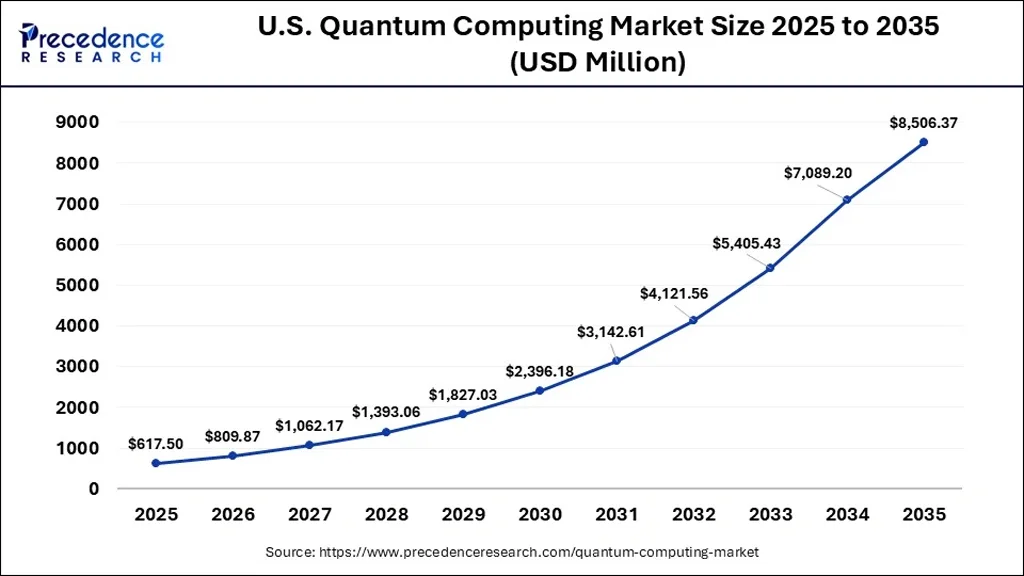
- The U.S. quantum computing market is projected to grow from $617.50 million in 2025 to $8,506.37 million by 2035.
- The market is expected to expand by more than 13.7 times between 2025 and 2035, showing strong long-term growth potential.
- By 2030, the U.S. market size is forecast to reach $2,396.18 million, nearly 4 times higher than its 2025 value.
- The market crosses the $1 billion mark in 2027, reaching $1,062.17 million.
- From 2029 to 2030, the market is expected to increase from $1,827.03 million to $2,396.18 million, adding around $569.15 million in one year.
- Growth accelerates strongly after 2030, with the market rising from $2,396.18 million in 2030 to $8,506.37 million in 2035.
- The biggest annual increase shown in the chart occurs between 2033 and 2034, when the market grows by approximately $1,683.77 million.
- In 2034, the U.S. quantum computing market is projected to reach $7,089.20 million, before climbing further to $8,506.37 million in 2035.
- The data indicates that quantum computing adoption, investment, and commercialization are expected to accelerate significantly across the U.S. market over the next decade.
- Overall, the chart suggests a strong upward trend, with the U.S. quantum computing market moving from an early-growth phase toward a multi-billion-dollar industry by 2035.
Quantum Computing Market by Offering
- Hardware solutions represented the largest revenue share of the quantum computing market in 2025, contributing more than 63% of total industry revenue.
- Quantum computing services are projected to grow at a CAGR above 35% through 2030 as enterprises seek consulting, integration, and managed infrastructure support.
- Quantum software revenue is expected to surpass $1 billion globally before 2030, driven by optimization and simulation tools.
- Cloud-based quantum access platforms accounted for nearly 70% of enterprise deployments in 2025 because organizations avoided large infrastructure costs.
- Quantum-as-a-Service adoption increased significantly in financial services and pharmaceutical sectors during 2025 and 2026.
- Professional consulting and algorithm development services generated strong demand as enterprises struggled with in-house quantum talent shortages.
- Hybrid quantum-classical software platforms emerged as the fastest-growing product category in 2026.
- Quantum networking and communication services attracted rising investment due to cybersecurity modernization programs.
- Demand for developer tools and SDKs increased as cloud vendors expanded access to quantum programming environments.
- Subscription-based pricing models became more common among enterprise quantum software providers in 2025 and 2026.
Quantum Computing Market Share by Country
- The United States captures about 44% of global private quantum funding and hosts roughly 300 quantum startups, far more than any other country.
- China leads public quantum investment with about $15 billion committed, representing over 50% of disclosed global government funding in quantum technologies.
- Japan’s national programs have pledged around $7.4 billion in quantum technology funding for 2025–2030, placing it among the top long‑term investors.
- The United Kingdom has announced over $4 billion (about £2.5 billion) in government quantum funding to build a “quantum‑enabled economy” within the next decade.
- Canada’s National Quantum Strategy is investing more than $360 million in quantum research, and Canadian firms help a UK‑Canada‑Australia bloc account for about 20% of global private quantum funding.
- Australia has committed around $620 million to utility‑scale quantum systems and, together with the UK and Canada, contributes about 20% of worldwide private quantum investment.
- Germany provides over 60% of the European Union’s roughly $10 billion public quantum investment and generates about 4% of the world’s top‑cited quantum computing papers.
- France’s National Quantum Strategy allocates about €1.8 billion over five years to quantum technologies, making it one of the largest public quantum investors globally.
- Singapore’s National Quantum Strategy dedicates around $222 million (about S$300 million) over five years to quantum R&D, infrastructure, and talent development.
- Spain’s National Quantum Technologies Strategy 2025–2030 includes a government commitment of about €808 million for quantum infrastructure, research, and commercialization.
Quantum Computing Market Revenue by Region
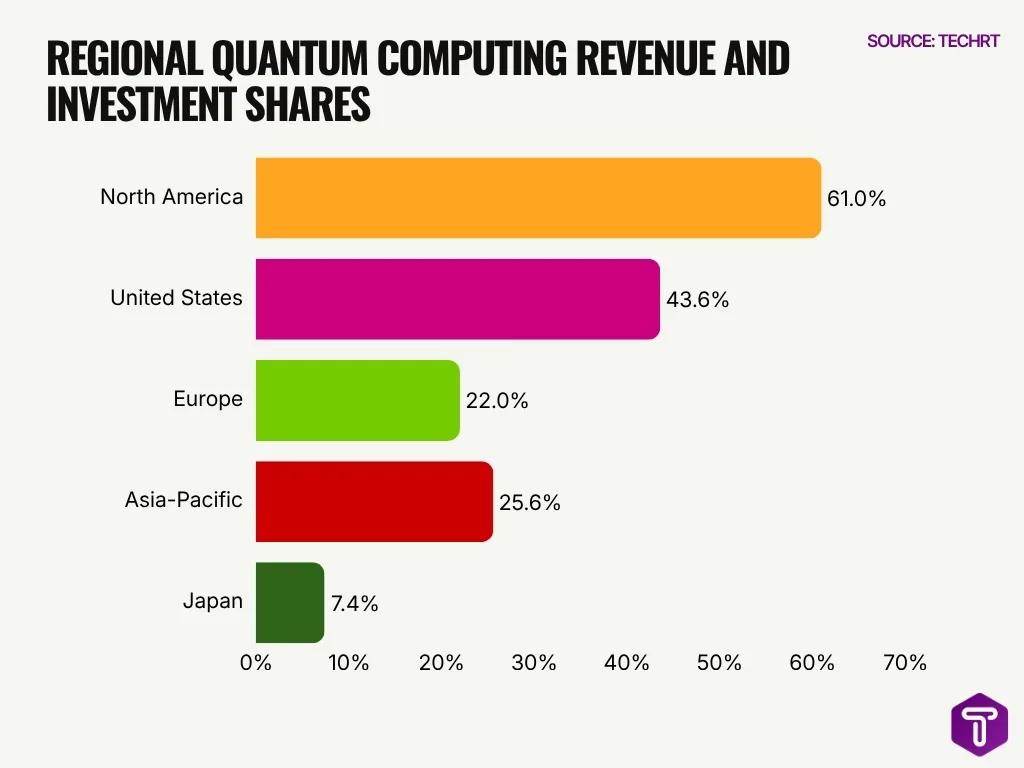
- North America captured approximately 61% of the global quantum computing market revenue in 2025, the largest regional share.
- The United States accounted for roughly 43.6% of total worldwide quantum computing revenue in 2025.
- Europe generated about 22% of global quantum computing revenue in 2025, led by strong public‑private R&D programs.
- Asia‑Pacific contributed around 25.6% of the global quantum computing market revenue in 2024, with rapid growth expected.
- Japan represented roughly 7.4% of Asia‑Pacific quantum computing spending, underpinned by a $7.4 billion national quantum initiative.
- China’s quantum technology investments exceeded $15 billion by 2025, positioning it as one of the largest public quantum spenders.
- Canada’s quantum‑related public and private funding reached over $1 billion cumulatively under its expanded National Quantum Strategy by 2025.
- Australian federal and state quantum infrastructure and talent programs committed more than $1.2 billion through 2025.
- European Union‑level quantum flagship and member‑state programs together allocated nearly €7–8 billion for quantum technologies by 2025.
- North American firms raised close to 79% of disclosed global venture capital in quantum computing over the past 12 months.
Quantum Computing Market by Technology Type
- $1.4B global quantum computing revenue in 2025, with hardware representing the majority of market value.
- >50% of private quantum hardware investment in 2025 went to superconducting and photonic platforms combined.
- Superconducting qubits held roughly 40% market share of deployed QPU capacity in 2025.
- Photonic quantum firms raised $2.1B in private capital in 2025, representing 21% of private quantum investments.
- Trapped-ion systems accounted for approximately 15–20% of academic and enterprise QPU deployments by end‑2025.
- Neutral-atom systems saw investment growth of about 30% YoY in 2025 as enterprise pilots expanded.
- Annealing/quantum-inspired systems captured ~10% of commercial optimization deployments in 2025.
- Silicon‑spin research funding increased by >25% in 2025 due to semiconductor foundry compatibility interest.
- Topological quantum computing remained <5% of hardware funding in 2025, staying mainly at the experimental stage.
- Analysts forecast no single architecture will dominate before 2030, with diversified adoption across industries driving a multi‑architecture market.
Quantum Computing Market by Deployment Model
- Cloud deployment held 65%+ of enterprise quantum workloads in 2025, making it the dominant model.
- The cloud segment was valued at $2.43 billion in 2022, showing the scale of cloud access demand.
- Quantum computing platforms saw adoption rise 19.7% in the last fiscal year, with 25.6% more businesses expected to adopt next year.
- The market is projected to grow at a 26.37% CAGR from 2024 to 2028, reinforcing strong cloud-led expansion.
- Quantum hardware development is estimated at around $500 million, highlighting why cloud access lowers entry costs.
- The broader quantum computing market is forecast to surpass $10 billion by 2045 at a 30% CAGR, supporting long-term cloud dominance.
- More than 300 global companies are already adopting quantum computing, increasing demand for cloud-based access models.
- Cloud-based quantum services reduce the need for specialized hardware and infrastructure, while hybrid models are rising to combine quantum and classical systems.
- On-premises quantum systems remain concentrated among government, defense, and research users because scaling them requires costly cryogenic infrastructure.
- Secure private-cloud and multi-cloud quantum strategies are expanding as organizations balance access, flexibility, and cybersecurity concerns.
Most Common Quantum Computing Use Cases
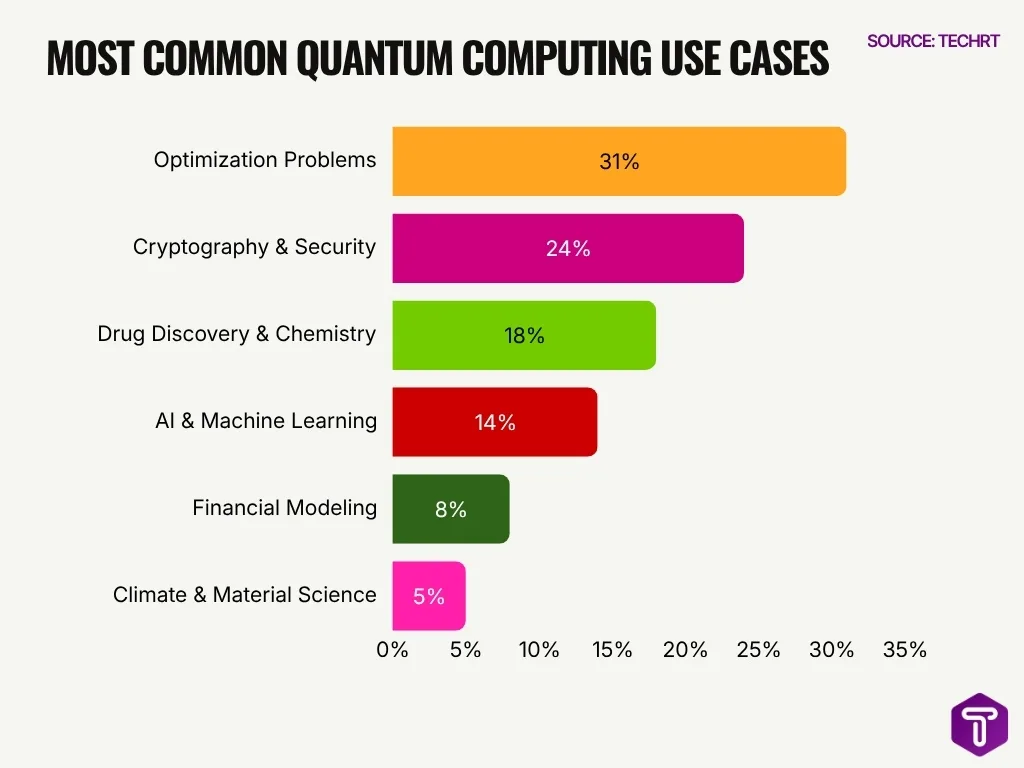
- Optimization Problems are the leading quantum computing use case, accounting for 31% of total usage.
- Cryptography & Security ranks second with a 24% share, showing strong interest in quantum-safe encryption, cybersecurity, and secure communication.
- Drug Discovery & Chemistry represents 18% of use cases, highlighting quantum computing’s growing role in molecular simulation and pharmaceutical research.
- AI & Machine Learning holds a 14% share, indicating that quantum technologies are increasingly being explored to improve complex data processing and model training.
- Financial Modeling accounts for 8%, mainly driven by applications in risk analysis, portfolio optimization, fraud detection, and pricing models.
- Climate & Material Science has the smallest share at 5%, but it remains an important emerging area for simulating materials, energy systems, and climate models.
- The top two use cases, Optimization Problems and Cryptography & Security, together make up 55% of all listed quantum computing applications.
- The data shows that quantum computing is currently most valuable in industries requiring complex calculations, advanced simulations, and high-security systems.
Quantum Computing Market by Application Area
- Optimization applications drove one of the highest enterprise interest levels in quantum computing in 2025–2026, as firms focused on complex routing, scheduling, and portfolio tasks.
- Quantum simulation is a leading use case in pharma and materials science, with life-sciences value creation estimated at $200 billion to $500 billion by 2035.
- Financial services pilots are expanding, with quantum secure communication demand valued at $595.39 million in 2025 and projected to reach $1.78 billion by 2035.
- Cybersecurity is accelerating because organizations must migrate to post-quantum protection, and NIST says quantum-vulnerable algorithms will be phased out by 2035.
- Quantum machine learning is scaling fast, with the market projected to grow from $318.03 million in 2025 to $6.79 billion by 2034.
- Supply chain optimization is gaining traction, with some forecasts expecting logistics use to cut costs by 20%–30% by 2030.
- Quantum chemistry remains funding-rich, with quantum startup equity funding reaching $3.77 billion by September 2025.
- Weather and climate simulation research is advancing, including hybrid quantum methods aimed at reducing computation time for high-dimensional forecasting problems.
- Quantum networking is moving into secure communications, and the quantum communication market is forecast to rise from $1.94 billion in 2026 to $4.46 billion by 2030.
- Quantum AI integration is becoming a major enterprise priority, with hybrid quantum-AI systems expected to influence optimization, drug discovery, and climate modeling.
Quantum Computing Investment and Funding Statistics
- Global quantum technology investments surpassed $55 billion through combined public and private initiatives by 2026.
- Quantum startup funding reached approximately $12.6 billion in 2025, marking one of the strongest years on record.
- Hardware-focused firms captured around 88.5% of disclosed funding capital during the past year.
- North American companies attracted nearly 79% of global quantum investment capital in 2025 and 2026.
- PsiQuantum raised $1 billion in one of the largest quantum financing rounds ever completed.
- QuEra Computing secured more than $230 million in funding to expand neutral-atom quantum development.
- Venture capital firms are increasingly focused on commercially viable quantum software and cybersecurity startups.
- Governments announced roughly $1.8 billion in new quantum funding programs during 2024 alone.
- Institutional investors increased participation in publicly traded quantum computing firms throughout 2025.
- Analysts expect annual private investment activity to remain elevated through 2030 as commercialization accelerates.
Quantum Computing Adoption by Industry Vertical
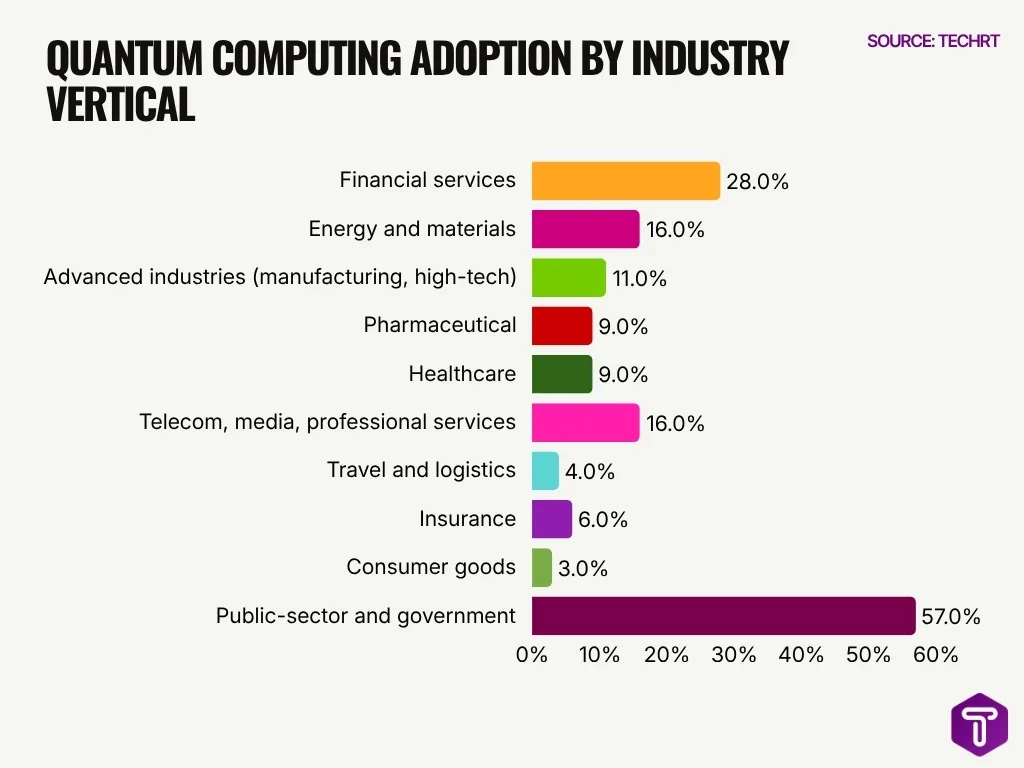
- Financial services currently account for around 28% of global quantum computing usage across industries, reflecting their role as leading early adopters for optimization and trading.
- Energy and materials companies make up about 16% of quantum adoption, applying it to complex reservoir modeling, grid management, and materials simulations.
- Advanced industries, including manufacturing and high-tech, represent roughly 11% of deployments, using quantum and hybrid systems for process and product optimization.
- Pharmaceutical firms contribute around 9% of industry quantum usage, focusing on molecular simulation and accelerated early-stage drug discovery.
- Healthcare providers add another 9% of adoption, exploring quantum-enabled diagnostics, genomics analysis, and personalized treatment planning.
- Telecom, media, and professional services together hold about 16% of current quantum deployments, with strong momentum in quantum networking and post-quantum security.
- Travel and logistics players account for roughly 4% of adoption, piloting quantum route optimization and fleet planning to cut fuel consumption and delays.
- Insurance companies represent around 6% of quantum usage, experimenting with advanced risk modelling, pricing, and portfolio optimization.
- Consumer goods organizations currently comprise only about 3% of quantum computing utilization, indicating very early-stage experimentation versus other verticals.
- Public-sector and government buyers account for approximately 57% of quantum communication technology purchases in 2024, anchoring adoption for cybersecurity and national research missions.
Government Initiatives and Public Funding in Quantum Computing
- $15+ billion committed by China to national quantum technology programs, making it one of the largest state-backed investors globally.
- The U.S. National Quantum Initiative was authorized at roughly $1.2 billion for its initial multi-year phase (2019–2024) and has been reauthorized with continued federal support.
- The U.S. Department of Commerce announced about $2 billion in quantum technology grants in 2026.
- The United Kingdom pledged £1+ billion for quantum technologies under its long-term national strategy.
- Canada launched a national quantum strategy with multi‑million dollar commitments focused on commercialization and workforce development.
- Japan allocated approximately $7.4 billion to bolster domestic quantum infrastructure and semiconductor research.
- The European Union’s Quantum Flagship expanded, contributing to €10+ billion in coordinated EU-level quantum research funding efforts.
- Singapore committed nearly $222 million toward quantum R&D and talent development programs.
- Australia increased public support for national quantum infrastructure projects across 2025–2026, including multi‑million-dollar investments.
- Global public investments in quantum technologies surpassed €40 billion by 2025, with public funding playing a major role in workforce, cybersecurity, and commercialization efforts.
Quantum Computing Startups and Ecosystem Statistics
- Global quantum startup funding reached approximately $12.6 billion in 2025, representing one of the strongest years for the sector.
- More than 350 active quantum technology startups operated globally by early 2026.
- North America accounted for nearly 79% of disclosed quantum startup funding capital during the last 12 months.
- Hardware-focused startups secured roughly 88.5% of total disclosed quantum investments in 2025 and 2026.
- PsiQuantum raised $1 billion to accelerate photonic quantum computer development.
- QuEra Computing closed a funding round exceeding $230 million to scale neutral-atom quantum systems.
- Quantum software startups experienced increased investor interest as enterprises demanded hybrid computing tools and optimization applications.
- Startup ecosystems expanded rapidly in the U.S., Canada, the UK, Germany, France, Singapore, and Australia.
- Universities continued serving as a major source of startup formation, especially in photonics, quantum networking, and cryptography.
- Enterprise partnerships between startups and cloud providers accelerated commercialization opportunities throughout 2025 and 2026.
Quantum Computing Startup Funding and Rounds
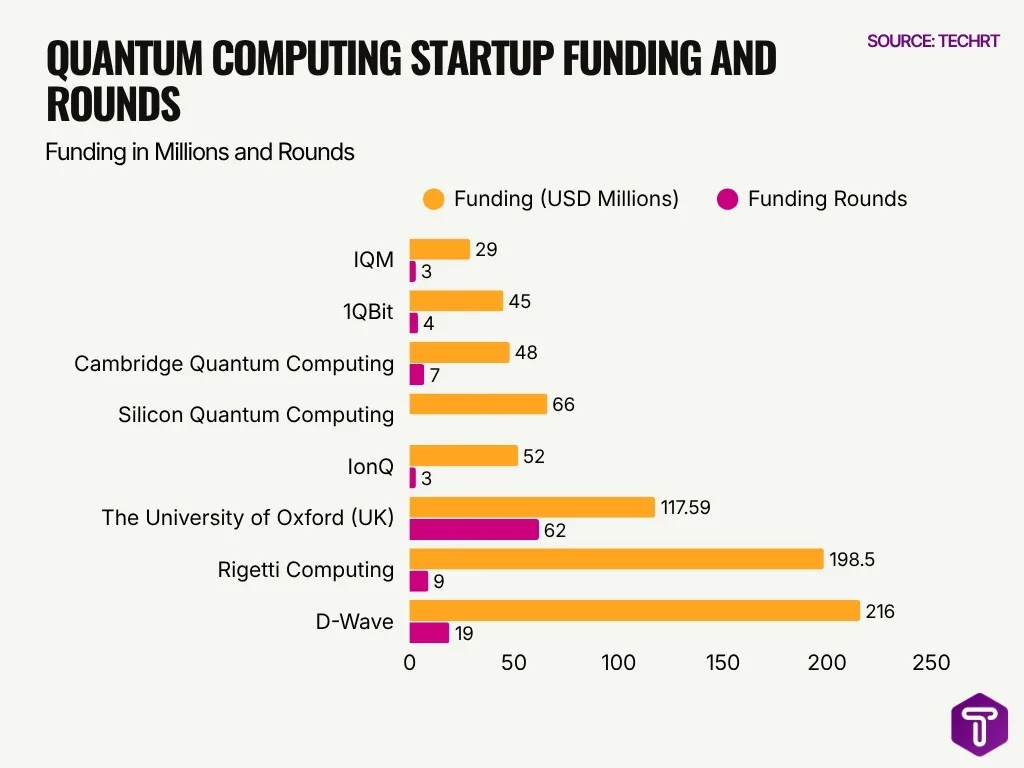
- D-Wave received the highest startup funding among the listed quantum computing organizations, with $216 million in funding across 19 rounds.
- Rigetti Computing ranked second in total funding, raising $198.5 million, despite having fewer funding rounds at 9 rounds.
- The University of Oxford (UK) recorded $117.59 million in funding and had the highest number of funding rounds, with 62 rounds.
- Silicon Quantum Computing secured $66 million in funding, placing it ahead of IonQ, Cambridge Quantum Computing, 1QBit, and IQM in total funding.
- IonQ raised $52 million through 3 funding rounds, showing strong capital concentration across fewer rounds.
- Cambridge Quantum Computing received $48 million across 7 rounds, indicating steady investor participation.
- 1QBit raised $45 million through 4 rounds, slightly below Cambridge Quantum Computing in total funding.
- IQM had the lowest funding among the listed organizations, with $29 million raised across 3 rounds.
- The data shows that quantum computing funding is highly concentrated, with D-Wave and Rigetti Computing together accounting for more than $414 million in combined funding.
- Organizations with fewer rounds, such as IonQ and IQM, still attracted notable funding, suggesting strong investor confidence in selected quantum computing startups.
- The wide gap between D-Wave’s $216 million and IQM’s $29 million highlights uneven funding distribution across the quantum computing startup ecosystem.
Patent Filings and Intellectual Property Trends in Quantum Technologies
- China led global quantum patenting with 60% of quantum patents as of 2024, keeping it the clear frontrunner.
- The United States ranked second, with about 19% of quantum patents, supported by strong private-sector investment.
- Global quantum patent filings grew fivefold from 2014 to 2024, showing sustained acceleration across the field.
- Quantum computing patents rose at an average annual rate of 49% from 2019 to 2023, while quantum communications patents grew 33%.
- In 2023, quantum computing patent counts were 61% higher than in 2022, reflecting rapid year-over-year momentum.
- Corporations and universities accounted for 91% of quantum computing patents, with 54% from corporations and 37% from universities.
- Universities filed a record 1,668 patent families in 2023, while corporations filed 837, highlighting academic strength in quantum IP.
- Europe saw its strongest recent patent growth in 2024, with filings up 33%, even though its total share remained below China and the US.
- Quantum technology patent activity has already generated around 9,740 international patent families between 2005 and 2024, underscoring the scale of the IP race.
- The global quantum market is projected to reach about €93 billion by 2035, which helps explain why patent competition is expected to keep rising.
Quantum Computing Hardware Market Statistics
- Hardware accounted for about 45% of the global quantum computing market revenue in 2024, making it the largest component segment.
- The global quantum computing hardware segment is projected to grow from roughly $1.2 billion in 2024 to around $27.6 billion by 2035 at a CAGR of 32.2%.
- 88.5% of disclosed venture capital in the last 12 months flowed into quantum hardware companies, underscoring investor focus on physical systems.
- Superconducting qubits held over 50% of commercial quantum processors deployed in 2025, remaining the dominant hardware architecture.
- Photonics‑based quantum hardware systems are forecast to grow from $0.8 billion in 2025 to above $2.8 billion by 2029, with 37% CAGR.
- The neutral‑atom quantum computing hardware market is projected to scale from $0.1 billion in 2025 to roughly $1–2 billion by 2030, reflecting strong enterprise adoption.
- Global cryogenic infrastructure for quantum systems reached about $1.42 billion in 2025 and is expected to grow to $1.72 billion by 2031, driven by superconducting‑chip testing demand.
- Average physical‑qubit error rates in leading processors fell by more than 50% between 2024 and 2026, helped by error‑correction and calibration breakthroughs.
- Leading quantum processor manufacturers now ship systems with 1,000–10,000 physical qubits, achieving roughly 10–100× scaling versus 2023‑era devices.
- The quantum chip market is projected to reach $5.58 billion by 2030, growing at 44.8% CAGR from 2025, as semiconductor firms expand silicon‑spin and cryo‑chip efforts.
Quantum Computing Growth Over 20 Years
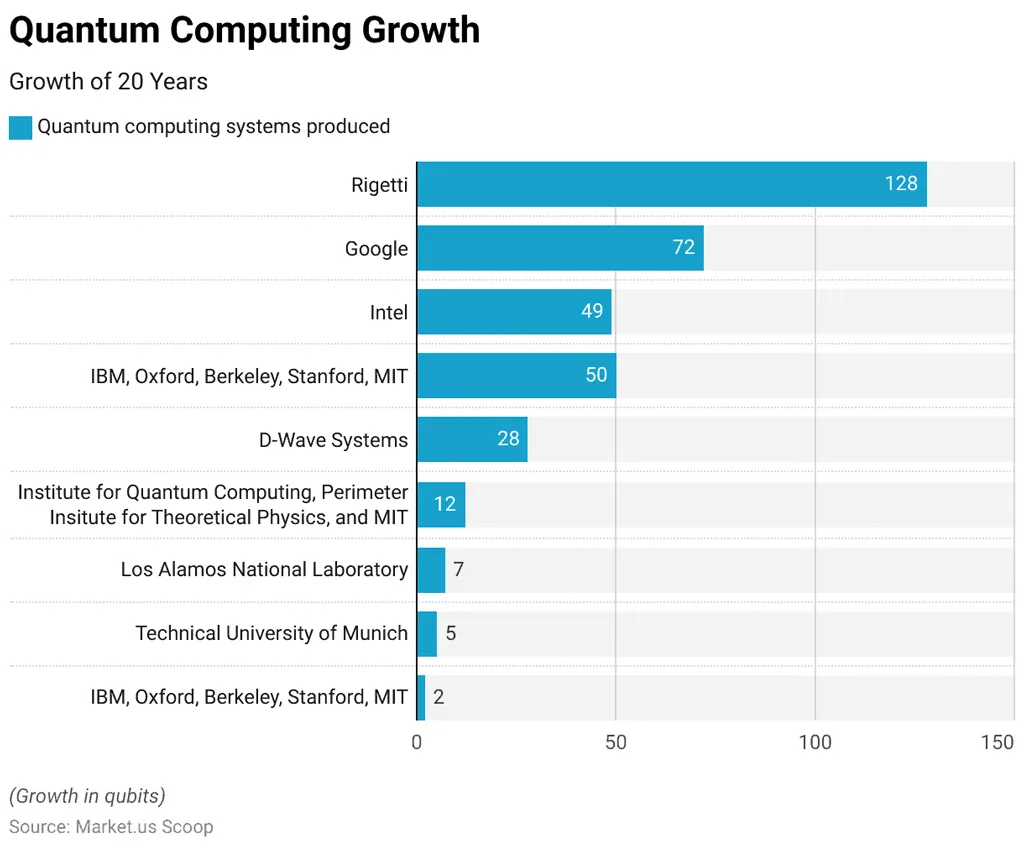
- Rigetti shows the highest quantum computing growth, reaching 128 qubits, making it the leading organization in this chart.
- Google ranks second with 72 qubits, showing strong progress in quantum computing system development.
- IBM, Oxford, Berkeley, Stanford, and MIT recorded 50 qubits, slightly ahead of Intel, which reached 49 qubits.
- Intel remains among the top contributors, with quantum computing growth of 49 qubits over the 20-year period.
- D-Wave Systems reported 28 qubits, placing it in the mid-range compared with other organizations in the chart.
- The group, including the Institute for Quantum Computing, Perimeter Institute for Theoretical Physics, and MIT recorded 12 qubits.
- Los Alamos National Laboratory showed smaller growth, with 7 qubits.
- The Technical University of Munich recorded 5 qubits, indicating limited but measurable progress.
- Another entry for IBM, Oxford, Berkeley, Stanford, and MIT appears at the lowest level, with 2 qubits.
- Overall, the chart shows that quantum computing growth is highly concentrated, with Rigetti’s 128 qubits far ahead of most other institutions.
Quantum Computing Software and Platform Market Statistics
- The global quantum software market was valued at $779.2 million in 2023 and will reach $2.51 billion by 2030.
- Quantum computing software grew at a 30.5% CAGR from 2021 to 2026, rising from $0.11 billion to $0.43 billion.
- Cloud-based quantum platforms accounted for 37% of market growth in North America during the forecast period.
- The BFSI sector is a top driver of quantum optimization software adoption, with 70% of enterprise leaders planning quantum adoption within a year.
- Quantum machine learning use cases now represent 71% of early adopter interest in the US for data analytics problems.
- The post-quantum cryptography market will surge from $0.42 billion in 2025 to $2.84 billion by 2030 at a 41.8% CAGR.
- Quantum SDK adoption expanded as over 300 global companies are now actively adopting quantum technologies.
- Software solutions are the fastest-growing segment in the quantum market, driven by demand for efficient quantum applications.
- Nearly 74% of technology decision-makers agree that businesses failing to adopt quantum within the decade will lose competitive advantage.
Competitive Landscape of the Quantum Computing Market
- IBM offered access to the world’s largest fleet of 100+ qubit quantum computers and has deployed over 90 quantum systems in total.
- IBM’s cloud milestone marked 10 years of public quantum access, reinforcing one of the deepest enterprise ecosystems in the market.
- Google’s 105-qubit Willow chip achieved below-threshold error correction, a key benchmark for scaling superconducting quantum hardware.
- IonQ posted $130 million in 2025 revenue and nearly $700 million in cash, giving it unusual firepower for acquisitions and expansion.
- IonQ completed the Oxford Ionics acquisition in September 2025, strengthening its trapped-ion technology stack and UK presence.
- D-Wave’s annealing approach remains strongly tied to optimization workloads, where it is described as better suited than gate-model systems for large-scale problems.
- PsiQuantum raised at least $750 million at a $6 billion pre-money valuation, later closing a $1 billion round at a $7 billion valuation.
- Microsoft’s 2026 quantum research program offered awards of up to $200,000 per selected proposal, signaling continued investment in topological research.
- Amazon Braket provides managed access to multiple hardware providers, including D-Wave, IonQ, and Rigetti, through a single cloud service.
- The quantum computing market is projected to reach $20.20 billion by 2030 from $3.52 billion in 2025, implying 41.8% CAGR and rising competitive pressure.
Frequently Asked Questions (FAQs)
What is the projected size of the global quantum computing market by 2030?
How much was the quantum computing market worth in 2025?
What market share did North America hold in quantum computing in 2025?
How much funding has the quantum computing industry received globally?
How fast is the quantum computing market expected to grow?
Conclusion
Quantum computing entered a defining growth stage as governments, enterprises, and investors accelerated commercialization efforts. The market continues expanding through rising cloud adoption, major funding rounds, stronger hardware performance, and broader enterprise experimentation across finance, healthcare, manufacturing, cybersecurity, and logistics.
North America still leads the market, although Europe and Asia-Pacific continue to increase investments through national quantum strategies and startup ecosystem development. At the same time, software platforms, hybrid computing systems, and post-quantum cybersecurity tools are opening new commercial opportunities for vendors and enterprises alike.
While technical challenges around scalability and error correction remain, the industry now shows stronger momentum toward practical business applications than at any previous point. As investments continue and enterprise adoption matures, quantum computing is expected to become one of the most strategically important technology markets of the next decade.

Leave a comment
Have something to say about this article? Add your comment and start the discussion.