



Apple Music continues to shape how people consume music, from daily commutes powered by CarPlay to brand campaigns driven by curated playlists and artist exclusives. As streaming becomes the dominant format, Apple’s ecosystem-driven approach, integrating hardware, software, and services, offers a distinct advantage. In this article, we break down the latest Apple Music statistics to help marketers, analysts, and creators understand its real-world impact and future direction.
Editor’s Choice
- Apple Music surpassed 94 million subscribers in 2025, reflecting steady year-over-year growth.
- The platform generated approximately $11.3 billion in revenue in 2025, marking strong service expansion.
- Apple Music holds around 20% global market share, built entirely on paid subscriptions.
- In the US, Apple Music commands 30.7% market share, second only to Spotify.
- The service pays artists about $0.0076 per stream, among the highest in the industry.
- Apple Music is pre-installed on over 1.5 billion active Apple devices globally, strengthening distribution.
- Monthly active users crossed 140 million globally, signaling strong engagement beyond paid subscribers.
Recent Developments
- Apple introduced AI-generated playlists in 2026, allowing users to create mixes using prompts.
- A playlist transfer tool now enables users to import libraries from Spotify and YouTube Music.
- Apple Music launched Collaborative Playlists in 2025, enabling shared music curation.
- The platform tested new subscription tiers in select markets like Canada and Australia.
- Apple expanded into niche content with Apple Music Classical, reaching 5 million users.
- AI-powered DJ mixes now offer personalized transitions based on listening habits.
- Apple Music streamed major events like the 2025 Grammy Awards exclusively, boosting engagement.
- SharePlay usage increased by 43% year-over-year, reflecting growth in social listening.
- Apple redesigned the app interface in 2026 with a “Liquid Glass” UI update.
Overview of Apple Music
- Apple Music launched in 2015 and reached 95 million users by 2024, showing consistent growth.
- The platform operates in over 165 countries, offering global reach for artists and labels.
- Apple Music is part of Apple’s Services segment, which contributes 24% of total company revenue.
- Apple’s Services division generated over $23 billion in a single quarter in 2025, highlighting ecosystem strength.
- Unlike competitors, Apple Music offers no free tier, focusing entirely on paid subscriptions.
- The service integrates across iOS, macOS, tvOS, watchOS, and CarPlay, ensuring seamless usage.
- Apple Music supports offline downloads and iCloud sync, improving usability during travel.
- The app features human-curated playlists, a key differentiator versus algorithm-heavy competitors.
- Apple Music Radio includes 12 live stations, expanding beyond on-demand streaming.
Apple Music Subscriber Growth Insights
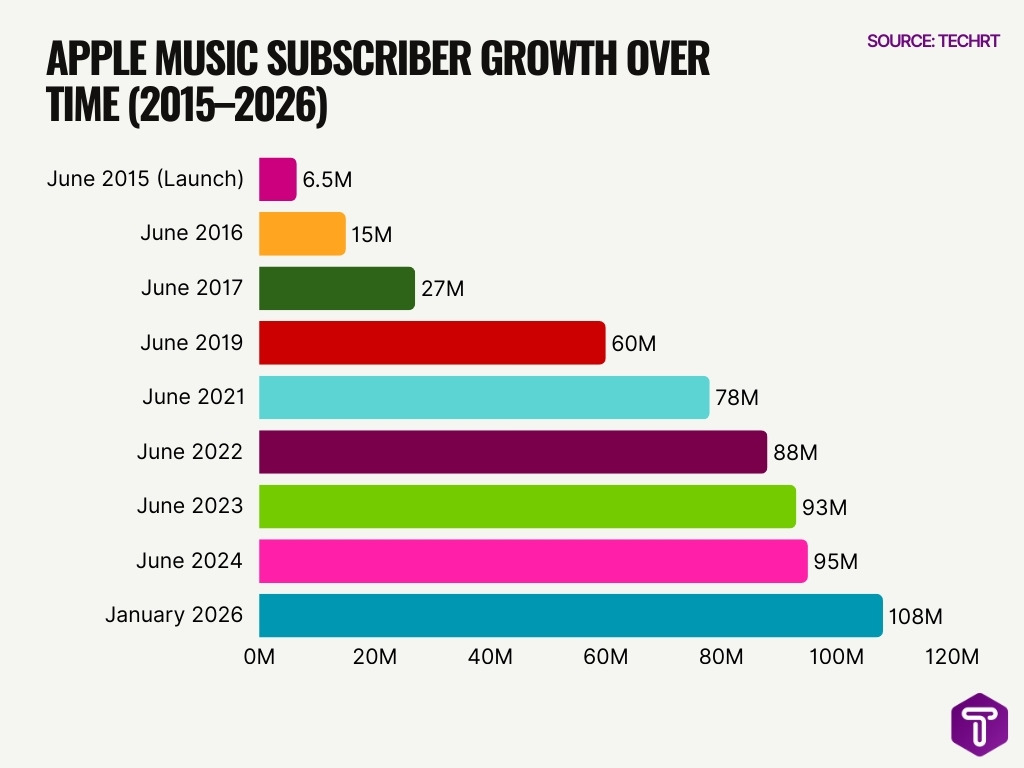
- Apple Music launched in June 2015 with 6.5 million subscribers, marking a strong entry into the streaming market.
- Within just 1 year, subscribers more than doubled to 15 million (June 2016), reflecting rapid early adoption.
- By June 2017, the platform reached 27 million users, showing consistent year-over-year growth momentum.
- Apple Music saw a major surge, crossing 60 million subscribers by June 2019, more than 2x growth in two years.
- Growth continued steadily, reaching 78 million users in June 2021, adding nearly 18 million subscribers since 2019.
- By June 2022, the platform had climbed to 88 million subscribers, highlighting sustained demand despite increasing competition.
- Subscriber growth began to slow slightly, reaching 93 million in June 2023 and 95 million in June 2024, indicating a maturing market phase.
- As of January 2026, Apple Music is estimated to have 108 million subscribers, adding 13 million users since 2024.
- Overall, Apple Music grew from 6.5 million to 108 million subscribers, representing a 16.6x increase in just over a decade.
- The data shows a clear pattern: hyper-growth (2015–2019) followed by steady expansion (2020–2026) as the platform scales globally.
Key Apple Music Statistics
- Apple Music has grown from 6.5 million users in 2015 to 95 million in 2024.
- Subscriber growth slowed slightly to ~5.68% YoY in 2023, indicating market maturity.
- Apple Music generates billions annually, reaching $9.2 billion in revenue in 2023.
- Revenue grew at a 12.7% CAGR over five years, showing consistent expansion.
- Apple Music accounts for a significant portion of Apple’s recurring services revenue.
- The average user listens to 28 hours of music per week, reflecting high engagement.
- Around 40% of listening comes from personalized playlists, highlighting recommendation impact.
- Search-driven listening accounts for only 14% of sessions, showing reliance on discovery tools.
- Apple Music’s retention rate after three months stands at 79%, indicating strong user loyalty.
Apple Music Revenue Statistics
- Apple Music generated $9.2 billion in revenue in 2023, up from $8.3 billion in 2022.
- Revenue reached an estimated $11.3 billion in 2025, reflecting continued growth.
- The platform has maintained a double-digit growth rate (~10–12%) annually.
- Apple Music contributes significantly to Apple’s Services revenue, which exceeded $23 billion in one quarter.
- Bundled subscriptions via Apple One account for 28% of Apple Music revenue.
- The US remains the largest revenue-generating market for Apple Music.
- Family plans contribute to nearly one-third of subscriptions, boosting recurring income.
- Global music streaming revenue hit $53.7 billion in 2024, with Apple Music holding a sizable share.
- Streaming accounts for 80% of recorded music revenue, reinforcing Apple Music’s importance.
Music Streaming Market Share Insights
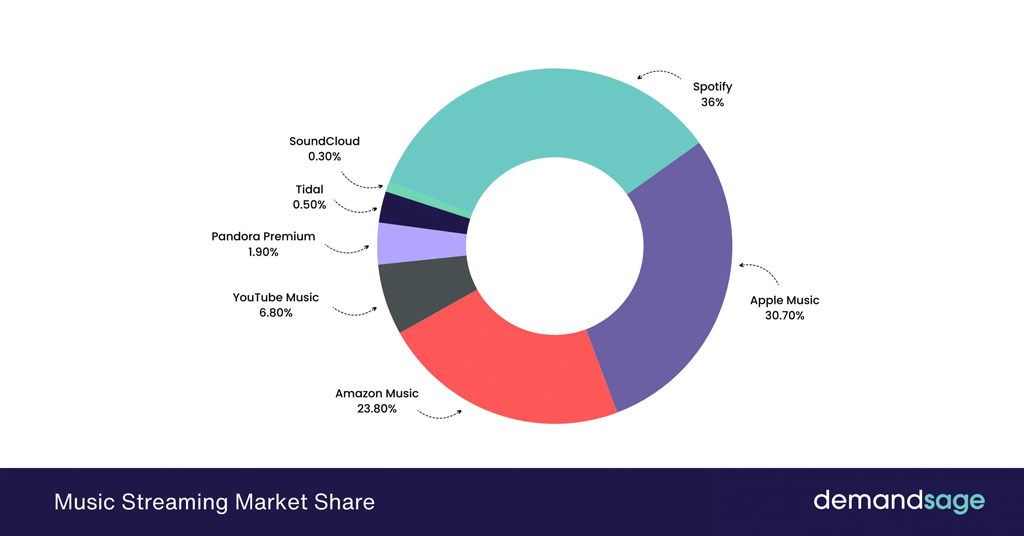
- Spotify dominates the market with a leading share of 36%, maintaining a strong gap over competitors.
- Apple Music ranks second with 30.7%, closely competing with Spotify but still trailing by over 5 percentage points.
- Amazon Music holds a significant position at 23.8%, securing the third-largest share in the market.
- The top three platforms (Spotify, Apple Music, and Amazon Music) collectively control over 90% of the total market share, indicating a highly concentrated industry.
- YouTube Music accounts for 6.8%, positioning itself as a mid-tier player with steady adoption.
- Pandora Premium captures 1.9%, showing a relatively small but notable presence.
- Tidal (0.5%) and SoundCloud (0.3%) have minimal market shares, reflecting niche or specialized user bases.
- The gap between top-tier and smaller platforms is substantial, highlighting strong dominance by a few major players.
- The market structure suggests limited competition at the top, with emerging platforms struggling to scale beyond single-digit shares.
Apple Music vs Other Music Streaming Services
- Apple Music boasted 108 million paying subscribers worldwide in 2026.
- Spotify commands 751 million total monthly active users, dwarfing competitors.
- Spotify’s 290 million premium subscribers lead the paid tier globally.
- Apple Music pays artists an average of $0.01 per stream, topping Spotify’s $0.003–$0.005.
- Both Apple Music and Spotify offer libraries exceeding 100 million songs.
- Spotify holds a dominant 31.7% global music streaming market share.
- Apple Music claims 12.6% of the worldwide subscriber market.
- 40% of Apple device buyers in the US prefer Apple Music over rivals.
- Amazon Music reaches 100 million subscribers, boosted by Alexa integration.
- YouTube Music and Premium surpass 125 million paid subscribers.
Apple Music User Growth Over Time
- Apple Music grew from 6.5 million users in 2015 to over 94 million in 2025, showing long-term expansion.
- Annual growth slowed to around 5–6% after 2022, reflecting saturation in mature markets.
- The service added approximately 2–3 million users annually between 2023 and 2025.
- Growth in emerging markets has outpaced developed regions by up to 2x since 2021.
- Apple Music’s global availability expanded to 165+ countries, aiding steady adoption.
- Apple One bundles contributed to double-digit subscriber growth in bundled users.
- The COVID-19 pandemic accelerated growth, adding over 20 million users between 2019 and 2021.
- Apple Music Classical added millions of niche users in its first year, supporting diversification.
- Forecasts suggest Apple Music could reach 110–120 million users by 2027.
Apple Music Demographics and User Profile Statistics
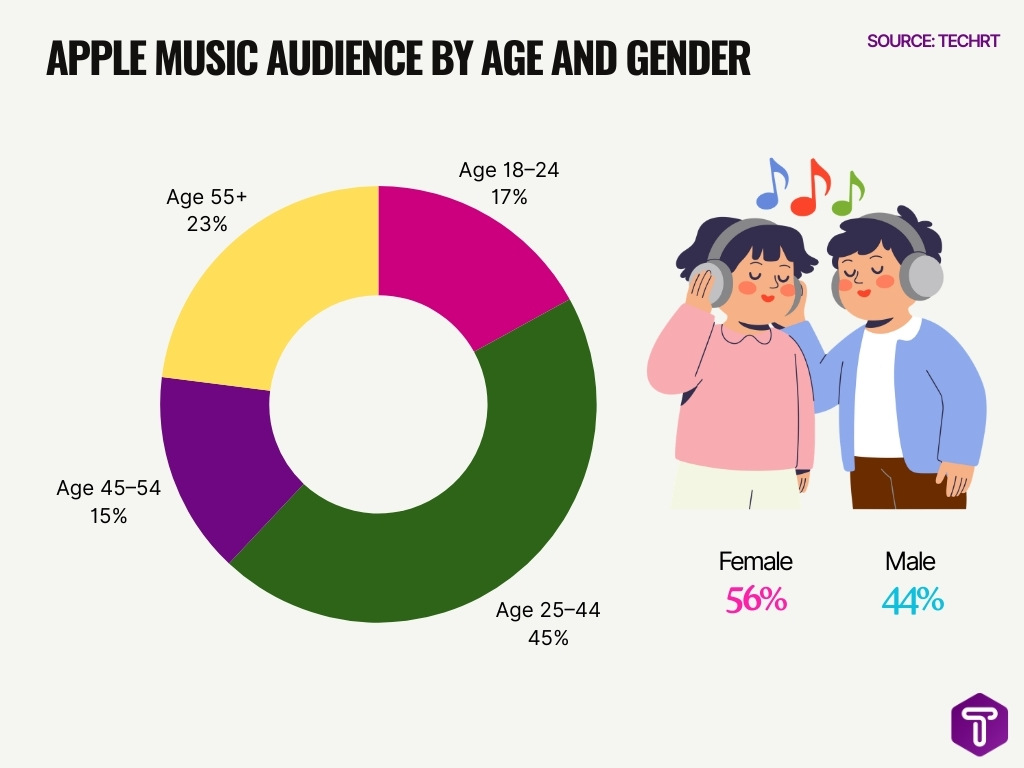
- Around 56% of Apple Music users are female, compared with 44% male, indicating a slight female-majority audience share.
- Users aged 25–34 and 55+ each account for 23% of the base, making these the two largest Apple Music age cohorts.
- Combined, listeners aged 25–44 represent about 45% of Apple Music users, underscoring the platform’s strength among prime-earning-age adults.
- Younger adults 18–24 make up roughly 17% of Apple Music users, a smaller share than older age segments, despite being heavy streamers overall.
- Only about 15% of Apple Music users fall in the 45–54 age group, making it the smallest demographic segment on the service.
- Apple Music is available in 167 countries, giving its user profile a broadly global footprint rather than a single-region concentration.
- The service reached an estimated 112 million premium users in 2024, with projections of about 124 million in 2025, expanding its demographic reach each year.
- Female listeners’ 56% share on Apple Music contrasts with many tech platforms where male usage still dominates, highlighting a more balanced gender appeal.
Apple Music Usage and Engagement Statistics
- The average Apple Music user listens for about 28 hours per week, indicating strong engagement.
- Over 40% of listening comes from curated or personalized playlists, not manual search.
- Apple Music Radio reaches tens of millions of listeners monthly, expanding beyond on-demand usage.
- SharePlay usage grew by 43% year-over-year, showing increased social listening trends.
- Offline listening accounts for over 30% of total usage, especially in mobile-first regions.
- Users create an average of 12 personal playlists per year, reflecting active engagement.
- Daily active users represent roughly 65–70% of monthly users, indicating high retention.
- Search-based listening makes up only 14% of sessions, highlighting reliance on discovery tools.
- Apple Music’s recommendation engine influences over 60% of song plays, driving user retention.
Apple Music Usage by Device and Platform
- Over 70% of Apple Music streams occur on smartphones, primarily iPhones.
- Apple Music is pre-installed on 1.5 billion+ active Apple devices, boosting accessibility.
- CarPlay accounts for a growing share, with over 80% of new US cars supporting Apple CarPlay.
- Desktop usage (Mac and Windows) represents about 15–20% of total listening time.
- Apple Watch contributes to 5–7% of listening sessions, especially for fitness-related usage.
- Smart speakers like HomePod drive in-home listening growth, especially in the US market.
- Android users account for 15–20% of Apple Music’s user base, showing cross-platform reach.
- Tablet usage (iPad) contributes to 8–10% of total sessions, often for casual listening.
- TV-based streaming via Apple TV is growing, especially for music videos and live events.
Most Popular Music Genres by Streaming Share
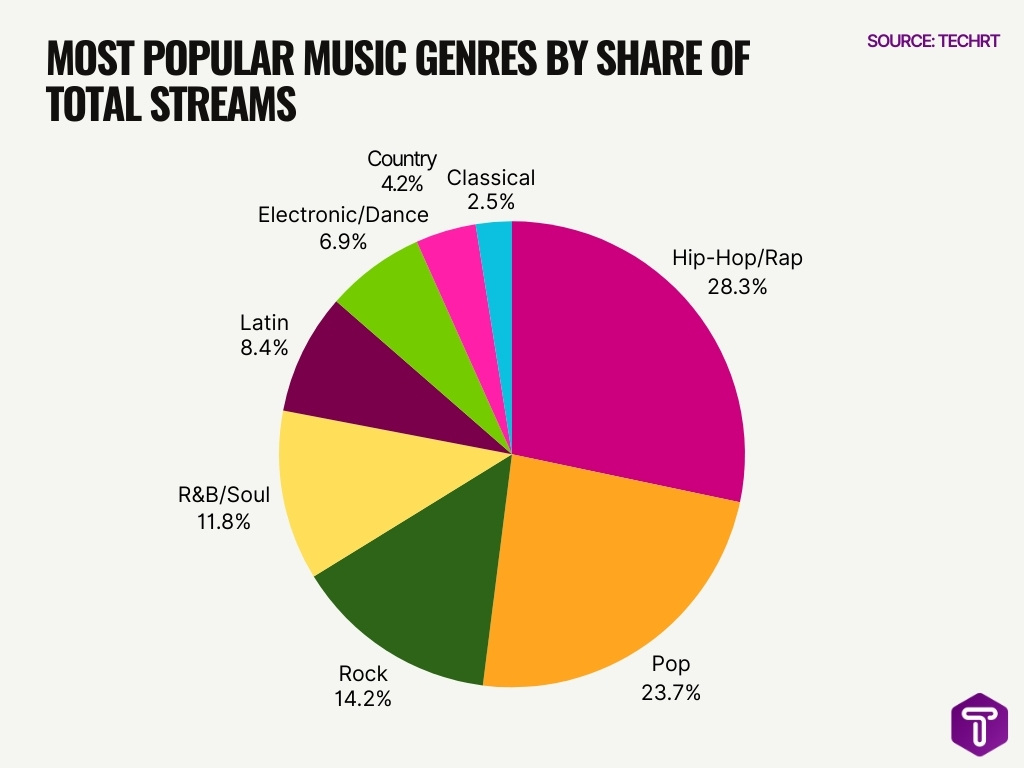
- Hip-Hop/Rap dominates the global music landscape, accounting for the highest share at 28.3% of total streams, making it the most consumed genre.
- Pop music follows closely with 23.7%, highlighting its strong mainstream appeal and consistent global audience reach.
- Rock ranks third with 14.2%, showing it still maintains a solid listener base despite the rise of newer genres.
- R&B/Soul contributes 11.8%, reflecting its steady popularity and influence on modern music trends.
- Latin music captures 8.4%, showcasing its growing global expansion and cross-cultural influence.
- Electronic/Dance music holds 6.9%, driven largely by club culture, festivals, and streaming playlists.
- Country music accounts for 4.2%, indicating a more niche but loyal listener base.
- Classical music has the smallest share at 2.5%, appealing to a specialized audience segment.
- The top two genres (Hip-Hop/Rap and Pop) together make up over 52% of total streams, dominating more than half of global music consumption.
- There is a significant drop after the top three genres, indicating a highly concentrated streaming preference toward a few dominant genres.
Apple Music Pricing and Plan Adoption Statistics
- The standard Apple Music individual plan costs $10.99/month in the US as of 2025.
- Family plans cost $16.99/month and support up to six users.
- Student plans are priced at $5.99/month, making them popular among younger users.
- Apple One bundles start at $19.95/month, increasing bundled service adoption.
- Approximately 28% of Apple Music users subscribe via Apple One bundles.
- Family plans account for nearly one-third of subscriptions, boosting retention rates.
- Price increases in 2022 led to a short-term churn increase of 3–5%, but recovery followed quickly.
- Free trials (1–3 months) convert at a rate of over 60% into paid subscriptions.
- Regional pricing strategies allow Apple Music to expand in markets like India at lower price tiers.
Apple Music Library Size and Catalog Stats
- Apple Music hosts over 100 million songs as of 2025, matching the largest global catalogs.
- The catalog has grown from 30 million songs in 2015 to 100+ million today, reflecting rapid expansion.
- Apple adds approximately 60,000 new tracks daily to its library.
- The platform supports lossless audio for the entire catalog, improving audio quality standards.
- Apple Music includes over 30,000 curated playlists, covering genres, moods, and activities.
- The service supports lyrics for millions of songs, enhancing user engagement.
- Apple Music Classical adds millions of classical tracks, expanding niche offerings.
- Around 20% of the catalog includes spatial audio support, improving immersive listening.
- Apple Music offers content in multiple languages across 165+ countries, supporting global audiences.
Apple Music Premium vs Free User Distribution by Region
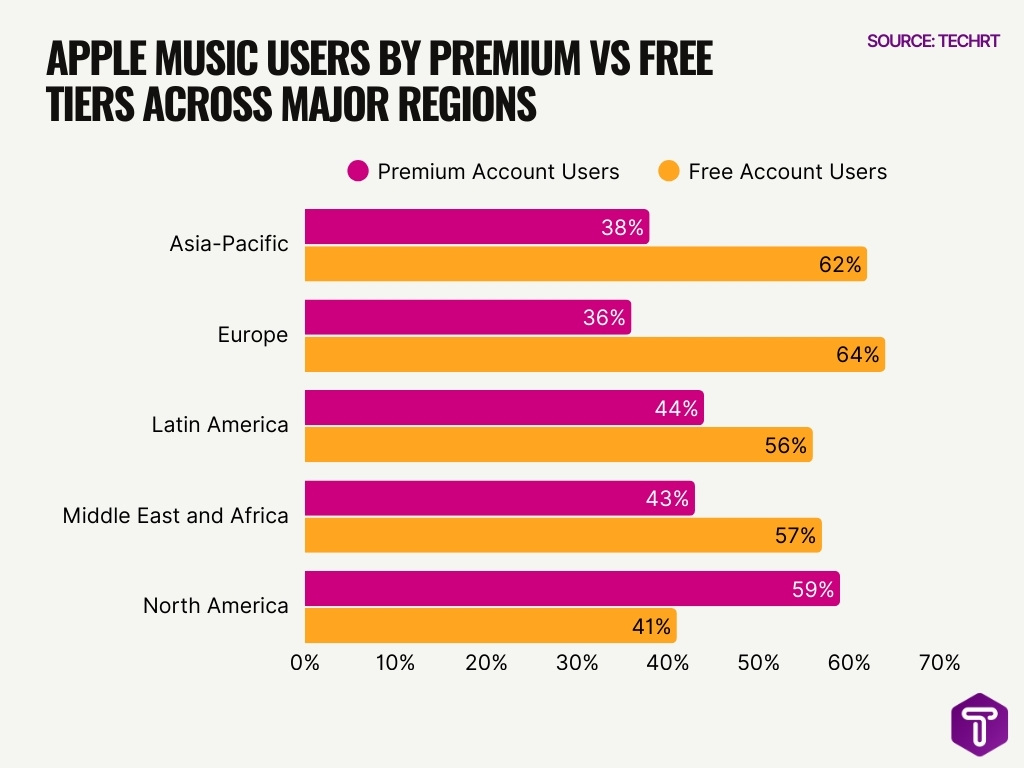
- North America leads in premium adoption, with 59% premium users compared to 41% free users, indicating a strong willingness to pay for music streaming.
- Europe shows a lower premium penetration, with only 36% premium users and a dominant 64% free user base, suggesting higher price sensitivity or reliance on free tiers.
- Asia-Pacific is heavily skewed toward free users, where 62% use the free tier versus 38% premium, highlighting significant growth potential for paid subscriptions.
- Latin America demonstrates a balanced market, with 44% premium users and 56% free users, indicating a transitioning user base toward paid services.
- Middle East and Africa also show moderate premium adoption, with 43% premium users and 57% free users, reflecting emerging monetization opportunities.
- Overall, free users dominate in 4 out of 5 regions, emphasizing that Apple Music’s global growth still relies heavily on converting free users to premium plans.
- The data highlights a clear regional disparity in monetization, where developed markets like North America outperform others in premium adoption, while emerging markets lean toward free usage.
Playlists, Radios, and Curated Content Statistics
- Apple Music features 30,000+ editorial playlists, curated by music experts.
- Personalized playlists drive over 40% of listening activity, reflecting discovery trends.
- Apple Music Radio includes flagship stations like Apple Music 1, reaching millions globally.
- Beats 1 (now Apple Music 1) launched with coverage in 100+ countries, expanding live radio globally.
- Users engage with weekly personalized mixes, including Favorites Mix and New Music Mix.
- Radio listening accounts for 15–20% of total listening time, especially during passive sessions.
- Curated playlists influence over 60% of new song discovery, outperforming manual search.
- Apple’s editorial team includes global genre specialists, enhancing regional music discovery.
- Collaborative playlists introduced in 2025 increased playlist-sharing activity by 25%.
Apple Music Features Adoption (Spatial Audio, Lossless, etc.)
- Spatial Audio adoption reached over 35% of active users in 2025, showing strong uptake.
- Lossless audio is now available for 100% of the Apple Music catalog, at no extra cost.
- Dolby Atmos-supported tracks exceed 20 million songs, expanding immersive listening.
- Apple Music Sing (karaoke feature) usage grew by 18% year-over-year.
- SharePlay usage increased by 43% YoY, reflecting social listening adoption.
- Apple Music Classical reached 5 million users within its first year.
- AI-driven recommendations influence over 60% of listening sessions.
- Offline downloads are used by 30%+ of users regularly, especially in mobile-first regions.
- Lyrics and real-time sync features are used by over 50% of active listeners.
Top Apple Music Artists by Streams: Key Insights
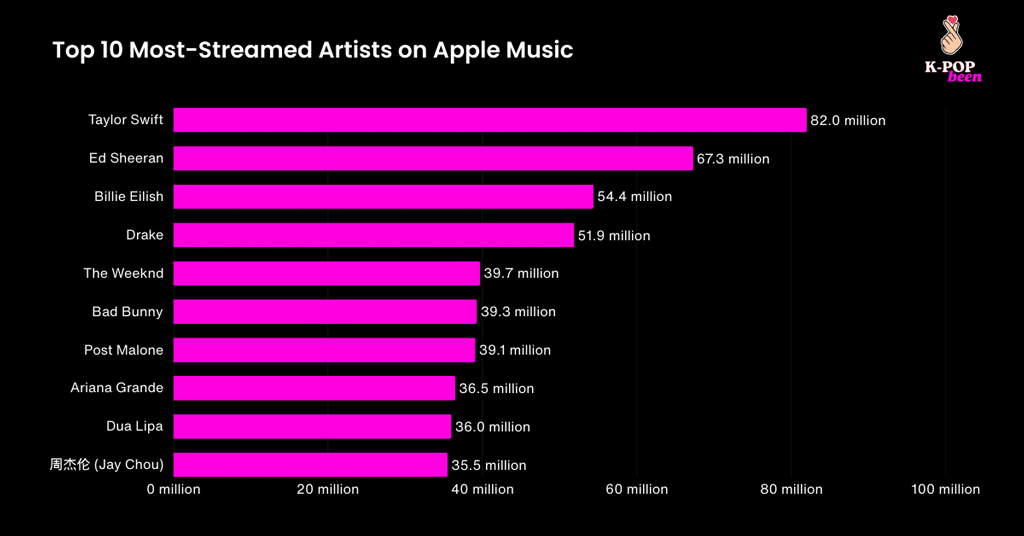
- Taylor Swift leads by a wide margin with 82.0 million streams, making her the most-streamed artist on Apple Music.
- Ed Sheeran secures second place with 67.3 million streams, trailing Taylor Swift by nearly 15 million streams.
- Billie Eilish ranks third with 54.4 million streams, maintaining a strong position among top global artists.
- Drake follows closely at 51.9 million streams, reinforcing his consistent dominance in streaming charts.
- There is a significant drop after the top 4, with The Weeknd at 39.7 million streams, nearly 12 million fewer than Drake.
- Mid-tier competition is tight, with Bad Bunny (39.3M), Post Malone (39.1M), and The Weeknd (39.7M) all clustered around the 39 million mark.
- Ariana Grande (36.5M) and Dua Lipa (36.0M) show very close streaming figures, separated by just 0.5 million streams.
- Jay Chou (35.5M) rounds out the top 10, highlighting regional diversity and Apple Music’s global artist reach.
- The top 4 artists alone exceed 50 million streams each, indicating a clear tier of elite streaming dominance.
- Overall, the chart shows a gradual decline after the top ranks, with only ~46.5 million streams separating #1 and #10, suggesting relatively competitive distribution beyond the leader.
Artist Earnings and Royalties on Apple Music
- Apple Music pays artists about $0.0076 per stream, higher than many competitors.
- Artists earn roughly $7,600 per million streams on Apple Music.
- Apple uses a subscriber-weighted royalty model, improving payout fairness.
- Over 70% of Apple Music revenue is paid to rights holders, including artists and labels.
- Independent artists benefit from direct distribution platforms integrated with Apple Music.
- Apple Music for Artists provides analytics to millions of creators globally.
- Artists featured in playlists can see revenue increases of 20–40%.
- Global recorded music revenue reached $28.6 billion in 2023, with streaming accounting for the majority of payouts.
- Apple Music’s higher payout rates attract premium content releases and exclusives.
Apple Music Growth Projections and Future Outlook
- Apple Music is projected to reach 110–120 million subscribers by 2027.
- Global music streaming revenue is expected to exceed $70 billion by 2030, driven by subscriptions.
- Emerging markets will contribute to over 50% of new user growth in the coming years.
- AI-driven personalization is expected to influence 70%+ of listening sessions by 2028.
- Apple’s ecosystem expansion (Vision Pro, wearables) will drive new listening experiences.
- Bundled services like Apple One are forecast to grow by double digits annually.
- Spatial audio adoption is expected to surpass 50% of users by 2027.
- Podcast and live audio integration may increase engagement time by 15–20%.
- Apple Music’s share in premium streaming could rise as paid-only models gain traction globally.
Frequently Asked Questions (FAQs)
How many subscribers does Apple Music have in 2025?
Apple Music has over 94 million paying subscribers worldwide as of 2025.
How much revenue does Apple Music generate annually?
Apple Music generates approximately $9.2 billion in annual revenue (2023–2025 estimates).
What is Apple Music’s market share in the United States?
Apple Music holds about 30.7% of the US music streaming subscriber market.
How much does Apple Music pay artists per stream?
Apple Music pays roughly $0.006 to $0.01 per stream on average, one of the highest rates in the industry.
How large is the Apple Music song catalog?
Apple Music offers access to over 100 million songs and 30,000+ playlists globally.
Conclusion
Apple Music continues to strengthen its position as a premium, ecosystem-driven streaming platform. While competitors focus on scale and ad-supported growth, Apple leans into high-value subscriptions, better artist payouts, and deep device integration. As features like spatial audio, AI-driven discovery, and bundled services expand, Apple Music is set to remain a key force in the evolving music streaming landscape.

Leave a comment
Have something to say about this article? Add your comment and start the discussion.